Capitalizing with ci cd consulting: Accelerate Deployments and Automation
CI/CD consulting is all about bringing in an expert to help you automate the way you build, test, and release your software. Think of it as hiring a specialist to design and build a high-speed, fully automated assembly line for your code. It replaces slow, error-prone manual work with a reliable system that gets new features to your customers faster.
What is CI/CD Consulting and Why Does It Matter?
Imagine trying to build a custom car by hand. Every single part is crafted and fitted manually. The final product might be a masterpiece, but the process is painfully slow, expensive, and a single mistake can set you back weeks. This is what software development feels like without a modern pipeline.
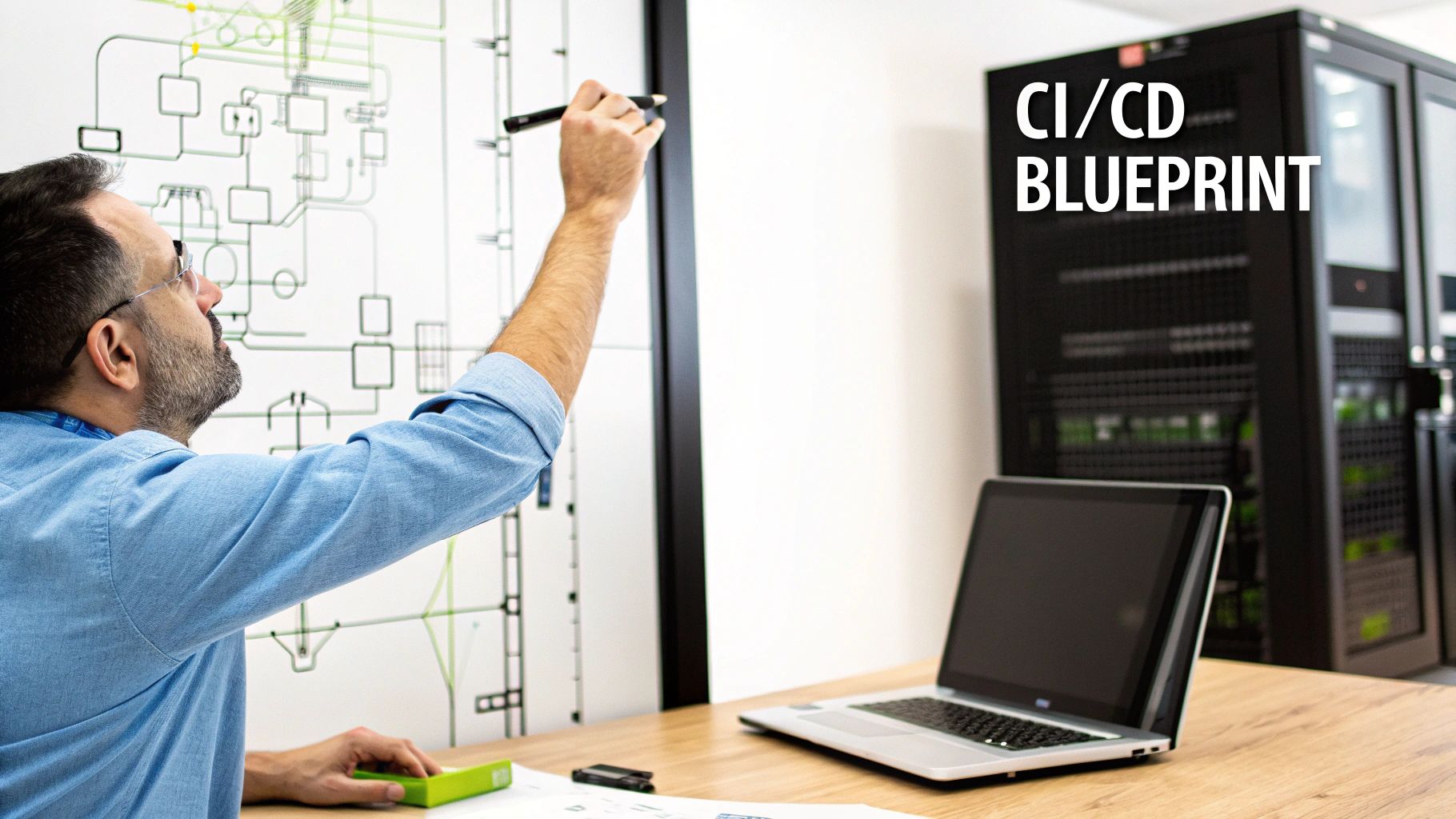
CI/CD consulting is what turns that artisan workshop into a high-tech factory floor. The letters stand for Continuous Integration (CI) and Continuous Delivery/Deployment (CD). It’s a powerful approach that automates every step of the process—from building the code to testing it and pushing it live—ensuring everything is reliable and can be shipped at a moment's notice.
A CI/CD consultant is the architect who designs and builds this automated system. They don't just throw tools at the problem; they create a strategic framework that lines up perfectly with your business goals.
The Consultant's Role as a Strategic Architect
The main job of a CI/CD consultant is to smooth out the bumps and remove the risks in your software delivery process. For any SaaS founder or business leader, this directly translates into a huge competitive edge. You can stop wrestling with chaotic release schedules and instead get a system that supports rapid, predictable innovation.
This strategic work breaks down into a few key activities:
- Process Auditing: They start by digging into your current development workflow to find the bottlenecks, manual steps, and risky areas.
- Pipeline Design: Next, they draw up a custom blueprint for an automated pipeline that fits right into your existing tech stack.
- Tool Selection and Integration: They'll recommend and set up the best tools for version control, automated testing, and deployment.
- Team Enablement: Finally, they train your developers on how to use and maintain the new system, helping build a culture of speed and efficiency.
The ultimate goal of CI/CD consulting is to make shipping software a boring, predictable, and repeatable event. When deployments are boring, your business can focus on what really matters: innovation and customer value, not fighting fires.
The demand for this kind of expertise is exploding. The continuous integration tools market was valued at USD 8.82 billion in 2025 and is on track to hit an incredible USD 43.13 billion by 2035. This massive growth shows that businesses everywhere are ditching old manual methods for automated workflows that slash deployment times.
Take a look at how this shift plays out in the real world.
Manual Deployment Vs Automated CI CD Pipeline
| Metric | Manual Process (Without CI/CD) | Automated Process (With CI/CD Consulting) |
|---|---|---|
| Deployment Frequency | Weeks or months | Daily or even multiple times a day |
| Lead Time for Changes | Days or weeks | Minutes or hours |
| Error Rate | High (human error is common) | Low (automated tests catch bugs early) |
| Developer Productivity | Low (bogged down by manual tasks) | High (focused on writing quality code) |
| Time to Recover (MTTR) | Hours or days | Minutes (can roll back instantly) |
| Business Agility | Slow to respond to market changes | Quick to pivot and release new features |
The table makes it clear: sticking with manual processes is a direct hit to your bottom line and your ability to compete.
In the end, CI/CD consulting is about turning raw code into a market-ready product faster and with far less risk. It solves the core scaling problems that hold so many businesses back, creating a strong foundation within the broader DevOps life cycle. It transforms a chaotic, slow process into a predictable engine for growth.
The Real-World Business Value of CI/CD Implementation
Let's cut through the jargon. A properly built CI/CD pipeline isn't just a technical toy for developers; it delivers real, measurable business results that the C-suite can get excited about. Think of it as fundamentally rewiring your company's delivery engine—transforming your development process from a slow, risky bottleneck into a powerful competitive advantage.

Founders and executives care about ROI, agility, and beating the competition. Investing in CI/CD consulting hits all three. The most immediate impact? A massive acceleration in your time-to-market. Instead of plodding through month-long release cycles, your teams can push small, valuable updates every single day. This is how you start reacting to customer feedback and market changes in near real-time.
This new speed creates a virtuous cycle. You can roll out a new feature, test an idea, or validate a business assumption with actual user data, not just boardroom guesswork. For any modern B2B or SaaS company, this rapid feedback loop is the absolute engine of growth.
Unlocking Marketing and Sales Agility
I see it all the time: marketing and sales leaders get stuck waiting weeks, or even months, for simple technical changes. A new landing page, an A/B test on pricing, or an integration with a new CRM gets buried in the development backlog, and the opportunity is lost.
A solid CI/CD pipeline breaks that dependency. It allows smaller, business-critical updates to be deployed independently from the main product release schedule. Suddenly, your marketing team can move at the speed they need to.
- Rapid A/B Testing: Launch two versions of a signup page at once to see which one performs better.
- Faster Funnel Optimization: Tweak a checkout flow or lead form in a few hours, not a few weeks, to plug conversion leaks.
- Safe Campaign Deployments: Add a new analytics script or marketing pixel without the paralyzing fear of crashing the whole site.
This is exactly why companies are pouring money into DevOps and CI/CD. The global DevOps market is on track to hit USD 14.9 billion by 2026 because businesses are desperate for this kind of speed and reliability. In fact, over 49% of companies report a significantly shorter time-to-market after they make the switch, giving their commercial teams a massive advantage.
Mitigating Risk and Boosting Developer Productivity
Every time a developer has to deploy code by hand, you're rolling the dice. Human error is inevitable, and it can introduce catastrophic bugs that kill your reputation and cause expensive downtime. CI/CD puts a professional quality control system right into the workflow.
A CI/CD pipeline acts as an automated gatekeeper. By enforcing automated tests before any code reaches production, it ensures that only high-quality, stable software is delivered to your customers, effectively minimizing business risk.
This automated safety net does wonders for developer morale and productivity. Your engineers stop wasting their days on tedious manual deployments and putting out fires. Instead, they can focus on what you hired them for: building creative, valuable features that push the business forward. This is a core principle of good continuous delivery and DevOps.
That shift—from reactive firefighting to proactive innovation—is where the real, long-term value of expert CI CD consulting comes from. It kicks off a powerful cycle of speed, quality, and sustainable growth.
Choosing Your CI CD Consulting Engagement Model
So, you're ready to bring in a CI/CD consultant. That's a great first step. The next, and equally important, decision is figuring out how you'll work with them. This isn't a one-size-fits-all deal; the right partnership structure can make all the difference between a successful project and a frustrating one.
Think of it like this: you wouldn't hire a master carpenter for a simple paint job, nor would you ask a painter to frame a new house. Your CI/CD project has a specific scope and set of needs, and your consulting engagement should match it perfectly. Let's walk through the three most common ways businesses partner with experts like us.
Project-Based Implementation
This is the most direct approach. You have a clear goal—like building a brand-new CI/CD pipeline from scratch or completely overhauling a clunky, old one—and you need someone to come in, build it, and hand you the keys.
A project-based engagement has a defined start, a clear finish line, and a specific deliverable. It's the perfect fit if your team doesn't have the deep DevOps knowledge needed for the initial heavy lifting.
- Best For: Companies without in-house DevOps expertise or those needing a complete pipeline built from the ground up.
- Typical Deliverables: A fully configured CI/CD pipeline, integrated testing automation, infrastructure-as-code scripts, and solid documentation.
- Key Benefit: You get a turnkey solution with a predictable cost and timeline. It frees up your developers to stay focused on building features, not wrestling with infrastructure.
This model is all about getting a tangible, finished product. You agree on the blueprint and the budget, and the consultant gets to work making it a reality.
Advisory and Strategy Services
What if your team is technically sharp but you're struggling with the big picture? Maybe you're stuck on which tools to choose or how to design a system that will scale with your business. This is where an advisory engagement shines.
Instead of doing the hands-on keyboard work, the consultant acts as your guide and mentor. They provide the strategic roadmap, architectural oversight, and seasoned advice to help your team avoid common dead-ends and costly mistakes.
An advisory model is a force multiplier. It combines your team’s existing technical skills with an expert’s strategic experience to produce a far better, more business-focused outcome.
This approach is fantastic for building up your team's internal capabilities. You're not just getting a pipeline; you're getting the wisdom to own and evolve it for years to come.
Retainer-Based Partnerships
A CI/CD pipeline isn't something you just set up and forget about. It's a living system that needs care and feeding. New tools emerge, security threats evolve, and your own business needs will change over time.
A retainer gives you ongoing access to an expert for a set number of hours each month. This is ideal for companies that already have a pipeline but need consistent support for maintenance, optimization, and troubleshooting. It’s peace of mind, ensuring a specialist is always on hand to keep things running smoothly and help you continuously improve.
Choosing Your CI CD Consulting Engagement Model
Picking the right model comes down to understanding your team's current skills, your immediate goals, and your long-term vision. Each approach offers a different kind of value. This table breaks down the core differences to help you see which path aligns best with your needs.
| Engagement Model | Best For | Typical Deliverables | Key Benefit |
|---|---|---|---|
| Project-Based | New pipeline implementation or major overhaul | A complete, documented, and operational CI/CD pipeline | Predictable outcome and cost for a defined scope |
| Advisory & Strategy | Teams with technical skills needing guidance | Strategic roadmap, architectural designs, tool analysis | Builds internal expertise and prevents costly errors |
| Retainer-Based | Ongoing optimization, maintenance, and support | Regular health checks, performance tuning, on-call support | Long-term stability and continuous improvement |
Ultimately, the best CI CD consulting model is the one that fits your company's reality. By taking a hard look at where you are today and where you want to be tomorrow, you can forge a partnership that truly accelerates your development and delivers a powerful return on investment.
Your Roadmap to a Successful CI/CD Implementation
Getting CI/CD right is a journey, not a single leap. A successful rollout needs a clear, structured plan that turns high-level goals into concrete actions. A seasoned CI/CD consultant doesn't just show up and build a pipeline; they guide you through a proven, phased roadmap that guarantees a smooth transition and keeps disruption to a minimum.
Think of it as a four-stage expedition. Each phase builds on the last, ensuring every decision is well-informed, every action is deliberate, and the final result is perfectly tuned to what your business actually needs. Let's walk through what that looks like in practice.
Phase 1: Discovery and Assessment
First things first: you have to know where you're starting from. Before a single line of code is written or a tool is configured, we conduct a deep audit of your current development lifecycle. This isn't just a technical check-up—it's a holistic review of your people, processes, and technology.
The goal is to find the exact bottlenecks holding you back. Where are manual handoffs creating delays? Which parts of your testing are unreliable or take forever? How much time are your engineers wasting on repetitive deployment chores instead of building great features? This phase wraps up with a detailed report that becomes our blueprint for improvement.
Phase 2: Strategy and Tool Selection
With a clear picture of the current state, it’s time to design the future. This is where strategic CI/CD consulting really proves its worth. Your consultant will sit down with your key stakeholders to define what success looks like and map out the ideal automated workflow from end to end.
This strategic plan covers a few key areas:
- Pipeline Architecture: We design the flow of code from a developer's machine all the way to production, outlining the specific stages for building, testing, and releasing.
- Toolchain Evaluation: We help you select the right technologies for your specific needs, taking into account your existing tech stack, budget, and where you want to be in a few years.
- Security Integration: A plan is put in place to embed security checks directly into the pipeline from day one—a practice often called DevSecOps.
This flowchart gives you a simplified look at how different engagement models fit into these project phases.
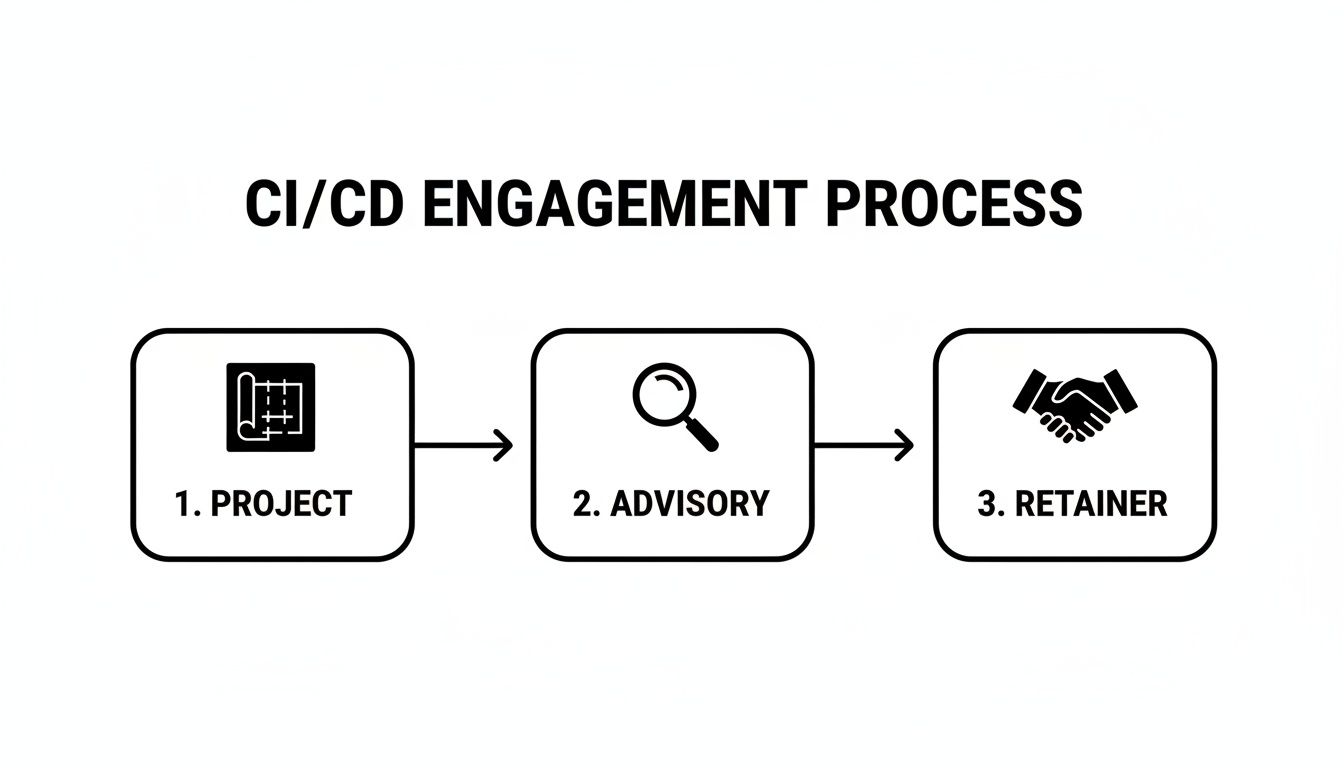
As you can see, different services like project work, advisory calls, and retainers can be applied at various stages of your CI/CD initiative.
Phase 3: Phased Implementation and Delivery
This is where the plan comes to life. A critical mistake we see companies make is trying to build the entire, perfect pipeline all at once. This "big bang" approach almost always leads to long delays and a frustrated team.
Instead, a seasoned consultant will use a phased implementation. We start by automating the one part of your process that will deliver the most value, the fastest. For many, that’s automating the build and unit testing (Continuous Integration) to give developers immediate feedback on their code.
By delivering value in small, incremental steps, we build momentum and demonstrate ROI early. This agile approach allows for continuous feedback and refinement, ensuring the final pipeline is practical and effective.
As you move forward, getting familiar with Continuous Deployment Best Practices will be key to building a resilient and efficient system. Each sprint adds another layer of automation, gradually building out the complete pipeline while your team reaps the benefits all along the way.
Phase 4: Team Enablement and Handover
A pipeline is only as good as the team that uses and maintains it. That makes this final phase arguably the most important: empowering your team to take full ownership of the new system. This goes way beyond a quick demo.
A proper handover includes:
- Comprehensive Documentation: Clear, detailed guides on how the pipeline works, how to use it, and how to troubleshoot common issues.
- Hands-On Training: Interactive sessions to make sure your developers are confident and comfortable with the new automated workflows.
- Establishing Best Practices: Defining the new "rules of the road" for everything from code commits and feature branching to release management.
This final step ensures the benefits of your investment stick around long after the consulting engagement wraps up. To see how these ideas fit into a larger DevOps strategy, check out our guide on DevOps and continuous delivery.
How to Select the Right CI/CD Consulting Partner
Picking a CI/CD consulting partner is one of those high-stakes decisions that can make or break your engineering momentum. The right expert acts as a force multiplier, speeding up your growth and building a truly resilient foundation for your business. The wrong one? You're looking at a wasted budget, mounting technical debt, and a pipeline that causes more headaches than it solves.
The secret is to look past the raw technical skills and screen for a genuine strategic partner who understands your business.
A great consultant knows the pipeline isn't the final product; it's the engine that drives business outcomes. They should speak your language, focusing on metrics you care about—like faster time-to-market, lower deployment risk, and higher developer productivity. If a potential consultant jumps straight into a debate about Jenkins vs. GitLab CI before asking about your business goals, that's a major red flag.
Look Beyond Technical Buzzwords
Your evaluation has to be heavily weighted toward real-world experience and a results-first mindset. Any consultant worth their salt can configure a tool. That’s table stakes. What you really need is someone who can architect a system that fits your specific business model, whether you're a multi-tenant B2B SaaS company or a fast-moving digital agency.
When you're trying to figure this out, a detailed guide for vetting DevOps consulting companies can be a huge help in spotting the firms that deliver real value. It’s a subtle but crucial shift in focus—you're not hiring a technician, you're partnering with an expert who is invested in your success.
A huge piece of this puzzle is their expertise with modern infrastructure. Today’s CI/CD world is dominated by cloud-based solutions, which grabbed 63.3% market share in 2023. This trend is fueling the continuous delivery market's explosive growth from USD 3.67 billion to a projected USD 12.25 billion by 2030, all at a blistering 19.2% CAGR. This is all about the flexibility of hybrid and multi-cloud setups, which is absolutely vital for B2B firms needing to scale automation without getting locked into a single vendor.
Critical Criteria for Vetting a Partner
To make a confident choice, you need a framework. Here are the core areas to dig into when evaluating potential consultants:
- Proven Business Model Experience: Have they actually worked with companies like yours before? A consultant with deep B2B SaaS experience gets the unique pains of multi-tenancy and enterprise-grade security in a way a B2C e-commerce specialist simply won't.
- Focus on Measurable Outcomes: They should be obsessed with business impact. Ask them point-blank how they measure success. You want to hear answers that tie back to revenue, customer satisfaction, or operational efficiency, not just technical jargon.
- Clear Communication and Documentation: A brilliant pipeline is worthless if your team can’t understand or maintain it. Great consultants are also great teachers, providing excellent documentation and training your team to take full ownership.
- Strategic vs. Tactical Thinking: Are they giving you a strategic roadmap or just a to-do list? A true partner helps you see around corners, designing a system that will grow with you for years to come.
A consultant's true value isn't just in the pipeline they build, but in the capability and confidence they build within your team. The goal is empowerment, not perpetual dependency.
Insightful Questions to Ask Potential Consultants
Once you have your criteria, you can cut through the noise with a few targeted questions. These will help you quickly separate the true strategists from the pure technicians.
How do you measure the business impact of a CI/CD pipeline you've built?
This question forces them to connect the dots between their technical work and real business value. Listen for metrics like Mean Time to Recovery (MTTR), Change Failure Rate, and Deployment Frequency, and how they explain the impact on your bottom line.Can you share a case study of a company similar to ours that you helped scale?
This directly probes their relevant experience. Pay close attention to the specific challenges the client had, the solution they implemented, and—most importantly—the measurable results they delivered.What is your process for knowledge transfer and team enablement?
This reveals their commitment to your long-term independence. A good answer will outline a clear plan involving detailed documentation, hands-on training sessions, and a structured handover process.
By prioritizing this kind of strategic alignment and asking the right questions, you can confidently select a CI/CD consulting partner who won't just build you a great pipeline, but will help you build a stronger, more agile business.
Your Growth is Our Mission. Let's Build It Together.
We’ve spent this guide exploring how a smart CI/CD strategy is more than just a developer’s tool—it’s a powerful engine for business growth. It's about creating a super-efficient, automated assembly line that gets value into your customers' hands faster and more reliably than ever before. Now, let’s talk about how that applies directly to you as a B2B or SaaS company.
At MakeAutomation, we build automation frameworks that think bigger than just code. A rock-solid CI/CD pipeline is the starting point, the technical backbone. But we take those core principles of speed, efficiency, and reliability and apply them to your entire business. We’re experts at building systems that automate everything from lead generation and client outreach to project management and even recruitment.
More Than Just a Pipeline
For ambitious SaaS and B2B companies, we know growth isn't just about shipping new features. It's about building scalable, repeatable processes that work across the whole organization. Our approach connects those dots, making sure your technical horsepower is directly fueling your commercial goals.
We handle the entire journey from start to finish:
- Strategy First: We begin by diving deep into your business objectives, not just your tech stack. What are you trying to achieve?
- Hands-On Building: Our team then gets to work, implementing the custom automation and CI/CD workflows that will get you there.
- Clear Documentation: We don't just build it and leave. We provide comprehensive guides so your team feels confident owning and managing the systems we create.
This complete view means we aren't just fine-tuning your code delivery; we're optimizing your entire path to market.
At its heart, MakeAutomation’s philosophy is simple: Eliminate manual work to reclaim valuable time. We help you build a scalable foundation where your team can finally focus on high-impact work, not mind-numbing, repetitive tasks.
The AI-Powered Advantage
Here’s where we really stand out. We specialize in weaving advanced AI operations directly into your business workflows. Think about it: an AI-powered agent handling your inbound sales questions 24/7, or an automated system that qualifies new leads and schedules demos while you sleep. This is the next frontier of operational efficiency, and we help our clients get there.
By working with us, you’re not just bringing on a technical consultant. You’re gaining a strategic partner who is genuinely invested in your growth. We’re here to help you build the automated infrastructure you need to scale well past the 7-figure mark and keep climbing.
Ready to see how our specialized CI/CD consulting and business automation can put your company on the fast track? Book a free consultation with our experts today. Let's map out a plan to eliminate the manual grind, win back your team's time, and build a truly scalable foundation for success.
Frequently Asked Questions
When you're looking to streamline how your team builds and ships software, a lot of questions come up. It's completely normal. For B2B and SaaS leaders, making a smart investment in automation is key, so let's tackle some of the most common questions we hear about CI/CD consulting with some straight answers.
We want you to have total clarity. Think of this as the final piece of the puzzle, giving you the confidence to move forward and improve how your business operates.
What’s the Typical Cost of CI/CD Consulting Services?
There’s no one-size-fits-all price tag, and that’s actually a good thing. The cost of CI/CD consulting really depends on what you need—the scope of the project, your existing setup, and what you’re trying to achieve.
A one-off project-based pipeline build, for example, could run anywhere from a few thousand to tens of thousands of dollars, depending on how complex your system is. If you're looking for guidance, advisory services are usually billed by the hour or day. For long-term help, an ongoing retainer partnership provides continuous support for a set monthly fee. Any good consultant will give you a clear proposal that connects every dollar you spend to the business results and ROI you can expect.
How Long Does It Take to Implement a CI/CD Pipeline?
This all comes down to the complexity of your software and where you're starting from. A basic Continuous Integration (CI) pipeline for a single, straightforward application can often be up and running in just a few weeks. Your team will start feeling the benefits almost right away.
But if you’re building a full-blown continuous delivery pipeline for a sophisticated SaaS platform, you’re likely looking at a timeline of two to four months. A seasoned consultant won’t try to boil the ocean. Instead, they'll recommend a phased approach, starting with the quick wins that automate the most painful parts of your workflow first. This way, you get value early and build momentum.
Can CI/CD Consulting Help with More Than Just Software?
Absolutely. This is where things get really interesting. While CI/CD was born in the world of software development, its core ideas—automation, consistency, and getting fast feedback—can be applied to almost any part of your business. It's really a philosophy for creating efficient, repeatable systems for any workflow that matters.
The real power of a CI/CD approach is its versatility. It's not just about code; it's about systematically eliminating manual, error-prone tasks anywhere in your business to unlock speed and reliability.
At MakeAutomation, for instance, we use these exact principles to automate marketing funnels, make client onboarding smoother, and even optimize sales processes.
Is CI/CD Consulting Worth It for a Small Team?
Yes, without a doubt. In fact, small teams often see the biggest impact. When you have a lean team, every single minute counts. Time your developers spend on manual deployments is time they aren't spending on building new features that actually bring in revenue. Automation acts as a force multiplier.
By bringing in a CI/CD consultant, you’re freeing up your best people to focus on innovation and creating value for your customers. It’s a strategic investment that builds a solid, scalable foundation for the future, letting you grow without having to hire more people just to keep up. It helps you punch above your weight and compete with much larger companies.
Ready to build a more efficient, scalable foundation for your business? MakeAutomation specializes in creating CI/CD and business automation frameworks that eliminate manual work and accelerate growth. Book a consultation today and let's map out your path to operational excellence.