15 Best AI Voice Agents for B2B & SaaS in 2026: A Deep Dive
The era of clunky, robotic voice menus is over. Today, the best AI voice agents offer fluid, human-like conversations that can handle everything from scheduling sales demos to resolving complex support tickets. For B2B and SaaS companies, this isn't just an innovation; it's a competitive necessity.
The right AI agent can automate lead qualification, provide 24/7 customer support, and streamline recruitment, all while integrating seamlessly with your existing CRM and contact center. But navigating the landscape of APIs, no-code builders, and enterprise platforms can be daunting. Connecting voice agents to your CRM, support stack, and escalation paths is a strong use case for n8n workflow automation. This guide cuts through the noise. To understand the broader landscape and future of the industry, explore this piece on the State of Voice AI and human-like voice AI agents.
We will provide a detailed, comparative analysis of the top 15 AI voice agents, breaking down their specific use cases, implementation hurdles, and true costs. This resource is designed to help you make an informed decision that drives real ROI for your business. Each entry includes direct links and screenshots to help you evaluate which solution is the best fit for your specific needs, whether you're a startup entrepreneur focused on automated lead generation or a project manager at a digital agency. We'll delve into platforms like Retell AI, Vapi, and OpenAI's Realtime API, as well as enterprise solutions from Google Cloud, AWS, and Microsoft Azure, equipping you with the practical insights needed to implement a powerful voice AI strategy.
One practical note from the implementation side: at MakeAutomation, we ended up building our own voice AI engine for client deployments because quality, latency control, telephony flexibility, and workflow integration mattered more than using an off-the-shelf wrapper. Our stack uses a Pipecat-based pipeline with Deepgram STT, Cartesia TTS, configurable LLM routing, telephony support, per-turn latency tracking, transcripts, post-call webhooks, and multi-tenant agent configuration. In one customer benchmark shared with us, visible runs stayed under 500ms end-to-end, with STT around 186–278ms, TTS around 105–113ms, and LLM first-token latency around 240–300ms. That doesn't replace this vendor comparison, but it matters if you need implementation depth rather than just another tool subscription.
1. OpenAI – Realtime API
OpenAI’s Realtime API offers a direct line to its powerful gpt-realtime models, enabling developers to build sophisticated, low-latency, full-duplex voice agents. It stands out by unifying the entire conversational process – listening, thinking, and speaking – into a single, continuous stream. This architecture is purpose-built for creating truly interactive and natural-sounding voice experiences, making it one of the best AI voice agents for applications requiring instant, human-like responsiveness.
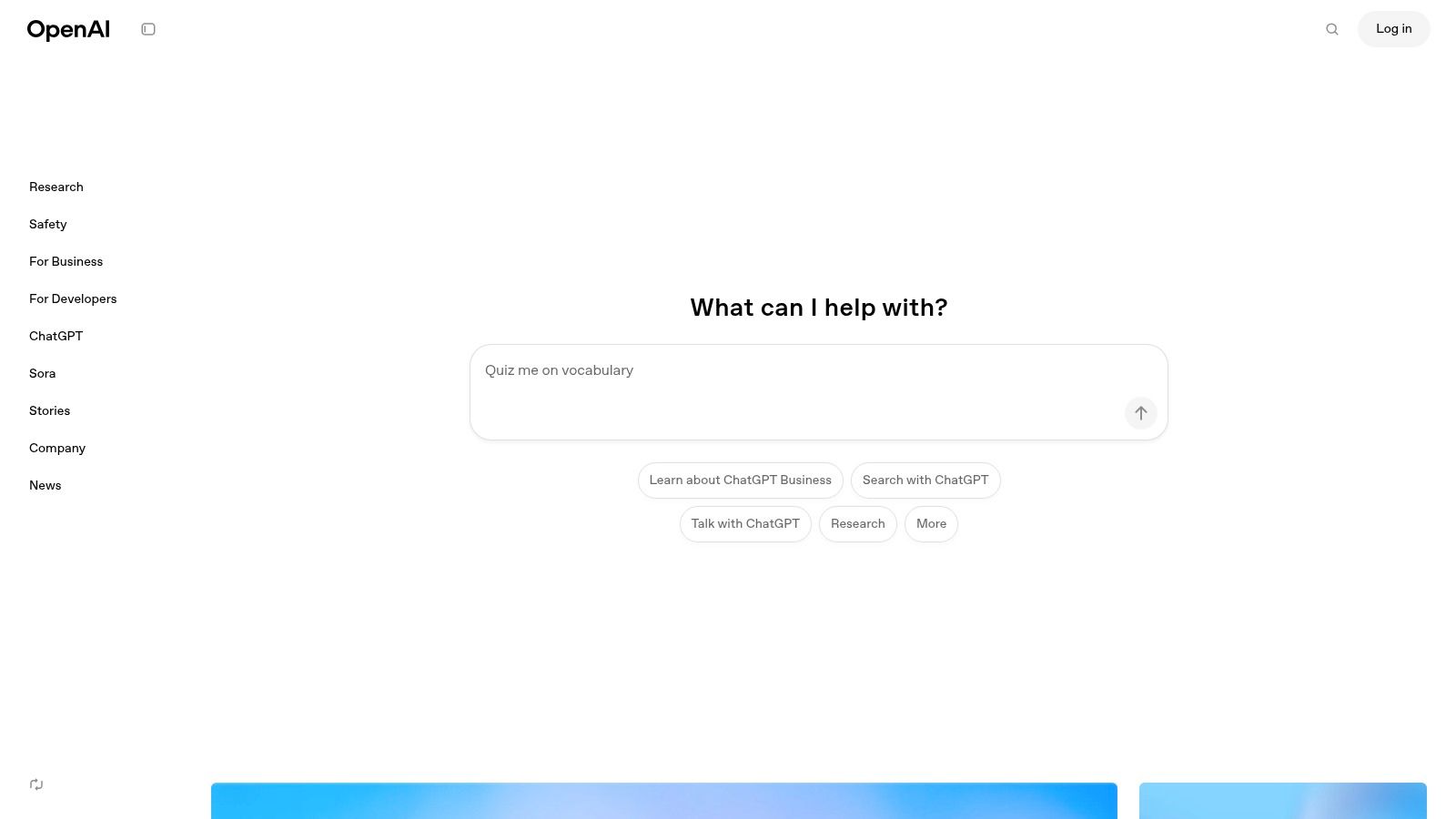
Unlike pre-packaged solutions, this API provides the foundational engine, giving you immense control. Developers can implement complex logic, including barge-in (interruptions) and real-time function calling, which is crucial for dynamic tasks like appointment setting or live data retrieval. While you get premier model quality from a first-party LLM provider, you are responsible for integrating your own telephony (PSTN) and Text-to-Speech (TTS) pipelines.
Key Details & Use Cases
- Best For: Teams needing maximum flexibility and direct access to a top-tier LLM for building custom, high-performance voice bots for in-app support, real-time sales assistants, or advanced interactive voice response (IVR) systems.
- Pricing: Follows a transparent, pay-as-you-go token-based model. OpenAI publishes clear audio token rates, but effective cost management requires careful tuning of context and token truncation to avoid unexpected expenses.
- Pros: Premier model quality, robust developer ecosystem, and a turnkey path to creating agents capable of genuine real-time interaction.
- Cons: Requires significant development effort. You must provide and manage your own telephony and TTS infrastructure.
Website: https://openai.com
2. Retell AI
Retell AI offers a comprehensive, all-in-one platform for building and deploying AI phone agents, bundling telephony, LLM integration, and analytics into a single managed service. It stands out by abstracting away the low-level infrastructure, allowing teams to go from concept to a production-ready voice agent in minutes rather than weeks. This streamlined, hosted approach makes it one of the best AI voice agents for businesses seeking rapid deployment without extensive development overhead.
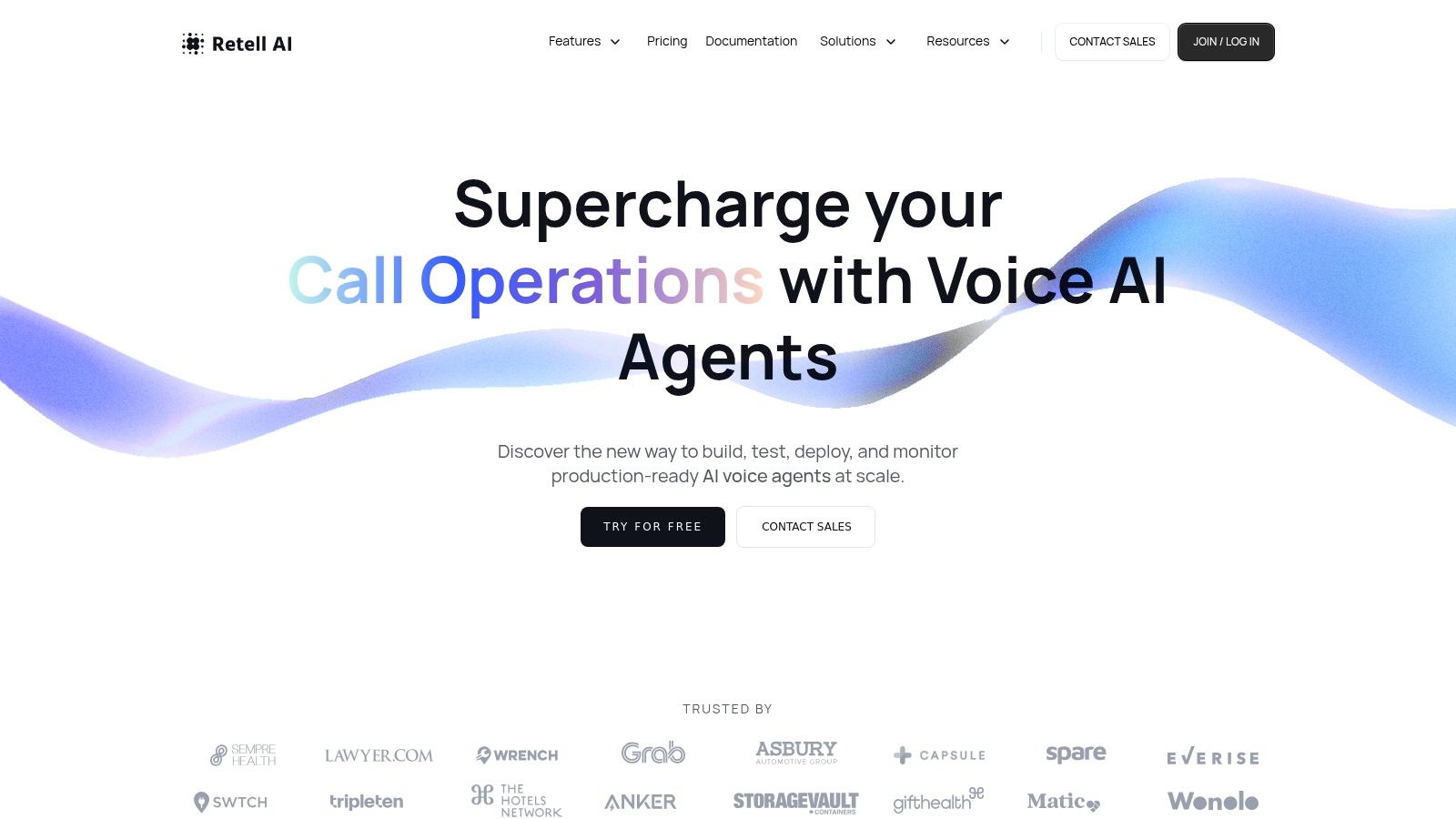
The platform provides a no-code builder and a testing simulator, enabling non-technical users to design conversational flows, connect knowledge bases, and test interactions before going live. Unlike API-first solutions, Retell manages phone number provisioning and call concurrency, simplifying the complexities of PSTN integration. While it offers less granular control than a pure code-first stack, its focus is on speed, scalability, and ease of use for call center-style applications.
Key Details & Use Cases
- Best For: Teams that need to quickly launch AI-powered inbound or outbound call campaigns, such as customer support qualification, appointment scheduling, or lead generation, without managing underlying telephony and AI model pipelines.
- Pricing: Features a transparent, per-minute pricing model with a built-in cost calculator. Generous free credits are available, allowing users to build and thoroughly test their agents before committing to a paid plan.
- Pros: Extremely fast time-to-production with minimal technical setup. The all-in-one package (telephony, LLM, analytics) and clear per-minute pricing simplify project planning and cost management.
- Cons: Less low-level control compared to building from scratch with an API. Advanced enterprise features and customization options may be gated behind higher-tier plans.
Website: https://www.retellai.com
3. Vapi
Vapi provides a developer-first orchestration layer designed to simplify the creation of phone and in-app voice agents. Instead of being a one-stop shop, it acts as a central coordinator, allowing you to bring your own Large Language Model (LLM), Text-to-Speech (TTS), Speech-to-Text (STT), and telephony providers. Vapi hosts and manages the real-time call flow, enabling you to mix and match best-of-breed components like OpenAI, ElevenLabs, and Twilio to build highly customized voice experiences without managing complex infrastructure.
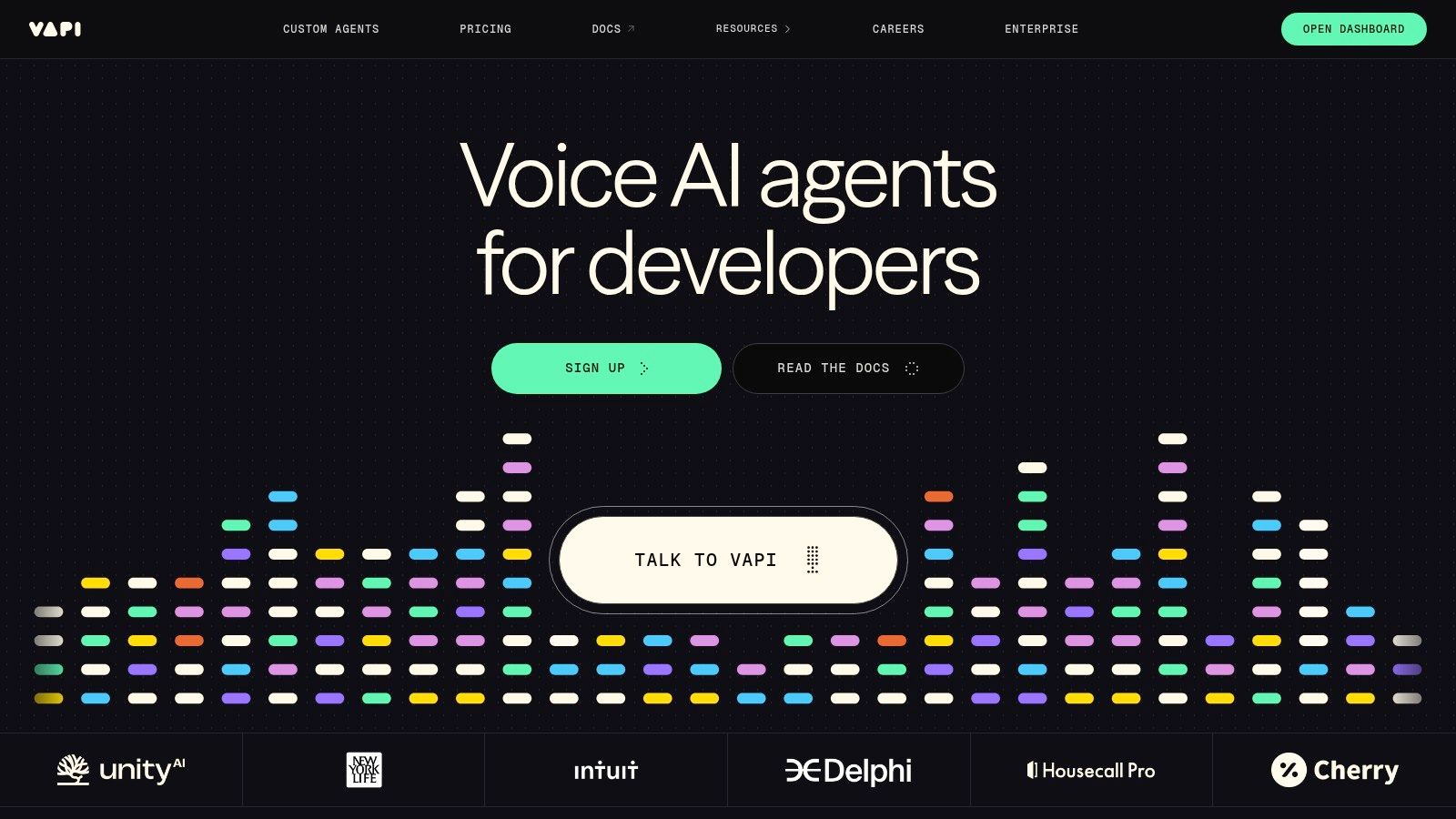
This modular approach makes it one of the best AI voice agents for teams that want ultimate control over their technology stack. The platform handles critical real-time functions like barge-in, endpointing, and function calling via webhooks, abstracting away the low-level complexities of voice conversations. This lets developers focus on the agent's logic and business value rather than the underlying plumbing, with paid tiers offering call logs and cost visibility for easier management.
Key Details & Use Cases
- Best For: Development teams wanting to build bespoke voice agents with their preferred providers (e.g., Anthropic for logic, Deepgram for transcription) without building the entire orchestration engine from scratch.
- Pricing: Vapi uses a platform fee model on top of the costs from your integrated providers. Pricing is not publicly listed on their main site and is typically surfaced through their documentation or by contacting support.
- Pros: Maximum flexibility to choose and swap providers, a lightweight hosting model, and simplified management of complex call logic.
- Cons: You are responsible for managing multiple vendor bills from your chosen providers. The lack of a public pricing page can make initial cost estimation difficult.
Website: https://vapi.ai
4. Deepgram – Voice Agent API
Deepgram’s Voice Agent API provides a streamlined solution for building responsive voice agents by unifying streaming Speech-to-Text (STT), Text-to-Speech (TTS), and built-in LLM orchestration into a single connection. It is designed for developers who want to minimize the complexity of stitching together multiple services. The platform leverages Deepgram's highly accurate and low-latency speech models, making it a strong contender among the best AI voice agents for real-time conversational applications where speech clarity is critical.
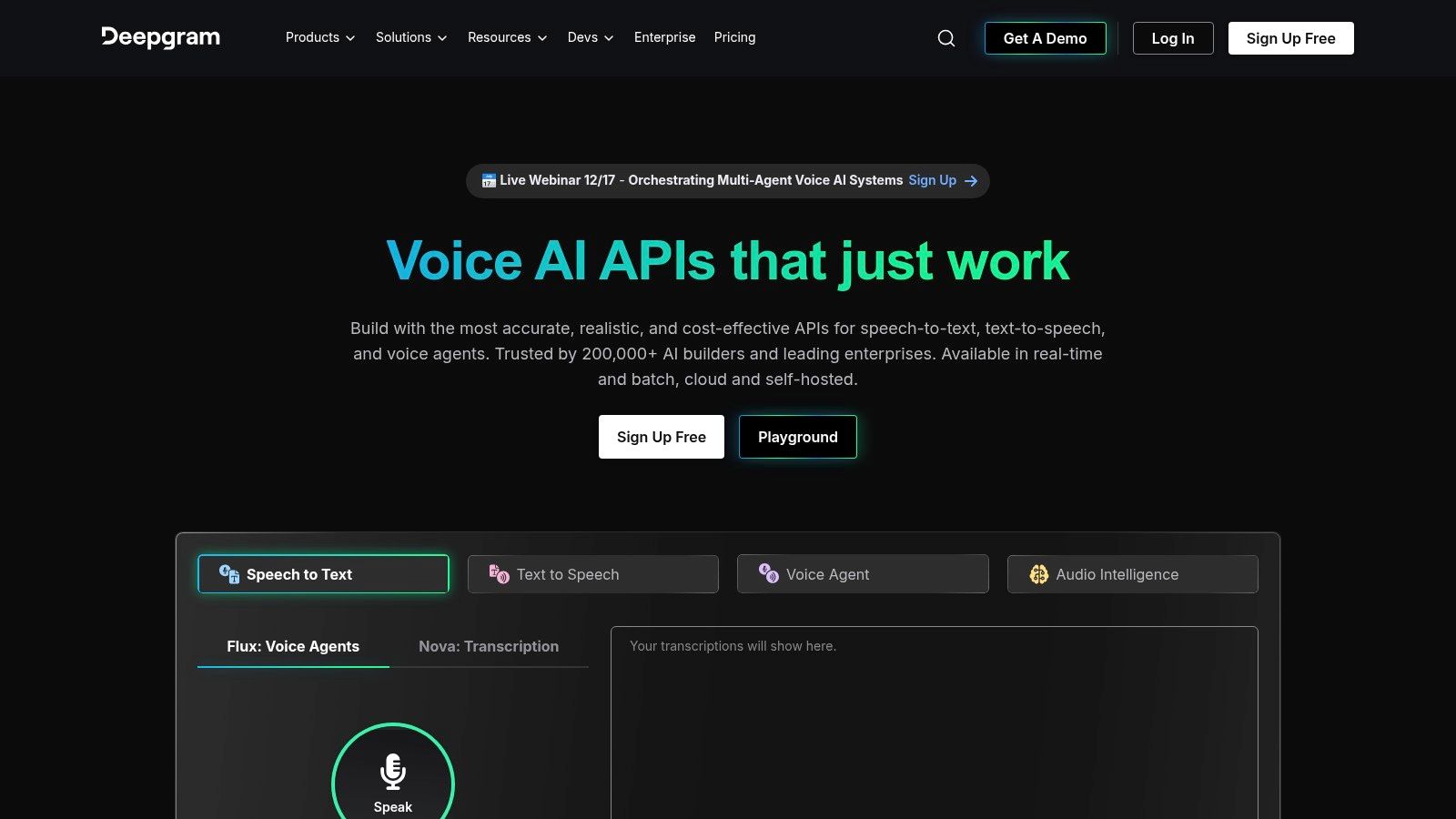
This API manages the listen, think, and speak cycle through a single WebSocket, simplifying the development process significantly. It features live TTS streaming with its Aura model and supports multi-language STT, catering to global use cases. While it offers built-in LLM orchestration, it remains flexible enough for developers to bring their own models. This balance makes it an excellent choice for teams that need a fast-to-implement yet powerful voice AI stack.
Key Details & Use Cases
- Best For: Developers and businesses looking for a fast, accurate, and integrated voice AI stack to build customer service bots, interactive product guides, or voice-controlled application interfaces with less backend complexity.
- Pricing: Follows a pay-as-you-go model with transparent pricing for its STT, TTS, and conversational AI components. Deepgram provides a generous amount of free credits for new users to test and build prototypes.
- Pros: Renowned for its strong speech recognition accuracy and low latency. The pricing page offers clear packaging and concurrency details, and the free credits make it easy to start.
- Cons: The Aura TTS is primarily English-first in some advanced modes. LLM-related costs and specific feature tiers can vary depending on the final implementation setup.
Website: https://deepgram.com
5. Hume AI
Hume AI offers a unique approach to conversational AI with its Empathic Voice Interface (EVI), an API designed to understand and generate emotionally resonant speech. It moves beyond simple text-to-speech by focusing on prosody, intonation, and affective cues, enabling the creation of voice agents that sound more natural and engaging. This focus on emotional intelligence makes it one of the best AI voice agents for applications where user experience and building rapport are critical.

The platform provides a speech-to-speech API that can analyze a user's tone and respond with an appropriate emotional expression, aiming to optimize conversations for user satisfaction. Developers can leverage its expression-measuring models to guide the agent's responses dynamically, creating a more adaptive and empathetic interaction. This is particularly useful in customer support or mental wellness applications where tone can significantly impact the outcome. For enterprise needs, Hume AI offers SOC 2 and HIPAA compliance options.
Key Details & Use Cases
- Best For: Companies building voice-first applications where emotional connection is key, such as virtual companions, empathetic customer service bots, mental wellness coaches, or interactive entertainment.
- Pricing: Features a tiered model with a free developer plan. Paid tiers include bundled minutes and offer access to more advanced features like voice cloning, with clear per-minute pricing for overages.
- Pros: Unique focus on emotional prosody significantly improves user experience. The API is straightforward to implement, and its tiered plans with included minutes are easy to understand.
- Cons: The emotional features may require careful tuning to align with specific brand voices or use cases. Advanced voice modes are currently English-focused.
Website: https://www.hume.ai
6. ElevenLabs
ElevenLabs is a leading Text-to-Speech (TTS) and voice synthesis platform, renowned for its high-fidelity, ultra-realistic voice generation. While not a complete voice agent solution itself, it serves as a critical component for many of the best AI voice agents, providing the lifelike "speaking" part of the conversational experience. Its core strength lies in its ability to create emotionally expressive audio and clone voices with remarkable accuracy, making it the go-to choice for applications where brand identity and vocal realism are paramount.
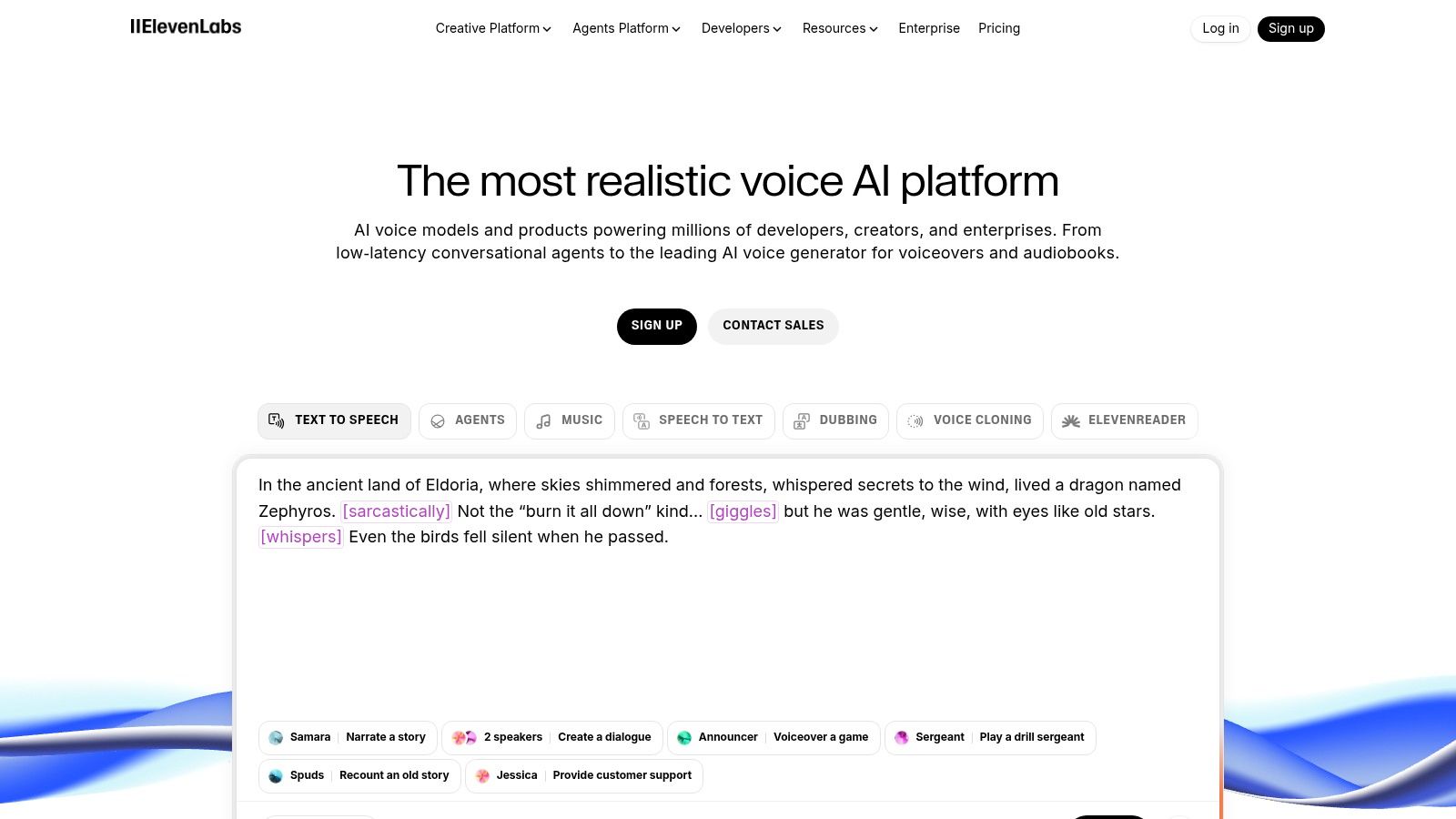
The platform provides a powerful API that developers integrate into their own voice agent frameworks, like those built on Vapi or Bland AI. This allows for low-latency audio streaming, which is essential for maintaining a natural conversational flow without awkward pauses. By combining ElevenLabs' superior TTS with a separate conversational AI engine, developers can build agents that sound incredibly human, enhancing customer engagement and trust in automated sales, support, and outbound calling scenarios.
Key Details & Use Cases
- Best For: Companies needing to power their custom-built voice agents with market-leading, realistic voices, voice cloning for brand consistency, or multilingual dubbing for global reach.
- Pricing: Operates on a credit-based system, with free and paid tiers scaling up to enterprise plans. The cost calculus depends on usage, as credits are consumed per character, but the mapping can require some initial analysis to forecast expenses accurately.
- Pros: Unmatched vocal realism and emotional range, extensive voice library with powerful cloning features, and a robust API designed for low-latency streaming.
- Cons: It is purely a TTS engine, not a full agent platform. The credit-per-minute cost can be complex to calculate initially and may be higher than bundled TTS options.
Website: https://elevenlabs.io
7. Cartesia
Cartesia is a developer-centric platform specifically engineered to tackle the biggest challenge in voice AI: latency. It combines its cutting-edge Sonic‑3 Text-to-Speech (TTS) engine, which boasts an incredibly low time-to-first-audio (TTFA), with its "Line" SDK. This integrated stack provides a code-first environment for building high-performance voice agents, complete with built-in telephony, analytics, and evaluation tools, making it one of the best AI voice agents for developers prioritizing real-time responsiveness.
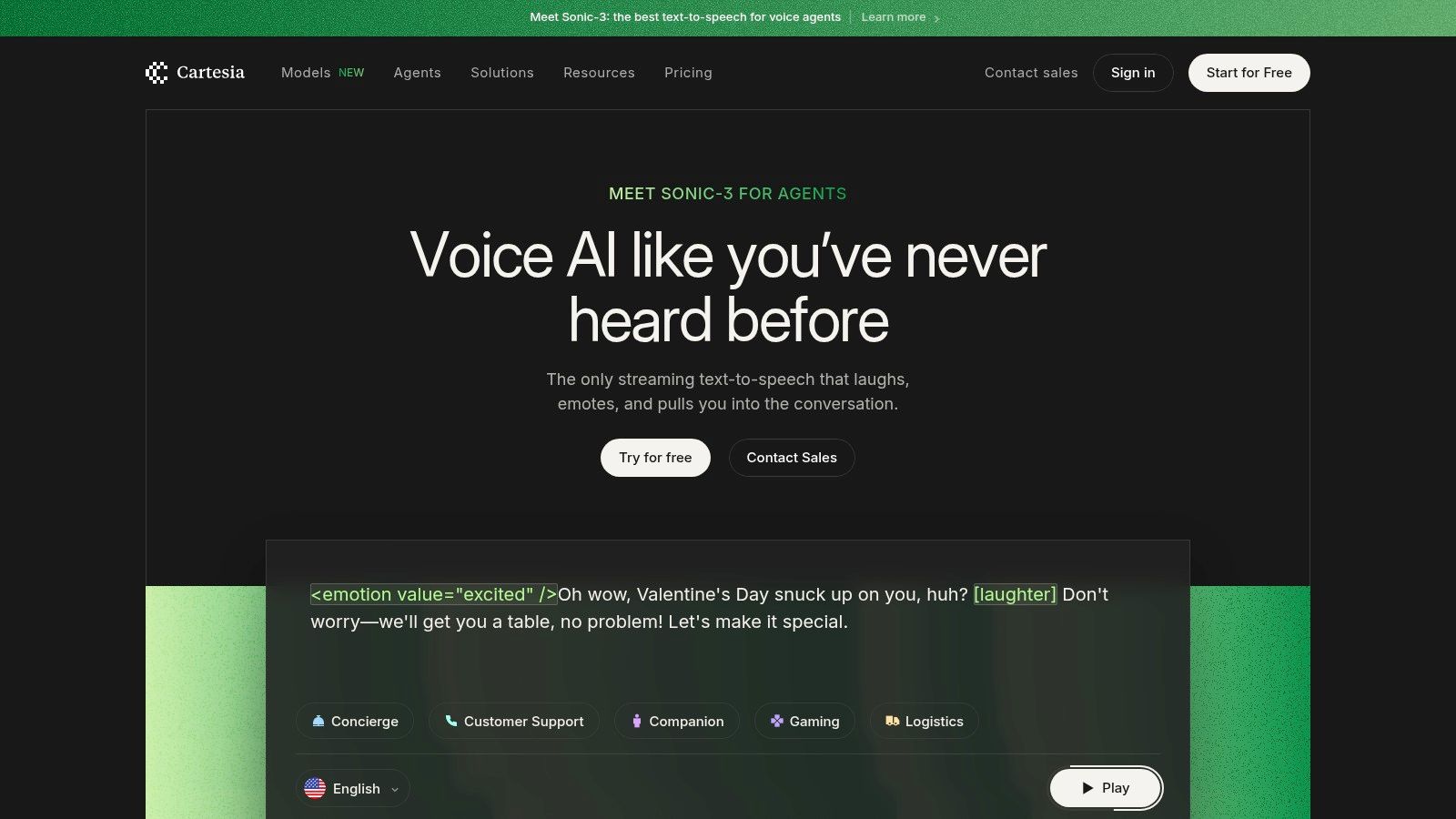
Unlike platforms that bundle everything into a no-code UI, Cartesia empowers developers with a streamlined workflow to build, deploy, and monitor agents directly from their codebase. This approach offers granular control over the agent's logic and performance. The platform’s unique features, such as voice cloning and infilling, further enhance the ability to create customized and natural-sounding conversational experiences. It is an ideal solution for teams that want to own the agent logic but offload the complexity of telephony and low-latency TTS infrastructure.
Key Details & Use Cases
- Best For: Developers and engineering teams building latency-sensitive applications like real-time customer support, appointment scheduling, or outbound sales bots where immediate, natural-sounding responses are critical.
- Pricing: Utilizes a dual-budgeting model with usage-based credits for the TTS/models and separate per-minute pricing for the agent's telephony. This requires careful planning to manage both components of the cost structure effectively.
- Pros: Purpose-built for ultra-low latency with a market-leading TTFA. The developer-friendly, code-first stack includes integrated telephony, simplifying deployment.
- Cons: The dual-budgeting system for models and agent minutes can be complex to forecast and manage. Requires coding expertise to utilize fully.
Website: https://cartesia.ai
8. Voiceflow
Voiceflow is a collaborative, low-code platform designed for building, testing, and deploying complex conversational AI agents across multiple channels, including voice. It excels by providing a visual, drag-and-drop interface that empowers both technical and non-technical team members to design sophisticated agent logic. This focus on a unified design and development workflow makes it one of the best AI voice agents for teams that need to rapidly prototype and iterate on conversational experiences before handing them off for production.
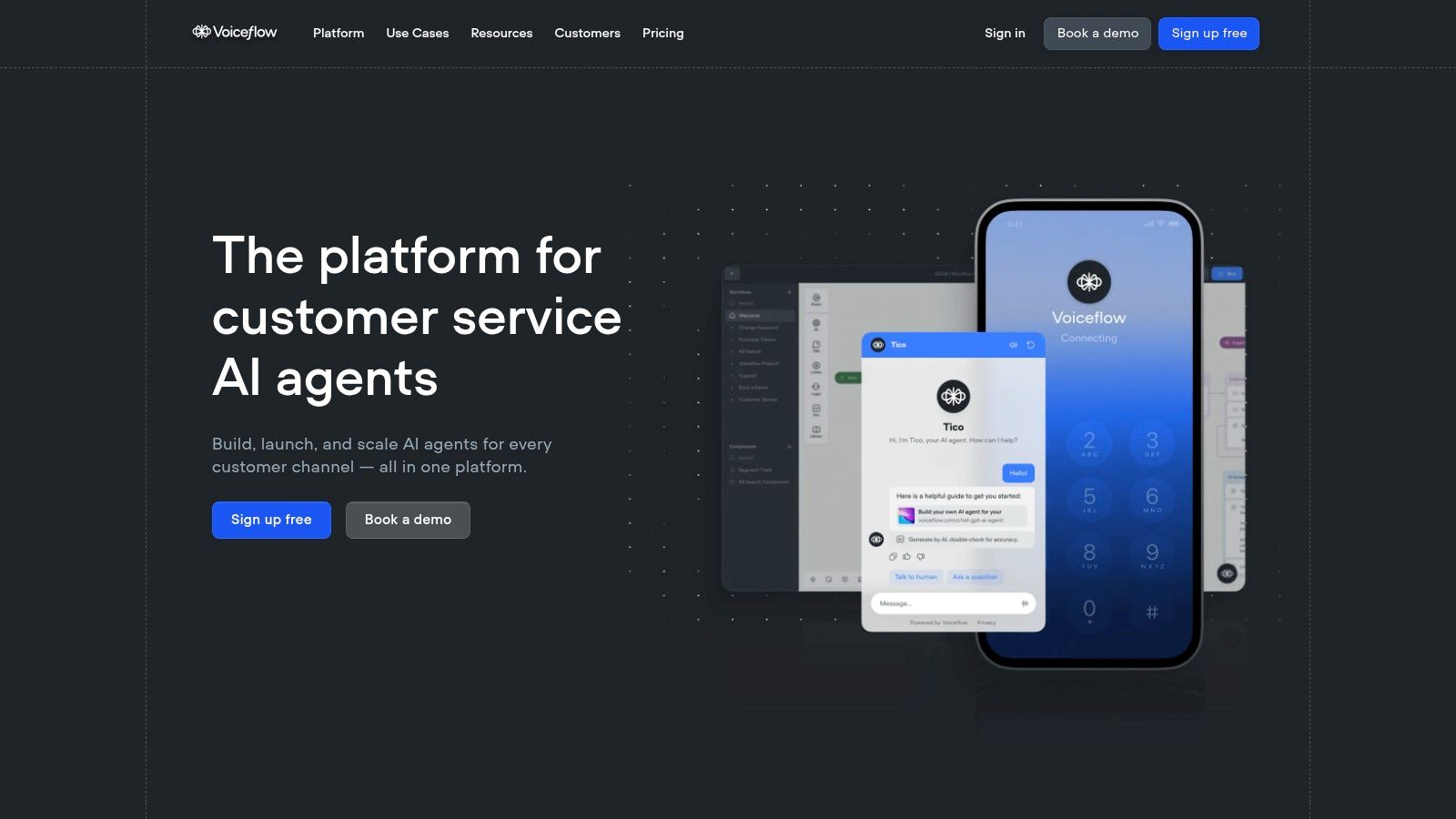
The platform abstracts away much of the underlying complexity with features like a knowledge base for grounding conversations, an agent CMS for managing content, and a powerful testing simulator. While Voiceflow provides the conversational brain, you are responsible for integrating your own telephony and infrastructure to bring the voice agent to life. This makes it a powerful design hub that plugs into your existing tech stack rather than a fully managed, all-in-one voice solution. By understanding the core components, you can learn more about what is an AI voice assistant and how platforms like Voiceflow fit into the ecosystem.
Key Details & Use Cases
- Best For: Product managers, designers, and development teams who need a collaborative environment to design, prototype, and manage the logic for custom voice agents before deploying them through integrated systems.
- Pricing: Offers various tiers, including a free plan for individuals, a Pro plan for small teams, and an Enterprise plan with advanced features. Usage is often governed by credits or concurrency quotas, which can add complexity.
- Pros: Highly intuitive visual builder accelerates design and iteration cycles. Excellent collaboration features make handoffs between design and development seamless.
- Cons: Not an end-to-end voice platform; requires separate configuration and management of telephony and core infrastructure. The usage-based credit model may be complex to forecast.
Website: https://www.voiceflow.com
9. Google Cloud – Dialogflow CX
Google Cloud’s Dialogflow CX is an advanced, enterprise-grade platform for building sophisticated voice and chat agents. It leverages Google’s powerful infrastructure to deliver contact-center quality conversational experiences. The platform stands out with its visual flow builder, which allows developers to design complex, stateful conversations with distinct flows and pages, making it one of the best AI voice agents for managing intricate customer journeys at scale.
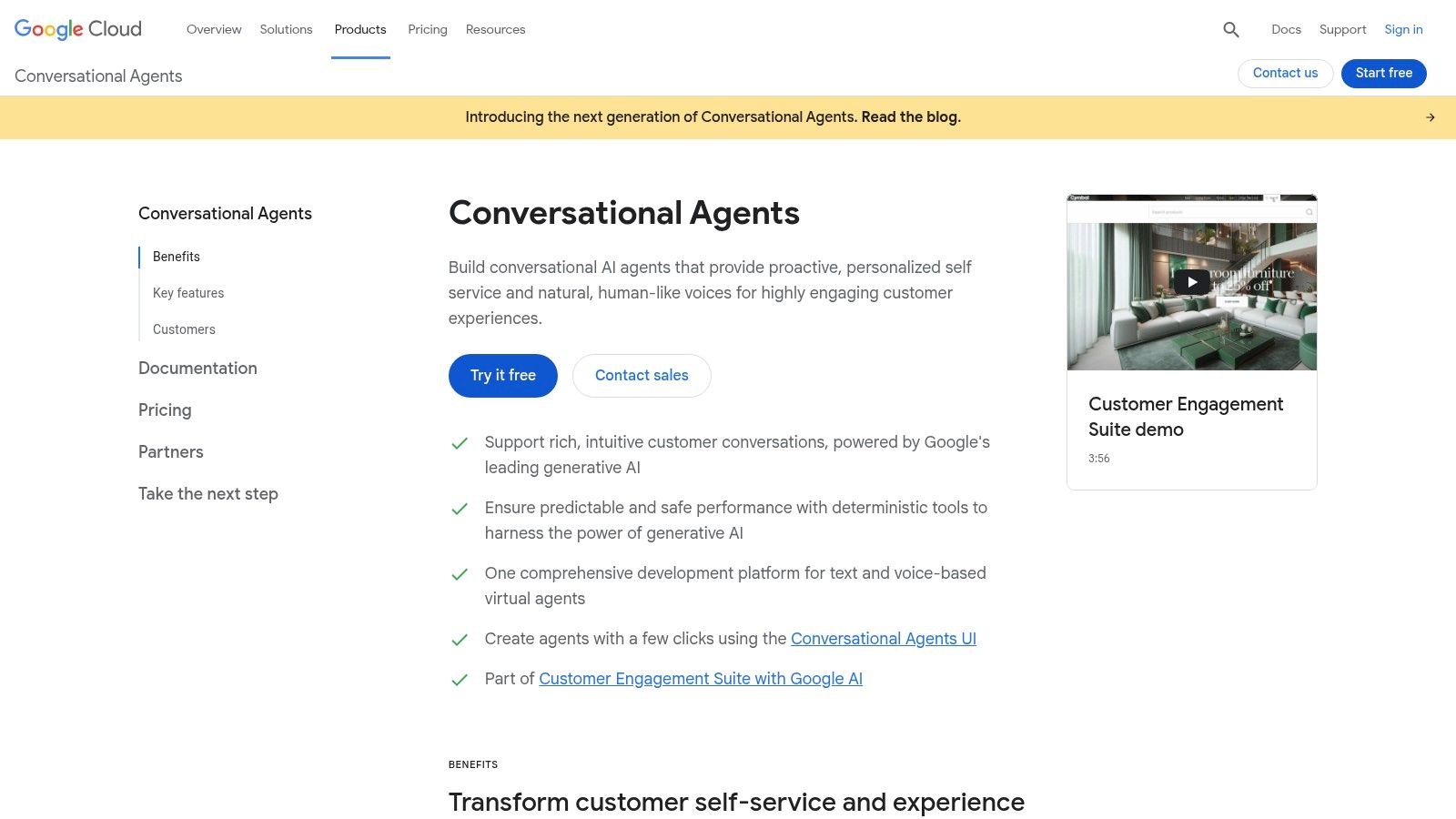
Unlike simpler tools, Dialogflow CX is built for reliability, offering robust features like versioning, environment management, and comprehensive analytics. Integrated telephony connectors and omnichannel routing capabilities enable seamless deployment across voice and digital channels. Its design is ideal for developers creating complex agents that require deep integration with other Google Cloud services for security, operations, and data processing. To understand more about the technology behind these systems, you can learn more about conversational AI.
Key Details & Use Cases
- Best For: Enterprise teams building complex, high-volume IVR systems, omnichannel customer support bots, and regulated industry applications that require enterprise-grade security and scalability.
- Pricing: Follows a usage-based model with predictable per-second voice pricing and per-request charges. Google offers a generous free tier and initial credits for new Cloud customers.
- Pros: Proven enterprise reliability and scalability backed by Google Cloud, powerful visual builder for managing complex conversation states, and strong integration with the broader Google ecosystem.
- Cons: The learning curve can be steep due to its complex terminology and structure (e.g., Flows, Pages, State Handlers). Setup and configuration are more involved than simpler no-code platforms.
Website: https://cloud.google.com/dialogflow
10. Amazon Web Services – Amazon Lex + Amazon Connect
For enterprises deeply integrated into the AWS ecosystem, the combination of Amazon Lex and Amazon Connect offers a powerful, scalable framework for building sophisticated AI voice agents. Lex provides the conversational AI engine for building bots with automatic speech recognition (ASR) and natural language understanding (NLU), while Connect delivers the cloud-based contact center infrastructure. This modular approach allows businesses to construct enterprise-grade, compliant voice solutions that leverage the full suite of AWS services.
This platform excels in scenarios requiring high levels of security, compliance, and custom integration with other cloud services like Amazon Bedrock for generative AI or Kinesis for real-time analytics. Unlike all-in-one platforms, AWS requires you to assemble these components, offering immense flexibility at the cost of increased complexity. This makes it a prime choice for organizations with development resources dedicated to creating highly customized call center automation solutions.
Key Details & Use Cases
- Best For: Large enterprises and existing AWS customers needing to build custom, scalable, and secure voice bots for customer service IVRs, financial services, or healthcare applications where compliance is paramount.
- Pricing: Follows a complex, a-la-carte model where costs are spread across multiple services (Lex, Connect, Lambda, etc.). While Lex has a free tier for initial development, modeling the total cost of ownership can be intricate.
- Pros: Unmatched scalability and reliability within the AWS cloud, extensive compliance certifications, and deep integration with a vast array of other AWS services.
- Cons: Requires significant technical expertise to assemble and manage. The multi-service pricing structure can be challenging to predict and control without careful monitoring.
Website: https://aws.amazon.com
11. Microsoft Azure – Azure AI Speech
Microsoft Azure’s AI Speech service provides the core speech-to-text (STT) and text-to-speech (TTS) capabilities essential for building custom voice agents. It acts as a foundational layer within the broader Azure ecosystem, offering enterprise-grade reliability, compliance, and governance. The platform is distinguished by its high-quality neural voices and robust streaming transcription, making it a strong contender for organizations already invested in Azure or requiring stringent data security.
Unlike all-in-one platforms, Azure AI Speech is a component that you must integrate with other services. This means you are responsible for connecting the LLM (like Azure OpenAI), telephony, and orchestration logic yourself. This unbundled approach offers immense flexibility but requires significant development resources. The service is one of the best AI voice agents for developers looking to construct a highly customized solution on a secure, fully managed cloud infrastructure.
Key Details & Use Cases
- Best For: Enterprises and development teams that need to build bespoke voice solutions on a secure, compliant cloud platform, especially those with existing Azure commitments or complex integration needs.
- Pricing: Follows a pay-as-you-go model. TTS is typically billed per character, while STT is billed per audio hour. Careful planning is needed as the pricing units differ across the speech services, which can complicate cost forecasting.
- Pros: Strong compliance and regional data options suitable for US enterprises. Provides a reliable, high-quality speech foundation inside a fully managed and integrated cloud environment.
- Cons: Requires you to assemble the full agent (LLM, telephony, orchestration) from separate components. This increases development complexity and time to market.
Website: https://azure.microsoft.com
12. Twilio
Twilio serves as the foundational telephony layer for many of the best AI voice agents, providing the essential infrastructure for connecting them to the global telephone network. While not an all-in-one agent platform, it offers the programmable APIs for PSTN, SIP, and WebRTC connectivity, along with phone numbers and call control. This makes it the industry-standard choice for developers building custom voice solutions who need a reliable, carrier-grade backbone to handle real-world call traffic.
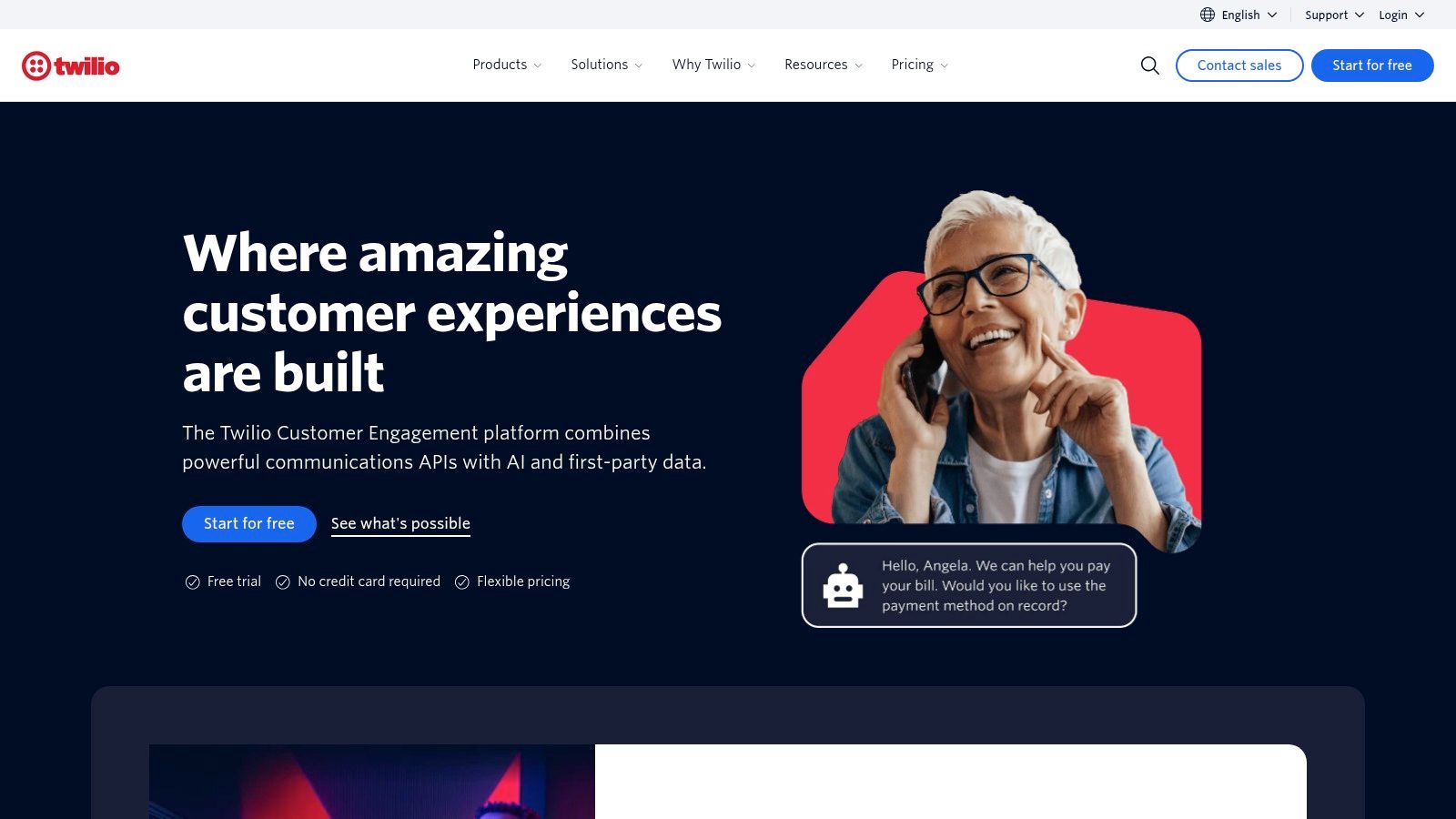
The platform is designed for developers who prefer a "bring-your-own" (BYO) approach. You use Twilio to manage the call flow and then integrate your preferred LLM, Speech-to-Text (STT), and Text-to-Speech (TTS) providers to create the conversational intelligence. For more structured environments, its Flex contact center platform can be extended with AI for agent-assist or full automation, blending human and AI interactions seamlessly.
Key Details & Use Cases
- Best For: Development teams building bespoke AI voice agents who need a robust, scalable, and globally-reaching telephony infrastructure. It's the go-to for custom IVR, automated appointment reminders, and agent-assist tools.
- Pricing: Follows a flexible, usage-based model with per-minute rates for calls and per-month fees for phone numbers. This approach allows costs to scale directly with usage, but requires careful management as telephony fees are separate from your AI model costs.
- Pros: Carrier-grade reliability with extensive global reach. It’s the standard choice for BYO agent stacks and has broad ecosystem support and excellent documentation.
- Cons: You must assemble and manage the entire AI pipeline (LLM, STT, TTS) yourself. The per-minute telephony costs add to the overall expense of running the agent.
Website: https://www.twilio.com
13. Bland AI
Bland AI has emerged as one of the fastest-growing AI voice agent platforms, purpose-built for enterprise phone call automation. What sets Bland apart is its focus on speed — the platform claims to deliver the fastest conversational AI latency in the market, enabling natural, real-time dialogue that callers often cannot distinguish from a human agent. For businesses processing thousands of calls daily, this performance edge translates directly into better customer experience and higher conversion rates.
The platform offers custom model fine-tuning using your own call recordings and transcriptions, giving you a voice agent that truly understands your business vocabulary, objections, and workflows. Bland also provides dedicated infrastructure for enterprise clients, ensuring data privacy and consistent performance under heavy call volumes.
Key Details & Use Cases
- Best For: High-volume outbound sales calls, appointment scheduling, lead qualification, and customer service automation. Ideal for teams that need enterprise-grade reliability with custom-trained voice models.
- Pricing: Usage-based pricing with enterprise tiers available. Custom model training and dedicated infrastructure available for larger deployments.
- Pros: Industry-leading latency, custom model fine-tuning, dedicated infrastructure options, and strong enterprise security with encrypted data on isolated servers.
- Cons: Enterprise focus means smaller teams may find the platform over-engineered for simple use cases. Custom training requires a library of existing call recordings.
Website: https://www.bland.ai
14. Synthflow AI
Synthflow AI positions itself as an end-to-end voice AI platform with a standout feature: in-house telephony. Unlike most competitors that rely on third-party telephony providers, Synthflow owns and operates its own calling infrastructure. This vertical integration results in lower latency, better call quality, and more competitive pricing — a significant advantage for businesses scaling their voice agent operations.
The platform offers a visual flow builder that lets non-technical users design complex conversation logic, including real-time appointment booking, lead qualification scripts, and multi-step customer support workflows. Synthflow emphasizes rapid ROI, with most enterprise deployments seeing measurable results within weeks rather than months.
Key Details & Use Cases
- Best For: Real estate lead qualification, healthcare appointment scheduling, e-commerce customer support, and restaurant booking automation. Strong fit for businesses wanting a no-code approach with enterprise-grade telephony.
- Pricing: Tiered pricing with per-minute rates. The in-house telephony reduces costs compared to platforms that pass through third-party carrier fees.
- Pros: In-house telephony for better quality and pricing, intuitive visual flow builder, proven deployment framework, and rapid time-to-value for enterprise clients.
- Cons: Newer entrant compared to established players like Twilio or Google. Less extensive third-party integration ecosystem than some competitors.
Website: https://synthflow.ai
15. Air AI
Air AI made headlines as one of the first platforms to demonstrate fully autonomous phone calls lasting 10–40 minutes without human intervention. The platform focuses specifically on sales and customer service conversations, with AI agents capable of handling objections, answering complex questions, and guiding prospects through entire sales processes — all while sounding remarkably human.
What differentiates Air AI is its conversation memory and context management across extended interactions. While many voice agents excel at short, transactional calls, Air AI is designed for the kind of consultative, multi-turn conversations that B2B sales teams rely on. The platform also integrates with over 5,000 applications, enabling agents to take real actions during calls like booking meetings, updating CRM records, or sending follow-up emails.
Key Details & Use Cases
- Best For: B2B sales outreach, inbound sales qualification, customer onboarding calls, and complex support scenarios that require extended conversation with context retention.
- Pricing: Custom pricing based on call volume and use case complexity. Generally positioned as a premium solution for businesses looking to replace or augment their sales development team.
- Pros: Handles long, complex sales conversations autonomously. Deep integration ecosystem (5,000+ apps). Excellent at objection handling and context retention across multi-turn dialogues.
- Cons: Premium pricing may be prohibitive for smaller operations. Less suitable for simple, transactional call automation where lighter platforms would suffice.
Website: https://www.air.ai
Top 15 AI Voice Agents — Feature Comparison
| Product | Core features | UX / Quality | Best fit (target & value) | Price & deployment |
|---|---|---|---|---|
| OpenAI – Realtime API | Low‑latency streaming listen/think/speak, function calling, SDKs | High model quality, truly interactive voice | Developers wanting first‑party LLM + streaming audio for phone/in‑app agents | Transparent token pricing; developer‑first — you supply telephony/TTS/PSTN |
| Retell AI | Hosted phone numbers, no‑code builder, routing, analytics | Fast time‑to‑production; testing simulator | Businesses needing turnkey hosted AI call‑center deployments | Per‑minute pricing, hosted SaaS with telephony included; free credits |
| Vapi | Orchestration/BYO LLM·TTS·STT·telephony, webhooks, real‑time controls | Flexible, code‑first orchestration layer | Teams wanting mix‑and‑match best‑of‑breed providers | Platform fee + BYO vendor bills; pricing via docs/support |
| Deepgram – Voice Agent API | Single WebSocket listen/think/speak, streaming STT, Live TTS, LLM orchestration | Strong speech accuracy, low latency, clear concurrency | Teams needing proven speech models and simpler full‑agent stacks | Pay‑as‑you‑go with free credits; hosted API |
| Hume AI | EVI conversational endpoints, emotion/intonation control, voice cloning | Affective prosody improves UX when tuned properly | Brands seeking emotionally expressive voice agents | Published minute bundles; enterprise SOC2/HIPAA options |
| ElevenLabs | High‑fidelity TTS, voice cloning, dubbing, API access | Market‑leading realism and voice library | Production agents requiring ultra‑realistic or branded voices | Credits‑based pricing; business & enterprise tiers |
| Cartesia | Sonic‑3 ultra‑low TTFA TTS, Line SDK, telephony & analytics | Extremely low latency (≈90ms TTFA), developer‑friendly | Latency‑sensitive, real‑time agent developers | Usage credits / agent minutes; separate model vs agent budgeting |
| Voiceflow | Drag‑and‑drop flow builder, multi‑LLM routing, CMS, simulator | Friendly for PMs/designers; strong collaboration tools | Product teams prototyping→production, low‑code workflows | Tiered SaaS plans with concurrency quotas; integrates with telephony |
| Google Cloud – Dialogflow CX | Visual flow builder, STT/TTS, telephony connectors, enterprise tooling | Contact‑center quality reliability and tracing | Enterprises building contact‑center grade voice & chat agents | Per‑second voice pricing; Google Cloud managed service |
| AWS – Lex + Connect | Lex bot builder, Connect contact center, analytics, AWS integrations | Scalable, compliant, enterprise‑grade | Large contact centers inside AWS ecosystem | Multiple service pricing; free Lex tier; assemble services yourself |
| Microsoft Azure – Azure AI Speech | Neural/custom TTS, streaming STT, speaker recognition, Azure OpenAI integration | Reliable speech foundation with strong compliance | Enterprises needing regional compliance and Azure ecosystem | Pay‑as‑you‑go (chars/audio hours); self‑assemble full agent |
| Twilio | Programmable Voice APIs, WebRTC, global phone numbers, Flex | Carrier‑grade reach and reliability | Teams needing PSTN/telephony backbone for BYO stacks | Per‑minute telephony costs + integrate LLM/STT/TTS; global coverage |
Choosing and Implementing Your AI Voice Agent: The Path to Automation ROI
Navigating the landscape of AI voice agents can feel overwhelming, but as we've explored, the market offers a diverse and powerful set of tools tailored to virtually any business need. From the raw, developer-centric power of OpenAI's Realtime API and Vapi to the streamlined, no-code platforms like Retell AI and Voiceflow, the right solution is within reach. The key is to move beyond a simple feature-for-feature comparison and focus on strategic alignment with your operational goals.
The journey to finding the best AI voice agents for your organization is less about finding a single "perfect" tool and more about identifying the optimal fit for your specific use case, technical resources, and scalability requirements. The most sophisticated technology is only as effective as the strategy it supports.
Key Takeaways: Your Decision-Making Framework
To synthesize the insights from our deep dive, consider these critical takeaways when making your selection:
- Developer-First vs. No-Code: The most significant fork in the road is your team's technical capability. Platforms like Retell AI offer rapid deployment for non-technical teams, while APIs from Vapi, Deepgram, and OpenAI provide unparalleled customization for those with engineering resources. Don't overbuy on complexity or underestimate your team's needs.
- Latency is Non-Negotiable: For conversational AI, latency is the silent killer of user experience. Tools like Retell AI and Vapi have built their entire architecture around minimizing this delay, a crucial factor for natural-sounding, real-time interactions in sales or support calls.
- Specialization Matters: A tool designed for emotionally intelligent support conversations (Hume AI) will have a different feature set than one built for high-volume outbound appointment setting. Similarly, a platform like Cartesia excels at creating a unique, brand-aligned voice, a key differentiator in a crowded market. Align the tool's core strength with your primary objective.
- Ecosystem and Integration are Paramount: An AI voice agent is rarely a standalone solution. Its true power is unlocked when seamlessly integrated with your existing CRM, contact center software, and other business systems. Evaluate the API documentation, pre-built integrations (like those offered by Google Cloud or AWS), and the overall developer ecosystem before committing.
From Selection to Successful Implementation
Choosing your tool is just the beginning. True return on investment is realized through thoughtful and strategic implementation. Avoid the common pitfall of simply "plugging in" an AI agent and expecting immediate results. A successful deployment requires a clear plan.
First, define your success metrics from the outset. Are you aiming to increase lead qualification rates by 20%? Reduce customer support wait times by 50%? These specific goals will guide your agent's design, scripting, and optimization.
Second, start with a narrow, high-impact use case. Instead of attempting to automate your entire inbound support system at once, begin with a specific task, such as handling password reset requests or scheduling product demos. This allows you to iterate, learn, and demonstrate value quickly before scaling to more complex workflows.
Finally, invest in conversation design. The quality of your prompts, scripts, and escalation paths will determine whether your AI agent feels like a helpful assistant or a frustrating robot. This involves understanding user intent, anticipating edge cases, and designing a natural, human-like interaction flow.
If your team doesn't want to assemble and maintain the whole stack internally, this is also where a custom implementation partner can be the better fit. At MakeAutomation, that has meant building and running our own voice engine so we can control latency, prompts, call flow, telephony behavior, CRM handoffs, and post-call automation more tightly for client use cases.
The rise of conversational AI represents a fundamental shift in how businesses engage with customers, manage operations, and drive growth. The tools we've covered are not just futuristic concepts; they are practical, deployable solutions that are delivering measurable results today. By making an informed choice and implementing it with a clear strategy, you can harness this technology to build a more efficient, scalable, and intelligent organization.
Ready to move from research to results? Choosing and integrating the best AI voice agents requires deep technical expertise and strategic planning. At MakeAutomation, we specialize in building and deploying robust, end-to-end voice automation frameworks that connect these powerful tools to your unique business processes, ensuring you achieve maximum ROI. Schedule a consultation with us today to discover how we can accelerate your automation journey.
Frequently Asked Questions About AI Voice Agents
What is an AI voice agent?
An AI voice agent is software that uses artificial intelligence to conduct phone conversations autonomously, without human intervention. Unlike traditional IVR systems that follow rigid menu trees, modern AI voice agents use large language models (LLMs) and natural language processing to understand context, handle interruptions, respond to unexpected questions, and carry out tasks like booking appointments, qualifying leads, or resolving support tickets — all in real-time with human-like speech patterns.
How much do AI voice agents cost?
AI voice agent costs vary widely depending on the platform and usage volume. Entry-level platforms like Retell AI and Vapi start at $0.05–0.15 per minute of conversation. Mid-tier solutions like Synthflow and Bland AI range from $0.10–0.30 per minute with enterprise tiers available. Enterprise platforms from Google Cloud, AWS, and Microsoft charge based on API calls and compute time, typically $0.004–0.02 per 15-second audio segment. Most businesses spend $500–5,000/month depending on call volume, with high-volume operations negotiating custom rates.
Can AI voice agents replace human agents?
AI voice agents can fully handle 60–80% of routine calls — appointment scheduling, FAQ answering, order status inquiries, and basic lead qualification. For complex scenarios requiring empathy, negotiation, or creative problem-solving, a hybrid approach works best: AI handles the initial conversation and qualification, then seamlessly transfers to a human agent when needed. Most businesses see the best ROI by using AI agents to handle volume while freeing human agents for high-value interactions.
What is the best AI voice agent for small businesses?
For small businesses, the best AI voice agents are platforms that offer no-code setup and affordable pricing. Retell AI, Synthflow, and Vapi are strong choices — they provide visual builders, built-in telephony, and pay-as-you-go pricing starting under $100/month for low call volumes. If you need something even simpler, Voiceflow offers a drag-and-drop conversation designer. Avoid enterprise platforms like AWS Lex or Google Dialogflow CX unless you have dedicated technical resources, as they require significant development effort.
How long does it take to set up an AI voice agent?
Setup time depends on the platform and complexity. No-code platforms like Retell AI and Synthflow can have a basic agent live in 1–2 hours for simple use cases like appointment booking. More complex deployments with custom integrations, CRM connections, and multi-step conversation flows typically take 1–2 weeks. Enterprise implementations using API-first platforms like OpenAI Realtime API, Twilio, or AWS Lex can take 4–8 weeks including development, testing, and telephony configuration.
What industries benefit most from AI voice agents?
The industries seeing the highest ROI from AI voice agents include healthcare (appointment scheduling and patient follow-up), real estate (lead qualification and property inquiries), e-commerce (order support and returns), financial services (account inquiries and fraud alerts), and B2B SaaS (sales qualification and demo booking). Any business handling more than 100 calls per day with repetitive conversation patterns is a strong candidate for voice AI automation.
Related Articles
- What is Conversational AI? — Understanding the technology behind voice agents
- Best AI Chatbot for Customer Service — Text-based alternatives to voice agents
- What is an AI Voice Assistant? — How voice assistants differ from voice agents
- Automated Customer Service Software — Full automation stack for support teams
- Call Handling Best Practices — Optimize both AI and human call performance