

Unlocking Speed and Stability with Continuous Delivery and DevOps
At their core, continuous delivery and DevOps are both about a single, powerful goal: shipping better software, faster. Think of DevOps as the cultural philosophy that smashes the walls between your development and operations teams. Continuous delivery, on the other hand, provides the automated, practical muscle to make that collaboration work like a well-oiled machine.
The Engine of Modern Software Development

Picture a traditional car factory. The designers are in one building, the engineers in another, and the assembly line workers are a world away. Blueprints get thrown over a wall from design to engineering, who then toss components over to assembly. When a door doesn't fit, the car gets sent all the way back to the start, sparking delays and finger-pointing. For a long time, this is exactly how we built software.
This old, fragmented approach was a recipe for friction and slow, unreliable products. Finding a single bug late in the game could torpedo an entire release schedule.
Uniting Teams With a DevOps Culture
DevOps isn't a tool you can buy or a job title you can assign. It's a fundamental cultural shift that tears down those organizational silos. It’s all about creating a mindset of shared ownership and deep collaboration that spans the entire software lifecycle, from the first sketch of an idea to its final release into the wild.
Instead of developers (Dev) and operations (Ops) professionals working on separate islands, DevOps brings them together into a single, cohesive unit. This integration makes everyone accountable for both the speed of delivery and the stability of the final product. The shift is built on a few core principles:
- Shared Responsibility: Developers don't just "throw code over the wall" anymore. They think about how it will run in production. Ops teams don't just manage servers; they provide crucial feedback that makes the development process better.
- Open Communication: Teams use the same tools, speak the same language, and engage in constant, transparent discussions to get ahead of problems.
- A Focus on Automation: Why have a human perform a repetitive, manual task? Automation frees up your best people to solve bigger, more interesting problems.
DevOps creates an environment where building, testing, and releasing software can happen more rapidly, frequently, and reliably. It's the human framework that makes high-velocity development possible.
Powering the Culture With Continuous Delivery
If DevOps is the collaborative mindset, then continuous delivery (CD) is the powerful, automated engine that makes it a reality. Continuous delivery is a disciplined set of practices where code changes are automatically built, tested, and prepared for release to production.
Think of it as a high-speed, fully automated conveyor belt for your code. The moment a developer commits a change, the system grabs it and sends it through a gauntlet of automated quality checks.
This discipline ensures that your main codebase is always in a deployable state. The final decision to push the button and release to customers might still be a manual one, but the confidence that it will work is incredibly high because it has already passed every automated test you can throw at it.
This quick table helps clarify the relationship between these two critical concepts.
| Concept | Primary Focus | Scope | Key Outcome |
|---|---|---|---|
| DevOps | Culture & Collaboration | Entire software lifecycle | Breaking down silos, shared ownership, faster feedback loops |
| Continuous Delivery | Automation & Process | Build, test, and release pipeline | A codebase that is always ready for a safe and reliable deployment |
While they focus on different areas, their goals are perfectly aligned.
Together, continuous delivery and DevOps transform software development. They take a process that was once slow, risky, and manual and turn it into a fast, predictable, and automated assembly line for innovation. For any modern B2B or SaaS company, this synergy isn't just a nice-to-have; it's the foundation for moving fast and building things that last.
The Real-World Business Impact of Adopting DevOps
It's one thing to talk about adopting a new philosophy, but it's another to see a real return on that investment. The business case for continuous delivery and DevOps isn't just about technical jargon—it translates directly into faster growth, rock-solid stability, and a serious competitive advantage. For any B2B or SaaS company, these aren't just nice-to-haves; they're the engine of success.
When you automate the path from a great idea to a live product, you completely change your company's metabolism. Suddenly, you can react to market feedback, ship new features, or patch a security hole in a matter of hours or days, not weeks or months. That kind of speed is a massive leg up when your competitors are still stuck in slow, manual release cycles.
Accelerate Your Time-to-Market
Think of your development process like a highway. The old, manual way is like a gridlocked city street with stoplights and traffic jams at every corner. Each stop—for a manual test, a hand-off between teams, or a long-winded approval process—drags out the time it takes to get value into your customers' hands.
A DevOps culture with a continuous delivery pipeline is the German Autobahn. It clears out the bottlenecks and automates the checkpoints, letting features fly from a developer's keyboard to your users at top speed.
This acceleration has a direct impact on your bottom line. It lets you:
- Launch new products faster and grab market share before anyone else.
- Respond to customer feature requests quickly, which keeps them happy and loyal.
- A/B test ideas rapidly to figure out what actually drives engagement and revenue.
Dramatically Improve Software Quality and Reliability
Going faster is only a good thing if the quality holds up. One of the biggest worries about speeding up releases is the fear of breaking things, which can lead to expensive downtime and a black eye for your brand. This is where the partnership between continuous delivery and DevOps really proves its worth.
By weaving automated testing into every step of the pipeline, you catch bugs early on when they’re small, cheap, and easy to fix. Instead of a single, massive, high-risk release once a quarter, you're doing dozens of small, low-risk releases. Each tiny change is thoroughly checked by the automated system, which massively lowers the chance of a catastrophic failure.
This approach essentially builds a safety net right into your development process. It gives your team the confidence to innovate and try new things, knowing that automated quality checks will stop critical errors from ever reaching a customer.
The data backs this up. Research shows that high-performing DevOps teams recover from failures up to 96x faster than their peers. On top of that, about 99% of organizations say DevOps has a positive effect, with roughly 61% seeing improved quality in their software. You can dive deeper into these figures with Spacelift’s research on DevOps performance statistics. This quick recovery and built-in quality control means less downtime and happier, more loyal customers.
Boost Developer Productivity and Morale
One of the most overlooked benefits of continuous delivery and DevOps is the huge positive effect it has on your engineering team. In a traditional setup, developers spend a frustrating amount of time on mind-numbing, repetitive work—things like setting up environments, running tests by hand, and fighting with bureaucratic deployment processes.
This manual grind is a one-way ticket to burnout and a productivity killer. It takes your most creative, talented problem-solvers and turns them into assembly-line workers.
Automation changes the entire game. By automating the build, test, and deployment pipeline, you free your engineers from the drudgery and let them focus on what they were hired to do: writing great code and creating value. This doesn't just make them more productive; it makes them happier and more engaged in their work. A happy engineering team is an innovative team, and that innovation is what will keep your business ahead of the pack. The ROI isn't just in the code they ship; it's in the problems they solve.
Your Blueprint for a Modern CI/CD Pipeline
The real magic of continuous delivery and DevOps happens inside the CI/CD pipeline. This is the engine that takes your team's hard work—all that code—and transforms it into a working product that actually reaches your customers. Building a great pipeline isn't just about scripting; it's about engineering a reliable, automated pathway that gives you confidence in every single release.
Think of it as the ultimate assembly line for software. Instead of relying on manual handoffs and checklists, the pipeline creates a predictable journey for every new feature, bug fix, or update. Let's walk through the essential stages of a modern pipeline, from a developer's keyboard to your end-users.
The Commit Stage: Where It All Begins
Everything kicks off the moment a developer commits their code. That single action is the starting gun for the entire automated process.
- Version Control with Git: This is the non-negotiable foundation. Using a version control system like Git acts as a central library for your code, tracking every single change. It allows developers to work on different things at the same time without tripping over each other.
- A Smart Branching Strategy: You need a plan for how code gets managed. A clean branching strategy, whether it’s GitFlow or Trunk-Based Development, keeps your main codebase (the "trunk") stable and ready to deploy at all times. Developers work on new features in separate "branches," which prevents unfinished work from breaking the live product.
Once code is pushed to a branch, a webhook automatically pokes the CI server, and the pipeline springs to life.
The Build Stage: Forging Code into an Artifact
The next stop is turning that raw source code into a runnable piece of software, which we call a build artifact. This stage is a fundamental sanity check—it ensures the code is syntactically sound and can be packaged up for the next steps.
For a Java application, this might mean compiling the code and bundling it into a JAR file using a tool like Maven. This self-contained package has everything the application needs to run, which is key for consistency. Getting this right is so important; mastering these Continuous Integration best practices will save you countless headaches down the road.
The Test Stage: Building Confidence Through Automation
This is where the rubber meets the road. The build artifact is now thrown into a gauntlet of automated tests to prove it’s ready for the real world, all without a human lifting a finger. A layered testing strategy is your best bet for catching issues early.
- Unit Tests: These are small, lightning-fast tests that check individual pieces of code in isolation. They make sure each little cog in the machine works perfectly on its own.
- Integration Tests: Once the individual parts pass their tests, integration tests check that they all play nicely together. Does the login service actually talk to the database correctly? This is where you find out.
- End-to-End (E2E) Tests: These tests mimic a real user's entire journey through your application. They are slower but absolutely critical for confirming the whole system works as one cohesive unit.
This diagram shows how a successful pipeline moves from the initial launch, through quality gates, and ultimately leads to higher productivity.
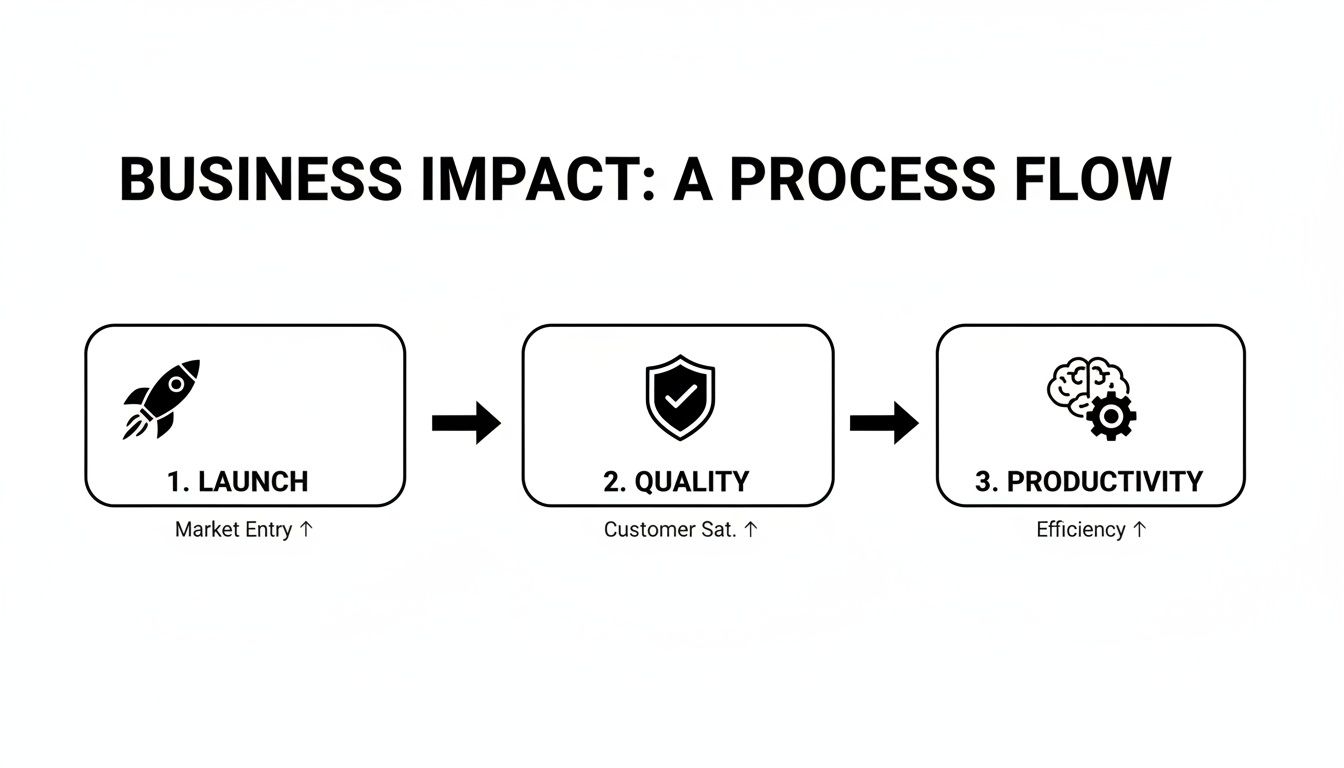
The takeaway here is simple: you can't have true productivity without pairing speed with obsessive quality. If you want to really strengthen this stage, our guide on quality assurance best practices is a great place to start.
The Deploy Stage: Releasing Value to Users
After an artifact has passed every test, it’s finally ready for prime time. This is the moment the new code gets released to your users. But just throwing it over the wall and hoping for the best is a recipe for disaster. Modern deployment strategies are all about minimizing risk and avoiding downtime.
A mature CI/CD pipeline doesn’t just deploy code; it deploys with confidence. These advanced strategies are the safety nets that make frequent releases a routine, stress-free event instead of a late-night emergency.
Here are a couple of the most popular and effective approaches:
- Blue-Green Deployment: Imagine you have two identical production environments, "Blue" and "Green." If your users are on Blue, you deploy the new code to the idle Green environment. After you’ve confirmed everything is working perfectly on Green, you just flip a switch to send all user traffic there. If something goes wrong, you can flip the switch right back to Blue. It makes rollbacks almost instantaneous.
- Canary Release: This strategy is about testing the waters. The new version is released to a tiny fraction of your users first (the "canaries in the coal mine"). You monitor them closely to see how the new code performs. If all signs are good, you gradually roll it out to everyone else, dramatically limiting the blast radius of any potential bugs.
By following this blueprint, you can build a pipeline that truly delivers on the promise of continuous delivery and DevOps, creating a fast, reliable, and automated path from an idea to a happy customer.
Building a Culture That Powers Your Pipeline
You can have the most advanced, perfectly automated CI/CD pipeline imaginable, but it won’t mean a thing if your company culture can’t support it. The best tools in the world are useless when teams work in silos, play the blame game when things break, and don’t feel like they’re all in it together. At its heart, continuous delivery and DevOps is about people, not just scripts.
This is where the real work begins, and frankly, it’s the hardest part. Technology is logical and predictable; people are not. Moving away from a traditional, walled-off structure toward a collaborative, high-trust environment takes real, conscious effort from leadership. It’s about fundamentally changing how your teams think, talk to each other, and solve problems.
Fostering a Culture of Shared Ownership
Think about what happens in a typical company when a bug hits production. The finger-pointing starts immediately. Developers blame ops for a wonky environment, and ops blames the developers for shipping buggy code. This constant friction doesn't just slow down fixes—it destroys morale.
A true DevOps culture throws that old model out the window and replaces it with shared ownership. This simple but powerful idea means that developers and operations are on the hook together for the entire life of the software, from the very first line of code to how it performs for a paying customer.
Shared ownership means you celebrate wins as a team and, more importantly, you tackle failures as a team. The question stops being "Whose fault is this?" and becomes "How do we fix this and make sure it never happens again?"
Getting there involves a few key moves:
- Integrate Your Teams: Break down the walls by putting operations engineers directly into development squads. Or, create a central platform team whose entire job is to serve developers. This builds natural communication bridges and empathy.
- Set Common Goals: Stop measuring teams on siloed metrics like "lines of code" or "server uptime." Instead, rally everyone around business outcomes, like application performance or customer satisfaction.
- Share Your Tools: Use common dashboards and communication channels (like Slack) so everyone is looking at the same data. From build statuses to production alerts, transparency is key.
Turning Failures into Learning Opportunities
When you're moving fast, things are going to break. It's inevitable. The real difference between a high-performing organization and a mediocre one is how they react to failure. A culture of fear—where mistakes are punished—just encourages people to hide problems until they become massive disasters.
This is where the blameless post-mortem comes in. When an incident happens, the team gets together not to find someone to blame, but to figure out what happened at a systemic level. The focus is on the "what" and "how," never the "who."
This creates a sense of psychological safety, which allows people to be honest so the real root causes can be found. The result isn't a list of who messed up; it's a list of concrete improvements to the system, process, or tools that makes the whole organization stronger.
Breaking Down Silos and Defining Key Roles
Your company's org chart can either be a superhighway for collaboration or a roadblock. Stiff, functional silos are the enemy of flow. You have to actively encourage cross-functional collaboration, getting people from different teams to work together toward the same goal. You can find out more about what it takes to build cross-functional collaboration and how it can help.
As you get better at this, you'll probably see a couple of new roles pop up to support this new way of working:
- Platform Engineer: This person's job is to build and run the internal platforms that developers rely on, like the CI/CD pipeline, testing environments, and observability tools. They treat the platform like a product and the developers like their customers.
- Site Reliability Engineer (SRE): An SRE is basically a software engineer who focuses on operations problems. They live and breathe reliability, using metrics like Service Level Objectives (SLOs) to define success and automating away as much manual work (or "toil") as possible.
Ultimately, a successful continuous delivery and DevOps program is a cultural revolution that happens to be supported by technology. It demands that leaders push for transparency, create a safe environment for failure, and reshape teams to make working together the easiest and most natural thing to do.
Choosing the Right Tools for Your DevOps Toolkit
Once you've got the culture and a pipeline blueprint in place, the last piece of the puzzle is the technology that actually makes it all happen. The market for DevOps tools is massive, and it’s easy to get overwhelmed. The real goal isn't to chase every shiny new tool but to build an integrated toolchain that fits your team's workflow like a glove.
Think of it like building a custom workshop. You wouldn’t just go out and buy a bunch of random tools. You’d carefully select a drill, a saw, and a sander that work well together to help you build things efficiently. A DevOps toolchain is exactly the same; each tool needs a clear purpose and must hand off work to the next one without a hitch.
Core Components of a Modern Toolchain
A truly effective toolchain has to cover the entire software development lifecycle. Let's break down the must-have categories and some of the most popular tools you’ll find in each.
- Source Code Management (SCM): This is your single source of truth—the definitive home for all your code. Tools like GitHub, GitLab, and Bitbucket are the industry standard here, offering much more than just version control, with built-in features for peer reviews and team collaboration.
- CI/CD Servers: This is the engine of your automation. A CI server keeps an eye on your SCM for new code changes and then kicks off the entire build, test, and deployment process. Jenkins has been the open-source workhorse for years, but GitLab CI and GitHub Actions are fantastic choices if your code already lives on those platforms.
- Containerization & Orchestration: You need your software to run the same way everywhere, from a developer's laptop to production. That’s where containers come in. Docker is the undisputed king for packaging applications. To manage all those containers, an orchestrator like Kubernetes is pretty much essential for handling deployments, scaling, and operations automatically.
The right toolchain isn't about having the most tools—it's about having the right ones, deeply integrated to create a frictionless path from code to customer. The less manual intervention required, the better.
Observability and Security Tooling
Once your application is live, you have to know how it’s performing. This is where observability tools come in, giving you the deep insights needed to spot and fix problems before your customers even notice.
- Monitoring & Logging: Tools like Prometheus for collecting metrics, Grafana for creating dashboards, and the ELK Stack for managing logs are a powerful combination for keeping tabs on system health. If you prefer an all-in-one approach, SaaS platforms like Datadog and New Relic have you covered.
Security can't be an afterthought, either. It’s critical to bake security checks right into your pipeline—a practice often called DevSecOps. To do this effectively, modern approaches like integrating Penetration Testing as a Service (PTaaS) can help automate the hunt for vulnerabilities. This idea of automation is a running theme, and getting a handle on what cloud automation is provides great context for building a pipeline that’s both fast and secure.
The Future: AI in Your Toolkit
The market for tools supporting continuous delivery and DevOps is growing fast, with a projected growth rate of around 20% CAGR. While a veteran like Jenkins still holds a huge piece of the pie with roughly 46% of CI/CD tool usage, a big shift is coming. By 2025, it’s projected that about 60% of companies will be using AI-assisted workflows to fine-tune their pipelines and cut down on failures. You can find more insights about these DevOps trends on baytechconsulting.com.
AI isn't science fiction anymore; it’s becoming a genuinely useful part of the DevOps toolkit. New tools are showing up that use machine learning to do some pretty amazing things:
- Predict Test Failures: They can analyze past test runs to flag new code changes that look likely to cause a break, saving developers a ton of time.
- Automate Root Cause Analysis: When something goes wrong, these tools can sift through mountains of logs and metrics to pinpoint the likely cause in seconds, not hours.
- Optimize Deployments: Some can even analyze user traffic patterns to figure out the best, least disruptive time to push out a release.
Building your toolchain is a journey, not a destination. Start with a solid foundation that covers the core stages, then strategically layer in tools for observability, security, and AI-driven optimizations as your team and its needs grow.
Frequently Asked Questions About Continuous Delivery and DevOps
Even with a solid plan, you're bound to have questions when you start putting these ideas into action. Let's tackle a few of the most common ones that pop up on the journey to continuous delivery and DevOps.
What’s the Real Difference Between Continuous Delivery and Continuous Deployment?
This is a classic, and it's simpler than it sounds. Think of it like this:
Continuous Delivery is like having a package perfectly wrapped, labeled, and sitting by the front door, ready to go. Every change that goes into your codebase is automatically tested and proven to be shippable. However, a real person makes the final call on when to open the door and send it out. This gives you manual control over the release timing.
Continuous Deployment takes it one step further. The moment that package is ready, it's automatically kicked out the door and sent on its way. Every single change that passes all the automated tests gets deployed to production immediately, with zero human intervention.
Most teams start with and aim for Continuous Delivery. Continuous Deployment is the next level, reserved for teams with unshakable confidence in their automated testing and deployment pipeline.
How Can a Small Team Even Get Started with DevOps?
You don't need a massive budget or a dedicated department. The key is to start small and focus on your biggest headache. For most teams, that’s usually a manual build or a painful testing process.
A fantastic first step is to set up a basic CI server using a tool like GitHub Actions or GitLab CI. Just get it to automatically build your code and run unit tests every time someone pushes a change.
That first small win builds momentum. Once you see the value, you can shift your attention to the cultural side. Get developers and operations folks talking, create shared goals, and open up communication channels. The right processes will naturally grow from that collaborative soil.
The goal isn't to boil the ocean. Pick one practical, high-impact automation project. This proves the value immediately and helps you get the buy-in you need to expand on DevOps and continuous delivery principles.
Is DevOps Just for Startups and Big Tech Companies?
Not at all. While companies like Google and Netflix made these practices famous, the core ideas—automation, collaboration, and fast feedback—are valuable for any organization building software.
We see traditional enterprises in finance, healthcare, and even manufacturing adopting these methods more and more. The reason is simple: their goals are universal. They need to modernize old systems, make them more stable and secure, and react faster to what the market wants.
Ultimately, the desire to lower risk while shipping value faster is a universal business need, no matter your company's size or industry.
Getting your continuous delivery and DevOps adoption right comes down to a smart automation strategy. At MakeAutomation, we provide the proven frameworks and hands-on support to help you build efficient, scalable pipelines that deliver real business results. Learn how we can optimize your workflows today.