What is Demand Generation Marketing: what is demand generation marketing
So, what is demand generation marketing all about? At its heart, it’s about creating genuine excitement and awareness for what you offer long before a potential customer is even thinking about buying. It's the art of becoming a go-to resource, not just another name on a vendor list.
The Foundation Of Sustainable Growth

Imagine you're hosting a popular tech meetup. You’re not standing at the door trying to sell tickets. Instead, you're busy building a vibrant community around a shared interest, offering real value, and sparking conversations.
When someone in that community eventually hits a wall with a problem your product can fix, who do they think of first? You. Not because you pitched them, but because you helped them. This is the essence of demand generation.
This holistic strategy is the engine for sustainable growth, especially in the B2B and SaaS worlds where trust and proven expertise are everything. It’s a world away from aggressive, short-term sales tactics that only care about the immediate conversion.
Demand generation isn't about finding customers; it's about making customers find you. It shifts the focus from chasing leads to attracting an audience that is genuinely interested in your perspective and solutions.
To get a quick sense of how these pieces fit together, here's a simple breakdown.
Demand Generation At A Glance
| Core Principle | Primary Goal | Key Focus Area |
|---|---|---|
| Educate & Inform | To create awareness and build brand authority. | Top-of-funnel content and thought leadership. |
| Build Relationships | To nurture interest and establish trust over time. | Mid-funnel engagement and community building. |
| Attract, Don't Chase | To generate a pipeline of well-informed prospects. | Full-funnel content aligned with the buyer's journey. |
This table shows how the strategy is designed to attract and warm up an audience, turning strangers into fans and, eventually, customers.
A Strategic And Full-Funnel Approach
Unlike tactics that laser-focus on people ready to buy right now, demand generation spans the entire customer journey. The goal is to educate, engage, and build a solid relationship with prospects at every single stage.
This long-game approach is more critical than ever. Marketing leaders are getting more confident in this model, expanding their budgets for content and account-based marketing (ABM) and working harder to connect their efforts directly to revenue.
The core pillars of demand generation are simple but incredibly powerful:
- Creating Awareness: Helping your ideal customers realize they have a problem and that solutions (like yours) exist.
- Building Interest: Pulling your audience in with valuable, educational content that proves you know your stuff.
- Nurturing Relationships: Using smart, targeted communication to build trust and stay top-of-mind.
More Than Just Marketing
Ultimately, demand generation is a company-wide mindset. It weaves content, email, social media, and paid ads into one seamless experience that guides potential customers from "who are you?" to "where do I sign up?".
It’s all about being helpful, insightful, and consistently present. When the time comes for a purchase, the choice feels obvious. For a deeper dive into the fundamental principles, explore this comprehensive guide on Demand Generation Marketing.
By focusing on the long-term relationship, you build a predictable pipeline of informed, high-quality prospects who see you as a partner, not just another provider.
Demand Generation vs. Lead Generation Explained
It’s easy to see why so many marketers use “demand generation” and “lead generation” interchangeably. On the surface, they sound similar. But in practice, they’re two completely different sides of the marketing coin.
Confusing them is like mixing up farming and fishing. Both get food on the table, sure, but their methods, tools, and timelines couldn’t be more different. Getting this distinction right is the first step toward building a marketing engine that truly works.
Think of demand generation as farming. It’s the long game. You’re preparing the soil (educating your market), planting seeds (creating genuinely helpful content), and nurturing them over time with consistent engagement. The goal isn’t to grab something today; it’s to cultivate a healthy, sustainable harvest for the future.
Lead generation, on the other hand, is fishing. It's a direct, tactical activity. You cast a net—like a contact form or a call-to-action—to catch prospects who are already actively looking for a solution. It’s all about capturing existing intent at the right moment.
The Core Philosophical Difference
Demand generation is the big-picture strategy. It’s about creating the fertile ground where high-quality leads can eventually grow. You’re focused on building brand authority, establishing trust, and generating genuine interest in your company's unique point of view. You give away your best ideas for free, positioning yourself as an indispensable resource long before anyone thinks about buying.
Lead generation is a crucial, but more focused, piece of that puzzle. It’s the specific act of converting an anonymous visitor into a known contact. This is the moment someone "raises their hand" by trading their email address for something valuable, like an ebook, a webinar seat, or a free trial.
To see how these concepts fit within a broader campaign, our guide on effective SaaS lead generation strategies provides practical examples of capturing interest once it's been created.
Tactics, Goals, and Metrics
Because their goals are different, the tactics and metrics you use to measure success are also completely different.
A demand generation marketer asks, "How can I make my target audience smarter and more successful?"
A lead generation marketer asks, "How can I get this person's contact information?"
To make this crystal clear, let’s look at a side-by-side comparison.
Comparing Demand Generation and Lead Generation
This table breaks down the fundamental differences between the two approaches, showing how their goals directly influence the tactics and KPIs that matter most.
| Aspect | Demand Generation | Lead Generation |
|---|---|---|
| Primary Goal | Create awareness, educate the market, and build long-term brand trust. | Capture contact information from prospects who show immediate interest. |
| Typical Tactics | Ungated blog posts, podcasts, social media content, thought leadership articles, community building. | Gated ebooks, webinars with registration, free trial sign-ups, demo request forms. |
| Key Metrics | Website traffic, brand search volume, social engagement, content downloads (without a gate). | Form conversion rates, Cost Per Lead (CPL), Marketing Qualified Leads (MQLs), lead quality. |
As you can see, one is all about building an audience, while the other is focused on converting that audience into tangible contacts.
Working Together for a Predictable Pipeline
A huge mistake many companies make is focusing only on fishing without ever tending the farm. If all you do is cast nets, you’ll eventually deplete the pond.
A truly successful strategy uses demand generation to constantly stock that pond with educated, high-intent prospects. This makes the act of lead generation far more effective and efficient. When people are ready to buy, they already know who you are and trust what you have to say.
This synergy is what creates a predictable revenue pipeline. Demand generation warms up the entire market, and lead generation provides the mechanism to capture that interest and formally hand it off to your sales process. This handoff can even be optimized; for instance, a well-implemented chatbot for lead generation can qualify and route prospects automatically, bridging the gap between the two functions.
Ultimately, you can't have a great harvest without first cultivating the field.
Building a Modern Demand Generation Strategy
A great demand generation program isn't about throwing one or two tactics at the wall to see what sticks. It’s a complete ecosystem where different pillars work together, creating and capturing interest across the entire buyer's journey. Think of it less like a single campaign and more like building a city—you don't just put up houses. You need roads, utilities, and public spaces that all connect and support one another.
In the same way, a modern strategy weaves together various channels and approaches. Each piece has a specific job, guiding a potential customer from that first spark of curiosity all the way to a confident buying decision. The goal is a seamless journey that builds real trust and cements your brand as an indispensable resource.
This diagram shows you exactly where demand generation sits in the marketing hierarchy. It’s the broad, foundational work that makes targeted lead generation possible.
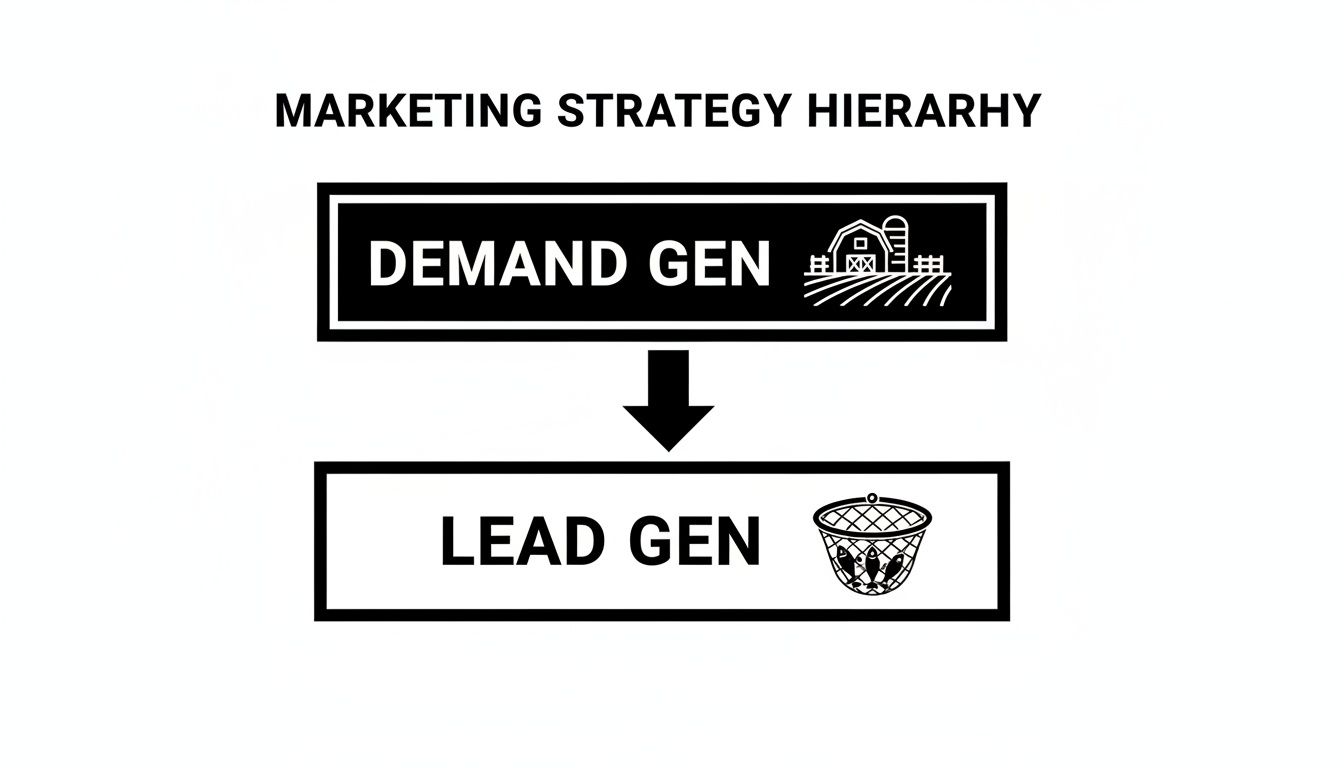
As you can see, demand generation is all about "cultivating the market." When you do that effectively, the specific act of "capturing leads" becomes much, much easier.
The Core Pillars of Your Strategy
To build real momentum, your strategy needs to stand on several key components. Each one plays a role at a different stage of the buyer's journey, from creating initial awareness to accelerating deals through the pipeline.
- Content Marketing: This is the educational engine. Think high-value assets like blog posts, ebooks, and detailed guides that answer your audience's burning questions and solve their problems, no strings attached.
- Search Engine Optimization (SEO): SEO is how you get found. When someone is actively looking for the solutions you offer, good SEO ensures your content shows up. It's all about capturing existing intent.
- Paid Media: This is your amplifier. Paid channels like LinkedIn or Google Ads put your best content right in front of your ideal audience, speeding up awareness and letting you retarget people who've already shown interest.
- Email Nurturing: Once someone is on your list, email is how you build a one-to-one relationship at scale. Automated sequences deliver the right message at the right time, guiding prospects with genuinely helpful resources.
- Account-Based Marketing (ABM): For your most valuable targets, ABM flips the traditional funnel. Instead of casting a wide net, you focus all your energy on a curated list of best-fit accounts.
These pillars don’t operate in silos. A prospect might first see your brand in a paid social ad, click through to a blog post they found via Google, and then subscribe to your newsletter for more in-depth content. It's a connected experience.
Content Marketing as the Foundation
At the heart of any durable demand generation program is content. And I don't mean just churning out articles. This is about strategically establishing your company as the go-to authority in your niche.
For example, imagine a B2B SaaS company selling to operations managers. Instead of running ads that just shout, "Buy Our Software Now!", they could host a webinar series on "The Future of Supply Chain Efficiency." This educational approach does more than just collect a few emails—it builds a powerful reputation.
The goal of demand generation content isn't to sell a product directly. It's to sell your company's unique point of view. By consistently delivering value and expertise, you make your brand the only logical choice when a buying need finally emerges.
This strategy positions them as a trusted advisor. When attendees from that webinar eventually face a problem their software can solve, that company is already the one they know, trust, and respect.
Amplifying Reach with Paid and Social Channels
While organic efforts like SEO and content build incredible long-term value, paid channels deliver something they can't: immediate reach and laser-focused targeting. Social media, in particular, has become a massive engine for discovery.
The numbers don't lie. Global social discovery stats show that 53% of shoppers now find products on social platforms, a big jump from 46% just a year earlier. And there's a reason 62% of marketing teams boosted their PPC budgets last year—channels like Facebook and Google often generate twice the visitors of organic search alone. You can dig into more of these trends by exploring marketing statistics on Salesforce.com.
What this data really tells us is that you need a balanced approach. Your organic content is the foundation that builds authority and trust. Paid media is the megaphone that gets your best ideas in front of the right people, right now. It's the combination of the two that creates a powerful, multi-channel presence and fuels your entire demand generation engine.
How to Measure Demand Generation Success
So, how do you actually know if your demand generation strategy is working? It’s a question that keeps a lot of marketers up at night. The truth is, it requires a different way of looking at your numbers. You have to stop counting leads as the ultimate prize and start looking at the entire journey, from the first time someone hears your name to the moment they sign a contract.
This is about swapping vanity metrics for real business outcomes. It’s about connecting every marketing dollar to a tangible impact on the sales pipeline. When you adopt this full-funnel view, you can finally demonstrate a clear, undeniable ROI. Instead of just celebrating a spike in ebook downloads, you start tracking the metrics that prove you're attracting the right people, building real trust, and ultimately making the sales team’s job easier. It’s a shift from measuring clicks to measuring influence.
Moving Beyond Top-of-Funnel Metrics
Look, top-of-funnel metrics are important. They’re the first chapter of your story. They tell you if you’re getting your name out there and grabbing attention. But they don't tell you if that attention is actually turning into revenue. Think of them as leading indicators—the early signs that something bigger is on the horizon.
Here are a few early signals to watch for:
- Branded Search Volume: Are more people searching for your company by name? That’s a fantastic sign that your brand is gaining traction and authority in the market.
- Direct Website Traffic: An uptick in visitors typing your URL straight into their browser means your brand recall is strong. People are seeking you out on purpose.
- Social Engagement Rate: Don't just count likes. Are people sharing, commenting on, and saving your posts? That’s a sign your content is truly hitting the mark and resonating with your audience.
These numbers prove you’re building an audience. But the real test is what happens next.
Tracking Mid-Funnel Conversion and Quality
This is where the rubber meets the road. Mid-funnel metrics connect the dots between the audience you've built and the sales pipeline you need to fill. Here, we’re focused on the quality of the handoff to sales. The goal isn’t just to generate noise; it's to tee up genuine opportunities for the sales team.
A classic mistake is to optimize for the sheer volume of Marketing Qualified Leads (MQLs). A successful demand gen program, however, obsesses over the MQL-to-SQL (Sales Qualified Lead) conversion rate. This one metric tells you if marketing is sending over leads that sales actually wants to talk to.
If that conversion rate is low, it’s a massive red flag. It usually points to a disconnect between the people marketing is attracting and the people sales can actually close. That’s your cue to go back and refine your ideal customer profile (ICP) or rethink your content strategy.
Focusing on Bottom-Funnel Revenue Metrics
At the end of the day, every marketing activity has to tie back to revenue. Bottom-funnel metrics are the ultimate proof of your value, showing how your efforts directly contribute to the company's bottom line. This is where you answer the one question your CEO really cares about: "Did marketing help us make money?"
The most critical revenue-focused KPIs are:
- Marketing-Sourced Revenue: This is it—the total dollar amount of closed-won deals that started with a marketing touchpoint. It’s the clearest measure of your contribution.
- Pipeline Velocity: How fast are deals moving through the pipeline, from first contact to close? A faster sales cycle is often the result of marketing delivering better-educated, higher-intent leads who are ready to buy.
- Customer Acquisition Cost (CAC): Calculating your CAC tells you how efficiently you're spending your budget. A great demand gen engine works to lower this cost over time by creating a predictable flow of organic and inbound prospects.
Keeping a close eye on these numbers is no longer optional. A recent survey revealed that 34.5% of B2B enterprise marketers are under intense pressure to prove real-time ROI. If you want to see how the industry is shifting, you can read more about the 2025 demand generation benchmarks. By focusing on these revenue-centric metrics, you change the conversation from, "How many leads did we get?" to, "How much revenue did we influence?"
Supercharging Your Strategy with AI and Automation
In today's marketing world, manual effort will only get you so far. If you're serious about scaling a demand generation engine, technology isn't just a nice-to-have; it's a must-have. This is where AI and automation come in, transforming a collection of good ideas into a powerful, self-sustaining growth machine.
Think about it: what if you could know which companies are most likely to buy your product before they even land on your website? That's not science fiction; that's the power of AI. It goes way beyond guesswork, using predictive analytics to pinpoint your next best customers by sifting through thousands of data points and buying signals—far more than any human could track.
This shift is fundamentally reshaping how demand generation works. As we head toward 2025, AI-powered tools are completely changing the game with predictive insights, deep personalization, and laser-focused targeting. With 63% of marketers already using generative AI, the technology is now central to spotting subtle customer patterns and forecasting market trends. This helps build the kind of sustained interest that short-term lead generation tactics just can't match. You can find more Salesforce marketing statistics that really drive this point home.
How AI Pinpoints Your Ideal Customers
AI-driven tools plug into massive data sources to create a living, breathing picture of your ideal customer profile (ICP). They analyze everything from firmographics (company size, industry) and technographics (what software a company uses) to real-time intent signals (like which topics a company's employees are actively researching online).
This allows you to:
- Spot In-Market Accounts: Uncover the companies that are already looking for solutions like yours right now.
- Prioritize Your Efforts: Focus your marketing and sales teams on the accounts with the highest probability of closing.
- Personalize Your Message: Walk into a conversation already knowing a prospect’s specific challenges and needs.
This data-first approach ensures your demand generation efforts are perfectly aimed at an audience that’s already warming up to the idea of a purchase.
Using Automation to Nurture Relationships at Scale
Once AI helps you identify the right audience, automation steps in to deliver a personalized journey that still feels human. It acts as the operational backbone of your strategy, making sure no valuable opportunity falls through the cracks. It turns messy, manual workflows into an efficient and repeatable engine for growth.
This is exactly where a platform like MakeAutomation becomes indispensable. It lets you build out sophisticated workflows that run flawlessly in the background. For a deeper dive, check out our complete guide to AI-powered lead generation.
Let’s look at a real-world example of this in action. The image below shows an automated workflow designed to identify and engage high-value visitors on your website.
This workflow maps out a multi-step process that kicks off the moment someone from a target account lands on your site.
Here’s how it unfolds:
- Identify Anonymous Visitor: An automation tool uses the visitor's IP address to identify their company, even if they never fill out a form.
- Enrich the Data: The system instantly enriches this data, finding key contacts within that company who fit your ideal buyer persona.
- Trigger a Personalized Campaign: This action launches a custom email nurture sequence, delivering relevant content based on the specific pages the person viewed.
This entire sequence happens automatically, turning a once-anonymous website visitor into a warm, engaged prospect. It's a perfect illustration of how automation doesn't just save you time—it actively creates opportunities you would have otherwise missed entirely.
Key Takeaway: AI figures out the "who" and "when," while automation handles the "how." Together, they create a scalable system that identifies high-intent prospects and nurtures them with personalized content, all without constant manual effort.
By bringing these technologies into your strategy, you shift from a reactive marketing model to a proactive one. You stop waiting for leads to find you and start actively creating demand within your most valuable accounts, building a revenue engine that is both predictable and powerful.
A Sample Demand Generation Campaign in Action
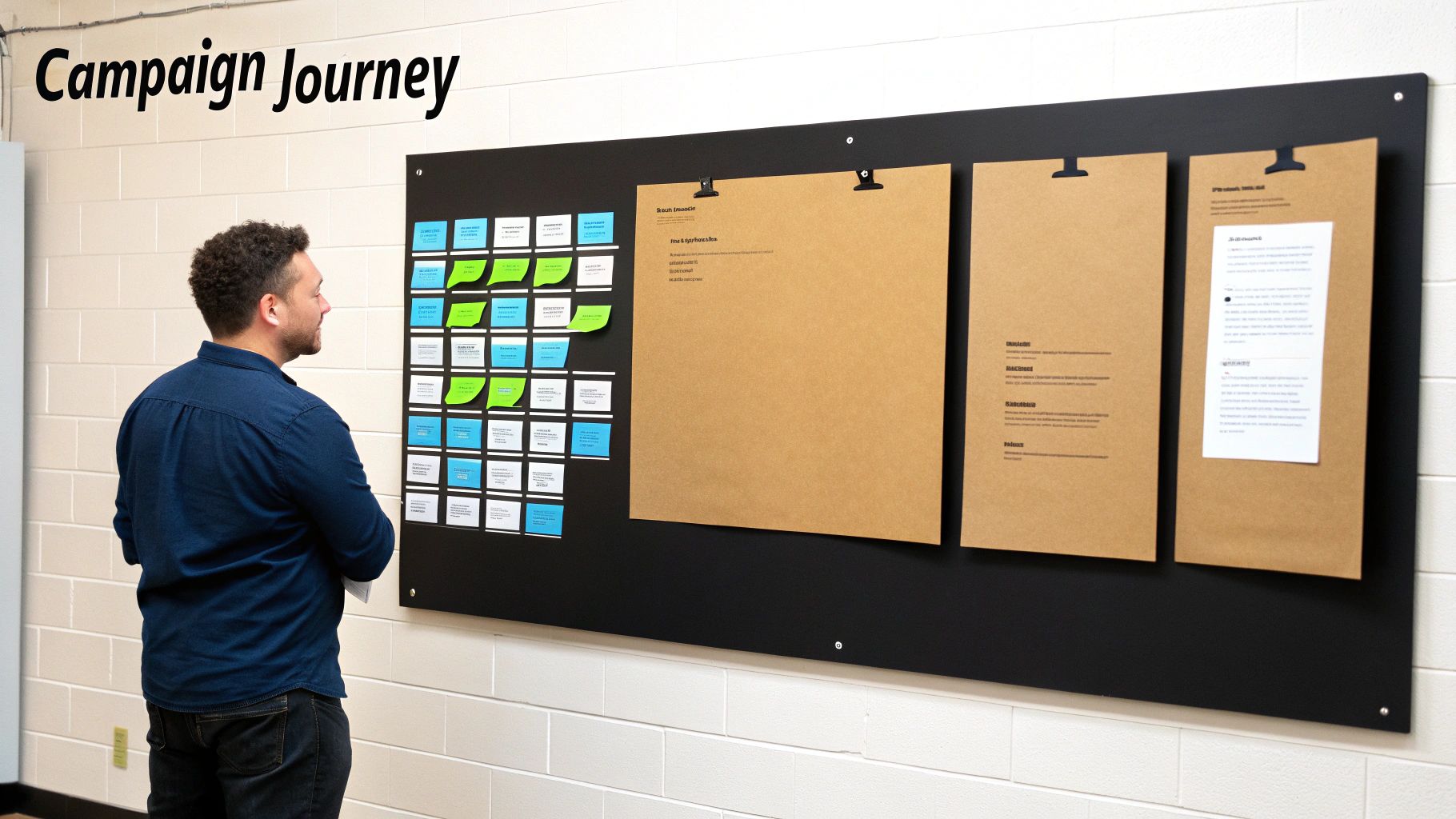
Theory is great, but let's see how these ideas actually come together in the real world. To make this tangible, let's follow a fictional B2B SaaS company, "LogiFlow," as they build a demand generation strategy for their supply chain optimization software.
The mission here isn't just to snag a few leads. LogiFlow wants to be seen as the ultimate authority on supply chain efficiency for a very specific audience, long before those people even think about buying new software.
Identifying the Niche and the Pain Point
First things first, LogiFlow gets specific. Instead of casting a wide net over the entire logistics industry, they focus laser-sharp on VPs of Operations at mid-sized manufacturing firms. Why them? Because this group feels the heat from rising shipping costs and inventory nightmares every single day. Their biggest headache is the lack of real visibility and control over their sprawling supply chains.
The campaign's centerpiece will be a seriously valuable, completely ungated resource built to solve this exact problem. LogiFlow produces an in-depth ebook: "The Ultimate Guide to Supply Chain Efficiency: How to Cut Costs and Improve Visibility in a Volatile Market."
This isn't a thinly veiled sales pitch. It’s a goldmine of actionable tips, industry benchmarks, and practical frameworks a VP of Operations can actually put to work. This move instantly positions LogiFlow as a helpful, credible expert.
Creating an Integrated Multi-Channel Plan
With their killer ebook in hand, LogiFlow maps out a multi-channel plan to spread the word and get people engaged. They aren't just spamming links everywhere; they're crafting a connected experience for their ideal customer.
- LinkedIn Ads: They launch highly targeted ad campaigns that share key takeaways from the ebook. These ads are shown exclusively to users with the job title "VP of Operations" in the manufacturing sector.
- SEO-Optimized Content: They publish a series of blog posts on specific topics their audience cares about, like "reducing demurrage fees" and "supply chain forecasting models." Each post naturally points to the ebook as the next step for a deeper dive.
- Partner Webinars: LogiFlow joins forces with a respected logistics consulting firm to co-host a webinar based on the ebook's core ideas. This gives them instant access and credibility with the partner's built-in audience.
By weaving these channels together, LogiFlow makes sure its target audience keeps stumbling upon its helpful content in different places, building familiarity and trust with every touchpoint.
Guiding the Prospect Through a Nurture Journey
When someone finally downloads the ebook, the real work begins. This is where demand generation moves beyond simple awareness and starts building a genuine relationship.
The moment a prospect converts is just the starting line. A great demand generation campaign uses that initial flicker of interest to start a longer conversation, delivering more value at every step and guiding them toward a solution, not just a quick sale.
So, a visitor hits the landing page and trades their email for the guide. That single action triggers a smart, automated email sequence designed to nurture their interest.
- Immediate Follow-Up: An email lands in their inbox instantly, delivering the ebook along with a friendly thank-you note that points out a must-read chapter.
- Value-Added Content: A few days later, another email arrives with a link to a relevant blog post or a short video case study, offering another bite-sized piece of value.
- Webinar Invitation: The next email invites them to the partner webinar, reinforcing LogiFlow's expertise and offering another chance to learn.
This entire sequence runs on its own. For any business wanting to build these kinds of powerful nurture flows, getting a handle on automated email marketing campaigns is the perfect place to start.
While the emails are going out, LogiFlow also uses retargeting ads to show testimonials and success stories to everyone who downloaded the guide, keeping their brand top-of-mind. After a few weeks of this consistent, no-pressure engagement, a final email makes the first direct offer: a complimentary "supply chain efficiency audit" with one of their experts. By now, the prospect is educated, trusts the brand, and is far more likely to say yes to a conversation.
Got Questions? We've Got Answers
Diving into a new marketing approach always brings up a few questions. Let's tackle some of the most common ones about demand generation so you can move forward with a clear plan.
How Long Until We See Real Results from Demand Generation?
This is the big one, isn't it? The honest answer is: it takes time. Demand generation isn't a quick-win tactic; it’s a long-term play. Think of it like building a reputation in your industry—it doesn't happen overnight.
You'll likely spot early signs of life within the first 3 to 6 months. This might look like more people visiting your site, a growing social media following, or more engagement with your content. But for the kind of results that really move the needle—like a steady stream of qualified leads and a clear impact on revenue—you should give it 6 to 12 months to truly gain momentum.
How Do I Figure Out a Budget for This?
There's no single magic number here. Instead of pulling a figure out of thin air, your budget should be a direct reflection of your business goals. Start by asking: What does success actually look like for us? Is it a certain number of sales opportunities? A specific amount of pipeline revenue?
Once you have that target, you can work backward and figure out how much you need to invest in the core components:
- Creating Valuable Content: This is your fuel. Budget for well-researched articles, in-depth ebooks, and engaging webinars that genuinely help your audience.
- Getting Eyes on Your Content: Great content is useless if no one sees it. Earmark funds for paid social, search ads, and other channels to make sure your message gets out there.
- The Right Tech: You'll need marketing automation and analytics tools to run your campaigns and track what's working.
A smart way to start is by tying your marketing spend to a percentage of your revenue target. As the data starts rolling in, you can double down on the channels and tactics that are giving you the best return on investment (ROI).
Is Demand Generation a Realistic Strategy for a Small Business?
Yes, 100%. You might not have the massive budget of a big corporation, but the principles of demand generation scale down beautifully. The trick is to be laser-focused instead of trying to be everywhere at once.
Small businesses win by zeroing in on high-impact activities. Forget trying to do it all. Instead, pick your battles. Dominate a very specific niche with your blog content. Build a tight-knit community on a single platform like LinkedIn. Or create one killer webinar and then slice and dice it into a month's worth of smaller content pieces. It's all about depth, not breadth.
Ready to stop chasing leads and start creating genuine demand? The experts at MakeAutomation can help you design and implement a powerful AI and automation strategy that turns your marketing into a predictable revenue engine. Build your growth machine with MakeAutomation today!