10 Proven Outbound Lead Generation Strategies for B2B Growth in 2025
In the competitive B2B landscape, relying on a single outreach method is a recipe for stagnation. The most successful companies aren't just sending emails; they're architecting sophisticated, multi-channel outbound lead generation strategies that cut through the noise and build genuine connections. Growth is no longer about simply scaling volume. It's about precision, personalization, and integrating multiple touchpoints to create a cohesive buying experience.
This guide moves beyond generic advice to provide a strategic blueprint for building a robust sales pipeline. We will dissect 10 powerful outbound methods, from modernized cold calling and strategic LinkedIn outreach to advanced tactics like intent data targeting and personalized video prospecting. For a comprehensive overview of the entire discipline, refer to this detailed guide on Mastering Outbound Lead Generation from Scalelist.
Each strategy in this listicle is broken down into actionable components. You will find not just the 'what' and 'why,' but the critical 'how,' complete with step-by-step implementation notes and real-world examples. We'll explore where automation and AI can streamline your workflow and detail the key performance indicators (KPIs) you must track for sustainable pipeline growth. This article provides the framework you need to move past random acts of outreach and develop a coordinated system. Prepare to transform your prospecting from a simple numbers game into a strategic, predictable growth engine for your business.
1. Cold Email Outreach
Cold email outreach is a cornerstone of many successful outbound lead generation strategies. It involves sending personalized emails to targeted prospects who have not previously interacted with your company. The goal is to initiate a conversation, provide value, and ultimately convert them into qualified leads, not just make a direct sale in the first email.
When to Use This Strategy
This strategy is highly effective when you have a well-defined Ideal Customer Profile (ICP) and can identify specific pain points your solution addresses. It's ideal for B2B and SaaS companies with a high-value product or service where personalized, direct communication can open doors to key decision-makers.
How to Implement Cold Email Outreach
- Build a Targeted List: Use tools like LinkedIn Sales Navigator, ZoomInfo, or Apollo.io to build a list of contacts that match your ICP. Focus on quality over quantity; a smaller, highly relevant list will always outperform a large, generic one.
- Segment and Personalize: Don't send the same email to everyone. Segment your list by industry, role, or company size. Personalize each email by referencing a recent company achievement, a shared connection, or a relevant piece of content they published.
- Craft Compelling Copy: Your subject line must be intriguing enough to earn a click. The email body should be concise, focused on the prospect’s problem, and offer a clear call-to-action (CTA), like asking for a brief 15-minute chat.
- Follow-Up Systematically: Most responses come from follow-up emails. Create a multi-touch cadence of 3-5 emails spaced out over a few weeks. Each follow-up should offer new value, not just be a "bumping this up" message.
Automation and AI Opportunities
Leverage tools like MakeAutomation.com to automate the tedious parts of this process. You can create workflows that automatically enrich contact data, personalize email templates with dynamic fields, and schedule follow-up sequences. This ensures you can scale your outreach without sacrificing the crucial element of personalization.
2. Cold Calling & Phone Outreach
While often seen as traditional, cold calling remains a powerful and direct outbound lead generation strategy. This high-touch approach involves sales representatives contacting potential customers by phone without prior interaction. Its core strength lies in facilitating real-time conversation, enabling immediate objection handling, and building rapport through direct voice communication.
When to Use This Strategy
Cold calling is particularly effective for B2B companies with complex or high-ticket offerings where a nuanced conversation is necessary to convey value. It excels when targeting senior-level decision-makers who may be less responsive to email. If your ICP is well-defined and your value proposition can be articulated concisely, phone outreach can cut through the digital noise and generate qualified meetings quickly.
How to Implement Cold Calling & Phone Outreach
- Develop a High-Quality Call List: Similar to email, a targeted list is paramount. Use data providers or LinkedIn Sales Navigator to gather direct-dial numbers for contacts fitting your ICP. Prioritize accuracy to maximize connect rates.
- Script a Compelling Opener: You have less than 30 seconds to capture interest. Start by stating your name and company, then immediately pivot to a relevant, research-based reason for your call. An effective opener could be, "I noticed your company recently expanded its logistics division, and I specialize in helping similar firms cut shipping costs by 15%."
- Focus on Discovery, Not Pitching: The goal of a first call is to qualify the prospect and set a meeting, not to close a deal. Use open-ended questions to uncover pain points and determine if there's a potential fit.
- Prepare for Objections: Anticipate common objections like "I'm not interested" or "We already have a solution." Have thoughtful, non-confrontational responses ready to keep the conversation going.
- Leave a Voicemail and Follow Up: If you don't connect, leave a brief, intriguing voicemail and follow up with an email referencing your call. For more efficient conversion of prospects into qualified meetings, consider incorporating dedicated appointment setters into your strategy.
Automation and AI Opportunities
While the call itself is manual, the surrounding process can be optimized. Tools like MakeAutomation.com can automate list building by enriching contact data with phone numbers, schedule call tasks in your CRM based on lead activity, and trigger follow-up email sequences after a call is logged. AI-powered call analytics tools can also transcribe and analyze calls to identify successful talk tracks and areas for coaching.
3. LinkedIn Outreach & Social Selling
LinkedIn outreach, often called social selling, is a powerful outbound lead generation strategy that leverages the world's largest professional network. It involves using LinkedIn's messaging, connection requests, and content engagement to build genuine relationships with prospects. This approach transforms cold outreach into a warmer, more contextual conversation by positioning you as a helpful expert rather than just another salesperson.
When to Use This Strategy
This strategy is exceptionally effective for B2B companies targeting specific roles, industries, or company sizes. It's ideal when your prospects are active on the platform and you can easily identify decision-makers. Social selling shines when building long-term relationships is key, especially for high-ticket services or complex enterprise software deals where trust is paramount.
How to Implement LinkedIn Outreach & Social Selling
- Optimize Your Profile: Your LinkedIn profile is your landing page. Ensure it's professional, speaks directly to your Ideal Customer Profile's pain points, and clearly communicates your value proposition.
- Identify and Engage Prospects: Use LinkedIn Sales Navigator to build highly-targeted lists. Before connecting, engage with a prospect's content by leaving thoughtful comments or sharing their posts. This warms them up to your name.
- Send Personalized Connection Requests: Avoid the generic connection message. Reference a shared interest, a recent post they made, or a mutual connection to significantly increase your acceptance rate.
- Provide Value, Then Pitch: Once connected, don't immediately pitch. Share a relevant article, offer a valuable insight, or compliment a recent company achievement. Build rapport first, then ask for a brief meeting when the timing is right.
Automation and AI Opportunities
You can use platforms like MakeAutomation.com to build sophisticated workflows that complement your manual efforts. For example, you can create a process that identifies new leads matching your criteria in Sales Navigator, finds their email address, and then initiates a multi-channel sequence across both LinkedIn and email. This is a core component of many advanced outbound lead generation strategies. To explore this further, you can learn more about how to automate lead generation on makeautomation.co.
4. Account-Based Marketing (ABM)
Account-Based Marketing (ABM) is a highly focused outbound lead generation strategy that inverts the traditional sales funnel. Instead of casting a wide net for individual leads, ABM concentrates marketing and sales resources on a select set of high-value target accounts, treating each one as a unique market. The goal is to engage key stakeholders within these accounts through coordinated, personalized campaigns.
When to Use This Strategy
ABM is most powerful for B2B companies with a high average contract value (ACV) where deals involve multiple decision-makers and a long sales cycle. It's the ideal approach when you've identified a list of dream clients that could significantly impact your revenue and you need a strategic way to get their attention and build consensus within their buying committee.
How to Implement Account-Based Marketing
- Identify and Tier Target Accounts: Work with sales to define your Ideal Customer Profile (ICP) and select a small, manageable list of 10-20 high-value accounts to start. Tier them based on revenue potential and strategic fit.
- Map Stakeholders and Research: Identify the key players in the buying committee for each account. Research their individual pain points, priorities, and roles in the decision-making process.
- Create Personalized Content: Develop bespoke content, messaging, and offers tailored to the specific challenges and goals of each target account. This could include custom reports, personalized landing pages, or account-specific webinars.
- Execute Coordinated Campaigns: Launch multi-channel campaigns that align sales and marketing efforts. Use a mix of personalized emails, targeted ads (e.g., on LinkedIn), direct mail, and strategic sales calls to engage the entire buying committee.
Automation and AI Opportunities
ABM platforms like Demandbase or 6sense use AI to identify accounts showing buying intent signals. You can use a tool like MakeAutomation.com to orchestrate the execution of your ABM plays. For example, create a workflow that triggers a personalized email sequence from the assigned sales rep and simultaneously adds key contacts to a targeted ad campaign on LinkedIn the moment an account shows a spike in engagement.
5. Content-Driven Outreach
Content-driven outreach is a strategic approach that leads with value instead of a direct sales pitch. This outbound lead generation strategy involves sharing relevant, high-quality content like research reports, whitepapers, or insightful blog posts with prospects to build trust and establish your company as a thought leader in your industry. The primary goal is to start a conversation by being helpful, not by asking for a meeting.
When to Use This Strategy
This method is particularly powerful for companies in complex or competitive markets where establishing credibility is paramount. It works exceptionally well for B2B and SaaS businesses with a longer sales cycle, as it helps nurture prospects and keep your brand top-of-mind. Use it when your target audience values data, research, and expert insights before making purchasing decisions.
How to Implement Content-Driven Outreach
- Create Pillar Content: Develop a significant piece of content, such as an original research report (like Gong's "State of Sales"), an in-depth guide, or a comprehensive webinar. This asset becomes the cornerstone of your outreach campaign.
- Identify and Segment Your Audience: Build a list of prospects who would find your content genuinely useful. Segment this list based on their specific pain points or interests so you can tailor your outreach message effectively.
- Craft a Value-First Message: Your email or message should focus entirely on the value of the content. Frame it as a resource you thought they would appreciate, based on their role or industry. A simple CTA might be, "Let me know if this is helpful."
- Nurture with Follow-Ups: Your follow-up sequence should continue the value-driven conversation. You could reference a specific statistic from the report or ask for their opinion on a key finding, gently guiding them towards a discussion about their challenges.
Automation and AI Opportunities
Use a tool like MakeAutomation.com to streamline this process by creating workflows that trigger personalized outreach sequences. For instance, you can set up a system that identifies new contacts matching your ICP on LinkedIn, finds their email, and automatically sends a customized email referencing a piece of content relevant to their industry. This allows you to scale a highly personalized, value-first approach, making your outbound lead generation strategies more effective.
6. Direct Mail & Physical Outreach
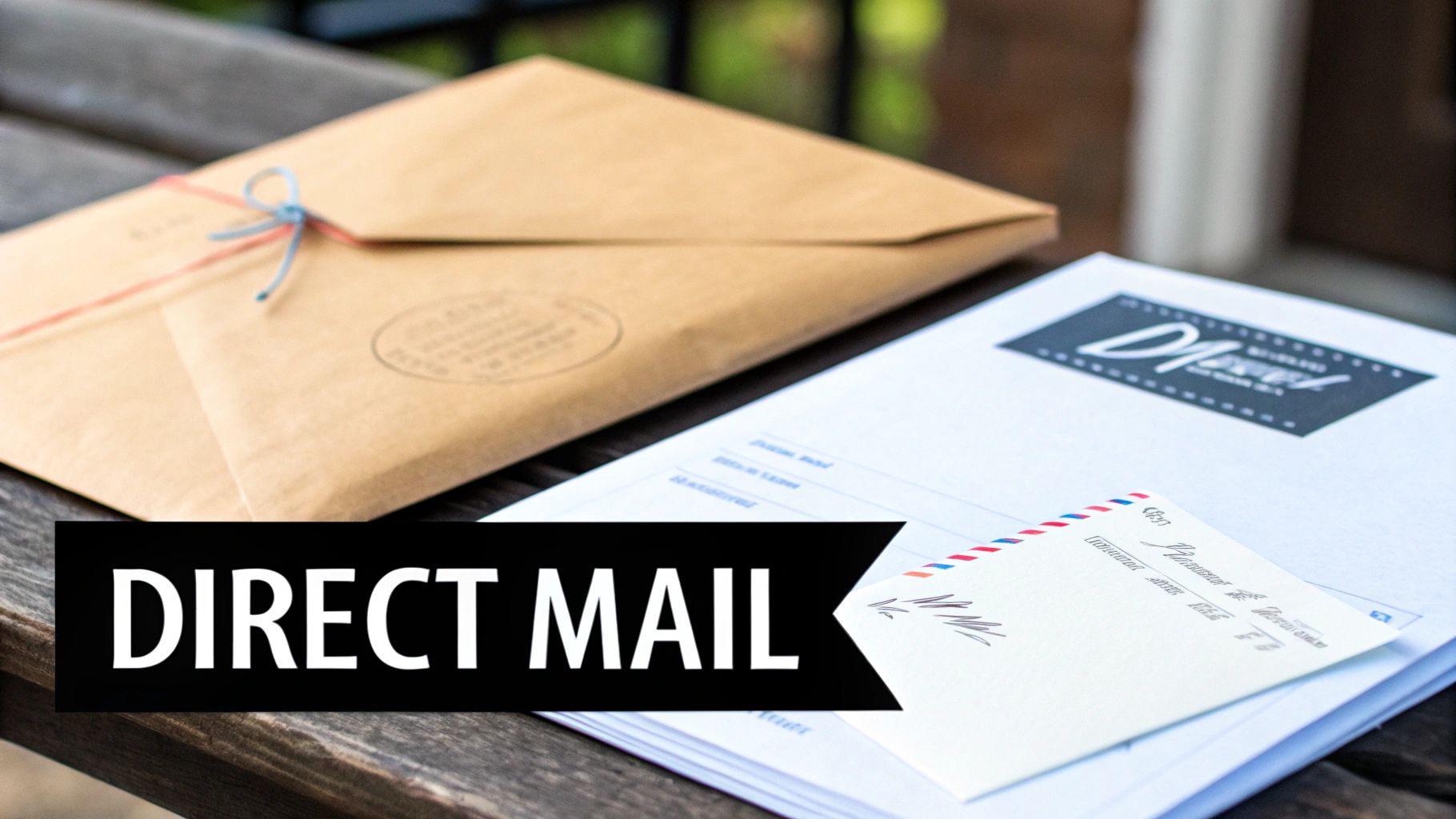
In a world dominated by digital communication, direct mail is a powerful outbound lead generation strategy that cuts through the noise. It involves sending tangible, personalized materials to a prospect's business address, creating a memorable, multi-sensory experience that an email simply cannot replicate. The goal is to make a high-impact impression that leads to a scheduled meeting or a warm introduction.
When to Use This Strategy
This strategy is best reserved for high-value accounts and key decision-makers where the potential lifetime value justifies the higher cost per lead. It is especially effective for reaching C-suite executives whose inboxes are heavily filtered and guarded. Use it to break into enterprise accounts, re-engage unresponsive prospects, or as a "shock and awe" tactic for your most desired clients.
How to Implement Direct Mail & Physical Outreach
- Curate a Hyper-Targeted List: This is not a volume play. Identify a small, highly qualified list of 50-200 top-tier prospects who perfectly match your Ideal Customer Profile. The success of the campaign depends entirely on the quality of this list.
- Design a High-Impact Package: Invest in high-quality materials and professional design. Your package could include a personalized letter, a thoughtful gift relevant to the prospect's industry (like a high-end coffee mug for a marketing director), or a creative item that explains your value proposition. A handwritten note adds a powerful personal touch.
- Integrate with Digital Channels: Don't let the mailer exist in a vacuum. Send a "heads-up" email a day or two before the package is scheduled to arrive. Follow up with a call or email a few days after delivery, referencing the item you sent.
- Include a Clear, Trackable CTA: Make it easy for the prospect to take the next step. Include a unique URL, QR code, or a specific person to contact. This allows you to directly measure the ROI of your campaign.
Automation and AI Opportunities
While the physical aspect is manual, the surrounding process can be automated. Use MakeAutomation.com to build a workflow that triggers a direct mail campaign when a lead reaches a certain score or status in your CRM. You can also automate the digital follow-up sequence, scheduling emails and creating tasks for your sales team to call the prospect at the optimal time after the package has been delivered.
7. Event-Based Prospecting
Event-based prospecting is a powerful outbound lead generation strategy that involves attending, sponsoring, or hosting industry events, trade shows, and webinars. It capitalizes on concentrated gatherings of potential customers to build relationships and generate leads through real-time, high-impact interactions, whether in person or virtually.
When to Use This Strategy
This strategy is most effective when your Ideal Customer Profile (ICP) regularly attends specific industry conferences or trade shows. It's a high-investment, high-return approach ideal for B2B companies with complex sales cycles, like those in enterprise software or specialized manufacturing, where building trust and demonstrating expertise in person can significantly accelerate deals.
How to Implement Event-Based Prospecting
- Pre-Event Planning: Identify the key events your prospects attend. Once you decide to participate, aim to secure the attendee list in advance to schedule meetings before the event floor gets busy. Define clear goals beyond just booth traffic, such as securing 20 qualified demos.
- On-Site Engagement: Design your booth or presence to solve a problem, not just showcase a product. Use QR codes or badge scanners for efficient lead capture. Train your team to ask qualifying questions and focus on having meaningful conversations with the right people.
- Post-Event Follow-Up: This is the most critical step. Contact new leads within 24-48 hours while the conversation is still fresh. Your follow-up should reference your specific discussion to personalize the outreach and propose a clear next step.
- Content and Promotion: Create event-specific landing pages or offers to drive engagement. Promote your presence on social media before, during, and after the event to maximize visibility and attract prospects to your booth.
Automation and AI Opportunities
Use a tool like MakeAutomation.com to supercharge your event follow-up. You can create a workflow that automatically adds scanned leads to your CRM, segments them based on on-site conversations, and triggers a personalized email follow-up sequence. This ensures no lead falls through the cracks and allows your sales team to focus on high-value conversations instead of manual data entry.
8. Referral & Partnership Programs
Referral and partnership programs formalize word-of-mouth marketing, turning your existing customers, partners, and professional network into a powerful engine for outbound lead generation strategies. This approach leverages the trust and credibility inherent in a recommendation to generate high-quality, warm leads who are often more inclined to convert. Instead of a cold introduction, you enter the conversation with a trusted endorsement.
When to Use This Strategy
This strategy is most effective when you have a base of satisfied customers or a strong network of complementary businesses. It is ideal for companies with a proven product that delivers clear value, as happy clients are the most willing advocates. It's particularly powerful in industries built on relationships and trust, such as professional services, finance, and high-value B2B software where a peer recommendation can significantly shorten the sales cycle.
How to Implement Referral & Partnership Programs
- Define Clear Incentives: Structure a program that offers compelling rewards. This could be a cash bonus, service credits, a discount on renewal, or a tiered system that provides greater rewards for more successful referrals. Make the "what's in it for me" crystal clear.
- Make Referring Effortless: The easier it is to refer, the more referrals you will get. Provide advocates with a unique referral link, pre-written email or social media templates, and a simple portal to track their referrals' progress.
- Build a Partner Ecosystem: Identify non-competing companies that serve a similar customer profile. Forge formal partnerships where you co-market, share leads, and offer reciprocal referrals, creating a mutually beneficial lead flow.
- Nurture Your Advocates: Don't just set it and forget it. Keep your referrers engaged by providing them with updates on their referrals' status, celebrating their successes publicly (with permission), and ensuring they receive their rewards promptly.
Automation and AI Opportunities
Use tools like MakeAutomation.com to build a streamlined referral management system. You can create workflows that automatically generate unique referral codes for new customers, trigger follow-up emails to nurture advocates, and instantly notify your sales team when a new referral lead is submitted through a form. This automation ensures a seamless, professional experience for both the referrer and the referred lead, maximizing participation.
9. Intent Data & Predictive Targeting
Intent data and predictive targeting represent one of the most powerful modern outbound lead generation strategies. This approach involves analyzing behavioral signals from prospects to identify which companies are actively researching solutions like yours. Instead of guessing who might be in-market, you use data to prioritize outreach to accounts already showing buying intent.

When to Use This Strategy
This data-driven strategy is perfect for B2B and SaaS companies operating in competitive markets where timing is critical. It is most effective when your Ideal Customer Profile (ICP) is well-defined but broad, making it difficult to know which of the thousands of potential accounts are ready to buy now. Platforms like 6sense, Bombora, and Demandbase pioneered this space.
How to Implement Intent Data & Predictive Targeting
- Select an Intent Data Provider: Choose a platform like Bombora, ZoomInfo, or 6sense that tracks relevant topics and keywords your target audience would be researching. Integrate this platform with your CRM.
- Define Intent Topics: Identify the keywords, competitor names, and industry topics that signal a prospect is in a buying cycle. For example, a prospect researching "CRM for small business" shows high intent.
- Score and Prioritize Accounts: Combine intent signals with firmographic data to create a lead scoring model. Prioritize accounts that both match your ICP and show a high volume of recent, relevant intent signals.
- Personalize Your Outreach: Use the specific intent signals to tailor your messaging. Instead of a generic intro, you can say, "Saw your team has been exploring solutions for X; we specialize in helping companies like yours achieve Y."
Automation and AI Opportunities
You can use MakeAutomation.com to build a workflow that acts on these intent signals automatically. For example, when an account reaches a certain intent score threshold in your data provider, Make can trigger a process that finds key contacts on LinkedIn, enriches their data, and adds them to a highly personalized email sequence. This creates a proactive system that engages warm leads the moment they show interest. To dive deeper into this, you can learn more about AI-powered lead generation on makeautomation.co.
10. Video Outreach & Personalized Video
Video outreach is a powerful outbound lead generation strategy that cuts through the noise of crowded inboxes. It involves sending short, personalized video messages to prospects, combining the visual impact of video with the tailored relevance of one-to-one communication. This high-touch approach builds trust and rapport much faster than text alone, making your outreach memorable and more likely to receive a response.
When to Use This Strategy
This strategy is highly effective for high-value accounts or when trying to reach senior decision-makers who are inundated with generic emails. It excels in industries where building a personal connection is key, such as high-ticket sales, consulting, and creative services. Use it to re-engage cold leads or to make a strong first impression with a top-tier prospect.
How to Implement Video Outreach
- Identify Key Prospects: Select a small segment of high-value prospects from your list. Since video is more time-intensive, focus on contacts where the potential ROI justifies the effort.
- Plan Your Message: Keep your video script concise, aiming for 30-60 seconds. Start by addressing the prospect by name, mention a specific trigger (like a recent LinkedIn post or company news), connect it to their potential pain point, and propose a clear, low-friction next step.
- Record and Personalize: Use tools like Vidyard or BombBomb to record. A simple, authentic webcam recording is often more effective than a highly-produced video. Hold up a small whiteboard with the prospect's name or company logo for an undeniable touch of personalization.
- Embed and Send: Embed a thumbnail of your video (preferably a GIF with you waving) into your email. This visually signals that the content is a personal video, dramatically increasing click-through rates.
Automation and AI Opportunities
While the video itself requires a personal touch, the surrounding process can be streamlined. Use MakeAutomation.com to create a workflow that triggers a task in your CRM for a sales rep to record a video when a lead reaches a certain score or stage. You can also automate the follow-up emails sent after the initial video, creating a multi-touch cadence that blends high-tech automation with high-touch personalization.
Outbound Lead Gen: 10-Strategy Comparison
| Method | Implementation complexity | Resource requirements | Expected outcomes | Ideal use cases | Key advantages |
|---|---|---|---|---|---|
| Cold Email Outreach | Moderate — needs list building, personalization, deliverability setup | Email platform, prospect data, copywriting, automation tools, deliverability monitoring | Low response rate (1–5%) but scalable; measurable ROI when optimized | Broad B2B prospecting, scalable top-of-funnel outreach | Cost-effective, scalable, trackable, automatable |
| Cold Calling & Phone Outreach | High — training, scripts, compliance and coaching required | Skilled reps, dialer/phone systems, call recording, time-intensive labor | High engagement per contact; low connection rates; fast qualification | Complex deals, immediate objection handling, high-value sales | Real-time conversation, fast qualification, strong rapport |
| LinkedIn Outreach & Social Selling | Moderate — requires consistent activity and profile optimization | LinkedIn accounts/Sales Navigator, content creation, time for engagement | Higher-quality B2B responses; warm introductions; variable rates | Exec targeting, account-based prospecting, network-led outreach | Social proof, targeted research, warm introductions |
| Account-Based Marketing (ABM) | Very high — cross-team coordination and customization | Sales + marketing alignment, intent/firmographic data, custom content, orchestration tools | High conversion rates (often 40%+), larger deal sizes, better ROI on target accounts | Enterprise accounts, strategic deals, multi-stakeholder sales | Highly personalized, coordinated multi-channel approach, strong ROI |
| Content-Driven Outreach | Moderate–High — content production and distribution effort | Subject-matter experts, content production, gating and distribution tools | Higher engagement than cold pitches; longer sales cycles; authority building | Thought leadership, industries needing education, mid-funnel nurture | Builds credibility, reusable assets, higher engagement |
| Direct Mail & Physical Outreach | Moderate — design, personalization, logistics management | Creative/design, printing/fulfillment services, accurate mailing lists, higher per-piece cost | Memorable touchpoints; response rates ~2–5%; slower timeline | Executive targeting, standout multi-touch campaigns, high-value accounts | Tangible, low digital competition, strong recall and brand impression |
| Event-Based Prospecting | High — event planning, staffing, and follow-up required | Sponsorship/booth budget, on-site staff, collateral, lead capture tech | High-quality conversations and rapid qualification; ROI varies | Trade shows, conferences, virtual summits, product demos | Face-to-face interaction, demos, pre-qualified audience |
| Referral & Partnership Programs | Low–Moderate — program design and relationship management | Customer success, partner managers, incentives, tracking systems | Highest conversion (20–50%), low CAC, short sales cycles | Retention-driven growth, partner-led expansion, trust-based sales | Very high-quality leads, strong retention, cost-efficient acquisition |
| Intent Data & Predictive Targeting | High — integrations, modeling, and compliance needed | Intent/data vendors, data engineers, CRM/marketing integrations, AI tools | Higher response from warm prospects; better prioritization, fewer wasted touches | ABM scaling, timing-based outreach, prioritizing active buyers | Timely buying signals, efficient targeting, improved outreach timing |
| Video Outreach & Personalized Video | Moderate — production plus personalization tooling | Camera/mic, video platform, hosting, personalization/automation tools | Very high engagement (open rates often 50–80%+); higher conversions per contact | High-touch outreach, demos, executive outreach, product walkthroughs | Highly engaging, memorable, strong personal connection and demonstration |
From Strategy to System: Activating Your Outbound Engine
We've just navigated a comprehensive landscape of ten powerful outbound lead generation strategies, from the time-tested effectiveness of cold calling to the cutting-edge precision of intent data. Each method, whether it's the personal touch of video outreach or the strategic focus of Account-Based Marketing, offers a unique pathway to connect with your ideal customers. But the most critical insight isn't found within any single strategy; it's discovered in their synthesis.
The era of relying on a single, isolated outbound channel is over. Modern B2B growth is not about choosing between cold email and LinkedIn outreach. It’s about creating a cohesive system where these tactics work in concert, amplifying each other's impact. A well-crafted direct mail piece can be the perfect conversation starter for a follow-up call. A connection request on LinkedIn adds a familiar face to an otherwise cold email. Intent data doesn't just give you a list; it tells you which ABM accounts to prioritize right now. This integrated approach transforms disjointed actions into a sophisticated, multi-touchpoint engine that consistently generates qualified pipeline.
Your Blueprint for Actionable Growth
As you move from reading to implementation, remember that the common thread weaving through all successful outbound lead generation strategies is a relentless focus on value and relevance. Blasting generic messages to massive, unverified lists is a recipe for wasted resources and a damaged brand reputation. True success comes from a deep understanding of your Ideal Customer Profile (ICP), meticulous research, and a commitment to personalizing every interaction.
Your next steps should be strategic and methodical. Don't attempt to implement all ten strategies at once. Instead, build your outbound system brick by brick:
- Audit and Prioritize: Review your current outbound efforts. Which strategy aligns most closely with your immediate revenue goals and target market? If you're targeting large enterprise accounts, an ABM framework might be your starting point. If you're in a high-volume, transactional space, refining your cold email and calling cadence could yield the fastest results.
- Establish Your Foundation: Before launching any campaign, ensure your foundational elements are solid. This includes a clean and accurate contact database, a well-defined ICP, compelling messaging that addresses specific pain points, and a CRM to track every interaction. Without this groundwork, even the best strategies will falter.
- Integrate and Automate: The true power of a modern outbound system lies in intelligent integration. Connect your strategies so they flow seamlessly. Use automation not to replace human touch, but to handle the repetitive, manual tasks that free up your team to focus on high-value activities like personalizing messages, building relationships, and closing deals.
Mastering these outbound motions is more than just a sales tactic; it is a fundamental driver of predictable, scalable growth. It puts you in control of your pipeline, allowing you to proactively pursue your best-fit customers rather than passively waiting for them to find you. By building a robust, multi-channel outbound engine, you create a sustainable competitive advantage that will fuel your business for years to come. The journey from a list of strategies to a fully operational system begins now.
Ready to turn these strategies into an automated, revenue-generating machine? MakeAutomation provides the powerful, code-free platform you need to connect your tools, automate workflows, and execute sophisticated multi-channel outbound campaigns at scale. Start building your unstoppable outbound engine today at MakeAutomation.