What Is Account Based Marketing A Guide to B2B Growth
Think of Account-Based Marketing (ABM) as a simple but profound shift in focus. Instead of shouting your message to a broad audience and hoping the right people hear it, you whisper it directly to the specific companies you know are a perfect fit.
It's a strategy where your sales and marketing teams join forces to go after a handpicked list of high-value accounts, treating each one like its own mini-market. This isn't about casting a wide net for just any lead; it's about precision. It’s like spear fishing.
Shifting from a Funnel to a Flip
Let's stick with that fishing analogy for a second because it perfectly captures the difference. Traditional marketing is the big net. You throw it out into the ocean, scoop up everything you can, and then spend ages sorting through the catch to find the few fish you actually wanted. That’s the classic lead-gen funnel: lots of volume at the top, very little at the bottom.
ABM flips that whole model upside down. With spear fishing, you don't just randomly chuck a spear into the water. You identify the exact fish you're after, you learn its patterns, and you strike with purpose.
The core idea behind ABM is simple but powerful: stop marketing to everyone and start focusing all your energy on the accounts that can truly move the needle for your business.
This is more than just a new tactic; it's a complete change in mindset. The goal isn't just to generate more leads. It’s to generate more revenue from the right accounts. This laser-focus on quality over quantity is exactly why ABM has become such a critical strategy for B2B and SaaS companies chasing predictable growth.
Why ABM is a Game Changer for B2B Growth
The buzz around ABM isn't just hype. It’s a direct answer to a very real problem: B2B buying has gotten incredibly complicated. Gone are the days of convincing a single decision-maker. Now, you’re dealing with buying committees of 6 to 10 different stakeholders, all with their own priorities and perspectives. A generic, one-size-fits-all message just gets lost in the noise.
ABM cuts through that noise by zeroing in on what matters:
- Forging a Sales and Marketing Alliance: ABM is the ultimate team-building exercise. It forces sales and marketing to tear down their walls, agree on a shared list of target accounts, and work together to orchestrate every single touchpoint. The result is a seamless, unified experience for the customer.
- Maximizing Relevance and Personalization: When you treat an account as a market of one, you can get incredibly specific. Your messages, content, and offers can speak directly to that company’s unique pain points, industry challenges, and strategic goals. That's how you stand out.
- Improving Efficiency and ROI: Spreading your budget thinly across the entire market is a recipe for wasted resources. ABM focuses your time, money, and effort only on the accounts with the highest potential return, leading to less waste and a much clearer line to revenue.
The numbers don't lie. The B2B world has embraced this approach, with a whopping 70% of marketers now running active ABM programs. And they're putting their money where their mouth is—companies now dedicate, on average, 29% of their marketing budget to ABM. Even better, nearly half plan to increase that spend because they've seen it work. You can discover more insights about these ABM statistics and trends if you want to dig deeper.
ABM vs Traditional Marketing: A Quick Comparison
To really see what makes account-based marketing so different, let's put it head-to-head with the old-school demand generation playbook. Think of it as "the net" versus "the spear."
This table breaks down the core differences in thinking and execution.
| Aspect | Traditional Marketing (The Net) | Account-Based Marketing (The Spear) |
|---|---|---|
| Primary Goal | Generate a high volume of individual leads. | Land and expand specific, high-value accounts. |
| Targeting | Broad, based on general personas and demographics. | Narrow, based on a predefined list of named accounts. |
| Personalization | Light personalization (e.g., first name, company). | Deep, 1-to-1 personalization for each account. |
| Key Metric | Cost Per Lead (CPL), MQLs. | Account engagement, pipeline velocity, revenue. |
| Sales & Marketing | Often siloed, with a linear handoff of leads. | Fully integrated and aligned from start to finish. |
As you can see, the two approaches operate on fundamentally different principles. Traditional marketing plays a numbers game, while ABM plays a strategy game.
Building Your Winning ABM Strategy
A powerful Account-Based Marketing program doesn't just happen. It’s built on a few core pillars that have to work together perfectly. Making the switch from theory to practice means having a clear, strategic plan that gets your entire revenue team on the same page. This is how you stop casting a wide, hopeful net and start using a laser-guided system aimed squarely at your highest-value targets.
The whole journey kicks off not with a campaign, but with a simple question: "Who are our absolute best-fit customers?" Nailing the answer to that is the first, and most important, step.
Identify Your High-Value Target Accounts
Before you can write a single personalized email, you have to know exactly who you're talking to. This is where Target Account Selection comes into play. It’s all about moving from a fuzzy idea of a customer to a concrete, data-backed list of companies that will actually move the needle on revenue.
First things first, you need to define your Ideal Customer Profile (ICP). This isn't a buyer persona describing a person. An ICP describes the perfect company for your solution, based on things like:
- Industry or Vertical: Which specific sectors get the most bang for their buck from what you offer?
- Company Size: Are you best suited for scrappy startups, mid-market players, or massive enterprises?
- Geography: Where are your happiest, most successful customers located?
- Technographic Data: What other software or tech are your best customers already using?
Once your ICP is crystal clear, you can build your Target Account List (TAL). This takes a deep dive into your own customer data and some solid market research. A critical part of this process involves setting up effective lead scoring to help you zero in on and prioritize the accounts with the most potential.
Personalize Every Interaction
With your target list ready, the next pillar is Deep Personalization. We're talking about way more than just using [First Name] in an email subject line. Real ABM personalization is about creating messages, content, and experiences that speak directly to a company's unique business problems, goals, and industry-specific challenges.
This diagram breaks the basic ABM flow down into its three core stages.
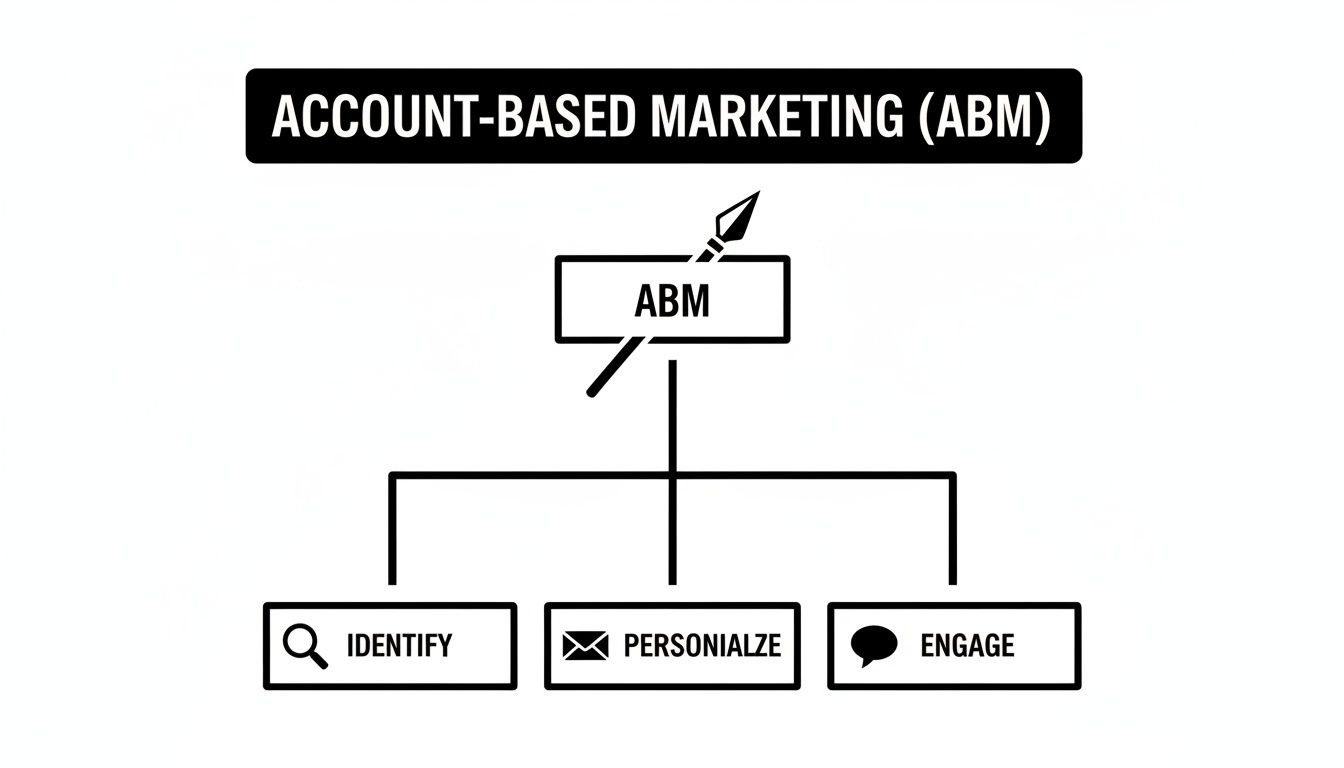
As you can see, once you've identified your accounts, personalization is the critical bridge you have to cross before you can engage them effectively. It's truly central to the entire approach.
For instance, forget sending a generic case study. Instead, you could create a "micro-case study" that shows results from a company in their exact niche. Or, instead of a standard demo, you might record a short, custom video walkthrough that tackles a specific pain point you uncovered in your research.
Personalization is what separates a message that gets deleted from an experience that starts a real conversation. It proves you've done your homework and are serious about solving their specific problems.
Coordinate Cross-Channel Engagement
That perfectly personalized message needs a delivery plan. Coordinated Cross-Channel Engagement makes sure your target accounts get a consistent, reinforcing experience no matter where they bump into your brand. This isn't about spamming the same ad everywhere; it's about orchestrating a cohesive story across different touchpoints.
Think of it like a conversation that unfolds over time. It might start with a hyper-targeted LinkedIn ad, followed by a personalized email from a sales rep. That could be reinforced by relevant articles on your website, and maybe it all leads to an invite for a custom-tailored webinar. Each channel has a job to do, and they all work together to build trust.
Forge an Unbreakable Sales and Marketing Alignment
The final pillar is the one that holds everything up: Sales and Marketing Alignment. Without it, the best-laid ABM plans will absolutely fall apart. ABM demands that these two teams act as a single, unified revenue machine, totally in sync on goals, metrics, and day-to-day actions.
This alignment shows up in a few key ways:
- Shared Goals: Both teams are judged on the same things—account engagement, pipeline from target accounts, and, of course, closed-won revenue.
- Collaborative Planning: Sales brings the on-the-ground intel about what accounts are struggling with, and marketing uses that to build the targeted content and campaigns that will resonate.
- Constant Communication: Regular huddles to review account progress, tweak tactics, and make sure everyone is reading from the same playbook are non-negotiable.
When sales and marketing are truly aligned, the prospect feels it. They experience a smooth, seamless journey. There's no jarring handoff between departments—just a single, helpful organization they feel like they're building a real relationship with. That unity is the engine that drives a winning ABM strategy.
The True Business Impact of ABM
Switching to an Account-Based Marketing strategy isn't just a minor tweak to your marketing plan; it's a complete shift in how your business goes after growth. The theory is great, but leaders and stakeholders always want to know about one thing: the results. What’s the real, tangible impact on the bottom line?
Put simply, it's huge. ABM turns marketing from a department people often view as a cost center into a predictable and powerful revenue engine. It does this by funneling all your resources into the opportunities with the highest possible potential. This eliminates wasted effort and creates a crystal-clear line from a marketing campaign directly to a closed-won deal.
This razor-sharp focus leads to dramatic improvements across the key business metrics every executive team obsesses over. Instead of casting a wide net for a high volume of so-so leads, your team concentrates on building deep, meaningful engagement with accounts that are a perfect fit. The result is better outcomes at every single stage of the sales cycle.
Boosting Revenue and Deal Size
One of the most powerful arguments for ABM is its proven track record of generating more revenue from much bigger deals. When you treat each target account as its own unique market, your sales and marketing teams can work together to create incredibly relevant, personalized experiences that speak to the entire buying committee, not just one person.
This deep level of engagement builds serious trust and shows you truly understand the customer's specific problems.
The data tells a compelling story. When it comes to ROI, ABM leaves traditional marketing in the dust, with a staggering 97% of marketers reporting higher returns. Companies that go all-in on ABM have seen a remarkable 208% increase in marketing-generated revenue over just three years. Deal sizes also get a massive boost, with the average annual contract value jumping by an impressive 171%. You can explore more data on ABM's ROI and performance to get the full picture.
This jump in deal value happens because ABM naturally elevates your company from just another vendor to a strategic partner in the eyes of your best-fit customers.
Accelerating the Sales Cycle
It’s easy to assume that focusing on larger, more complex accounts would automatically mean a longer sales cycle. But a well-run ABM program often does the exact opposite. By getting sales and marketing on the same page from day one, you eliminate internal friction and ensure every touchpoint with the target account is consistent, coordinated, and genuinely helpful.
By the time a sales conversation actually begins, the key players at the target account are already warmed up. They know your brand, they get your value proposition, and they’ve already interacted with content built just for them.
This "pre-engagement" work knocks down many of the early-stage hurdles that cause deals to stall. Instead of burning time on basic qualification, sales reps can jump straight into strategic, high-level conversations, effectively shrinking the time it takes to get from that first "hello" to a signed contract. This efficiency perfectly complements many proven outbound lead generation strategies, ensuring that when you do reach out, you’re hitting a receptive and well-informed audience.
Improving Win Rates and Customer Lifetime Value
Finally, ABM delivers a major punch to two of the most critical long-term metrics: win rates and Customer Lifetime Value (CLV). Because you’re starting the process by targeting accounts that are an absolutely ideal fit for your solution, you are inherently far more likely to win their business. These aren't random leads that filled out a form; they are hand-picked opportunities with a high probability of success.
This strategic upfront selection is the foundation for a much stronger, more successful customer relationship after the sale is done.
- Higher Win Rates: You’re not trying to jam a square peg into a round hole. By focusing only on best-fit accounts, your team's efforts are more potent, leading to a much higher percentage of deals won.
- Increased CLV: Customers who are a great fit and see real value from your product are far more likely to stick around, renew, and even expand their contract with you. ABM plants the seeds for this long-term partnership from the very beginning.
- Stronger Advocacy: These ideal customers are also the most likely to become your biggest fans and most powerful case studies, creating a virtuous cycle of growth.
When you add it all up, the business impact of ABM is undeniable: it drives more revenue from better deals, shortens the path to "closed-won," and builds a healthier, more profitable customer base for the long haul.
Launching Your First ABM Campaign
Alright, enough theory. Let's get our hands dirty. This is where the real fun of ABM begins, and thankfully, launching your first campaign doesn't require a massive budget or a suite of complicated software. The key is to start smart with a pilot program.
Think of it as a focused experiment. Your goal is to prove the ABM concept works for your business, learn what resonates with your market, and create a playbook you can scale later. Follow these steps, and you’ll run a tight, efficient campaign that gets results and builds the internal momentum you need for a full-scale rollout.
Step 1: Assemble Your Core ABM Team
Before you even think about which accounts to target, you need to pick your people. A great ABM pilot is a team sport, and you need a small, agile crew from both sales and marketing who are ready to collaborate.
For your first run, keep the team lean. An ideal setup includes:
- One dedicated marketer: This person will own the strategy, coordinate the moving parts, and personalize the content.
- One or two sales reps: They bring the ground-level account intel and will handle the direct outreach and relationship-building.
- An executive sponsor: Think a VP of Sales or Marketing. They’ll champion the project, clear any roadblocks, and communicate progress to the higher-ups.
This small group keeps communication tight and decisions fast—exactly what you need for a successful pilot.
Step 2: Define Clear Goals and Success Metrics
You have to know what winning looks like before you start. Vague goals like “more engagement” just won't cut it. You need specific, measurable objectives that tie directly to revenue. This clarity gets everyone on the same page and rowing in the same direction.
A pilot campaign's primary goal is often to prove a hypothesis: "If we focus our coordinated efforts on these ten accounts, we can generate more qualified pipeline than with our traditional methods."
Your metrics need to reflect this new focus. Ditch the obsession with MQLs and start tracking what really matters in ABM:
- Account Engagement: Are the right people at your target accounts visiting your site, reading your content, or opening your emails?
- Account Penetration: How many new, relevant contacts have you identified and started conversations with inside each company?
- Pipeline Velocity: Are you actually booking meetings and creating real opportunities within your target list?
Step 3: Build Your Target Account List
With your team and goals set, it’s time to pick your targets. For a pilot, quality beats quantity every single time. A list of 5 to 10 accounts is the perfect starting point.
Use your Ideal Customer Profile (ICP) as your north star. Look for companies that fit your criteria based on industry, size, geography, or the tech they use. But don't stop there. Get your sales reps in the room for this discussion; their firsthand knowledge of which accounts are showing interest or are a perfect strategic fit is pure gold. Tech can help, too—many of the best lead generation tools for B2B can quickly surface companies that match your ICP.
Step 4: Craft Personalized Messaging and Content
This is where you separate yourself from the noise. Generic, one-size-fits-all messaging will sink your ABM campaign before it even sets sail. You need to do your homework. Dig into each target account to understand their unique challenges, strategic goals, and recent news.
This research is the fuel for creating content that feels like it was made just for them. Maybe you create a one-page "mini case study" that addresses a pain point specific to their industry. Or perhaps your sales rep records a quick, personalized video addressing an initiative they mentioned in their latest quarterly report.
Step 5: Execute Your Coordinated Campaign
Now it’s time to put your plan into action. This is a multi-touch, multi-channel effort designed to surround the key decision-makers at your target accounts. The keyword here is coordination. Sales and marketing must work in lockstep.
A typical play might look something like this:
- Air Cover: Marketing launches highly targeted LinkedIn ads aimed at the known buying committee within the target account.
- Personalized Outreach: A sales rep follows up with a custom email that echoes the theme of the ads.
- Value-Added Content: Marketing sends an invite to a private micro-webinar designed specifically for their industry.
- Direct Engagement: The sales rep makes a follow-up call, referencing the content and webinar to start a meaningful conversation.
Step 6: Measure, Analyze, and Optimize
Finally, you need to track your progress obsessively. Hold weekly check-ins with your core team to go over the key metrics. What’s working? Which accounts are lighting up with engagement? Which ones are cold?
This isn’t about waiting until the end to see how you did. It’s about real-time analysis. Use these weekly insights to tweak your approach on the fly. If one message isn't landing, change it. If one channel is driving all the engagement, double down on it. This constant loop of measuring, learning, and optimizing is what turns a simple pilot into a powerful, scalable growth engine for your business.
The Future of ABM: Smarter Targeting with AI and Intent Data

The core principles of Account-Based Marketing are already solid, but technology is taking it to a whole new level. We're moving beyond a simple targeted strategy and into the realm of predictive revenue generation. The question is no longer just who to target, but who to target right now.
Driving this evolution are two game-changing forces working together: Artificial Intelligence (AI) and intent data. This combination is turning ABM into a much sharper, more intelligent spear. It’s no longer just about identifying your ideal customers; it's about seeing what they're doing in real-time and understanding their needs before they even reach out.
The Power of Intent Data
At its heart, intent data is the collection of signals that show an account is actively looking for solutions like yours. Think of it as digital body language.
When employees from a target company start reading articles on a specific problem, visiting competitor websites, or searching for keywords related to your industry, they leave a trail of digital breadcrumbs.
Intent data platforms gather and analyze these signals, giving you an almost unfair advantage. Instead of guessing which target accounts are actually in-market, you get a clear alert. This allows you to prioritize outreach and aim your personalized campaigns at accounts showing active buying behavior, massively increasing your chances of starting a timely and relevant conversation.
This shift changes everything for engagement and revenue predictability. It’s a major reason why accounts in ABM programs see 72% higher engagement than those in broad campaigns. Today, 40% of companies are already blending ABM with demand generation, using intent data to find prospects who are ready to buy.
AI: The Engine for Personalization at Scale
While intent data tells you who to target and when, AI tells you how. AI is the engine that crunches massive datasets and automates personalization at a scale that was simply impossible for human teams to manage before.
Here's how AI is changing the game:
- Predictive Account Scoring: AI algorithms sift through thousands of data points—from company size to real-time intent signals—to score and rank your entire list of potential accounts. This ensures your team is always focused on the opportunities most likely to close.
- Hyper-Personalization: AI can generate personalized email copy, suggest relevant content, and even tailor your website experience for visitors from specific target accounts. It figures out the pain points an account cares about most and helps you craft the perfect message to address them.
- Optimized Channel Mix: AI can analyze which channels and touchpoints work best for engaging different people within an account, helping you build a more efficient and impactful multi-channel campaign.
The combination of intent data and AI removes the guesswork from ABM. It empowers revenue teams to operate with precision, focusing their creative and strategic energy on accounts that are ready to engage.
To get a sense of the broader picture, staying informed on the evolving Generative AI landscape can offer valuable context on how this technology is reshaping marketing. As AI continues to advance, its role in creating smarter, more predictive ABM programs will only grow, turning your best-fit customers into true strategic partners.
Got Questions About Account-Based Marketing?
Even when you've got the concept down, practical questions always pop up once you start thinking about actually doing account-based marketing. That’s totally normal. Shifting to an ABM mindset is a big strategic move, so it's smart to tackle the common curiosities before you jump in.
Let’s walk through some of the most frequent questions we hear from B2B leaders when they're on the fence about ABM. The answers are straightforward and designed to clear the path so you can move forward with confidence.
Wait, Isn't This Just Good Sales?
This is probably the most common—and insightful—question of them all. And it's true, great salespeople have always instinctively zeroed in on key accounts, built strong relationships, and worked hard to understand their customer's world. ABM takes that powerful instinct and turns it into a systematic, company-wide strategy.
The real difference-maker is proactive, unified execution. Instead of a salesperson working alone on an island, ABM forges an unbreakable link between sales and marketing, right from the very start.
Think about it like this:
- Good Sales: A star salesperson spots a major opportunity. They do their homework, build a plan, and masterfully pursue the deal. They are a lone hunter, relying on their own skill and grit.
- Account-Based Marketing: Sales and marketing huddle up to identify that same opportunity together. Marketing then acts as the air cover, launching hyper-relevant ads, creating personalized content, and warming up the entire buying committee before sales even makes the first call. The salesperson is now part of an elite, coordinated team.
In an ABM world, marketing’s job fundamentally changes. They’re no longer a lead factory, tossing names over the wall to sales. Instead, they become a strategic partner, creating targeted engagement that makes the sales team’s job exponentially more effective.
This alignment means every single touchpoint a target account has with your brand feels consistent, relevant, and part of a deliberate plan. It turns good sales instincts into a scalable, repeatable revenue engine for the whole business.
What Kind of Budget Do I Need to Get Started?
There’s a huge myth that you need a massive budget and a whole new suite of expensive tools to even think about ABM. Good news: that's not true. You can get a powerful ABM pilot off the ground with a surprisingly modest budget.
Honestly, your biggest initial investment isn't cash—it's time, focus, and strategic alignment.
Your first ABM campaign should be a tightly focused pilot program. Start small. Pick a list of just 5 to 10 high-value target accounts. This lets you prove the concept and build a playbook you can scale later, all without a huge financial risk.
Before you even think about buying specialized ABM software, pour your resources into these areas:
- Strategic Time: Carve out dedicated time for sales and marketing to collaborate on building the target list and digging deep into each company's specific challenges and goals.
- Content Personalization: You don't need to create everything from scratch. That blog post you wrote last month? Turn it into a personalized one-pager. That case study? Tweak it to highlight results that matter to your target's industry.
- Coordinated Outreach: Use the tools you already have. A smart mix of personalized emails from sales, targeted LinkedIn ads from marketing, and maybe even some high-impact direct mail can create a powerful, multi-channel campaign.
Once your pilot starts showing green shoots—like a jump in engagement or meetings booked with your dream clients—you'll have a rock-solid internal case for a bigger budget to scale up with more advanced tools.
How Long Does It Take to See Results from ABM?
When it comes to account-based marketing, patience is key. This is a long-term strategy, not a quick-win tactic that will flood your inbox with leads overnight. You're going after bigger, more strategic deals with complex buying committees, so the sales cycle is naturally going to be longer.
But that doesn't mean you'll be waiting for months to see if it's working. You should start seeing positive leading indicators within the first 90 days of launching a focused pilot.
These early signals are crucial for tracking momentum and keeping your team energized. They won’t be closed deals, but they're strong signs you're on the right track.
| Timeline | What to Expect from Your ABM Program |
|---|---|
| First 90 Days | Leading Indicators: You should see a real lift in engagement from your target accounts. This looks like more website visits from their company, higher open and reply rates on your emails, more content downloads, and new LinkedIn connections with key people. The main goal here is getting those first discovery meetings on the calendar. |
| 6 Months | Pipeline Growth: By now, you should be seeing qualified opportunities and real pipeline value popping up from your target account list. This is when you can start measuring things like pipeline velocity and compare the quality of ABM-sourced opportunities to your other channels. |
| 12+ Months | Revenue Impact: Depending on your sales cycle, this is when the deals start closing and you see tangible revenue. Now you can calculate the full ROI of your ABM program, pointing to higher contract values and better win rates. |
The most important thing is to set the right expectations with leadership from day one. Frame ABM as a strategic investment in long-term, high-value growth, and be sure to report on those leading indicators of engagement and pipeline all along the way to show you’re making real progress.
Ready to stop wasting time on manual processes and build a scalable growth engine? MakeAutomation specializes in creating the AI and automation frameworks that B2B and SaaS companies need to accelerate revenue. We can help you implement AI-driven outreach, automate your CRM, and build efficient workflows for your ABM strategy. Book a consultation with MakeAutomation to discover how we can help you reclaim time and boost your ROI.