10 B2B Cold Calling Best Practices to Dominate Sales in 2025
Cold calling isn't dead, it's evolving. The days of generic scripts and brute-force dialing are over, replaced by a smarter, data-driven approach that combines human connection with powerful automation. In the modern B2B and SaaS landscape, success hinges on precision, personalization, and efficiency. This guide moves beyond outdated advice to deliver a comprehensive roundup of the ten most effective cold calling best practices you can implement today.
We will provide a blueprint for transforming your outbound sales strategy. You won't find generic tips here; instead, you will get actionable frameworks and specific examples for every stage of the process. This listicle is designed to be a practical resource for sales leaders, founders, and entrepreneurs aiming to build a scalable and repeatable lead generation engine.
Inside, you will learn how to:
- Use AI-powered tools for intelligent lead qualification and scoring.
- Integrate multi-channel cadences that combine calls, emails, and social touches.
- Deploy Voice AI agents and automation to handle initial outreach and scheduling.
- Develop research-based value propositions that build instant rapport.
- Implement advanced objection-handling frameworks and CRM workflows.
Whether you're refining an existing sales process or building one from scratch, these ten strategies provide the framework to turn your outbound efforts from a numbers game into a predictable system for generating high-quality opportunities and closing more deals. We will explore each practice with the detail needed to implement them effectively.
1. AI-Powered Lead Qualification and Scoring
One of the most impactful cold calling best practices is to stop calling cold leads altogether. Instead, use artificial intelligence to qualify and score prospects before your sales team ever picks up the phone. This approach transforms a traditionally low-ROI activity into a highly targeted, efficient process. AI platforms analyze vast datasets, including firmographic details, online behavior, and engagement signals, to assign a numerical score indicating a lead's conversion likelihood. This ensures your reps focus their valuable time on prospects who are already warm and show genuine buying intent.
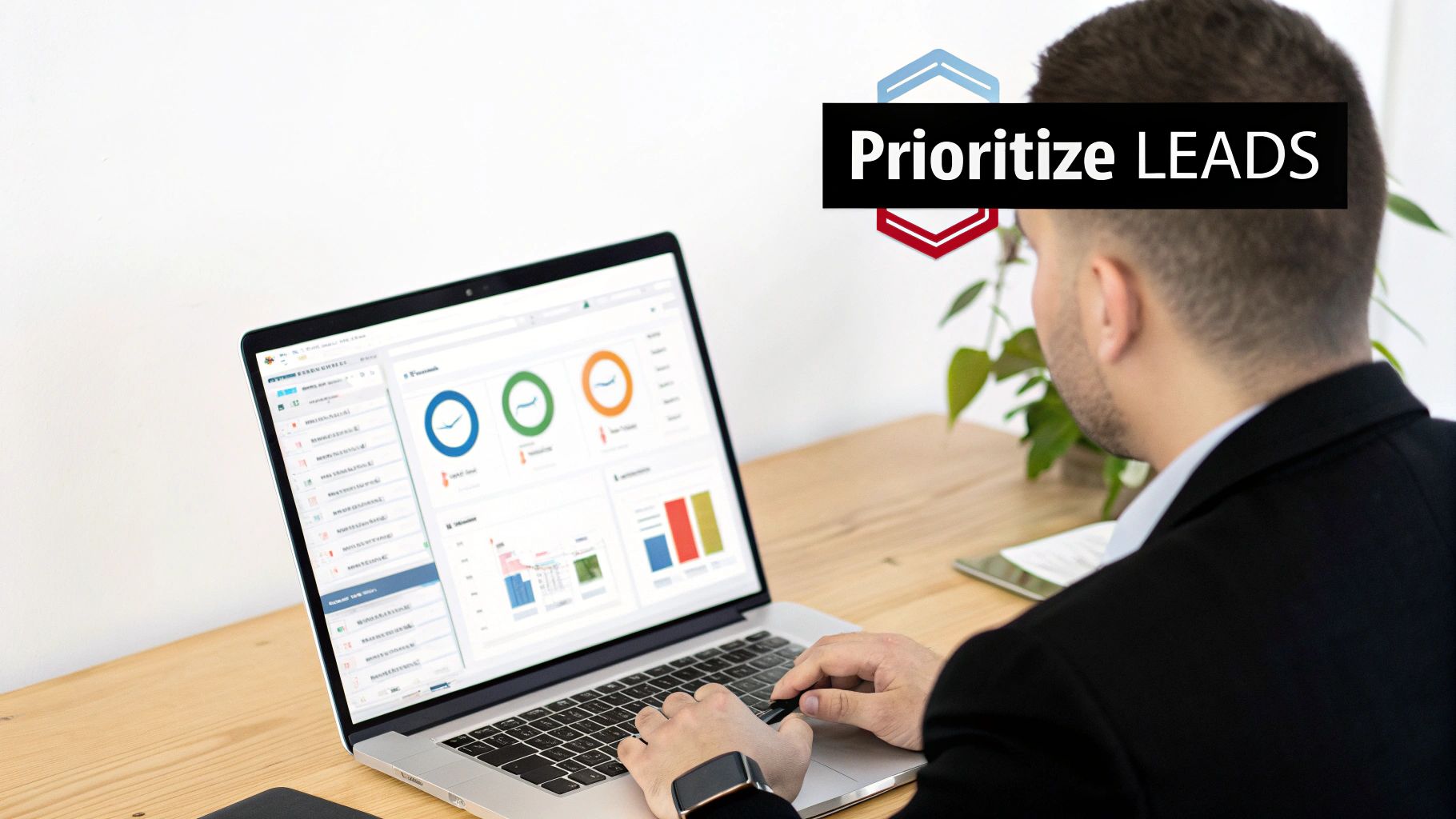
This method moves sales teams from a "quantity" mindset to a "quality" focus, dramatically boosting connection rates and meaningful conversations. By prioritizing the hottest leads, you not only improve efficiency but also enhance sales rep morale by reducing rejection and increasing successful outcomes.
How to Implement AI Lead Scoring
Platforms like Salesforce Einstein and HubSpot's predictive scoring tools make this accessible. They integrate with your CRM to create a dynamic feedback loop, continuously refining scoring accuracy based on real-world outcomes. The fundamental goal is to build a detailed, data-backed understanding of what constitutes a qualified lead. If you want to learn more about the fundamentals, you can review this guide on how to qualify sales leads.
To maximize your results, follow these steps:
- Segment Your Lists: Create tiered calling lists based on AI scores (e.g., Tier A for scores 85-100, Tier B for 70-84). Direct your most experienced reps to Tier A.
- Continuously Validate: Regularly analyze which scores lead to actual conversions. Feed this data back into the AI model to refine its criteria and improve its predictive power.
- Combine with Manual Review: For top-tier accounts, supplement AI scores with a quick manual review to add context and personalize your opening.
- Integrate with Automation: Use AI Voice Agents to handle initial qualification for inbound leads, automatically scoring and routing them to the appropriate human agent based on the conversation.
For a deeper dive into optimizing your outreach, consider exploring advanced AI-powered lead scoring strategies to build a truly intelligent outbound engine.
2. Personalization at Scale Using Data Intelligence
One of the most effective cold calling best practices is to move beyond generic scripts and embrace deep personalization fueled by data. By leveraging data intelligence platforms, sales teams can deliver messaging that demonstrates genuine research and relevance. This approach uses real-time information about a company's challenges, recent business events, or a decision-maker's specific role to craft a compelling and highly relevant opening, which significantly boosts engagement and credibility from the first second of the call.

This strategy transforms the cold call from an interruption into a timely, valuable conversation. Instead of a one-size-fits-all pitch, reps can reference specific triggers, like a recent funding round or a new executive hire, proving they've done their homework. This immediately builds rapport and positions the caller as a resourceful advisor rather than just another salesperson.
How to Implement Data-Driven Personalization
Tools like Apollo.io, Clearbit, and LinkedIn Sales Navigator are essential for gathering the necessary intelligence. These platforms provide access to firmographic data, technology stacks, and recent company news, allowing you to create dynamic, context-aware scripts. The objective is to make every prospect feel like you are calling them for a specific, well-researched reason.
To deploy this strategy effectively, follow these key steps:
- Reference a Specific Trigger: Open your call by mentioning a specific, recent event. For example, "I saw your company just announced a new product launch, and I had a few thoughts on how similar teams are tackling user adoption."
- Leverage Business Intelligence: Use platforms like Crunchbase and LinkedIn to find unique conversation starters, such as company growth trends, competitor news, or a decision-maker’s recent post.
- Create Dynamic Templates: Build script templates in your sales engagement platform that automatically populate with real-time data from your CRM or data provider, such as
[Company Name],[Recent News], or[Competitor Mention]. - Audit for Accuracy: Regularly check the data points you are using for personalization. Citing outdated or incorrect information can instantly destroy credibility and undermine your outreach efforts.
3. Strategic Call Timing and Frequency Optimization
One of the most overlooked cold calling best practices is dialing with purpose, not just volume. Strategic call timing involves using data analytics to determine the optimal days, times, and frequency for outreach based on your target industry, prospect role, and historical engagement data. This data-driven approach replaces guesswork with precision, ensuring your calls are placed when prospects are most likely to be available and receptive.
This strategy is about working smarter, not just harder. Instead of randomly calling throughout the day, your team connects with decision-makers during their peak availability windows. Research from platforms like Gong.io consistently shows that certain times, like mid-morning from Tuesday to Thursday, can yield significantly higher connection rates. By aligning your cadence with these proven windows, you maximize the impact of every dial.
How to Implement Strategic Call Timing
The key is to move from generalized industry advice to specific data from your own CRM. While broad studies provide a great starting point, your ideal call windows will be unique to your target audience. The goal is to build a calling schedule that reflects your prospect's actual work habits.
To optimize your calling schedule for better results, follow these steps:
- Analyze Historical Data: Dive into your CRM and call analytics. Identify which days and times have historically resulted in the highest number of answered calls and positive outcomes (e.g., meetings booked).
- Schedule Calls Before Meetings: A clever tactic is to schedule calls for times like 9:45 AM or 1:45 PM. Decision-makers are often at their desks and wrapping up tasks just before their next scheduled meeting.
- Establish Quiet Periods: Block out historically low-performing times from your team's schedule. Common "do-not-call" windows include Monday mornings, Friday afternoons, and any time after 4:00 PM.
- Implement Smart Cadence Gaps: Avoid overwhelming prospects. Design your calling cadence with intentional 2-3 day gaps between attempts on the same lead to avoid appearing aggressive while maintaining persistence.
- Leverage Time Zone Intelligence: Use tools within your sales engagement platform to automatically adjust call times based on a prospect's geographic location, ensuring you never call a lead in California at 8:00 AM Eastern Time.
4. Voice AI and Automated Outbound Call Systems
One of the most transformative cold calling best practices is leveraging Voice AI to automate initial outreach. Instead of human reps spending hours on repetitive, low-conversion dialing, AI-powered agents handle the top-of-funnel activity at a massive scale. These systems can place thousands of calls simultaneously, use natural language processing to engage prospects, handle initial objections, and qualify interest, all without human intervention. This frees up your skilled sales team to focus exclusively on warm, qualified leads who have already expressed interest.
This technology allows you to dramatically increase outreach volume while maintaining a consistent and optimized message. Voice AI handles the draining, high-rejection part of the job, boosting team morale and allowing reps to dedicate their expertise to closing deals rather than just finding them. The result is a more efficient, scalable, and cost-effective outbound engine.
How to Implement Voice AI and Automation
Platforms like MakeAutomation's Voice AI Agent and Dialpad's AI-powered outbound dialer are making this technology accessible. These systems integrate with your CRM to initiate calls, log activity, and seamlessly transfer qualified prospects to a live agent. The core goal is to automate the repetitive tasks of dialing and initial qualification to supercharge your team's efficiency.
To effectively deploy this strategy, follow these steps:
- Start with Simple Campaigns: Begin by using Voice AI for straightforward tasks like event invitations or simple lead qualification. Use these initial campaigns to gather data and refine your scripts.
- Enable Warm Handoffs: Always have a human representative available for an immediate, seamless transfer the moment a prospect shows genuine interest. The transition from AI to human should feel natural and effortless.
- A/B Test AI Scripts: Just as you would with email, test different AI voices, opening lines, and value propositions. Analyze call recordings to understand what resonates and what causes prospects to hang up.
- Ensure Strict Compliance: Automated calling is subject to regulations like the TCPA. Work closely with legal counsel to ensure your campaigns are fully compliant, including adhering to consent requirements and call time restrictions.
For those looking to build a high-volume outreach system, integrating tools like Myphoner can help automate workflows and bridge the gap between AI-driven outreach and human-led conversations.
5. Multi-Touch Cadence and Channel Integration
One of the most effective cold calling best practices is to stop relying solely on the phone. A modern outbound strategy integrates cold calls into a structured, multi-touch cadence that leverages various channels like email and LinkedIn. This coordinated approach ensures your messaging consistently reaches prospects across different platforms, significantly increasing the odds of engagement and response. By creating a sequence of strategic touchpoints, you build familiarity and demonstrate persistence without being intrusive.
This method transforms cold calling from a standalone action into a pivotal step within a broader, more intelligent communication workflow. Instead of a single, high-pressure call, the prospect experiences a thoughtful series of interactions, making them more receptive when you finally connect. Platforms like Outreach.io and SalesLoft have pioneered this approach, proving that a well-timed call following an email or LinkedIn connection is far more effective than a truly "cold" one.
How to Implement a Multi-Channel Cadence
Building an effective cadence requires more than just random actions; it demands a strategic sequence designed to build momentum. The key is to make each touchpoint feel connected and purposeful, guiding the prospect through a logical journey. The goal is not to bombard the lead but to create multiple opportunities for a conversation to start.
To build and optimize your multi-channel sequences, follow these steps:
- Design a Logical Flow: Start with a low-friction touchpoint. A common sequence is Day 1: Personalized Email, Day 3: Cold Call (referencing the email), Day 5: LinkedIn Connection Request, Day 7: Follow-up Call.
- Vary Your Messaging: While your core value proposition should remain consistent, slightly adapt your messaging for each channel. An email can be more detailed, while a LinkedIn message should be concise and professional.
- Use Engagement Triggers: Implement logic that triggers a call immediately after a prospect opens your email or views your LinkedIn profile. This capitalizes on moments of peak interest.
- Pace Your Outreach: Space touches 2-3 days apart to stay top-of-mind without causing fatigue. A well-paced cadence of 5-7 touches over two weeks is often the sweet spot.
For a deeper dive into structuring these sequences, you can explore this guide on sales cadence best practices to build a truly effective outreach machine.
6. Research-Based Value Proposition Development & Rapport Building
One of the most powerful cold calling best practices involves abandoning generic pitches in favor of highly personalized, research-backed outreach. This consultative approach combines deep pre-call research with genuine rapport-building skills to position the caller as a knowledgeable partner, not just another salesperson. By understanding a prospect's specific business context, recent challenges, and industry trends, you can craft a value proposition that resonates on a business impact level and builds trust from the first sentence.
This method transforms the cold call from an interruption into a relevant business conversation. Leading with insight-for example, referencing a recent SEC filing or a competitor's technology shift-shows you've done your homework. This earns you the right to ask questions and pivot to your solution, dramatically increasing your chances of securing a meaningful follow-up meeting and building a strong foundation for a long-term relationship.
How to Implement a Research-First Approach
This strategy, championed by experts like Jeb Blount and Anthony Iannarino, requires a systematic process for gathering and deploying intelligence. The goal is to spend 10-15 minutes on high-value prospects to uncover a compelling reason for your call. It's not about finding a shared hobby, but about connecting business dots.
To integrate this into your workflow, follow these steps:
- Build a Research Template: Systematize your research by creating a checklist. Include fields for recent company news, key executive changes, financial performance highlights (from earnings calls or reports), and their current technology stack.
- Lead with Insight, Not Product: Instead of opening with your name and company, start with your research. For example, "I noticed your company's latest expansion into the APAC region, which often strains supply chain logistics…"
- Prepare Relevant Case Studies: Have 2-3 case studies ready from similar companies that faced the challenges you've identified in your research. This provides instant credibility and social proof.
- Practice Active Listening: Once you've earned their attention, listen more than you speak. Ask open-ended questions about their role and priorities to uncover pain points that your research might have missed. Adapt your communication style, speed, and formality to match theirs.
7. Objection Handling and Response Frameworks
One of the most crucial cold calling best practices is to treat objections not as roadblocks, but as opportunities for deeper conversation. Developing pre-planned, tested response frameworks for common objections transforms a potential rejection into a chance to demonstrate value. This systematic approach removes emotional, on-the-spot reactions and equips sales reps with the confidence to guide the conversation toward a productive outcome. By preparing for pushback, your team can reframe skepticism and keep the sales process moving forward.
This strategy shifts reps from a defensive posture to an offensive one, where they can proactively address concerns about budget, timing, or existing solutions. Having a playbook for objections like "we don't have the budget" or "we already use a competitor" ensures the call doesn't end prematurely. Instead, it becomes a diagnostic tool to uncover the prospect's real pain points and priorities.
How to Implement Objection Handling Frameworks
The goal is to create a living "objection playbook" that is continuously refined based on real-world call data. Inspired by the work of sales experts like Jeb Blount and research from platforms like Gong.io, this playbook should be a core training asset for your sales team. It turns objection handling from an art into a repeatable science.
To build your framework, follow these steps:
- Identify Common Objections: Record and categorize the top 5-10 objections your reps hear daily. Common examples include budget, timing, authority ("I'm not the right person"), and need skepticism ("We're happy with our current solution").
- Develop and Test Responses: For each objection, write 2-3 potential responses. For example, if a prospect says, "Call me back in 6 months," a good response is, "I can definitely do that. So I know what to prepare for that call, could you share what will be different about your business then?"
- Role-Play Regularly: Dedicate time in weekly sales meetings for role-playing scenarios. This builds muscle memory and helps reps deliver responses naturally and confidently under pressure.
- Analyze and Refine: Use call recording software to analyze which objection responses lead to conversions or next steps. Continuously update your playbook with the winning phrases and strategies. This data-driven approach is a key part of modern cold calling best practices.
8. Call Recording, Analysis, and Continuous Improvement Systems
One of the most transformative cold calling best practices is to stop guessing what works and start knowing. By systematically recording, transcribing, and analyzing calls with AI-powered conversation intelligence, you create a data-driven feedback loop for perpetual improvement. This technology moves coaching from subjective opinion to objective fact, identifying the exact words, questions, and techniques that lead to success. It allows you to bottle the magic of your top performers and scale it across the entire team.
This approach ensures every call becomes a learning opportunity, not just a win-or-loss event. Conversation intelligence platforms like Gong.io and Chorus.ai analyze patterns across thousands of interactions, revealing insights such as the optimal talk-to-listen ratio or which competitor mentions signal a high-value opportunity. This data empowers sales leaders to provide targeted, effective coaching that directly impacts results and boosts rep confidence.
How to Implement a Call Analysis System
The goal is to build a culture of continuous learning, not a surveillance state. Frame the implementation as a tool for professional development and team-wide success. Platforms like Gong.io integrate directly with your dialer and CRM to automate the recording and analysis process, making it seamless for your team.
To get the most out of your system, follow these steps:
- Focus on Aggregate Insights: Start by sharing team-wide trends and best practices identified by the AI. For instance, you might discover that top reps ask 60% more discovery questions than their peers.
- Create a Best-Practice Library: Use transcriptions to build a searchable library of successful calls. New reps can study real-world examples of how to handle specific objections or pitch a new feature.
- Generate Personalized Coaching: Use the platform’s analytics to identify individual areas for improvement. Provide reps with specific, actionable feedback based on their own call data, such as "Try to reduce your monologue time in the first minute."
- Facilitate Peer Learning: Host monthly sessions where top performers share clips from their successful calls, breaking down their thought process and strategy for the rest of the team.
9. CRM Integration and Automation for Call Workflow
One of the most significant drains on a sales rep's time isn't the calling itself; it's the manual administrative work that surrounds it. A critical cold calling best practice is to fully integrate your calling activities with a CRM and leverage automation to eliminate these tedious tasks. This means automatically logging calls, transcribing conversations, and triggering next steps based on call outcomes, freeing your team to focus exclusively on high-value conversations.
This automated workflow transforms your CRM from a passive data repository into an active, intelligent assistant for your sales team. When a rep dispositions a call in their dialer as "Meeting Booked" or "Follow-up Required," the system can instantly create a calendar event, schedule the next task, and enroll the prospect in a specific email nurture sequence. This ensures no lead falls through the cracks and maintains momentum after a successful call.
How to Implement a CRM-Integrated Workflow
Modern sales platforms like Salesforce, HubSpot, and Outreach.io are built for this level of integration. The key is to create clear rules that translate call outcomes into automated actions. To truly optimize your call workflow and boost productivity, consider the advantages of mastering CRM with VoIP integration for sales success, which syncs your entire communications stack.
Follow these steps to build a seamless workflow:
- Establish Smart Disposition Codes: Create a set of clear call dispositions (e.g., "Connected – Not Interested," "Left Voicemail," "Meeting Set"). Link each code to an automated action, such as moving a lead to a different pipeline stage or scheduling a follow-up task.
- Automate Post-Call Follow-Up: Build email templates that are automatically sent based on the call's outcome. For example, a "Left Voicemail" disposition could trigger an email that says, "Sorry I missed you, just left you a voicemail regarding X."
- Leverage AI for Note-Taking: Use tools that automatically record, transcribe, and summarize calls. These notes can be attached directly to the contact record in your CRM, providing perfect context for future interactions.
- Trigger Pipeline Movements: Set up rules where specific call results automatically move a deal to the next stage in your sales pipeline, keeping your forecast accurate and up-to-date without manual intervention.
To get a better understanding of the underlying technology, you can find more information about what CRM automation is and how it works.
10. Segmentation and Vertical Specialization Strategy
One of the most powerful cold calling best practices is to abandon the generalist approach and adopt a vertical specialization model. This involves segmenting your prospect database into specific industries, company sizes, or buyer roles, then training reps to become deep experts in one or two of those verticals. This strategy transforms reps from product-pitchers into trusted industry advisors who can speak the prospect's language with authority and relevance.
This targeted approach allows for hyper-relevant messaging that resonates deeply with a specific audience. A rep specializing in Healthcare Tech can discuss HIPAA compliance challenges with credibility, while a rep focused on Financial Services can speak to FINRA regulations. This specialization builds instant rapport and positions your solution as a tailored answer to industry-specific pain points, not a generic tool.
How to Implement a Vertical Specialization Strategy
The goal is to empower your sales team with the knowledge to lead consultative conversations. Instead of every rep trying to understand every market, they develop a profound understanding of a select few, dramatically increasing their effectiveness and conversion rates.
To build a successful specialization program, follow these steps:
- Prioritize High-Value Verticals: Start by identifying your 2-3 most successful or highest-potential industries. Analyze your existing customer data to see where you have the strongest product-market fit.
- Dedicate Learning Time: Mandate that reps dedicate a portion of their week (e.g., 20%) to learning about their assigned vertical. This includes reading industry publications, following key influencers, and understanding market trends.
- Create Vertical-Specific Assets: Develop unique call scripts, email templates, and case study libraries for each vertical. Equip reps with content that features relevant terminology, common challenges, and measurable results from similar clients.
- Promote Industry Immersion: Encourage and sponsor reps to attend industry-specific webinars, trade shows, and conferences. This deepens their expertise and provides valuable networking opportunities.
- Rotate and Cross-Train: To maintain team flexibility and prevent knowledge silos, consider rotating vertical assignments quarterly or semi-annually. This keeps reps engaged and broadens the team's overall expertise.
10-Point Cold Calling Best Practices Comparison
| Technique | Implementation Complexity | Resource Requirements | Expected Outcomes | Ideal Use Cases | Key Advantages |
|---|---|---|---|---|---|
| AI-Powered Lead Qualification and Scoring | Medium–High: model training and integration | Clean historical data, ML expertise, CRM integration | Prioritized leads; 30–50% lift in conversion likelihood | High-volume B2B lead lists; CRO/SDR prioritization | Focuses reps on high-probability prospects; scalable |
| Personalization at Scale Using Data Intelligence | High: data pipelines and dynamic templates | Third-party data, personalization engine, compliance controls | Significant engagement uplift (40–60%) | Account-based outreach; enterprise-targeted campaigns | More relevant conversations; higher answer rates |
| Strategic Call Timing and Frequency Optimization | Low–Medium: analytics and scheduling rules | Historical call data, scheduling tools, timezone logic | Increased connection rates (20–35%); fewer wasted calls | Multi-region outreach; time-sensitive prospecting | Improved contact efficiency; reduced prospect fatigue |
| Voice AI and Automated Outbound Call Systems | Very High: voice models, compliance, complex deployment | Voice/NLP engineering, compliance/legal, monitoring | Massive scale; 60–80% lower cost-per-contact; 24/7 outreach | Extremely high-volume qualification and scheduling | Scales outreach; automates initial qualification and handoffs |
| Multi-Touch Cadence and Channel Integration | Medium–High: orchestration across platforms | Sequence platform, CRM, email/LinkedIn/SMS integrations | Response rates +50–100% vs phone-only | Complex sales cycles; multi-decision-maker accounts | Consistent multi-channel presence; higher recall |
| Research-Based Value Proposition & Rapport Building | Medium: research workflows and rep training | Market intel tools, skilled reps, playbooks | Higher-quality conversations; increased meeting rates | High-value deals; consultative sales approaches | Positions reps as advisors; stronger trust and differentiation |
| Objection Handling and Response Frameworks | Medium: playbook creation and role-play testing | Objection taxonomies, training time, testing data | Converts many objections into continued talks (30–50%) | Teams facing common, repeatable objections | Consistent, confident responses; faster progression |
| Call Recording, Analysis, and Continuous Improvement Systems | Medium: recording + conversation intelligence | Recording/transcription tools, analytics, coaching processes | Identifies best practices; targeted rep improvement | Scaling sales teams focused on performance coaching | Data-driven coaching; replicates top-performer behaviors |
| CRM Integration and Automation for Call Workflow | Medium: CRM configuration and workflow rules | CRM admin, automation tools, integration resources | Saves hours per rep; reduces errors; faster follow-ups | Teams reliant on CRM for pipeline and reporting | Eliminates manual entry; ensures timely next steps |
| Segmentation and Vertical Specialization Strategy | Medium: segmentation strategy and training | Vertical research, persona libraries, specialized reps | 30–50% higher conversion in focused segments | Companies targeting specific industries or buyer roles | Deep relevance and credibility; better objection handling |
Integrate, Automate, and Accelerate Your Sales Engine
We've journeyed through ten critical pillars of modern outbound sales, from the granular details of crafting a value proposition to the high-level strategy of vertical specialization. Each of these cold calling best practices represents a powerful lever for growth. But the true, transformative potential isn't found in mastering one or two of these areas in isolation. It's unlocked when you weave them together into a single, cohesive, and intelligent sales engine.
Think of it this way: AI-powered lead scoring without a multi-touch cadence to engage those leads is just a list. A perfectly timed call without a research-backed value proposition is just an interruption. And a brilliant script without a CRM to track outcomes and automate follow-ups is a wasted opportunity. The magic happens at the intersection of these strategies. When your CRM automatically triggers a personalized email after an automated Voice AI leaves a voicemail, and your sales rep is instantly notified when that prospect opens the email, you're no longer just making calls. You're orchestrating a symphony of strategic touchpoints.
From Individual Tactics to an Integrated System
The core takeaway is this: success in today's B2B landscape requires a fundamental shift in mindset. You must move from viewing cold calling as a series of manual, disconnected actions to seeing it as a dynamic, automated system. This system-based approach is where efficiency, scalability, and predictability are born.
Let's recap the most important threads connecting these best practices:
- Intelligence and Data: Your outreach should be driven by data, not guesswork. This includes using AI to score leads, leveraging data intelligence for deep personalization, and analyzing call recordings to refine your approach.
- Automation and Efficiency: The goal is to automate everything that doesn't require a human touch. This frees up your highly-skilled sales team to do what they do best: build rapport, handle complex objections, and close deals. CRM workflows, Voice AI dialers, and automated sequencing are your greatest allies here.
- Process and Consistency: A defined process is repeatable, and a repeatable process is scalable. By implementing clear frameworks for everything from objection handling to multi-channel cadences, you create a predictable pipeline that isn't dependent on the heroic efforts of a single salesperson.
This integrated approach fundamentally changes the nature of the sales role. Reps become strategic communicators, armed with the best data and supported by a seamless technological backbone. They spend less time on tedious administrative tasks like dialing, logging calls, and scheduling follow-ups, and more time on high-value conversations that drive revenue.
The Path to a Modern Sales Operation
Adopting these cold calling best practices is not just about improving your call connection rates; it's about building a modern, resilient, and highly profitable sales operation. It’s about creating a machine that consistently turns cold outreach into warm conversations and, ultimately, into closed revenue. By integrating technology, process, and strategy, you build a competitive advantage that is difficult to replicate. Your sales engine becomes a powerful asset that fuels growth, provides clear visibility into your pipeline, and allows you to adapt quickly to changing market conditions.
The journey from manual effort to automated excellence is a strategic imperative for any B2B or SaaS company serious about scaling. It's the difference between linear growth and exponential success. Embrace this holistic system, and you won't just be making better cold calls; you will be building a world-class sales organization poised for the future.
Ready to build a powerful, automated outbound system but don't know where to start? MakeAutomation specializes in designing and implementing the exact end-to-end sales automation frameworks discussed in this article for B2B and SaaS companies. Visit MakeAutomation to learn how we can help you build a 7-figure pipeline and eliminate costly manual processes.