
What is sales operations? A Practical Guide to Boosting Growth
Sales operations is the backbone of any successful sales organization. Think of it as the central nervous system, quietly managing all the processes, tools, and data that empower your sales reps to do what they do best: sell. It's the function dedicated to reducing friction, streamlining workflows, and giving your team the insights they need to build a predictable revenue engine.
Decoding Sales Operations and Its Impact
Let's use an analogy. Imagine your sales team is a group of world-class chefs. Their talent lies in creating amazing dishes and delighting customers. But they can't do it alone.
Sales Operations is the master architect of the entire kitchen. They design the layout for maximum efficiency, select the best ovens and tools, manage the inventory system so ingredients are always on hand, and analyze which dishes are most profitable. Without that support, even the most gifted chef would be stuck running to the store, washing dishes, and guessing at recipes.
That’s exactly what Sales Ops does for your sales team. Without a strong operations function, your top-performing reps end up buried in administrative tasks, fighting with clunky software, and flying blind without clear data on which leads to pursue.
The Strategic Engine Behind the Sales Team
Many people mistakenly believe Sales Ops is just about pulling reports or handling administrative tasks. While data is certainly a huge part of the job, the true purpose is far more strategic. The core mission of any sales operations team is to eliminate every single obstacle that gets in the way of a salesperson selling.
This is a big mission, and it’s accomplished by zeroing in on a few critical areas:
- Process Optimization: Building and refining a repeatable, efficient sales process from the first touchpoint all the way to a closed deal.
- Technology Management: Choosing, implementing, and managing the entire sales tech stack. The CRM is the heart of it all, but it also includes all the automation and analytics tools that make reps' lives easier. To get a better handle on the cornerstone of this stack, you can check out our guide on what customer relationship management is.
- Data and Analytics: Creating dashboards, tracking key performance indicators (KPIs), and turning raw sales data into actionable insights for everyone from the CRO to the newest rep.
- Strategic Planning: Tackling big-picture projects like territory design, quota setting, and designing compensation plans that drive the right behaviors.
To better understand how these pieces fit together, let's look at the core responsibilities of a modern sales ops team.
Key Functions of Modern Sales Operations
This table breaks down the core responsibilities of a sales operations team, showing how each function directly contributes to building a high-performance sales organization.
| Core Function | Primary Focus | Impact on Business Growth |
|---|---|---|
| Strategy & Planning | Territory mapping, quota setting, and compensation plan design. | Aligns sales activities with business goals and motivates performance. |
| Process Optimization | Designing and refining the end-to-end sales process. | Increases rep productivity and creates a predictable sales cycle. |
| Tech Stack Management | Selecting, implementing, and managing CRM and other sales tools. | Arms the team with the right tools to sell more efficiently. |
| Data & Analytics | Reporting, dashboard creation, and performance analysis. | Provides data-driven insights for forecasting and strategic decisions. |
| Sales Enablement | Creating content, training materials, and playbooks. | Equips reps with the knowledge and resources to close deals faster. |
Each of these functions is essential for turning a sales team into a well-oiled machine, ensuring that growth is not just possible, but repeatable.
From Report Puller to Revenue Driver
The role of sales operations has come a long way. It first appeared in the 1970s as a way to use data to improve prospecting and closing rates. Today, it’s a strategic force that influences everything from lead management to high-level sales strategy, all powered by sophisticated analytics and automation.
A well-run sales operations function turns the art of selling into a science. It creates a predictable, scalable system that allows a company to forecast revenue with confidence and grow without the wheels falling off.
Ultimately, sales operations is what makes scalable growth possible. By implementing effective sales enablement best practices, the ops team empowers reps with everything they need to succeed. When salespeople can focus purely on building relationships and closing deals, the entire business thrives. This powerful alignment is what transforms a good sales team into an unstoppable growth engine.
The Four Pillars of a Winning Sales Operations Strategy
A great sales operations function isn't just a list of tasks—it's a complete strategy built on four core pillars. When these pillars are firing on all cylinders, they create the rock-solid foundation you need to build a scalable, high-performance sales machine. Nailing each one is the key to spotting weaknesses and building a team that actually drives revenue, not just supports it.
This diagram shows how the core pillars of Strategy, Technology, and Data are fundamental components managed under the umbrella of Sales Operations.
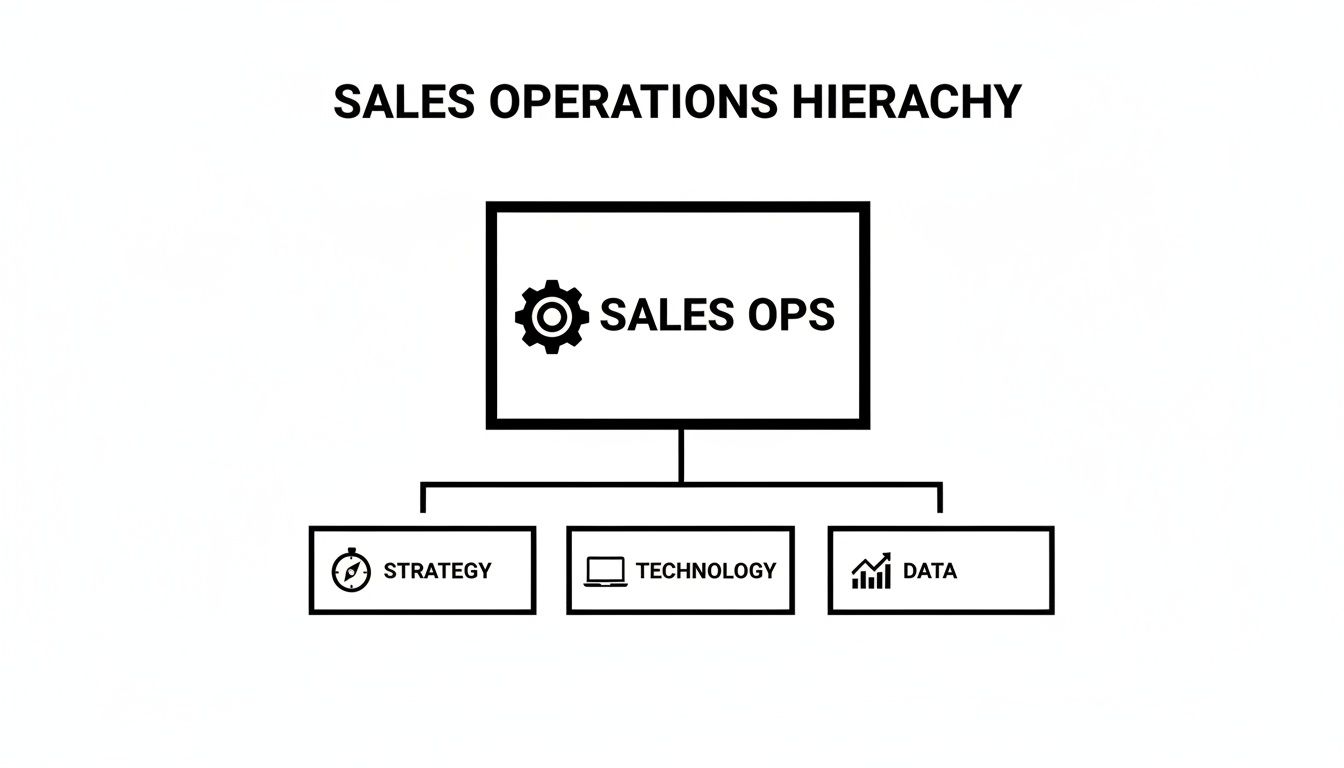
Think of it this way: Sales Ops is the general contractor, integrating these key strategic areas to build a structure that supports the entire sales organization.
Pillar 1: Strategic Planning and Forecasting
This is where sales ops shifts from putting out fires to designing the future. Strategic planning is all about looking around the corner and setting the battlefield so your sales team has the best possible shot at winning. It’s about tackling the big-picture questions that shape your company's long-term success.
These activities are absolute game-changers for any B2B or SaaS company trying to build predictable revenue. A sales ops leader worth their salt will lay out a multi-year vision and then work backward to create annual goals. This involves things like territory planning to put reps in the right spots, capacity planning to figure out who to hire and when, and setting quotas that are ambitious but achievable. It's also about designing compensation plans that actually motivate the right behaviors.
Key strategic functions include:
- Territory Design: Carving up territories by geography, industry, or account size. The goal is to ensure reps aren't tripping over each other and you've got max market coverage.
- Quota Setting: Establishing sales targets that are both challenging and realistic, based on solid data, market potential, and company goals.
- Capacity Planning: Figuring out exactly how many reps you need to hit your revenue targets and then building the hiring plan to match.
Without this kind of strategic foresight, sales teams just devolve into chaos. Reps step on each other's toes, and leadership is left guessing what next quarter will look like.
Pillar 2: Technology and Automation
In today's sales world, tech is the engine and automation is the high-octane fuel. This pillar is all about building and managing a tech stack that empowers your reps, not slows them down. The entire point is to kill off manual, repetitive tasks so your sellers can spend their time on what matters: building relationships and closing deals.
The Customer Relationship Management (CRM) system, like Salesforce, is the heart of it all. It has to be the single source of truth for every piece of customer and deal info.
A well-managed tech stack should be invisible to the salesperson. It should feel like a natural extension of their workflow, making their day easier and offering helpful insights without ever getting in the way.
But it’s not just the CRM. We're talking about a whole suite of tools—sales engagement platforms for outreach, lead scoring tools for prioritization, and data enrichment services to keep contact info from going stale. The real magic happens when you integrate these tools, creating automated workflows that shuttle data and trigger actions behind the scenes.
Pillar 3: Data Management and Analytics
Data is just noise until you make sense of it. This pillar is all about turning the raw numbers from your CRM and other tools into clear, actionable insights that guide decisions across the entire organization. A solid data function helps you see what’s working, what isn't, and—most importantly—why.
This means building and maintaining dashboards that give you an at-a-glance view of your most important Key Performance Indicators (KPIs). A good dashboard tells a story, highlighting trends, flagging risks before they become disasters, and uncovering hidden opportunities.
Essential analytics activities involve:
- Pipeline Analysis: Digging into the health of your sales pipeline, finding the bottlenecks, and tracking conversion rates from one stage to the next.
- Performance Reporting: Keeping a close eye on individual and team performance against quota to spot your top performers and identify who needs a bit of coaching.
- Sales Forecasting: Using historical data and current pipeline health to predict future sales revenue with a high degree of confidence.
This data-first approach takes the guesswork out of sales management. It allows leaders to make calls based on cold, hard evidence instead of just gut feelings.
Pillar 4: Process Optimization and Enablement
This final pillar is the glue that holds everything together. It’s all about the "how"—defining, documenting, and constantly tweaking the sales process to make it as lean and effective as possible. A well-oiled process ensures every rep is running the same playbook, which leads to consistent results and a far more predictable customer experience.
This pillar is also deeply connected to sales enablement. While Sales Ops builds the systems, it also has a hand in creating the resources reps need to actually execute the plan. This can include developing sales playbooks, managing content libraries, and training reps on the new processes and tools. To see how top teams approach this, check out these proven sales enablement best practices.
By constantly hunting for friction in the sales funnel and eliminating it, this pillar ensures the entire sales organization can adapt, grow, and scale without breaking.
Tracking the Metrics That Actually Matter
Without data, sales operations is just guesswork. The real magic happens when this function cuts through the noise to focus on the key performance indicators (KPIs) that truly signal the health of your sales engine. It’s not about tracking everything; it’s about tracking the right things.

Think of a sales operations dashboard as the cockpit of an airplane. A pilot isn't staring at hundreds of random dials. They focus on a critical few—altitude, speed, and fuel—that tell them everything they need to know at a glance. Sales Ops builds this exact kind of cockpit for your sales leaders.
These dashboards are designed to tell a clear, compelling story about performance. They move beyond simple vanity metrics like call volume and instead zero in on numbers that directly impact revenue and efficiency. This helps leaders spot problems before they escalate into full-blown crises.
Measuring Pipeline Health
Your sales pipeline is the lifeblood of your business, and keeping a close watch on its health is a primary job for sales ops. These metrics tell you if you have enough opportunities in the works to hit your targets and, just as importantly, where deals are getting stuck.
Key pipeline metrics include:
- Pipeline Coverage: This is the simple ratio of your open pipeline to your sales quota. A healthy ratio, often 3x to 5x, suggests you have enough potential deals in the funnel to meet your revenue goals, even if some inevitably fall through.
- Sales Velocity: This isn't just about speed; it's about how quickly deals move through your pipeline to generate revenue. You calculate it by multiplying your number of opportunities, average deal size, and win rate, then dividing by the length of the sales cycle. A higher velocity means money is hitting the bank faster.
- Lead Response Time: How long does it take for a rep to follow up with a new inbound lead? Studies have shown that responding within the first five minutes dramatically increases your chance of qualifying that lead. It’s a critical lever for maximizing your marketing ROI.
Analyzing Sales Team Efficiency
A great sales ops function makes the entire team more productive. This isn't about pushing people to work harder; it's about helping them work smarter. These KPIs help you pinpoint coaching opportunities and make sure your reps are spending their time on the activities that actually move the needle.
One of the cornerstones of sales ops is mastering KPIs like average sales cycle length, win rate, and the lead-to-opportunity ratio. These numbers are what fuel predictable growth. By optimizing them, you directly boost your return on investment.
Tracking the right efficiency metrics isn't about micromanaging your team. It's about finding and removing the hidden roadblocks that prevent your top performers from reaching their full potential.
These numbers give you a clear picture of what’s working and what isn’t, allowing you to replicate successful behaviors across the entire team.
Gauging Revenue Predictability
Ultimately, the whole point of sales operations is to help the business generate predictable, scalable revenue. The following metrics are essential for forecasting with confidence and truly understanding the financial health of your sales efforts.
Top Revenue-Focused KPIs:
- Customer Acquisition Cost (CAC): What is the total sales and marketing cost required to land one new customer? A lower CAC points to a more efficient and profitable go-to-market motion.
- Customer Lifetime Value (CLV): This is the total revenue you can reasonably expect from a single customer over their entire relationship with you. A healthy CLV to CAC ratio (ideally 3:1 or higher) is a powerful indicator of a sustainable business model.
- Quota Attainment: What percentage of your sales team is hitting or exceeding their quota? This might be the ultimate measure of whether your strategy, territories, and targets are actually working in the real world.
These KPIs are far more than just numbers on a screen. When visualized in a well-designed dashboard, they become the foundation for smarter strategic decisions. For a deeper understanding of how these metrics are presented, explore our guide on the fundamentals of business intelligence reporting.
By tracking what truly matters, sales operations transforms sales from an art into a science, paving the way for consistent and repeatable growth.
4. Building The Right Sales Operations Tech Stack
The right technology is what separates a reactive, manual sales ops function from a strategic, automated powerhouse. Think of your tech stack as the central nervous system for your entire sales organization—it’s the engine that ensures data flows smoothly and reps have exactly what they need to win deals.
This isn't about just buying a bunch of software. It’s about creating a truly integrated ecosystem where every single tool has a clear purpose and works in harmony with the others.
A well-designed stack tears down the data silos that create confusion and drag down your team. When your tools talk to each other, you free your reps from the soul-crushing admin work that keeps them from what they do best: selling.
Your CRM: The Undeniable Heart Of The Stack
The Customer Relationship Management (CRM) platform is the sun in your sales solar system. Everything revolves around it. It’s your central database for every customer interaction, every deal, and every pipeline movement.
A messy CRM leads to total chaos. But a well-oiled one? It gives you a crystal-clear command center with a single source of truth that every other tool connects back to. This is non-negotiable for data consistency and getting a complete picture of the customer journey.

There are countless CRM options out there, from giants like Salesforce to more SMB-focused platforms like HubSpot. The "best" one really depends on your company's size, sales process complexity, and budget. The key is to pick one that scales with you.
Essential Tools That Layer On Top Of Your CRM
Once your CRM is locked in as the foundation, you can start layering on specialized tools to supercharge specific parts of your sales motion. These aren't just fancy add-ons; they are force multipliers that integrate directly with your CRM to automate tasks and deliver deeper insights.
The goal isn't to have the most tools. It's to have the right tools, all working together to create a frictionless experience for your reps. Every piece of software should either kill a manual step or provide an insight that helps your team close deals faster.
A solid sales ops tech stack typically includes a few core categories of tools that work together. Here's a quick breakdown of what you'll need and why.
Core Sales Operations Technology Stack
| Tool Category | Core Function | Popular Examples |
|---|---|---|
| Sales Engagement | Automates outreach sequences (email, calls, social), task management, and prospect engagement tracking. | Outreach, Salesloft, Apollo.io |
| Data Enrichment & Intelligence | Cleans and enriches lead/contact data with firmographic and demographic details to improve targeting. | ZoomInfo, Clearbit, Cognism |
| Conversation Intelligence | Records, transcribes, and analyzes sales calls to provide coaching insights and identify best practices. | Gong, Chorus.ai |
| CPQ (Configure, Price, Quote) | Streamlines the creation of complex quotes and proposals, ensuring pricing accuracy and consistency. | Salesforce CPQ, PandaDoc |
| Integration/Automation (iPaaS) | Acts as the "glue" connecting disparate systems, allowing for custom, code-free workflow automation. | Zapier, Make |
This table covers the fundamentals, but the landscape is always evolving. Tools offering AI-powered sales intelligence are quickly becoming essential for staying ahead of the competition.
The real magic happens when you build a cohesive ecosystem where data flows effortlessly between these systems. Imagine a new lead fills out a form on your website. An automation tool like Zapier should instantly create a new record in your CRM, enrich it with data from Clearbit, and then drop that contact into the right follow-up sequence in Outreach. All without a single human click.
That’s the kind of integration that turns a simple collection of tools into a powerful, intelligent system that actively helps your team sell more. It's the hallmark of a truly mature sales ops function.
How to Implement Sales Operations in Your Business
Knowing what sales operations is and actually building the function in your company can feel like two different worlds. It's easy to get overwhelmed, but you don't have to boil the ocean. The best approach is to treat it as a journey, not a one-off project. It's all about taking methodical steps to build a system that can truly support scalable growth.
The trick is to start small. Zero in on your team's biggest headaches, solve them, and show some immediate value. Whether you’re a founder juggling a dozen hats or a sales leader tasked with building this from the ground up, the playbook is the same: audit, prioritize, execute, and repeat.
Start with a Sales Process Audit
Before you can fix a single thing, you need a brutally honest look in the mirror. A thorough sales process audit is your non-negotiable first step. The goal here is to map out every single action your team takes, from the second a lead hits your system to the moment the deal is signed.
As you walk through this process, you have to ask the tough questions at every stage:
- Where are deals getting stuck?
- What manual, repetitive tasks are sucking up our reps' precious selling time?
- Can we actually trust the data in our CRM, or is it a dumpster fire of inconsistencies?
- Is there a consistent sales process, or is it the Wild West out there?
This audit isn't just an academic exercise. It transforms those vague feelings of "we could be more efficient" into a concrete, evidence-based list of what's actually broken.
Your first audit doesn't need to be perfect. The whole point is to find the most painful, friction-filled parts of your sales motion. These are your prime candidates for quick wins.
Once you have this map, you can finally see the exact spots where a small operational tweak could have a massive impact on both revenue and your team's sanity.
Define Your First Priorities for Quick Wins
You can’t fix everything at once. Trying to will only lead to burnout and half-finished projects. Instead, take your audit findings and pick two or three high-impact, low-effort initiatives that can deliver real, tangible results within the first 90 days.
This is all about building momentum. When your sales team sees that these ops efforts are making their lives genuinely easier and helping them close more deals, you’ll earn the trust and political capital you need to tackle the bigger, more complex problems later on.
A few classic examples of powerful first priorities:
- Automate Lead Routing: If leads are still being passed around manually, you're bleeding time and money. Setting up automated routing rules in your CRM is a textbook quick win. It gets the right leads to the right reps, instantly.
- Clean Up CRM Data: A messy CRM is a productivity black hole. Kick off a project to standardize naming conventions, merge those pesky duplicate records, and clear out old, inactive contacts. Clean data builds trust, which is the foundation of everything.
- Create a Simple Sales Dashboard: You don't need dozens of charts. Build one single dashboard that tracks the 3-5 most critical KPIs you uncovered in your audit, like lead response time or pipeline coverage. This creates immediate visibility and gives you a baseline to measure against.
Nailing these first few projects proves the value of sales ops right out of the gate, making it a whole lot easier to get the resources and support you'll need down the road.
Decide on the Right Hiring Strategy
Once you start delivering results, the question of ownership becomes front and center. Early on, a founder or the Head of Sales is usually the de facto Head of Sales Ops. That’s fine for a while, but it’s not a sustainable plan. Your hiring strategy needs to evolve with your company's stage and budget.
- Stage 1 (Under 5 reps): The founder or sales leader typically handles it. The focus is purely on setting up basic CRM hygiene and some initial reporting.
- Stage 2 (5-15 reps): This is the sweet spot for your first dedicated hire. Look for a Sales Operations Analyst or a Generalist—someone who is scrappy, loves technology, and gets excited about process.
- Stage 3 (15+ reps): As the team grows, you need to build out the function. This might mean hiring a Sales Operations Manager to own the strategy and bringing in specialists like a dedicated CRM Administrator or a Data Analyst.
If you're not quite ready for a full-time hire, bringing in a fractional consultant or a specialized agency can be a game-changer. They can build the foundational systems and processes for you, setting your team up for success before you make that permanent hire. This approach gives you access to senior-level expertise without the full-time price tag.
Common Questions I Hear About Sales Ops
As founders and sales leaders start wrapping their heads around the power of sales operations, a few questions always pop up. Getting straight, practical answers is the difference between building a function that truly moves the needle and one that just creates busywork.
Let's cut through the noise and tackle the big ones—the stuff that trips people up when they're trying to build a real ops engine.
What's the Difference Between Sales Operations and Sales Enablement?
This is easily the most common point of confusion. People throw these terms around interchangeably, but they are two very different jobs, even though they work hand-in-hand. Getting this right is crucial for structuring your team properly.
Here’s the simplest way I can put it:
Sales Operations builds the race car. Sales Enablement teaches the driver how to win.
-
Sales Operations is all about the infrastructure. They’re the engineers and the pit crew. Their world is the systems, processes, data, and tech that make the whole sales engine run smoothly and efficiently. Think CRM management, territory design, forecasting models, and workflow automation. They build the machine.
-
Sales Enablement, on the other hand, is all about the people. They’re the driver coaches. Their job is to give the sales team the skills, knowledge, and content they need to crush it in front of a customer. This means onboarding, continuous training, building out sales playbooks, and managing content. They get the driver race-ready.
Their focus might be different, but they're chasing the same finish line: more revenue. The smartest companies treat them as two sides of the same coin, working in lockstep to make sure the team has a world-class machine and knows how to drive it.
When Should a Startup Hire Its First Sales Ops Person?
Nailing the timing for your first sales ops hire is a huge deal. Go too early, and you're paying for someone who doesn't have enough to do. Wait too long, and you’re drowning in operational debt that will take months, or even years, to fix.
The clearest sign it's time? When your Head of Sales or your best reps are burning over 20% of their week on admin crap instead of selling. If you’re constantly fighting with messy CRM data, broken lead routing, or processes that change every other day, you're already behind.
Another big trigger is when you're about to scale your sales team from 3-5 reps to 10 or more. The duct-taped-together processes that worked for a tiny team will absolutely implode as you grow, bringing productivity to a screeching halt.
You don't have to go from zero to a full-time hire overnight. A great first step is often bringing in a fractional consultant or a specialized agency. They can lay the right foundation from the get-go, setting you up for success before you commit to an in-house role. This gives you senior-level expertise without the full-time salary.
What Are the Most Common Sales Ops Mistakes to Avoid?
I’ve seen a lot of companies get this wrong. Building a great sales ops function is full of pitfalls, and sidestepping these common blunders can mean the difference between creating a strategic weapon and an expensive, ineffective admin team.
-
Treating Ops as an Admin Function: This is the cardinal sin. If you relegate Sales Ops to just pulling reports and doing data entry, you've completely missed the point. Their real value is in strategic process design, tech stack architecture, and deep data analysis. Define their strategic role from day one.
-
Buying Tech Before Defining the Process: So many people fall into this trap. They buy a shiny new tool hoping it will solve their problems, but they never mapped out the actual process or problem first. This always ends in wasted money, reps who refuse to use the tool, and a tech stack that's a total mess. Process first, then technology. Always.
-
Forgetting to Get Buy-In from Sales: If your reps see a new process or tool as just another hoop to jump through, they won't adopt it. Period. The key is to involve them in the design process and relentlessly communicate how every new change will directly help them sell more and make their lives easier. Frame everything in terms of "what's in it for them."
How Do AI and Automation Fit into Sales Operations?
AI and automation aren't just buzzwords; for a modern sales ops team, they're force multipliers. They take the core mission of driving efficiency and supercharge it across the entire sales floor.
Think about it. AI can chew through enormous datasets to deliver surprisingly accurate forecasts, flag at-risk deals before a rep even knows there's a problem, and even suggest the very next step a salesperson should take with an account. This shifts the team from being reactive to being predictive and strategic.
On top of that, automation kills the soul-crushing, repetitive tasks that salespeople hate. Things like logging activities, scoring new leads, or even scheduling that first discovery call can all be handled by smart workflows. This frees up your expensive reps to do the one thing they can't automate: building relationships and closing deals.
At MakeAutomation, this is exactly what we live and breathe. We design and build the AI and automation frameworks that turn sales operations from a cost center into your company's growth engine. If you're tired of manual work and ready for a scalable system that drives predictable revenue, let's talk about how we can help you get there.