

How to improve candidate experience: Practical strategies for faster hires
When we talk about improving the candidate experience, what we're really talking about is clear communication, a simple application process, and giving respectful, timely feedback at every single stage. It boils down to treating applicants like future colleagues, not just another number in your ATS. How you treat them matters, whether you hire them or not.
Why a Poor Candidate Experience Costs More Than You Think
In the cutthroat world of B2B and SaaS recruiting, a clunky hiring process isn't just a minor annoyance—it's a direct hit to your company's growth. I see it all the time: founders and hiring managers treating candidate experience as a fluffy "nice-to-have" while they scramble to fill roles. This is a massive blind spot.
Every single interaction, from a buggy application form to a ghosted rejection email, is a direct reflection of your employer brand.
A bad experience doesn't just cost you that one great hire. It can poison your talent pool for years. Tech circles are small and people talk. An engineer's terrible interview loop quickly becomes a cautionary tale whispered in private Slack channels or blasted on Glassdoor. Before you know it, you're not just a company with an open req; you're that company—the one that ghosts people or runs a circus of an interview process.
The Ripple Effect of a Bad Reputation
The fallout from a poor candidate experience creates a nasty feedback loop that gets more expensive to fix over time. The initial damage might seem small, but it snowballs into real business problems.
Here’s how it usually plays out:
- Shrinking Talent Pools: As bad reviews and word-of-mouth spread, the best candidates—the ones with plenty of options—simply take themselves out of the running. You won't even know they were looking.
- Increased Hiring Costs: With a damaged reputation, you suddenly have to spend a lot more on sourcing, job ads, and external recruiters just to get the same quality of talent your competitors attract for free.
- Lower Offer Acceptance Rates: A disorganized process screams dysfunction. Even if you make a fantastic offer, a candidate who’s been through a chaotic interview journey will have serious doubts about what it’s like to actually work there.
And this isn't just a hunch; the numbers are stark. Research shows that almost 72% of job seekers share their negative hiring experiences online or with their network. Worse, 58% will flat-out reject a job offer because the process itself was so bad. For a SaaS company trying to scale, where brand and reputation are everything, this is a killer. You can find more data on how candidate experiences shape hiring outcomes over at Recruit CRM.
A poor candidate experience isn't a one-time mistake—it's a liability that accrues interest. It makes every single future hire harder and more expensive, putting a direct brake on your ability to scale.
The Long-Term Business Impact
This goes way beyond just hiring. A bad candidate experience can actually hurt your bottom line. Remember, candidates are often your potential customers, partners, or at the very least, people who talk about your brand. Burn them in the hiring process, and you might just lose them as a customer, too.
Ultimately, investing in a thoughtful and efficient hiring process isn't about being "nice." It's a core business strategy. It protects your brand, builds a stronger talent pipeline, and is absolutely essential for hitting your long-term growth targets.
Mapping Your Candidate Journey to Find the Friction
You can't fix a problem you don't fully understand. Before you start tweaking your hiring process, you need to see it through your candidates' eyes. This means walking through every single step they take, from the moment they stumble upon your job ad to the final email they get from you.
The real goal here is to hunt for friction points. These are the little annoyances and major roadblocks that make qualified people throw their hands up and leave. It could be a clunky application form, a week of radio silence, or getting mixed signals from different interviewers.
Auditing Every Stage of the Funnel
The best way to find these hidden problems is to do a systematic audit. Think of your entire hiring process as a funnel—each stage is a chance to either win a candidate over or push them away.
Here are the key stages you need to put under a microscope:
- Awareness and Discovery: How are people finding you in the first place? Is it a job board, a LinkedIn post, or a referral? Really scrutinize that first impression.
- Application: Put yourself in their shoes. Try applying for a job on your own site, using both a desktop and a phone. Is it straightforward? How long does it take? Are you asking for information you already have on their resume?
- Screening and Communication: What happens the second someone hits "submit"? Do they get an instant confirmation, or just silence? How long until a real person reaches out?
- Interviewing: Look at the entire interview loop. Are your interviewers all on the same page? Is scheduling a painful back-and-forth of emails?
- Offer or Rejection: How do you deliver the final news? An offer should feel exciting and clear. A rejection, while disappointing, should be handled with respect and timeliness.
This kind of mapping and auditing is your foundation. For a deeper look at the strategy behind this, our guide on talent acquisition best practices can help you build a broader framework.
From Job Description to First Contact
The candidate journey doesn't start with the first interview; it starts with the job description. In fact, a crucial part of this audit involves looking at your JDs. A great first step is learning about writing compelling job descriptions that set clear, realistic expectations right from the get-go.
An unclear or overwhelming job description is often the very first friction point. It's a huge leak in your talent pipeline that you need to plug—fast.
If you don't, the negative impact snowballs. A single poor experience doesn't just cost you one candidate; it can actively harm your brand.
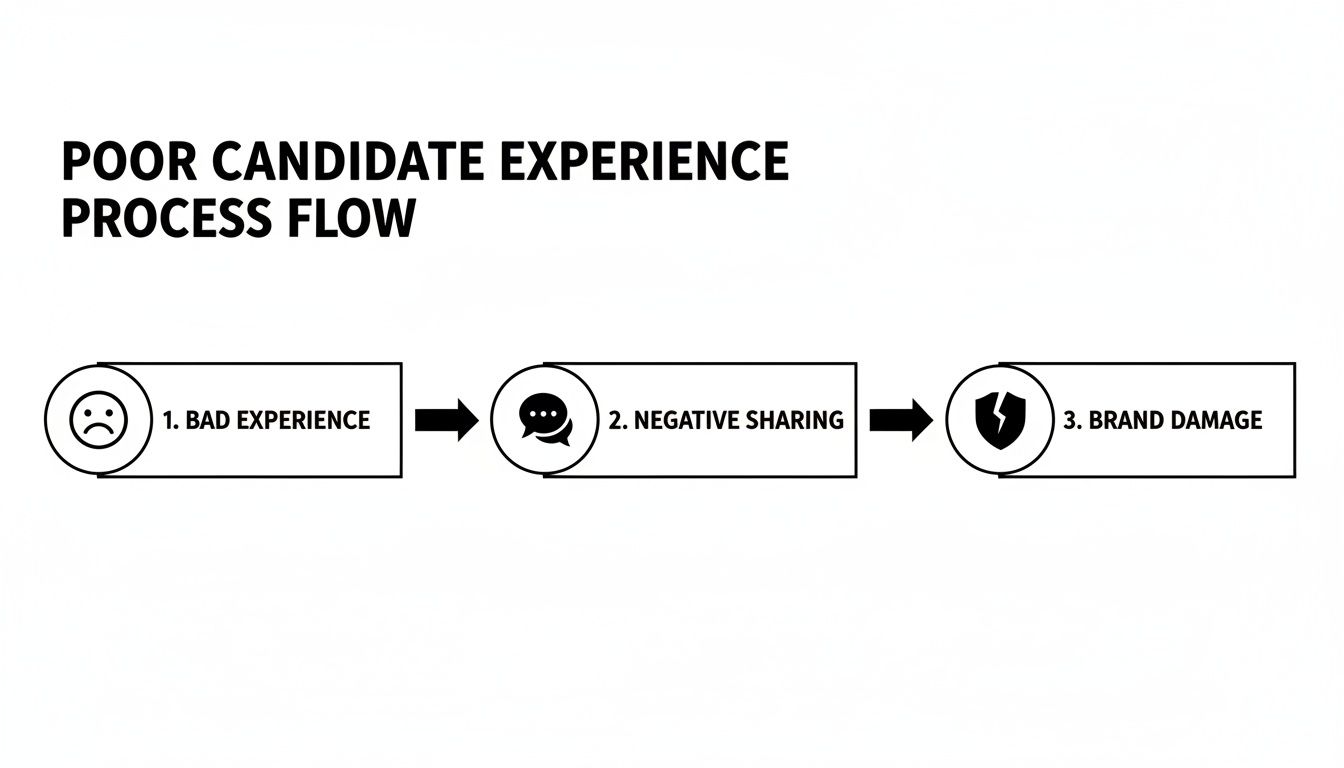
This flowchart says it all. A bad experience leads to negative reviews and word-of-mouth, which ultimately damages your reputation in a competitive talent market.
Using Data to Pinpoint Problems
Walking through the process yourself gives you that qualitative, "I feel their pain" insight. But data gives you the hard proof of where your funnel is leaking. One of the most telling metrics here is your application drop-off rate.
A staggering 41.2% of job candidates abandon their applications halfway through. Think about that—almost half the people interested enough to start an application just give up. It’s a massive loss of talent.
To help you systematically find these issues, use a checklist to guide your audit.
Candidate Experience Audit Checklist
This simple checklist can help you and your team evaluate each stage of your recruitment funnel for the most common issues.
| Recruitment Stage | Key Metric to Track | Question to Ask | Common Friction Point |
|---|---|---|---|
| Awareness & Discovery | Referral source tracking, click-through rate | Is the job description clear, compelling, and inclusive? | Vague or jargon-filled job descriptions that deter applicants. |
| Application | Application completion rate | Does the form work flawlessly on mobile? How long does it really take? | Requiring candidates to manually re-enter their entire work history from their resume. |
| Screening | Time-to-first-contact | How quickly do we acknowledge an application with a personal touch? | The "black hole"—candidates apply and hear nothing for weeks. |
| Interviewing | Time-to-schedule, candidate feedback scores (NPS) | Are interviewers prepared? Is our scheduling process a mess? | Poorly coordinated interviews and inconsistent feedback from the panel. |
| Offer & Rejection | Offer acceptance rate, time-to-fill | Do we send rejections to everyone? Is the offer process transparent? | Ghosting rejected candidates or sending a cold, impersonal rejection email. |
By working through a checklist like this, you move from guessing to knowing exactly where the problems lie.
To truly improve the candidate experience, you have to combine empathy with data. Walk the path yourself to feel the friction, then use metrics like drop-off rates to measure the impact and guide your improvements.
Once you complete this mapping exercise, you'll have a clear, data-backed "friction map." This map is your blueprint for making targeted, effective changes that will actually move the needle.
Nail the Quick Wins for an Immediate Boost

After auditing your candidate journey, it's easy to feel a bit overwhelmed by the list of friction points you've uncovered. The good news? You don't need to rebuild your entire hiring process from the ground up to make a real difference.
Focusing on a few low-effort, high-impact "quick wins" can give your candidate experience an immediate and noticeable lift, often in just a matter of days. These first moves are all about improving clarity and communication. They don't require a big budget or fancy new software—just a bit of empathy and a commitment to treating candidates like valued professionals.
Revamp Your Job Descriptions
Think of your job description as your company's first handshake. All too often, it's a cold, robotic list of demands that scares off great people before they even consider applying. It’s time to change that.
Rewrite your job descriptions to be an invitation, not a filter. Focus on what someone will actually do and achieve in the role and what it’s genuinely like to be on your team. This simple shift reframes the job as an opportunity, not just a set of requirements.
- Ditch the corporate jargon. Write in clear, plain language. If your marketing team wouldn't use a word to talk to a customer, you shouldn't use it here.
- Define what success looks like. Be specific about what a new hire will be expected to accomplish in their first 90 days. This helps them visualize themselves in the role.
- Show your culture, don’t just state it. Instead of saying "fast-paced environment," describe a project or a team dynamic that illustrates it.
Master Your Communication Cadence
Radio silence is the number one killer of candidate experience. Period. Candidates know you're busy, but being left in the dark is frustrating and sends a clear message that you don't value their time.
The fix is surprisingly simple: set and manage expectations at every single stage. Even a quick, automated "no update yet" message shows you haven't forgotten about them. This small gesture builds trust and keeps your talent pipeline from going cold.
A candidate who receives consistent updates feels seen and respected. A candidate who hears nothing assumes the worst about your company’s organization and culture. Small acts of communication prevent major brand damage.
You don't need a high-end system for this. Most modern Applicant Tracking Systems (and even basic email clients) allow you to schedule template-based messages. If you're looking for a system with this capability, our guide on essential applicant tracking system features can point you in the right direction.
Implement High-Impact Email Templates
This might be the single most powerful quick win on the list. Creating a handful of essential email templates ensures every single candidate gets a timely, professional, and consistent response, no matter how chaotic things get.
Start with these three non-negotiables:
- The Instant Application Confirmation: This should go out the second a candidate hits "submit." It confirms you got their application and gives them a realistic timeline for what’s next (e.g., "Our team will review applications over the next week and reach out by Friday if you're a potential match.").
- The "Still in the Mix" Update: For candidates who've interviewed but are waiting, a weekly check-in is a game-changer. A simple, "Hi [Name], just wanted to let you know you're still in consideration. We're finalizing the next round and will have an update for you by [Date]," is all it takes to keep them engaged.
- The Respectful Rejection: Ghosting is never okay. A kind, clear, and professional rejection template is a must for every stage. While detailed, personalized feedback isn't always scalable, a timely "no" is infinitely better than silence.
These aren't just minor tweaks; they're the foundational building blocks of a great hiring process. They signal to every candidate that you are organized, professional, and respectful of their time—setting a positive tone that reflects directly on your brand.
Building an Automated Hiring Engine That Feels Human
Simple fixes and new email templates are great, but they won't get you very far if you're serious about scaling. To really grow your hiring without letting quality slip, you need to build a system. This is where automation and AI stop being trendy buzzwords and start becoming your most important tools for creating a fantastic candidate experience.
The point isn't to replace your team with robots. It’s to get rid of the administrative headaches—the tedious tasks that cause delays, ghosting, and a whole lot of frustration for everyone involved.
When you get it right, automation frees up your team to do the work that actually matters: having great conversations, digging into a candidate’s skills, and building real relationships. A well-designed automated engine takes care of all the repetitive stuff in the background, making sure the human touchpoints are memorable for all the right reasons.
Eliminating the Scheduling Nightmare
Let's be honest, one of the most painful parts of hiring is just trying to get a meeting on the calendar. The endless email chains trying to sync up a candidate with three different interviewers is a huge time-waster and, frankly, a terrible first impression. It makes you look disorganized before you've even had a chance to say hello.
This is where intelligent scheduling tools are an absolute lifesaver.
Platforms like Calendly or Clockwise plug right into your team’s calendars, letting candidates pick a time that works for them with a single click. No more back-and-forth.
This one small change makes a huge difference:
- It gives candidates control. Letting them book their own time shows you respect their schedule.
- It kills delays. You can move a candidate from application to screen within hours, not days, keeping momentum high.
- It frees up your team. Your recruiters and hiring managers can stop playing calendar Tetris and start prepping for a quality interview.
Putting Your ATS to Work with Smart Workflows
Your Applicant Tracking System (ATS) needs to be more than a digital filing cabinet for resumes. Think of it as the command center for your entire hiring operation. Smart workflows are what ensure no candidate ever falls into the dreaded "black hole" of silence.
By setting up automated triggers, you can guarantee clear and consistent communication at every single stage.
The real magic of an ATS workflow is that it forces you to stick to your communication promises. It turns a "we hope to provide a good experience" goal into a systematic reality, protecting your brand even when things get crazy busy.
For example, set up an automation for when a candidate is moved from "Applied" to "Screening." This can trigger a friendly email letting them know what to expect next. When they’re moved out of the process, a respectful rejection email is sent automatically. This systematic approach is the backbone of the best recruitment automation software out there.
Using AI for Instant Answers and Engagement
Today's candidates are used to consumer-grade experiences. They can track a pizza delivery in real-time but are often left completely in the dark about their job application. AI-powered tools like chatbots can fix this by offering 24/7 support.
A simple chatbot on your careers page can instantly answer common questions about benefits, company culture, or the interview process. This gives candidates immediate information and can even help pre-qualify them, making sure your team is talking to the most engaged and informed people.
Unfortunately, most companies are dropping the ball here. A recent report found that 87% of Fortune 500 companies score poorly on AI-driven personalization, and 83% don’t even have chatbots for job recommendations. This is a massive opportunity to stand out from the competition by simply meeting candidates with the tech they already expect.
Building a truly effective system requires a clear plan. Developing a complete roadmap to effective talent acquisition can help you strategically integrate these tools without losing that crucial human connection.
Manual vs. Automated Recruitment Workflows
The difference between a clunky, manual process and a smooth, automated one is night and day. Before we dive deeper, this table clearly illustrates how automation transforms tedious recruitment chores into seamless, positive experiences for candidates.
| Task | Manual Process (High Friction) | Automated Process (Low Friction) |
|---|---|---|
| Application Confirmation | Candidate waits for days, wondering if their application went through. | Instant, automated confirmation email sets clear expectations. |
| Interview Scheduling | Multiple back-and-forth emails over several days to find a time. | Candidate books an available slot in seconds via a sharing link. |
| Status Updates | Recruiter manually emails candidates when they can, causing long silences. | Automated updates are triggered as candidates move between stages. |
| Answering FAQs | Recruiter spends hours answering the same questions over and over. | A chatbot provides instant, 24/7 answers on the careers page. |
| Rejection | Ghosting is common, or a generic email arrives weeks too late. | Timely, respectful, and automated rejection emails are sent. |
As you can see, this isn't about making your hiring process cold or robotic. It's about using technology to handle the logistics flawlessly. That way, every human interaction—from the first call to the final offer—is focused, prepared, and genuinely impactful. This is how you build a hiring process that’s not only efficient and scalable but also feels surprisingly personal and respectful to every single person who applies.
Using Feedback Loops to Continuously Refine Your Process

Here's a hard truth: improving your candidate experience isn't a one-and-done project. You can't just fix a few things, dust off your hands, and call it a day. It’s a living, breathing part of your recruiting function that needs constant attention.
Without a system for gathering feedback, you're essentially flying blind. You might think your new scheduling tool is a hit, but you're just guessing. Building simple, effective feedback loops is how you turn those assumptions into concrete data and create a process that actually gets better over time.
Collecting Candid Feedback at Every Stage
The secret to getting good feedback is asking the right questions at the right moments. Blasting every candidate with a 20-question survey after every single interaction is a surefire way to get ignored. The real magic lies in short, targeted, and often automated surveys at key points in the journey.
And please, don't be afraid to ask for feedback from candidates you’ve rejected. This is where the gold is. They have nothing to lose and are often brutally honest about what felt clunky, confusing, or just plain disrespectful. Their insights are invaluable.
A few high-impact touchpoints I've found work well are:
- Post-Application: A simple, one-question survey—"How easy was it to apply?"—can immediately tell you if your careers page is a source of friction.
- Post-Interview: After their final interview, a quick pulse-check on their interactions with the team and the clarity of the process is incredibly insightful.
- Post-Rejection: A few days after sending a rejection email, trigger an automated survey asking for their unvarnished thoughts on the experience.
The goal here isn't just about data collection. It's about signaling to every single person—hired or not—that you value their time and perspective. That simple act can salvage your employer brand, even when you're delivering bad news.
Key Metrics That Actually Matter
Once feedback starts rolling in, you need a way to measure what’s happening. Vague goals like "make hiring better" are useless. You need tangible numbers to hold yourself accountable.
It's time to move past old-school metrics like Time-to-Fill. That tells you about your efficiency, but it says absolutely nothing about the quality of the experience you provided.
Candidate Net Promoter Score cNPS
The Candidate Net Promoter Score (cNPS) is the single most important metric for this. It’s the gold standard for a reason—it boils everything down to one powerful question:
"On a scale of 0-10, how likely are you to recommend our hiring process to a friend or colleague?"
This number tells you a story. It reveals whether your process is creating fans who will speak highly of your company or detractors who will warn their network to stay away. A rising cNPS is one of the clearest signs that the changes you’re making are actually working.
Offer Acceptance Rate
Your Offer Acceptance Rate is the other critical KPI. If you’re consistently getting top candidates all the way to the finish line only to have them walk away, something is seriously wrong. It’s a massive red flag.
A low acceptance rate can point to all sorts of problems:
- A slow, disorganized interview loop that makes the company seem chaotic.
- Conflicting messages from different interviewers that create confusion.
- A major gap between what the job description promised and what was discussed in the interviews.
Tracking this metric helps you draw a straight line between the improvements you’re making and your ability to close the talent you desperately need. When you get the candidate experience right, you're not just being nice—you're directly impacting your ability to hire the best people.
Answering Your Top Questions on Candidate Experience
Even with a solid plan, I get it—reworking your entire hiring process can seem daunting. Founders and hiring managers I talk to often have the same practical questions, mostly boiling down to cost, time, and the fear of losing that human element.
Let's dig into those real-world concerns that hold B2B and SaaS teams back.
How Can a Small Startup Possibly Afford Hiring Automation?
This is the big one. The good news is, you don't need an enterprise budget. Many modern platforms offer pricing that scales with you, and the trick is to start small and aim for an immediate return on your investment. Please don't try to automate everything at once.
Pinpoint the most tedious, repetitive tasks that eat up your team's day.
- Automated "we've received your application" emails.
- Using a tool like Calendly for scheduling initial calls.
The hours your team gets back almost always outweigh the software cost. Honestly, the cost of not automating—in the form of lost candidates and your engineers' valuable time spent on admin—is almost always much higher.
Won't Automation Make Our Hiring Feel Cold and Impersonal?
It's a valid fear, but when done right, the opposite is true. The whole point isn't to replace human interaction; it's to get rid of the administrative headaches and delays that make candidates feel ignored.
Smart automation ensures every single person gets a timely, professional update at each stage. This frees up your recruiters and hiring managers to spend their time on what truly matters: writing thoughtful outreach, having deep conversations in interviews, and actually building relationships.
Automation is the reliable backbone that allows your team to be more human, not less. It handles the logistics so your team can focus on connection.
If We Can Only Track One Thing, What's the Most Important Metric?
While things like Time-to-Fill are great for measuring internal efficiency, the Candidate Net Promoter Score (cNPS) is the single best measure of the experience itself. It all comes down to one question: "On a scale of 0-10, how likely are you to recommend our hiring process to a friend or colleague?"
That one number tells you if your process is creating advocates or detractors for your brand.
A low cNPS score is a massive red flag that something is fundamentally broken, even if your other efficiency stats look healthy. Tracking it over time is the clearest indicator of whether your changes are actually making a difference from the candidate's point of view. Think of it as the ultimate pulse-check on your employer brand.
At the end of the day, improving your candidate experience is all about a commitment to constant, small adjustments. By tackling these common worries with practical, real-world solutions, you can move forward with confidence. The goal isn't a flawless process overnight; it's about making consistent, thoughtful progress that builds a hiring engine that attracts—and impresses—the best people in your industry.
Tired of watching top talent slip away because of a clunky hiring process? At MakeAutomation, we build the automated recruitment engines that B2B and SaaS companies need to scale. We'll help you implement a seamless, human-centric system that wins over candidates and frees up your team. Book a consultation with us today and let's build your hiring advantage.