
Finding the Best Recruitment CRM Software for Modern Hiring
The best recruitment CRM software isn't just about tracking applicants. It's a strategic tool that blends applicant tracking with proactive relationship-building, letting you cultivate a network of amazing talent long before you even have an open role. Think of platforms like Recruit CRM, Zoho Recruit, and Salesforce—they combine talent pooling, communication automation, and sharp analytics to turn hiring from a frantic, reactive task into a real competitive edge.
What Is Recruitment CRM Software and Why It Matters Now
Ever tried to manage your professional network with a shoebox full of business cards versus a tool like LinkedIn? That’s a good way to think about the difference between a traditional Applicant Tracking System (ATS) and a Recruitment CRM.
An ATS is fundamentally reactive. It’s built to manage a flood of applications for a specific, open job. A recruitment CRM, on the other hand, is designed for the long game. It’s all about building and nurturing a pipeline of talent, continuously.
This proactive approach is a game-changer in today's tight hiring market. Instead of scrambling and starting from scratch every time a position opens up, you can dip into a warm pool of pre-vetted, engaged candidates who already know and like your brand. The payoff is immediate and significant:
- Faster Hiring Cycles: When you have talent on deck, you slash your time-to-hire.
- Lower Hiring Costs: Proactive sourcing means less money spent on expensive job boards and third-party recruiters.
- Improved Candidate Quality: You can connect with top-tier professionals who aren't actively job hunting but are open to the right opportunity.
- Enhanced Employer Brand: Consistent, personalized communication builds a stellar reputation within your talent community.

These tools are now a distinct and critical part of the modern HR tech stack, moving well beyond basic applicant tracking.
The Market Shift to Relationship-Driven Recruiting
The blending of recruitment and CRM technology isn't just a fleeting trend; it's a fundamental evolution of the market. The global recruitment software market was valued at USD 2.38 billion in 2024 and is on a steady growth trajectory. At the same time, the wider CRM market is projected to hit over USD 262 billion by 2032.
This massive scale is directly influencing hiring tools. We're seeing major CRM players shape recruitment workflows with powerful integrations and AI-driven features, making relationship-based hiring the new standard.
A recruitment CRM turns your talent database from a static archive into a dynamic, living ecosystem. It empowers you to build relationships at scale, ensuring your next great hire is already in your network.
From Data Entry to Strategic Asset
At the end of the day, the right recruitment CRM transforms your talent acquisition function from a reactive, administrative chore into a proactive, strategic powerhouse. You’re no longer just filling empty seats. You’re building a community of talent that can fuel your company’s growth for years to come.
If you understand the basics of what customer relationship management is, you can see how perfectly those principles apply to nurturing potential hires. This foundational shift is precisely why a recruitment CRM has gone from a "nice-to-have" luxury to a core component of any modern hiring engine.
The Essential Features of Top Recruitment CRMs
When you start digging into the best recruitment crm software, it's easy to get overwhelmed by endless feature checklists. But let’s cut through the noise. The platforms that truly move the needle aren't just about having the longest list of features; they're about having the right ones that fuel a proactive, relationship-first hiring strategy.
Think of it this way: a basic tool is just a digital filing cabinet. A great recruitment CRM is an engagement engine. Let's break down the critical features that separate the workhorses from the show ponies.
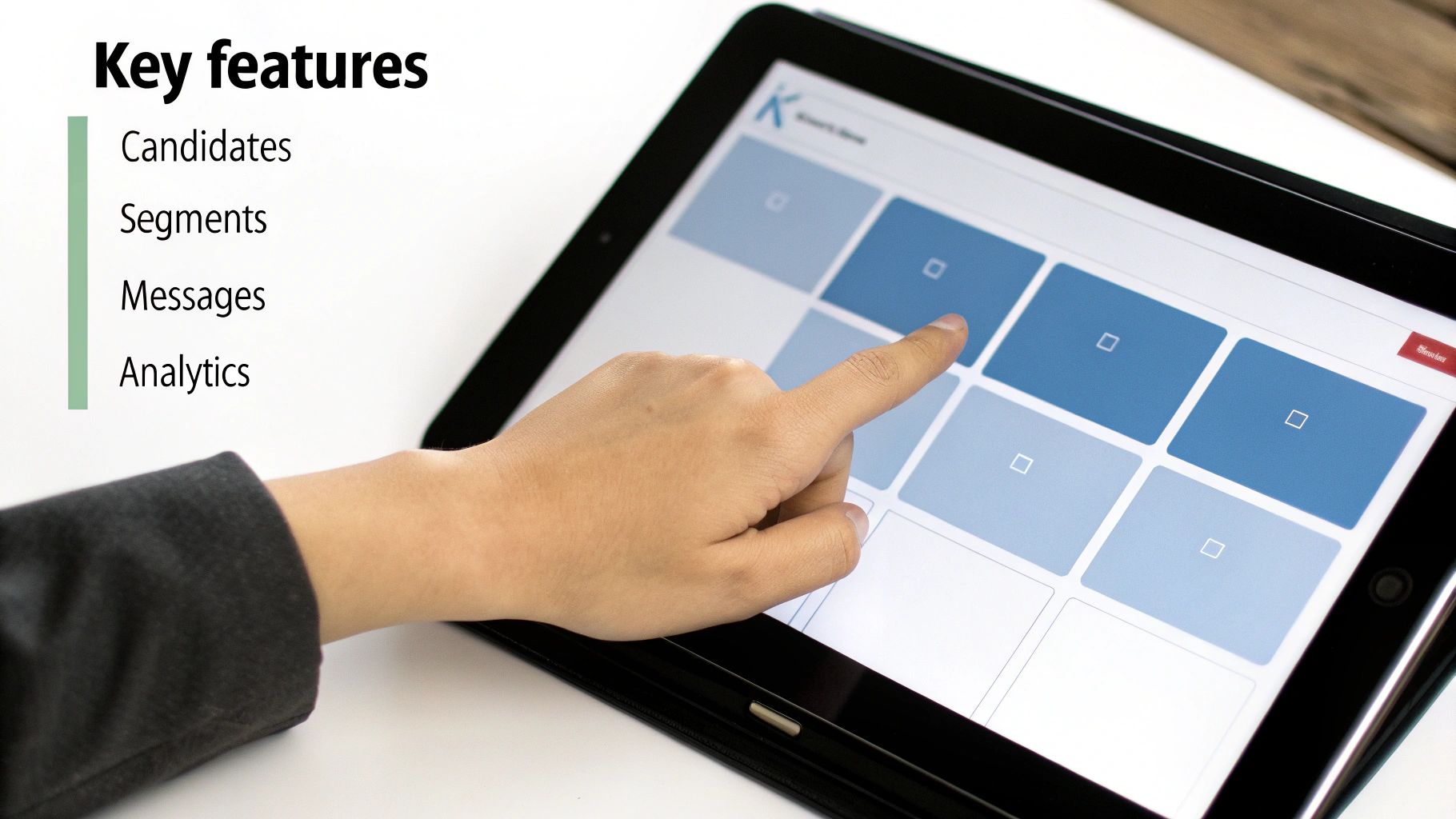
Talent Pooling and Segmentation
At its core, a recruitment CRM is built on the idea of creating and organizing talent pools. This isn't just a list of past applicants. It's your own private, high-quality network of talent—people who might not be looking right now but are perfect for your company down the line.
But a giant, unsorted list is useless. The magic is in segmentation. This is where you slice and dice your talent pools based on criteria that actually matter to your business.
- Skills & Experience: Group candidates by Python developers, certified project managers, or those with 5+ years of SaaS sales experience.
- Location: Easily build pipelines for your Austin office or your global remote workforce.
- Engagement Level: Tag candidates who recently opened an email versus those you haven't spoken to in a year.
- Past Roles: Keep track of your "silver medalists"—those amazing candidates who were the runner-up for a previous role. You don't want to lose them.
Good segmentation turns your passive database into a searchable, active pipeline. You can find the perfect person in minutes, not days.
Multi-Channel Communication Tools
Today's talent expects to be reached on their terms. The best recruitment CRMs act as a central command center for all your outreach, letting you connect with people where they are—all from one screen. This stops messages from getting lost in different inboxes and keeps your company's voice consistent.
Look for a system that brings these channels together:
- Integrated Email: Not just sending emails, but sending personalized bulk messages and tracking who’s opening and clicking.
- SMS/Text Messaging: Incredibly effective for quick updates, interview reminders, or time-sensitive messages.
- Social Media Integration: Connect with and message talent directly on platforms like LinkedIn without leaving the CRM.
This unified approach ensures no one falls through the cracks and helps your team build real relationships with timely, relevant conversations.
Automated Nurturing Campaigns
Here’s where you get a massive return on your investment: automated nurturing campaigns. These are pre-built sequences of messages that keep your talent pools engaged over time, all without you lifting a finger. It's the key to staying top-of-mind.
Imagine that "silver medalist" from six months ago getting a relevant industry article or a quick note about a new company project. When a new role opens up that’s a perfect fit, you’re already on their radar. That’s the power of nurturing.
For instance, you could create a campaign for a "Future Marketing Leaders" talent pool. The system could automatically send them your company's monthly newsletter or an alert anytime a senior marketing position is posted. This is how you keep your pipeline from going cold.
Advanced Analytics and Reporting
If you can't measure it, you can't improve it. A top-tier recruitment CRM gives you powerful analytics that go way beyond just counting applicants. It gives you the intelligence to see what's working and what isn't.
Your reporting toolkit absolutely must include:
- Source Effectiveness: Finally get a clear answer on which channels (job boards, referrals, sourcing efforts) actually deliver the candidates you hire.
- Pipeline Health: Get a visual snapshot of your entire hiring process to spot bottlenecks before they become major problems.
- Time-to-Hire Metrics: Track exactly how long it takes to fill roles, helping you set realistic expectations with hiring managers.
- Recruiter Performance: See key activity metrics for your team to understand who is excelling and where coaching might be needed.
These insights are gold. They help you build a business case for your strategy, optimize your spending, and make smart decisions that directly support the company's growth.
Choosing a system with these core functionalities ensures you’re getting a strategic asset, not just another piece of software. To help visualize the difference, here’s a breakdown of what you typically find in basic versus advanced systems.
Core Feature Comparison for Recruitment CRMs
This table breaks down the essential features across different tiers of recruitment CRMs, helping you spot the must-haves for your team's needs.
| Feature | Basic (ATS-Hybrid) | Advanced (True Recruitment CRM) | Why It Matters for Growth |
|---|---|---|---|
| Talent Pooling | Simple contact list attached to job requisitions. | Dynamic, searchable talent pools independent of open roles, with custom tagging and segmentation. | Allows you to build proactive pipelines and source for future needs, drastically reducing time-to-hire. |
| Communication | Basic, one-off email templates. | Integrated multi-channel outreach (email, SMS, social) with tracking and personalization at scale. | Engages candidates on their preferred platforms, leading to higher response rates and a better candidate experience. |
| Automation | Simple alerts (e.g., new applicant). | Fully automated, multi-step nurturing campaigns ("drip campaigns") triggered by candidate behavior or time. | Keeps your talent network warm and engaged without manual effort, ensuring you're top-of-mind when the right role opens. |
| Analytics & Reporting | Basic reports (e.g., number of applicants per job). | Advanced dashboards tracking source effectiveness, pipeline velocity, recruiter activity, and candidate engagement scores. | Provides the data-driven insights needed to optimize your hiring strategy, justify budget, and prove the ROI of your recruitment efforts. |
| Candidate Experience | Functional but often clunky; focused on applying. | Seamless journey from first touchpoint to application, with personalized communication and easy scheduling. | A superior candidate experience is a huge competitive advantage, attracting top talent and strengthening your employer brand. |
As you can see, the jump from a basic system to a true recruitment CRM is significant. It’s the difference between managing applicants and strategically building a talent pipeline that becomes a long-term competitive advantage for your business.
How AI and Automation Are Redefining Recruitment
Artificial intelligence and automation aren't just buzzwords anymore; they’re the engine powering the best recruitment CRM software on the market. These technologies are fundamentally changing how companies find, engage, and ultimately hire top talent. We've moved way beyond simple task management and into the realm of intelligent, predictive workflows.
Think of it this way: traditional recruiting often feels like fishing with a single line, just hoping the right candidate happens to swim by. AI and automation, on the other hand, give you a smart, wide net that actively finds the best talent pools and pulls the most qualified people straight to you. This is so much more than just parsing resumes faster—it’s about making genuinely smarter decisions at every step.
Moving Beyond Keywords to Predictive Insights
For a long time, "AI in recruiting" just meant pulling keywords from a resume to see if it matched a job description. That’s helpful, sure, but it's a pretty narrow view of a person's actual potential. Today's recruitment CRMs use AI for far more sophisticated tasks that create a real competitive edge.
Here’s where advanced AI is making a tangible impact:
- Intelligent Candidate Sourcing: AI algorithms are constantly scanning millions of profiles across professional networks, niche job boards, and public databases. They can pinpoint ideal passive candidates—people who fit your profile perfectly but aren't even looking for a job yet.
- Predictive Fit Scoring: By learning from the data of your past successful hires, AI can score new applicants on their likelihood to not only succeed in a role but also thrive in your company culture. This helps cut through unconscious bias and directs your attention to high-potential individuals.
- Communication Sentiment Analysis: Some AI tools can even analyze the tone of email exchanges between your recruiters and candidates. This gives you incredible insight into engagement levels and can flag someone who might be losing interest, giving you a chance to re-engage them before it's too late.
These features give your team a level of insight that was previously impossible. You end up spending your valuable time on the candidates who are most likely to become your next great hires.
Practical Automation Playbooks That Save Time
If AI provides the intelligence, automation is what executes the strategy at scale. It’s the workhorse that tirelessly handles all the repetitive, time-sucking tasks, freeing up your recruiters to focus on what they do best: building real human relationships.
Automation in a recruitment CRM isn't about replacing recruiters. It's about empowering them to be more human by removing the robotic, administrative tasks that drain their time and energy.
Imagine setting up automated workflows, or "playbooks," that run 24/7 in the background. A classic example is a "Passive Candidate Nurturing" playbook. Once you add a promising but not-yet-ready candidate to a talent pool, the system can automatically send them relevant company news, interesting industry articles, or simple check-in emails every few months. This keeps your brand top-of-mind, so when the perfect role finally opens up, you're not starting from scratch—the relationship is already warm. To get a deeper understanding of the available tools that make this possible, you can check out our guide on the best AI tools for recruitment.
The Growing Influence of AI on CRM Technology
The rush to integrate AI into recruitment CRMs mirrors a much larger trend. The AI in CRM market is projected to be a USD 11.04 billion industry by 2025 and is expected to soar to USD 48.4 billion by 2033. Research also shows that effective CRM use can improve customer retention by up to 27%—a principle that applies directly to recruiting by boosting candidate engagement and preventing talented people from dropping out of your pipeline.
For anyone making a purchasing decision, this means the best recruitment CRM software will be the one that uses AI for genuine workflow automation, not just for spitting out analytics.
Ultimately, all this technology comes together to create a far better candidate experience. When interviews are scheduled automatically, feedback is delivered on time, and every communication feels personalized, top-tier talent notices. That's how you build a powerful employer brand that attracts the best people organically. To delve deeper into specific tools transforming the hiring landscape, you can explore leading recruitment automation software and see what's possible for your team.
A Practical Framework for Choosing Your Recruitment CRM
Let's be clear: there's no single "best" recruitment CRM out there. The right platform for a high-octane staffing agency will feel like overkill for a nimble startup. The key isn't finding a one-size-fits-all solution but finding the one that fits your company's unique DNA. This framework is all about helping you make that choice with confidence.
First things first, you need to take an honest look at your current hiring process. Don't just gloss over it—map out every single step, from how you first find a candidate to the moment they're onboarded. Document the tools you're already using, how much time gets eaten up by manual work, and where communication constantly seems to fall apart.
This self-audit is your blueprint. Without it, you’ll just be wowed by flashy demos and features that don’t actually solve your real-world problems, and that’s an expensive mistake.
Start with Your Company Size and Hiring Volume
The scale of your organization is the biggest filter you have. It instantly narrows the field because the needs of a five-person team are worlds away from a global enterprise.
Here’s a simple way to think about it:
- Startups & Small Businesses (1-50 employees): You need something that just works. Your priorities are ease of use, affordability, and the core features to keep candidates organized. Look for platforms you can set up in an afternoon without calling in an IT specialist.
- Mid-Sized Companies (50-500 employees): As you grow, things get more complicated. Now, you need to think about how the CRM plays with other tools (like your HRIS or calendars), what kind of reports you can pull, and how much automation you can build. Your CRM has to support a team of recruiters and hiring managers working together.
- Large Enterprises (500+ employees): At this level, it's all about scalability, security, and deep customization. You're dealing with thousands of candidates, so you need a system with granular user permissions and powerful analytics that can track everything from recruiter performance to the ROI of a specific job board.
This flowchart gives you a quick visual to see where you might land, especially if you have big plans for growth.
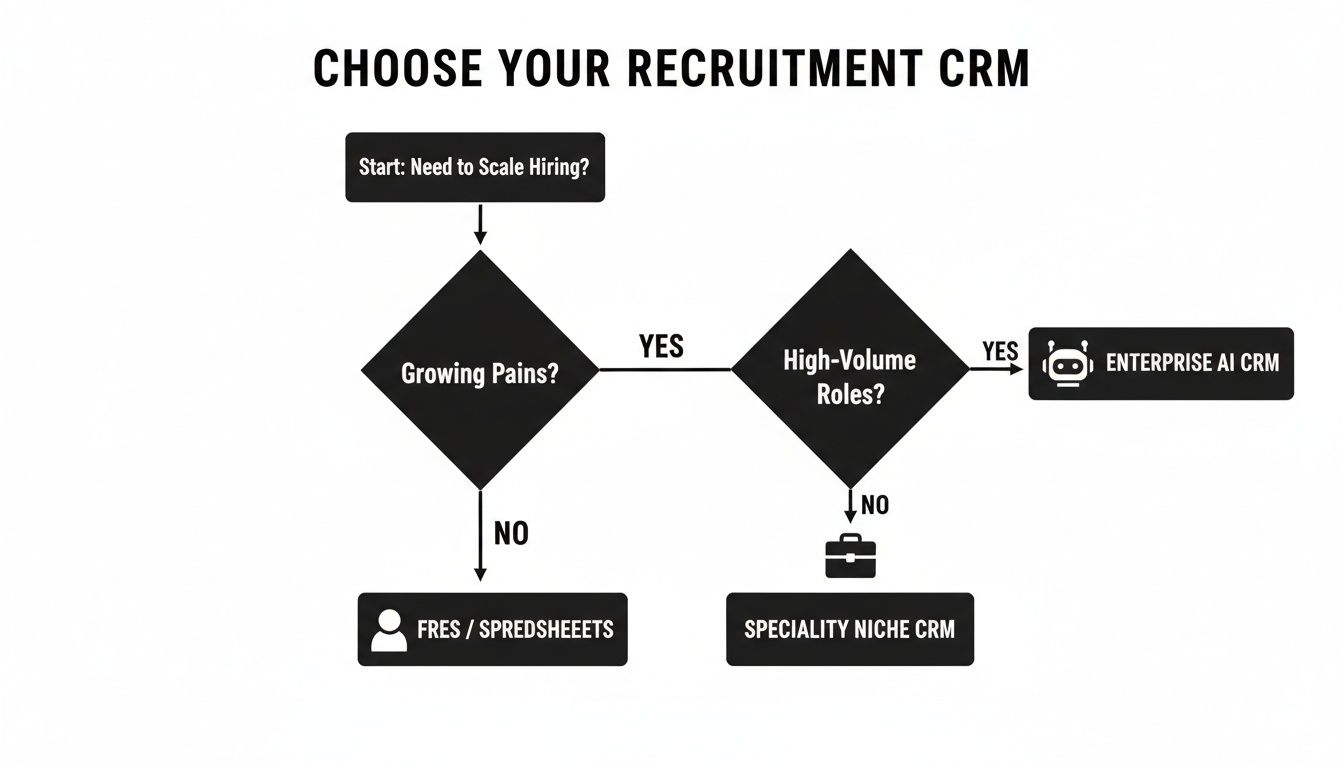
As the graphic shows, the moment you decide to seriously scale your hiring efforts, you've outgrown basic tools. It's time to look at specialized, and often AI-powered, platforms.
Define Your Non-Negotiable Integration Needs
A recruitment CRM doesn't live on an island. It has to connect seamlessly with the other software your team uses every single day. Before you start looking at demos, make a simple checklist of your absolute "must-have" integrations.
Think of your tech stack like a puzzle. Your new recruitment CRM is the big piece in the middle that has to connect perfectly with everything else—your email, calendars, ATS (if you're keeping it), and HRIS. If the pieces don't fit, the whole picture falls apart.
At a minimum, you should be thinking about:
- Communication Tools: Does it sync flawlessly with Google Workspace or Office 365? Nothing is more frustrating than a calendar or email inbox that's out of sync.
- Sourcing Platforms: Can it pull candidates directly from LinkedIn Recruiter or your favorite job boards without a bunch of manual copy-pasting?
- Existing HR Systems: Will it talk to your main HRIS or payroll software? Avoiding duplicate data entry is a huge time-saver.
A bad integration isn't just a minor headache; it's a productivity black hole that creates messy data and makes your team's job harder. Don't compromise on this.
Focus on Scalability and Future Growth
Finally, try to look past what you need right now. The best recruitment crm software for you today should still be the right one in three years.
Ask potential vendors some tough questions about growth. How does their pricing change when your team doubles? Can the platform handle a sudden 10x increase in your candidate pipeline without slowing down? A CRM that can't grow with you is just a temporary fix, not a long-term investment.
This kind of forward-thinking is critical. The global market for this software, sitting at around USD 10.8 billion in 2024, is on track to more than double by 2034. This boom is fueled by automation and AI, with cloud platforms expected to make up nearly 59% of the market by 2025. Choosing a scalable, cloud-based system means you're investing in a solution built for the future. You can dig into more talent acquisition software trends here.
If you need a hand mapping all these requirements to the right platform and building an implementation plan, the experts at MakeAutomation can offer a tailored consultation to get you started.
Measuring the True ROI of Your Recruitment CRM
So, you're thinking about investing in new tech. To get the green light from leadership for the best recruitment CRM software, you need to speak their language. That means getting past the cool features and talking dollars and cents—specifically, Return on Investment (ROI). It's all about showing how the platform translates into real financial gains and a genuine strategic edge.
Figuring out the ROI of a recruitment CRM isn't about one magic formula. It’s a mix of tangible cost savings you can count and other valuable, long-term benefits that are just as crucial. Let's break it down into two parts: the numbers-driven "hard ROI" and the equally important "soft ROI."
Calculating the Hard ROI Metrics
Hard ROI is all about the concrete data that directly hits the bottom line. These are the numbers that show up on financial reports and make your business case undeniable. Your calculations here should focus on doing more with less and cutting direct costs.
Here are the key metrics you’ll want to track:
- Reduced Time-to-Hire: When you have a pool of warm, engaged candidates ready to go, you can fill roles much faster. To prove this, track the average number of days it takes to fill a role before and after you get the CRM up and running. Remember, every day a key position sits empty, it's costing the company in lost productivity or revenue.
- Lower Cost-per-Hire: Building your own talent pipeline is a game-changer for your budget. One of the biggest wins from a recruitment CRM is the ability to reduce your recruitment cost per hire, since you'll spend far less on expensive job boards and agency fees.
- Improved Recruiter Productivity: Think about all the time your team spends on manual data entry and sending follow-up emails. Automation takes that off their plate, freeing them up for the stuff that really matters. You can measure this by looking at the number of candidates sourced, interviews scheduled, or roles filled per recruiter each month.
To get started with these calculations, our guide on how to calculate return on investment provides some practical formulas you can easily adapt for your own team. Having these figures ready gives you a powerful, data-backed argument.
Measuring the Equally Important Soft ROI
While hard numbers are your foundation, they don’t paint the full picture. Soft ROI is where you capture the strategic benefits that make your company stronger and more competitive down the road. You might not be able to put a simple dollar value on these, but their impact on growth is huge.
Think of soft ROI as investing in your company’s reputation. A great candidate experience today builds a powerful employer brand that attracts top talent organically tomorrow, creating a self-sustaining hiring advantage.
Here are a few of the key soft benefits:
- Enhanced Candidate Experience: A smooth, communicative hiring process leaves a great impression on everyone, even the people you don't hire. This boosts your offer acceptance rates and can turn unsuccessful applicants into future customers or brand advocates.
- Stronger Employer Brand: When your outreach is consistently professional and engaging, you start to build a reputation as a great place to work. A strong brand makes it far easier to attract those high-quality passive candidates who aren't even actively looking for a new job.
- Better Hiring Decisions: With all your candidate data and analytics in one place, recruiters and hiring managers can spot trends and make much more informed choices. This ultimately leads to better hires who stick around longer and make a bigger impact.
When you make your case, combining these hard financial wins with the compelling strategic benefits creates an argument that's tough to ignore. You're not just asking for a new tool; you're laying out a plan to build a smarter, more efficient, and more powerful talent engine for the entire company.
Your Step-By-Step Implementation Playbook
Let's be honest: rolling out a new recruitment CRM is about changing habits, not just installing software. If you want this tool to become the engine of your hiring process instead of just another forgotten subscription, you need a smart plan. This playbook is your roadmap to a smooth and successful launch.

Before you even think about software settings, get your team in a room with a whiteboard. Your first job is to map out your current hiring workflow, warts and all. Pinpoint every manual task, every communication breakdown, and every source of frustration. This isn't just an exercise; it's a treasure map that shows you exactly where the CRM can make the biggest difference.
With your process mapped, you can set real, measurable goals. Forget vague ambitions like "improve hiring." Get specific. Aim to cut your time-to-hire by 15% or boost qualified candidates from direct sourcing by 25%. These numbers will be your north star during setup and will be crucial for proving the ROI down the line.
Data Migration and Team Onboarding
Moving your existing candidate data is often the part everyone dreads. The single most important thing you can do here is clean your data before you import it. Get rid of duplicates, standardize job titles, and archive anyone you haven't spoken to in years. A clean slate ensures your new system is a reliable source of truth from the very beginning.
Next up is training, and a simple feature walkthrough won’t cut it. Your training needs to be rooted in the day-to-day reality of your recruiters. Show them how the CRM solves the exact problems you identified in your mapping session. Role-play common tasks, like adding a new passive candidate or starting a nurture campaign, to make the training stick.
Successful implementation hinges on adoption. If your team sees the CRM as a tool that makes their jobs easier and more effective, they will embrace it. If they see it as just more administrative work, it will fail.
Automation and Initial Campaigns
Once your team is up and running, it's time to unleash the power of automation. Don't try to build a complex, multi-stage masterpiece right away. Start small with high-impact workflows that deliver immediate value. Automating interview scheduling or creating a simple welcome sequence for new talent pool members are fantastic places to begin.
Ready for a quick win? Launch a mini-playbook to nurture passive candidates you already have in your system. Here’s a simple three-step strategy you can run this week:
- Segment Your Audience: Create a special talent pool for your "Silver Medalists"—those high-potential candidates who were a great fit but didn't land a past role.
- Launch a Simple Drip Campaign: Start with a two-email sequence. The first email could share a relevant industry article or a cool company update. A month later, a second email can just be a simple, human check-in to stay on their radar.
- Track Engagement: Use your new CRM to watch the open and click rates. This simple campaign not only gets you using the tool but immediately demonstrates the value of building relationships.
Following a structured plan like this ensures you don't just launch your best recruitment crm software—you weave it into the very fabric of how you hire. For expert help designing and building these custom automation playbooks, the team at MakeAutomation can provide both strategy and hands-on support.
Frequently Asked Questions
Diving into the world of hiring software can feel overwhelming, so let's clear up some of the most common questions. Here are some straightforward answers to help you navigate recruitment CRMs.
What Is the Main Difference Between an ATS and a Recruitment CRM?
Think of it this way: an Applicant Tracking System (ATS) is your digital filing cabinet. It’s built to manage people who have already applied for a specific, open job. It's a reactive tool—someone applies, and the ATS helps you track them through the hiring process for that one role.
A Recruitment CRM, on the other hand, is your relationship-building engine. It’s a proactive tool designed for the long game. You use it to nurture connections with a whole community of talent—including promising people who aren't even looking for a job right now. The goal is to have a pipeline of warm, engaged candidates ready to go before a position even opens up.
Can a Small Business Benefit from a Recruitment CRM?
Absolutely. In fact, for a small business, a recruitment CRM can be a game-changer. It’s how you compete with the big guys without a massive recruiting budget. Instead of starting from scratch and paying for expensive job ads every time a key role opens up, you can build your own private talent pool.
This proactive approach helps you punch way above your weight. Plus, getting a scalable system in place early on saves you from massive headaches with data migration and process changes as your company grows.
It's a common myth that CRMs are just for big corporations. The reality is they give smaller teams the power to build a high-quality talent pipeline that would otherwise take a much larger recruiting staff to manage.
How Much Technical Work Is Involved in Integrating a Recruitment CRM?
It really depends on what you need it to do. Most modern recruitment CRMs are designed to be user-friendly right out of the box. You can expect simple, often one-click, integrations with the tools you already use every day, like Google Workspace, Office 365, and the major job boards.
Where it can get more complex is with deeper integrations, like connecting to your main HR system or setting up custom automation workflows. This is why it’s so important to map out your hiring process before you choose a tool. If you're planning a more advanced setup, bringing in an expert can save you a lot of time and frustration.
Ready to turn your recruitment CRM into a powerhouse with custom automation that saves time and supercharges your hiring ROI? The team at MakeAutomation specializes in building the exact workflows that make your software a true strategic asset. Get started with a consultation today.