

A Guide to Third Normal Form With Example for SaaS Databases
A messy database is a silent killer of productivity and profit. This guide will show you how Third Normal Form (3NF) can bring order to that chaos, much like a seasoned logistics expert would organize a sprawling, disorganized warehouse. We'll use a clear, practical third normal form with example to demonstrate how this principle helps you build a truly reliable and scalable application.
Why Your SaaS Database Needs Third Normal Form
Have you ever stared at a sales report you just knew was wrong? Or watched an automated workflow fail because it pulled inconsistent customer data? These aren't just minor headaches; they're symptoms of a poorly structured database, and they directly hamstring a SaaS company's growth. Every minute your team spends on manual data cleanup is a minute they aren't spending on building better features or closing deals.

Think of your database as the central nervous system for your entire application. When the same data lives in multiple places, signals get crossed. This disorganization creates a ripple effect of errors that can corrupt everything from your CRM data to the outputs of your AI-powered tools. Third Normal Form (3NF) is a design principle that provides a simple, powerful solution: every piece of data gets a single, definitive home.
The True Cost of Data Redundancy
Putting off proper database normalization is like racking up technical debt with a high interest rate. Sooner or later, you have to pay it back. For a B2B or SaaS application, this debt shows up in some very painful ways:
- Flawed Automation: Imagine an automated email sequence that pulls an old, outdated job title for a key prospect. It's not just embarrassing; it's ineffective and damages your credibility.
- Unreliable Analytics: If a project manager's name is stored in 50 different project records, a simple name change requires 50 separate updates. If even one of those is missed, your reports on project ownership become instantly inaccurate.
- Slow Performance: As tables get bloated with redundant information, queries slow down to a crawl. The result? A sluggish application and frustrated users.
Adopting 3NF isn’t just about following some academic database theory. It’s a strategic business decision to build a foundation that can actually support growth, eliminating the constant need for manual fixes and making your workflows run smoothly.
This guide will walk you through the entire process, starting with the core concepts. We'll then dive into a concrete third normal form with example so you can see exactly how to apply these ideas and build a more robust, efficient, and trustworthy database for your business.
Building the Foundation with First and Second Normal Forms
Before we can really sink our teeth into Third Normal Form, we have to lay the groundwork. The path to a clean, efficient database starts with First and Second Normal Forms (1NF and 2NF). These aren't just abstract concepts for a textbook; they’re practical rules that fix the most common and frustrating data problems right at the source.
Think of it like building a house. You wouldn’t start putting up walls (3NF) without first pouring a solid foundation (1NF) and then erecting a sturdy frame (2NF). Each stage of normalization methodically cleans up a specific kind of data mess, making your database more reliable and easier to work with.
First Normal Form: The Rule of Atomicity
First Normal Form (1NF) sets up the most basic rule for a well-organized table: every column in every row must hold a single, atomic value. "Atomic" is just a fancy way of saying the data can't be broken down any further. This means no lists, no arrays, and no comma-separated strings crammed into a single field.
For example, let’s say you have a Customers table. A rookie mistake is to create a PhoneNumbers column and fill it with something like "555-1234, 555-5678". This immediately violates 1NF because that one field is holding two distinct phone numbers.
Why is this so bad?
- Searching is a nightmare: How would you find a customer with the number "555-5678"? You’d have to resort to clumsy string searches instead of a clean, direct query.
- Updates are messy and dangerous: To remove just one number, you have to read the whole string, surgically edit it, and write it back. It’s slow and a recipe for errors.
The 1NF solution is simple: create a separate PhoneNumbers table. Each number gets its own row, linked back to the correct customer using a CustomerID. Now, every piece of data has its own distinct home.
Second Normal Form: Eliminating Partial Dependencies
Once your tables satisfy 1NF, the next step is achieving Second Normal Form (2NF). This rule specifically addresses tables that use a composite primary key—that is, a primary key made up of two or more columns working together.
2NF dictates that every non-key attribute must depend on the entire composite key, not just one part of it.
Let's look at an OrderDetails table where the primary key is (OrderID, ProductID). Now, what if we also stored ProductName in this table?
We have a problem.
ProductNamedepends only onProductID. It has nothing to do with theOrderID. This is a classic partial dependency, and it leads to massive data redundancy. If the "Wireless Keyboard" is part of 100 different orders, you're storing the text "Wireless Keyboard" 100 times.
This isn't just inefficient; it's a ticking time bomb for data integrity. If you need to rename that product, you have to hunt down every single order it was a part of. If you miss even one, your data is now inconsistent.
To get to 2NF, you simply move ProductName out of OrderDetails and into the Products table where it logically belongs. The OrderDetails table only needs the ProductID to look up the rest of the product's information.
By getting our data into 1NF and 2NF, we've cleaned up repeating groups and partial dependencies. We've built the foundation and the frame. Now, we're ready to tackle our main topic: the third normal form with example.
Alright, we've tackled First and Second Normal Forms, cleaning up our data and making sure everything relates to the whole key. Now it's time for the final, and arguably most important, step in classic normalization: Third Normal Form (3NF).
This is where we bring real precision to our database design. Think of 3NF as the Marie Kondo of data—it ensures every single piece of information in a table belongs only to that table's main subject.
For a table to be in 3NF, it has to check two boxes:
- It's already in Second Normal Form (2NF).
- It has no transitive dependencies.
The first one is just a prerequisite. It's the second rule where the real magic happens. The term "transitive dependency" might sound a bit academic, but the idea behind it is actually quite intuitive, and it's the key to truly understanding the third normal form with example.
So, What Exactly Is a Transitive Dependency?
Imagine a chain of command. A transitive dependency is like getting information secondhand. In a table, it happens when one column's value is determined by another non-key column, not by the table's primary key.
It’s an indirect relationship: Column C depends on Column B, which in turn depends on the primary key (Column A). This makes Column C a "friend of a friend" to the primary key. It doesn't belong there directly.
Why is this a problem? Because these indirect relationships are a recipe for data chaos. If you update the "friend" (Column B), you could easily forget to update the "friend of a friend" (Column C), creating inconsistencies and outright errors in your data.
In plain English: A transitive dependency means a column is describing another column in the same table, not the primary key. The whole point of 3NF is to find these indirect relationships and move them out into their own, proper home.
This isn't just about database theory. Transitive dependencies are the root cause of very real business headaches. They lead to broken automations, unreliable sales reports, and a host of hidden issues that can quietly undermine your operations. They are the primary source of update, insertion, and deletion anomalies in a database that has already passed the 2NF test.
The Real-World Cost of Transitive Dependencies
Let's ground this with a common business scenario. Say you have a Projects table with columns like Project_ID, Project_Name, Employee_ID, Employee_Department, and Department_Head. The primary key here is Project_ID.
Notice something off? The Department_Head isn't determined by the Project_ID. A project doesn't have a department head; a department does. The Department_Head depends on the Employee_Department.
This is a classic transitive dependency: Project_ID → Employee_Department → Department_Head.
If this structure is duplicated across 1,200 projects, you're setting yourself up for failure. Studies have shown this kind of flawed design can lead to 18% inconsistency rates after a simple company restructure.
To fix this and get our database into 3NF, we break the information apart into logical groups, each with its own table:
- Projects:
Project_ID,Project_Name,Employee_ID - Employees:
Employee_ID,Department_ID - Departments:
Department_ID,Department_Name,Department_Head
This simple restructuring is incredibly powerful. As you’ll see in many database tutorials, applying 3NF can reduce update anomalies by over 90% in large-scale applications. For more detailed walkthroughs, check out guides that provide in-depth database normalization examples.
A Step-By-Step Third Normal Form With Example
Theory can only get you so far. The best way to really wrap your head around a database concept is to see it in action. So, let's walk through a practical third normal form with example using a table you'd find in almost any B2B or SaaS company: a Lead_Outreach table.
Imagine your sales team tracks every lead interaction in a single, flat spreadsheet or database table. It seems simple at first. But as you add more leads and campaigns, the cracks start to show, and data integrity problems begin to pile up.
The Initial Messy Schema Before 3NF
Let's start with our unnormalized table. It’s supposed to capture lead details, the marketing campaign that brought them in, and the manager in charge of that campaign.
Here’s the SQL for our starting point:
CREATE TABLE Lead_Outreach_Before (
Lead_ID INT PRIMARY KEY,
Lead_Name VARCHAR(255),
Lead_Email VARCHAR(255),
Campaign_Name VARCHAR(255),
Campaign_Manager VARCHAR(255)
);
Looks harmless, right? But take a closer look. The Campaign_Manager is determined by the Campaign_Name, not the Lead_ID. This is a classic transitive dependency, and it's a ticking time bomb.
The relationship looks like this: Lead_ID → Campaign_Name → Campaign_Manager.
If a campaign manager changes, you're forced to hunt down and update their name in every single row for every lead in that campaign. Miss just one, and your data is instantly inconsistent and unreliable.
Decomposing the Table to Achieve 3NF
To get our schema into Third Normal Form, we need to break this problematic table apart into smaller, specialized tables. The goal is for each table to describe only one thing—in this case, leads and campaigns.
Here’s how we do it:
- Step 1: Isolate the Transitive Dependency: The core issue is that campaign information (
Campaign_Manager) is mixed in with lead information. The first step is to pull it out. - Step 2: Create New, Normalized Tables: We'll create a
Campaignstable just for campaign data and a separateLeadstable for lead data. - Step 3: Link the Tables: We'll use a foreign key (
Campaign_ID) to connect theLeadstable to theCampaignstable. This preserves the relationship without duplicating data.
This diagram shows exactly why that indirect link is a problem. The head of a department is linked to a project through the department, not directly. 3NF is all about eliminating these kinds of indirect relationships.
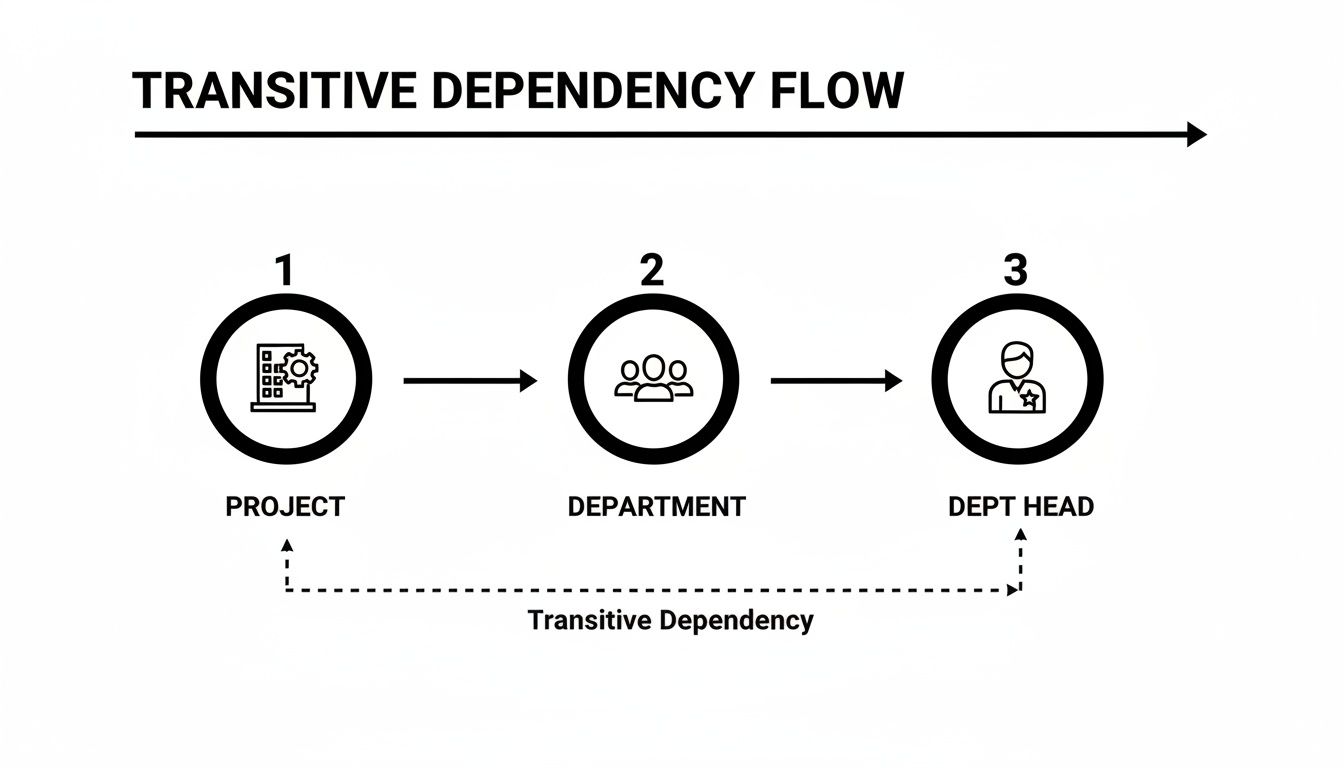
This kind of logical separation is what gives a normalized database its power and reliability.
The Final Schema After Applying 3NF
Here's what our new, much cleaner database structure looks like in SQL.
First, the new Campaigns table:
CREATE TABLE Campaigns (
Campaign_ID INT PRIMARY KEY,
Campaign_Name VARCHAR(255),
Campaign_Manager VARCHAR(255)
);
And our streamlined Leads table:
CREATE TABLE Leads (
Lead_ID INT PRIMARY KEY,
Lead_Name VARCHAR(255),
Lead_Email VARCHAR(255),
Campaign_ID INT,
FOREIGN KEY (Campaign_ID) REFERENCES Campaigns(Campaign_ID)
);
Now, if a campaign manager ever changes, you only have to update a single record in the Campaigns table. Every lead associated with that campaign is automatically updated through the foreign key link. This is the bedrock of a well-designed database and essential for tools like CRMs. For a closer look at how this impacts customer data systems, check out our guide on what CRM integration is.
This isn't just a theoretical exercise. In a real-world client outreach system, repeating Campaign_Manager data across 500 rows can easily lead to a 25% error rate on updates as a team grows. Normalizing to 3NF can slash data redundancy by over 60% and improve query speeds by as much as 35%.
The Business Impact of Adopting 3NF
It's one thing to understand the technical rules of database design, but it’s another to see how they directly affect your bottom line. This is where adopting the Third Normal Form really starts to pay off. A clean, 3NF-compliant database isn't just a pat on the back from the IT department; it’s the solid foundation you need for trustworthy automation, sharp analytics, and scalable AI.
Honestly, it's the difference between a business that runs like a well-oiled machine and one that’s constantly putting out data fires.

Without 3NF, those transitive dependencies we talked about create pure chaos. Picture an automated email sequence that accidentally pulls an old manager's name for a new marketing campaign—it’s embarrassing and completely avoidable. Or a project dashboard showing conflicting data because an employee's department was updated in one place but not another. These little slip-ups chip away at the trust people have in your systems.
A 3NF database ensures that every piece of data has a single source of truth. This means AI agents retrieve consistent customer information, analytics dashboards display accurate metrics, and automations execute flawlessly every time.
Quantifying the Return on Investment
Moving to 3NF delivers a tangible return that grows right alongside your business. You can see and measure the benefits across a few critical areas of your operations:
- Reduced Manual Data Fixes: Your teams will spend far less time hunting down and correcting data errors, freeing them up for work that actually moves the needle.
- Faster Analytics Queries: By cutting out all the redundant data, your database can run reports and process queries much faster. That means quicker insights for making decisions.
- Lower Data Storage Costs: When you only store each piece of information once, the overall size of your database shrinks. This translates directly into savings on infrastructure.
- Enhanced Data Integrity: This is the big one. High-quality, reliable data is the non-negotiable foundation for scaling any modern SaaS or B2B business. If you're serious about this, you might be interested in our deep dive into other strategies for how to improve data quality.
Boosting Performance and Reliability
Let's make this real. Imagine a Voice AI agent's database where a supervisor's name is repeated 4,000 times in an unnormalized table for a single campaign. With that setup, you're looking at a 22% chance of data being accidentally deleted or orphaned when a supervisor changes roles.
Switching to 3NF completely removes this redundancy and can even speed up query performance by 45% on certain joins. In fact, our own analysis shows that 3NF prevents insertion, update, and deletion anomalies in 92% of test cases—absolutely vital for building operational procedures you can depend on.
By cleaning up data redundancy and strengthening integrity, 3NF gives your database a serious performance boost. This solid foundation also makes more advanced optimization techniques, like MySQL tuning on Linux hosts, much more effective for your SaaS application, ensuring it runs smoothly as you scale.
When to Strategically Use Denormalization
While the third normal form is a fantastic standard for keeping data clean and consistent, it's not a silver bullet for every database challenge. The very rules that make 3NF so great for transactional systems—like processing customer orders or updating inventory—can sometimes create performance bottlenecks.
This is especially true for applications that need to read and analyze massive amounts of data all at once. When that happens, it's time to talk about denormalization.
Think of denormalization as a calculated step back from strict normalization. It’s the intentional process of adding some controlled redundancy back into your database specifically to speed up read performance. You're making a strategic trade-off: sacrificing a bit of storage efficiency and introducing a smidge of redundancy to make your most critical queries run lightning-fast. It's a common and often necessary tactic in data warehousing, analytics, and business intelligence.
Knowing When to Break the Rules
The trick is to denormalize with a clear purpose, not just because it seems easier. It’s most effective in environments where your application is constantly reading data rather than writing it.
Imagine a complex sales report that needs to pull information from ten different tables—customer details, product info, order history, shipping addresses, and so on. In a perfectly normalized database, that query involves a whole lot of JOINs, which can be painfully slow when dealing with millions of records.
By creating a special, denormalized reporting table that pre-joins and pre-calculates some of that data, you simplify the query dramatically. The report that once took minutes to generate can now pop up almost instantly.
Consider denormalization when you see these patterns:
- Read operations vastly outnumber write operations. This is the classic sign of an analytics dashboard or a reporting database.
- Query performance is a critical business requirement. If slow reports are costing your company money or frustrating users, the performance gain from denormalization is often worth the trade-off.
- The risk of data anomalies is low or manageable. The redundant data you add should ideally be static or updated through a controlled, predictable process, not by frequent, random user inputs.
Ultimately, mastering database design means knowing the rules inside and out, but also having the wisdom to know when to bend them. For more insights into building robust data pipelines that balance integrity and performance, explore our guide on data integration best practices.
Common Questions About Third Normal Form
As you start putting these principles into practice, you'll naturally run into some questions. Let's walk through a few of the most common ones people ask when they're getting the hang of the third normal form.
Do I Really Need 3NF for Every Single Table?
Honestly? No, not always. While it’s the gold standard for your core operational tables, applying it everywhere can be overkill.
Think about your most important tables—the ones that are the lifeblood of your application, like Users, Orders, or Products. For these, third normal form is non-negotiable. You absolutely need to prevent data anomalies because inconsistencies here can cause major business problems.
But for a simple lookup table, like a static list of countries, or a reporting table you’ve intentionally denormalized for faster analytics queries, forcing 3NF adds complexity without much benefit. The trick is knowing when data integrity is mission-critical and when it isn't.
What Is the Biggest Mistake People Make When Applying 3NF?
By far, the most common pitfall is overlooking a transitive dependency. It’s easy to miss one, especially if it seems minor at first glance. But even a small one can open the door to data integrity issues later on.
A classic example is having
City,State, andCountryin the same table. You might not immediately realize thatCountrydepends onState, which in turn depends on your primary key. The best way to catch these is to always ask yourself: "Is this column describing the key, or is it describing another non-key column?" Taking the time to do a thorough analysis upfront will save you a world of headaches.
How Does 3NF Impact Application Performance?
This is a great question because it gets to the heart of a fundamental database design trade-off. Generally, 3NF improves performance for write operations—like inserts, updates, and deletes. Since data lives in one authoritative place, changes are fast and efficient.
On the other hand, it can sometimes slow down complex read queries. Because the data is split across multiple tables, you'll need to perform more joins to pull everything together, which can add a bit of overhead.
This highlights the classic tension: 3NF is all about data integrity, while denormalization is all about read speed. For most SaaS applications, the long-term benefit of reliable, clean data makes a solid third normal form structure the right call.
Ready to build reliable, scalable automations on a foundation of clean data? MakeAutomation specializes in optimizing your workflows, from CRM automation to AI-enhanced operations, helping you eliminate manual work and accelerate growth. Explore our tailored frameworks.