
B2B Lead Generation Funnel: Stages and Metrics That Work
Most funnel advice tells you to get more leads. I'd tell you to stop until you can prove what happens to the leads you've already got. A B2B lead generation funnel isn't a volume contest. It's a set of measurable state changes, each with a written rule, an owner, and an elapsed time. When those rules don't exist, extra volume doesn't create pipeline. It hides the leak.
Why Lead Capture Is Not Commercial Progress
A high lead count can conceal a broken funnel. A B2B team may capture plenty of contacts while buyers encounter inconsistent messages, wait too long for follow-up, or exit before sales recognizes their intent.
A 2015 McKinsey analysis of B2B sales organizations found that B2B customers regularly used six different interaction channels during the decision journey, and approximately two-thirds of deals were lost before a formal request-for-proposal process began. Form fills alone therefore say little about whether buyers are progressing toward a purchase.
Where prospects actually exit
A prospect can lose confidence when the offer changes between touchpoints. The website promises one outcome, an email emphasizes a different problem, and a sales call presents a third scope. The contact may stop replying, leaving the CRM with no clear record of what caused the exit.
Consider a SaaS team with strong demo volume and flat revenue. Its dashboard looks healthy because reporting starts at lead capture. Buyers who research through peers, review sites, and comparison content may enter the CRM late, after they have shortlisted another provider. Lead volume can look strong even as the path from initial interest to a real sales conversation breaks down.
Lead capture is an event, not progress. Progress is a contact changing state for a defined reason that the CRM can record.
Channel quality affects who enters the funnel. If you're building search visibility to feed the top of the funnel, favor acquisition sources that attract buyers who fit your profile, because low-quality traffic fills stage one with contacts who were never going to qualify. For another perspective on search acquisition, a founder's guide to safer backlinks covers backlink practices. Teams that use lead generation and prospecting interchangeably should clarify the distinction in lead generation compared with prospecting, so ownership of the handoff and its success criteria are clear.
Measure the journey through channel consistency, pre-RFP engagement, qualification speed, and conversion to revenue. Those measures help locate where interest stops becoming a sales opportunity, instead of treating more captured contacts as proof of commercial progress.
The Six Stages of a B2B Lead Generation Funnel
Think of your funnel as a sorting line, not a storage bin. Each checkpoint makes one decision. Does this contact move forward, go to nurture, or leave the line? The size of the pile at any checkpoint matters far less than whether the sorting rule is right.
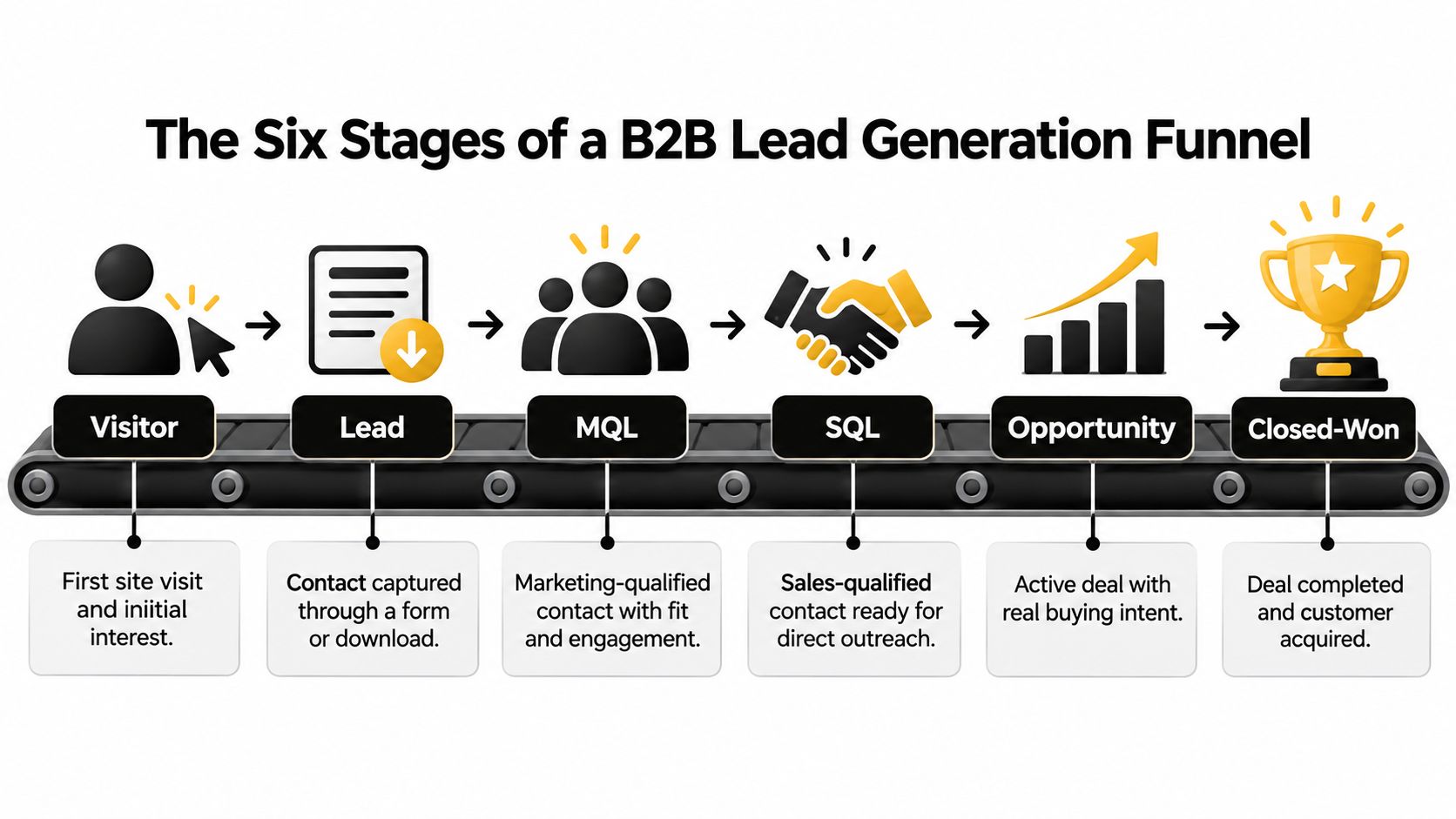
The six stages run in this order. Visitor, Lead, MQL, SQL, Opportunity, Closed-Won. That's the spine. Everything else in your system, scoring, routing, nurture, reporting, hangs off whether these six boundaries are written down and enforced in the CRM.
What each checkpoint decides
A visitor becomes a lead when they submit contact details through a form, chat, or download. That lead becomes an MQL when its fit score passes the threshold you agreed with sales and it shows real engagement, such as visiting pricing or product pages rather than only downloading a top of funnel guide. An SQL exists when sales has validated a problem worth solving plus a budget or a timeline. Not interest. Not a polite meeting. A confirmed need with money or urgency behind it.
The opportunity stage starts when there's a qualified buying process and a named decision maker. Closed-won means a signed contract and a handoff to onboarding, not a verbal yes in a forecast call.
| Stage | Entry rule | Exit signal | Owner |
|---|---|---|---|
| Visitor | Anonymous session on a key page or content piece | Identified through a form, chat or enrichment | Marketing |
| Lead | Contact details captured | Scored and passes basic fit rules | Marketing operations |
| MQL | Fit score and engagement threshold met | Accepted by sales or routed for qualification | Marketing, with sales agreement |
| SQL | Sales confirms need, budget or timing | Meeting or opportunity created | Sales development |
| Opportunity | Qualified buying process with a named decision-maker | Proposal sent, then won or lost | Account executive |
| Closed-won | Contract signed | Handoff to onboarding | Account executive and customer success |
Why the rules must live in the CRM
Stage boundaries written as opinions produce arguments. Marketing calls a contact qualified because it hit a score. Sales calls it junk because nobody confirmed a budget. Both are describing the same record with different definitions, and the contact sits still while they debate.
Written CRM rules end that. Entry rule, exit signal, owner. If a field doesn't satisfy the rule, the stage doesn't change, no matter how optimistic someone feels in a pipeline review.
If marketing and sales can't point to the same field values and reach the same stage decision, you don't have a funnel. You have two funnels sharing a database.
The mistake I see most often is teams skipping the SQL checkpoint entirely. MQLs flow straight into opportunities, the opportunity count looks impressive, and then deals stall because nobody ever confirmed budget or timing. You've inflated your pipeline by removing the filter that made it meaningful.
If you want a broader view of how these stages connect to campaign planning, the SubmitMySaas guide to marketing funnels from SubmitMySaas walks through funnel construction from the campaign side, which pairs well with the operational rules here. Keep the table above as your reference. The action plan at the end shows you how to write these rules into your own CRM this week.
Channels That Feed Each Funnel Stage
Channels don't have value in isolation. A channel earns its budget by feeding a specific stage well. Map each one to the checkpoint it serves, and you'll immediately see which stages you're overfeeding and which you're starving.
Matching channels to stages
- Search and educational content: Brings in visitors who are still defining the problem. Judge it on qualified traffic, not raw sessions.
- Comparison and proof pages: Captures buyers actively checking vendors against each other. Unclear claims can cost you the shortlist spot.
- Email nurture: Moves captured leads toward fit by answering objections in sequence. It works on leads and early MQLs, not as a substitute for sales qualification.
- Webinars, trials, and calls: Confirms intent. A trial signup or a technical deep dive is the kind of engagement that justifies moving an MQL toward SQL.
- Outbound and referrals: Reaches accounts that haven't identified themselves yet. Referrals in particular skip early stages because trust arrives pre-built.
- Sales-led proof: Case studies, implementation plans, and security documentation support opportunities where a buying group needs internal ammunition.
Structured, specific claims matter more than they used to on comparison pages. In IDC's 2026 analysis of buyer behavior, 68% of buyers report using AI always or often during evaluation to compare products and features across vendors, and 77% characterize their most recent B2B purchase as highly complex. If your feature claims are buried in vague marketing copy, AI comparison tools will summarize you inaccurately or skip you, and the multiple stakeholders behind a complex purchase will each find a different version of your story.
Capturing buyers before they identify themselves
Most of the journey happens where your CRM can't see it. The 2026 B2B Buyer Behavior Report from Consensus reports that B2B buyers spend only about 17% of the journey in direct contact with suppliers, while 61% prefer a rep-free buying experience. Anonymous research, peer validation, and internal business case work never touch your funnel stages. You capture that demand with useful gated resources at the moment a buyer needs depth, comparison content they can circulate internally, and consented retargeting that keeps you present without demanding a conversation they don't want yet.
Complexity also means your channels serve different people. The technical evaluator enters through documentation and trials. The economic buyer enters through a peer referral or an ROI focused webinar. Write a message for each, but keep the underlying positioning, claims, and pricing logic identical across website, email, and calls. Prospects leave when the story changes.
End this mapping with a simple checklist. One owner per channel. One approved message each owner must use. If a channel has no owner, it has no stage accountability, and it will drift.
Response Speed and Automation Touchpoints
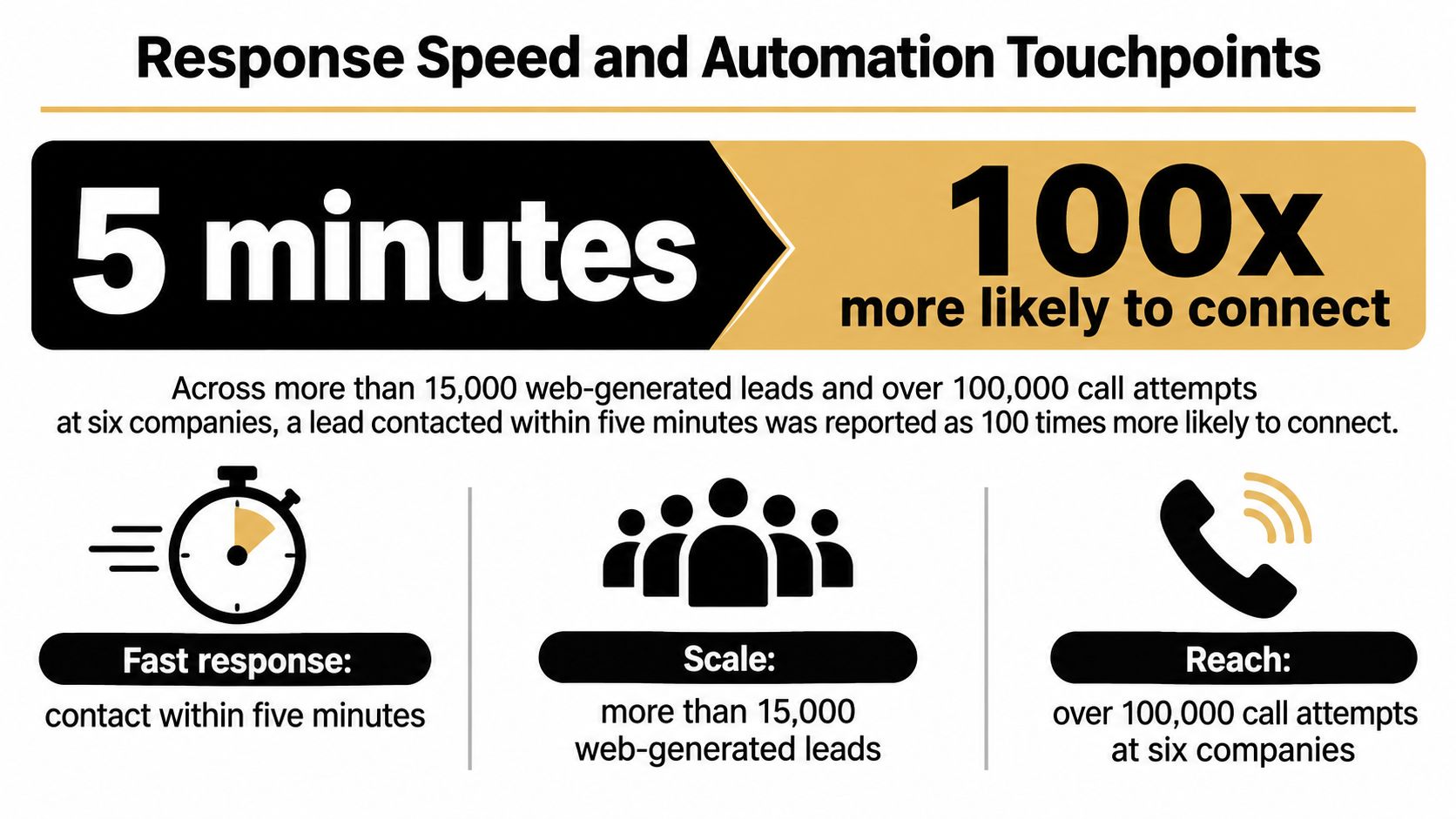
Speed is the most influential control point in the entire funnel, and the difference between fast and slow is significant. The Lead Response Management study analyzed more than 15,000 web-generated leads and over 100,000 call attempts across six companies, and leads contacted within five minutes were reported as 100 times more likely to be reached and 21 times more likely to enter the sales process than leads contacted after 30 minutes.
Intent decays fast after an inbound conversion. The person who requested your demo is, at that moment, comparing you with two competitors in other tabs. Every minute you wait increases the chance they book with someone else, lose urgency, or get pulled into a meeting and forget you entirely.
The automation sequence in order
Build the response as an event-driven chain that fires on submission, not as a task someone remembers to do.
- Enrich and score on arrival. Append firmographic data and calculate intent score before a human touches the record.
- Route to the correct owner. Territory, segment, and account rules decide ownership instantly. Unassigned leads are where speed dies.
- Send an immediate acknowledgement. Confirm receipt and offer a booking link while the prospect is still on your site.
- Start parallel follow-up. Email, SMS, or a voice agent workflow runs alongside the human owner, so contact doesn't depend on one person's calendar.
- Move non-bookers into nurture. In our B2B SaaS lead workflow, leads are enrolled in nurture sequences if they do not book within 24 hours, so silence triggers a defined path instead of a forgotten record.
Capacity is the usual constraint behind slow response. If your reps can't cover inbound volume at this speed, adding headcount is one option, and teams evaluating that route often look at how to hire sdrs through LatHire. But hire into a defined routing process, not instead of one. More people working an undefined queue just produces faster chaos. The mechanics differ by segment too, and the specifics for lead generation in technology companies show how routing rules change when buyers are technical evaluators.
Measure speed honestly
Average response time is a flattering lie. A team can average twelve minutes while a fifth of leads wait three hours, and those outliers are exactly where deals die. Measure p50 and p95 time to first contact, plus contact rate, qualification rate, and opportunity creation broken out by response-time cohort.
Then test it properly. Run a controlled experiment comparing sub-five-minute routing against 30-minute-plus routing while holding source, industry, and lead score constant. A B2B SaaS company losing deals because its sales team could not respond to demo requests fast enough is the classic case this experiment diagnoses. Don't assume an automated response inside 60 seconds performs the same as a human one, either. Test that variant separately and let qualification rate, not contact rate alone, decide.
Metrics to Track at Every Transition
A single lead-to-revenue percentage is nearly useless. It tells you the funnel underperforms without telling you where, which means every team blames a different stage and nothing gets fixed. Measure the funnel as state transitions, one conversion rate and one elapsed time per boundary.
| Transition | Metric | Why it matters |
|---|---|---|
| Visitor to lead | Conversion rate by source and page | Shows which content captures identities |
| Lead to MQL | Conversion rate and elapsed days | Reveals scoring that is too loose or too strict |
| MQL to SQL | Acceptance rate by source | Shows whether marketing and sales agree on fit |
| SQL to opportunity | Conversion rate and days to create | Tests how fast qualification happens |
| Opportunity to won | Win rate and days to close | Measures revenue, not volume |
| Lead response | p50 and p95 time to first contact | Exposes slow routing that averages hide |
This transition view is already common practice among disciplined teams. The Demand Gen Report and MX Group attribution survey reports that 47% of marketers track mid-funnel progression through MQLs, SQLs, opportunities, and closed/won deals, and 57% of marketers use both sourced and influenced attribution approaches. Reporting both matters, and the section below explains why.
The recording rules behind trustworthy numbers
Define explicit stage-entry and stage-exit rules in the CRM, then calculate conversion and elapsed time for every transition. That's what stops a flood of weak leads from masking poor qualification. Your visitor-to-lead rate can look excellent while MQL-to-SQL acceptance collapses, and only transition metrics expose that.
Preserve these fields as fixed event data on every record.
- Source and campaign: So you can judge channels by revenue contribution, not clicks.
- Account and persona: So buying group activity rolls up instead of scattering across contacts.
- Intent signal and enrichment confidence: So a scored guess is never mistaken for confirmed data.
- Owner and disqualification reason: So stalled and rejected leads teach you something instead of vanishing.
Your approach to lead scoring determines whether the lead-to-MQL transition means anything, because a threshold nobody validated against SQL acceptance is just a number that makes reports look busy.
On attribution, sourced attribution credits the first or last touch that created the record. Influenced attribution credits the touches that contributed along the way. Use sourced to judge acquisition efficiency and influenced to judge whether nurture and proof content move deals. Either one alone misleads you.
Finally, run cohort analysis. Group leads by channel, firmographic fit, response speed, and engagement, then compare which combinations produce revenue. Automate anomaly flags on stage conversion and recycle stalled opportunities into nurture automatically. Cohorts show you where revenue comes from. Form fill counts never will.
A SaaS Funnel Rebuilt Around Response Speed
The image below captures the starting point accurately. A team watching demo requests arrive faster than anyone can answer them.

This B2B SaaS company wasn't short of demand. Qualified prospects were requesting demos and going cold because the sales team couldn't respond fast enough. The funnel problem wasn't generation. It was everything after the form.
Step one fixed the stage rules
The rebuild started with definitions, not tools. For this client, we designed a 4-stage sales pipeline after SQL covering opportunity, proposal, negotiation, and closed-won, with automated stage advancement so records moved when defined conditions were met instead of when someone remembered to drag a card. Every stalled contact now had a named owner and a stage rule it had failed to satisfy.
This order matters. You can't route a lead to an owner your stage rules don't define. Teams that buy routing automation before fixing stage definitions end up delivering leads faster to people who still disagree about what qualified means.
Steps two and three fixed speed and rescue
Second, demo request routing was rebuilt so the correct owner was alerted and the prospect contacted immediately on submission. Measured against this step, the client's lead response time was reduced by 40%.
Third, we built 12 automated nurture sequences for leads who didn't book. These rescued contacts the sales team couldn't reach on the first attempts, keeping them in a defined path instead of letting them age out in an unworked list. Nurture only pays off at this point in the sequence. Once speed stops leads going cold in the first hour, nurture handles the ones who need weeks.
The short walkthrough below shows how the rebuilt flow moves a request from submission to booked meeting.
The combined result was a 3x improvement in demo booking rate alongside that 40% faster response. State the limits plainly, though. These figures come from one client and one rebuild. The gains depended on clean stage rules and an accurate CRM underneath the automation. A team with duplicate records, missing owners, and undefined disqualification reasons would automate its own mess and get a smaller return.
Automation multiplied a funnel that was defined first. It would have multiplied the confusion just as efficiently if the definitions had come second.
Ask three questions about your own setup. Where do demo requests wait today, and for how long at p95? Which stage has no named owner? Which single nurture sequence would rescue the most leads you're currently abandoning? Your answers locate your rebuild's starting point.
Confirm Your Stages Before You Automate
Everything above reduces to one discipline. Fix the stage rules first, then automate. Tools purchased before the audit get configured around your current disagreements, and you'll pay to rebuild them within a year.
Your audit for this week
- Write the rules. One entry rule, one exit rule, and one owner for each of the six stages, entered as CRM logic so marketing and sales judge the same contact the same way.
- Pull your real response times. Median and 95th percentile time to first contact for the last 90 days. Not the average.
- Pick the weakest transition. Choose the boundary with the lowest conversion and the longest elapsed time. That's your constraint.
- Run a 30-day test on that transition only. Change one variable, such as routing speed or the MQL threshold, and leave everything else alone.
- Review cohort results before buying anything. If the test cohort doesn't produce more SQLs or opportunities, a new tool won't rescue the idea.
The output is a one-page map. Stage rules, owners, current p50 and p95 response times, and the chosen test, all on a single page your whole revenue team can argue with productively. If it doesn't fit on one page, your definitions aren't finished.
For context on what implementation looks like after an audit, our HubSpot consulting process runs in five phases covering discovery and audit, strategy and roadmap, implementation, training and documentation, and optimization and support. Timelines scale with scope. Basic HubSpot setup takes 1-2 weeks, marketing automation implementation 3-4 weeks, full CRM migration with sales pipeline setup 4-6 weeks, and complex multi-hub implementations with custom integrations 8-12 weeks. Every engagement starts with a free 15-minute discovery call, followed by mapping the client's critical workflows.
Start with the audit whether or not you hire anyone. A one-page map built from your own CRM data will tell you more about your funnel than another quarter of top of funnel spend.
If your audit shows undefined stages, slow p95 response times, or leads dying between handoffs, MakeAutomation can rebuild the system underneath, from CRM stage rules and lead routing to follow-up sequences and pipeline reporting. Start with a free 15-minute discovery call where we map your critical workflows and identify the transition costing you the most revenue. Bring your one-page stage map, or come without one and we'll build the first version together.