
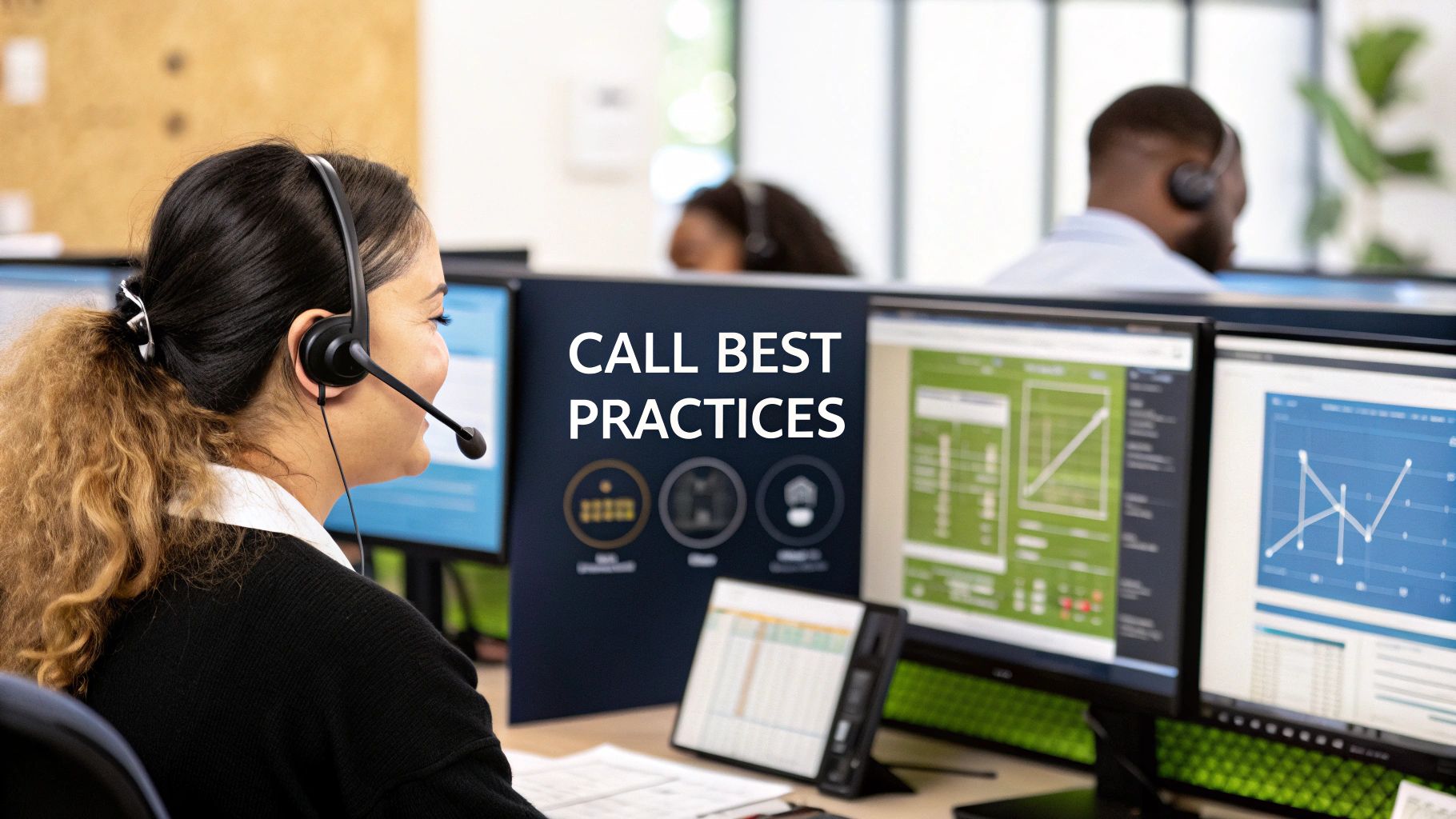
10 Essential Call Handling Best Practices for B2B Teams in 2025
In the competitive B2B and SaaS landscape, every conversation is an opportunity to build trust or lose a customer. While many teams rely on outdated, generic scripts and reactive problem-solving, high-growth companies are adopting a more strategic approach. The difference lies in mastering specific call handling best practices that transform routine interactions into powerful engines for revenue and retention. A single poor call experience can erase months of marketing effort, while a well-managed one can secure a high-value client for years.
This article moves beyond surface-level advice to provide a detailed, actionable roundup of 10 essential practices your team can implement today. We're not just telling you what to do; we're showing you how with practical examples, implementation checklists, and fresh perspectives on established techniques. This guide is designed to be a definitive resource for any B2B or SaaS leader aiming to build a scalable, efficient, and customer-centric communication framework.
You will learn how to:
- Develop dynamic scripts and leverage active listening for genuine connection.
- Implement intelligent call routing and real-time quality monitoring.
- Integrate CRM systems for seamless documentation and data-driven insights.
- Empower agents with the authority to solve problems on the first call.
- Automate post-call follow-ups to nurture long-term relationships.
By adopting these proven call handling best practices, you can reduce churn, shorten sales cycles, and create a consistently exceptional customer experience that sets you apart from the competition. Let’s dive into the strategies that will redefine your team's performance.
1. Call Preparation and Scripting
Effective call handling begins long before the phone rings. A core principle of modern call handling best practices is meticulous pre-call preparation and the development of structured, yet flexible, scripts. This approach equips agents with the context, confidence, and consistency needed to manage interactions effectively, significantly boosting first-contact resolution rates and customer satisfaction. It involves a systematic review of customer history, defining clear objectives for the call, and outlining key talking points.

This foundational practice reduces the cognitive load on agents, allowing them to focus on active listening and problem-solving rather than scrambling for information. By standardizing the initial framework of a conversation, businesses ensure that every customer receives the same high-quality, on-brand experience, regardless of which agent they speak to.
How to Implement Call Preparation and Scripting
Implementing a robust preparation protocol is a multi-step process that integrates technology and strategy. For instance, integrating your CRM, like Salesforce, with your telephony system can automatically surface a customer’s entire interaction history, recent support tickets, and purchase data the moment a call connects. This gives agents immediate, actionable context.
For outbound sales teams, platforms like HubSpot offer extensive libraries of customizable call script templates that can be adapted for various scenarios, from cold outreach to follow-up calls. These templates provide a proven structure that can be personalized for each prospect.
Actionable Tips for Success
To maximize the impact of your preparation and scripting efforts, consider these strategies:
- Build Modular Scripts: Create a "script library" with interchangeable components (greeting, discovery questions, objection handling, closing) that agents can assemble to fit the specific context of a call. This promotes natural conversation over robotic recitation.
- Leverage AI for Insights: Use call intelligence platforms like Gong to analyze thousands of recorded calls. AI can identify phrases, questions, and pacing used by your top-performing reps, providing data-backed insights to refine your scripts.
- Establish a Review Cadence: Scripts are not static. Set a quarterly review to update talking points, address new customer objections, and incorporate feedback from your sales and support teams.
- Focus on Product-Pain Point Alignment: For SaaS teams, ensure your scripts explicitly connect specific product features to the prospect's identified pain points. For example, if a prospect mentions workflow inefficiency, the script should guide the agent to discuss automation features.
2. Active Listening and Empathy-Driven Communication
Beyond simply hearing words, effective call handling involves a deep commitment to active listening and communicating with genuine empathy. This crucial call handling best practice shifts the focus from a transactional, solution-first mindset to one of relational understanding. It requires agents to fully concentrate, understand, respond, and then remember what the customer is saying, allowing them to uncover unarticulated needs and build foundational trust.
This approach transforms customer interactions from mere support tickets or sales pitches into meaningful conversations. By demonstrating that they truly understand the customer's context and emotional state, agents de-escalate frustration, foster loyalty, and create opportunities to deliver more precise and impactful solutions. This is especially vital in B2B SaaS, where complex problems require a deep grasp of the customer's unique business challenges.
How to Implement Active Listening and Empathy
Implementing this practice requires a cultural shift supported by structured training and technology. For example, Zappos famously builds its entire service model on creating personal emotional connections, empowering agents to spend as long as needed on a call to resolve an issue and build rapport. Similarly, many successful SaaS customer success teams use frameworks like HubSpot’s MEDDIC methodology, which integrates deep discovery and active listening to understand customer metrics and pain points before ever discussing a solution.
On the technology front, tools that provide customer sentiment analysis can offer real-time feedback on the emotional tone of a conversation, helping agents adjust their approach. Integrating these insights into your quality assurance scorecards ensures that empathy isn't just a talking point but a measurable performance metric.
Actionable Tips for Success
To embed active listening and empathy into your team's DNA, consider these strategies:
- Train on the RASA Model: Implement training based on Julian Treasure's RASA framework: Receive (pay attention), Appreciate (make affirming sounds), Summarize (restate for clarity), and Ask (ask clarifying questions).
- Integrate Empathy into QA: Update your quality assurance scorecards to include specific metrics for empathy, such as using empathetic statements, validating customer concerns, and asking clarifying questions about their challenges.
- Conduct Role-Playing Scenarios: Create regular training sessions where agents role-play difficult customer conversations. This provides a safe environment to practice and receive feedback on active listening and empathy skills.
- Align Pain Points with Features: For B2B sales and support, train agents to actively listen for specific business pain points (e.g., "we're wasting too much time on manual reporting") and then explicitly connect those pains to a product feature (e.g., "our automated dashboard feature was designed to solve that exact problem").
3. Call Routing and Intelligent Queue Management
Once a call enters your system, getting it to the right person quickly is paramount. Strategic call routing and intelligent queue management are crucial call handling best practices that directly impact efficiency and customer satisfaction. This practice involves using technology to direct incoming calls to the most appropriate agent based on predefined criteria like skills, availability, language, or customer history, drastically reducing transfers and wait times.
By intelligently matching callers with the agents best equipped to handle their specific needs, businesses improve first-contact resolution and prevent customer frustration. This systematic approach ensures that valuable resources are allocated effectively, preventing agent burnout from handling mismatched queries and ensuring high-value customers receive priority service.
How to Implement Call Routing and Intelligent Queue Management
Modern contact center platforms are central to implementing sophisticated routing. For example, systems like Genesys and NICE use skills-based routing algorithms that maintain a profile for each agent, detailing their expertise in specific products, languages, or support tiers. When a call arrives, the system matches the caller's needs, often identified through an IVR menu, to the best-available agent’s skill set.
For SaaS companies, this means routing a complex technical question about API integration directly to a Tier 2 product specialist, while a billing inquiry is sent to an account manager. Platforms like Amazon Connect leverage AI to analyze caller intent in real-time, making routing decisions more dynamic and accurate than static rule-based systems. Explore our guide for more details on advanced call center automation solutions.
Actionable Tips for Success
To optimize your routing and queue management strategy, implement these targeted tips:
- Map Agent Skills to Customer Needs: Create a detailed matrix that links specific agent skills (e.g., "SaaS Onboarding," "Enterprise Billing") to customer segments and common inquiry types.
- Implement Overflow and Escalation Paths: Design clear rules for peak periods. If the primary queue exceeds a certain wait time, automatically route calls to a secondary group or an available manager to maintain service levels.
- Use Historical Data for Predictive Routing: Analyze past call data to identify patterns. If calls about a specific feature spike after a new release, proactively route those inquiries to agents trained on that update.
- Route by Customer Value: For B2B or SaaS models, integrate your CRM to identify high-value enterprise accounts and route them to a dedicated team of senior account managers for a premium experience.
4. Real-Time Quality Monitoring and Feedback
Waiting for weekly or monthly reviews to address performance issues is an outdated model. A cornerstone of modern call handling best practices is the implementation of real-time quality monitoring and feedback systems. This proactive approach involves using technology to listen to calls as they happen, enabling managers to provide immediate, in-the-moment coaching and guidance. It transforms quality assurance from a retrospective analysis into a dynamic, live development tool.
This methodology empowers agents to correct their course mid-conversation, preventing small mistakes from escalating and ensuring adherence to company standards. By providing instant support, businesses can improve agent confidence, accelerate the onboarding process, and maintain a consistently high standard of customer interaction across the entire team.
How to Implement Real-Time Monitoring and Feedback
Deploying a real-time monitoring system involves leveraging advanced call intelligence platforms. Tools like Gong.io or CallRail use speech analytics and AI to monitor live calls, flagging specific keywords, filler words, or deviations from best-practice scripts. This allows managers to receive alerts and discreetly "whisper" suggestions to the agent without the customer hearing, or even join the call if necessary.
For B2B sales teams, this means a manager can instantly provide a key talking point about a competitor mentioned by a prospect or suggest a different approach to handling a difficult objection. Platforms like Eleveo offer real-time guidance by automatically pushing relevant knowledge base articles or script snippets to an agent’s screen based on the conversation's context.
Actionable Tips for Success
To effectively implement real-time feedback without creating a high-pressure environment, focus on these strategies:
- Establish Clear Quality Standards: Define a clear, objective scorecard for what constitutes a "good call" before you begin monitoring. This ensures feedback is consistent and fair, not subjective.
- Train Managers on Coaching vs. Critiquing: Emphasize that the goal is supportive coaching, not just pointing out errors. Train leaders to deliver feedback constructively and positively to foster agent growth.
- Use AI to Flag Coaching Opportunities: Configure your system's AI to automatically identify moments for coaching, such as when a prospect mentions a competitor or when an agent struggles with pricing questions. This focuses managers' attention where it's needed most.
- Create Positive Feedback Loops: Don't limit real-time feedback to corrections. Actively use the system to praise agents for handling a difficult situation well or for expertly closing a sale, reinforcing positive behaviors.
5. Objection Handling and Reframing Techniques
Mastering objection handling is a cornerstone of effective call management, transforming potential roadblocks into opportunities for deeper engagement. A critical component of call handling best practices involves systematically addressing customer objections without dismissing their concerns. This approach builds credibility and moves conversations forward by anticipating common points of resistance, validating the customer's perspective, and strategically reframing the issue.
This practice moves beyond simple rebuttals, encouraging agents to explore the root cause of an objection. By understanding the "why" behind a customer's hesitation, whether it's related to price, timing, or features, agents can provide tailored solutions that directly address the underlying concern, significantly increasing the likelihood of a positive outcome.
How to Implement Objection Handling and Reframing
Successful implementation requires a proactive, data-driven approach. Start by creating an "objection playbook" that categorizes common objections by customer segment or product line. For example, a SaaS company might have separate plays for overcoming price objections from SMBs versus implementation timeline concerns from enterprise clients.
Methodologies like Sandler Training’s pain-based approach teach reps to dig deeper into the prospect's challenges before presenting a solution. The Challenger Sale model takes this further by encouraging reps to reframe the customer's entire way of thinking about their problem, introducing a new perspective that positions their solution as indispensable.
Actionable Tips for Success
To elevate your team's ability to handle objections, focus on these strategies:
- Use the LAER Method: Train your team on the Listen, Acknowledge, Explore, Respond framework. This structured approach ensures agents fully understand the objection before offering a solution, preventing them from jumping to conclusions.
- Analyze Lost Deals: Collect and analyze the specific objections that arise in lost deals. Use this data to build realistic training scenarios and refine your objection-handling playbook with proven responses.
- Practice with Role-Playing: Conduct regular, realistic role-playing sessions where agents can practice handling difficult objections in a safe environment. This builds confidence and muscle memory for real-world calls.
- Leverage Social Proof: For objections related to skepticism or risk, use case studies, testimonials, and customer success stories as powerful tools to build trust and validate your claims.
- Track Resolution Rates: Monitor objection resolution rates by agent and by objection type. This data helps identify which objections are most challenging and which agents may need additional coaching.
6. Call Documentation and CRM Integration
A call doesn't end when the agent hangs up; its value is captured through meticulous documentation. A crucial element of modern call handling best practices is the systematic logging of every interaction directly into a CRM. This practice transforms transient conversations into a permanent, accessible institutional knowledge base, ensuring service continuity and preventing customers from having to repeat themselves. It gives the next agent full context for a seamless customer experience.

By embedding call data within your CRM, you create a single source of truth for every customer relationship. This centralized information empowers sales, support, and success teams to deliver personalized, context-aware service that strengthens loyalty and uncovers new opportunities.
How to Implement Call Documentation and CRM Integration
Successful implementation hinges on automating the data capture process to minimize administrative burden on agents. Integrating your VoIP or contact center software with your CRM is the first step. For a deeper understanding of how these systems connect, you can explore the fundamentals of CRM integration. This connection allows for automatic call logging, recording, and transcription.
Platforms like Gong or Chorus.ai take this further by not only logging calls in Salesforce or HubSpot but also using AI to analyze conversations, identify key topics, and summarize action items. Similarly, Salesforce Einstein can generate AI-powered call summaries, drastically reducing the manual effort required from agents and ensuring high-quality, consistent documentation across the team.
Actionable Tips for Success
To get the most out of your call documentation and CRM integration, focus on these strategies:
- Set Up Templated Note Fields: Create standardized fields within your CRM for agents to fill out post-call (e.g., "Customer Goal," "Pain Point Discussed," "Next Step"). This enforces consistency and makes reporting easier.
- Automate Task Creation: Configure workflows that automatically create follow-up tasks in the CRM based on call outcomes. For example, if a call is dispositioned as "Demo Scheduled," a task is created for the account executive.
- Tag Calls Systematically: Use tags to categorize calls by issue type, customer segment, or product mentioned. This data is invaluable for identifying trends and informing product development or support training.
- Use AI for Action Items: Leverage tools that automatically detect action items ("I'll send you the proposal by EOD") from call transcripts and create calendar reminders or tasks, ensuring no commitment is missed.
7. First Call Resolution (FCR) Focus and Problem-Solving Authority
Prioritizing First Call Resolution (FCR) is a cornerstone of elite call handling best practices, shifting the focus from simply closing tickets to resolving issues on the very first interaction. This requires empowering agents with the authority, tools, and knowledge to make decisions independently. When agents can solve problems without needing to escalate or promise a callback, it dramatically reduces customer effort, boosts satisfaction, and improves operational efficiency.

This empowerment transforms agents from script-readers into genuine problem-solvers. By granting them the autonomy to handle issues completely, businesses like Zappos and Ritz-Carlton build legendary customer loyalty. This approach demonstrates trust in both the agent and the customer, creating a more positive and effective service environment.
How to Implement FCR Focus and Agent Authority
Implementing an FCR-centric model involves a strategic blend of training, technology, and cultural change. A critical first step is creating a comprehensive and easily searchable internal knowledge base using platforms like Confluence or Guru. This ensures agents have instant access to product information, troubleshooting guides, and policy details.
Furthermore, defining clear boundaries of authority is essential. For instance, SaaS companies can empower support agents to issue a specific amount of product credit or grant temporary trial extensions without managerial approval. This authority, combined with robust training on when and how to use it, directly enables one-call resolutions for common billing or access issues.
Actionable Tips for Success
To effectively embed an FCR focus and empower your team, consider these strategies:
- Define Clear Authority Limits: Establish specific, documented guidelines on what agents can offer, such as discounts, credits, or exceptions, and define clear triggers for when an escalation is necessary.
- Train for Root Cause Analysis: Move training beyond fixing symptoms. Equip agents with frameworks to diagnose the underlying cause of a customer's problem, preventing future calls for the same issue.
- Track FCR by Agent and Issue Type: Use your contact center analytics to monitor FCR rates. This data helps identify top performers who can mentor others and reveals complex issue types that require better documentation or training.
- Empower SaaS Agents with Product Levers: For B2B/SaaS teams, give agents the ability to offer a trial extension, enable a key feature for a limited time, or provide a small service credit. This authority is a powerful tool for retention and satisfaction.
8. Post-Call Follow-Up and Relationship Nurturing
The interaction doesn't end when the call does. A crucial element of modern call handling best practices is a systematic post-call follow-up and nurturing strategy. This process transforms a single conversation into a sustained relationship, significantly improving conversion rates and customer loyalty. It involves sending timely, relevant information and maintaining contact to guide prospects through the sales funnel or support existing customers.
This strategic approach ensures that the momentum built during the call is not lost. By delivering value after the initial conversation, businesses demonstrate commitment and keep their brand top-of-mind, moving beyond transactional interactions to build long-term partnerships.
How to Implement Post-Call Follow-Up and Nurturing
Implementing a structured follow-up system leverages automation to maintain a personal touch at scale. For example, sales engagement platforms like Outreach.io or Revenue.io allow agents to enroll contacts into pre-built sequences of emails, calls, and social media touches directly from their CRM after a call. These sequences can be customized based on the call outcome and prospect's needs.
Marketing automation platforms like HubSpot and Marketo excel at creating sophisticated lead nurturing campaigns. After a discovery call, a prospect can be added to a workflow that delivers targeted content, such as case studies or ROI calculators, that directly addresses the pain points discussed, guiding them toward a purchase decision.
Actionable Tips for Success
To create a powerful and effective post-call strategy, consider these tips:
- Create Tiered Follow-Up Sequences: Design different nurturing paths based on prospect engagement levels or their stage in the sales cycle. A highly engaged lead might receive a different sequence than one who is still in the early awareness stage.
- Personalize with Call-Specific Details: Reference specific points from your conversation in the first follow-up email. Mentioning a particular challenge they shared or a goal they have makes the communication feel genuine, not automated.
- Leverage Progressive Content: Structure your follow-ups to build value over time. Start with a summary, then share a relevant blog post, followed by a case study, and finally an invitation to a product demo or a more in-depth strategy session.
- Set Automated Next-Action Reminders: Use your CRM to automatically create a task for the agent to follow up on a specific date. This ensures no lead falls through the cracks and maintains a consistent cadence of communication.
9. Agent Training, Development, and Knowledge Management
Exceptional call handling isn't a one-time achievement; it's the result of continuous investment in your team. A cornerstone of sustainable call handling best practices is a robust framework for agent training, ongoing development, and centralized knowledge management. This approach transforms agents from reactive problem-solvers into proactive, knowledgeable brand ambassadors, ensuring consistent service quality and fostering career growth that boosts retention.
This holistic strategy creates a powerful feedback loop. As agents develop new skills and gain deeper product knowledge, they handle calls more effectively, which in turn improves performance metrics and customer satisfaction. A well-managed knowledge base ensures that this expertise is captured and shared, elevating the entire team's capability.
How to Implement Agent Training and Development
Implementing a successful training program involves integrating learning into the daily workflow. For example, many top SaaS companies build internal "academies," like the renowned Salesforce Academy, using learning management systems (LMS) to deliver structured courses on product updates, soft skills, and advanced support techniques. Integrating platforms like LinkedIn Learning can supplement this with a vast library of professional development content.
At the core of superior call handling lies comprehensive training; delve into a modern playbook for customer service training to continuously elevate your team's skills. Furthermore, knowledge management platforms like Guru or Confluence can be integrated directly into an agent's CRM, providing real-time, context-aware information during a live call, dramatically reducing hold times and escalations.
Actionable Tips for Success
To build a culture of continuous improvement, consider these strategies:
- Create Clear Career Paths: Define and communicate clear progression paths from frontline agent to senior specialist or team lead. Tie advancement to the completion of specific training modules and performance milestones.
- Implement Certification Programs: Develop internal certifications for mastering complex product areas or advanced skills like de-escalation. This gamifies learning and recognizes expertise.
- Use AI to Identify Knowledge Gaps: Leverage call analytics tools to automatically detect common questions or areas where agents struggle. Use this data to create targeted micro-trainings or update your knowledge base.
- Foster a Mentorship Culture: Pair new hires with experienced agents for peer-to-peer learning and support. This accelerates onboarding and reinforces best practices in a practical setting.
- Build a Video-Based Learning Library: For distributed or remote teams, create a library of short, on-demand video tutorials covering common procedures, software usage, and effective call-handling scenarios.
10. Performance Analytics, Metrics Tracking, and Data-Driven Decision Making
In a modern contact center, intuition isn't enough; data is king. A critical component of call handling best practices is establishing a robust framework for performance analytics and metrics tracking. This practice moves teams from making assumptions to making informed, strategic decisions based on quantifiable evidence. By systematically analyzing key performance indicators (KPIs), businesses can identify trends, pinpoint areas for improvement, and hold teams accountable for results.
This data-driven approach transforms call centers from cost centers into strategic assets that directly impact revenue and customer retention. It provides a clear, unbiased view of individual and team performance, enabling targeted coaching and process optimization that drives continuous improvement and aligns operational activities with overarching business goals.
How to Implement Performance Analytics and Metrics Tracking
Implementing a data-driven culture starts with choosing the right tools and defining what to measure. Platforms like Gong use call intelligence to automatically transcribe and analyze every conversation, providing deep insights into rep performance and customer sentiment without manual review. For a broader view, business intelligence tools like Tableau can consolidate data from your telephony system, CRM, and other sources into a single, interactive contact center dashboard.
For instance, Twilio Flex includes built-in analytics to monitor real-time metrics, while a tool like Databox can be used to create visually appealing KPI dashboards that are shared company-wide. This integration of technology makes it possible to track performance against goals in real time. For a deeper understanding of the principles behind this, learn more about data-driven decision-making here.
Actionable Tips for Success
To effectively leverage performance analytics, focus on these key strategies:
- Define Critical KPIs: Don't track everything. Identify 4-5 core metrics that directly align with your business objectives, such as First Call Resolution (FCR), Average Handle Time (AHT), Customer Satisfaction (CSAT), and call-to-close rate for sales teams.
- Balance Quality and Efficiency: Avoid focusing solely on speed. Pair efficiency metrics like AHT with quality metrics like CSAT or QA scores to ensure agents aren't rushing calls at the expense of customer experience.
- Establish a Review Cadence: Hold weekly team huddles to review performance dashboards. Discuss what the numbers mean, celebrate wins, and collaboratively brainstorm solutions for areas needing improvement.
- Use AI for Root Cause Analysis: Leverage AI-powered analytics tools to dig deeper into metric changes. For example, if CSAT scores drop, AI can identify a spike in calls related to a new product bug, pointing directly to the root cause.
Call Handling: 10 Best Practices Comparison
| Practice | Implementation complexity | Resource requirements | Expected outcomes | Ideal use cases | Key advantages | Key limitations |
|---|---|---|---|---|---|---|
| Call Preparation and Scripting | Medium | CRM integration, periodic training | Lower AHT, consistent messaging | Scalable outbound sales, standard support flows | Consistency, faster ramp-up, clearer objectives | Can sound scripted, needs regular updates |
| Active Listening and Empathy-Driven Communication | Medium | Extensive training, coaching, sentiment tools | Higher CSAT/NPS, better retention | Complex support, relationship sales, upsell scenarios | Builds trust, uncovers real needs | Longer calls, hard to quantify, training intensive |
| Call Routing and Intelligent Queue Management | High | Robust telephony infra, routing algorithms, real-time data | Reduced wait times, higher FCR | Large contact centers, mixed-skill environments | Faster resolution, optimized agent utilization | Complex to implement, requires strong tech stack |
| Real-Time Quality Monitoring and Feedback | High | Monitoring platform, QA staff, analytics | Faster performance improvement, compliance control | High-compliance industries, coaching-focused centers | Immediate coaching, automated quality insights | Perceived surveillance, significant tech investment |
| Objection Handling and Reframing Techniques | Medium | Training programs, playbooks, role-play | Higher close rates, shorter sales cycles | B2B sales, high-value deals, negotiation scenarios | Increases conversions, preserves credibility | Can seem manipulative if mishandled, needs upkeep |
| Call Documentation and CRM Integration | Medium | CRM, transcription/AI tools, integration work | Better follow-ups, less repeat info, higher retention | Any team needing continuity (sales/support) | Saves time, creates searchable history | Data privacy concerns, auto-notes need QA |
| First Call Resolution (FCR) Focus and Problem-Solving Authority | High | Knowledge base, agent empowerment, training | Fewer callbacks, lower ops cost, higher satisfaction | Support centers aiming to reduce churn | Reduces repeat contacts, increases agent morale | Risky decisions without controls, heavy training |
| Post-Call Follow-Up and Relationship Nurturing | Medium | Marketing automation, content assets, sequencing | Higher conversion and LTV, stronger relationships | Lead nurturing, SaaS renewals, cross-sell campaigns | Extends value of calls, automates outreach | Over-communication risk, personalization at scale |
| Agent Training, Development, and Knowledge Management | High | LMS, trainers, mentorship programs, content maintenance | Better performance, lower turnover, scalable quality | Growing teams, high-complexity products | Sustains long-term quality, career paths | Time-consuming, resource intensive, ROI hard to measure |
| Performance Analytics, Metrics Tracking, and Data-Driven Decision Making | High | Dashboards, analysts, data pipelines, KPIs | Objective improvements, predictive insights | Operations optimization, executive reporting | Identifies opportunities, supports decisions | Data quality issues, risk of metric misuse |
From Best Practices to Business-as-Usual
Navigating the landscape of modern business communication requires more than just picking up the phone; it demands a strategic, refined approach to every interaction. Throughout this guide, we've unpacked the ten pillars of exceptional call handling, moving from foundational elements like script preparation and active listening to sophisticated strategies involving intelligent call routing and data-driven performance analytics. The journey from a reactive call center to a proactive revenue engine is built on these very principles.
The core takeaway is this: mastering these call handling best practices is not about checking boxes. It’s about building a resilient, customer-centric culture. When your team is empowered with problem-solving authority to boost First Call Resolution (FCR), equipped with seamless CRM integration for context, and trained in advanced objection handling, every call becomes an opportunity. It's an opportunity to solve a problem, build trust, and strengthen a relationship.
Synthesizing Strategy into Daily Operations
Integrating these practices requires a shift in mindset, from isolated tactics to a cohesive, operational philosophy. The goal is to make excellence the default setting.
- Human-Centric Foundation: Active listening, empathy, and effective post-call nurturing are the bedrock. They ensure that even as you scale with technology, the human connection remains strong and authentic.
- Process-Driven Efficiency: Structured systems for call routing, quality monitoring, and documentation eliminate friction and create consistency. This operational backbone ensures every agent can perform at their peak, guided by clear standards and real-time feedback.
- Technology as an Amplifier: The true catalyst for growth is the intelligent application of technology. Integrating AI and automation isn't about replacing your team; it's about augmenting their capabilities. Voice AI can manage initial triage, automate data entry, and provide instant analytics, freeing your human agents to focus on complex, high-value conversations that require genuine empathy and strategic thinking.
Your Path Forward: From Theory to Action
The transition from understanding these concepts to implementing them is the most critical step. Start small but be deliberate. Begin by auditing your current processes against the ten practices we've discussed. Identify the one or two areas with the biggest gaps or the highest potential for immediate impact. Perhaps it's formalizing your objection handling techniques or implementing a more robust system for real-time quality feedback.
As you refine your internal processes, remember that the ecosystem of tools and knowledge is vast. For a deeper dive into overall strategies, consider this comprehensive guide on call handling best practices to further boost customer satisfaction. Continuous learning is essential to staying ahead. By committing to this journey of incremental improvement, supported by the right training and technology, you transform your call handling from a simple operational function into a powerful competitive advantage that drives customer loyalty and sustainable business growth.
Ready to elevate your operations with intelligent automation? MakeAutomation builds and deploys custom Voice AI agents that integrate seamlessly into your existing workflows, handling routine calls, automating documentation, and providing the real-time data you need to perfect your call handling best practices. Discover how you can empower your team and scale your success by visiting MakeAutomation today.