Cold Email Best Practices to Boost Response Rates in 2026
Cold email is far from dead, but the bar for success is higher than ever. Generic templates and "spray and pray" tactics are actively harming your brand's reputation and your domain's deliverability. In the competitive B2B and SaaS sectors, where every interaction can lead to a significant opportunity, mastering the art and science of outreach is critical for scalable, predictable growth. Simply sending more emails is not the answer; sending smarter emails is.
This guide breaks down the essential cold email best practices that separate high-performing teams from the noise in the inbox. We're moving beyond generic advice to provide a comprehensive, actionable playbook. You will learn the specific frameworks needed to achieve personalization at scale, design intelligent multi-touch sequences, and ensure your messages actually land in the primary inbox, not the spam folder.
We'll cover everything from the technical foundation of domain setup and deliverability to advanced automation strategies. You'll get practical insights on:
- Crafting subject lines that demand to be opened.
- Building multi-channel sequences that integrate social selling.
- Leveraging dynamic variables for deep personalization without manual effort.
- Implementing a continuous testing framework to iterate and improve results.
Get ready to transform your outreach strategy from a guessing game into a repeatable, data-driven system that turns cold prospects into qualified leads and meaningful conversations.
1. Personalization at Scale with Dynamic Variables
One of the most effective cold email best practices is moving beyond generic templates and embracing personalization at scale. This strategy uses dynamic variables, or merge tags, within your email automation platform to insert specific, relevant details about each prospect and their company automatically. It’s the key to making a mass outreach campaign feel like a one-to-one conversation.
While basic personalization includes the prospect's {{first_name}} and {{company_name}}, true scaling involves more sophisticated custom fields. Platforms like HubSpot, Lemlist, and Outreach.io allow you to create and populate fields for details like recent company news, a new product launch, or a competitor they use. This transforms a generic message into a highly contextual one that demonstrates genuine research and interest.
How to Implement Dynamic Personalization
-
Reference a Recent Trigger Event: Mentioning a prospect’s recent funding round or a new executive hire shows you're paying attention. For example: "Saw that
{{company_name}}just closed its Series B funding – congratulations! As you scale your engineering team, our platform can help…" -
Connect to Their LinkedIn Activity: Reference a recent post or article they shared. "Hi
{{first_name}}, I enjoyed your recent LinkedIn article on the challenges of{{industry_pain_point}}…" -
Highlight Relevant Use Cases: Segment your list by industry and tailor the call to action. "Given your role at
{{company_name}}, I thought you might be interested in how we helped another{{industry}}firm solve{{specific_problem}}."
To get this right, it’s crucial to use multiple data sources to ensure accuracy and avoid embarrassing mistakes. Create 3-5 distinct audience segments with tailored messaging for each, and always A/B test your personalization elements to see what resonates most. To further refine your strategy, delve into CRM email personalization best practices for tailoring your outreach effectively.
2. Subject Line Optimization and A/B Testing
Your subject line is the gatekeeper to your email. No matter how compelling your message is, it won’t be read if the subject line fails to earn the open. This makes subject line optimization one of the most critical cold email best practices. It involves crafting concise, intriguing, and relevant subject lines that stand out in a crowded inbox and then systematically A/B testing them to discover what truly motivates your audience to click.
The goal is to balance curiosity with clarity, making the prospect feel that opening your email will provide immediate value or insight. Avoid generic, salesy language that triggers spam filters and skepticism. Instead, focus on creating a hook that directly relates to the prospect's role, company, or potential challenges. This data-driven approach moves you from guessing what works to knowing what works.
How to Implement Subject Line Optimization
-
Test Different Angles: Systematically test various subject line formulas to see what resonates. For example, pit a benefit-driven line against a curiosity-based one.
- Benefit-Driven: "Cut
{{company_name}}'s onboarding time by 40%?" - Curiosity-Based: "A quick question about your team's Q4 goals"
- Personalized: "
{{first_name}}, saw your post on{{topic}}"
- Benefit-Driven: "Cut
-
Run Disciplined A/B Tests: When testing, change only one variable at a time. Test your original subject line (Control) against a new version (Variation) with a 50/50 split of your audience segment. Let the test run on at least 100-200 sends to gather statistically significant data before declaring a winner.
-
Avoid Spam Trigger Words: Stay clear of words that email service providers flag, such as "free," "act now," "limited time," or "urgent." These can harm your domain reputation and ensure your email never reaches the primary inbox. Tools like SubjectLine.com can help you score your subject lines for deliverability.
Effective subject line testing is an ongoing process, not a one-time task. As you learn more about your audience, your hypotheses will become more sophisticated, leading to continuous improvements in open rates. Always monitor deliverability alongside open rates to ensure your tests aren’t negatively impacting your sender reputation.
3. Build and Maintain a Warm Email List Through Engagement Tracking
One of the most overlooked cold email best practices is stratifying prospects based on their real-time engagement. Instead of pushing every contact through the same generic sequence, this strategy involves segmenting your list based on actions like opens, clicks, and replies. This dynamic approach ensures you send the right message at the right time, nurturing warm leads more aggressively while avoiding fatigue with colder contacts.
This method, championed by automation platforms like HubSpot and ActiveCampaign, transforms a one-size-fits-all blast into a responsive, multi-tiered nurturing system. It recognizes that a prospect who clicks a link is fundamentally different from one who never opens an email, and your follow-up strategy should reflect that distinction. By tracking engagement, you can automate moving prospects between sequences, maximizing conversions without manual intervention.
How to Implement Engagement-Based Segmentation
-
Create Tiered Follow-Up Sequences: Segment prospects into distinct paths based on their actions. For example, high-engagement contacts (e.g., multiple opens, clicked a link) can be moved to a sales-focused sequence offering a demo, while medium-engagement contacts receive case studies and educational content.
-
Set Clear Engagement Thresholds: Define what constitutes a "warm" lead within your system. A simple rule could be: "If a prospect opens 2+ emails or clicks at least one link, move them from the 'Initial Outreach' sequence to the 'Nurture' sequence."
-
Automate Re-Engagement and Pruning: For low-engagement or cold prospects, send a final "breakup" email before moving them to a quarterly check-in list or removing them entirely. This keeps your main list clean and focused on those showing interest, which also improves deliverability.
To execute this effectively, you must set up automated workflows in your email tool that trigger based on these engagement rules. This systematic approach ensures you capitalize on interest signals instantly and allocate your team's energy where it matters most. For a deeper understanding of this process, explore what is lead nurturing and how it works.
4. Multi-Touch Email Sequences with Strategic Timing
A single cold email is rarely enough to capture a busy prospect's attention. One of the most critical cold email best practices is designing multi-touch email sequences, which involve sending a series of 3-7 automated follow-ups over several weeks. This approach systematically builds awareness and provides multiple opportunities to engage, significantly increasing your chances of getting a reply without overwhelming the recipient.
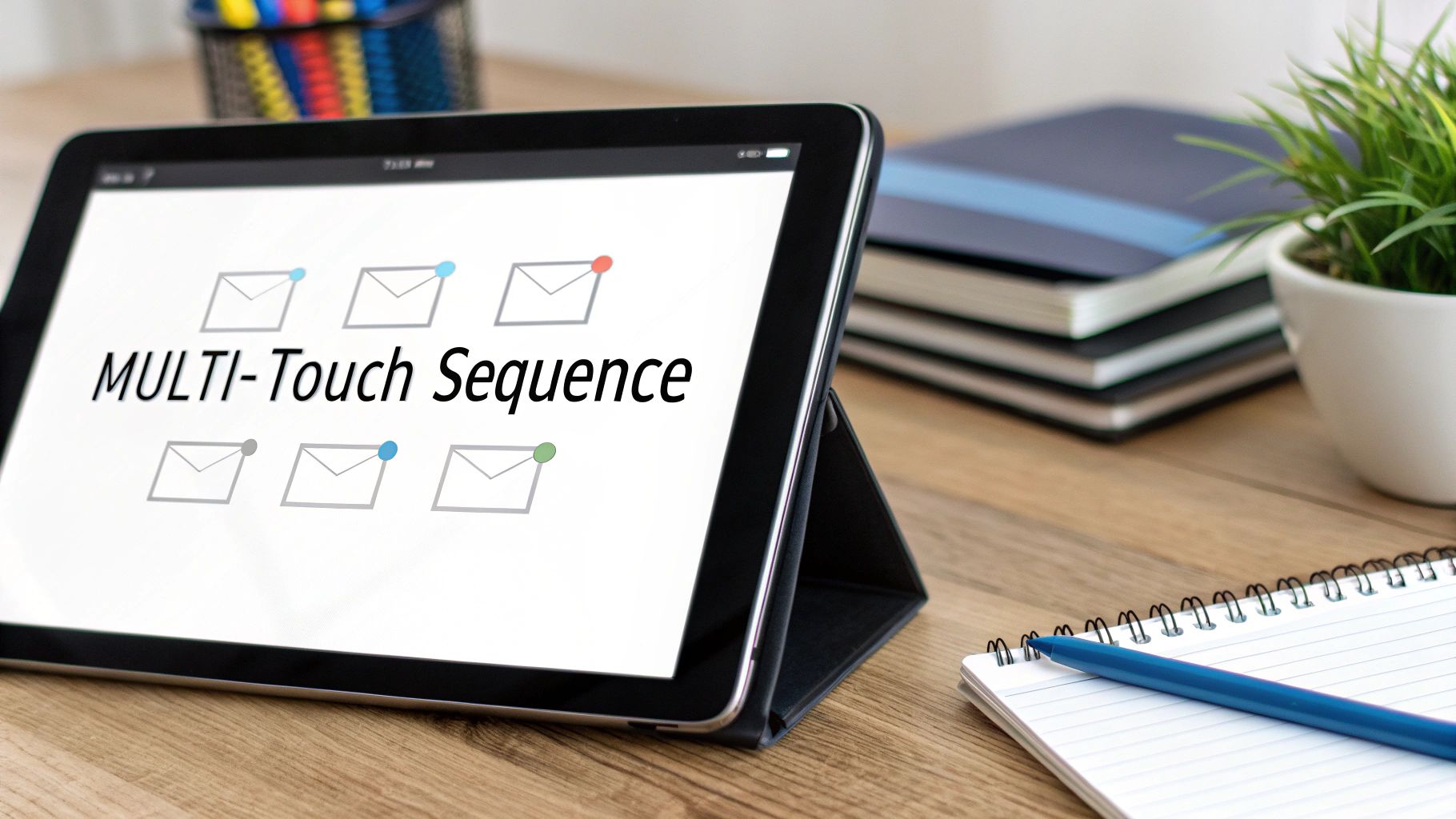
The key to a successful sequence, popularized by platforms like Outreach.io and Salesloft, is varying the message and angle with each touchpoint. Instead of just "bumping" the first email, each message should offer a new piece of value or a different perspective on the problem you solve. This progression guides the prospect through a micro-buyer's journey, moving from awareness to consideration with each strategic follow-up.
How to Implement a Strategic Sequence
-
Email 1: Problem-Focused Opener: The first touch should be hyper-personalized and focused entirely on the prospect's potential pain point. The goal is to establish relevance and earn the right to follow up.
-
Email 2: Social Proof & Credibility (3 days later): Introduce a mini case study or a compelling statistic. For example: "Just wanted to follow up and share how we helped
{{competitor_or_similar_company}}achieve a 25% increase in{{metric}}." -
Email 3: Offer a Different Value Prop (5 days later): If the first angle didn't resonate, try another. "Hi
{{first_name}}, another way our clients use our tool is to solve{{secondary_problem}}by…" -
Email 4: The Breakup Email (7 days later): This final, polite email aims to close the loop and often generates a high reply rate. "Since I haven't heard back, I'll assume this isn't a priority. I won't follow up again, but please let me know if that changes."
To succeed, start with a simple 3-4 email sequence and analyze performance before adding more steps. Keep a 2-5 day gap between emails to stay top-of-mind without being intrusive, and always remove anyone who replies or books a meeting. For deeper insights into structuring these campaigns, explore these sales cadence best practices to design more effective outreach.
5. Social Proof and Social Selling Integration
One of the most powerful cold email best practices involves blending your outreach with social proof and social selling. This strategy moves beyond the inbox to build credibility and familiarity, leveraging signals like customer testimonials, case studies, and social media engagement to warm up a cold lead. It’s about proving your value before you even ask for a meeting.
Instead of just telling a prospect you can solve their problem, you show them you already have for companies just like them. This approach, popularized by sales platforms like Outreach.io and Lemlist, combines the directness of email with the trust-building nature of social proof. By integrating these elements, you answer the prospect’s unspoken question: "Why should I trust you?"
How to Implement Social Proof and Social Selling
-
Reference Specific Case Studies: Tailor your proof to the prospect’s context. For instance: "I saw you're expanding your logistics team, and it reminded me of how we helped
{{similar_company}}reduce their shipping costs by 22%." -
Cite Credible Press or Awards: Mentioning a well-known publication builds instant authority. "Our AI-driven platform, recently featured in TechCrunch for its automation capabilities, can help
{{company_name}}achieve…" -
Leverage Mutual Connections: Use LinkedIn to find shared contacts, which can instantly warm up a cold outreach. "Hi
{{first_name}}, I noticed we're both connected with John Smith from{{mutual_connection_company}}." -
Engage on Social Media First: Before sending an email, like or comment on the prospect's recent LinkedIn post. This simple interaction makes your name familiar when it appears in their inbox a day later.
To make this strategy effective, ensure your social proof is highly relevant; a case study from a different industry will fall flat. Quantify results with specific metrics like revenue gained or costs reduced. For high-value prospects, a brief, genuine interaction on LinkedIn before the first email can dramatically increase your chances of getting a positive response.
6. Clear Value Proposition, Specific Use Cases, and CTA Optimization
One of the most crucial cold email best practices is to immediately articulate your value proposition and pair it with a low-friction call-to-action (CTA). Prospects delete emails that are vague or self-serving. To capture attention, your message must clearly state the specific, measurable outcome you provide and guide the recipient toward a simple, obvious next step. This is not about what your product does; it's about the tangible result it delivers for them.
Instead of a generic pitch like "we help companies work smarter," a powerful value proposition focuses on a single, concrete use case. For example, "we help SaaS founders cut customer onboarding time from 2 weeks to 3 days." This approach transforms a vague concept into a compelling solution for a specific pain point. When this is followed by a clear CTA, it eliminates guesswork and boosts response rates.
How to Implement a Strong Value Prop and CTA
-
Focus on a Single, Quantifiable Outcome: Start your email by addressing a specific problem, not your solution. Include one metric that demonstrates your impact. For example: "I noticed your team manually qualifies leads, a process that often takes 15+ hours weekly. Our platform automates this, saving teams like yours an average of 60 hours per month."
-
Tailor Use Cases to the Prospect: Segment your outreach by job title or industry and highlight the most relevant benefit. "Given your role in
{{industry}}, I thought you'd be interested in how we helped another{{industry}}firm reduce{{specific_pain_point}}by 40%." -
Optimize Your Call-to-Action: Make your CTA incredibly specific and easy to act on. Avoid passive phrases like "let me know if you're interested." Instead, propose a clear action. For example, "Does Tuesday at 2pm or Thursday at 10am work for a quick 15-minute call to explore this?" or include a direct calendar link to minimize friction.
To master this, always frame your message using "you" language that centers on the prospect's benefit. Test different use cases and CTA types, such as a demo, a consultation, or sharing a relevant case study, to see what resonates most with each audience segment. For further guidance on crafting compelling messages, the frameworks shared by platforms like Lemlist offer excellent, data-driven examples.
7. Compliance, Deliverability, and List Health Management
A brilliant cold email campaign is useless if it never reaches the inbox. This is where compliance and deliverability become essential cold email best practices. This strategy involves adhering to anti-spam laws like CAN-SPAM and GDPR, properly authenticating your sending domain, and maintaining a clean, healthy email list. Neglecting these foundations damages your sender reputation and guarantees your messages land in the spam folder.
Platforms like Lemlist and Outreach.io have built-in features to manage these technical aspects, from automatic bounce handling to domain warm-up schedules. Proper list hygiene and technical setup are not optional; they are the bedrock of any successful outreach effort. Ignoring them is a surefire way to get blacklisted by internet service providers, making future campaigns nearly impossible to execute.
How to Implement Proper Deliverability and Compliance
-
Authenticate Your Sending Domain: Implement SPF, DKIM, and DMARC records for your domain. These are like a digital passport, proving to email providers like Google and Outlook that your messages are legitimate and not spoofed.
-
Warm Up New Domains Gradually: Never send a high volume of emails from a new domain. Start with 20-30 emails per day and slowly increase the volume over several weeks. This process, known as domain warming, builds a positive sender reputation.
-
Maintain Strict List Hygiene: Before launching any campaign, use a list validation service (e.g., NeverBounce, ZeroBounce) to remove invalid, misspelled, and risky email addresses. Immediately suppress any hard bounces from your sending list to protect your reputation.
-
Always Include Compliance Essentials: Every email must have your physical business address and a clear, one-click unsubscribe link. This is non-negotiable for CAN-SPAM compliance. For prospects in GDPR regions, ensure you have a documented lawful basis for processing their data.
For a deeper dive into the technical side, exploring guides on setting up DMARC for email deliverability can provide the specific steps needed to secure your domain. By prioritizing these technical and legal requirements, you ensure your carefully crafted messages have the maximum chance of being seen.
8. Conditional Logic and Smart Automation Workflows
Advanced cold email best practices involve moving beyond linear sequences and adopting smart automation workflows. This strategy uses conditional logic, or "if/then" rules, within your outreach platform to create dynamic, responsive prospect journeys. Instead of sending the same sequence to everyone, the automation adapts based on each prospect's real-time engagement and attributes.
This approach ensures your outreach is always relevant and timely. By automatically routing prospects to different paths based on their actions, you can deliver the right message at the right moment, significantly boosting engagement and conversion rates. Platforms like HubSpot, ActiveCampaign, and Marketo are built to handle this level of sophisticated workflow automation.
How to Implement Smart Automation Workflows
-
Adapt to Engagement Levels: Create rules that change the sequence based on how a prospect interacts. For example: If a prospect opens your first two emails but doesn't reply → send a third email with a case study. If they don't open either → automatically send a follow-up with a completely different subject line.
-
React to High-Intent Clicks: Trigger specific actions when a prospect shows strong interest. "If
{{first_name}}clicks the link to our pricing page → immediately remove them from the cold sequence, notify their assigned sales rep via Slack, and send a personalized pricing follow-up email." -
Automate List Management: Use rules to keep your lists clean and effective. "If a prospect has not opened any of the last 4 emails → automatically pause the sequence and add them to a re-engagement list for a campaign in 3 months."
To succeed with this, you must first map out the entire prospect journey, defining clear trigger points and desired outcomes. Always test your automation rules with a small segment of your list before launching a full campaign. Regularly monitor the performance of each workflow to identify bottlenecks and opportunities for optimization, ensuring your CRM integration is robust enough to capture all the necessary data points.
9. Voice AI and Outbound Call Integration with Email
One of the most forward-thinking cold email best practices is to integrate your sequences with AI-powered outbound calls. This multichannel approach breaks through inbox noise by creating multiple, coordinated touchpoints across different platforms. Using Voice AI, you can automate follow-ups, qualify leads, and deliver personalized pitches at a scale that’s impossible for human teams to match alone.
This strategy moves beyond email-only cadences to create a more immersive and persistent outreach experience. Platforms like Lemlist and Conversica enable you to trigger an automated, natural-sounding voice call after a prospect engages with an email or after a certain period of no response. This transforms a passive email sequence into an active, conversational sales motion that captures attention and accelerates the sales cycle.
How to Implement Voice AI Integration
-
Trigger Calls Based on Engagement: Don't cold call everyone. Instead, trigger a Voice AI call 2-3 days after a prospect opens your email but doesn't reply. For example: "Hi
{{first_name}}, I'm following up on my email about optimizing{{company_name}}'s outreach. I had a quick idea for you regarding{{specific_pain_point}}…" -
Create Multi-Step, Multi-Channel Sequences: Design a flow where the channels support each other. An initial email introduces the value, a follow-up call a few days later reinforces the message, and if the prospect engages on the call, an email with a case study is sent immediately.
-
Use AI for Lead Qualification: Program the AI agent to ask key qualifying questions. If a lead meets the criteria (e.g., confirms they are the decision-maker and have a relevant challenge), the AI can escalate the call to a live sales representative or automatically book a meeting.
To implement this effectively, ensure your AI voice sounds natural and keep scripts concise, ideally under 90 seconds. Always monitor compliance with regional telemarketing regulations and extensively test call quality before a full rollout. For a deeper dive into the technology, explore the different types of automated outbound calling software available to find the best fit for your stack.
10. Continuous Testing, Analytics, and Iteration Framework
One of the most crucial cold email best practices is to treat your outreach not as a one-time task but as a scientific process. Establishing a continuous testing and iteration framework means moving beyond assumptions and using data to systematically improve performance. This involves tracking key metrics, running controlled A/B tests, and making data-driven adjustments to your strategy over time.
This approach, popularized by growth marketing experts and data-driven sales organizations, turns your cold email campaigns into a perpetual optimization engine. Instead of guessing what works, you test one variable at a time, measure its impact, and implement the winner. This ensures your campaigns become progressively more effective, delivering higher open, reply, and conversion rates.
How to Implement a Testing and Iteration Framework
-
Test High-Impact Variables First: Start by A/B testing elements with the greatest potential impact. For example, test a short, intriguing subject line against a longer, more descriptive one. "Quick question" vs. "Idea for improving
{{company_name}}'s lead generation." -
Experiment with Your Call-to-Action (CTA): Analyze whether a direct or indirect CTA performs better for your audience. Test a hard ask like booking a demo link against a soft ask like gauging interest. "Book 15 mins here" vs. "Would this be a priority for you right now?"
-
Vary Sequence Length and Cadence: Determine the optimal number of touchpoints. Run a test comparing a 3-email sequence over two weeks against a 5-email sequence over three weeks to find the point of maximum engagement without causing fatigue.
To make this framework successful, always test one variable at a time to ensure you can attribute performance changes accurately. Define your success metrics (e.g., reply rate, meetings booked) before launching and ensure your test has a sufficient sample size, typically at least 100-200 sends per variation. Document all findings in a centralized repository to build institutional knowledge and share insights across your team.
10-Point Cold Email Best Practices Comparison
| Approach | Implementation complexity | Resource requirements | Expected outcomes | Ideal use cases | Key advantages |
|---|---|---|---|---|---|
| Personalization at Scale with Dynamic Variables | Medium–High: segmentation, variable mapping, testing | CRM/data enrichment, automation platform, data maintenance | Higher opens/responses (up to ~50%); improved trust | B2B SaaS lead gen, account-based outreach, segmented lists | Scalable, contextual personalization; authentic outreach |
| Subject Line Optimization and A/B Testing | Low–Medium: test setup and analysis | A/B testing tools, copywriting time, sufficient send volume | Increased open rates (+20–50%); audience insight | New campaigns, improving open rates, list refinement | Data-driven subject performance, low-cost experiments |
| Build and Maintain a Warm Email List Through Engagement Tracking | Medium: tracking, segmentation, nurture rules | Engagement analytics, automation workflows, CRM sync | Better ROI, higher conversions, fewer unsubscribes | Long-term nurture, re-engagement, lead qualification | Prioritizes responsive prospects; preserves list health |
| Multi-Touch Email Sequences with Strategic Timing | Medium: sequence design, conditional branches | Automation platform, sequence copywriting, timing strategy | Much higher response rates vs single email; consistent follow-up | B2B sales cycles, complex purchase journeys | Structured progression; varied messaging; automated persistence |
| Social Proof and Social Selling Integration | Medium: content curation and coordinated social activity | Case studies, testimonials, social accounts, outreach time | Increased credibility and responses (up to ~40%) | Enterprise deals, trust-sensitive markets, brand building | Builds trust quickly; multi-channel reinforcement; differentiation |
| Clear Value Proposition, Specific Use Cases, and CTA Optimization | Low–Medium: research and focused copywriting | Buyer research, tailored messaging, calendar/CTA tools | Higher CTRs and replies (+20–40%); reduced friction | Conversion-focused outreach, demo scheduling, role-specific pitches | Clarity drives action; easy next steps; role/industry relevance |
| Compliance, Deliverability, and List Health Management | High: technical auth and legal processes | IT/technical expertise, validation tools, monitoring | Improved inbox placement; reduced legal and reputation risk | All outbound programs, new sending domains, regulated regions | Protects sender reputation; ensures long-term deliverability |
| Conditional Logic and Smart Automation Workflows | High: complex rules, decision mapping, CRM integration | Advanced automation platform, rule design, testing resources | Faster routing to sales, higher efficiency, better qualification | High-volume outreach, multi-stage qualification flows | Behavior-driven journeys; scalable routing; reduced manual work |
| Voice AI and Outbound Call Integration with Email | High: voice AI setup, scripting, regulatory compliance | Voice AI platform, call infrastructure, legal review, QA | Higher multi-channel engagement; faster deal progression | High-value accounts, warm prospects, multi-touch cadences | Humanized outreach at scale; breaks email clutter; quicker qualification |
| Continuous Testing, Analytics, and Iteration Framework | Medium–High: measurement framework and governance | Analytics tools, data volume, testing discipline, expertise | Incremental, compounding performance gains; validated optimizations | Scaling programs, optimization roadmaps, data-driven teams | Removes guesswork; prioritizes high-impact tests; institutional learning |
Turning Best Practices into Your Competitive Advantage
You've just navigated a deep dive into the engine room of modern B2B outreach. We’ve moved far beyond the generic advice of "personalize your emails" and into the granular, system-level strategies that separate high-growth teams from the rest. The journey from manual, one-off emails to a sophisticated, scalable outreach system is not just an upgrade; it's a fundamental transformation of how you generate opportunities and build relationships.
Mastering these cold email best practices means treating your outreach not as a series of isolated tasks but as an interconnected, intelligent ecosystem. It’s about understanding that a compelling subject line is only as good as the deliverability of the domain it’s sent from. A perfectly personalized message will fall flat if it’s part of a poorly timed, single-touch sequence. And even the most advanced automation workflow is useless without a rigorous framework for testing, analyzing, and iterating.
From Theory to Tangible Results: Your Action Plan
The difference between reading about these strategies and achieving real-world results lies in implementation. The most successful teams don't just adopt these practices; they integrate them into a cohesive, data-driven machine. Here are the most critical takeaways to focus on first:
-
Build the Foundation: Before sending a single email, prioritize your technical setup. This means configuring SPF, DKIM, and DMARC records, warming up your domains, and establishing robust list hygiene protocols. This isn't the glamorous part of outreach, but it's the bedrock upon which all success is built. Without it, you’re broadcasting into a void.
-
Embrace Systematic Personalization: Move away from manual, one-by-one personalization. Instead, build systems that use dynamic variables, conditional logic, and integrated data sources (like LinkedIn activity or company news) to create relevance at scale. The goal is to make every prospect feel like the email was written exclusively for them, even when it’s part of a 1,000-contact sequence.
-
Commit to Continuous Iteration: Your first sequence will not be your best. Your initial value proposition might miss the mark. True mastery comes from a relentless commitment to A/B testing and data analysis. Constantly test your subject lines, CTAs, sequence timing, and value angles. Let the data, not your assumptions, guide your strategy.
The Strategic Shift: Cold Email as a System
Ultimately, implementing these advanced cold email best practices is about shifting your perspective. You are not just sending emails; you are designing a system for predictable pipeline generation. This system respects the recipient's time, delivers genuine value, and uses technology to create human-centric connections efficiently.
When you integrate social proof, deploy multi-channel sequences that include calls or social touches, and use smart automation to trigger the right action at the right time, you create a powerful competitive advantage. Your outreach becomes more than just noise in a crowded inbox; it becomes a welcome, relevant conversation. To truly stand out, integrate these insights with broader, comprehensive B2B email marketing best practices tailored for sustained growth. By doing so, you build a holistic communication strategy that nurtures leads from the first cold touchpoint to a closed deal and beyond.
The path forward is clear: build, measure, learn, and repeat. Each email sent is a data point, each reply a lesson, and each campaign an opportunity to refine your engine. The teams that embrace this iterative, system-driven approach will be the ones who consistently fill their calendars, crush their quotas, and drive meaningful revenue growth.
Ready to turn these best practices into a fully operational, automated outreach engine without the technical headache? MakeAutomation specializes in building the exact custom systems described in this article. We handle the complex setup, integration, and optimization so you can focus on what you do best: closing deals.
Frequently Asked Questions About Cold Email
What is the best time to send cold emails?
The optimal send time for cold emails is Tuesday through Thursday, between 8:00–10:00 AM in the recipient’s local time zone. Studies consistently show that mid-morning emails receive the highest open rates, as professionals are actively checking their inbox at the start of the workday. Avoid Mondays (inbox overload from the weekend) and Fridays (winding down for the weekend). However, the best approach is to A/B test send times with your specific audience, as ideal timing can vary by industry and role.
How many follow-up emails should I send?
A well-structured cold email sequence should include 4–7 emails spaced over 2–4 weeks. Research shows that 80% of deals require at least five follow-ups, yet most salespeople give up after just one or two. Space your follow-ups strategically: send the first follow-up 2–3 days after the initial email, then gradually increase the interval to 4–5 days, then 7 days. Each follow-up should add new value — a relevant case study, a helpful resource, or a different angle — rather than simply asking “did you see my last email?”
What is a good open rate for cold emails?
A good open rate for cold emails is 40–60%. If you are consistently below 30%, there is likely an issue with your subject lines, sender reputation, or deliverability setup. Top-performing campaigns often achieve 60–80% open rates by combining strong personalization, curiosity-driven subject lines, and excellent domain health (proper SPF, DKIM, and DMARC configuration). Track your open rates per campaign and benchmark against your own historical data rather than generic industry averages.
How do I avoid my cold emails going to spam?
To keep cold emails out of spam folders, focus on three areas: technical setup, content quality, and sending behavior. On the technical side, configure SPF, DKIM, and DMARC records for your domain, and warm up new sending domains gradually over 2–4 weeks. For content, avoid spam trigger words (free, guaranteed, act now), keep image-to-text ratios low, and include a plain-text version. For sending behavior, start with low daily volumes (20–30 emails) and scale up slowly, maintain list hygiene by removing bounces immediately, and never purchase email lists.
Is cold emailing legal?
Cold emailing is legal in most jurisdictions when done correctly, but regulations vary by region. In the US, CAN-SPAM requires a valid physical address, clear identification, and an easy opt-out mechanism. The EU’s GDPR requires a legitimate interest basis for B2B outreach and stricter rules for B2C contacts. Canada’s CASL requires implied or express consent. Best practice: always include an unsubscribe link, honor opt-out requests within 24 hours, target business email addresses for B2B outreach, and maintain documentation of your compliance processes.
What is the ideal cold email length?
The ideal cold email length is 50–125 words. Emails in this range see the highest response rates because they respect the recipient’s time while delivering enough value to prompt a reply. Your email should be scannable in under 30 seconds. Focus on one clear pain point, one proof element (metric, case study, or social proof), and one specific call to action. Avoid long paragraphs — use short sentences and white space to improve readability on mobile devices, where over 60% of emails are now opened.
Related Articles
- Outbound Lead Generation Strategies — Build a complete outbound pipeline beyond email
- Sales Cadence Best Practices — Design multi-touch sequences that convert
- Cold Calling Best Practices — Combine cold calls with your email outreach
- AI Tools for Sales Prospecting — Automate research and personalization with AI
- How to Qualify Sales Leads — Focus your outreach on the right prospects