

Top 12 JavaScript Data Validation Library Options for 2026
In modern web development, data is the lifeblood of every application, flowing from user forms, external APIs, and internal services. But without rigorous checks, this data can become a source of bugs, security vulnerabilities, and unpredictable application states. Invalid inputs can lead to system crashes or, worse, create openings for malicious activities. To understand the potential damage without proper validation, consider how critical vulnerabilities like SQL Injection attacks can compromise sensitive data.
A robust javascript data validation library is no longer optional; it's a foundational tool for building reliable, secure, and maintainable software. Choosing the right one, however, can be difficult. The ecosystem is packed with options, each with different philosophies, feature sets, and performance characteristics. Do you need schema-first validation with static type inference, or a lightweight utility for simple form checks?
This guide dives deep into the 12 best libraries available today, moving beyond surface-level features to provide a practical analysis. We will explore their unique strengths, ideal use cases, and performance trade-offs, helping you select the perfect tool to ensure data integrity across your entire stack. Each entry includes direct links, code examples, and honest assessments of pros and cons.
Whether you're a TypeScript enthusiast needing runtime type safety, a Node.js veteran securing your API endpoints, or a front-end developer focused on bundle size, this curated list has a solution tailored to your specific needs. Let's find the right library to serve as your code's first line of defense.
1. Zod
Zod has rapidly become the standard for TypeScript-first schema validation, positioning itself as a premier JavaScript data validation library. Its core strength lies in its "define once, validate everywhere" philosophy. You create a single schema that not only validates your data at runtime but also automatically infers static TypeScript types. This eliminates the tedious and error-prone process of keeping types and validation logic in sync, a common pain point in modern web development.
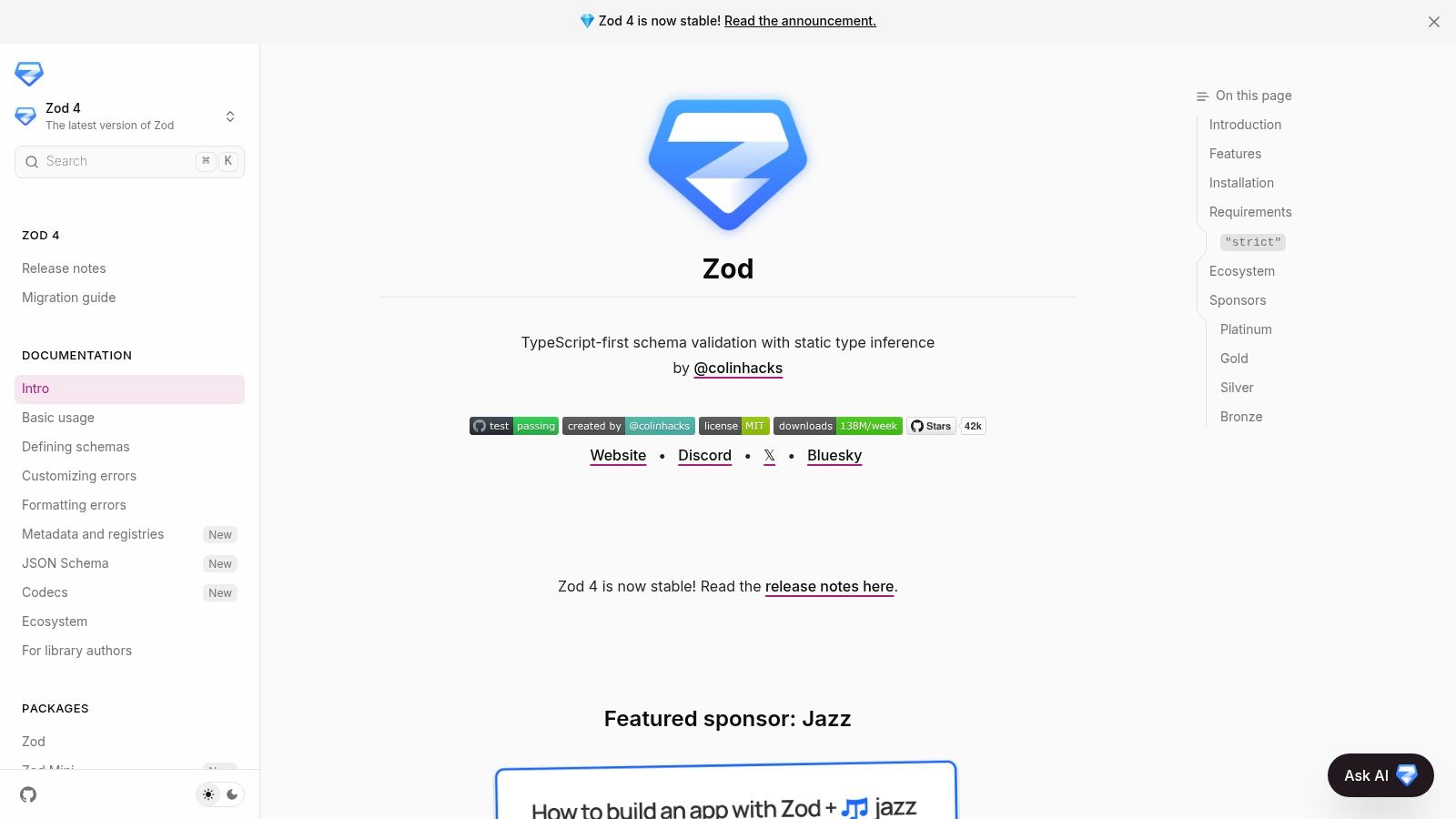
The developer experience is a significant differentiator. Zod’s fluent, chainable API is intuitive, and its error messages are exceptionally clear, pinpointing exactly what failed validation and why. This precision is critical for debugging complex data structures in APIs or forms. It's an open-source library, completely free to use, with no hidden costs or access requirements.
Key Features & Considerations
- TypeScript-First Design: Zod's main draw is its seamless type inference. Define a schema like
z.object({ name: z.string().min(1) }), and Zod automatically gives you a corresponding TypeScript type. - Immutable API: Schemas are immutable, preventing accidental modifications and making your validation logic more predictable and secure.
- Ecosystem Integration: It has deep integrations with popular frameworks like tRPC, Next.js, and form libraries such as React Hook Form, making it a go-to for full-stack TypeScript applications. Effective data validation is a cornerstone of any system, and you can learn more about how to improve data quality in your projects.
- Performance: While extremely fast for most use cases, Zod’s runtime validation can be slower than pre-compiled, code-generation-based validators on exceptionally large and complex datasets. This is a minor trade-off for the immense flexibility and developer comfort it provides.
Website: https://zod.dev
2. Yup
Yup has long been a heavyweight in the JavaScript data validation library space, establishing itself as a robust and expressive schema builder for runtime validation. It gained significant popularity for its tight integration with form libraries, particularly Formik, making it a go-to choice for developers building complex forms in React. Its API is designed to be fluent and chainable, allowing for the construction of sophisticated, interdependent validation rules with remarkable clarity.

The library excels at parsing and validating JavaScript objects, offering powerful features like value transformations and asynchronous tests directly within the schema definition. For teams already familiar with its patterns, Yup provides a stable and predictable developer experience backed by extensive documentation and a large community. As a mature open-source project, it is completely free to use and has proven its reliability across countless production applications.
Key Features & Considerations
- Expressive, Chainable API: Yup's API, like
yup.string().required().email(), is intuitive and makes defining complex validation logic straightforward. It handles dependent field validation (e.g., "password confirmation must match password") especially well. - Asynchronous Validation: It has built-in support for
test()functions that can be asynchronous, which is essential for server-side checks like verifying if a username is already taken. - Value Transformation: Schemas can transform values before and after validation using methods like
.trim()or.lowercase(), cleaning up data as it passes through. - TypeScript Support: While Yup offers good TypeScript support and can infer types from schemas, it's generally considered less seamless than Zod's "TypeScript-first" approach. Maintaining perfect type parity in very complex, nested schemas can sometimes require more manual effort.
Website: https://github.com/jquense/yup
3. Joi
Originating from the hapi.js framework ecosystem, Joi stands as a mature and feature-rich schema description language and data validator. It has long been a favorite for server-side validation in Node.js applications, celebrated for its expressive and powerful API. Joi allows developers to build complex validation rules with a declarative, chainable syntax that is both readable and robust, making it an excellent javascript data validation library for API endpoints and configuration management.
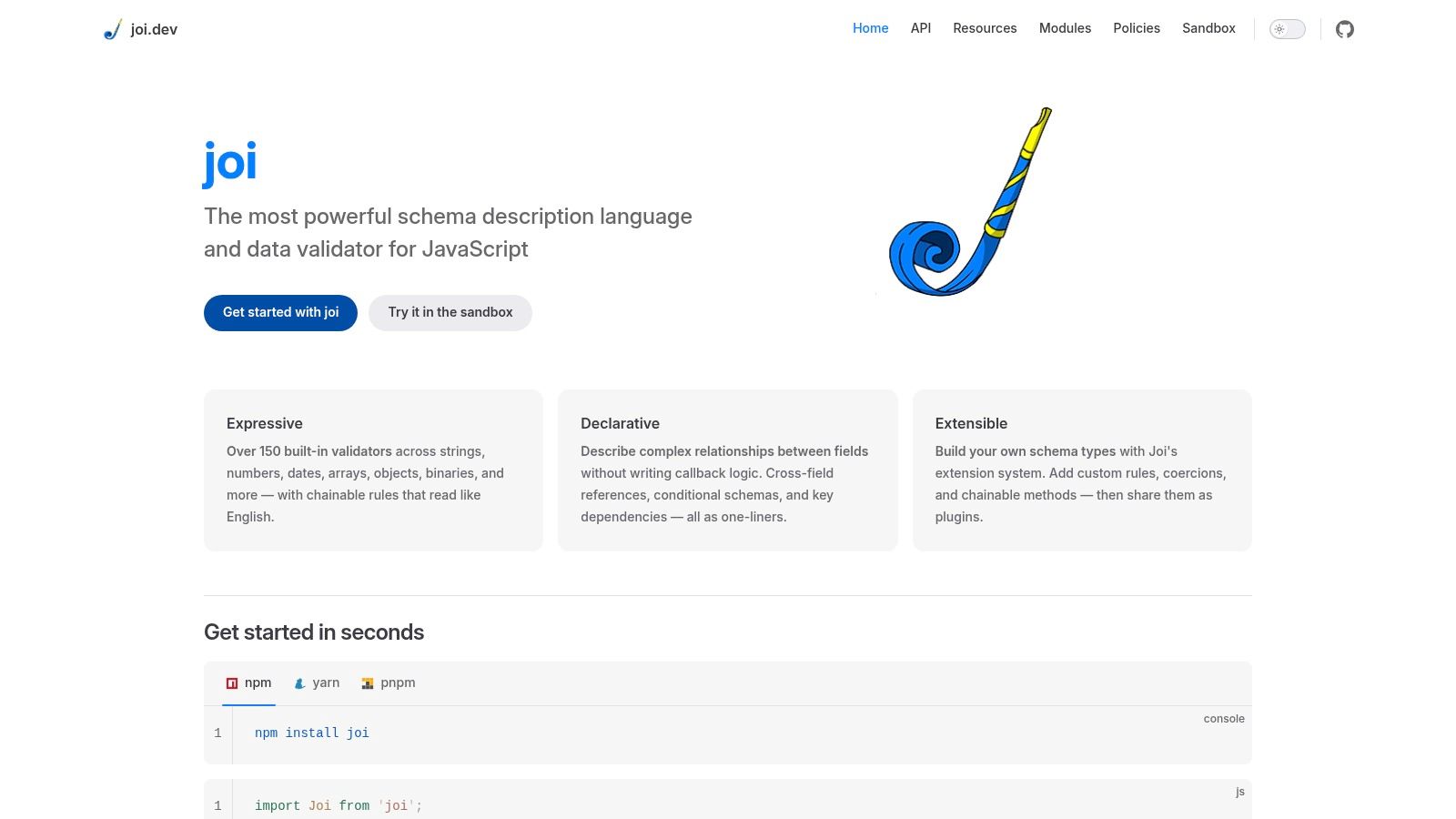
The developer experience with Joi is defined by its stability and extensive documentation. Having been battle-tested in countless production environments, there is a large community and a deep well of knowledge to draw from. Its detailed error messages provide clear context, which simplifies debugging. As an open-source project, Joi is completely free to use and has maintained its relevance through consistent updates and community support.
Key Features & Considerations
- Expressive & Powerful API: Joi excels at creating detailed validation schemas. Its rich set of primitives allows for intricate rules, such as conditional validation (
.when()), complex string patterns, and specific date formats. - Maturity and Stability: As a long-standing library, Joi is incredibly stable and reliable. Its API is well-understood, and its behavior is predictable, which is a significant asset for mission-critical server-side logic.
- TypeScript Support: While Joi works perfectly well in TypeScript projects, it was not designed with a TypeScript-first approach. Type inference is not automatic as it is with libraries like Zod; you typically need to manage types separately or use community-supported tools to generate them from Joi schemas.
- Bundle Size: For client-side applications, Joi’s bundle size can be a notable drawback compared to more modern, smaller alternatives. It is generally better suited for Node.js environments where bundle size is less of a concern.
Website: https://joi.dev
4. Ajv
Ajv (Another JSON Schema Validator) is a high-performance JavaScript data validation library built for speed and strict adherence to standards. It operates by taking a JSON Schema and pre-compiling it into an optimized validation function. This just-in-time (JIT) compilation approach makes it exceptionally fast at runtime, positioning it as a top choice for performance-critical applications like API gateways, backend services, and configuration management tools where throughput is paramount.
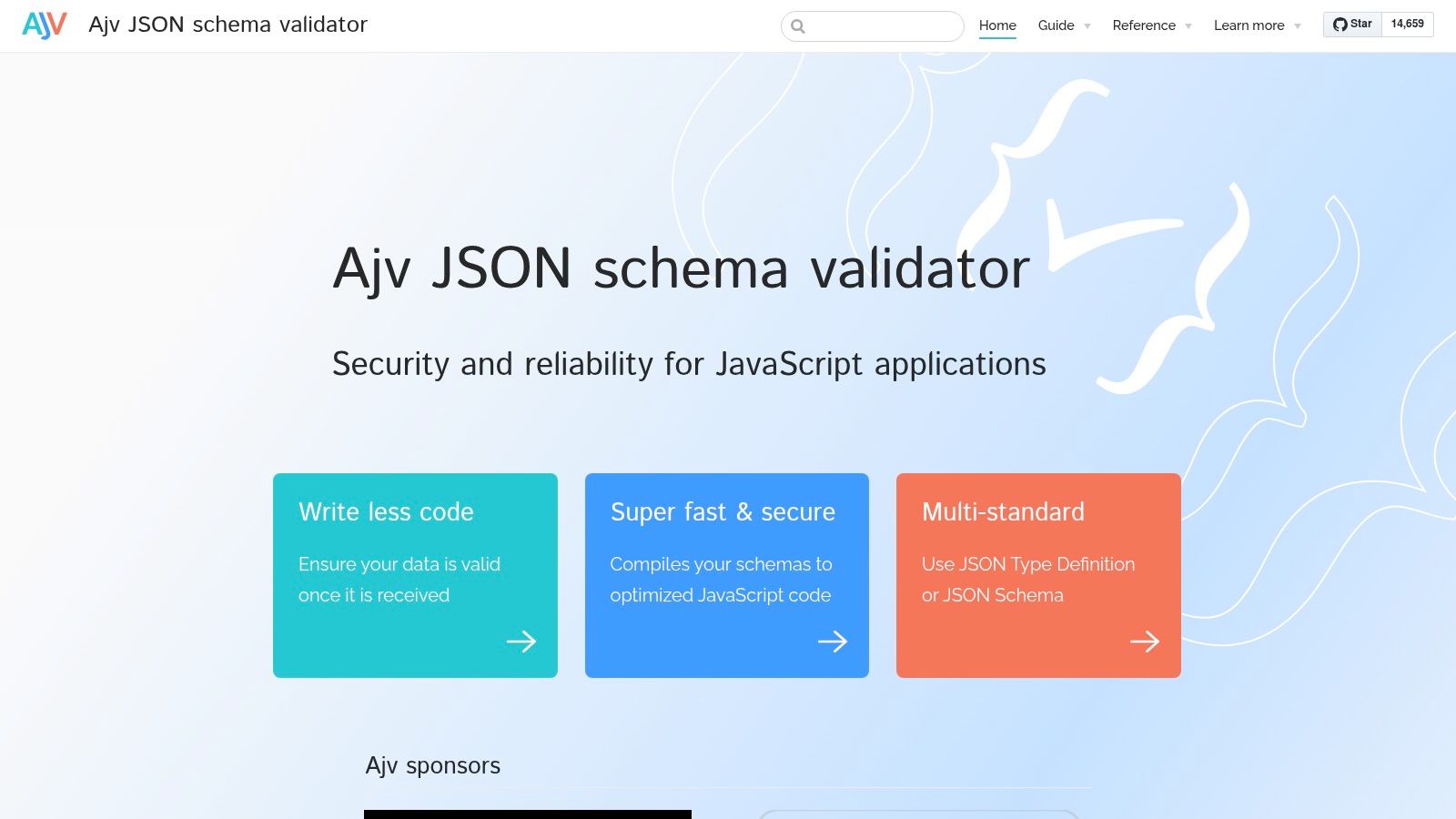
Unlike code-first libraries, Ajv is schema-first. This means your schema is the single source of truth, making it ideal for systems that rely on interoperability with tools like OpenAPI/Swagger. The developer experience is centered on defining schemas as plain JavaScript objects, which can then be used to validate data. Ajv is a completely free, open-source library that provides a solid foundation for building robust, standards-compliant data pipelines.
Key Features & Considerations
- Standards-Compliant: Ajv offers full support for multiple JSON Schema drafts (including the latest versions) and the newer, simpler JSON Type Definition (JTD) specification. This ensures interoperability across different languages and platforms.
- Exceptional Performance: Its key differentiator is speed. By JIT-compiling schemas into highly efficient JavaScript code, Ajv significantly outperforms many other validators, especially in server-side scenarios with high request volumes.
- Extensible Architecture: The library supports custom keywords and formats through a plugin system, allowing developers to extend its core functionality to meet specific business logic requirements.
- Learning Curve: For those unfamiliar with it, JSON Schema itself can have a steeper learning curve compared to the fluent APIs of code-first libraries. Writing complex validation rules can feel more verbose, as you are authoring a declarative data structure rather than imperative code.
Website: https://ajv.js.org
5. validator.js
Where many libraries focus on complex object schemas, validator.js takes a different approach by specializing entirely in string validation and sanitization. This laser focus makes it an exceptionally powerful and lightweight tool for a common subset of data validation tasks. It's not a schema builder; instead, it provides a rich toolkit of individual validation functions for everything from emails and URLs to credit card numbers and UUIDs. Its reliability and small footprint have made it a dependency in thousands of other projects, including many larger frameworks.
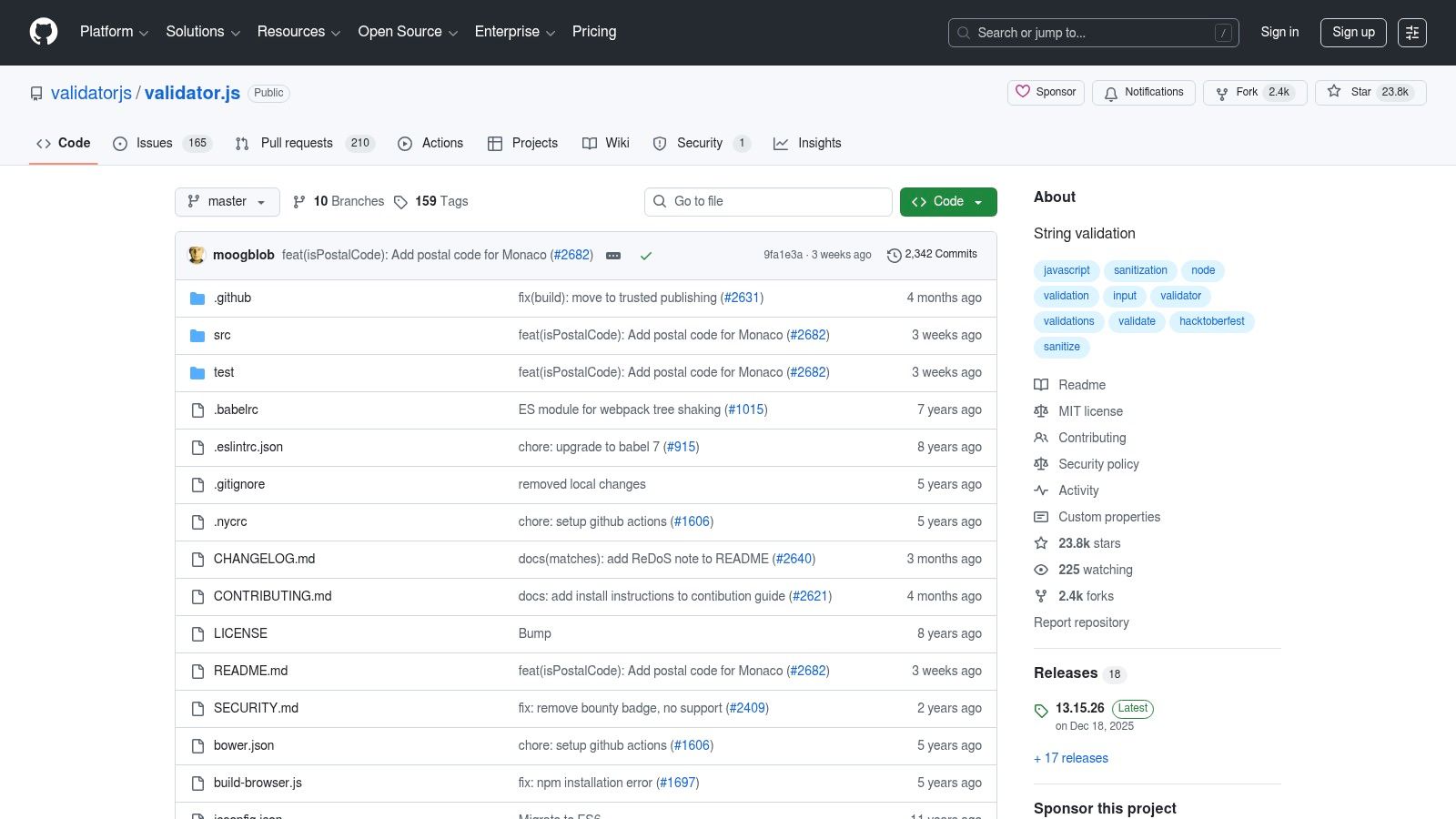
The primary appeal is its simplicity and directness. You import the functions you need and apply them directly to string variables, making it perfect for quick, targeted checks in form inputs or API query parameters. This makes it an ideal javascript data validation library when you don't need the overhead of a full schema definition. As an open-source library, it is completely free to use and has no access restrictions, embodying the "do one thing and do it well" philosophy.
Key Features & Considerations
- Extensive String Validators: Offers a massive collection of specific checks like
isEmail(),isURL(),isUUID(),isJWT(), and many more, covering most common string formats. - Sanitization Functions: Beyond just validating, it can sanitize inputs to enforce formats, such as
trim(),escape()(for HTML), andnormalizeEmail(). - Lightweight & Focused: With no dependencies and a tiny bundle size, it's perfect for projects where performance and minimal overhead are critical. It doesn't try to validate objects or complex data types.
- Manual Composition: This is not a schema builder. Validating an object requires you to call validators for each property manually. For complex nested objects, a library like Zod or Joi is a better fit.
Website: https://github.com/validatorjs/validator.js
6. express-validator
For developers working within the Express.js ecosystem, express-validator is a purpose-built JavaScript data validation library designed to integrate seamlessly into the middleware chain. It acts as a wrapper around the powerful validator.js library, offering a declarative and chainable API specifically for validating request data like req.body, req.query, and req.params. Its main appeal is its simplicity and directness for hardening API routes without introducing a complex, separate schema layer.
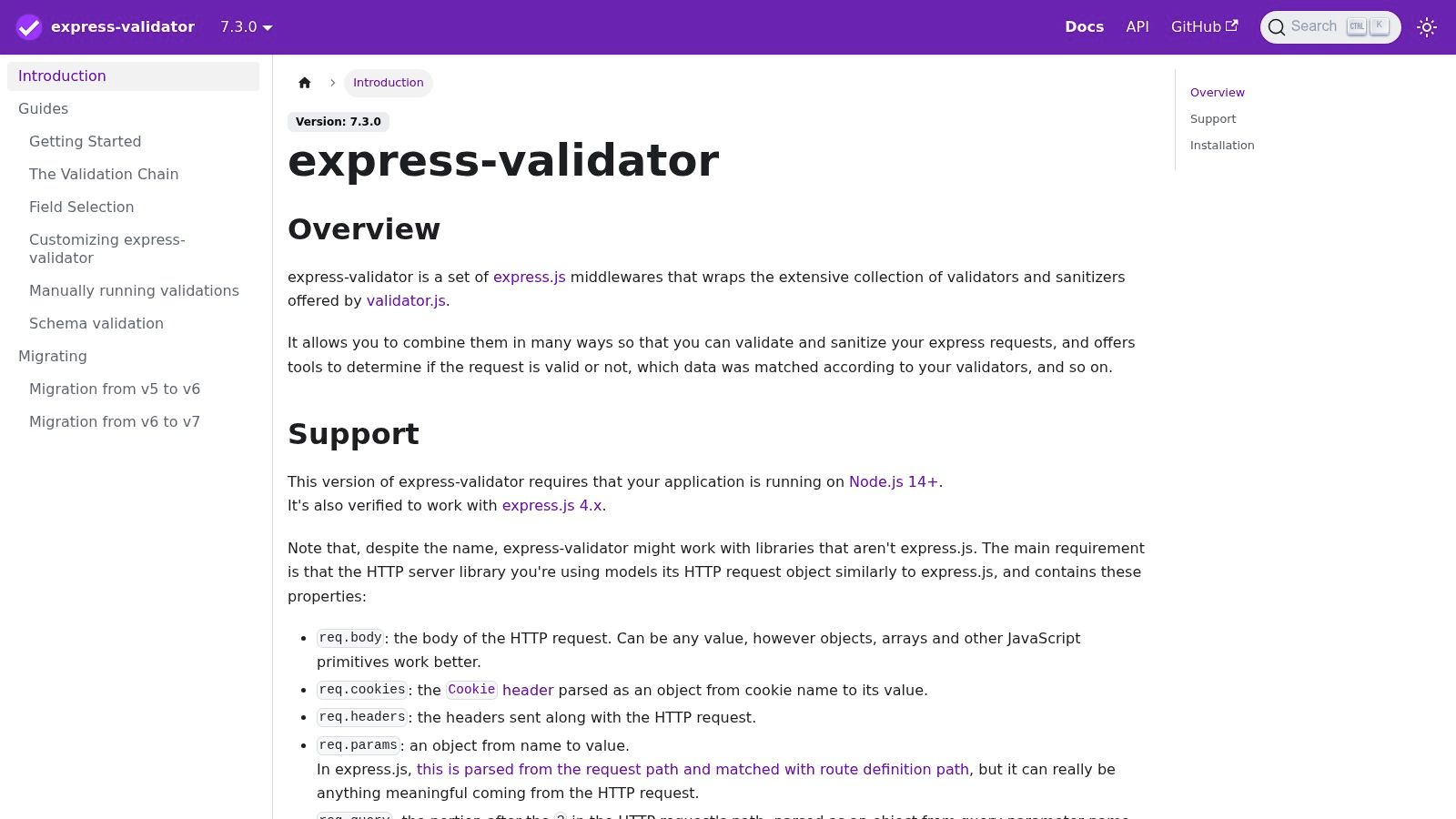
The developer experience focuses on a middleware-centric workflow. You define validation rules as part of your route definitions, making the logic easy to locate and manage alongside the corresponding controller. This approach is excellent for incrementally adding validation to an existing Express application or for projects where a full schema-based solution would be overkill. The library is open-source and free, requiring Node.js 14 or higher to operate.
Key Features & Considerations
- Middleware-Centric: Validation is applied as Express middleware, allowing you to chain checks like
body('email').isEmail()directly in your route handler arrays. This keeps validation logic coupled with the route it protects. - Built on validator.js: It exposes the extensive collection of validators and sanitizers from the battle-tested
validator.jslibrary, from checking for credit cards to sanitizing HTML. - Express-Specific: Its greatest strength is also its main limitation. It is tightly coupled to Express.js and is not portable to other frameworks like Koa, Fastify, or front-end applications. For building robust backends, understanding the fundamentals of Node.js and microservices can provide valuable context.
- Not a Schema Language: Unlike Zod or Joi, you do not define a reusable schema. Instead, you compose validation chains for each route individually. This can lead to repetition in larger applications where the same data structure is used across multiple endpoints.
Website: https://express-validator.github.io/docs/
7. class-validator
For developers working within object-oriented programming (OOP) paradigms, particularly in the NestJS ecosystem, class-validator offers a powerful decorator-based approach. This JavaScript data validation library allows you to define validation rules directly on class properties. By annotating your Data Transfer Objects (DTOs) with decorators like @IsEmail() or @MinLength(10), you create a single source of truth for your data's shape and constraints, tightly coupled with your class definitions.
The library shines when used with its companion, class-transformer, to automatically transform plain objects into class instances and validate them. This pattern is fundamental to NestJS's ValidationPipe, making API request body validation almost effortless. As an open-source tool, class-validator is completely free. It relies on validator.js for its underlying validation logic, ensuring a robust and well-tested foundation.
Key Features & Considerations
- Decorator-Based API: Validation rules are declared with intuitive decorators directly on class properties. This makes the validation logic declarative and co-located with the data structure it protects.
- OOP & NestJS Integration: It is the de-facto standard for validation in NestJS. The pattern of defining DTO classes with validation decorators is a core part of the framework's architecture for building robust APIs.
- Custom Validators: Beyond the large set of built-in validators, you can easily create and register your own custom validation constraints to handle specific business logic.
- Configuration Overhead: Its primary drawback is the dependency on decorators and
reflect-metadata. This setup can feel verbose and adds a layer of complexity compared to schema-first libraries, making it less suitable for projects that follow a purely functional programming style.
Website: https://github.com/typestack/class-validator
8. io-ts
For developers steeped in functional programming, io-ts presents a powerful and mathematically sound approach to data validation. It is a runtime type system for TypeScript that integrates deeply with the fp-ts ecosystem. Instead of just validating, io-ts defines "codecs" that handle decoding (parsing untyped input), encoding (serializing typed data), and validation simultaneously, all while acting as a static type guard. This makes it a robust JavaScript data validation library for applications requiring provable correctness.
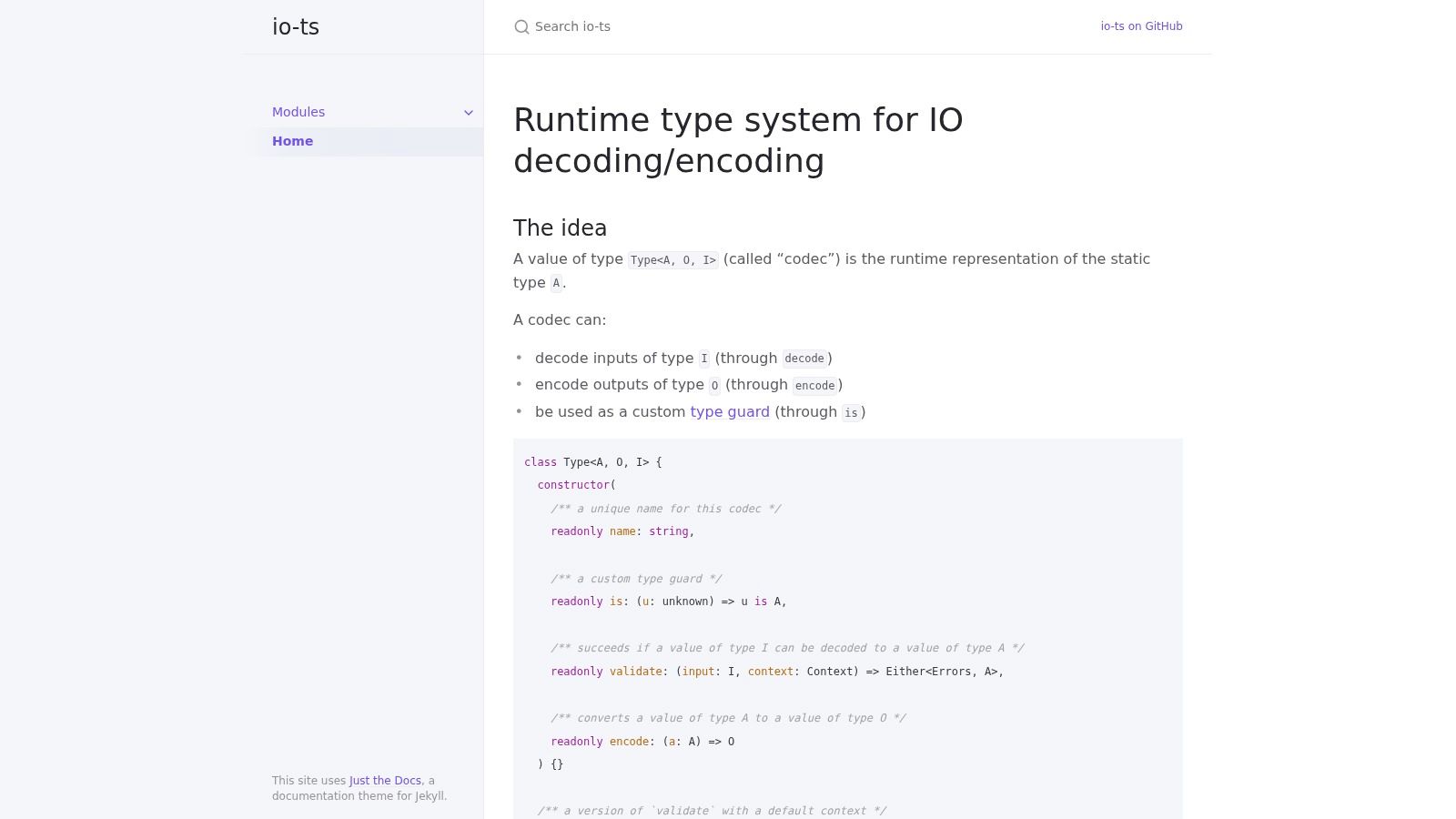
The primary differentiator of io-ts is its use of functional constructs, particularly the Either type, for error handling. A validation result is either a Right (containing the successfully decoded value) or a Left (containing a detailed validation error). This explicit, type-safe error channel prevents runtime exceptions and forces developers to handle failure states. It's an open-source library, completely free to use and well-suited for building resilient, enterprise-grade systems where data integrity is critical.
Key Features & Considerations
- Functional & Type-Safe: Its foundation in functional programming provides exceptional composability. Codecs can be combined to build validators for complex, nested data structures with strong static type guarantees.
- Explicit Error Handling: By using
Eitherfromfp-ts, io-ts makes error handling a first-class citizen. This eliminates ambiguity around validation failures and improves application reliability. - Decode/Encode Pipeline: A single codec definition manages the entire data lifecycle from an unsafe external source to a trusted internal type and back again, ensuring consistency.
- Learning Curve: The biggest consideration is its dependency on functional programming concepts and the
fp-tslibrary. For developers unfamiliar with Functors, Monads, or theEithertype, the learning curve can be steep compared to more imperative libraries like Zod or Yup.
Website: https://gcanti.github.io/io-ts/
9. Runtypes
Runtypes offers a compelling approach to runtime validation for static types, striking a balance between powerful features and a clean, composable API. It's designed to bring type safety to the dynamic world of JavaScript, making it an excellent JavaScript data validation library for TypeScript projects. The core idea is to define "runtypes" that act as both runtime validators and the source of truth for static TypeScript types, ensuring your data conforms to expectations at every boundary.
This library stands out by providing advanced concepts like branded types and contracts without overwhelming the developer. Its clear, functional API makes defining complex validation logic feel intuitive. Runtypes is an open-source project, completely free to use, and a solid choice for teams who prioritize explicit type safety and a straightforward validation process.
Key Features & Considerations
- Static Type Inference: Like Zod, Runtypes excels at inferring static types from your runtime definitions. Using its
Static<T>utility, the typeStatic<typeof MyRuntype>automatically reflects your validation schema. - Contracts and Branded Types: It offers powerful tools for creating highly specific types. Contracts can enforce complex business rules beyond simple type checks, while branded types prevent accidental mixing of similar data structures, like
UserIdandProductId. - Composability: The API is designed for composition, allowing you to build complex validators by combining smaller, reusable pieces like
Record,Union, andIntersect. This promotes a clean and maintainable validation codebase. - Ecosystem and Focus: Runtypes has a smaller community and ecosystem compared to giants like Zod or Yup. Its focus is more on pure type validation rather than features like JSON Schema conversion, which might be a consideration for projects needing that interoperability.
Website: https://github.com/runtypes/runtypes
10. Superstruct
Superstruct offers a simple and composable approach to data validation in both JavaScript and TypeScript. It distinguishes itself by using small, focused "structs" that you combine to build up complex validation logic. This design encourages a clear and modular way of thinking about data structures, making schemas easy to read, extend, and reason about. It’s an ideal choice for developers who appreciate a minimal API and a functional programming style.
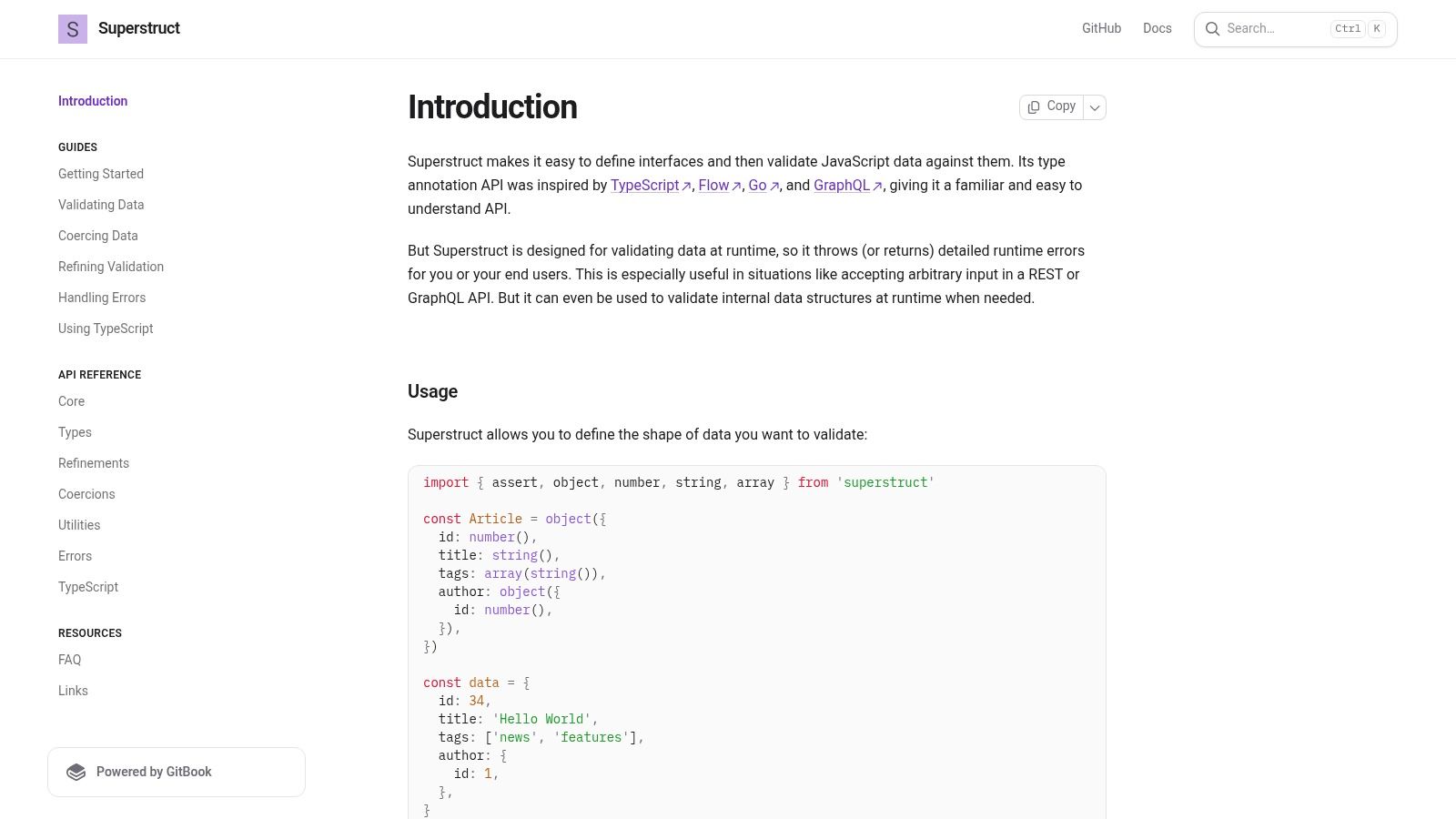
The developer experience focuses on simplicity and flexibility. Superstruct allows you to define custom "refinements" to add specific constraints and "coercions" to transform data before validation, all without a heavy or complex API. This lightweight nature makes it a great JavaScript data validation library for projects where bundle size is a critical concern. As an open-source library, it's completely free to use in any browser or Node.js environment.
Key Features & Considerations
- Composable Structs: The core concept involves composing small validation functions (
string(),number(),object()) to define the shape of your data. This makes schemas highly reusable and maintainable. - Refinements and Coercions: Easily add custom validation rules or data transformations. For example, you can define a refinement to check if a string is a valid email or a coercion to convert a string to a
Dateobject. - TypeScript-Friendly: While not as tightly integrated as Zod for automatic type inference, it provides excellent TypeScript support and utilities to help you derive types from your validation schemas.
- Lightweight Footprint: Superstruct is very small, making it a strong contender for client-side validation in performance-sensitive applications. Its smaller ecosystem means fewer pre-built integrations compared to larger libraries, so you may need to write more boilerplate for framework-specific connections.
Website: https://docs.superstructjs.org/
11. Vest
Vest introduces a unique, test-inspired approach to data validation, setting it apart as a specialized JavaScript data validation library. Instead of building schemas, you write validation suites that resemble unit test files using a familiar test and enforce syntax. This mental model is especially powerful for complex, multi-step forms where validation logic can become tangled with UI state. Vest decouples these concerns, creating portable and maintainable validation logic.
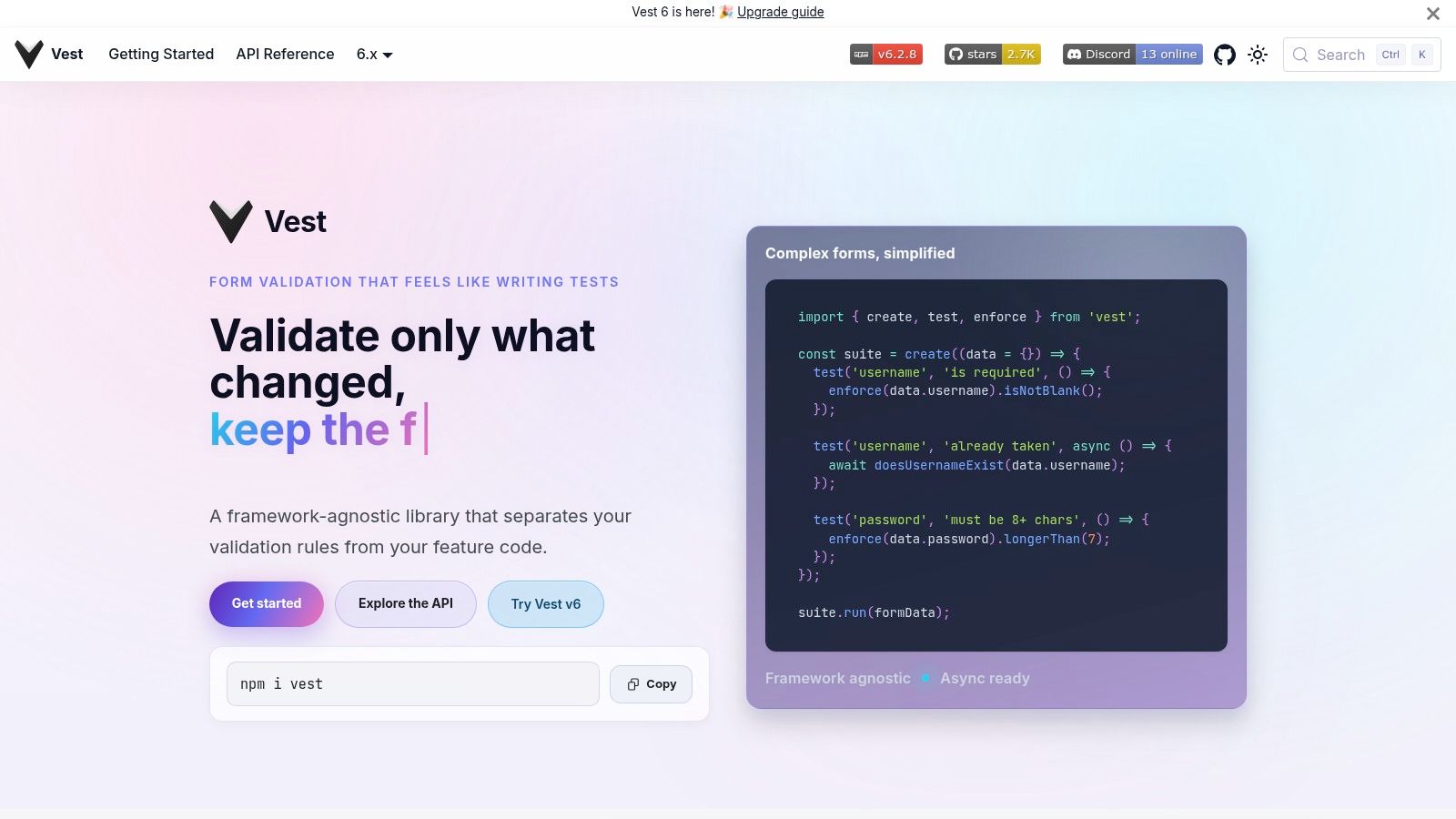
The library excels at orchestrating asynchronous validations and managing validation state. It intelligently handles race conditions and only runs tests for the fields that have changed, optimizing performance in user-facing applications. Vest is completely free, open-source, and has zero external dependencies, making it a lightweight addition to any project. Its focus on a testing paradigm is a fresh take that can improve code clarity and resilience.
Key Features & Considerations
- Declarative Test-Like Syntax: Validations are defined in suites using
test()functions, making the logic easy to read and reason about. This structure aligns well with Agile development, and you can learn more about testing best practices in Agile to further improve your workflows. - Stateful Validation: Vest maintains the validation state, including errors, warnings, and pending async tests. This makes it straightforward to build responsive UIs that reflect the real-time validity of form data.
- Framework Agnostic: It is designed to work with any UI framework, from React and Vue to Svelte or vanilla JavaScript, ensuring your validation logic remains portable.
- Learning Curve: The testing-inspired approach is different from traditional schema-based validators like Zod or Yup. Teams accustomed to schema builders may need time to adapt to Vest's distinctive mental model. It is also more focused on front-end form validation than server-side data sanitization.
Website: https://vestjs.dev
12. Valibot
Valibot is a modern, TypeScript-first schema validation library that prioritizes a minimal bundle size, making it a strong contender in the crowded field of JavaScript data validation. It positions itself as a size-optimized alternative to Zod, offering a very similar, fluent API that will feel immediately familiar to developers already acquainted with the more established library. Its core design philosophy revolves around modularity, allowing bundlers to tree-shake unused validation logic, resulting in tiny client-side footprints.
This focus on performance and size makes Valibot particularly well-suited for front-end applications where every kilobyte counts, such as high-traffic e-commerce sites or performance-critical single-page applications. The library is completely open-source and free to use. Despite being a newer project, it has active development and comprehensive documentation, making it a viable and attractive choice for performance-conscious projects that still require robust, type-safe validation.
Key Features & Considerations
- Modular and Tree-Shakable: Valibot's greatest strength is its modular architecture. You only import the specific validation functions you need, which can reduce the initial bundle size to less than 1KB, a significant advantage for client-side performance.
- Zod-Like Ergonomics: The API is intentionally designed to mirror Zod's, providing a comfortable developer experience with a minimal learning curve for teams transitioning or looking for a lighter alternative. It maintains full static type inference.
- Smaller Ecosystem: As a more recent library, Valibot has fewer third-party integrations, plugins, and community-built adapters compared to giants like Zod or Yup. This may require more manual setup for integration with certain form libraries or backend frameworks.
- Performance-Oriented: It’s built from the ground up for speed and size efficiency. For developers building applications where bundle size is a primary constraint, Valibot offers the safety of a schema-based JavaScript data validation library without the associated weight.
Website: https://valibot.dev
Comparison of 12 JavaScript Data Validation Libraries
| Library | Core focus | TypeScript & typing | Performance / bundle size | Best for / Target audience | Unique selling points & tradeoffs |
|---|---|---|---|---|---|
| Zod | TypeScript‑first runtime schemas | Excellent TS‑first inference | Small core, can be heavier than ultra‑minimal libs | Modern TS stacks (tRPC, React, APIs) | Great DX and ecosystem; JSON Schema support; not tiniest client bundle |
| Yup | Chainable schema builder for runtime parsing | Solid TS support (not TS‑first) | Moderate | React forms and rich interdependent validations | Concise API and widespread examples; deep schemas can get verbose |
| Joi | Declarative, feature‑rich server schemas | JS‑centric; TS integration less seamless | Heavier for client use | Node APIs, server‑side validation | Battle‑tested and expressive; larger bundle for browser use |
| Ajv | JSON Schema validator with JIT compilation | Standards‑aligned (JSON Schema/JTD) | Very high performance | APIs, OpenAPI pipelines, config validation | Extremely fast and interoperable; JSON Schema learning curve |
| validator.js | Focused string validators & sanitizers | Basic type defs; utility‑style | Very small and lightweight | Email/URL/UUID checks, sanitization, small utilities | Tiny, reliable tools; not a full schema language |
| express-validator | Express middleware wrapper around validator.js | Works in Node/Express (Node 14+) | Server‑side, minimal overhead | Incrementally adding validation to Express routes | Easy Express integration; Express‑specific, not portable |
| class-validator | Decorator‑based DTO validation | Good for TS classes (requires reflect‑metadata) | Server‑oriented | NestJS and OOP DTO patterns | Clear reusable DTOs; needs decorators and more boilerplate |
| io-ts | FP‑oriented codecs with decode/encode | Very strong static typing (fp‑ts/Either) | More verbose, steeper learning curve | Functional/enterprise TS stacks needing rigorous typing | Powerful composability and decoding; higher learning cost |
| Runtypes | Runtime validation with Static |
Strong TS inference | Moderate | Teams wanting clear API + type safety | Branded types and exact checks; smaller ecosystem than Zod |
| Superstruct | Small, composable "structs" with refinements | Friendly TS utilities | Lightweight | Lightweight projects needing custom constraints | Simple mental model and coercions; fewer integrations |
| Vest | Test‑style validation with smart state handling | TypeScript supported, zero deps | Lightweight, no external deps | Complex front‑end multi‑step forms | Excellent ergonomics for large forms; different mental model |
| Valibot | Modular, TS‑safe schemas optimized for tiny bundles | Full static inference | Extremely small via tree‑shaking | Front‑end apps where bundle size is critical | Zod‑like ergonomics with tiny bundles; newer, smaller ecosystem |
Choosing the Right Tool for Your Data Integrity Strategy
Navigating the ecosystem of JavaScript data validation libraries can feel overwhelming, but making an informed choice is a critical step toward building robust, reliable applications. This article has explored twelve distinct tools, from schema-first powerhouses to lightweight utility functions, each with its own philosophy and ideal application. The central takeaway is that there is no single "best" library for every project. The right tool is the one that best fits your specific technical stack, performance requirements, and development workflow.
A clear pattern emerges from our analysis. For modern projects built with TypeScript, Zod has established itself as a dominant force. Its ability to infer static types directly from runtime validators eliminates the need to declare types twice, significantly improving developer experience and reducing the chance of synchronization errors. Its growing ecosystem and intuitive API make it a default choice for many new full-stack applications.
Making the Right Selection for Your Use Case
Your decision should be guided by your primary goal. Are you building a complex user-facing form, a high-performance backend API, or something in between?
For Complex Forms and Client-Side Logic: If you're working in a JavaScript-heavy environment (like legacy React projects without TypeScript) and need powerful, chainable validation for intricate forms, Yup remains a steadfast and mature option. Its integration with form libraries like Formik is a significant advantage. For a more modern take on form validation, Vest offers a unique, test-suite-like syntax that is exceptionally clear for describing validation rules and states.
For Performance-Critical Backend APIs: When raw speed is your top priority for a Node.js backend, Ajv (Another JSON Schema Validator) is the undisputed champion. By pre-compiling schemas, it achieves outstanding performance, making it perfect for API gateways, microservices, and any high-throughput system where every millisecond counts. Its adherence to the JSON Schema standard also promotes interoperability. For those building with Express.js, express-validator provides a declarative middleware-based approach that keeps validation logic neatly separated from your business controllers.
For Strong Type Safety and Integration: Beyond Zod, developers invested in functional programming paradigms might find io-ts to be a powerful, albeit more complex, choice for creating bulletproof runtime type decoders. For those seeking a balance of Zod's features with a smaller bundle size, the newcomer Valibot presents a compelling, modular alternative that is gaining traction for its performance and modern API design.
Final Considerations Before Implementation
Selecting a javascript data validation library is just the first step. True data integrity is achieved when validation is integrated deeply into your development and deployment pipelines. Consider how your chosen tool will fit into your CI/CD process. Can you automate schema validation against API contracts? Can you generate documentation or client-side types from your backend schemas?
By thinking strategically about data validation, you are not just preventing bad data from entering your system. You are building a foundation of trust and reliability that supports scalable growth. You ensure that your automated workflows, analytics, and business logic are all operating on clean, predictable, and secure data. This commitment to data quality is a hallmark of a mature and resilient engineering culture.
A robust javascript data validation library is your first line of defense for data quality, but true operational excellence comes from automating the entire data workflow. MakeAutomation specializes in creating these resilient, automated systems, connecting your APIs and applications to ensure that validated data flows seamlessly to where it's needed most. Let us help you build the automated infrastructure that turns clean data into scalable growth.
Discover how MakeAutomation can fortify your data workflows.