Making a Roadmap to Hit 7 Figures
Trying to scale a B2B SaaS company without a solid plan is like driving from New York to L.A. with no map and a half-tank of gas. You're going to waste a ton of time, burn through resources on wrong turns, and probably end up stranded somewhere you never intended to be. Making a roadmap isn't just some stuffy corporate exercise; it's a survival guide for turning big ambitions into actual, measurable growth and ditching the expensive guesswork.
The Real Cost of Running Your Business on a Prayer

Flying by the seat of your pants feels agile and exciting… until it descends into total chaos. Without a structured roadmap, you'll find yourself trapped in a reactive loop, constantly putting out fires instead of methodically building a business that can stand on its own. I've seen it happen to too many promising companies that get stuck in neutral.
The warning signs are always the same. Your sales team is chasing one type of lead while marketing is busy targeting a completely different audience. The dev team sinks weeks into a shiny new feature that no customer actually asked for. Brilliant automation ideas that could save hundreds of hours die on the vine because their value was never properly mapped out.
The Tangible Consequences of Guesswork
The fallout from this kind of misalignment is serious, and it goes way beyond just wasted time. When every team is running in a different direction, the whole business grinds to a halt. Productivity tanks, morale plummets, and your most precious resource—focus—gets spread thin across a dozen low-impact activities.
You end up with a mess:
- Misaligned Teams: Sales, marketing, and ops start working against each other. They duplicate efforts and create a ton of internal friction that didn't need to be there.
- Wasted Development Cycles: You're burning engineering salaries on projects that don't move the needle on core business goals or solve real customer pain points.
- Stagnant Growth: Founders get trapped in the weeds, drowning in manual tasks instead of focusing on the big-picture strategy needed to break past that seven-figure ceiling.
The data doesn't lie: companies with structured roadmaps see 20-25% faster revenue growth than those just winging it. A roadmap takes a fuzzy vision and turns it into a concrete, battle-tested plan of attack.
The Financial Drain of No Plan
This lack of direction hits you right in the wallet. Research has found that 71% of fast-growing businesses credit their success to a strategic plan. It gives them a massive advantage. On the flip side, a staggering 60% of strategy failures come down to a simple misalignment of funding—a direct result of not having a clear roadmap.
That game-changing AI agent or automation project you're dreaming of? It's dead on arrival if you can't show exactly how it fits into the bigger picture. You can dig deeper into how planning fuels execution with these insights on business success from Tessarines.
At the end of the day, making a roadmap is about creating a system for intentional, focused growth. It’s the framework that guarantees every dollar you spend and every hour your team works is pushing the business forward. Without one, you're not just guessing—you're choosing a slower, more expensive, and far riskier path to the top.
Define Your North Star and Align Everyone to It

Before you even think about features, timelines, or tasks, every solid roadmap needs a destination. This isn't some fuzzy, inspirational quote for the wall; it's your North Star—the one clear, unifying objective that guides every single decision.
This goal acts as your compass. It's the filter you run every potential project through. Your North Star needs to be incredibly specific and measurable so that everyone, from the CEO down to the newest hire, knows exactly what winning looks like.
Are you aiming to hit $1M in Annual Recurring Revenue (ARR) this fiscal year? Is the real goal to slash customer churn by 15% in the next six months? Or maybe you're trying to capture a new market by signing 500 new enterprise clients.
Whatever it is, get it down on paper with absolute clarity. This goal is the bedrock of your roadmap. If you need help locking this down, our guide on the strategic planning process is a great place to start.
Get Your Vision Out of the Ivory Tower
With your North Star defined, the next move is to make sure it’s grounded in reality, not just executive-level assumptions. This means talking to the people who are actually in the trenches: your stakeholders. This isn't about making everyone happy. It's about blending different perspectives to create a plan that’s both ambitious and actually achievable.
This is a massive stumbling block for a lot of companies. Research shows that only 22% of employees feel like their leadership provides a clear direction. Getting this right from the start is critical. It often requires a dedicated effort toward fixing internal alignment before you even begin roadmapping.
A roadmap built in a vacuum will shatter the second it hits the real world. Real alignment comes from gathering, respecting, and acting on the intelligence your own team holds.
Talk to the Right People (and Ask the Right Questions)
Stakeholder interviews are your fact-finding missions. You need to connect with the key people who will build, sell, support, and use whatever your roadmap outlines. The goal is simple: uncover their biggest pain points, spot hidden opportunities, and understand what each department truly needs to succeed.
To get the most out of these conversations, you need to be targeted. Here’s a quick-reference guide for gathering the feedback that matters most.
Stakeholder Input And Roadmap Alignment
| Stakeholder Role | Key Questions to Ask | How Their Input Shapes the Roadmap |
|---|---|---|
| Sales Team | "What's the one feature that would help you close 10% more deals next quarter?" "What objections are we consistently losing to?" | Prioritizes features that directly impact revenue and remove sales blockers. |
| Operations/PMs | "Where could automation save your team 5 hours a week?" "Which manual process is causing the most errors or delays?" | Identifies opportunities for internal efficiency gains and process improvements. |
| Customer Support | "Which bug or missing feature generates the most support tickets?" "What's the #1 frustration you hear from our users?" | Highlights critical bug fixes and quality-of-life improvements that reduce churn. |
| Customers | "Walk me through your workflow. Where do you get stuck?" "If you had a magic wand, what's one thing our product would do?" | Provides direct validation for new features and uncovers unmet needs. |
The insights you'll get are pure gold. Your sales leader might tell you that lacking a single integration is a deal-breaker for enterprise clients. The ops team might point to a clunky internal process that’s secretly killing productivity.
This is the kind of qualitative data that numbers on a dashboard just can't give you. When you blend these real-world insights with your North Star, your roadmap transforms from a simple wish list into a powerful strategic plan built on shared intelligence.
How to Prioritize Initiatives with the RICE Method
So, you’ve locked in your North Star and gathered a ton of great feedback from stakeholders. The result? A mountain of fantastic ideas. You might be staring at a list with everything from a sleek Voice AI agent for your sales team to a powerful new CRM automation module. They all sound good, but you can't do everything at once.
How do you decide what to tackle first?
This is where you need to get surgical. It's time to move past vague labels like "high-impact" and start making choices based on data. Prioritization isn't about picking favorites; it's about systematically figuring out which projects will deliver the most bang for your buck in the shortest amount of time. Getting this right is what separates a roadmap that gathers dust from one that builds real momentum.
Without a solid framework, it's easy to get distracted by the shiniest new object or cave to the loudest request. A structured approach ensures you’re always working on what truly moves the needle.
Deconstructing the RICE Framework
For B2B and SaaS companies, one of the most effective tools I've found is the RICE scoring model. It’s a simple but powerful way to force an objective look at each project, evaluating it against four specific criteria to generate a single score you can use for comparison.
The formula looks like this:
(Reach x Impact x Confidence) / Effort = RICE Score
Let's break down what each of these components actually means in practice.
- Reach: How many people will this actually touch in a given timeframe? For a new feature, you might measure "customers per quarter." For an internal tool, it could be "employees per month." Be specific.
- Impact: How much will this move the needle for each person? This one can feel a bit subjective, so I recommend a simple scale to keep it consistent: 3 for a massive impact, 2 for high, 1 for medium, 0.5 for low, and 0.25 for minimal.
- Confidence: This is your reality check. How sure are you about your Reach and Impact numbers? A percentage scale works best here: 100% for high confidence (you have solid data), 80% for medium (you've made some educated guesses), and 50% for low (it's more of a long shot).
- Effort: What's the total time investment from your entire team—product, design, engineering, etc.? Estimate this in "person-months," which is the amount of work one person can do in a month.
By putting numbers to these factors, you replace gut feelings with a logical system. This disciplined approach is a cornerstone of effective work management. For more on this, check out our guide on how to prioritize tasks at work.
Applying RICE to a Real-World Scenario
Let's see how this works with a common dilemma. Imagine your team has to choose between two big projects for the next quarter.
Project A is a Voice AI Sales Agent. The idea is to have it automatically qualify inbound leads, freeing up the sales team.
Project B is a New CRM Automation Module. This would automate data entry and follow-ups for your account managers, saving them from tedious manual work.
Here’s how you could score them side-by-side:
| Metric | Project A: Voice AI Agent | Project B: CRM Automation |
|---|---|---|
| Reach | 500 leads per month | 20 account managers |
| Impact | 3 (massive improvement to lead quality) | 2 (high impact on daily workflow) |
| Confidence | 80% (some technical unknowns) | 100% (we know our CRM inside and out) |
| Effort | 12 person-months (a complex build) | 4 person-months (much simpler) |
Now for the math.
For the Voice AI Agent: (500 x 3 x 0.80) / 12 = 100
For the CRM Automation Module: (20 x 2 x 1.0) / 4 = 10
Suddenly, the picture is much clearer. The Voice AI agent might sound more exciting, but its massive effort and slightly lower confidence score tank its priority. The CRM module, while less flashy, is a much smaller, surer bet that still delivers solid value. The data points you toward the smarter immediate investment.
Other Prioritization Models to Consider
While I’m a big fan of RICE for its data-driven nature, it’s not the only tool in the shed. Other frameworks are incredibly useful, especially in different contexts.
-
MoSCoW Method: This is my go-to for clarifying requirements with stakeholders early on. You categorize every potential feature into one of four buckets:
- Must-Have: Absolutely non-negotiable. The product is dead on arrival without these.
- Should-Have: Important and valuable, but not critical for the first launch.
- Could-Have: Nice-to-have additions that you can tackle if you have spare resources.
- Won't-Have: Features that are explicitly out of scope for this round.
-
Kano Model: This one is all about customer delight. It helps you think beyond just functional requirements by classifying features based on how they affect user satisfaction. It forces you to ask if a feature is a basic expectation (they'll be unhappy if it's missing), a performance satisfier (the more, the better), or an unexpected delighter (a pleasant surprise that sets you apart).
Using frameworks like these ensures your roadmap is more than just a wish list. It becomes a strategic plan that balances big ambitions with on-the-ground reality, keeping your team focused on what truly matters.
Structuring Your Roadmap with Phased Timelines
A great roadmap isn't a rigid, year-long plan set in stone. I've learned that the most effective ones are dynamic blueprints for growth, designed to evolve. The real key to making a roadmap that actually works is breaking it down into actionable phases. This approach balances the immediate needs of the business with your long-term vision.
Instead of staring at an overwhelming 12-month task list, think in terms of distinct time horizons. When you do this, you start delivering value continuously, which builds incredible momentum and keeps your stakeholders bought-in. It’s all about creating a rhythm of delivery that proves the plan is working.
The Three-Phase Approach to Roadmapping
The most effective structure I’ve seen time and again organizes everything into three clear timeframes. Each phase has a distinct purpose, moving from quick wins that build confidence, to foundational projects that enable scale, and finally, to the big bets that define your future.
Here’s a simple way to visualize how these phases flow into one another, creating a clear timeline for your strategic initiatives.
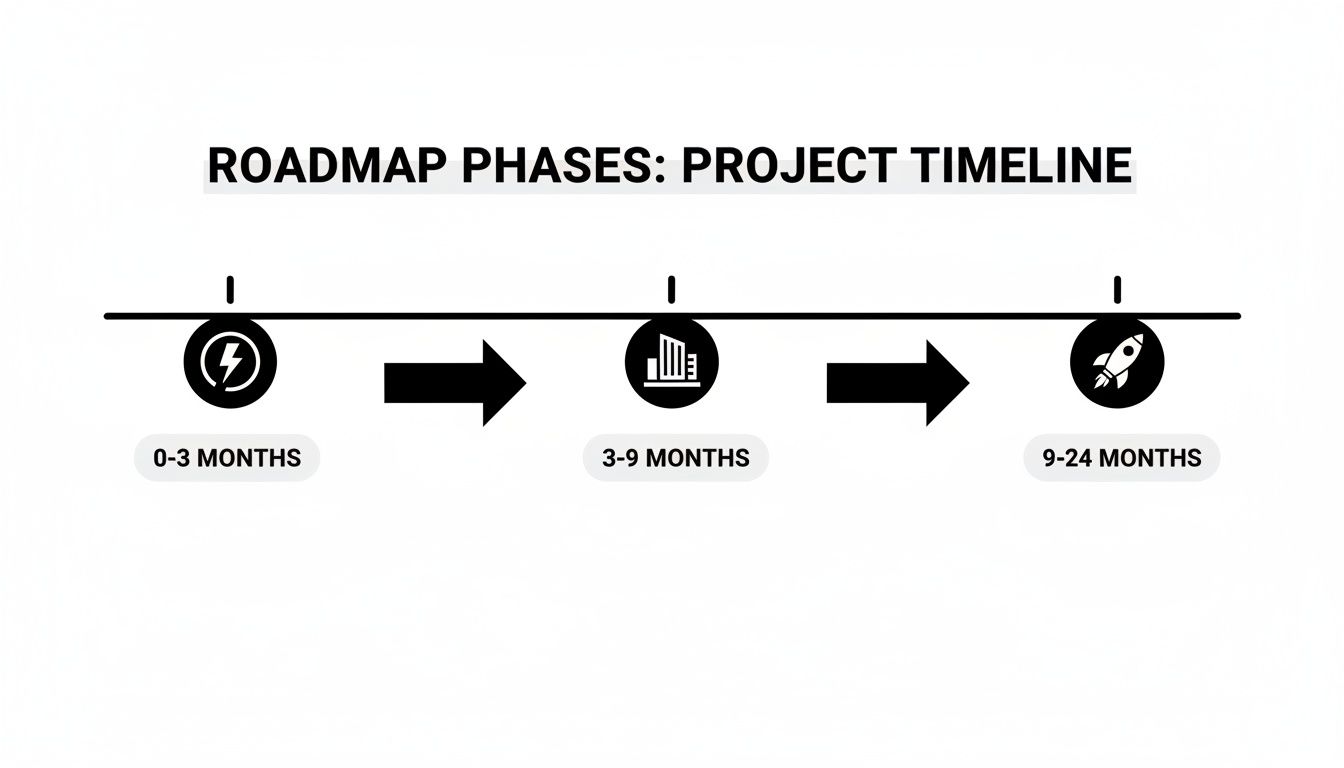
This visual timeline does a fantastic job of separating immediate actions from long-term goals, helping everyone on the team understand the strategic flow of work.
Phase 1: Quick Wins (0-3 Months)
This first phase is all about immediate impact. These are the low-hanging-fruit projects you likely uncovered during your stakeholder interviews—the ones that solve urgent pain points and can be implemented fast.
A classic example? Automating lead data entry from web forms directly into the CRM. It's a relatively small change, but it can save the sales team hours every single week. That delivers instant value and, just as importantly, builds credibility for the entire roadmapping process.
Phase 2: Foundational Builds (3-9 Months)
With some momentum from your quick wins, you can now shift focus to more substantial projects. These are the foundational builds that truly set you up for future growth.
Think about initiatives like:
- Rolling out core Standard Operating Procedures (SOPs)
- Implementing a new CRM framework
- Building out a customer onboarding automation sequence
These projects require more resources, but they create the stable systems you absolutely need to scale effectively.
Phase 3: Transformational Projects (9-24 Months)
This is where you place your big bets. These are the game-changing, long-term initiatives that tie directly to your North Star. A perfect example is deploying a sophisticated AI support agent to handle first-tier customer inquiries or even developing an entirely new product line.
These projects are complex and resource-intensive, but they're built on the stable foundation you created in Phase 2. You can't get here without the earlier work.
Mapping Dependencies and Building in Flexibility
A roadmap is so much more than a timeline; it's a strategic document that has to account for how all the different pieces fit together. As you place initiatives into these phases, you have to map their dependencies. You can't build a new CRM integration (Phase 2) until the core CRM is properly configured (Phase 1). Obvious, but easily overlooked.
Visualizing these connections is crucial. Tools like Miro or Jira can help create a visual flow that shows which tasks must be completed before others can begin. This clarity prevents bottlenecks and ensures a much smoother progression from one phase to the next.
A phased roadmap’s most critical element is its built-in flexibility. Your plan is a hypothesis, not a prophecy. The market will shift, new opportunities will arise, and priorities will change.
This is exactly why quarterly reviews are non-negotiable.
Every three months, get your leadership team back in a room to assess progress, review KPIs, and re-evaluate the next phase of the roadmap. This regular check-in is your chance to pivot. Did a new competitor emerge? Did a customer insight reveal a massive new opportunity? The quarterly review allows you to adapt without completely derailing your long-term vision.
For those focused on major organizational shifts, understanding how to apply this to building a digital transformation roadmap can provide a deeper framework for managing change.
By structuring your plan into these manageable, outcome-focused phases, you transform your roadmap from a static document into a living, breathing guide for strategic execution.
Bringing Your Roadmap to Life with Tools and Communication
All that hard work—the strategic planning, the stakeholder wrangling, the painful prioritization—is for nothing if your roadmap just gathers dust in a forgotten spreadsheet. The final, and arguably most important, step is to turn that static document into a living, breathing guide that actually drives your team's work.
This comes down to two things: finding the right tool to visualize your plan and building a communication rhythm that keeps everyone locked in.
Your roadmap should never be a "set it and forget it" affair. It needs to become the central nervous system for your strategy, easily accessible to everyone. The goal is to create a single source of truth that the entire company can rally around. When someone asks what’s coming next or why their project matters, the roadmap should give them a clear, immediate answer.
Choosing Your Roadmap Visualization Tool
The tool you pick to display your roadmap is more than just a preference; it fundamentally shapes how people interact with the plan. If it's clunky or a pain to update, people will simply stop using it. You need something that fits your team’s existing workflow, not the other way around.
There's no magic bullet here. A small, scrappy team doesn't need a heavy-duty enterprise tool, and a simple Kanban board will fall apart trying to manage the complex dependencies of a large organization. It's all about finding that sweet spot between powerful features and genuine usability.
Roadmap Tool Comparison for B2B and SaaS
Choosing the right tool depends on your team's size, methodology, and specific needs. Here's a breakdown of top contenders.
| Tool | Best For | Key Feature | Potential Drawback |
|---|---|---|---|
| Productboard | Dedicated product teams needing to link customer feedback directly to roadmap items. | Integrates user insights, feature validation, and roadmapping in one place. | Can be overly complex and expensive for teams outside of product development. |
| Jira | Engineering-heavy teams that need to connect high-level goals with granular development tasks. | Deep integration with development workflows, sprints, and ticket management. | The user interface can feel intimidating for non-technical stakeholders. |
| Trello | Small teams and straightforward projects that benefit from a simple, visual workflow. | Its Kanban-style card system is intuitive and extremely easy to learn and adapt. | Lacks advanced features for managing complex dependencies or resource planning. |
| Miro | Highly collaborative teams that need a flexible, free-form canvas for brainstorming and planning. | Infinite whiteboard-style space allows for creative layouts and visual storytelling. | It’s a visualization layer, not a task management system, so it needs to be paired with other tools. |
For a more detailed breakdown, our guide comparing the top project management tools can help you dig deeper based on your specific needs.
Making the Roadmap Part of Your Culture
Once your roadmap has a home, you need to weave it into the fabric of your company's daily life. A plan that isn’t discussed regularly is a plan that will be forgotten. This is where you transform a simple document into a culture of execution.
It all starts with a proper kickoff. Don’t just fire off a company-wide email with a link. Present the roadmap in an all-hands meeting. Walk everyone through the major themes, explain the why behind the big bets you're making, and show how each initiative ladders up to that North Star Metric we talked about. This is your chance to build real buy-in.
Your roadmap is more than a plan; it's a storytelling device. It should clearly articulate where you are, where you're going, and how you're going to win. When your team believes in the story, they'll move mountains to make it a reality.
After that initial launch, the real work begins. You have to keep the momentum going with consistent, predictable communication. This shows everyone that the roadmap is a serious commitment, not just the flavor of the month.
Here are a few things that have worked for me:
- Set Up a Regular Review Cadence: Put a recurring meeting on the calendar to review progress against the roadmap—weekly for core project teams, maybe bi-weekly or monthly for the leadership team. These aren't just status updates; they’re for spotting roadblocks and making course corrections.
- Build a Progress Dashboard: Don't let your roadmap live in a vacuum. Connect its initiatives to your most important KPIs and build a simple, highly visible dashboard. Tracking metrics like customer acquisition, churn reduction, or feature adoption makes the impact of your work undeniable.
- Celebrate the Wins, Big and Small: When a team knocks a major initiative off the roadmap, make some noise! Acknowledge their hard work in a company-wide email, a dedicated Slack channel, or at the start of your next all-hands meeting. This builds positive momentum and shows everyone that their effort is recognized.
By pairing the right tool with a relentless communication rhythm, your roadmap becomes the engine of your business. It stops being a static plan on a page and starts being the daily guide that aligns every decision and every person toward your most critical goals. This is how you bridge the gap between just planning and actually winning.
Common Questions We Hear About Roadmapping
Even with a great framework, actually sitting down to build your first roadmap can feel a little daunting. It’s easy to get bogged down in the details or stuck on a few common questions. Let's tackle some of the ones that trip up B2B and SaaS founders most often.
How Granular Should This Thing Be?
This is the classic Goldilocks problem. Too much detail, and your roadmap becomes an unreadable, mile-long task list. Too little, and it’s too vague to offer any real direction. The trick is to find the right altitude.
Your roadmap should always focus on outcomes, not outputs. Instead of getting lost in the weeds of individual tasks, think in terms of larger, strategic initiatives.
- Don't do this: "Code feature X, write documentation, run QA tests, launch marketing campaign."
- Do this instead: "Launch Customer Self-Service Portal (Q2)."
See the difference? The second example keeps the focus on the why—the strategic value we're delivering. All those nitty-gritty tasks belong in a project management tool like Jira or Trello, not cluttering up your strategic view. The roadmap points to the destination; your project plan gives the turn-by-turn directions.
What's the Difference Between a Roadmap and a Project Plan, Anyway?
This one trips up a lot of teams, and confusing the two is a recipe for disaster. They’re deeply connected, but they serve completely different purposes.
I like to use a house-building analogy.
The roadmap is the architect's blueprint. It shows the overall vision—a three-bedroom, two-bath modern home with a finished basement. It’s all about communicating the big goals and the major phases of construction.
The project plan is the contractor's daily schedule. It gets into the weeds: pouring the foundation on Monday, framing the walls by Friday, and getting the electricians in the following week. It’s the "how" and the "when" of getting the job done.
Your roadmap answers "what" and "why." The project plan handles "how" and "when." You absolutely need both, but they have to stay in their own lanes.
How Often Should I Be Updating My Roadmap?
A roadmap is a living document, not something you carve in stone and forget about. Markets shift, customer needs change, and your internal priorities will evolve. A static roadmap is a useless roadmap. At the same time, changing it every other day will give your team whiplash.
You need a rhythm that balances stability with agility.
- Quarterly Reviews: This is your non-negotiable. Every quarter, get the key players in a room to review progress, re-evaluate priorities, and adjust the next one or two quarters. This is your main strategic checkpoint.
- Minor Monthly Tweaks: It's okay to make small adjustments more often. Maybe a small initiative gets pushed from April to May. These little shifts reflect on-the-ground reality without derailing the whole strategy.
Whatever you do, avoid making huge, reactive changes every week. That’s a clear sign of a shaky strategy, and it’s a surefire way to kill team morale. The goal is to be responsive, not reactive.
How Do I Get Everyone to Actually Buy Into This?
Want to know the fastest way to get pushback? Drop a fully-baked roadmap on your team's desk without asking for their input first. Real buy-in isn't something you get at the final presentation; it's something you earn throughout the entire process.
Pull your key stakeholders in from the very beginning. When you include department heads, team leads, and even key individual contributors in the discovery and prioritization phases, you make them co-authors of the plan. They see their own ideas and pain points reflected in the final document, turning them into its biggest advocates.
When you finally do present the roadmap, don't just show a list of features. Tell a story. Connect every single initiative back to your North Star goal. Explain exactly how it solves a problem you heard about in your stakeholder interviews. This transforms it from a boring list of projects into a shared vision for where you're all going together.
At MakeAutomation, we specialize in turning strategic goals into reality by building the automated systems that power growth. If you're ready to create a roadmap that gets results, we can help implement the AI and automation frameworks to make it happen. Explore how we help B2B and SaaS businesses scale.