What Is Sales Cadence A Guide To Predictable B2B Revenue
Think of a sales cadence as your team's playbook for contacting a potential customer. It's a structured series of touchpoints—a mix of calls, emails, and social media messages—all scheduled out over a specific period. The goal? To guide a prospect from a cold lead to a warm conversation without letting anyone fall through the cracks.
The Rhythm of Predictable Sales Outreach

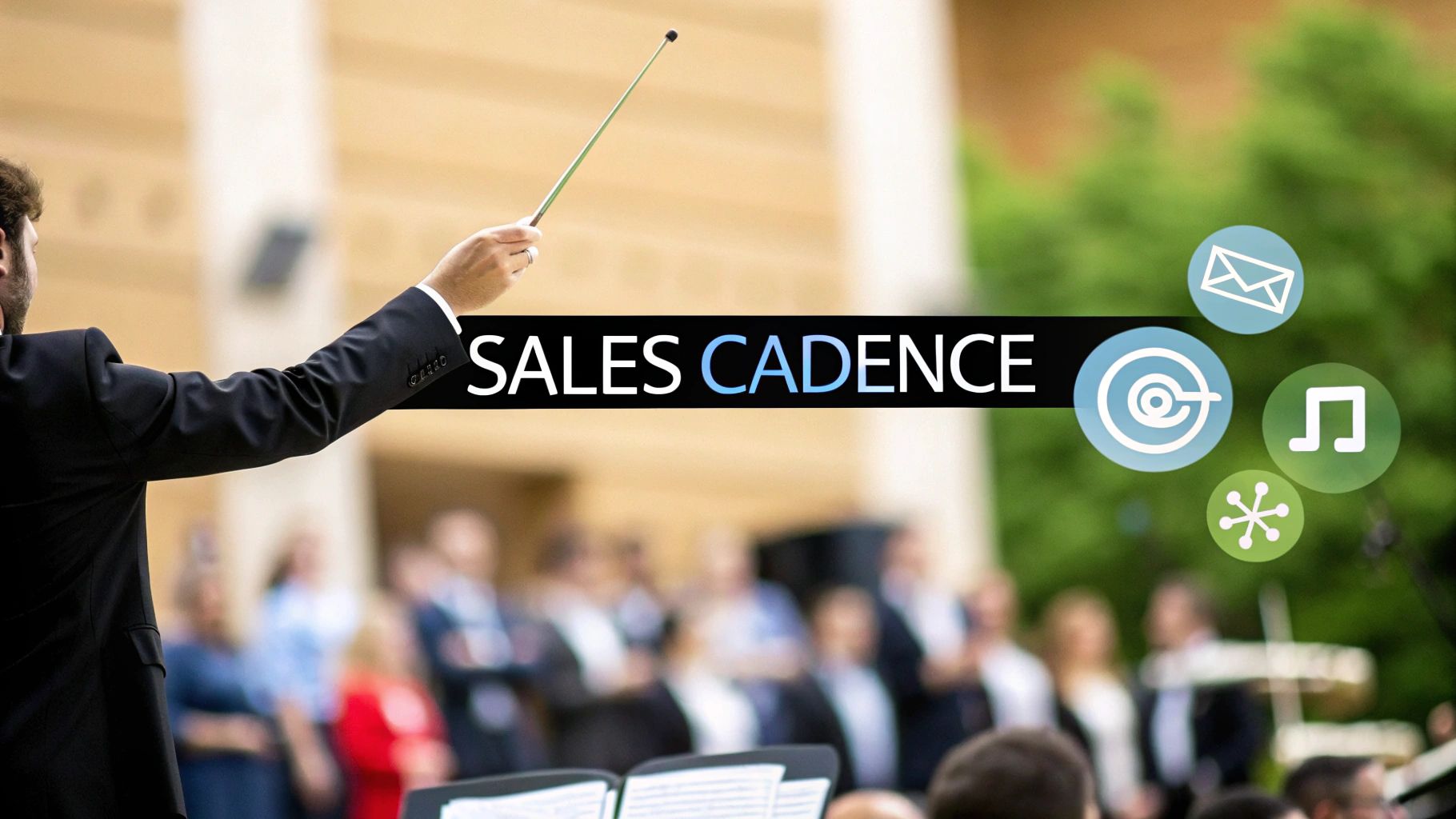
Picture a conductor leading an orchestra. Each musician knows exactly when to play their part, creating a powerful, harmonious performance. A sales cadence does the same thing for your sales team. It brings a predictable rhythm to what can otherwise feel like a chaotic outreach process.
Without a set plan, your reps are just improvising. One might send two follow-ups, another might send five, and a third could forget entirely. This kind of inconsistency is a recipe for lost deals and a pipeline that’s all over the place.
A well-crafted sales cadence changes all that. It provides a clear blueprint for engagement, telling your team which channel to use, when to reach out, and what message to deliver.
What Goes Into a Sales Cadence?
At its core, every effective sales cadence is built on four fundamental pillars. Getting these right is the first step toward building a system that delivers consistent results. They work together to make sure your outreach is persistent without being annoying and structured without feeling robotic.
Let's break them down.
Here’s a quick look at the essential components that form the foundation of any successful sales cadence.
The Four Pillars of an Effective Sales Cadence
| Component | Description | Example |
|---|---|---|
| Touchpoints | The total number of interactions you'll have with a prospect. | A 12-step cadence with a mix of calls, emails, and LinkedIn messages. |
| Timing | The spacing and frequency between each of your outreach attempts. | Day 1: Email, Day 3: Call, Day 5: LinkedIn message, Day 7: Email. |
| Channels | The communication methods you'll use to connect with your prospect. | Phone calls, personalized emails, video messages, LinkedIn InMail, SMS. |
| Content | The messaging you use in each email, call script, or social post. | A "breakup" email, a voicemail script with a case study, a personalized video. |
By defining these four pillars, you're not just creating a schedule—you're building a repeatable framework that your entire team can execute flawlessly.
This system is absolutely critical for effective sales development. It turns outreach from a guessing game into a predictable, scalable engine for booking meetings. You can dive deeper into this crucial role by checking out our guide on what is sales development.
A sales cadence isn’t just a schedule; it’s a strategic framework that ensures every prospect receives the right message, on the right channel, at the right time. It’s the difference between random acts of outreach and a predictable system for revenue growth.
Ultimately, truly understanding and implementing a sales cadence is a game-changer for any B2B or SaaS company. It solves common headaches like inconsistent follow-up and leaky pipelines, paving the way for scalable, predictable growth.
Why a Structured Cadence Is Your Competitive Edge
Let's be honest, without a structured sales cadence, your team is flying blind. Reps are left to their own devices, guessing when to call, what to email, and how often to follow up. This kind of random outreach is a recipe for disaster—it’s inconsistent, lets hot leads fall through the cracks, and is impossible to scale.
A well-designed cadence completely changes the game. It’s not just a schedule; it’s a clear, repeatable roadmap for engaging every single prospect. It ensures every lead gets the right touch, at the right time, every time. That consistency is what turns a chaotic sales effort into a predictable growth engine.
From Chaos to Predictable Performance
Trying to manage, measure, or improve an unstructured sales process is a nightmare. If every rep is doing their own thing, how can you possibly know what’s working? You can't. A sales cadence standardizes your approach, creating a system that produces reliable results you can actually analyze and improve.
This isn't just about being organized; it's about a direct impact on your bottom line. In the cutthroat world of B2B sales, a landmark study from InsideSales.com research found something staggering: reps using an optimized, structured cadence saw their results jump by as much as 110% compared to those using random methods.
A sales cadence is your competitive advantage because it turns prospecting into a science. It replaces random acts of outreach with a methodical, measurable system that consistently generates conversations and builds pipeline.
By implementing a clear sequence of touchpoints, you build real momentum. Instead of sporadic follow-ups that lose steam, a cadence creates persistent, professional engagement that keeps you top-of-mind and pushes deals forward.
Efficiency and Scalability for Growing Teams
For any B2B or SaaS company trying to grow, scalability is the name of the game. A structured cadence is the secret to expanding your sales team without watching performance fall off a cliff. It gives new hires a proven playbook they can pick up and run with, cutting their ramp-up time dramatically.
This standardization means your entire team operates more efficiently. They're not wasting mental energy figuring out what to do next. Instead, they’re spending their valuable time having meaningful conversations with qualified prospects. It also gives them a solid framework for putting new strategies for generating business leads and growing sales into practice.
Here’s exactly how a structured cadence gives you an edge:
- Boosts Pipeline Velocity: Consistent follow-up keeps leads warm and moving, which helps shorten the overall sales cycle.
- Improves Team Efficiency: It takes the guesswork out of the equation, providing clear, step-by-step actions for every lead.
- Deepens Prospect Engagement: Using multiple channels to deliver value builds trust and a stronger connection over time.
- Enables Predictable Forecasting: When your outreach is consistent, you can use your conversion data to forecast your pipeline and revenue with far more accuracy.
At the end of the day, a sales cadence is more than a to-do list. It’s a strategic asset that empowers your team to work smarter, engage prospects more effectively, and drive the predictable revenue growth your business needs to thrive.
How To Build Your First Sales Cadence
Alright, this is where the rubber meets the road. Building your first sales cadence is all about turning theory into action. You're taking everything you know about your ideal customer and mapping it into a deliberate sequence of touchpoints.
The goal isn't to create some rigid, robotic script for your reps to follow. Far from it. Think of it as a flexible playbook that guides them toward real, meaningful conversations. It's like building a custom workout plan—you wouldn't give a pro athlete the same routine you'd give a total beginner, right? Your sales cadence needs that same level of tailoring for the specific "fitness level" and goals of your audience.
This is a journey from unstructured, hopeful outreach to a system built for strategic, repeatable growth.
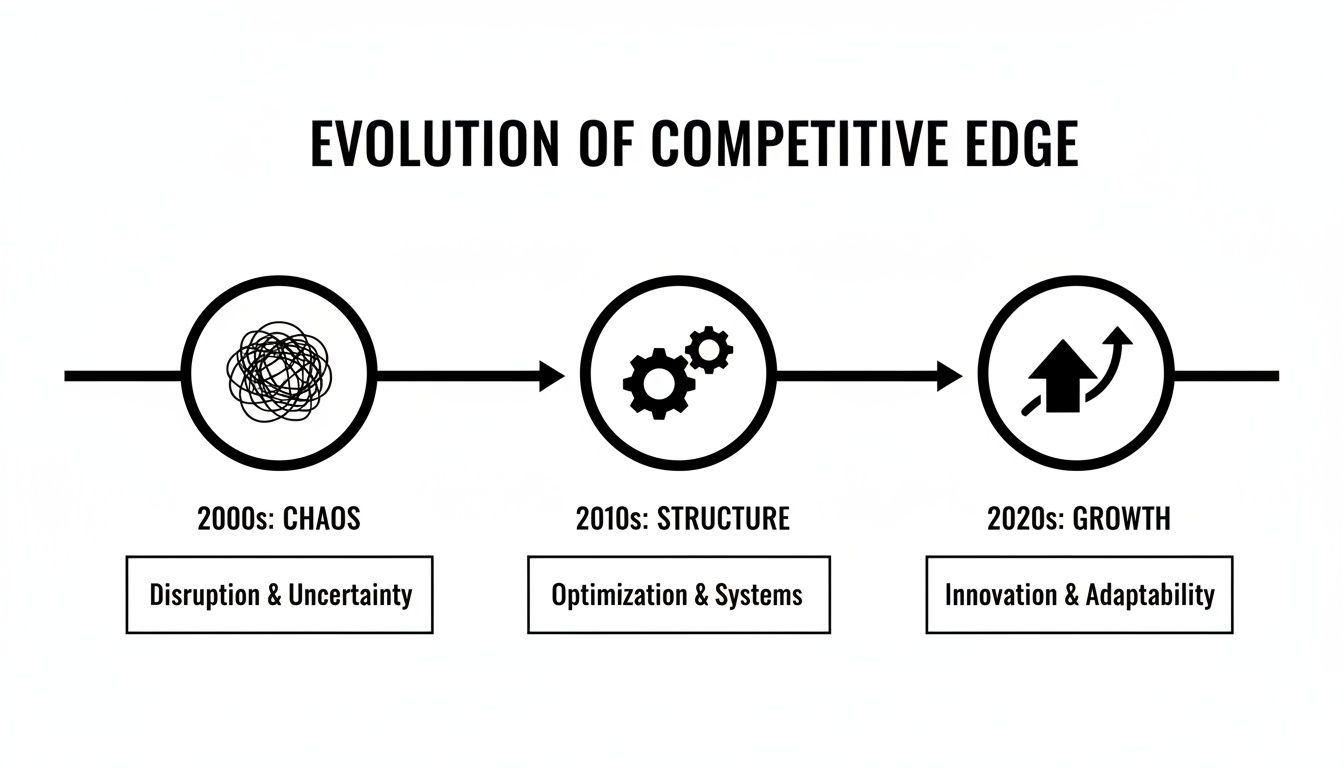
As you can see, implementing a structured cadence is what takes a sales process from chaotic guesswork and transforms it into a machine that drives predictable revenue.
Step 1: Start With Your Ideal Customer Profile
Before you write a single email or dial a single number, you have to know exactly who you're talking to. This is the bedrock of any successful sales cadence. Without a crystal-clear Ideal Customer Profile (ICP), your messaging will feel generic and your efforts will completely miss the mark.
Your ICP is a deep-dive description of the company that gets the most bang for their buck from your product. Go way beyond basic details like industry or company size. You need to get into their heads—what are their biggest pain points? What are their business goals? What specific event would trigger them to start looking for a solution like yours?
A well-defined ICP is your north star. It ensures every single touchpoint in your cadence is relevant, hits home, and speaks directly to the problems your prospect is desperately trying to solve.
Once you’ve locked in your ICP, the next move is to identify the key personas inside those companies. Who holds the purse strings? Who influences the decision? Understanding their individual roles and what makes them tick is what allows you to craft messaging that actually lands.
Step 2: Select a Strategic Mix of Channels
A modern sales cadence is a multichannel game. If you're only relying on email, you're just adding to the noise in their inbox and hoping for the best. The winning strategy is to engage prospects where they actually hang out, using a smart mix of communication channels.
Let your ICP and personas guide your channel selection. For instance, a C-level exec might respond best to a sharp, high-impact email, while a tech lead could be much more active and approachable on LinkedIn.
Here are the core channels you should be thinking about for your mix:
- Email: This is the backbone of most cadences. It’s perfect for delivering detailed value props, sharing case studies, and offering personalized insights.
- Phone Calls: Nothing beats a real conversation. Calls add a human touch and let you handle objections on the fly. This is also where you can deploy a Voice AI agent for those initial qualifying calls to save time.
- LinkedIn: The go-to platform for building rapport. You can engage with a prospect's content, warm them up, and send less formal messages that feel more natural.
- Video Messages: Want to stand out? This is how you do it. A short, personalized video can boost your engagement rates through the roof.
The key isn't to blast every channel at once. It's about using the right channels in the right combination to create a seamless experience.
Step 3: Map Your Sequence and Timing
You know your audience and you've picked your channels. Now it's time to map out the actual sequence. This is where you decide on the number of touchpoints and, just as importantly, the timing between them. The biggest mistake here is being either way too aggressive (and annoying your prospect) or too passive (and letting them forget you exist).
For most B2B sales, a solid cadence usually lasts between 10 to 21 days and includes 8 to 14 touchpoints. You'll want to front-load the intensity, with more frequent outreach in the first week to build momentum, and then space things out a bit more over time.
This structure shows persistence and professionalism without being a pest. And remember, a staggering 80% of sales require 5+ follow-up touches, so having a well-thought-out sequence is absolutely non-negotiable.
Step 4: Craft Compelling and Personalized Content
This is the final, crucial piece of the puzzle: creating the actual content for each touchpoint. This is where personalization goes from a buzzword to a real, tangible asset. Every email, call script, and LinkedIn message needs to build on the last one, telling a cohesive story about the value you bring to the table.
Ditch the generic templates. Seriously. Instead, think in terms of "content pillars" for each step in your sequence.
- Touchpoint 1 (Email): Zero in on a specific pain point that's highly relevant to their role and industry.
- Touchpoint 3 (Call): Reference that first email and ask an insightful, open-ended question.
- Touchpoint 5 (LinkedIn): Share a helpful article or resource (not your own!) that you think they'd genuinely find valuable.
Follow these four steps, and you'll build a powerful sales cadence that doesn't just get replies—it builds relationships and drives the predictable revenue you're after.
Measuring and Optimizing Your Cadence Performance
So, you've built your first sales cadence. That's a huge step, but the work isn't over. A common mistake is to treat your cadence as a "set it and forget it" tool. The best sales teams know their cadences are living things—they need to be measured, analyzed, and tweaked constantly.
Without keeping an eye on performance, you're essentially flying blind. You have no real way of knowing which messages are landing and which are getting ignored. This data-driven approach is what turns a decent outreach strategy into a powerhouse for generating results.
This cycle of continuous improvement is absolutely critical. Consider this: it takes an average of 5 follow-ups to close a deal, yet a staggering 44% of salespeople give up after just one call. That means 80% of potential deals are left on the table simply from a lack of persistence. A well-optimized cadence is specifically designed to close that gap. You can dive deeper into building these frameworks in this detailed guide on Leadsatscale.com.
The Key Performance Indicators You Must Track
To figure out what’s actually working, you have to track the right numbers. These KPIs tell the story of your cadence's health, pointing out both its strengths and its weaknesses. Think of them as the vital signs for your outreach machine.
Here are the non-negotiable metrics every sales team should be watching:
- Email Open Rates: This is your first impression. Are your subject lines interesting enough to make someone click? A low open rate (anything below 20% for cold outreach is a red flag) means your hook isn't catching anyone.
- Reply Rates: This is where the real engagement happens. It’s one thing to get an open, but another to get a response. A strong reply rate tells you the message inside the email is relevant and your call-to-action is compelling.
- Call Connection Rates: How many of your attempted calls are actually connecting with a real person? This metric helps you diagnose the quality of your contact list and identify the best times of day to be dialing.
- Meeting Booked Rate: At the end of the day, this is what it’s all about. This metric directly measures how many leads your cadence is turning into qualified appointments for the sales team.
By keeping a close watch on these numbers, you can spot problems early and fix them before they bring your whole pipeline to a halt.
Turning Data Into Action
Data is useless without interpretation. The real skill is connecting the dots between these metrics to uncover the weak links in your sequence. You have to learn to read the story the numbers are telling you.
For instance, let’s say you have a fantastic open rate, but your reply rate is in the gutter. This is a classic problem. It tells you your subject line is doing its job, but the email body is failing to connect with the prospect or your call-to-action isn't strong enough.
The goal of measurement isn't just to report numbers; it's to ask 'why?' Why do we get more replies on email #3 than email #1? Why are our call connection rates so low on Friday afternoons? Answering these kinds of questions is how you truly get better.
Improving your cadence also has a huge effect on another crucial metric we cover in our guide on what is sales velocity. A more efficient cadence moves prospects through your pipeline faster, which directly fuels your revenue engine. By constantly testing different variables—like your messaging, timing, and the channels you use—you can systematically improve your results and build a pipeline you can actually count on.
Supercharging Your Cadence With Automation And AI
Let's be honest: running a detailed sales cadence by hand is a soul-crushing time sink. Your reps get stuck in a loop of repetitive, low-impact tasks—sending another follow-up, logging a call, updating the CRM. All that admin work steals precious hours they should be spending on what actually moves the needle: building relationships and having real conversations.
The cracks in a manual approach really start to show when you try to scale. It’s nearly impossible to make sure every single prospect gets the right touchpoint at the perfect time when you're juggling it all on spreadsheets and sticky notes.
This is where automation and AI come in, and they completely change the game. By bringing in the right tech, you can turn your sales cadence from a manual chore into a powerful, self-running engine.
The Power Of An Automated System
Think of automation as the workhorse that handles all the predictable, rule-based tasks eating up your team's day. Imagine a system that automatically triggers the next email in a sequence, creates a follow-up task in the CRM, or even enrolls a new lead into the perfect cadence based on how they came in.
This instantly frees up your sales reps to focus on the uniquely human side of selling—personalizing a message, running a great discovery call, or navigating a complex negotiation. To get there, you need the right tools. Integrating powerful drip campaign software is a non-negotiable for managing these kinds of sophisticated sequences without the manual headache.
With an automated foundation, your team can handle a much larger pipeline far more effectively, ensuring no lead slips through the cracks because someone forgot to follow up. It builds a level of consistency and precision that manual effort just can't compete with.
Automation isn't about replacing salespeople; it's about empowering them. By taking over the robotic tasks, it allows reps to operate at the top of their game and focus on building genuine connections with prospects.
Integrating AI For Smarter Outreach
If automation handles the "what" and "when," Artificial Intelligence (AI) takes care of the "how" and "who." AI-powered tools dig through mountains of data to surface insights that make your outreach smarter, not just faster.
For example, AI can analyze which of your subject lines are actually getting opened or pinpoint the absolute best time to call a prospect based on their past engagement. It takes all the guesswork out of optimization, giving you a data-driven blueprint for getting better results.
Even better, modern tools like Voice AI agents can handle those initial qualifying calls, asking the first few screening questions and booking meetings right onto your reps' calendars. This is huge—it means your team only spends time with prospects who are genuinely qualified and interested. You can dive deeper into how these systems work in our complete guide to AI-powered sales automation.
The impact here is real and measurable. Companies that layer these tools into structured cadences often see a 25% bump in response rates and 15% more conversions in just six months. That success comes from executing a multi-channel strategy over an optimized timeline—a perfect job for outbound Voice AI agents and smart CRM automations.
By combining a thoughtfully designed sales cadence with the raw power of automation and AI, you create a system that's not just scalable and efficient, but truly intelligent. You build a machine for predictable revenue growth.
Of course. Here is the rewritten section with a more natural, human-expert tone.
Where Sales Cadences Go Wrong (And How to Get Them Right)
You can have the most brilliantly designed sales cadence on paper, but if the execution is off, it’s going to fall flat. I’ve seen it happen time and again: well-meaning outreach plans fail not because the strategy was bad, but because of a few common, completely avoidable mistakes that kill a conversation before it even has a chance to start.
So, what are these cadence killers?
One of the biggest culprits is sounding like a robot. When reps just copy and paste a generic template, prospects can sniff it out instantly. The email feels cold, automated, and it’s a one-way ticket to the trash folder. It basically screams, "You're just another name on my list," not a potential partner I actually want to talk to.
Another classic mistake is getting the timing all wrong. You’re either way too aggressive or far too passive. Firing off three emails and a LinkedIn message in one day? You’re going to get blocked. On the flip side, if you wait a whole week between follow-ups, you lose all momentum. Your prospect has already forgotten who you are.
Ditch the Robot and Get Personal
Fixing a robotic cadence means putting in a little effort to be a real human. And no, just dropping in a {FirstName} tag doesn’t count as personalization anymore. You have to do your homework.
- Reference something recent: Did their company just announce a new funding round? A product launch? Did the person you're reaching out to get quoted in an article? Mention it. It shows you’ve actually paid attention.
- Try a quick, personal video: A simple 30-second video where you say their name and mention something specific about their company can work wonders for reply rates. It’s hard to ignore a message made just for you.
- Connect with their content: If they’re active on LinkedIn, that’s your opening. Something as simple as, "Hey, I saw your post on scaling sales teams and it really got me thinking…" turns a cold pitch into a warm conversation.
This isn't about spending hours on every single prospect. It’s about spending a few minutes to show you’re a real person who has done their research.
Finding Your Cadence Rhythm
There's a fine line between persistence and becoming a pest. The trick is to find a rhythm that feels professional and intentional, not desperate or lazy.
The goal of a sales cadence isn’t just to get a response; it’s to build a bridge of communication. If your outreach feels like a series of disconnected, robotic demands, that bridge will never get built.
A good rule of thumb is to start with more frequent touchpoints to build that initial awareness, then gradually space them out. For example, your first three touches might happen over five days, but the next three could be spread out over the following two weeks.
And most importantly, look at your data! If you're seeing a spike in unsubscribes after your third email, that’s a massive red flag. Your timing or your message is off. A great cadence is a living thing—it should always be tested, measured, and tweaked based on how your prospects are actually responding.
Sales Cadence FAQs
Even with the best strategy laid out, you're bound to have questions once you start building and running your cadences. Let's tackle some of the most common ones that pop up in the real world. Getting these details right is what separates a sharp, effective outreach strategy from one that just makes noise.
How Long Should a Sales Cadence Be?
This is the million-dollar question, and the honest answer is: it depends. There’s no single "correct" length. The right duration is all about who you're talking to and how they found you. A great cadence is tuned to the temperature of the lead.
- Warm Inbound Leads: These folks already raised their hand. You don't need to play the long game. A shorter, punchier cadence of 7-10 days with 5-7 touchpoints is usually perfect for getting a meeting on the calendar without being annoying.
- Cold Outbound Prospects: You're starting from scratch here, so you need more runway. A longer cadence of 14-21 days with 8-14 touchpoints gives you the time you need to cut through the static, build a little name recognition, and actually show them why they should care.
A good rule of thumb is to pack more activity into the first week to grab their attention, then give them some breathing room with more spaced-out follow-ups.
What’s the Difference Between a Cadence and a Workflow?
It's easy to get these two mixed up, but the distinction is actually pretty simple.
Think of a sales workflow as any broad, automated process that kicks off when something specific happens. For instance, when someone downloads an ebook, a workflow might tag them in your CRM and add them to a general newsletter. It's a background process.
A sales cadence, on the other hand, is a very specific type of workflow. It's a pre-planned sequence of outreach steps—emails, calls, social touches—with one single goal: to start a conversation and book a meeting.
A workflow is any automated set of actions in your sales system. A sales cadence is a specialized workflow built for one thing: getting a response from a prospect.
Can You Over-Automate Your Sales Cadence?
Yes, absolutely. In fact, it’s one of the fastest ways to kill your results. Automation is a game-changer for handling the grunt work—scheduling emails, logging calls, creating tasks. But leaning on it too much makes your outreach feel cold and robotic, and prospects can smell a generic, automated message from a mile away.
The best sales teams use automation to buy back time for personalization. Let the machine schedule the email, but you write a custom first sentence based on their LinkedIn profile. Let the tool create the call task, but you record a quick, personal video to send beforehand. The parts of your outreach that require real thought, research, or a human touch should always be handled by a human.
Ready to build a predictable revenue engine? MakeAutomation specializes in creating and implementing the AI-powered automation frameworks that supercharge your sales cadences. Stop guessing and start growing by visiting https://makeautomation.co to see how we can help you scale.