
What Is Sales Intelligence for B2B Growth
At its heart, sales intelligence is all about using data to help sales teams make smarter, faster decisions. It’s about ditching the guesswork and arming your reps with the right information to find the best prospects, engage them at the perfect moment, and have conversations that actually resonate.
From Paper Maps to a Live GPS
Remember trying to navigate a new city with a folded paper map? You could see the main roads, but you had no idea about the massive traffic jam up ahead, the unexpected road closure, or the brand-new shortcut that just opened. That's what traditional selling feels like—you're operating with outdated information, essentially driving blind and just hoping you get there.
Sales intelligence is your live GPS. It doesn't just give you the map; it shows you real-time traffic, alerts you to roadblocks, and actively reroutes you for the quickest path. For any B2B or SaaS company, this "GPS" is a game-changing competitive edge.

To make this clearer, let's break down the difference in a quick comparison.
Sales Intelligence At a Glance
| Aspect | Traditional Sales (The Paper Map) | Sales Intelligence (The Live GPS) |
|---|---|---|
| Prospecting | Manual research, static lists, guesswork. | Automated ICP matching, dynamic contact data. |
| Timing | Reaching out on a fixed schedule or hunch. | Engaging based on real-time buying signals. |
| Messaging | Generic, one-size-fits-all pitches. | Highly personalized, context-aware conversations. |
| Efficiency | Hours spent on manual data entry and research. | Automated data enrichment and workflow triggers. |
This table really just scratches the surface. The shift from a static map to a dynamic GPS changes not just the route, but the entire experience and outcome of the journey.
Beyond Basic Contact Information
Modern sales intelligence goes so much deeper than a simple list of names and phone numbers. It gives you a complete picture of your potential customers, answering three absolutely critical questions that drive the entire sales process:
-
Who should we talk to? It pinpoints companies that perfectly match your Ideal Customer Profile (ICP) and identifies the actual decision-makers you need to connect with. This is the bedrock of any successful outreach, a process we cover in our guide to prospect research.
-
When should we reach out? It tracks crucial buying signals—like a company hiring for a specific role, a key executive changing jobs, or a prospect visiting your pricing page—so your timing is always on point.
-
What should we say? It provides the context you need for a truly personal conversation. Knowing a company just received funding, uses a competitor's software, or posted about a new initiative lets you craft a message that stands out.
This move toward a data-first strategy isn't just a fleeting trend. The global sales intelligence market is expected to hit USD 9.53 billion by 2034, a clear sign that founders and sales leaders are embracing AI and automation to win back time from inefficient, manual work.
Think of it as adding layers to your sales engine. For instance, incorporating conversation intelligence allows you to analyze customer calls and meetings, giving you another powerful stream of data to refine your approach.
The Four Pillars of Modern Sales Intelligence
To really get what sales intelligence is all about, you have to look under the hood. It’s not just a single list of contacts or companies. Instead, it’s a powerful mix of different kinds of information that come together to paint a vivid, actionable picture of your ideal customer.
Think of it like building a house. You need a solid foundation, sturdy walls, a roof, and working plumbing. Each part is critical on its own, but together, they create something functional and complete. Modern sales intelligence works the same way, standing on four distinct pillars. Each one answers a vital question that guides your team from that first cold call to a signed contract.

Pillar 1: Firmographics and Demographics
This first pillar answers the most basic questions: "Who are they?" and "Where are they?" Firmographics are simply the core facts about a company, much like demographics describe a person. This is your foundation—the data that lets you slice up your market and make sure you’re not wasting time on businesses that are a poor fit.
Key firmographic details include:
- Industry: Are you targeting SaaS, healthcare, or finance companies?
- Company Size: Is your sweet spot with startups, mid-market businesses, or massive enterprise corporations?
- Annual Revenue: Can they actually afford your solution?
- Geographic Location: Do they fall within your sales territories?
On the flip side, demographics zoom in on the specific people inside those companies—their job title, seniority, and department. This is how you pinpoint the actual decision-makers and influencers, ensuring your pitch lands in the right inbox.
Pillar 2: Technographics
While firmographics tell you about the company, technographics tell you about its tools. This pillar answers a game-changing question for any B2B or SaaS business: "What technology are they already using?" This information is pure gold. It reveals a prospect’s current tech stack, from their CRM and marketing automation software to the servers they run on.
Knowing a prospect's tech stack gives you incredible leverage. You can:
- Find Easy Integration Wins: If your product connects seamlessly with their existing CRM, that’s a huge selling point.
- Spot Competitive Openings: Seeing a prospect use a competitor's tool is an invitation to show them what makes you better.
- Confirm a Good Fit: A company already spending money on a certain type of software clearly understands its value, making your job much easier.
For instance, if you sell marketing automation software, finding companies using a clunky, outdated email tool lets you craft a highly relevant pitch. This context instantly transforms a cold outreach into a helpful, problem-solving conversation.
Pillar 3: Buying Intent Signals
This might be the most exciting pillar of them all. Buying intent signals answer the million-dollar question: "Are they ready to buy now?" Intent signals are the digital breadcrumbs a prospect leaves behind that show they’re actively researching a solution just like yours. It’s like seeing someone raise their hand in a crowded room, asking for help.
Intent data flips the script on sales. It moves your team from a reactive, guessing-game approach to a proactive one. You're no longer just hoping someone is interested; you're engaging prospects who are already showing they're in the market, which radically improves your odds.
These signals can be anything from a company’s employees visiting your pricing page, downloading a whitepaper on a related topic, or checking out your competitors. By tracking these activities, you can focus your time and energy on accounts that are hot right now. It's a key part of smart qualification, a topic we dive into in our guide on what is lead scoring. Ultimately, this data ensures your team is working on deals that are most likely to close.
Pillar 4: Data Enrichment
And finally, we have the glue that holds everything together: data enrichment. This pillar answers the practical question: "How do we keep all this information accurate and useful?" Your CRM is only as good as the data inside it, and that data gets old fast as people switch jobs and companies evolve.
Data enrichment is the ongoing process of cleaning, updating, and adding to your existing records. It automatically fills in missing phone numbers, corrects outdated job titles, and layers in new insights from the other three pillars. This process guarantees your sales team is always working with the freshest, most complete information possible.
Pulling these four pillars together has a massive impact. The global sales intelligence market is expected to rocket from USD 7.53 billion in 2024 to USD 29.13 billion by 2035, a testament to the clear ROI of making data-driven decisions. In fact, sales reps who use platforms built on these pillars often close deals 20-30% faster because they have everything they need at their fingertips. You can see the full trend in a report from Market Research Future. Together, these pillars create a 360-degree view that helps sales teams work smarter, not just harder.
How Sales Intelligence Actually Impacts Your Bottom Line
It’s one thing to understand what sales intelligence is, but it’s another to see it in action, driving real, measurable growth. Let's move past the theory. The right data isn’t just information; it’s a direct line to a sales engine that’s more efficient, more predictable, and ultimately, more profitable.
For B2B and SaaS founders, this is about making a fundamental shift. You can leave behind the high-effort, low-yield grind and embrace a smarter, data-driven strategy. The change creates a powerful ripple effect across your entire business, completely overhauling how you find and keep your best customers.
Drive Hyper-Personalization At Scale
Let's be honest: the generic, one-size-fits-all sales pitch is dead. The data backs this up—a staggering 80% of customers are more likely to buy from a company that provides a personalized experience. The problem has always been doing this at scale without burning out your team. This is precisely the gap sales intelligence fills.
Instead of another cookie-cutter email, your reps can now open a conversation by referencing a prospect’s recent funding round, the specific competitor’s software they’re using, or a new company initiative they just announced on LinkedIn. This isn't just a gimmick; this level of detail builds instant rapport and positions your team as insightful advisors, not just another vendor.
By arming your reps with deep insights, you empower them to have conversations that are genuinely relevant. This is the key to breaking through the noise and building relationships that lead to closed deals.
We're talking about more than just slotting a {{first_name}} tag into an email. It’s about showing you’ve done your homework and truly understand their world.
Dramatically Reduce Acquisition Costs
Every founder obsesses over Customer Acquisition Cost (CAC), and for good reason. A high CAC can bleed a business dry, and most of that cost comes from one place: wasted time chasing leads that were never a good fit. Sales intelligence attacks this problem head-on by refining your targeting and boosting efficiency.
Using firmographic and technographic data, your team can build a crystal-clear Ideal Customer Profile (ICP). This lets them focus exclusively on accounts with the highest probability of converting, cutting out the countless hours wasted on prospects who were never going to buy.
Here’s how it slashes your costs:
- Better Lead Quality: Your sales reps spend far less time disqualifying leads and more time actually selling to qualified opportunities.
- Higher Conversion Rates: When outreach is personal and timely, you get more "yes" responses, which naturally shortens the sales cycle.
- Increased Rep Productivity: With better data and automation, each rep can manage a larger, more valuable pipeline without getting overwhelmed.
Here’s a real-world example. A SaaS company selling project management software used sales intelligence to find 200 companies using a competitor’s tool known for its clunky UI. They ran a targeted campaign highlighting their own intuitive design and seamless integrations. The result? A 40% jump in qualified demos in a single quarter, which sent their CAC plummeting.
Increase Sales Velocity and Pipeline Value
Sales velocity is all about how quickly you can move deals through your pipeline to generate revenue. Think of sales intelligence as a powerful accelerant here. It removes the friction that slows deals down. By catching active buying signals, your team can engage prospects at the exact moment they’re ready to talk.
This proactive approach means your team is always working on deals with real momentum, rather than trying to manufacture interest out of thin air. The result is a much healthier pipeline and a shorter path from conversation to cash.
To really see the impact, you need to be tracking the right numbers.
Key Metrics to Measure Success
| Metric | What It Measures | Why It Matters |
|---|---|---|
| Lead Quality Score | The "fit" and "interest" level of new leads. | Higher scores mean sales spends time on the best opportunities. |
| Sales Cycle Length | The average time from first contact to closed deal. | A shorter cycle means faster revenue and higher team efficiency. |
| Pipeline Value | The total potential revenue of all open opportunities. | Indicates future revenue and the health of the sales forecast. |
| Win Rate | The percentage of opportunities that become customers. | A direct measure of sales effectiveness and message resonance. |
By keeping a close eye on these KPIs, you can clearly see the ROI of your sales intelligence strategy. It stops being a cost center and starts becoming the predictable, data-backed growth engine your business needs.
Putting Sales Intelligence Into Your Workflow
Knowing what sales intelligence is is one thing. Actually weaving it into your sales process to generate real revenue? That's the whole game. A shiny new tool is great, but its true power is only unlocked when it becomes a natural part of your team's daily hustle. This is about shifting from just having data to using it in a smart, automated way.
The journey from buying a platform to seeing a real productivity boost depends entirely on smart integration and clear, repeatable workflows. You're aiming to build a system where crucial data flows effortlessly from your intelligence tool, into your CRM, and straight into your team’s outreach sequences and follow-up reminders.
The infographic below shows how this transformation unfolds. It starts with deep personalization and leads directly to lower acquisition costs and a faster sales cycle.
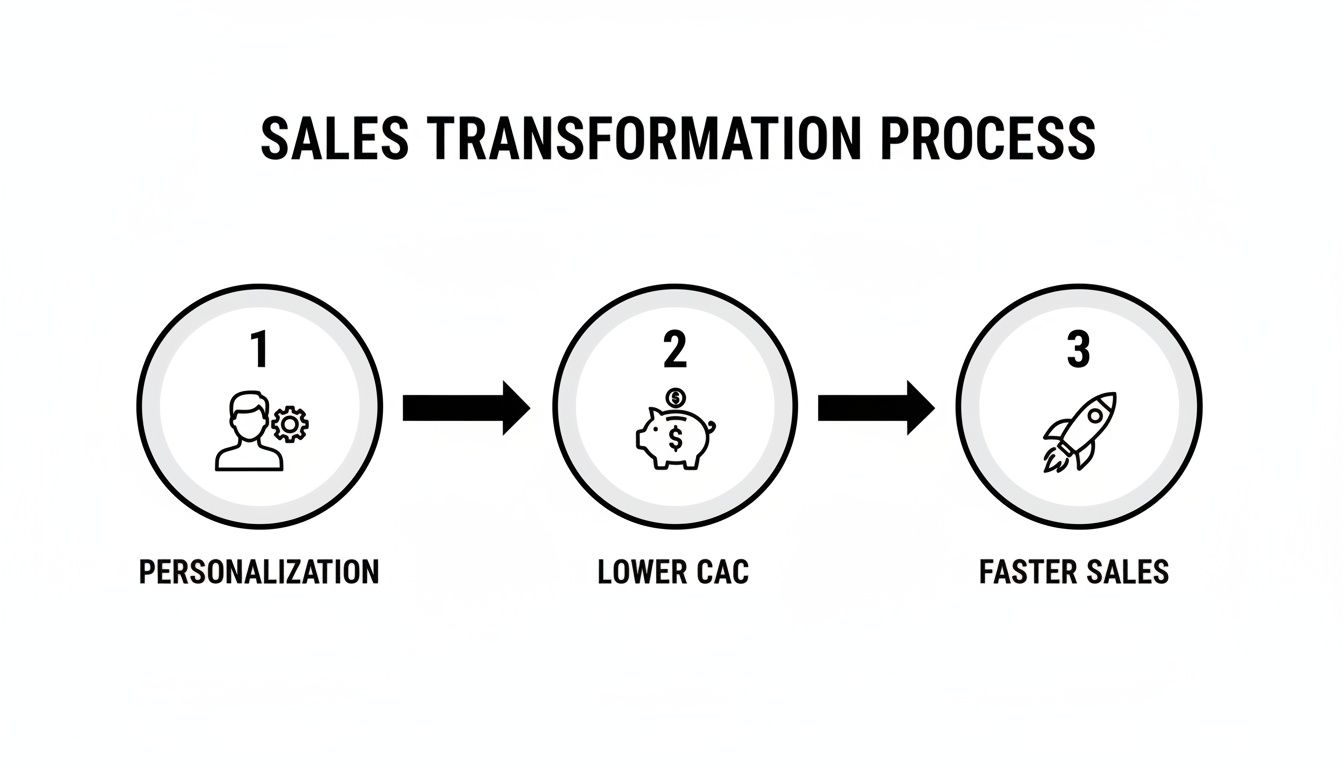
As you can see, each step builds on the last, turning raw information into a well-oiled sales machine that makes a real impact on your bottom line.
Choosing The Right Platform For Your Business
First things first, you need to pick a sales intelligence platform that actually fits your business—your budget, your goals, and the tools you already use. Not all platforms are built the same. What works for a massive enterprise is often total overkill for a lean startup.
Here are a few things to keep in your back pocket during demos:
- Data Quality and Depth: Can you get the specific details you need, like direct-dial phone numbers or technographics? And just as important, how often is that data refreshed and verified?
- CRM Integration: How well does it play with your CRM, whether it's Salesforce, HubSpot, or something else? A clunky connection can create more manual work than it eliminates.
- User-Friendliness: A tool is useless if your team hates using it. Let your sales reps have a go during the trial period to see if it’s intuitive for them.
- Scalability and Pricing: Will this tool grow with you? Get a clear picture of the pricing model to make sure it makes sense for you today and tomorrow.
This market is absolutely exploding. SkyQuest predicts it will rocket from USD 3.56 billion in 2024 to USD 9.26 billion by 2033, all thanks to the powerful combination of big data and AI. This tech gives B2B founders the ability to profile a prospect's tech stack with up to 95% accuracy. And in a world where the average rep is juggling 10 different tools, a single, unified sales intelligence platform can boost their productivity by a solid 15-25%. For a deeper dive into the numbers, check out this comprehensive sales intelligence report from SkyQuest.
Choosing the right tool can feel overwhelming, so here's a quick look at a few of the top players and what they're best at.
Choosing Your Sales Intelligence Platform
| Platform Feature | LinkedIn Sales Navigator | ZoomInfo | Demandbase (ABM) |
|---|---|---|---|
| Primary Use Case | Relationship-building, social selling, and leveraging the LinkedIn network. | B2B contact and company data, direct dials, and email verification. | Account-Based Marketing (ABM) and identifying in-market accounts. |
| Data Strengths | Real-time job changes, company updates, and professional connections. | Massive database of direct phone numbers, email addresses, and firmographics. | Intent data, technographics, and account-level engagement signals. |
| Best For | Sales teams that rely heavily on social selling and personal connections. | Outbound-focused teams needing high-volume, accurate contact information. | B2B marketing and sales teams targeting a specific list of high-value accounts. |
| CRM Integration | Strong native integrations with major CRMs like Salesforce and Microsoft Dynamics. | Robust integrations that enrich CRM records automatically. | Deep integrations designed to orchestrate ABM plays across sales and marketing. |
Ultimately, the best platform is the one that directly supports your specific sales motion, whether you're focused on high-volume outbound, strategic account-based selling, or relationship-building.
Integrating Intelligence With Your CRM
Once you’ve made your choice, integrating it with your CRM is where the magic really happens. This isn’t a "set it and forget it" task. It's about building an automated bridge that keeps your CRM—your single source of truth—constantly updated with fresh, accurate data.
Proper CRM integration tears down data silos and puts information on autopilot. Your sales team gets the most current, complete picture of every prospect without ever having to lift a finger.
The trick is to map the data fields correctly. You're basically telling your systems that a field like "Annual Revenue" in your intelligence tool corresponds to a specific field in your CRM. This simple setup is the engine behind everything from automatic lead routing to sophisticated scoring models. To see how this comes to life, check out our guide on AI-powered sales automation.
Actionable Workflow Examples To Implement
With your tools talking to each other, you can start building powerful workflows that turn all that data into action. These aren't just abstract ideas; they're practical plays your team can run right away to work smarter and close more deals.
1. Automated Lead Scoring and Prioritization
Stop treating every lead the same. Create a scoring system that automatically surfaces the best ones. Your system can instantly assign points based on the firmographic data pulled from your intelligence tool.
- +10 points if the company is in a target industry (like "SaaS").
- +15 points if their annual revenue is over $10 million.
- +20 points if you see they're using a competitor's technology.
Any lead that hits a certain score—say, 40 points—gets automatically routed to your best account executives. This ensures your top reps are always focused on the most promising opportunities.
2. Dynamic and Personalized Outreach Sequences
It's time to ditch the generic email templates for good. Use technographic data to trigger outreach that is hyper-relevant and timely.
- Workflow Trigger: Your system spots a prospect using a key competitor’s software.
- Action: They are automatically enrolled in an email sequence that highlights your product’s key advantages and includes a case study from a customer who happily made the switch.
- Personalization: The email itself can dynamically mention their current tool, instantly showing you’ve done your homework and understand their world.
By building out workflows like these, you make sales intelligence an active, indispensable part of your sales motion, driving smarter, more effective engagement every single day.
Common Pitfalls to Avoid on Your Journey
Bringing a sales intelligence platform into your stack feels like a game-changer, and it can be. But just signing the contract won't magically overhaul your sales process. There are a few classic mistakes I've seen teams make time and time again that can stop progress dead in its tracks.
The biggest one? Drowning in data. Suddenly, your team has access to everything—technographics, buying signals, org charts—and they have absolutely no idea what to do with it. This is what I call "data overload without action." Instead of feeling empowered, your reps are just overwhelmed.
The point of sales intelligence isn't to see who can collect the most data. It’s about finding the right data that leads to a specific, profitable conversation. Otherwise, you're just paying for static.
It’s like being handed a giant ring with a key to every door in the city. Great, but which one are you supposed to open? Without a map, the keys are useless. That’s why a razor-sharp Ideal Customer Profile (ICP) is your most important tool.
Taming the Data Beast
Your ICP is the filter that cuts through the noise. It tells your team which data points actually matter and gives them permission to ignore everything else. By focusing strictly on the signals that define your best customers, you turn a firehose of information into a focused beam.
Here's how to make that practical. Give your sales reps a simple checklist to run through:
- Is it the right fit? Does the company’s industry, size, and location line up with our sweet spot?
- What's their tech stack? Are they using a competitor's product or a technology we integrate with? That’s a huge conversation starter.
- Are they showing intent? Have they been on our pricing page, downloaded an ebook, or researched topics related to our solution?
This simple framework turns a mountain of raw data into a clean, prioritized list of accounts to go after. It makes sure every piece of intel has a purpose: getting your team in front of the right people, faster.
Dodging the Automation Backfire
The other big trap is getting a little too excited about automation and ending up with robotic, impersonal outreach. Yes, automation can make you incredibly efficient. But using it to spam thousands of people with the same generic "Hi {first_name}" email is the fastest way to burn your leads and tarnish your brand. Sales intelligence gives you the ammo for personalization; it’s on you to actually use it.
The secret is to find the right balance between automation and a genuine human touch.
How to Use Automation Wisely
- Automate the Research, Not the Relationship. Let your tools handle the grunt work, like enriching CRM records with new contacts or flagging key talking points. The actual conversation? That’s for your reps.
- Use Triggers to Be Timely. Build workflows that notify a rep the moment a target account gets a new round of funding or posts a relevant job opening. This allows them to reach out with a message that’s both immediate and highly relevant.
- Personalize That First Touch. Make sure the very first outreach—whether it’s an email or a call—mentions a specific insight you found. It instantly shows you've done your homework and aren't just another number in their inbox.
When you treat sales intelligence as a tool to make human connections smarter—not replace them—you’ll sidestep these common stumbles and build a sales engine that really performs.
Turning Sales Intelligence Into Revenue
Having a firehose of great sales intelligence data is one thing, but it won’t magically pad your bottom line. The real magic—and frankly, where most companies drop the ball—is in how you actually put that data to work. A powerful tool is useless without a smart process to guide it.
This is where the less glamorous but absolutely essential work of process optimization comes in. Just dumping raw data on your sales team is a recipe for overwhelm and inaction. You need a solid operational backbone to turn that stream of information into predictable pipeline and, ultimately, revenue. It’s about shifting from just having intelligence to actively using it.
Building a Revenue-Focused Framework
For any B2B or SaaS company, a solid framework is the bridge connecting data to dollars. This means building specific, repeatable processes that weave intelligence directly into your team's daily workflow. The goal isn’t to add more tasks; it’s to make their existing work smarter and more effective.
A great starting point is to tackle the most common roadblocks. For instance, we all know manual data entry is a soul-crushing time-waster. Setting up custom CRM automations to handle data enrichment in the background isn't a "nice-to-have"—it's a must. This keeps your team working with fresh, accurate information without ever having to manually update a record.
The ultimate goal is to create a system where sales intelligence isn't just a resource reps check occasionally. It should be the engine that proactively guides their next best action, from who to call to what to say.
Clear Standard Operating Procedures (SOPs) are also non-negotiable. These simple playbooks give your team a consistent, repeatable way to act on intelligence insights. An SOP might outline the exact steps for responding to a key buying signal or how to personalize an email based on a prospect's tech stack. This removes the guesswork and ensures everyone is on the same page.
Implementing AI-Enhanced Operations
To really squeeze every drop of value out of your investment, the next step is to layer AI-powered operations on top of your sales intelligence foundation. This is where you can automate complex tasks that used to require a human touch, dramatically boosting both efficiency and effectiveness.
Think about deploying AI agents for outbound calling. You can feed these agents real-time prospect data from your intelligence platform, enabling them to start personalized conversations based on the very latest information. This frees up your human reps to do what they do best: handle high-intent conversations and close deals. To see just how profoundly this impacts the numbers, it’s worth understanding how AI sales enablement revolutionizes revenue.
Here are a few practical ways to combine AI and intelligence:
- Automated Meeting Scheduling: Let an AI agent handle the back-and-forth of booking a demo after a positive interaction, syncing calendars and sending invites automatically.
- Intelligent Lead Nurturing: AI can trigger and send hyper-personalized follow-up emails based on a prospect’s behavior and enriched data profile.
- Dynamic Scripting: During live calls, AI can feed reps real-time talking points and answers based on the specific prospect's known pain points and company data.
At the end of the day, sales intelligence is the high-octane fuel. A smart, automated operational framework is the high-performance engine that turns that fuel into speed, power, and most importantly, revenue.
Got Questions? We’ve Got Answers.
As you start piecing this all together, a few questions are bound to pop up. It’s completely normal. Getting these cleared up now is what turns a good idea into a concrete plan for crushing your sales goals. Let's dig into the most common ones we hear.
How Is Sales Intelligence Different From Market Research?
This one comes up a lot. Here’s a simple way to think about it:
Market research is like looking at a map of the entire country. You get a fantastic, big-picture view of the terrain—major cities, highways, population centers, and general economic trends. It’s essential for deciding which state you want to do business in, but it won’t help you navigate a specific neighborhood.
Sales intelligence is your GPS. It zooms all the way in on a specific street, a single address. You get real-time, granular details about a specific account or contact. You know they just started looking for a new car, what model they’re interested in, and that they just drove by your dealership. It gives you the hyper-specific, actionable insight you need to start a relevant conversation right now.
Is This Really Something a Small Startup Can Use?
Absolutely. In fact, you could argue startups need it more than anyone else. It's a common myth that these tools are only for giant corporations with massive budgets.
For a startup, every minute and every dollar is critical. You can't afford to waste time chasing leads that are never going to pan out. Sales intelligence prevents that. It helps a small, scrappy team zero in on the exact prospects who are ready to buy.
For a startup, sales intelligence isn't a luxury; it's a force multiplier. It allows a small team to punch far above its weight by focusing its efforts with surgical precision on the accounts most likely to close.
Today's platforms are built to scale, with pricing models that make sense for businesses of all sizes. The efficiency boost alone often makes it one of the smartest early-stage investments a company can make.
How Quickly Can We Expect to See a Payoff?
Look, this isn't a magic button that will triple your pipeline by tomorrow. Getting everything set up and properly integrated with your CRM takes some focused effort at the beginning.
But the impact is felt much faster than you’d think. Once the data starts flowing, teams often notice an immediate improvement in the quality of their conversations and the efficiency of their outreach within the first few weeks. As for the bigger-picture metrics—like a shorter sales cycle and a healthier win rate—you’ll typically see that tangible proof within the first business quarter.
Ready to stop guessing and start building a predictable revenue engine? MakeAutomation specializes in implementing the AI and automation frameworks that turn sales intelligence into your company's greatest competitive advantage. Explore our services and book a consultation today.