
What Is Operations Management and Why It Matters
Operations management is the art and science of getting things done. It’s the behind-the-scenes work of designing, managing, and improving the business processes that turn raw materials, labor, and ideas into the final products or services customers buy. Think of it as the engine room of any company—the place responsible for maximizing efficiency, creating value, and making sure the business actually delivers on its promises.
What Is Operations Management at Its Core
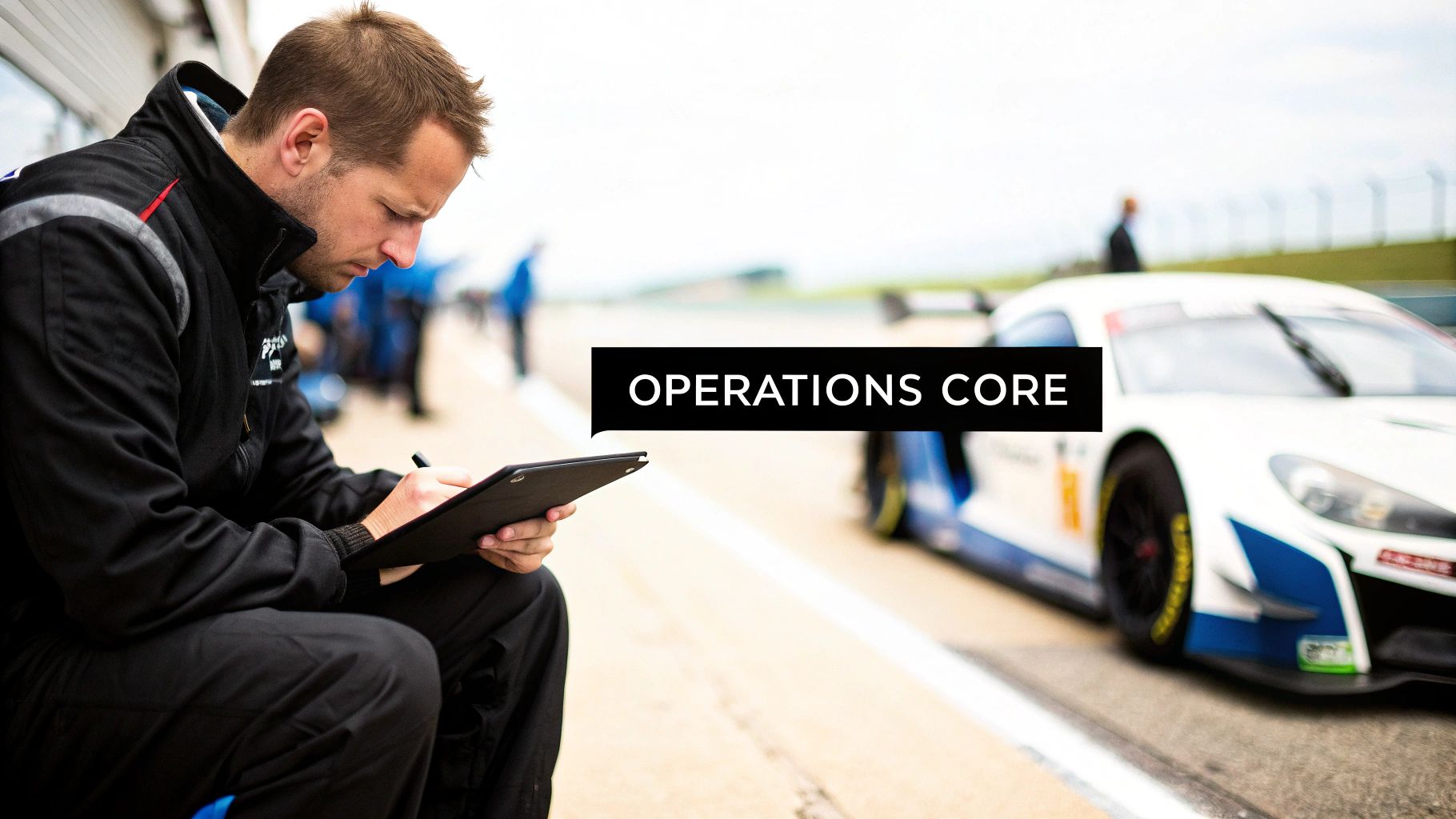
Think of a successful business like a high-performance race car. The driver might get the glory, but the race is really won in the pits. It's the chief engineer and the crew who ensure every component works in perfect harmony—that’s operations management.
From sourcing the right parts to delivering the finished product, operations management oversees the entire journey. The main goal is always to produce the highest quality goods or services in the most efficient and cost-effective way. This requires a delicate balance of managing people, technology, resources, and complex supply chains.
The Orchestra Director of Business
You could also think of an operations manager as an orchestra conductor. They don't play every instrument, but they guide each section—the strings, the brass, the percussion—to play in sync and at the right tempo. Without that central guidance, you'd have noise, not a symphony.
In the same way, operations management brings together departments like finance, marketing, and production to work toward a common goal. It creates a seamless flow from the initial idea to the final customer delivery. A critical part of this is having clear instructions, which is why understanding https://makeautomation.co/what-is-process-documentation/ is so fundamental for any operations leader.
An effective operations strategy doesn't just manage the "how" of a business; it fundamentally defines the "what" by shaping product quality, delivery speed, and overall customer satisfaction. It transforms abstract goals into tangible, repeatable results.
The Growing Importance of Efficient Operations
In today’s competitive market, operational excellence isn't just a nice-to-have; it's a must-have. Companies that get their operations right can offer better products at lower prices, react faster to market shifts, and build unshakable customer loyalty. A huge part of this is finding smart ways of reducing operational costs without sacrificing quality.
This intense focus on efficiency is driving major investment. The global Operations Management System (OMS) market, valued at roughly $50 billion in 2025, is expected to grow at a Compound Annual Growth Rate (CAGR) of 12% through 2033. This isn't just a trend; it's a clear signal that businesses see solid operations as the backbone of their success. You can dig into the numbers and projections in this detailed report.
Understanding the 5 Core Operational Processes
If you think of operations management as the engine room of a business, then its core processes are the pistons, gears, and shafts that actually turn strategy into forward motion. These systems are all connected, working in concert to keep the entire operation humming along smoothly. To really get what operations management is all about, you have to understand these fundamental parts.
At the heart of any solid operations strategy, you'll find five core processes. Each one tackles a specific piece of the journey, from the first spark of an idea to the final product in a customer's hands. Getting these right isn't just a good idea—it's essential for any kind of lasting growth.
1. Process Design
Process design is the blueprint for how work actually gets done in your organization. It's about mapping out every single step it takes to turn inputs (like raw code, data, or materials) into outputs (a new software feature, a signed contract, or a finished product). The whole point is to create a workflow that’s logical, repeatable, and as lean as possible.
Think of a classic car assembly line. The process design is what dictates the exact sequence: this part gets installed first, that station has 30 seconds to complete its task, and a quality check happens right here. A sloppy design creates bottlenecks and defects. A great one ensures a smooth, predictable flow from start to finish. A huge part of this is building out and sticking to clear Standard Operating Procedures (SOPs).
2. Supply Chain Management
This is the art of orchestrating the entire flow of goods, services, and information—all the way from your very first supplier to your end customer. Supply chain management is all about getting the right resources to the right place at the right time, and doing it all without breaking the bank.
You can think of it like a sophisticated data pipeline in the cloud. Data (your resources) has to be pulled from different sources (suppliers), processed correctly (manufacturing or development), and then delivered to the user (customer) without getting corrupted or delayed. Just one breakdown in that chain—a delayed shipment or a vendor suddenly going dark—can bring the entire operation to a screeching halt.
3. Quality Control
Quality control isn't about inspecting for mistakes at the very end; it's about building quality into every single step of the process. It's a systematic approach that involves setting clear standards, constantly monitoring performance, and jumping in with corrective action the moment things go off track.
It’s a lot like the rigorous QA testing you see in software development. Testers don't just poke around the final app. They run unit tests, integration tests, and user acceptance tests all through the development cycle. Their job is to find and squash bugs before they ever make it to the end-user, protecting both the product's reputation and the customer's sanity.
The real goal of quality control isn't just to find defects—it's to prevent them from ever happening. A strong quality system is all about improving the process itself, making it almost impossible for errors to occur in the first place.
This proactive mindset is what modern operational excellence is all about. Great operations management ties daily tasks directly to bigger strategic goals, which has a massive impact on customer satisfaction.
4. Inventory Management
At its core, inventory management is all about overseeing the flow of goods from manufacturers to warehouses and, finally, to the customer. The real trick is striking a very delicate balance. You need enough inventory on hand to meet demand, but you can't afford to tie up too much capital in stock that’s just sitting there gathering dust.
Think of it as the company's pantry. A well-run pantry has all the ingredients you need for any meal, but it isn't overflowing with perishable items that will spoil before you can use them. Good inventory management uses forecasting and hard data to know exactly what to order and when, preventing costly stockouts while keeping waste to a minimum.
5. Capacity Planning
Finally, capacity planning answers one critical question: "Do we have enough resources—people, equipment, and technology—to handle the work we have now and the work that's coming?" It's the process of figuring out the production capacity your organization needs to meet ever-changing demand for its products or services.
This is exactly what an airline does when managing its fleet. Before the busy holiday season, the airline has to determine if it has enough planes, pilots, and ground crew to handle the surge. It digs into booking trends and forecasts to make strategic calls, ensuring it can meet peak demand without having a bunch of expensive, idle resources sitting around during the slow months.
These five processes are deeply connected. Mastering them takes a smart blend of big-picture thinking and on-the-ground execution. For any business ready to level up its operations, exploring different process optimization techniques is the best place to start.
Applying Key Frameworks to Measure Success
https://www.youtube.com/embed/I1x0HvIO2d4
Knowing your core processes is one thing, but actually putting proven methods into practice is what separates the companies that thrive from those that just get by. To truly get a handle on operations management, you need a solid toolkit of frameworks designed to boost efficiency and a clear set of Key Performance Indicators (KPIs) to track your progress.
These frameworks aren't just dry, academic theories. They are battle-tested systems for cutting waste, slashing error rates, and building a genuine culture of continuous improvement. When you pair them with the right metrics, they transform your day-to-day operations into real business results—think bigger profit margins and happier, more loyal customers.
Popular Frameworks for Operational Excellence
While there are dozens of methodologies out there, three have consistently proven their worth across countless industries. Each gives you a unique way to look at and improve your processes, but they all share the same North Star: delivering more value with fewer resources.
-
Lean Management: The heart of Lean is simple but incredibly powerful: maximize customer value while minimizing waste. It pinpoints eight specific types of waste (like defects, overproduction, waiting, and unused talent) and gives you the tools to systematically hunt them down and eliminate them. It's like decluttering your entire workflow, getting rid of anything that doesn't add something the customer actually cares about.
-
Six Sigma: This is a deeply data-driven approach laser-focused on stomping out defects and reducing inconsistency in your processes. The goal is to get as close to perfection as you can, aiming for a process that is an incredible 99.99966% free of defects. Six Sigma uses statistical analysis to dig down to the root causes of errors and then builds solutions that make them nearly impossible to repeat. It’s basically the scientific method for your business.
-
Total Quality Management (TQM): TQM is less a set of tools and more a cultural shift that gets every single employee involved in the pursuit of quality. It’s built on the idea that quality is everyone's job, from the CEO down to the person on the front line. TQM creates an environment where teams are constantly looking for small, incremental ways to make things better.
The diagram below shows how all the key operational gears—like design, supply, quality, and capacity—need to work in harmony.
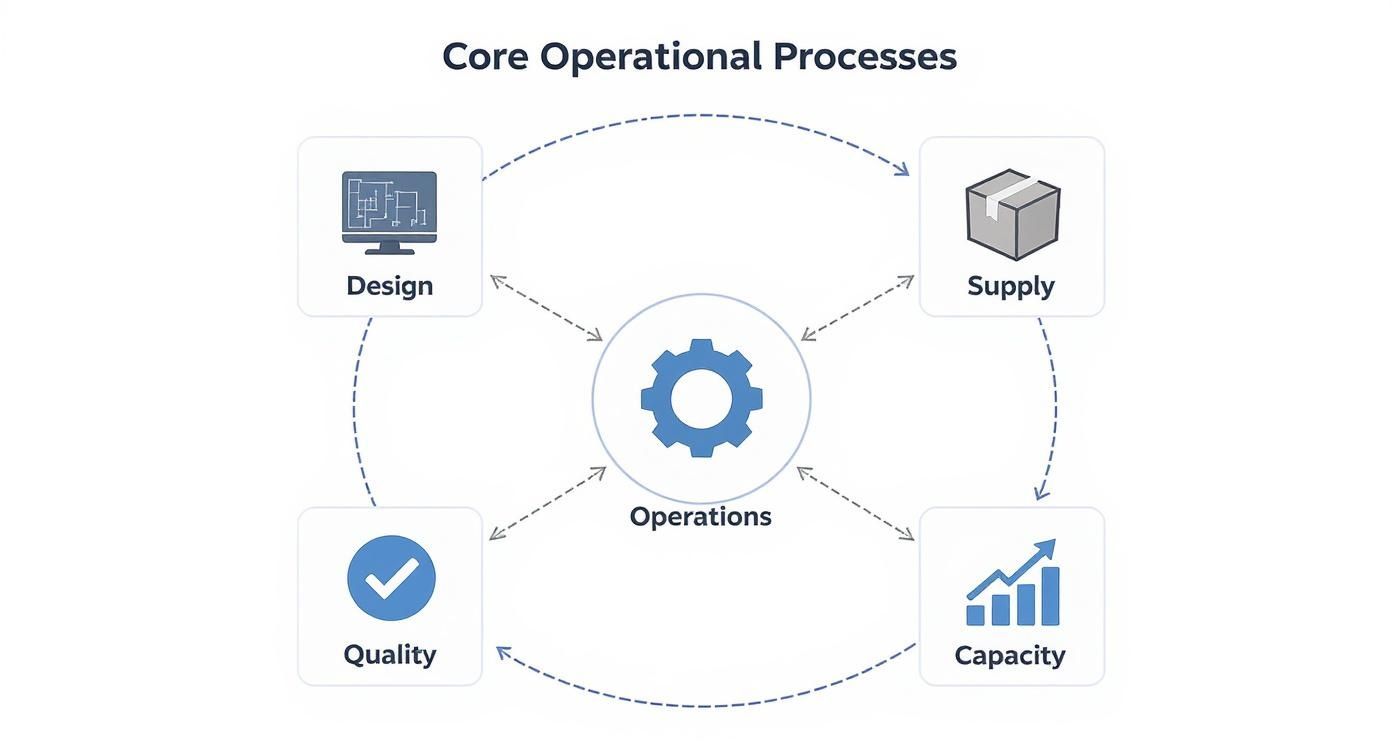
This just goes to show that a strong operations strategy isn't about excelling in one area. It’s about keeping all these interconnected parts balanced and running smoothly together.
Comparing Operations Management Frameworks
To help you decide which approach might fit your business best, here’s a quick breakdown of how these three popular frameworks stack up against each other.
| Framework | Primary Goal | Key Principles | Best For |
|---|---|---|---|
| Lean | Eliminate waste and maximize value | Identify and remove non-value-adding activities, continuous flow, pull-based systems | Businesses looking to increase speed and efficiency by streamlining processes. |
| Six Sigma | Reduce defects and process variation | Data-driven decision making (DMAIC), statistical process control, focus on quality | Companies in manufacturing or service industries where consistency and precision are critical. |
| TQM | Create a culture of continuous improvement | Total employee involvement, customer focus, process-centered thinking | Organizations seeking a long-term cultural shift toward quality and employee empowerment. |
Ultimately, you don't have to choose just one. Many of the most successful companies blend principles from all three to create a hybrid system that works for their specific needs.
Connecting Frameworks to Crucial KPIs
Frameworks give you the "how," but KPIs tell you "how well." Without clear metrics, you're essentially flying blind. The right KPIs link your daily tasks directly to your company's big-picture goals, giving you a clear scoreboard for your operational performance. They are the ultimate measure of your efficiency, quality, and speed.
Effective operations management isn't just about being busy; it's about being productive. The right KPIs ensure you're focusing on activities that actually move the needle on what matters most—customer value and business growth.
Here are a few of the most vital KPIs that operations managers live and breathe by:
-
Order Fulfillment Cycle Time: This is the stopwatch for your entire sales process, measuring the total time from when a customer clicks "buy" to when the product is in their hands. A shorter cycle time almost always leads to a happier customer and less internal friction.
-
Inventory Turnover: This ratio tells you how many times your company sells and replaces its entire stock over a set period. A high turnover is a great sign—it means sales are strong and you aren't tying up cash in products sitting on a shelf. A low rate can be a red flag for overstocking or weak demand.
-
First Pass Yield (FPY): A crucial metric for quality, FPY calculates the percentage of products or services completed correctly the first time, without needing any rework or being scrapped. An FPY of 95% means 95 out of 100 units were perfect from the get-go, which is a fantastic indicator of a healthy, reliable process.
By bringing these elements together, you create a powerful engine for improvement. For instance, you could use Lean principles to find and eliminate wasted steps in your fulfillment process, and then track your Order Fulfillment Cycle Time KPI to get hard data on whether your changes are actually working. This constant loop of action, measurement, and adjustment is what operational excellence is all about.
How AI Is Reshaping Modern Operations

Operations management is in the middle of a massive change. We're moving away from a world of reactive problem-solving and into one that’s predictive, automated, and much smarter. At the heart of this shift are two things: Artificial Intelligence (AI) and powerful workflow automation platforms.
Think about it this way. Instead of a manager manually sifting through spreadsheets to forecast demand, an AI algorithm can now chew through thousands of data points in real time. It can spot buying trends with startling accuracy, letting an e-commerce business not just anticipate a sales spike but automatically trigger inventory orders before a single item goes out of stock.
This jump from manual oversight to intelligent automation is where modern operations teams are finding their biggest wins.
From Reactive Fixes to Proactive Strategy
For decades, operations teams were the company firefighters. They spent their days dealing with supply chain delays, fixing production mistakes, or handling unexpected quality dips. AI is flipping that entire model on its head. It gives teams the power to prevent fires from even starting.
Let's take a B2B SaaS company. In the past, they’d only find out a customer was unhappy when they churned. Now, AI can monitor how users interact with the software, spot patterns that show someone is struggling, and automatically create a support ticket for the success team to reach out. That's a game-changer.
The focus moves from damage control to building systems that see problems coming. You can learn more about setting up these kinds of workflows in our guide to AI-powered workflow automation.
By automating the repetitive, data-heavy tasks, AI frees up your people to focus on what they do best: strategic thinking, creative problem-solving, and building relationships. The goal isn't to replace people—it's to make them better at their jobs.
This no-code approach makes sophisticated automation a real possibility for operations teams of any size, allowing them to build and fine-tune their own efficiency engines without needing a developer.
Tangible Benefits of AI in Operations
The impact of AI isn't just a nice idea; it delivers real, measurable results. It’s no surprise that business leaders are investing heavily to stay ahead of the curve.
A recent global survey of operations leaders confirms this. The study found that a staggering 93% of leaders are prioritizing operational efficiency, and 62% said AI tools have been very effective at boosting productivity and managing costs. These numbers show a clear consensus: AI is no longer optional.
Here are just a few concrete examples of how it's making a difference:
- Intelligent Inventory Management: AI systems analyze sales history, seasonality, and even market trends to predict demand far more accurately than any manual method. This means fewer stockouts and less money tied up in excess inventory.
- Predictive Maintenance: In a factory, sensors on a machine can feed data to an AI that predicts when a part is likely to fail. Maintenance can be scheduled before the breakdown, avoiding costly and disruptive downtime.
- Optimized Logistics: AI algorithms can calculate the most efficient shipping routes on the fly, considering traffic, fuel costs, and delivery windows. This cuts down transportation expenses and gets products to customers faster.
- Enhanced Quality Control: AI-powered cameras on an assembly line can spot tiny defects that are impossible for the human eye to catch, ensuring a much higher standard of product quality.
Ultimately, bringing AI into your operations transforms it from a cost center into a strategic engine for growth. It provides the data and automation needed to build a more resilient, efficient, and customer-focused business.
Building Your Operations Strategy Checklist
Getting a handle on frameworks and KPIs is a great start, but the real work begins when you turn that theory into a tangible plan. A powerful operations strategy doesn't just materialize out of thin air; it’s built piece by piece, with a clear purpose. Think of this checklist as your roadmap from square one to a well-oiled machine.
Following these steps will help you build an operational engine that’s not just efficient but also scalable and tied directly to what you're trying to achieve as a business. Each step logically follows the last, creating a strong foundation for long-term success.
1. Map Every Process
You can't fix what you can't see. The first order of business is to get everything out on the table. Create simple, visual maps of your core workflows—from the moment a lead enters your pipeline to how a new client is onboarded.
This exercise is always eye-opening. You'll almost certainly uncover weird workarounds, hidden complexities, and steps that don't make sense anymore. Don't stress about making it perfect; just aim for an honest picture of how things actually get done right now.
2. Pinpoint Bottlenecks and Waste
With your maps in hand, it's time to put on your detective hat. Go through each process step-by-step and ask the tough questions. Where do projects stall waiting for someone's approval? What tasks are just busywork, adding zero real value for the customer?
This is where you'll spot your low-hanging fruit—the quick fixes that can boost speed and cut costs right away. Identifying these pain points is the critical first move toward a leaner, more effective operation.
3. Set Meaningful KPIs
If you don't measure it, you can't manage it. Simple as that. Based on the problems you’ve just uncovered, pick a small number of Key Performance Indicators (KPIs) that truly matter. If customer support tickets are piling up, track your Average Resolution Time. If product quality is inconsistent, measure your First Pass Yield.
These metrics become your compass. They give you hard data to guide your decisions and, just as importantly, prove that the changes you're making are actually working.
4. Choose Your Technology Stack
Let's be clear: technology should support your process, not dictate it. Once you know your biggest bottlenecks, you can pick tools that solve those specific problems. Maybe you need a project management platform like Asana to clear up confusion, a CRM to automate follow-ups, or an integration tool like Make to get your apps talking to each other.
The right tech stack takes the grunt work off your team’s plate, slashes human error, and frees people up to focus on work that requires a human brain.
5. Create Clear Standard Operating Procedures
After you’ve ironed out the kinks in a process, you need to lock in the improvements. Do this by documenting everything in clear, concise Standard Operating Procedures (SOPs). An SOP isn't just a dusty binder on a shelf; it's a living guide that becomes the single source of truth for how a task gets done.
This step is huge for consistency, makes training new hires a breeze, and ensures your business isn't dangerously reliant on one or two key people.
A well-defined SOP doesn’t just standardize a process; it empowers your team by providing the clarity and autonomy they need to execute their roles confidently and effectively.
6. Launch, Monitor, and Measure
Time to go live. Roll out the improved workflows, new tools, and fresh SOPs to the team. But remember, the launch is just the beginning of the race, not the finish line. You have to keep a close eye on your KPIs to see what’s happening.
Are you hitting the targets you set? Did fixing one problem accidentally create another one somewhere else? This is the feedback loop that keeps you on track.
7. Foster a Culture of Continuous Improvement
This is the most important step of all: never, ever consider the job "done." Great operations management isn't a one-and-done project; it’s a constant cycle of refine, repeat, and improve.
Encourage everyone on your team to be on the lookout for a better way to do things. Revisit your processes, KPIs, and tech stack regularly to make sure they still make sense as your company grows. When you do this, operational excellence stops being a goal and becomes part of your company's DNA.
Common Operations Pitfalls and How to Avoid Them
Even the sharpest operational strategies can hit a snag. It happens to everyone. The real trick is knowing what roadblocks tend to trip up growing businesses so you can steer clear of them before they derail your momentum.
If you can anticipate these common issues, you’re already halfway to building a more resilient and effective operational backbone for your company. Let's look at a few of the biggest offenders.
Breaking Down Departmental Silos
One of the most classic—and destructive—problems is the dreaded departmental silo. This is what happens when your teams (think marketing, sales, product) start operating like their own little islands. Information gets hoarded, communication breaks down, and suddenly you’re dealing with duplicated work, missed opportunities, and a customer experience that feels disjointed and confusing.
The only way to fix this is to intentionally build bridges between these islands.
- Create cross-functional teams: Get people out of their departmental comfort zones. Put together small, dedicated "squads" with folks from different teams to tackle specific projects. This forces collaboration and creates a powerful sense of shared ownership.
- Use shared data dashboards: Nothing breaks down walls like transparency. Implement a central dashboard where key metrics from every single department are visible to everyone. When everyone sees the same numbers, they start working toward the same goals.
Misalignment with Business Goals
Here’s another big one: your operations team gets so focused on its own world that it loses sight of the company's big-picture goals. For example, they might get obsessed with cutting costs on a specific process, not realizing that the change is actively harming the premium customer experience your brand is famous for. This kind of disconnect creates internal friction and wastes a ton of resources on "improvements" that don't actually move the needle.
Operations management should never exist in a vacuum. Its primary purpose is to serve and accelerate the company's strategic vision, not just to optimize processes for the sake of efficiency.
The fix is simple, at least in theory. Your operations leaders need a seat at the table during high-level strategy meetings. When the ops team truly understands the "why" behind the company's goals, they can design processes that genuinely support them. Every efficiency gain then becomes a direct contribution to the larger mission.
Reliance on Outdated Technology
Sticking with old systems and clunky manual processes just because "that's how we've always done it" is a classic operational mistake. It might feel comfortable and familiar, but that legacy tech is creating a massive drag on your organization. It leads to slowdowns, more errors, and makes it nearly impossible to scale effectively. Often, it's just a fear of change—or the perceived cost of upgrading—that keeps companies stuck.
The key here is a mindset shift. Stop seeing technology as a cost and start seeing it as an investment in your future. Proactively audit your tech stack. Find the tools that can automate the soul-crushing, repetitive tasks. This frees up your brilliant team to focus on the strategic work that actually requires human creativity and problem-solving, which is where the real value is.
Common Questions About Operations Management
Even after you get the basics down, a few questions always seem to come up when people are trying to wrap their heads around operations management. Let's clear up some of the most common points of confusion to really pin down its role in the real world.
What’s the Difference Between Operations and Project Management?
This is a classic. It’s easy to mix them up, but the simplest way to separate the two is to think about continuity versus finality.
-
Operations Management is all about the repeatable, day-in-and-day-out processes that keep the lights on. Think about running your customer support queue, managing a SaaS subscription service, or keeping an assembly line moving. These things don’t have an end date; they’re the core rhythm of the business.
-
Project Management, on the other hand, is for temporary gigs with a clear start and finish line. The whole point is to deliver a unique result—like launching a new website, rolling out a product feature, or building a new office. Once the project's done, the team moves on.
So, you could say project management builds something new, and operations management makes sure that new thing runs like a well-oiled machine for the long haul.
What Are the Most Crucial Skills for an Operations Manager?
A great operations manager is a rare mix of a big-picture strategist, a hands-on problem-solver, and a skilled communicator. The full list of skills is long, but a few are absolutely essential to thrive in the role today.
An effective operations manager doesn't just manage processes; they empower people. Their true value lies in building systems that allow team members to do their best work with the least amount of friction.
Three skills, in particular, are non-negotiable:
- Analytical Problem-Solving: At its heart, the job is about looking at a messy workflow, using data to pinpoint the real bottleneck (not just the obvious one), and coming up with a fix that actually works.
- Technological Fluency: You don’t have to be a software developer, but you absolutely must understand how to use technology—especially automation and data tools—to make processes smarter and faster.
- Leadership and Communication: Getting people on board with change is never easy. A strong operations leader knows how to explain the "why" behind a new process and inspire their team to get it done right.
How Can a Small Business Apply These Principles?
You don't need a giant budget or a formal "Ops Department" to put these ideas to work. For a small business, it’s all about starting simple and tackling your biggest headaches first.
Pick just one core process to start with—maybe how you onboard a new customer. Map it out, step by step, and look for the glaring delays or steps that feel redundant. You'd be surprised how much time you can claw back just by using simple, affordable automation tools from a platform like Make to handle repetitive tasks like sending follow-up emails or creating project folders. The aim isn't to build a perfect system overnight; it's to make small, steady improvements that save you time and cut down on mistakes.
Ready to stop wasting time on manual tasks and start building scalable systems? MakeAutomation specializes in implementing the AI and automation frameworks that drive growth. We'll help you optimize your workflows from lead generation to client delivery, so you can focus on what matters most. Discover how we can transform your operations.