
How to Reduce Labor Costs A Practical Guide for Smart Businesses
Before you can even think about trimming labor costs, you have to know exactly where your money is going. It's a classic case of "you can't manage what you don't measure." This means getting a complete, data-backed picture of your current spending.
We're not just talking about salaries. To do this right, you need to understand the fully-loaded cost of every single employee—that includes everything from benefits and payroll taxes to overtime and the cost of getting them in the door. Only then can you spot the real opportunities for savings.
Establishing Your Baseline to Understand Labor Costs
Jumping into cost-cutting without this baseline is like trying to drive to a new destination without a map. You’ll be making moves, but you'll have no idea if you're actually getting closer to your goal. For most service and B2B businesses, labor can eat up as much as 70% of total business costs, so getting this first step right is non-negotiable.
This initial audit isn't about finding a single, scary number. It’s about understanding all the pieces that make up your total labor spend. You have to dig much deeper than a simple payroll report to find the hidden costs that are quietly inflating your budget.
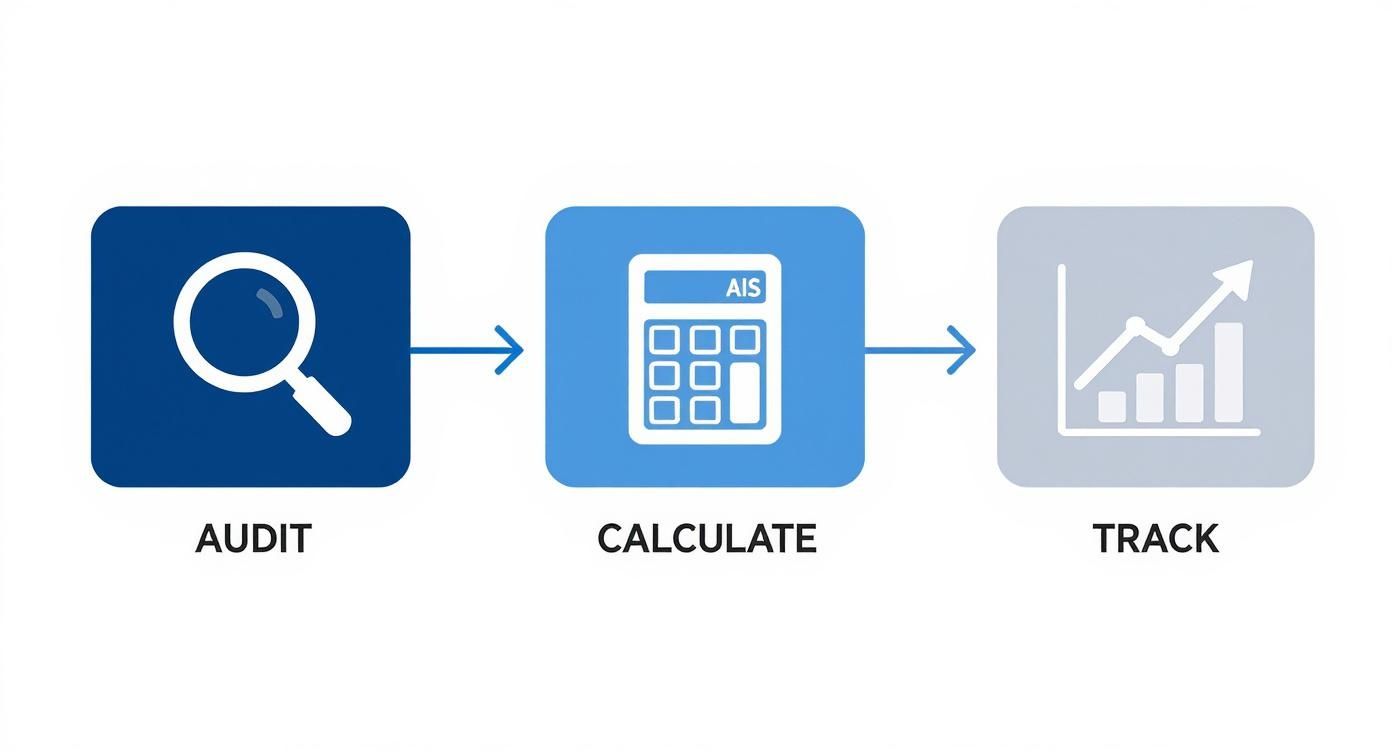
This simple audit-calculate-track loop creates a constant feedback cycle. It turns what could be a one-off cost-cutting exercise into a proactive, ongoing strategy.
Deconstructing Your Total Labor Spend
A proper audit means cataloging every single expense tied to your people. Think of it as creating a financial blueprint of your entire team. This is how you'll see where the bulk of your cash is really going and, more importantly, find the areas that are ripe for a little optimization.
Start by pulling together the data on these key components:
- Gross Wages and Salaries: This is the obvious starting point—the direct pay for all your full-time, part-time, and contract workers.
- Payroll Taxes: Don't forget the employer's share. This includes Social Security, Medicare, and any federal and state unemployment taxes you pay.
- Benefits and Insurance: Add up the premiums for health, dental, and life insurance, plus any contributions you make to retirement plans like a 401(k).
- Paid Time Off (PTO): Vacation days, sick leave, and holidays are all paid time for non-productive hours. You need to calculate this cost.
- Overtime Pay: Always track overtime as its own line item. Spikes in overtime are almost always a red flag for scheduling problems or being understaffed in a key area.
- Recruitment and Training Costs: The money spent on job board fees, background checks, and onboarding materials all adds up.
Once you have all this, you can calculate the true, fully-loaded cost per employee. This number is far more insightful than just looking at their salary.
Identifying Key Performance Indicators
With your total costs mapped out, the next move is to connect those dollars to actual performance. This is where you decide which metrics truly define productivity and efficiency for your teams. Tracking the right KPIs helps you understand the value you’re getting from your investment in labor.
A common mistake I see is focusing only on cutting costs without thinking about the impact on output. The goal isn't just to spend less; it's to get more done with the money you're already spending.
Before you can know if your cost-saving measures are working, you need to know what "good" looks like right now. This means establishing a baseline for the metrics that matter most.
Key Labor Cost Metrics to Track
| Metric | What It Measures | Why It's Important |
|---|---|---|
| Labor Cost as a % of Revenue | The portion of total revenue consumed by labor expenses. | A high-level indicator of overall cost efficiency. |
| Revenue Per Employee | The average revenue generated by each full-time employee. | A core measure of workforce productivity and profitability. |
| Fully-Loaded Cost Per Employee | The total cost of an employee beyond their salary (benefits, taxes, etc.). | Gives you the true cost of your workforce, not just payroll. |
| Overtime Hours/Cost | The amount of overtime being worked and its associated expense. | Often signals scheduling issues, burnout risk, or understaffing. |
| Employee Turnover Rate | The percentage of employees who leave the company in a given period. | High turnover brings significant recruitment and training costs. |
By setting this baseline, every single strategy you try later can be measured against these initial numbers. This data-first approach is the only way to prove you’re making progress and to make smarter decisions down the road. For a deeper dive into measuring the impact of your changes, our guide explains how to calculate return on investment in a way that makes sense for these kinds of initiatives.
Finding Quick Wins to Lower Costs Immediately
Once you’ve got a clear picture of your labor costs, it's time to hunt for the low-hanging fruit. These are the quick, high-impact changes that can start saving you money right away without requiring a massive overhaul of your operations. The idea here is to build momentum and prove the value of this effort from the get-go.
So many businesses are leaking cash through things like inefficient schedules or redundant tasks. On their own, these might seem like minor drips, but they add up fast, draining your budget. Plugging these leaks first gives you an immediate boost to both morale and your bottom line.

Optimize Your Staff Scheduling
Overtime is the silent killer of many a labor budget. While it’s sometimes unavoidable, chronic overtime is usually a red flag signaling a deeper problem with how you’re planning your workforce coverage. The solution is to move from a reactive scheduling model to a smarter, data-driven one that actually anticipates demand.
Pull your sales or project data from the last quarter. Can you spot clear peaks and valleys? For a SaaS business, maybe support ticket volume skyrockets on Mondays. For a service agency, it might be a flurry of client meetings near the end of the month. The fastest way to cut down on unnecessary overtime is to align your staff schedules directly with these demand cycles.
Instead of a rigid 9-to-5 for the whole team, you could try:
- Staggered Shifts: Have people start and end their days at different times. This ensures you have coverage during your busiest hours without having too many people on the clock during the lulls.
- Split Schedules: If you have distinct morning and afternoon peaks, a split shift can cover both without paying someone to sit through the quiet hours in between.
- Flexible Part-Time Roles: Bringing on part-time help just for those peak periods is often far more cost-effective than burning out your full-time team with overtime.
I once worked with a marketing agency that was constantly paying overtime to its design team to meet end-of-week deadlines. By simply shifting two designers to a Tuesday-Saturday schedule, they eliminated 90% of their overtime costs and improved project turnaround times.
Consolidate Overlapping Roles and Tasks
As a company grows, it's natural for roles to evolve in ways that create accidental overlap. You might have two different people in two different departments spending hours each week doing nearly the same thing—like pulling similar data for reports or managing separate contact lists. A quick task audit can uncover these hidden inefficiencies.
Start by asking your team members to briefly log their main tasks for a week. As you review the logs, look for patterns and redundancies. You might discover that a customer success manager and a sales associate are both spending time updating the same client records in different systems.
This isn't about cutting jobs; it's about making every role more effective. When you consolidate these duplicate tasks under one person, you free up the other employee to focus on higher-value activities. For an immediate impact, look into proven ways to increase employee productivity, which directly lowers your labor cost for every unit of output.
Embrace Simple Process Automation
You don't need a massive, complex AI system to start automating. The quickest wins often come from using simple, off-the-shelf software to take over the repetitive, low-value tasks that eat up your team's valuable time.
Think about the daily routines in your business that are manual but don't require much critical thinking. These are the perfect places to start.
Easy Automation Starting Points
| Task Category | Example Automation Tool | Impact on Labor Cost |
|---|---|---|
| Data Entry | Zapier, Make | Frees up administrative staff from manually copying information between apps like your CRM and email marketing platform. |
| Email Responses | Gmail Templates, Gorgias | Automatically answers frequently asked questions, reducing the time your support or sales team spends on repetitive inquiries. |
| Social Media Posting | Buffer, Hootsuite | Schedules posts in advance, eliminating the need for an employee to manually post content multiple times a day. |
Automating just one task might only save an employee 15-30 minutes a day. But multiply that across your team and over an entire year, and those small savings compound into hundreds of reclaimed hours. That's time your team can now spend on the strategic work that actually grows the business.
Using Technology and Automation for Long-Term Savings
Once you've picked the low-hanging fruit, it's time to think bigger. True, sustainable labor cost reduction isn't about one-off fixes; it's about fundamentally changing how work gets done. This is where you strategically weave technology into the fabric of your operations.
This isn't just about buying new software. It's about a mindset shift—investing in systems that make your team more powerful and productive. When you get this right, you build a more scalable business that doesn't need to throw more people at problems as it grows. You learn to do more with less.

Blueprint Your Processes with SOPs
Before you can automate anything, you need to know your processes cold. This is where Standard Operating Procedures (SOPs) come in. They’re your operational blueprint.
Forcing yourself to document every single step—from how you onboard a new client to how an invoice gets paid—is incredibly revealing. You'll almost immediately spot weird workarounds, redundant steps, and frustrating bottlenecks you can fix right away.
Even better, a crystal-clear SOP gives you the exact logic you need to set up any automation tool. It ensures the technology follows your best-practice workflow, not the other way around.
Streamline Workflows with CRM Automation
Too many businesses use their Customer Relationship Management (CRM) system as a glorified digital address book. If that’s you, you're sitting on a goldmine of untapped efficiency.
Think about a typical B2B sales cycle. All that manual work of logging calls, sending follow-up emails, and dragging deals from one stage to the next adds up to a mountain of wasted time. With a few automated workflows, you can make that busywork disappear.
- Lead Nurturing: Set up a sequence of helpful emails that automatically goes out to every new lead.
- Task Creation: When a sales rep finishes a demo, a follow-up task can be instantly assigned to them.
- Data Entry: A contact's record can update automatically when they click a link in an email or fill out a form.
Suddenly, your sales team is freed up to focus on what actually moves the needle: talking to prospects and closing deals. A smaller, more potent team can now manage a much larger pipeline. Choosing the right platform is key, and this guide to the best workforce management software can point you in the right direction for long-term savings.
Harness AI for Practical Productivity Gains
Artificial intelligence isn't some far-off concept anymore; it's a practical tool you can use today. The easiest entry point for most service businesses? Customer support.
An AI-powered chatbot on your website can handle up to 80% of common customer questions without anyone on your team lifting a finger. Think about all the time spent answering "What are your hours?" or "How do I reset my password?"
Offloading these simple, repetitive queries to AI allows your support agents to focus their brainpower on complex, high-value problems that actually require a human touch.
AI doesn’t replace your team; it elevates them. By automating the mundane, you empower your people to focus on the creative, strategic, and relationship-driven work that technology can't replicate.
Beyond chatbots, AI is changing the game in operational planning. You can dig deeper into its applications by exploring https://makeautomation.co/what-is-ai-automation/ to see how it can be applied across your business. This kind of tech adoption is a proven way to boost labor productivity and keep costs from spiraling.
Exploring Strategic Outsourcing And Offshoring
Sometimes, the most powerful way to slash labor costs isn't found on your local payroll. The real opportunity lies in looking beyond your own four walls to tap into a global talent pool, often at a fraction of the cost.
This isn't just about finding cheaper labor. It's a strategic move to build a more flexible, specialized, and ultimately more profitable workforce. The core idea is to identify non-essential business functions—those necessary but repetitive tasks that don't define your main value—and hand them off to external experts. This immediately frees up your key people to focus on what they do best: driving revenue.

Different Models For Different Needs
People often use "outsourcing" and "offshoring" interchangeably, but they serve different goals. Outsourcing is simply hiring a third party for a task. Offshoring specifically means moving a business function to another country to capitalize on lower labor costs. You can mix and match these to suit your needs.
Here are a few common ways I've seen businesses approach this:
- Project-Based Freelancers: Perfect for one-off tasks with a clear beginning and end. Think logo design, writing a block of website copy, or developing a small software feature. You pay for the result, not a permanent salary.
- Dedicated Contractors or Agencies: This is a great middle ground for ongoing, specialized work. Hiring a digital marketing agency to run your social media or a bookkeeping firm for your monthly accounting are classic examples.
- Building a Remote Team: The most involved option, where you hire full-time remote employees in a lower-cost region. This works exceptionally well for building out entire departments like customer support or a dedicated software development team.
Be surgical. The biggest mistake is outsourcing a core competency that gives you a competitive edge. Instead, focus on high-volume, repeatable processes like data entry, IT helpdesk support, or lead qualification.
The Strategic Advantages Of A Global Workforce
Cost savings are, without a doubt, the primary driver. Companies have been moving manufacturing and service jobs to countries with lower wages for decades to achieve massive cost reductions. This isn't slowing down. In fact, lower-middle income economies are projected to drive most of the growth in the global working-age population, opening up even larger talent pools.
But the benefits today go way beyond simple wage differences. A smart outsourcing strategy gives you access to specialized skills you might not find or be able to afford locally. It also adds incredible flexibility to your operations—you can scale your workforce up or down based on demand without the headache of traditional hiring and firing.
Vetting Partners And Managing Remote Teams
I can't stress this enough: your outsourcing success completely depends on finding the right partner and managing the relationship well. The wrong choice leads to quality nightmares, communication breakdowns, and hidden costs that will wipe out any savings you hoped for.
When you're vetting potential partners or freelancers, you absolutely must look for:
- A Strong Portfolio and References: Ask to see their work and talk to past clients. This is non-negotiable.
- Clear Communication Processes: How will you stay in touch? What tools will you use? Are they fluent in your primary business language?
- Cultural Alignment: Do their work ethic and values match yours? A mismatch here creates constant friction.
Once your team is in place, the real work begins. Effective management is everything. You have to set crystal-clear expectations, provide fantastic documentation, and make them feel like part of the team. For a detailed playbook on this, check out our guide on how to manage remote teams successfully. It breaks down the tools and processes you need to keep a distributed workforce productive and aligned, which is the only way to realize the full cost-saving potential of going global.
Outsourcing Model Comparison
Choosing the right model is crucial. Each comes with its own set of trade-offs in terms of cost, control, and complexity. This table breaks down the most common approaches to help you decide which path makes the most sense for your specific needs.
| Model | Best For | Pros | Cons |
|---|---|---|---|
| Freelancers | One-off projects, specialized tasks, short-term needs (e.g., content writing, graphic design). | High flexibility, access to niche skills, low commitment, cost-effective for specific tasks. | Inconsistent availability, less integration with your team, potential for quality variance. |
| Agencies | Ongoing specialized functions that require a team of experts (e.g., digital marketing, accounting, PR). | Access to a dedicated team, proven processes, scalability, reduced management overhead. | Higher cost than freelancers, less direct control over individual contributors, may serve competitors. |
| Offshore Team | Building a dedicated, full-time team for core but non-client-facing functions (e.g., customer support, development). | Significant cost savings, full control over the team, deep integration with your company culture. | High initial setup effort, cultural and time zone challenges, requires strong remote management. |
| BPO | High-volume, standardized processes (e.g., data entry, call centers, payroll processing). | Economies of scale, established infrastructure, process expertise, predictable costs. | Rigid contracts, potential for quality control issues, can feel impersonal and disconnected. |
Ultimately, the best model depends on the function you're outsourcing and your long-term goals. Many companies I've worked with use a hybrid approach, leveraging freelancers for creative bursts and a dedicated offshore team for steady, ongoing support.
Building a Sustainable, Low-Cost Workforce Structure
Quick wins and shiny new tech are great for immediate impact, but if you want to truly get a handle on your labor spend for the long haul, you have to look at the bones of your organization. This is where we move past tactical tweaks and start making deep, structural changes. It’s about building a leaner, more agile company that's cost-effective by design, not by constant firefighting.
This isn't a one-time slash-and-burn. It's about fundamentally reshaping your teams, roles, and how you pay people. The end game is a resilient structure that can ride the waves of market changes without having to resort to expensive hiring sprees or painful layoffs every time things shift. These strategies take more thought and planning, but the payoff is enormous and, more importantly, sustainable.
Redesigning Your Organizational Chart
Let's be honest, org charts can get messy as a company grows. Departments get bloated, roles start to bleed into one another, and you end up with layers of management that add more to the payroll than they do to the bottom line. A deliberate organizational redesign is one of the most powerful ways to cut out this structural fat for good.
Start by looking at your current org chart not as a list of names, but as a map of functions. You have to be willing to ask the tough questions about every single role:
- Does this job directly drive revenue or keep the lights on?
- Are the responsibilities here truly unique, or do they overlap heavily with someone else's?
- Could these tasks be folded into a more senior or junior position without overwhelming them?
I once worked with a mid-sized SaaS company that had both a "Project Coordinator" and a "Junior Project Manager" in the same department. On paper, they looked different. But when we dug in, we found they spent 60% of their time on virtually identical administrative work. By consolidating those duties into one well-defined role, they eliminated an entire salary and actually clarified who was accountable for what.
The point of an org redesign isn't just about cutting headcount. It's about building a more logical, streamlined structure where every single person has a clear purpose and a direct impact on the business.
Implementing Strategic Workforce Planning
Most businesses hire reactively. A key person leaves or a big new client signs, and it triggers a frantic, expensive scramble to fill the seat. Strategic workforce planning completely flips that script. It’s all about looking one to three years down the road, forecasting the skills your business will actually need, and building a plan to get them before you're in a panic.
This forward-thinking approach can dramatically cut labor costs by minimizing your reliance on last-minute recruiting fees and killer overtime hours. When you can see what's coming, you have options—cheaper, better options.
Workforce Planning Strategies
| Strategy | Description | Cost-Saving Impact |
|---|---|---|
| Upskilling | Training current employees to develop new, necessary skills. | Massively cheaper than hiring from the outside; plus, it boosts morale and people stick around. |
| Cross-Training | Teaching employees skills from adjacent roles to create a more flexible team. | Reduces the need for temp staff to cover absences and lets you run leaner day-to-day. |
| Succession Planning | Identifying and developing internal talent to fill future leadership positions. | Avoids huge executive search firm fees and ensures a smooth, cost-effective transition. |
Imagine your marketing team sees the writing on the wall: video content is going to be huge in the next 18 months. Instead of waiting and then paying a premium for an experienced video editor, you could start a subsidized training program now for one of your current graphic designers. That proactive investment is a fraction of the cost of a new hire and keeps their institutional knowledge in-house.
Realigning Compensation and Incentives
Your pay structure is one of the biggest levers you can pull to influence behavior and manage costs. The classic salary-only model pays people for showing up, not necessarily for knocking it out of the park. Shifting toward a structure that includes performance-based pay can be a total game-changer for both productivity and your budget.
This doesn't mean you have to scrap salaries. It’s about adding incentives that tie an employee's wallet directly to the company's success. When a chunk of someone's earnings is tied to measurable outcomes—like hitting sales targets, finishing projects on time, or boosting customer satisfaction scores—they're naturally motivated to find the most efficient way to get things done.
This model helps control labor costs in two key ways. First, it ensures your biggest paydays are directly connected to your best results. Second, it almost always leads to higher overall productivity, meaning you can achieve more with the team you already have. For a sales team, this is the classic commission structure. For a support team, it might be a quarterly bonus tied to a specific Net Promoter Score (NPS). When you reward the output you want, you create a high-performance culture that is inherently more cost-effective.
Tying It All Together: Measuring Success and Staying Compliant
So, you’ve put in the work to streamline your operations. But how do you actually know if it’s working? And more importantly, how do you make sure your smart business moves don’t land you in legal hot water?
Implementing new strategies is really just the beginning. Without solid metrics, you’re essentially flying blind, hoping your investments in new tech or process changes are paying off. At the same time, every decision you make—from consolidating roles to adjusting schedules—has to be viewed through the lens of employment law. Getting this wrong can turn your hard-won savings into a massive legal bill.
This final piece of the puzzle is about creating a feedback loop: tracking your return on investment (ROI) with real numbers while keeping your business legally sound.
Are Your Efforts Actually Paying Off? Calculating ROI
Proving the value of a cost-saving project is non-negotiable. It’s how you get buy-in from leadership and justify spending money to save money. A simple ROI calculation is the best way to cut through the noise and show clear, tangible results. The question you need to answer is straightforward: are the savings we’re generating bigger than the cash we’re laying out to get them?
Let's walk through a real-world example. Imagine you invested $12,000 in a CRM automation platform to free up your sales team. Six months later, you track the impact and find it's saving the team a collective 150 hours every month. If your average loaded hourly rate for a sales rep is $40, you're looking at $6,000 in monthly savings (150 hours x $40).
Here’s how you’d calculate the ROI for that six-month period:
Simple ROI Formula: (Total Savings – Total Investment) / Total Investment
- Total Savings: $6,000/month * 6 months = $36,000
- Total Investment: $12,000
- ROI: ($36,000 – $12,000) / $12,000 = 2.0 or 200%
A 200% ROI is a powerful story to tell. It means for every dollar you put in, you got that dollar back plus another two in pure savings. This is how you shift the conversation from "cutting costs" to making strategic investments that directly boost the bottom line.
Navigating the Legal and Compliance Maze
As you start reshaping roles, tracking new performance metrics, or bringing in outside help, you’re stepping into a minefield of legal requirements. One small misstep here can completely wipe out any financial gains you've made. Thinking about labor laws isn't just a "nice-to-have"—it's a critical part of your risk management strategy.
I’ve seen it happen time and again: business owners get so laser-focused on the operational and financial wins that they completely overlook compliance until a problem lands on their desk. Being proactive here is the only way to go.
Take something as simple as changing a job description. If you fundamentally alter an employee's core duties, some jurisdictions could see it as "constructive dismissal," which might mean you owe severance. Similarly, if you introduce new performance metrics, they have to be objective, fair, and applied consistently to everyone in that role. If they aren't, you could be facing a discrimination claim.
A Quick Compliance Checklist for Common Pitfalls
Before you pull the trigger on any major changes, run through this mental checklist to stay on the right side of the law.
- Dust Off Those Employment Contracts: Do your current agreements say anything about changing roles, pay structures, or termination? What you’ve already agreed to in writing matters.
- Check Local Fair Workweek Laws: Many cities and states now have strict rules about giving employees advance notice of their schedules. Last-minute changes can come with hefty penalties.
- Classify Workers Correctly: This is a big one. The line between an employee and an independent contractor is sharp and legally defined. Getting it wrong when you outsource can lead to a world of pain, including back taxes, fines, and benefit payments.
- Document Everything: Create a paper trail. Keep detailed records of communications, performance reviews, policy updates, and the business reasons behind your decisions. Clear documentation is your single best defense if a legal challenge ever comes your way.
Staying on top of federal and local labor laws is crucial. My best advice? A quick consultation with an HR pro or an employment lawyer before you implement big changes is a tiny investment that can save you from monumental headaches later on.
Ready to implement rock-solid automation and AI strategies that cut costs while scaling your business? MakeAutomation specializes in building the exact frameworks you need to eliminate manual work and accelerate growth. Get started with a consultation today!