Business Requirements Document Template Agile: Quick Guide
An Agile business requirements document isn't your grandfather's BRD. It's a living, breathing guide that focuses on the why behind the work, connecting big-picture business goals to the day-to-day tasks of your development team. It ditches the rigid, hundred-page tomes of the past for a lean, collaborative framework that can actually keep up with your project.
Why Traditional Requirements Fail in Agile
Trying to force a massive, static BRD into an Agile workflow is like trying to fit a square peg in a round hole. It just doesn't work. You end up creating friction, slowing everyone down, and reintroducing the very bottlenecks Agile was meant to eliminate.
The Core Conflict Between Old and New
Classic BRDs are born from a waterfall mindset. They’re built on the assumption that you can—and should—define every single requirement before a single line of code is written. For a project with a totally fixed scope, like building a bridge, that makes sense. But for software development? Not so much.
Agile, on the other hand, is all about embracing change. It’s a philosophy that acknowledges the best solutions are discovered through iteration, feedback, and constant adaptation. The conflict is immediate: you can't ask a team to be nimble and responsive while chaining them to a document that's set in stone.
The real problem with a traditional BRD in an Agile setting isn't the documentation itself—it's the mindset of finality. Agile thrives on discovery, while a rigid BRD implies everything is already known. This fundamental mismatch is where projects begin to derail.
To get a clearer picture of this shift, let's look at a side-by-side comparison.
Traditional BRD vs Agile BRD: A Quick Comparison
This table breaks down the key differences between the old-school approach and the more modern, flexible alternative.
| Characteristic | Traditional BRD (Waterfall) | Agile BRD (Hybrid) |
|---|---|---|
| Timing | Created once, upfront, before any development begins. | A living document, continuously updated throughout the project. |
| Scope | Aims to be exhaustive and comprehensive from the start. | Focuses on high-level goals and outcomes, with details emerging later. |
| Flexibility | Rigid and difficult to change. Amendments require formal change requests. | Highly flexible and designed to accommodate change and new insights. |
| Level of Detail | Extremely detailed, specifying every feature and function. | Starts broad and becomes more detailed incrementally, sprint by sprint. |
| Purpose | Serves as a contract or a definitive source of truth. | Acts as a guide for conversation and a tool for shared understanding. |
| Stakeholder Role | Stakeholders approve the document and then wait for delivery. | Stakeholders are active collaborators, providing constant feedback. |
The table really highlights the philosophical divide. The Agile BRD is about fostering collaboration, not just handing down instructions.
Common Pain Points of a Mismatched Approach
When teams try to shoehorn old documentation methods into a modern workflow, they run into the same predictable—and expensive—problems time and again. These aren't just minor annoyances; they can completely jeopardize a project.
Some of the most frequent challenges include:
- Widespread Stakeholder Misalignment: When requirements are locked in early, the business and development teams often drift apart. The final product ends up being technically correct according to the doc, but it misses the actual, evolved needs of the business.
- Uncontrolled Scope Creep: With a rigid document, new ideas are either rejected out of hand (stifling innovation) or shoehorned in without proper planning, leading to chaos, confusion, and blown budgets.
- Significant Wasted Effort: I've seen teams spend months building features based on initial assumptions, only for user feedback to reveal they were building the wrong thing entirely. It's a soul-crushing and costly mistake.
This isn't just theory. Statistics show that 47% of failed projects are a direct result of inaccurate or poorly managed requirements. That number is a stark reminder of just how critical it is to get this right.
One of the biggest issues is that traditional documents don’t account for the unknown. A solid approach to software project risk management is crucial for navigating that uncertainty, and an Agile BRD provides the framework to do so.
Ultimately, your documentation has to match how your team actually works. Before you can pick the right tools, you need to understand your team's operational style. Our project management methodology comparison can help you explore those nuances further. Remember, a successful Agile BRD creates a shared understanding, not just a static list of instructions.
The Core Components of Your Agile BRD
You’ve got the template; now it’s time to breathe life into it. This isn't about creating a massive, dusty document that no one ever reads. In an Agile world, each section of the BRD serves a very specific purpose: to build a shared understanding, from the 30,000-foot view down to the nitty-gritty details.
Think of these components as a recipe. Sure, you could leave out an ingredient, but you'll feel its absence in the final product. Let's walk through each one and turn those blank spaces into the DNA of your project.
Nailing the Project Vision
The Project Vision is your North Star. It's that one powerful sentence you can point to when anyone asks, "Remind me, why are we doing this again?" It needs to be clear enough for a developer starting on day one to grasp and compelling enough to keep stakeholders excited.
A weak vision is generic and forgettable, like "To build a new CRM." A strong one is aspirational and ties the what to the why.
For example, instead of that vague goal, try this: "Create an intuitive, self-service customer portal that cuts support ticket volume by 30% and empowers our users to find answers instantly, building both loyalty and independence." See the difference? Now we know exactly what we’re aiming for and what success looks like.
Defining Measurable Business Goals
If the vision is the "why," the business goals are the "what"—the tangible, measurable outcomes that prove the vision is becoming a reality. This is where you swap ideas for metrics. Without them, you’re just guessing whether the project was a success.
These goals are the finish line. They give the team something concrete to aim for.
Here’s what solid business goals look like in practice:
- Increase new user sign-ups through the redesigned onboarding flow by 25% within Q1 post-launch.
- Slash the average cart abandonment rate from 68% to under 50% by simplifying the checkout process.
- Boost the Net Promoter Score (NPS) among our power users by 15 points within six months of releasing the new analytics dashboard.
The key is to anchor every goal to a specific number. "Improve user engagement" is just a wish. "Boost daily active users by 20%" is a goal you can actually hit. That clarity is what makes a BRD truly useful in an Agile setting.
Crafting Realistic User Personas
User Personas are your defense against building in a vacuum. These aren't just made-up characters; they're semi-fictional profiles of your ideal users, built from real research and data. By giving them a name, a job, and real-world frustrations, you force the team to build with empathy.
Imagine you're designing a new project management tool. You'd likely have at least two very different users to consider:
Persona 1: "Maria the Project Manager"
- Role: Juggles multiple cross-functional teams at a growing tech company.
- Goals: Needs a single, high-level dashboard to see where every project stands. Wants to spot bottlenecks without having to ping ten different people.
- Pains: Wastes hours every week compiling reports from different tools. Team members forget to update their task statuses, throwing her forecasts off.
Persona 2: "David the Developer"
- Role: A front-end developer on one of Maria's teams.
- Goals: Just wants a clean, simple board to see his tasks, log his progress, and talk to his immediate teammates.
- Pains: Hates context-switching between a dozen apps. Overly complicated PM tools with too many features feel like a distraction from actual coding.
These personas become the lens through which every feature and design choice is evaluated. Does this help Maria? Does it make David’s life harder? Suddenly, prioritization becomes much clearer.
Outlining a High-Level Feature List
This is where you start mapping out the major capabilities the product needs to deliver. In an Agile BRD, this is not a detailed, exhaustive list of every single function. Instead, think of it as a collection of feature "buckets"—the big rocks that will later be broken down into epics and stories.
The point is to define what the system needs to do, not get bogged down in how it will do it.
| Feature Bucket | High-Level Description | Related Business Goal |
|---|---|---|
| User Authentication | Secure login, password reset, and profile management for all users. | Improve security and user data integrity |
| Interactive Dashboard | A customizable dashboard displaying key project metrics and upcoming deadlines. | Increase user engagement by 20% |
| Automated Reporting | The ability to schedule and automatically email weekly project summary reports. | Reduce manual reporting time by 5 hours/week |
| Third-Party Integration | Seamless connection with popular tools like Slack and Google Calendar. | Improve team workflow efficiency |
This approach provides guardrails for the development team while giving them the creative freedom to find the best technical solutions.
Specifying Non-Functional Requirements
Often overlooked but incredibly important, non-functional requirements (NFRs) describe how the system should work. These are the critical qualities like performance, security, and uptime. You can deliver every feature on the list, but if the site is slow, buggy, or insecure, the project is a failure.
A few critical NFRs you can't afford to skip:
- Performance: All pages must load in under 2 seconds on a standard broadband connection.
- Security: The system must be fully GDPR compliant, with all personally identifiable information (PII) encrypted at rest and in transit.
- Scalability: The platform must handle 1,000 concurrent users without any noticeable slowdown.
- Availability: We're aiming for 99.9% uptime, excluding our scheduled weekly maintenance window.
Putting these on paper sets clear technical expectations and ensures you end up with a product that's truly enterprise-ready.
Acknowledging Assumptions and Constraints
No project plan survives contact with reality. This section is where you get honest about what you're taking for granted (assumptions) and the roadblocks you already know about (constraints). Calling these out early is the best way to prevent nasty surprises later.
Common assumptions include things like:
- The third-party payment gateway API will be ready for us to integrate by Q3.
- Our internal subject matter experts will have 5 hours per week to dedicate to feedback and UAT.
And constraints might be:
- The total project budget is capped at $150,000.
- For security reasons, the development team will not have direct access to the production database.
- The initial launch must go live before the end of the fiscal year, no exceptions.
Getting these out in the open allows your team to plan around them from day one.
From Business Goals to Actionable User Stories
A great Agile BRD is more than just a document; it's the strategic bridge between a business idea and the actual work your development team tackles every day. But how do you get from high-level goals and feature lists to a practical, prioritized backlog? This is where you translate strategy into execution, making sure every single task can be traced right back to a core business objective.
The whole point is to create a clear line of sight from the top down. The project vision informs your goals, and those goals dictate the features you need to build.
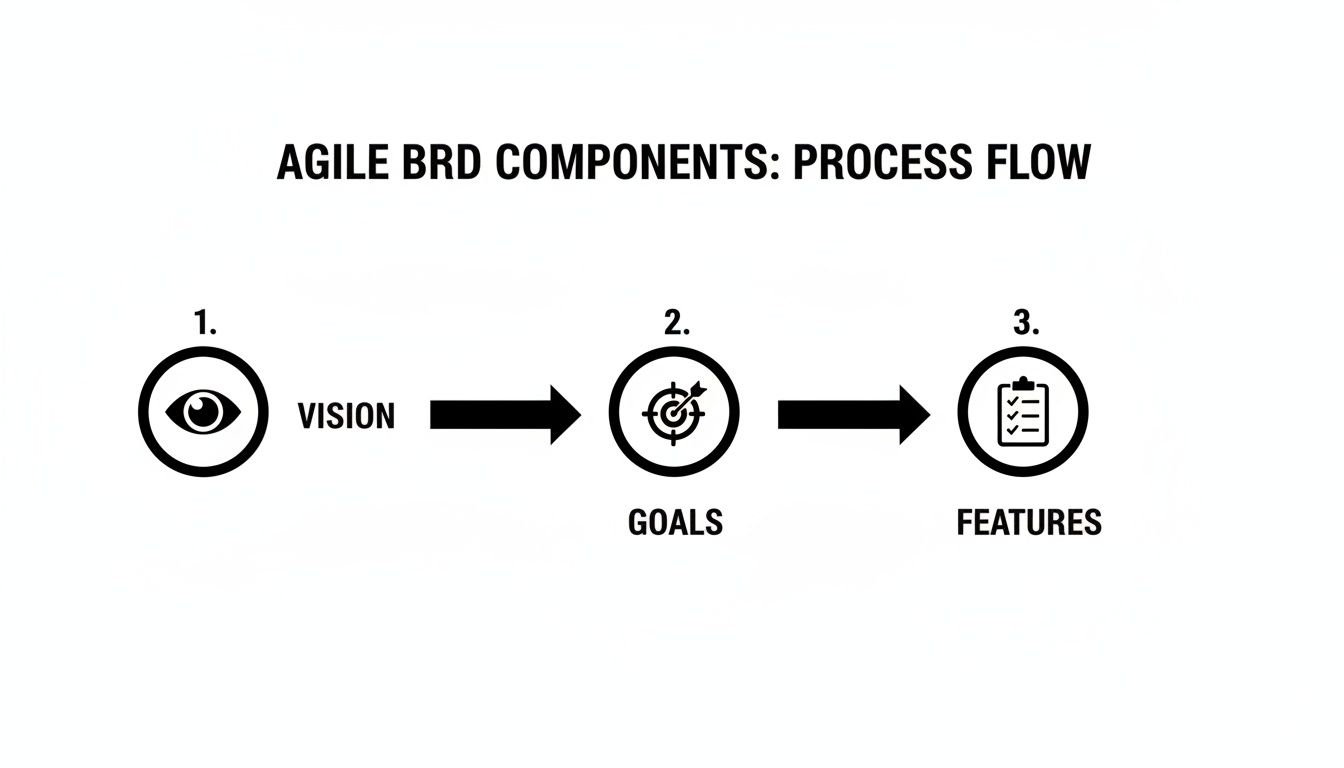
This flow is critical. Without it, you risk building things that seem cool but don't actually move the needle on what the business is trying to achieve. Features should never be arbitrary—they are the tangible results of your strategic planning.
Deconstructing Features into Epics
The feature list in your business requirements document template for Agile gives you the "what," but it's usually way too broad for a development team to start working. The first real step in translation is breaking these big ideas into epics.
Think of an epic as a major chapter in your project's story. It’s a large chunk of work that delivers a significant piece of value, often spanning several sprints.
Let's imagine a real-world e-commerce example. The BRD might list a feature like "Improved Checkout Experience." That’s a noble goal, but it's far too vague to be actionable. Turning it into an epic makes it concrete: "Simplify the checkout flow to a single page." Now that's a self-contained initiative a team can get behind, even if it's still a big undertaking.
Crafting Effective User Stories
Once you have an epic, you can start slicing it into smaller, manageable pieces called user stories. These are the fundamental building blocks of an Agile backlog. Each one is a short, simple description of a feature from the perspective of the person who will use it.
The classic format is a lifesaver because it keeps the focus where it belongs: on the user.
As a [type of user], I want to [perform some action], so that I can [achieve some benefit].
This structure forces you to answer three vital questions: who, what, and why. Honestly, the "why" is often the most important part. It gives the development team the context they need to make smart decisions and understand the motivation behind the request.
Let's break down our "Simplify the checkout flow" epic into a few user stories:
- Story 1: As a first-time shopper, I want to check out as a guest so that I don't have to create an account.
- Story 2: As a returning customer, I want my shipping and billing information pre-filled so that I can complete my purchase faster.
- Story 3: As a mobile shopper, I want to pay using Apple Pay or Google Pay so that I don’t have to manually enter my credit card details.
See how each story delivers a specific piece of value to a specific person? They're small enough to be completed in a single sprint but clearly contribute to the larger epic.
Defining Rock-Solid Acceptance Criteria
A user story tells the team what to build, but acceptance criteria (AC) define what "done" actually looks like. ACs are just a set of testable conditions that have to be met for the story to be considered complete. This is your best defense against the dreaded "that's not what I meant" conversation at the end of a sprint.
Good acceptance criteria are crystal clear, concise, and written from the user's point of view. The goal isn't to dictate how the code is written, but to confirm the outcome is correct.
Let's flesh out one of our user stories with some solid ACs:
User Story: As a mobile shopper, I want to pay using Apple Pay or Google Pay so that I don’t have to manually enter my credit card details.
Acceptance Criteria:
- Given I am on the payment step of the checkout on a compatible mobile device,
- When I select a digital wallet option (Apple Pay/Google Pay),
- Then the native payment interface for that wallet should appear.
- And after successful authentication, my order is placed without me entering card information.
- And if authentication fails, I am returned to the payment step with an error message.
With criteria this specific, there's no room for confusion. The developer knows exactly what the feature needs to do, and the QA tester has a clear checklist for validation. This entire process, flowing from the BRD all the way down to ACs, ensures the work being delivered perfectly matches the original business intent.
Weaving Your BRD into the Team's Daily Rhythm
An Agile BRD that just sits in a shared drive gathering digital dust is a wasted effort. Its real power is unleashed only when it becomes a living, breathing part of your team's day-to-day work. To make your business requirements document template for Agile truly effective, you have to knit it directly into the fabric of the tools your team already lives in, like Jira and Confluence.
This isn't just about linking two platforms. It's about building a single, traceable ecosystem. The goal is a crystal-clear line of sight from a high-level business objective in your BRD all the way down to a specific development task in the current sprint.
Make Confluence the Home for Your Living Document
Confluence is pretty much the perfect home for an Agile BRD. Unlike a static Word doc or PDF that's outdated the moment you save it, a Confluence page is built for collaboration and constant evolution. It becomes the central source of truth where stakeholders, product owners, and developers can all contribute, comment, and stay on the same page.
Getting it set up is no big deal:
- Start with a Template: Use one of Confluence's built-in requirements templates or create your own based on the sections we've discussed. Consistency is your friend here.
- Encourage Collaboration: Get stakeholders comfortable using inline comments to ask questions or suggest tweaks right on the document. This keeps all feedback contextual and out in the open.
- Embrace Version History: Confluence automatically tracks every single change. This built-in version control means you can instantly see who changed what and when, killing the chaos of managing "BRD_v3_final_final_real.docx".
This dynamic approach shifts the BRD from a one-off deliverable to an active, invaluable project asset.
Connecting Requirements to Real Work in Jira
Once your BRD has a home in Confluence, the next move is to connect it to where the development work actually happens: Jira. The native integration between these two Atlassian tools is what makes true traceability possible.
This is the bridge between strategy and execution.
From your Confluence BRD page, you can literally highlight any piece of text—a feature description, a user story, a non-functional requirement—and create a Jira issue right from that selection. This action automatically links the new epic or story back to its origin in the BRD.
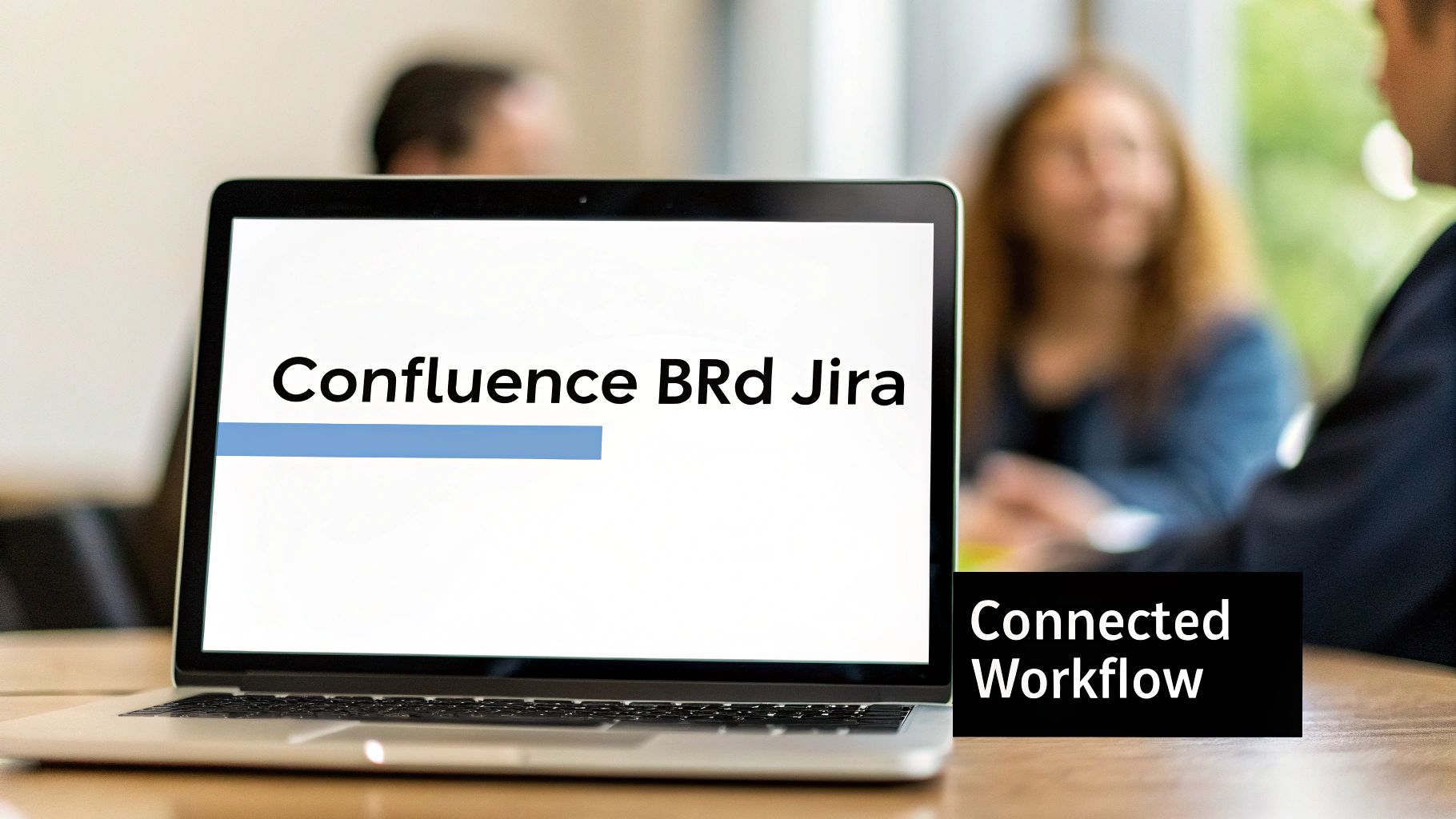
This seamless connection is more than a nice-to-have. It provides incredible clarity for the entire team. A developer picking up a new story can click a single link to see the original business context in the BRD, ensuring they fully grasp the "why" behind the "what." This deeper understanding almost always leads to smarter implementation choices.
It's no surprise that the global Agile tools market is projected to hit $9.2 billion by 2025, largely because of powerful integrations like this that provide real-time visibility.
Using Automation for Smarter Workflows
To really embed your Agile BRD into your team's processes, you can lean on workflow automation solutions to handle the busywork. Imagine setting up an automation that pings a Slack channel whenever a key section of the BRD is updated. Or one that automatically creates a Jira task when a stakeholder's comment is tagged as an "action item."
A well-integrated BRD ensures that your project's "source of truth" is never out of sync with the work being done. It makes traceability effortless and provides stakeholders with real-time visibility into how their business needs are being translated into a functional product.
Choosing the right tools to manage this flow is crucial. For a deeper look at the options out there, check out our comprehensive https://makeautomation.co/workflow-management-software-comparison/ guide. By building this connected ecosystem, your Agile BRD becomes more than just a document—it becomes the operational backbone of your project.
Keeping Your Living Document Alive and Accurate
Let's be honest: the single biggest risk with any requirements document is that it becomes a digital fossil. The moment it stops reflecting the current reality of the project, it stops being a source of truth and starts being a source of confusion.
To stop your Agile BRD from gathering dust, you have to treat it as a living artifact. It needs to be woven into the fabric of your project from day one, not just filed away in a forgotten folder. This isn't about creating a bureaucratic nightmare of change request forms. It’s about building a lightweight, clear process for letting the document evolve as you learn. An outdated BRD is genuinely dangerous—it creates a chasm between what stakeholders expect and what the team is building, and that's where expensive mistakes happen.
Establishing Clear Ownership and Governance
Every living document needs a gardener. Without someone responsible for tending to it, updates become a free-for-all, leading to a messy, inconsistent document nobody trusts. This role is a perfect fit for the Product Owner (PO), who is ultimately accountable for the business outcomes anyway.
But while the PO is the final approver, proposing changes should be a team sport. Your developers, designers, and key stakeholders should all feel empowered to suggest updates when they discover new information or when an early assumption proves wrong. The trick is to channel these suggestions through a simple, visible process.
Here’s what a lightweight governance model might look like in practice:
- The Proposal: Anyone on the team can suggest a change. Maybe they leave a comment directly in the Confluence doc or create a quick "BRD Update" task in Jira.
- The Gut Check: The PO, along with the right subject matter experts, quickly assesses the impact. Is this a minor tweak or a major pivot? What does it mean for the scope, timeline, and budget?
- The Decision: For small clarifications, the PO can approve and update on the spot. If a change alters a core business goal, it's time for a quick huddle with key stakeholders to get everyone on the same page.
- The Announcement: Once a change is approved, the PO is responsible for updating the BRD and, just as importantly, letting the entire team know what changed and why.
This structure keeps the document from drifting off course without bogging you down in red tape.
Using the BRD as a Communication Hub
Your Agile BRD shouldn't just be a reference manual; it should be an active tool in your team's most important meetings. By integrating it into your regular ceremonies, you keep it top-of-mind and ensure everyone stays aligned.
Think of it as the centerpiece for strategic conversations. During sprint planning, you can pull up the BRD's goals to double-check if the proposed user stories are truly the most valuable things to work on. It helps answer that critical question: "Will this work actually move us closer to our business objectives?"
A BRD that’s only opened at the start and end of a project has failed. Its true value is realized when it becomes the shared language connecting the C-suite's vision to a developer's daily tasks. It's the 'why' that fuels every single sprint.
The BRD also provides essential context for stakeholder reviews. Instead of just demoing new features in a vacuum, you can frame the presentation around the business goals outlined in the document. This simple shift changes the conversation from "Look at this cool thing we built" to "Here's how we're delivering on the value we all agreed was important."
Fostering Buy-In Across the Organization
For your Agile BRD to actually work, everyone from the executive sponsor to the newest developer needs to trust it. Building that trust requires transparency and a shared understanding of its purpose. You have to position the document not as a rigid contract, but as a guidepost that helps everyone make smarter, more aligned decisions.
Here are a few ways to build that critical buy-in:
- Host a Kick-off Session: When the project starts, walk all stakeholders through the BRD. Explain its structure, its purpose, and how it will be used.
- Make it Easy to Find: Don't bury it. The BRD should live in a central, easy-to-access place like the company wiki or a shared project space.
- Show, Don't Just Tell: Continuously connect sprint goals and feature demos back to the BRD. By consistently showing its relevance, you reinforce its value.
Ultimately, maintaining a living document is a discipline, and that discipline requires a solid foundation. You can learn more about building these kinds of repeatable systems in our guide on what is process documentation, which dives into the principles of creating clarity and consistency. By establishing clear ownership and making the BRD a central part of your communication rhythm, you ensure it remains a powerful asset that guides your project to a successful outcome.
Common Questions About Agile BRDs
Whenever you try to blend methodologies, questions and a healthy dose of skepticism are bound to pop up. This is especially true for teams who are either hardcore Agile purists or deeply rooted in traditional Waterfall practices. It's smart to tackle these concerns head-on.
Getting these common questions answered helps build trust in the process and makes sure everyone sees the real value of a modern business requirements document template for Agile projects.
Let's clear the air on a few of the most common points of confusion I hear.
Isn't a BRD Just a Waterfall Document in Disguise?
This is easily the most common pushback, and honestly, it’s a fair point. A classic, 100-page BRD that tries to define every single detail from the start is the definition of anti-Agile.
The real difference is in the intent and content. A modern, Agile-friendly BRD is a lean, living document. It's laser-focused on the "why"—the business goals, the user problems, and the overall vision.
It gives the team just enough strategic context to guide development without locking them into a rigid plan. Think of it as the project’s North Star, not a turn-by-turn GPS. You're aligning on the destination, not dictating the exact route.
Who Is Responsible for the Agile BRD?
While the whole process is collaborative, the Product Owner (or sometimes a Business Analyst) usually takes the lead here. They are the steward of the document, gathering insights from stakeholders and making sure it stays true to the business needs.
But—and this is a big but—the entire team needs to have a hand in it. Developers, designers, QA… everyone. Getting their input early confirms what's technically possible and builds a shared sense of purpose right from the get-go. This keeps the BRD from becoming just another top-down directive nobody feels connected to.
An Agile BRD is a conversation starter, not a set of commandments carved in stone. Its value comes from ongoing collaboration, where the whole team feels a sense of ownership over the project's strategic direction.
How Often Should We Update the BRD?
You only touch the Agile BRD when there's a significant shift in strategy, scope, or one of your core assumptions. It’s not a backlog or a task board that you’re updating daily or even weekly. Updates are strategic, not tactical.
So, when would you update it?
- After a major stakeholder review uncovers a game-changing insight.
- When market feedback forces you to pivot your approach.
- As you wrap up a major phase or a massive epic.
The idea is for the BRD to be the stable source of truth for the project's "why," while the "how" (the user stories and tasks) evolves sprint by sprint in a tool like Jira. It provides stability without sacrificing the agility you need to build the right thing.
At MakeAutomation, we specialize in creating the operational frameworks that help your business scale efficiently. If you need help implementing smarter project management systems or automating your workflows, book a discovery call with our experts.