What is Lead Generation Process? (what is lead generation process)
So, what exactly is the lead generation process? Think of it less as a rigid system and more as a well-oiled machine that attracts potential customers, grabs their attention, and guides them toward a sale. It’s not just about hoarding a list of email addresses; it's a thoughtful, multi-step journey that turns total strangers into genuinely interested, qualified leads. This process is the real engine behind sustainable B2B growth.
Understanding the Lead Generation Process
At its heart, lead generation is like creating a well-lit path for your ideal customer. Instead of just shouting your message into the void and hoping for the best, you’re creating a series of intentional steps. These steps are designed to draw the right people in and gently show them how you can solve their problems with your product or service.
It’s the magic that turns an anonymous person scrolling on social media or a random visitor to your website into a real, tangible prospect—someone your sales team can actually talk to.
Let’s put it this way: someone who stumbles upon your blog is just a visitor. But the moment they trade their email address for your new e-book? Bam. They’ve just become a lead. The whole dance of attracting them with that blog post and getting them to sign up for the e-book—that's lead generation in a nutshell.
Why a Documented Process Matters
Without a clear, documented process, lead generation is pure chaos. You get marketing teams celebrating a huge list of new contacts, while the sales team complains that none of them are any good. It’s a classic recipe for wasted time, missed opportunities, and internal friction.
Having a solid process in place gets everyone on the same page about what a "good lead" actually looks like and how to handle them. This alignment is critical for a few big reasons:
- Quality Over Quantity: You stop chasing vanity metrics (like the sheer number of contacts) and start focusing on attracting prospects who are a genuine fit.
- Smarter Workflows: It allows you to automate the tedious, repetitive tasks, which frees up your team to do what they do best—building relationships with people who are close to buying.
- Scalable Growth: When you have a process that works, you can repeat it. This makes your pipeline predictable and helps you decide where to invest your budget for the biggest impact.
The numbers don't lie. The lead generation industry is expected to hit around $295 billion by 2027, with the average company pulling in 1,877 leads a month. But here's the kicker: a shocking 79% of those leads never turn into sales. The main culprit? A total lack of nurturing. It's no wonder that 68% of B2B marketers say improving lead quality is their absolute top priority. You can discover more lead generation insights from Martal Group.
A successful lead generation process isn't a one-and-done campaign. It's a continuous cycle of attracting, engaging, qualifying, and converting. It’s the foundational system that separates thriving businesses from those that are always scrambling to find their next customer.
To really get a grip on this, let's break the journey down into its key stages. The table below gives you a quick snapshot of the path a lead takes, which we'll dive into more deeply throughout this guide.
The Core Stages of the Lead Generation Process at a Glance
| Stage | Primary Goal | Common Activities & Channels |
|---|---|---|
| Awareness & Attraction | To attract your ideal audience and make them aware of a problem you can solve. | SEO, content marketing, paid ads, social media |
| Capture & Interest | To convert anonymous traffic into known leads by capturing their contact information. | Lead magnets, landing pages, forms, webinars |
| Qualification & Segmentation | To determine which leads are most likely to become customers and group them. | Lead scoring models, BANT framework, CRM data |
| Nurturing & Engagement | To build a relationship and guide qualified leads toward a purchase decision. | Email sequences, retargeting ads, personalized content |
| Conversion & Hand-off | To convert a marketing-qualified lead (MQL) into a sales-qualified lead (SQL). | Demo requests, consultation calls, sales outreach |
Each of these stages plays a crucial role in moving a potential customer from "Who are you?" to "Where do I sign up?" Now, let's explore how to master each one.
The 5 Stages of a High-Performing Lead Generation Process
Thinking about lead generation is like mapping out a road trip. You don't just magically arrive at your destination; you follow a series of planned steps that take a complete stranger and guide them toward becoming a sales-ready opportunity. It’s a journey.
Think of it as building a bridge. Each stage is a critical support pillar, and if one is weak, the whole structure feels shaky. This process is what turns abstract interest into a real, measurable pipeline for your business. It's the framework that ensures your marketing efforts aren't just making noise, but are actually creating value.
Let's walk through how this journey unfolds, step by step.
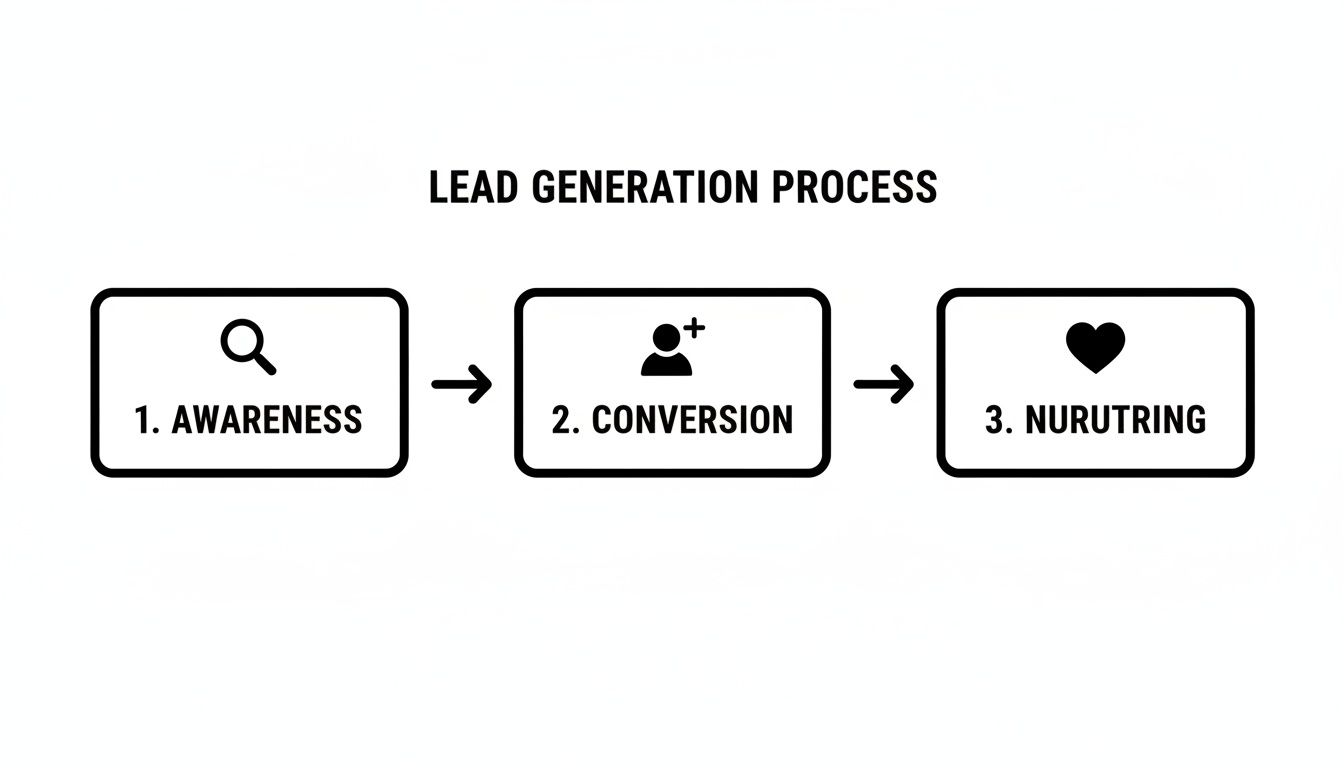
As you can see, it’s a logical flow. You start by attracting a broad audience and then carefully refine that group until you're left with the prospects who are genuinely interested in what you have to offer.
Stage 1: Awareness and Attraction
This is the top of your funnel. The goal here isn't to sell anything—it's simply to cast a wide but targeted net. You want to attract your Ideal Customer Profile (ICP) and get on their radar by showing them you understand their problems.
This stage is all about giving away value. You’re answering questions, solving small frustrations, and positioning your brand as a helpful authority in your space.
Common ways to do this include:
- Content Marketing: Publishing blog posts, videos, or podcasts that dig into the specific pain points your audience faces.
- Search Engine Optimization (SEO): Making sure your website and content pop up when potential customers are searching for solutions.
- Social Media: Showing up where your community hangs out, sharing valuable insights, and building a genuine following.
- Paid Advertising: Running targeted ads on platforms like Google or LinkedIn to reach a specific demographic with a message that resonates.
The key is to meet people where they are, offering a helping hand without asking for much in return.
Stage 2: Capture and Interest
Once you've got someone's attention, the game changes. Your next move is to turn that anonymous website visitor into a known contact. This is the "capture" phase, where you offer something so valuable that a person is willing to trade their contact information for it.
This is the exact moment a visitor becomes a lead. You’re shifting from a one-to-many broadcast to a potential one-to-one conversation.
The Capture stage is the first real test of your value proposition. If your offer isn't compelling enough to earn an email address, it's a sign you need to better understand your audience's needs.
To make this happen, you need two things: a lead magnet and a landing page.
- Lead Magnet: This is your irresistible offer. It could be an e-book, a webinar registration, a free checklist, a case study, or a trial of your software. Whatever it is, it has to be incredibly relevant and solve a real problem for your audience.
- Landing Page: This is a dedicated webpage with one single, focused goal: to convince visitors to download your lead magnet by filling out a form.
Effective lead capture is a delicate dance. Ask for too much information, and you'll scare people off. Ask for too little, and you won't have enough data to qualify them later. It’s no surprise that 84% of marketers still rely on form submissions to capture leads—getting this step right is crucial.
Stage 3: Qualification and Segmentation
Let’s be honest: not all leads are created equal. A student downloading your e-book for a research paper is miles away from a decision-maker at a target company who just requested a demo. The qualification stage is all about separating the window shoppers from the serious buyers.
Here, you start analyzing the information you've gathered to figure out a lead's potential. This is a critical step that prevents your sales team from wasting precious time on prospects who aren't a good fit or simply aren't ready to buy.
There are a few solid ways to qualify leads:
- Lead Scoring: This is a system where you assign points to leads based on who they are (job title, company size) and what they do (visit the pricing page, open an email). Once a lead hits a certain score, they’re flagged as "qualified" and ready for more attention.
- BANT Framework: This is a classic sales qualification method that looks at Budget, Authority, Need, and Timeline. Does the lead have the budget? Can they actually make the purchasing decision? Do they have a clear need for your solution? And what’s their timeline for making a move?
Once leads are qualified, you can segment them into different lists—for example, one for small businesses and another for enterprise clients. This allows you to tailor your messaging and make it far more relevant in the next stage.
Stage 4: Nurturing and Engagement
Very few leads are ready to pull out their credit card the moment they give you their email. In fact, it takes an average of 64.5 days for a lead to convert, which is why a patient, strategic nurturing process isn't just nice to have—it's essential.
Lead nurturing is the art of building a relationship over time. You continue to provide value, build trust, and keep your brand top-of-mind so that when they are ready to buy, you're the first one they think of.
Effective nurturing usually involves a mix of:
- Automated Email Campaigns: A series of pre-written emails, sent automatically over a few weeks or months, that offer helpful tips, customer stories, and useful insights.
- Personalized Content: Sending articles or resources that are directly relevant to a lead's industry, interests, or where they are in their buying journey.
- Retargeting Ads: Showing targeted ads to leads who have visited your site but haven't taken that next step yet.
This stage is all about playing the long game. Your job is to be a helpful guide, not a pushy salesperson.
Stage 5: Conversion and Hand-off
This is it—the final and most important stage. After careful qualification and patient nurturing, a lead starts showing strong buying signals. Maybe they hit a high lead score, or they took a specific action like requesting a demo or a price quote.
At this point, they graduate from being a Marketing Qualified Lead (MQL) to a Sales Qualified Lead (SQL).
The hand-off from marketing to sales has to be seamless. The salesperson needs all the context gathered so far—what pages the lead visited, the content they downloaded, and any other info they’ve shared.
This context ensures the sales conversation starts off on the right foot, feeling relevant and personal from the very first "hello." A smooth hand-off means the lead doesn't have to repeat themselves and the salesperson can get straight to the point of closing the deal. This is where all your hard work pays off, turning a carefully cultivated prospect into a happy new customer. And if you're looking to sharpen your team's approach, check out these powerful outbound lead generation strategies.
How to Measure Lead Generation Success
Bringing in a flood of new leads feels great, but it's only half the story. If you aren't measuring your efforts, you're essentially flying blind. You have no real way of knowing which campaigns are hitting the mark and which are just burning through your budget.
Success isn't about vanity metrics or feeling busy. It's about answering the tough questions: Are we attracting the right kind of people? Are our campaigns efficient? Most importantly, is this investment actually turning into revenue?
To get those answers, you need to focus on the right Key Performance Indicators (KPIs). Think of these metrics as the dashboard for your lead generation engine—they give you a clear, real-time view of what’s working so you can make smart decisions that drive real growth.
Creating a Data Table for Your Lead Generation KPIs
You could easily drown in a sea of data. The trick is to focus on a handful of KPIs that directly tie your marketing activities to actual business outcomes. These are the numbers that tell the true story of your performance.
The table below breaks down the essential metrics every B2B and SaaS business should be watching, what they mean, and how to calculate them.
Key Lead Generation KPIs and Their Business Impact
| Metric (KPI) | How to Calculate It | What It Tells You |
|---|---|---|
| Conversion Rate | (Number of Conversions / Total Visitors) * 100 | This shows how effective your offer and landing page are at convincing people to take action (e.g., download an ebook, book a demo). A low rate might mean your message isn't resonating or your call-to-action is unclear. |
| Cost Per Lead (CPL) | Total Campaign Cost / Number of Leads Generated | This is your efficiency score. It tells you exactly how much you're spending to get one new lead in the door. It's crucial for budgeting and understanding the ROI of different channels. |
| Marketing Qualified Lead (MQL) to Sales Qualified Lead (SQL) Rate | (Number of SQLs / Number of MQLs) * 100 | This is a critical health check for your sales and marketing alignment. A low number often signals a disconnect—either marketing is sending poor-fit leads or sales has overly strict criteria. |
| Customer Lifetime Value (CLV) | (Average Purchase Value) x (Average Purchase Frequency) x (Average Customer Lifespan) | This metric reveals the total revenue you can expect from a single customer over time. When you trace CLV back to lead sources, you can pinpoint the channels that deliver your most profitable, long-term customers. |
By keeping a close eye on these core metrics, you can get a holistic view of your funnel's health and make adjustments that directly impact your bottom line.
Your Cost Per Lead Is More Than Just a Number
Your Cost Per Lead (CPL) is a direct reflection of your marketing efficiency. A low CPL for high-quality leads? That's the sweet spot—it means your strategy is humming along perfectly. On the other hand, a steadily rising CPL should set off alarm bells.
It's no secret that leads are getting more expensive. With increased competition and crowded channels, the average CPL jumped from around $200 in 2017 to nearly $400 by 2023. This trend makes it absolutely vital to focus on acquiring high-quality leads that are likely to convert, otherwise, you'll see your profit margins shrink. You can discover more insights about lead generation costs to see just how much things have changed.
A high CPL isn't automatically a bad thing, especially if those leads bring a high Customer Lifetime Value. The real goal is to strike the right balance between what you pay to acquire a customer and the long-term value they bring to your business.
From MQL to SQL: The Ultimate Quality Check
The handoff from a Marketing Qualified Lead (MQL) to a Sales Qualified Lead (SQL) is where the rubber meets the road. It’s the moment you find out if your lead quality is truly up to snuff.
A consistently low MQL-to-SQL conversion rate is a classic sign of a disconnect between your teams. Maybe marketing is a little too generous with the "qualified" label, or perhaps the sales team's expectations are out of sync with reality.
The first step to fixing this is getting both teams in a room to agree on a crystal-clear definition of a "qualified" lead. This is where a solid lead scoring system becomes a game-changer. By assigning points to leads based on who they are (demographics, firmographics) and what they do (website behavior, content engagement), you create an objective, data-backed standard for when a lead is truly ready for a sales conversation. If you want to dive deeper, you can learn more about setting up an effective lead scoring model right here.
When you regularly track these KPIs, your lead generation stops being a series of one-off campaigns and becomes a predictable, measurable system that reliably fuels your company's growth.
Using AI and Automation to Scale Your Process
Trying to manage lead generation manually is a guaranteed path to burnout and missed opportunities. As your business scales, juggling spreadsheets and manual follow-ups becomes impossible. It’s like trying to fill a swimming pool with a bucket—you’ll get exhausted long before you make any real progress.
This is exactly where automation and artificial intelligence (AI) come in. They turn your process from a tedious, hands-on chore into a growth engine that works around the clock. This shift frees up your team from the grind of repetitive tasks so they can focus on what really matters: closing deals and building strong customer relationships.
How Automation Creates a Smarter Funnel
At its heart, automation builds a bridge between all your marketing and sales activities. Instead of data getting trapped in different platforms, information flows exactly where it needs to, triggering the right action at the right time. This seamless flow is the bedrock of a modern, efficient lead generation process.
Think about what happens when a new lead fills out a form on your site. Without automation, a real person has to:
- Copy and paste their info into the CRM.
- Figure out which salesperson to assign them to.
- Draft and send a welcome email.
- Set a calendar reminder for a follow-up.
With a good automated workflow, all of this happens instantly, the second they hit "submit." No delays, no human error.
Elevating Your Process with AI Applications
While automation is great at handling clear "if this, then that" rules, AI brings a layer of intelligence to the table. It can analyze massive datasets to make smart predictions and personalize interactions in ways simple automation just can't match. This is where your lead generation process gets a serious upgrade.
Here are a few game-changing ways to apply AI:
- Predictive Lead Scoring: AI goes way beyond basic scoring. It analyzes a prospect's behavior, social media activity, and even historical customer data to predict who is most likely to convert. This ensures your sales team is always talking to the hottest leads first.
- Dynamic Nurturing Sequences: Forget rigid, one-size-fits-all email drips. AI can adjust nurturing paths on the fly. If a lead clicks a link about a specific feature, the system can automatically send them a case study or demo video about that exact topic.
- AI-Powered Chatbots and Voice Agents: Today’s chatbots do so much more than answer FAQs. They can qualify leads right on your website, book demos directly into a rep’s calendar, and hand off conversations to a human agent without missing a beat. You can learn more in our guide on using a chatbot for lead generation.
The real goal of AI isn't to replace your team—it's to make them better. It takes on the high-volume, data-heavy work, freeing up your people for the strategic thinking and relationship-building that machines can't replicate.
The results speak for themselves. Businesses using AI in their lead generation see a 50% increase in sales-ready leads and can slash customer acquisition costs by up to 60%. Those aren't just vanity metrics; that's a direct, powerful return on investment.
Building Your Automated Growth Engine
Putting this all into practice is about connecting the tools you already use into one unified system. This "stack" usually includes your CRM, an email marketing platform, and an automation tool that acts as the central hub tying everything together.
To truly scale your outreach, learning to automate content marketing is a critical piece of the puzzle. By setting up smart triggers and actions, you can build a self-operating system that captures, qualifies, nurtures, and routes leads without needing constant oversight. It's the key to breaking through growth plateaus and achieving real, sustainable scale.
Common Lead Generation Mistakes to Avoid

Even with the best-laid plans, it’s all too easy to fall into a few classic traps that can sabotage your entire lead generation effort. Think of these as the common-sense rules that get forgotten in the rush for results. Understanding these pitfalls ahead of time is half the battle won.
One of the most tempting mistakes is chasing quantity over quality. It feels good to report big numbers, but a list of 1,000 uninterested contacts is practically worthless compared to 50 genuinely qualified prospects. This approach just clogs your pipeline and demoralizes your sales team.
Focusing on Quantity Instead of Quality
We've all seen it: marketing pops the champagne over a record number of new leads, while the sales team is pulling their hair out because none of them are closing. This is a classic symptom of misalignment.
It’s a huge waste of time and money, and it creates a rift between two teams that absolutely need to be in sync.
- The Problem: Your funnel is stuffed with people who aren’t a good fit. They don't have the budget, the authority, or even a real need for your product. Sales reps end up spending all their time just trying to find a needle in a haystack.
- How to Fix It: Lock marketing and sales in a room (figuratively!) until they agree on a crystal-clear definition of a Marketing Qualified Lead (MQL) and a Sales Qualified Lead (SQL). Then, build a lead scoring system to automatically flag the prospects who are actually worth pursuing.
Chasing a high volume of low-quality leads is like trying to quench your thirst with saltwater. You're putting in a lot of effort for something that will never actually satisfy the need.
Neglecting the Power of Nurturing
Another all-too-common blunder is forgetting to nurture leads. So many companies pour all their energy into getting a name and an email, then immediately jump to a hard sell. It’s the business equivalent of asking someone to marry you on the first date—it’s just too much, too soon.
When you don't nurture, you're essentially abandoning perfectly good prospects on the side of the road for your competitors to pick up. You have to remember you’re building a relationship, not just processing a transaction.
Using a One-Size-Fits-All Message
Blasting the same generic email to every single person on your list is a surefire way to get ignored. Your audience is not a monolith. A startup founder cares about completely different things than a director at a Fortune 500 company. Your messaging has to reflect that reality.
- The Problem: Your emails land in the trash, your ads get scrolled past, and your engagement metrics are in the gutter. Why? Because your content doesn’t feel relevant to anyone.
- How to Fix It: Segment your audience. Break them down by industry, company size, role, or where they are in their buying journey. Then, create personalized content that speaks directly to their specific problems and goals.
The modern what is lead generation process is worlds away from the spray-and-pray cold calling of the 1990s. Today, 90.7% of marketers see their website as their primary channel, with blogs coming in at a close second (89.2%). This just goes to show that a thoughtful, multi-channel strategy is no longer optional. If you want to dive deeper into the data, you can explore the full lead generation research here.
A Few Common Questions About Lead Generation
Even with the best game plan, a few questions always pop up when you're deep in the trenches of building a lead generation engine. Let's tackle some of the most common ones we hear.
Getting these details sorted out is the difference between a process that just works and one that truly scales with your business.
What’s the Real Difference Between a Lead and a Prospect?
This is a classic point of confusion, and it’s easy to see why. People often use "lead" and "prospect" interchangeably, but in a well-oiled sales and marketing machine, they represent two very different stages. Nailing this distinction is critical for a smooth handoff from your marketing team to your sales reps.
Think of a lead as someone who has simply raised their hand. They've shown a flicker of interest—maybe they downloaded an ebook or signed up for your newsletter. You have their contact info, but that’s about it. You don't really know if they're a good fit or just kicking tires.
A prospect, however, is a lead that's been vetted. You've qualified them, either through a lead scoring model or a direct conversation, and confirmed they match your ideal customer profile. They have a real need you can solve. The entire goal of your what is lead generation process is to build a reliable system for turning those curious leads into sales-ready prospects.
How Long Should This Whole Process Take?
There's no magic number here. The timeline for lead generation is all over the map, depending heavily on your industry, the complexity of your sale, and your price point. A simple, low-cost SaaS tool might see leads converting in a matter of weeks. An enterprise-level solution with a six-figure price tag? That could easily take months, or even over a year.
As a general benchmark, a B2B lead often takes around two months to become a customer. But the focus shouldn't be on speed; it should be on consistency. A solid nurturing system is your best friend here, keeping you top-of-mind no matter how long the buyer's journey takes. This is where automation really shines, letting you maintain that personal touch at scale without burning out your team.
Don't try to rush it. A longer sales cycle often signals a more thoughtful, higher-value customer. Your job is to keep delivering value along the way, so when they're finally ready to buy, you're the only logical choice.
What Are the First Steps to Automating Our Process?
The idea of automation can feel like you have to boil the ocean, but it's best to start small. The first step is to simply map out your current process. Look for the biggest time-sinks and the most repetitive, mind-numbing tasks. Those are your prime candidates.
Here are a few of the best places to start:
- Lead Capture: Instead of manually entering data, set up an automation that instantly sends form submissions from your website straight into your CRM. It’s a simple fix that ensures no lead ever falls through the cracks.
- Lead Routing: Create rules that automatically assign new leads to the right salesperson based on territory, company size, or industry. No more delays or debates about who owns the lead.
- Initial Follow-Up: Trigger a welcome email sequence the second someone fills out a form. You engage them immediately, right when their interest is at its peak.
Once you’ve got these foundational pieces running smoothly, you'll have a solid base to build on for more advanced automations, like AI-powered qualification or dynamic nurturing campaigns.
Is AI Going to Replace My Sales Team?
Absolutely not. AI isn't here to replace the human touch in lead generation; it's here to supercharge it. The real magic of AI is its ability to handle the high-volume, repetitive work with superhuman speed and accuracy. This frees up your team to do what they do best: build relationships and solve complex problems for customers.
Here’s a practical way to think about it: AI is fantastic at things like initial data entry, qualifying leads 24/7, and scheduling meetings. An AI Voice Agent, for example, can make thousands of initial outreach calls, filter out the unqualified leads, and book appointments around the clock. Your sales team can then walk into conversations with prospects who are already warmed up, interested, and confirmed to be a great fit. It’s all about letting the machines handle the grunt work so your people can focus on closing deals.
Ready to stop wasting time on manual tasks and build a scalable lead generation machine? At MakeAutomation, we specialize in implementing the AI and automation frameworks that transform your process from a liability into your greatest asset. Book a call with us today and discover how we can help you accelerate your growth.