Your Guide to Hiring a CI CD Consultant for Scalable Growth
Are you trying to innovate faster but also need your software to be rock-solid and stable? That's the classic tug-of-war in development. A CI/CD consultant is the specialist who steps in to solve this exact problem. They turn slow, manual development work into a fast, automated delivery machine, giving you a real edge over the competition. Think of them as the architects of your modern, high-speed software factory.
From Bottleneck to Breakthrough
For many growing B2B and SaaS companies, the software delivery process feels more like a small, artisanal workshop than an efficient, scalable factory. The quality might be there, but the whole system is slow, prone to human error, and just can't keep up with what the market demands. This is where innovation grinds to a halt and competitors start to pull ahead.
Every manual deployment, every long integration phase, every bug that slips through to production—these are all bottlenecks. They don't just delay new features. They waste precious engineering time, hurt team morale, and add a ton of operational risk. You end up stuck in a frustrating loop, forced to choose between moving fast and keeping things stable.
The Architect of Automation
A CI/CD consultant comes into this situation like a master architect. Their job is to find all the hidden points of friction and design an automated system—a CI/CD pipeline—that smooths out the entire journey from a developer's code to your live production servers. It's not about just installing a few tools; it's about fundamentally re-engineering how your team builds and ships software.
By automating the repetitive, error-prone tasks and creating solid feedback loops, a CI/CD consultant frees up your engineers to focus on what they were hired to do: build great features that grow the business.
This kind of transformation isn't just for Silicon Valley giants anymore. The demand for CI/CD expertise is exploding as more companies see how directly it impacts their bottom line. Market analysts are predicting the Continuous Deployment Solution market will hit $15 billion by 2025, fueled by businesses that need to deliver software faster. The data backs it up, too. Reports show that teams with solid CI/CD practices cut their deployment failures by 60% and get back on their feet twice as fast after an outage. That’s the power of specialized guidance.
A Strategic Business Advantage
At the end of the day, bringing in a CI/CD consultant is a strategic move to build a stronger, more adaptable organization. They introduce proven best practices and frameworks that make your development process a reliable, predictable asset. Similar to how strategic IT consulting services help align technology with business goals, a CI/CD consultant turns your software delivery process into a powerful engine for growth.
This partnership helps you move from a state of constant operational friction to a flow of continuous, predictable delivery. That’s the breakthrough that lets your business scale.
What a CI/CD Consultant Actually Does
Let's get past the job title and talk about what these experts really do. Think of a CI/CD consultant as a "workflow doctor" for your entire software development process. They don't show up with a generic cure-all; they come with a diagnostic toolkit to figure out exactly what’s slowing you down and putting your releases at risk.
Their first move is always to observe and diagnose. They map out the entire journey of your code, from a developer's laptop all the way to your customers. They’re looking for every manual handoff, every bottleneck, and every hidden point of failure. This is way more than just glancing at a few deployment scripts—it's a deep dive into your entire development lifecycle.
Designing the Automation Blueprint
After getting a clear picture of how things work today, the consultant puts on their architect hat. Their main job is to design a tough, automated CI/CD pipeline that will become the central nervous system for your software delivery. This isn’t about just stringing a few tools together; it's about building a logical, cohesive flow that makes sense for your team.
The blueprint they create answers the critical questions:
- How can we automate code integration so we catch bugs almost immediately?
- What’s the smartest automated testing strategy for our specific application?
- How do we manage our development, staging, and production environments without causing chaos?
- Out of the hundreds of tools available, which ones are the right fit for our technical needs and budget?
The final deliverable is a detailed plan for an automated workflow that slashes manual work and dramatically cuts the risk of human error. A great CI/CD consultant makes sure this design isn't just powerful but also easy for your team to maintain long after the engagement is over.
Implementing and Integrating the Right Toolchain
With a solid plan in place, the work gets very hands-on. The consultant leads the charge on implementation, integrating a carefully chosen set of tools. This stack often includes version control systems like Git, build automation platforms like Jenkins or GitLab CI, and containerization tools like Docker and Kubernetes.
This step is make-or-break. A poorly configured tool can create more headaches than it solves. The consultant’s expertise is in making sure every piece of the puzzle fits together perfectly, creating a smooth, reliable, end-to-end automated process. They set up the automated triggers, build in the right feedback loops, and ensure every action is logged and visible.
A well-built pipeline acts as an automated quality gate, stopping bad code from ever reaching a customer. It’s a fundamental shift from the old way of finding and fixing bugs after they’re already causing problems.
Embedding Security and Optimizing Performance
In today's world, security can't be an afterthought—it has to be baked into the process. A top-tier CI/CD consultant will champion DevSecOps, a practice that weaves security testing directly into the pipeline. They’ll add automated security scans at different stages to check for vulnerabilities in your code, its dependencies, and even the container images you use.
At the same time, they are obsessed with performance. A fast feedback loop is everything. Developers need to know within minutes, not hours, if their latest change broke something. The consultant will fine-tune the pipeline for speed and efficiency, making sure builds, tests, and deployments are as fast as possible without compromising quality. This drive for continuous improvement is where they deliver massive value.
You can get a deeper look into the philosophies that drive this work by reading about DevOps and continuous delivery here.
Ultimately, a truly experienced consultant sees the bigger picture. They understand that the principles of automation aren't just for code. They can spot opportunities to apply the same CI/CD mindset to other parts of the business—like lead nurturing or client onboarding—to drive efficiency across the entire organization.
What a CI/CD Consultant Actually Delivers

When you bring in a CI/CD consultant, you’re not just paying for advice. You’re investing in specific, measurable outcomes that will fundamentally change how your team builds and ships software.
It all starts with a deep dive into your current reality. A consultant needs to understand your existing workflows, tools, and team habits to pinpoint what’s working and, more importantly, what’s holding you back. This isn’t just a quick look-around; it’s a full diagnostic.
CI/CD Pipeline Audits and Health Reports
Think of a consultant's first step as a structural engineering inspection for your software pipeline. They meticulously examine every part of your process—from code commits and build times to testing gaps and deployment failures—to find the weak points and hidden risks.
The main deliverable here is a Pipeline Health Report. This isn't just a list of problems. It’s a data-backed analysis that shows you exactly where you stand, benchmarks you against industry best practices, and gives you a clear, prioritized roadmap for improvement. This report becomes your playbook, connecting every technical recommendation back to a real business goal, like shipping features faster or reducing production bugs.
Greenfield Implementations and Pipeline Modernization
For teams starting from scratch or struggling with a clunky, outdated system, a consultant can design and build a modern CI/CD pipeline from the ground up. This "greenfield" approach ensures best practices are baked in from the very beginning. For others, it might mean modernizing an existing toolchain, swapping out slow or inefficient tools for a slick, integrated stack.
Either way, you walk away with tangible assets:
- Fully Documented Pipelines: You get a complete, working CI/CD pipeline defined as code (using tools like Jenkinsfiles or GitLab CI YAML). This makes your entire process transparent, version-controlled, and much easier to manage.
- Integrated Toolchain: A hand-picked set of tools for version control, building, testing, and deploying, all configured to work together without friction.
- Environment Strategy: A rock-solid plan for managing your development, staging, and production environments, which finally puts an end to the classic "but it works on my machine!" problem.
A well-architected pipeline built by an experienced CI/CD consultant isn't just an assembly line for code; it's a strategic asset that builds quality and security into your product automatically.
Automated Testing and Security Strategies
Speed is great, but a fast pipeline that ships broken or vulnerable code is a liability. A huge part of a consultant's job is to build a robust, automated testing strategy that validates every single change before it ever gets near a customer.
A consultant can add massive value by guiding your team through the process of automating regression testing, which is a common bottleneck that prevents new features from accidentally breaking old ones. They also weave security scanning tools right into the pipeline (a practice called DevSecOps), catching vulnerabilities when they are cheapest and easiest to fix.
The deliverables here are all about managing risk:
- Comprehensive Test Automation Suite: A powerful set of automated unit, integration, and end-to-end tests that run on every commit, giving developers instant feedback.
- DevSecOps Framework: The integration of security tools that automatically scan your code for flaws, keeping your application secure by default.
- Quality Gates: Automated checkpoints that act as gatekeepers, stopping any code with failing tests or major security issues from moving forward.
The difference between the old way of doing things and the new reality a consultant can create is night and day. This table shows just how stark that contrast can be.
Manual Processes vs CI/CD Automated Workflows
| Operational Area | Before CI/CD Consultant (Manual Process) | After CI/CD Consultant (Automated Workflow) |
|---|---|---|
| Code Deployment | A high-stress, all-hands manual event taking hours or days. | A routine, one-click automated process that takes minutes. |
| Quality Assurance | Manual, repetitive testing that is slow and prone to human error. | Automated test suites that run continuously, catching bugs instantly. |
| Security Review | A late-stage, bottlenecked process that often delays releases. | Automated security scans integrated into the pipeline for early detection. |
| Feedback Loop | Developers wait hours or days to know if their change broke anything. | Developers receive feedback on code quality and tests within minutes. |
As you can see, the shift isn't just about doing the same things faster. It’s about creating a fundamentally more reliable, secure, and efficient way to build software.
Knowing When It's Time to Hire a Consultant
Figuring out the right moment to bring in a CI/CD consultant isn't usually about one big, spectacular failure. It's more often a slow burn—a pattern of nagging, expensive friction points that quietly grinds productivity down. It’s the kind of inefficiency that tells you something is fundamentally broken in how you deliver software.
If your team dreads release day, that’s a massive red flag. Deployments should be routine, predictable, maybe even a little boring. When they turn into high-stress, all-hands-on-deck marathons that demand heroics and a weekend of frantic bug fixes, your manual processes are failing you. This isn't just a tech problem; it's a business problem that burns out your best people and stalls your company’s growth.
Common Pain Points That Signal Trouble
Your developers are your most valuable—and most expensive—engine for innovation. If they’re spending a huge chunk of their week wrestling with integration problems, debugging flaky test environments, or running manual checks, they aren't building the features your customers actually pay for. That’s a direct hit to your bottom line and a huge opportunity cost.
Another major warning sign pops up when your quality assurance process becomes a bottleneck. Maybe security flaws are only being found right before a big launch, forcing everyone to scramble for last-minute patches. Or worse, customer-reported bugs keep slipping through, eroding trust and causing people to leave your platform. These are classic symptoms of a pipeline that lacks automated quality and security gates—exactly the kind of problem a CI/CD consultant lives and breathes.
"Deployments are high-stress, all-hands-on-deck events." This single statement is one of the most common and clearest indicators that your business is losing money and momentum to an inefficient delivery lifecycle. It's a symptom of deeper issues that require expert diagnosis.
These operational headaches have a real, measurable impact on the business. A slow time-to-market means your competitors can get their ideas out there first. Unstable releases tarnish your brand's reputation and overload your customer support teams. The internal cost is just as damaging, as constant developer frustration tanks morale and leads to higher turnover. You can learn more about turning these operational costs into clear financial numbers by exploring how to calculate your return on investment.
The Growing Need for Specialized Expertise
Let's be honest: finding in-house talent with deep, up-to-date CI/CD expertise is tough. The demand for specialists who can truly master complex toolchains, secure a Kubernetes cluster, or implement GitOps properly far outstrips the supply. This skills gap is a major reason enterprise projects stall out, and it has driven consulting rates up by 20-30% annually.
Without an expert guiding the way, companies often make expensive missteps. The market for Continuous Integration tools is expected to hit $5.36 billion by 2031, because everyone knows automation is the answer. But a powerful tool in the wrong hands, or one that's poorly configured, can create more problems than it solves, introducing serious security holes and actually slowing things down. You can find more insights on this trend in the full industry report.
Hiring a consultant becomes a smart, strategic move when the cost of doing nothing outweighs the investment in a real solution. If any of these situations sound painfully familiar, it's probably time to get some help:
- Your lead time for new features is measured in months, not weeks or days.
- The same old bugs seem to reappear in production after every release.
- Your cloud infrastructure bills are creeping up because of inefficient, bloated environments.
- Your team simply doesn't have the time or the specific skills needed to build and maintain a modern pipeline.
If you see your organization in these descriptions, a consultant can bring the focused expertise you need to break the cycle and build a solid, scalable foundation for future growth.
How to Partner for a Successful Engagement
Bringing a CI/CD consultant on board shouldn’t feel like you’re rolling the dice. A truly successful partnership isn’t some mysterious process that happens behind a curtain; it’s a structured journey built on clear communication and a shared vision of what "done" looks like.
The whole point is to map out a clear path that takes you from your current development headaches to a place where your team is empowered and productive. It’s a predictable plan, not a shot in the dark.
This is the mental model we use for hiring a consultant. It all starts with a specific pain point, which leads to a careful evaluation and, finally, the right hiring decision.
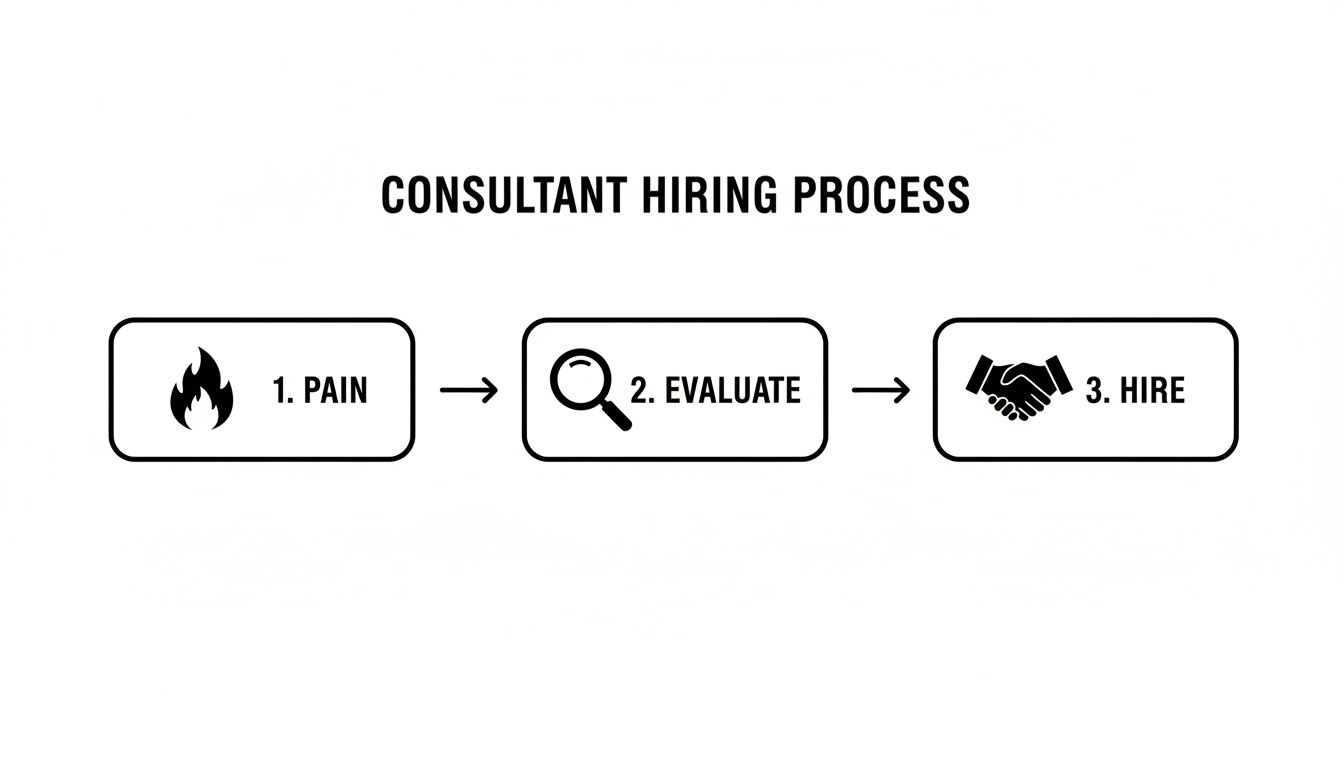
As you can see, a great partnership begins with a well-defined problem, not just a vague desire for a new tool. That focus makes the evaluation sharper and the final outcome much stronger.
Phase 1: Discovery and Assessment
Every engagement kicks off with a discovery phase. Think of it as a diagnostic visit for your entire development lifecycle. The consultant’s first job is to get a deep, honest understanding of your current situation—your people, your processes, and the tools you’re using today.
To do this, they’ll interview everyone from engineers in the trenches to team leads and leadership. They'll map out your existing workflows, warts and all. Expect them to dig into your codebase, review any existing automation, and look at your deployment history. This isn't about pointing fingers; it's about collecting the raw data needed to build an effective plan.
The main takeaway from this phase is a comprehensive assessment report. It benchmarks where you are today against industry best practices and pinpoints the biggest bottlenecks holding you back.
Phase 2: Strategy and Roadmap
With a clear picture of the challenges, the next step is to build a strategic roadmap. This is the blueprint for your transformation. It’s a prioritized, step-by-step plan that shows exactly how you’ll get from where you are now to where you want to be: a state of efficient, automated delivery.
A good roadmap is far more than a list of tools to install. It breaks down the specific changes needed, estimates the effort involved, and connects each step to a tangible business outcome. It’s a living document, built collaboratively with your team to make sure it’s both ambitious and achievable.
The roadmap becomes your single source of truth for the entire project. It gets everyone on the same page about the "what," the "why," and the "how," making sure the work stays on track and delivers real value.
Phase 3: Implementation and Integration
This is where the rubber meets the road. The consultant rolls up their sleeves and works directly with your team to bring the roadmap to life. That might mean setting up new tools, scripting automation pipelines, or weaving automated testing and security scanning right into your workflow.
This phase has to be collaborative. A great consultant doesn't just build things for you; they build them with you. This co-creation is crucial for transferring knowledge and giving your team a sense of ownership from the very beginning. Managing expectations is a two-way street here, and our guide on how to manage client expectations offers some solid frameworks for keeping everyone aligned.
The demand for this kind of hands-on expertise is exploding. The Continuous Delivery market is on track to hit $20.17 billion by 2035, and a big reason is that a staggering 30% of security breaches are caused by misconfigurations—a risk that expert consultants are hired to eliminate. As the continuous integration market grows, it’s clear that bringing in this expertise is no longer a luxury but a core part of driving efficiency and growth.
Phase 4: Team Training and Handover
You could argue this is the most important phase of all. A CI/CD project is only a true success if your team is left stronger and more self-sufficient than when it started. Here, the consultant's focus shifts from building to empowering through training, documentation, and a seamless handover.
This typically includes:
- Workshops and Training: Hands-on sessions to get your team comfortable with the new tools and processes.
- Comprehensive Documentation: Clear, practical guides explaining how the new pipeline works and how to maintain it.
- Pair Programming: Sitting side-by-side with your engineers to solve real-world problems using the new system.
Ultimately, the goal of the handover is to make the consultant unnecessary. By the time the engagement wraps up, your team should have the skills, confidence, and documentation to own, operate, and improve their automated delivery system for the long haul.
Answering Your Questions About Working With a CI/CD Consultant
Bringing in a CI/CD consultant is a big decision, and it naturally comes with questions about cost, how they'll fit in with your team, and what kind of real-world results you can actually expect. Let's tackle some of the most common concerns head-on so you know exactly what to expect from this kind of partnership.
Getting these answers upfront helps clear the air and makes sure you feel confident moving forward.
How Much Does a CI/CD Consultant Cost?
You'll find that hourly rates can swing quite a bit, typically landing somewhere between $150 and over $300. This range really depends on the consultant's depth of experience, how complex your project is, and the length of the engagement.
But focusing only on the hourly rate misses the bigger picture. The smart way to think about it is in terms of Return on Investment (ROI). A great consultant pays for themselves, often very quickly, by cutting out costly manual mistakes, getting your expensive engineers off of repetitive tasks, and dramatically speeding up how fast you get your product to market. The real conversation should always be about the value they create, not just the rate they charge.
What Is the Typical ROI From a CI/CD Project?
The payoff from doing CI/CD right is huge, and you'll see it pop up in a few critical areas of the business. On the financial side, you'll immediately see a drop in costs tied to production downtime, frantic bug fixes, and wasted developer time. It's not uncommon for teams to see deployment failures fall by as much as 60%, which directly pads your bottom line.
Operationally, the biggest win is pure speed. Teams that used to sweat through stressful, quarterly releases can shift to deploying multiple times a day without breaking a sweat. This kind of agility isn't just a tech metric; it's a massive strategic advantage that lets you react to market shifts and customer feedback faster than the competition.
The real ROI isn't just about shipping code faster; it's about building a more resilient, efficient, and innovative organization. This newfound speed and stability become a core competitive advantage that fuels long-term growth.
Will a Consultant Disrupt My Existing Team?
This is a totally fair question, and one we hear a lot. A professional CI/CD consultant is there to be a partner and a coach, not a disruptor. Their job is to work alongside your developers, share their knowledge, and build solutions with them. They’re there to lift your team up, not to replace them or hand down orders.
The true measure of a successful project is what your team can do after the consultant is gone. They should be left with sharper skills, better tools, and smoother processes that they feel confident owning and improving on their own. The goal is to build a self-reliant, high-performing engineering culture, not a permanent dependency on outside help.
Can CI/CD Principles Automate Other Business Areas?
Yes, absolutely. This is where the value of a consultant can ripple out far beyond your engineering department. The fundamental ideas behind CI/CD—automation, consistency, and getting fast feedback—can be applied to just about any business process that's repetitive and follows a set of rules.
Think about it. These same concepts can be used to create automated workflows for things like:
- Lead Generation: Automatically moving leads through your sales funnel without manual nagging.
- Client Onboarding: Giving every new customer a flawless, consistent onboarding experience.
- Recruitment Pipelines: Automating the initial screening and communication for job applicants.
- CRM Management: Keeping your customer data clean and up-to-date without someone having to type it all in.
By bringing this automation-first mindset to the whole company, a CI/CD consultant can help you build a genuinely efficient and scalable business from top to bottom.
Ready to transform your development process and unlock scalable growth? MakeAutomation specializes in implementing the automation frameworks that B2B and SaaS businesses need to thrive. We build the systems that eliminate manual bottlenecks, allowing you to focus on innovation. Learn more about our approach.