
How to Nurture Leads: Proven Strategies for Revenue Growth
Effective lead nurturing is all about connecting with your audience, delivering content that actually matters to them across different channels, and using smart automation to keep the process running smoothly. Done right, this turns mild curiosity into genuine, sales-ready conversations by building trust and proving your value over time.
Why Your Nurturing Strategy Is Costing You Revenue

Lost revenue often hides in plain sight. It’s sitting in that gap where potential customers are interested but just not ready to buy. Lead nurturing is the bridge you build across that gap, forming real relationships with prospects who aren’t purchasing today but are absolutely your ideal customers for tomorrow.
In the B2B and SaaS space, buyers do their homework. They might interact with up to eight different touchpoints before they even think about talking to a sales rep. If you’re not there to guide that journey, you’re missing out on a massive—and often invisible—opportunity.
This guide treats lead nurturing not as just another marketing task, but as the critical revenue engine it should be. We’ll show you how to use automation not to sound like a robot, but to scale personal, human-like experiences that connect with your prospects.
By automating the right touchpoints, you free up your team for the high-value, human conversations that ultimately close deals. It's about working smarter, not just harder, to build a predictable pipeline.
The Real Cost of Neglecting Leads
The financial hit from a weak or nonexistent nurturing process is staggering. We’ve seen that companies that get lead nurturing right boost their sales by a massive 65%. This single stat shows just how powerful a solid strategy can be for any business trying to scale its growth.
Here’s a hard truth: a shocking 79% of marketing leads never convert into sales, and the main culprit is a lack of consistent nurturing. This makes sense when you consider that many B2B sales cycles are long and complicated. In fact, 48% of businesses say most of their leads require 'long cycle' nurturing with multiple decision-makers involved. Patience and persistence really do pay off here. You can dig into more compelling lead nurturing statistics to get the full picture.
Without a system to stay top-of-mind, you’re essentially just handing future deals over to your competitors.
From Task to Revenue Engine
So, how do we turn this cost center into a source of predictable income? It starts with a shift in both mindset and method.
Go Beyond Random Acts of Marketing: Ditch the one-off email blasts. Instead, build cohesive, multi-step journeys that guide leads logically from one stage to the next.
Embrace Scalable Personalization: Use the data you have—like job titles, company size, and website behavior—to send content that speaks directly to a lead’s specific problems and goals.
Connect Your Channels: A great strategy doesn't live in email alone. It should be integrated with platforms like LinkedIn to create a unified and professional experience for your prospect.
By putting a structured framework in place, you transform lead nurturing from a reactive follow-up task into a proactive system for growth. It’s the difference between hoping for revenue and building a machine that reliably generates it.
Building Your Foundation with Smart Lead Segmentation
Before writing a single email or making a call, you have to know who you're talking to. Blasting the same generic message to your entire list is a surefire way to get ignored, unsubscribed, and ultimately, nowhere.
This is where smart segmentation comes in. It’s not about just organizing contacts; it’s about understanding them. By grouping leads into meaningful buckets, you can make every single interaction feel relevant and personal. For any B2B or SaaS business, this is the bedrock of an effective nurturing strategy.
Moving Beyond Basic Demographics
A name and an email are just the starting point. The real magic happens when you start layering different types of data to build a complete picture of your lead. Think of it like putting together a puzzle—each piece of information gives you a clearer view of their needs, challenges, and potential fit for your product.
Let's look at the most critical data points we use to segment leads.
- Firmographics: First, look at the company level. Is this lead from a scrappy startup or a huge enterprise? What industry do they operate in? A pitch that works for a 10-person marketing agency will completely miss the mark with a 5,000-employee corporation in the healthcare space.
- Demographics: Next, zoom in on the individual. A CTO cares about security and integration, while a marketing manager is focused on ROI and campaign performance. Segmenting by job title and seniority helps you speak directly to their unique pain points.
- Technographics: This is a goldmine for SaaS companies. What tools are they already using? Knowing their tech stack—like their CRM, analytics platform, or project management software—lets you frame your product as the perfect integration or a much-needed upgrade.
- Behavioral Data: This is where you separate the curious from the committed. What have they actually done on your website? Did they download a top-of-funnel ebook, or have they watched three different product demos? Someone who keeps coming back to your pricing page is sending a very different signal than someone who just reads a blog post.
A lead who downloads a "Beginner's Guide" needs a completely different conversation than one who requests a "Pricing Comparison" sheet. Behavioral data lets you meet them exactly where they are.
Introducing a Practical Lead Scoring Model
Once your segments are defined, lead scoring puts them into action. It’s a simple but powerful system: you assign points to different lead attributes and actions to quantify their sales-readiness. This automatically surfaces the hottest leads, telling your sales team exactly where to direct their energy.
A straightforward scoring model could look something like this:
| Attribute or Action | Points Assigned | Rationale |
|---|---|---|
| Job Title: C-Level/Director | +15 | This person has decision-making authority. |
| Company Size: 50-200 Employees | +10 | They fit your ideal customer profile. |
| Page View: Pricing Page | +10 | A strong signal of purchase intent. |
| Action: Demo Request | +25 | The clearest sign of a sales-ready lead. |
| Email Domain: Generic (e.g., Gmail) | -5 | Often indicates lower-quality or non-business leads. |
This isn't a "set it and forget it" system. It’s a living tool that turns a messy database into a prioritized work queue.
When a lead’s score hits a certain number—let’s say 75 points—they are officially considered a Marketing Qualified Lead (MQL). That’s the trigger. This is the handoff moment when you can confidently pass the lead to sales, knowing they’re warmed up and ready for a real conversation.
For a closer look at this process, check out our guide on advanced customer segmentation strategies and how to apply them across your entire business.
Designing a Multi-Channel Nurture Sequence That Actually Converts
Okay, so you've got your leads sorted and scored. Now for the fun part: building the engine that actually turns those prospects into customers. This is where your strategy gets real. A powerful nurture sequence isn’t just an email blast—it’s a carefully planned, multi-channel journey that feels personal and genuinely helpful.
Let's be honest, the old-school, email-only approach just doesn't cut it anymore. Your buyers are on LinkedIn, they’re on calls, they’re everywhere. Your nurturing has to be, too. The real goal here is to create a seamless experience where every touchpoint builds on the last, gently guiding prospects toward a solution without ever feeling like you're cornering them.
This integrated approach is no longer optional. While 78% of B2B marketers are successfully using content to nurture leads, the best ones are looking beyond the inbox. Sure, email is still a workhorse for 69% of marketers, but a solid 67% are also bringing social media into the mix. Building a unified, multi-channel strategy is how you stand out, even though creating that targeted content can be a major challenge. You can dig into more of the data by checking out the full findings on lead generation strategies.
Crafting a Foundational Email Sequence
Email is still the backbone of any solid nurture campaign, but its job has changed. It's not about "just checking in." It’s about delivering real, tangible value every single time you hit send.
Here’s a simple 5-touchpoint email sequence I've seen work time and time again. Feel free to adapt it for your own business.
Email 1: Deliver Instant Value (Day 1)
Your first email is your first impression. It needs to land immediately after they take an action, like downloading your ebook. Don't just send the link and call it a day. Remind them why they wanted it in the first place and add a quick, related tip that gives them even more value right away.Email 2: Share a Relatable Case Study (Day 4)
Nothing builds trust like social proof. Find a short story or a case study about a company they can relate to. Frame it simply: "Customer X was struggling with [the same problem you have], so they tried [our solution], and here’s the [amazing result] they got."Email 3: Tackle a Common Objection (Day 8)
Get ahead of their doubts. What are the common questions or roadblocks that keep people from taking the next step? Use this email to address one of those objections directly. By offering helpful advice, you show transparency and position yourself as an expert they can trust.Email 4: The 'Soft' Webinar or Event Invite (Day 12)
Instead of going straight for the demo, try a lower-commitment offer. Invite them to something that provides value, like a practical webinar or an industry Q&A session. It's another chance for them to learn from you without feeling the pressure of a sales call.Email 5: The Gentle Call-to-Action (Day 17)
The final email in this initial sequence can be a soft ask. Acknowledge the resources they've seen and simply ask if they're open to a brief chat to see if there's a fit. You're opening a door, not shoving them through it.
Layering in LinkedIn for a Cohesive Touch
Email alone is good, but it's so much better when you reinforce it on other channels. This is where LinkedIn comes into play. It’s the perfect place to add a human, one-on-one element to your automated sequence. But context is everything.
The right time to connect is after a lead has shown some interest—maybe after they’ve engaged with your second or third email. That’s your trigger. Don’t send a generic connection request. Make it count by referencing what they did.
LinkedIn Connection Request Template:
"Hi [First Name], I saw you downloaded our guide on [Topic]. I'm a specialist in that area at [Your Company] and wanted to connect. Hope you found the guide useful!"
This approach does two things beautifully:
- It puts your brand in front of them in a completely different, more personal context.
- It makes the whole interaction feel less like a faceless automation and more like a genuine outreach from a real person.
Once they accept, you can follow up a few days later by sharing another helpful article or asking a thoughtful question about their work. Keep it natural, not salesy. If you want to dive deeper into structuring these kinds of multi-step plays, check out our guide on sales cadence best practices.
Integrating Strategic, Human-Touch Phone Calls
Automation gets you efficiency, but real human interaction is what closes deals. Not every lead warrants a phone call, of course, but your high-intent prospects absolutely do. This is where your lead scoring model becomes your sales team's best friend.
You should have a workflow in your CRM that triggers a task for a sales rep the moment a lead’s score crosses a certain threshold (say, 75 points). This usually happens when they take an action that screams "I'm interested!"
What are some of these high-intent actions?
- Visiting your pricing page more than once.
- Downloading a bottom-of-funnel resource like a buyer's guide.
- Requesting a demo or signing up for a trial.
When your rep makes that call, they aren't flying blind. They have the lead's entire history at their fingertips—the emails they’ve opened, the links they’ve clicked, the content they’ve consumed. This context makes the conversation instantly warmer and more relevant. The call isn't about a hard pitch; it's about understanding their needs and genuinely trying to help.
Automating Your Nurturing Engine with CRM Workflows
Your multi-channel strategy is a great blueprint, but it’s time to start building. This is where your CRM stops being just a database and becomes the automated engine that drives consistent follow-up and predictable growth. We’re moving from theory to practice.
Think about it: a mere 2% of B2B website traffic turns into leads. That means a staggering 98% of your visitors vanish unless you have a smart way to nurture them. And yet, a shocking 26% of companies admit they have no lead nurturing plan at all.
The fix is automation, especially when you bring in powerful channels like LinkedIn, which is known to generate up to 80% of B2B leads for teams that use it right.
Building Your First Automation Workflow
Let’s see how this works in the real world. Imagine a new lead, "Alex," signs up for your webinar. Instead of their name just landing on a static spreadsheet, their submission instantly kicks off a workflow in your CRM. This is where the "if/then" logic you’ve designed comes to life.
Here’s a practical look at how that might unfold in a CRM like HubSpot:
- Trigger: A new contact is created, and the lead source is "Webinar Registration."
- Action 1 (Segmentation): The CRM automatically adds a "Webinar Attendee" tag and enrolls Alex in your "Post-Webinar Nurture" email sequence.
- Action 2 (Scoring): The system sees Alex’s title is Director of Marketing (a key persona for you) and automatically adds +15 points to their lead score.
This all happens in seconds, without a single person on your team lifting a finger. Alex is now segmented, scored, and already on the right nurture path, getting that first piece of relevant content almost immediately. That kind of instant, personalized response is what effective lead nurturing is all about.
This process isn't just about email anymore. It's a coordinated effort across multiple channels.
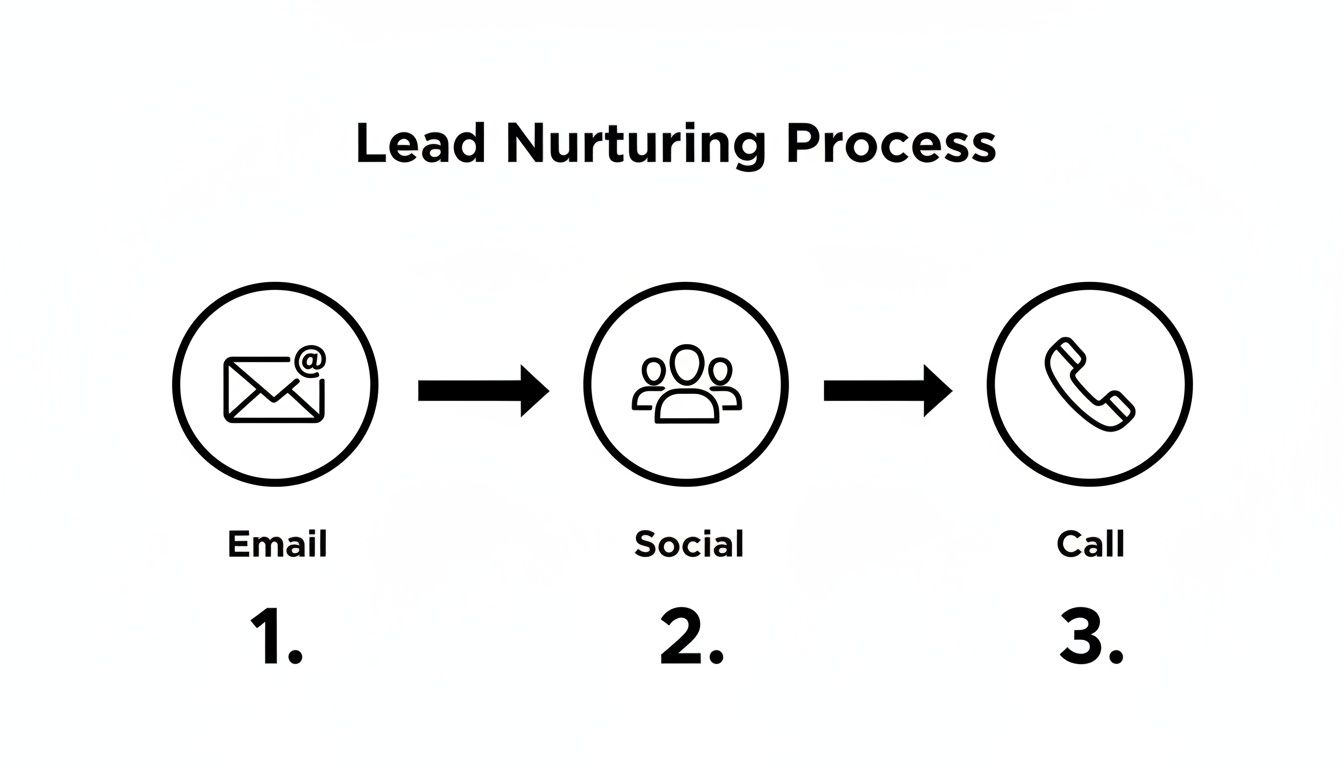
As you can see, a modern nurture sequence is a journey that meets your leads wherever they happen to be, whether it’s their inbox, their LinkedIn feed, or a phone call.
Using If/Then Logic for Smarter Actions
The true magic of CRM workflows lies in conditional logic. Your automation shouldn't be a one-way street; it needs to be a dynamic system that reacts to what your leads actually do.
Let's stick with Alex. A few days later, they click a link in one of your nurture emails that takes them to your pricing page. This is a huge buying signal. The system sees this and adds another +10 points to their score. Alex is now at 75 points—your MQL threshold.
This is the critical handoff moment. When a lead’s score crosses that threshold, it’s the trigger that bridges the gap between marketing automation and a real conversation with sales.
The "if/then" logic in your CRM immediately springs into action:
- IF lead score is greater than 74,
- THEN create a high-priority task for a sales rep.
The task that lands in the sales rep's queue isn't just a name. It’s full of context: "Connect with Alex on LinkedIn. They attended our webinar and just viewed the pricing page. Lead score: 75." Now your sales team can have a relevant, timely conversation.
Creating SOPs for Consistency and Scale
Automation tells your team when to act. Standard Operating Procedures (SOPs), on the other hand, tell them how. SOPs are your guardrails, ensuring every sales-ready lead gets the same high-quality follow-up, no matter who on the team picks it up.
Your SOP for this handoff should be simple, clear, and non-negotiable:
- Rule: All MQLs from the "Post-Webinar Nurture" must be contacted within 4 business hours.
- Action 1: Send a personalized LinkedIn connection request using the pre-approved template.
- Action 2: Log the connection request as a new activity in the CRM.
- Action 3: If the connection is accepted, follow up with a brief, non-salesy message within 24 hours.
As you build out this automated engine, consider a VoIP CRM integration to automatically log calls and sync all communication. This keeps your CRM as the single source of truth, giving your team the full story behind every interaction.
And if you’re looking for a deeper dive into email sequences specifically, our guide on creating automated email marketing campaigns is a great place to start.
Measuring Performance and Optimizing Your Campaigns
Once your nurture sequences are live, the real work isn't over—it's just getting started. Now it's time to figure out what's actually working and what's falling flat. Running campaigns without measuring their performance is like flying blind; you’re burning time and money on guesswork.
A great nurturing strategy is never "set and forget." Think of it as a living, breathing system that needs regular check-ups and adjustments. The key is to look past vanity metrics and zero in on the numbers that actually impact your bottom line.
Identifying KPIs That Actually Matter
To get a true pulse on your nurturing efforts, you need to track the right data. These metrics tell a story about how your leads behave as they move through the funnel and, more importantly, where you can step in to improve their journey.
Here’s a breakdown of the key metrics to track to measure the effectiveness of your lead nurturing campaigns and identify areas for optimization.
Essential KPIs for Lead Nurturing Success
| KPI | What It Measures | Why It Matters |
|---|---|---|
| Stage-to-Stage Conversion Rates | The percentage of leads moving from one funnel stage to the next (e.g., MQL to SQL). | A low MQL to SQL conversion rate often signals a disconnect between marketing's definition of a "qualified" lead and what the sales team actually needs to close a deal. |
| Sales Cycle Length | The time it takes for a nurtured lead to become a customer compared to a non-nurtured lead. | Effective nurturing accelerates the buying process by delivering the right info at the right time. A shorter cycle for nurtured leads is a clear win. |
| Revenue Attribution | The total revenue generated from leads that went through your nurture campaigns. | This is your ultimate proof of ROI. When you see that nurtured leads make 47% larger purchases, connecting your efforts directly to revenue becomes incredibly powerful. |
These are the numbers that give you a real, tangible picture of what’s working. For a deeper dive into performance metrics, especially in customer-facing roles, you can find some great insights in this article on how to measure and improve Call Center KPIs.
Adopting a Data-Driven Optimization Mindset
With your key metrics in hand, it's time to start experimenting. This is where you transform a good strategy into a revenue-generating machine. The most effective way to do this is through simple, consistent A/B testing.
A/B testing is nothing more than testing one change at a time to see what your audience prefers. You can test almost anything—from a subject line to the color of a CTA button—to slowly but surely improve engagement.
A/B testing isn't just about finding a "winner." It's about learning what your audience responds to, which helps you refine your messaging and build a stronger connection with every interaction.
Let’s imagine a common scenario. Your team just launched a new nurture email with a fantastic case study, but the click-through rate is dismal. Instead of shrugging it off, you can use A/B testing to diagnose the problem.
First, you need a hypothesis. What do you think is wrong? Maybe the subject line, "New Case Study Available," is too generic. Your hypothesis could be: "A benefit-driven subject line will grab more attention and drive more clicks."
Next, you run the test. You create a second version of the email with a new subject line, something like, "See How [Competitor's Industry] Companies Are Cutting Costs." Send Version A (the original) to half of your segment and Version B (the new one) to the other half.
After a few days, analyze the results. Did the new subject line produce a statistically significant lift in open and click-through rates? If so, you have a winner.
Finally, you implement the change and iterate. The winning subject line becomes your new control, and you move on to the next test. Perhaps this time you test the CTA button copy or the opening line of the email body. This continuous cycle of testing and optimizing is how you achieve incremental gains that compound into massive improvements over time.
Even with the best-laid plans, a few common questions always pop up when you start putting a lead nurturing strategy into practice. Let's tackle some of the hurdles I see most often.
How Long Should a Nurture Sequence Be?
This is the million-dollar question, isn't it? While there’s no universal answer, a solid benchmark for most B2B and SaaS companies is 5-7 touchpoints spread over 2-4 weeks. The real trick is to stop thinking about a generic timeframe and start mirroring your own sales cycle.
If you're selling a complex, six-figure enterprise solution, your sequence will naturally need to be longer. Think months, not weeks, with a focus on high-value, spaced-out content. On the other hand, for a simpler SaaS tool with a shorter sales cycle, a more condensed and intense sequence often gets better results.
My advice? Start with a baseline, then watch your data like a hawk.
- Getting a lot of unsubscribes? You’re probably coming on too strong. Ease up on the frequency.
- Seeing a big drop-off after the second or third email? That's a sign your later content isn't hitting the mark. It's time to rethink your value proposition at that stage.
What Is the Difference Between Lead Nurturing and Email Marketing?
This one trips up a lot of people. The simplest way to put it is that email marketing is a tool, while lead nurturing is the strategy that uses that tool (and others).
Sending a one-off newsletter to your entire contact list? That's email marketing. But an automated, multi-step sequence that kicks off when a prospect downloads your ebook? That's lead nurturing.
Nurturing is always triggered by a specific behavior, it's highly segmented, and it often goes beyond just email to include channels like LinkedIn or even a well-timed phone call. All lead nurturing involves email marketing, but not all email marketing is true, strategic nurturing. It’s the difference between shouting into a crowd and having a guided conversation.
Think of it this way: Email marketing is like sending a postcard to everyone you know. Lead nurturing is like sending a series of personalized letters based on a conversation you've already started.
How Do I Align Sales and Marketing for Better Nurturing?
I've seen more nurturing strategies fall apart from a lack of sales and marketing alignment than for any other reason. Getting this right is non-negotiable, and it all begins with shared goals and a common language. Both teams absolutely have to agree on the precise definitions of a Marketing Qualified Lead (MQL) and a Sales Qualified Lead (SQL), which should be directly tied to your lead scoring model.
The next step is to formalize this handshake with a Service Level Agreement (SLA). This document isn't just corporate jargon; it's a written pact that turns vague intentions into concrete, measurable commitments.
Example SLA Commitments:
| Team | Commitment Example |
|---|---|
| Marketing | Deliver 50 MQLs per month that meet the agreed-upon scoring threshold of 75+ points. |
| Sales | Follow up with every MQL from marketing within 24 business hours. |
Finally, you need a regular meeting—weekly or bi-weekly—to review performance. This creates a feedback loop. Is lead quality dipping? Are sales reps struggling with the follow-up? These meetings ensure both teams are working from a single source of truth (your CRM) and rowing in the same direction: driving revenue.
At MakeAutomation, we live and breathe this stuff. We specialize in designing and implementing these sophisticated automation frameworks for B2B and SaaS businesses. If you're ready to stop guessing and turn your lead nurturing into a predictable revenue engine, explore how our expert services can help you scale.