How to Optimize Sales Funnel for B2B Growth
Think of your sales funnel not as a single process, but as a series of crucial handoffs. Optimizing it is all about systematically finding where you're dropping the ball, making targeted fixes, and then testing everything to make sure you're actually improving conversions. The whole idea is to figure out where potential customers are slipping through the cracks and plug those gaps for good.
Why Your B2B Sales Funnel Is Quietly Losing Money
It’s a story I’ve seen play out dozens of times with B2B and SaaS companies. You've got a steady stream of leads, your sales team looks busy, but the revenue just isn't climbing the way it should. The culprit is rarely one big, obvious problem. It's almost always a collection of small, nearly invisible leaks that quietly bleed profit from your funnel. These little drop-offs have a compounding effect, creating a massive revenue gap by the time a lead reaches the finish line.
Let's walk through a real-world scenario. A SaaS founder I worked with was pulling in 1,000 MQLs a month. A seemingly harmless 5% drop-off at the demo booking stage didn't ring any alarm bells. Another small 10% leak during the follow-up process felt like just the cost of doing business. But then they lost another 15% before the proposal stage.
When we tallied it up, the cumulative effect was staggering. Those "minor" leaks had combined to wipe out hundreds of qualified leads before they even had a chance to see a contract.
The Compounding Cost of Small Inefficiencies
This is exactly why fine-tuning your sales funnel isn't just a "nice to have" — it's how you reclaim lost revenue. Every single percentage point you claw back goes straight to your bottom line. These leaks usually come from a few common, costly mistakes:
- Slow Lead Response Times: If you're not getting back to a lead within the first hour, you're watching your qualification rates fall off a cliff.
- Vague Nurturing Content: Blasting out generic emails that don't speak directly to a prospect's pain points is a surefire way to kill their interest.
- Friction in the Sales Process: Is your demo booking tool a pain to use? Is the proposal process clunky? Anything that makes it hard for an interested buyer to move forward will push them away.
By diagnosing and fixing these seemingly small issues, you stop just running a sales process and start engineering a predictable growth engine. The goal is to make smart, data-backed improvements that turn your funnel into your company's most valuable asset.
This approach is the heart of data-driven decision-making. Instead of relying on gut feelings, you use real analytics to guide your strategy. If you want to dive deeper, our guide on what is data-driven decision-making is a great starting point. By adopting this mindset, you can pinpoint exactly where your money is leaking out and put permanent fixes in place. This article is your roadmap for doing just that—moving from diagnosis to real, sustainable improvements.
Conducting a Data-Driven Funnel Audit to Find Your Leaks
Before you can fix your sales funnel, you have to play detective. The real goal here is to pinpoint exactly where potential customers are "leaking" out of the process before they buy. A data-driven audit isn't about hunches or guesswork; it's about digging into the hard numbers in your CRM and analytics tools to find the biggest drop-off points.
Honestly, this audit is the foundation for everything else you'll do. Without this clarity, you're just shooting in the dark, wasting time and money fixing minor issues while a massive hole drains your revenue. Think of it as a diagnostic for your sales process—it tells you exactly where to focus your energy for the biggest impact.
Even small leaks at each stage can add up, creating a huge revenue gap between the leads you generate and the deals you close.
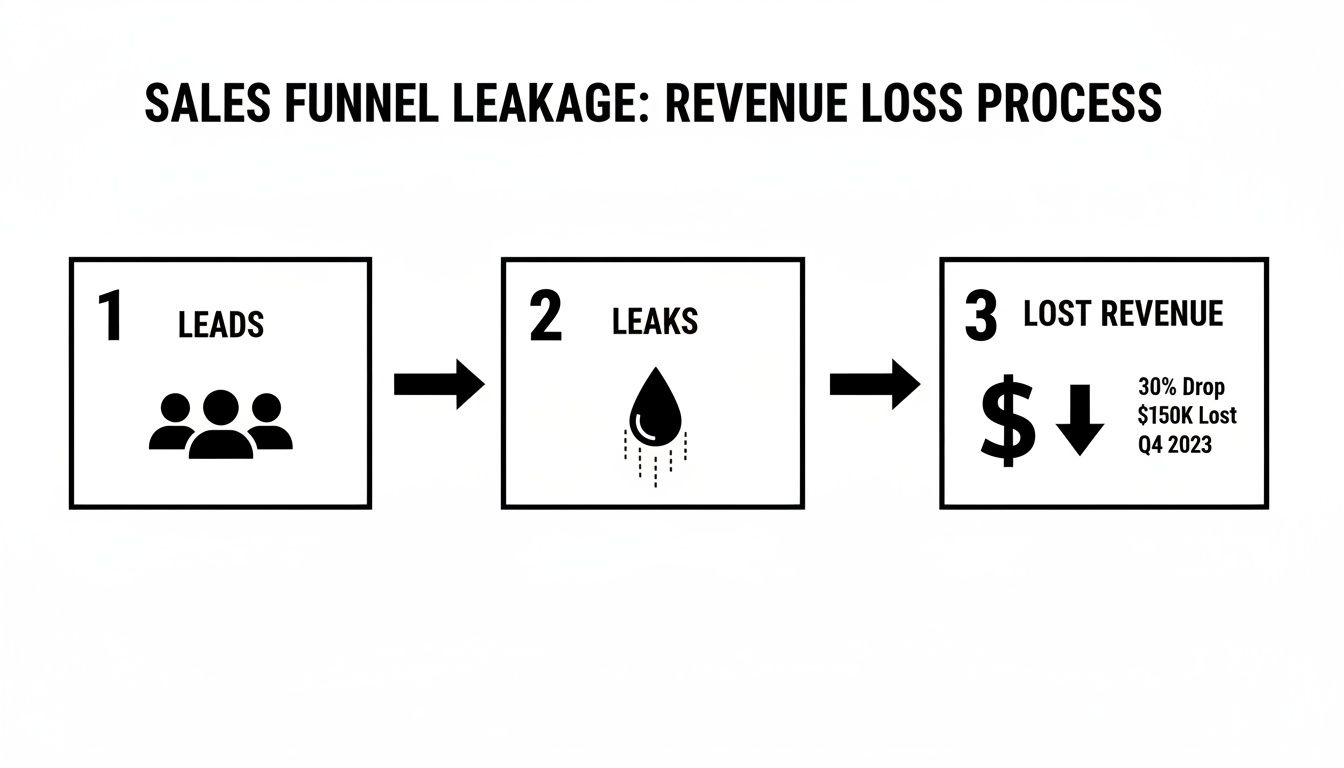
As you can see, it's the cumulative effect of these small drips that really stalls growth.
Map the Real Customer Journey With Data
First things first: you need to trace the actual path a customer takes, from their very first click to signing a contract. Don't just rely on what you think the journey is. Get into your data and prove it. Pull reports from Google Analytics, your CRM (like HubSpot or Salesforce), and any marketing automation tools you use.
The goal is to map out your core stages and, most importantly, calculate the conversion rate between each one. For a lot of B2B SaaS companies, that path looks something like this:
- Website Visitor to Lead: How many people who land on your site actually fill out a form or start a trial?
- Lead to Marketing Qualified Lead (MQL): Of those new leads, how many meet your basic criteria (e.g., right company size, industry, title)?
- MQL to Sales Qualified Lead (SQL): How many of those MQLs does your sales team accept and agree are worth pursuing?
- SQL to Demo/Meeting: What percentage of those accepted leads actually get a meeting on the calendar?
- Meeting to Proposal: After a demo, how often do you get to the proposal stage?
- Proposal to Closed-Won: What's your final close rate on deals that receive a proposal?
Once you have these numbers, the weak spots become obvious. The transitions with the lowest percentages are your biggest, most urgent leaks.
Anchor Each Stage with a Key Performance Indicator
With your journey mapped out, it's time to assign specific KPIs to every stage. This is how you turn a vague flowchart into a measurable dashboard. Vague goals like "get more demos" are useless here; you need concrete metrics to know if you're making progress.
The core principle of a funnel audit is simple: what gets measured gets managed. By assigning a primary KPI to each stage, you create a clear scorecard for your sales and marketing efforts.
The right metrics take the emotion and office politics out of the conversation. The data tells the story of what’s working and what isn’t, giving you a clear, objective guide for where to optimize.
To get started, you need to understand which metrics matter most at each part of the funnel.
Key Sales Funnel Stages And Their Core KPIs
This table breaks down the essential metrics you should be tracking to identify performance gaps in a typical B2B/SaaS funnel. It gives you a clear starting point for what to measure and what "good" looks like.
| Funnel Stage | Primary KPI | What It Measures | Industry Benchmark |
|---|---|---|---|
| Awareness (TOFU) | Cost Per Lead (CPL) | The average cost to acquire one new lead from a specific channel. | $150 – $400 |
| Consideration (MOFU) | Lead-to-Opportunity Rate | The percentage of leads that become qualified sales opportunities. | 10% – 25% |
| Decision (BOFU) | Close Rate | The percentage of qualified opportunities that become paying customers. | 20% – 30% |
| Overall Funnel | Customer Lifetime Value (LTV) | The total revenue a single customer is expected to generate. | 3x+ your CAC |
While these benchmarks are a helpful guide, your most important comparison is always your own historical data. The goal should be constant, steady improvement against your own baseline.
Let Automation Spot the Trends for You
Look, manually pulling all these reports every week is a surefire way to drive yourself crazy. It’s tedious and easy to mess up. This is where automation becomes your best friend in a funnel audit.
In fact, teams that automate their sales funnel analysis see a 15-25% revenue uplift while cutting down the manual grunt work by a staggering 80%. Yet somehow, 68% of companies still don't have a defined, tracked funnel, leaving all that potential growth on the table. If you want to dive deeper, you can learn more about automating funnel analysis to boost revenue.
Using tools with built-in visual funnel charts and cohort analysis can help you spot opportunities that you'd completely miss in a spreadsheet. They let you slice and dice your data by channel, campaign, or lead source to see what's really working, giving you the insights you need to optimize your funnel effectively.
Attracting High-Quality Leads at the Top of Your Funnel
Every great sales funnel is built on a foundation of high-quality ingredients. It’s easy to get caught up in chasing a huge volume of leads, but the real secret to a high-performing funnel is attracting prospects who are a genuinely good fit right from the start.
When you pour low-quality leads into the top, you just create headaches down the line. Your sales team wastes time on dead-end calls, and your conversion rates suffer at every single stage. The focus has to shift from sheer quantity to undeniable quality.

Optimize Landing Pages for Intent, Not Just Clicks
Your landing page is often the very first meaningful interaction a prospect has with your brand. Get it wrong, and you’ve lost them. Instead of a generic "Contact Us" form, you need to create specific, high-value landing pages tailored to different campaigns, keywords, and audiences.
Think about it: someone searching for "B2B project management software for agencies" is way further down the buying path than someone looking for "project management tips." The landing page for that first searcher has to immediately show them they’ve found what they're looking for.
Here’s how to dial in your landing pages:
- Match the Message to the Ad: Your landing page headline should be a near-perfect mirror of the ad copy that brought them there. It’s a simple trick, but it instantly reassures visitors they're in the right place.
- Flash That Social Proof: Show off testimonials or logos from companies that look just like them. For that agency prospect, feature quotes from other agency owners who love your product.
- Keep the Form Simple: Only ask for what you absolutely need right now. A shorter form almost always converts better. That said, consider adding one optional qualifying question (like "Company Size" or "Biggest Challenge") to help you segment leads from the get-go.
Create Lead Magnets That Pre-Qualify Prospects
Generic lead magnets like simple checklists might get you a lot of email addresses, but they don't necessarily attract actual buyers. If you want higher-quality leads, your content needs to solve a deeper, more specific problem—one that’s directly tied to the pain your product solves.
Stop thinking "10 Tips for Better Marketing." Start thinking about an in-depth whitepaper like "A Financial Model for Calculating the ROI of Marketing Automation in SaaS."
Sure, the second one will get fewer downloads. But every single person who downloads it is a much, much more qualified prospect. This approach naturally weeds out the tire-kickers.
The best lead magnets act as a filter. They should be so specific and valuable to your ideal customer that they actively repel people who are a poor fit.
This is a cornerstone of the most effective SaaS lead generation strategies—focusing on attracting prospects who are already problem-aware and hunting for a solution like yours.
A Quick Story: Shifting From Cold Outreach to Warm Referrals
I once worked with a B2B agency that was burning through thousands a month on cold email campaigns. They generated hundreds of "leads," but their sales team was completely demoralized from low-quality calls that went nowhere. Their lead-to-close rate was just abysmal.
We hit pause on all cold outreach and rolled out a simple, structured referral program targeting their happiest clients. The change was immediate. While the raw number of incoming leads dropped by a whopping 70%, the quality went through the roof.
These new leads came in already convinced of the agency's value. The sales cycle shrank dramatically, and their close rate on these referral leads was nearly 4x higher than what they ever saw from cold emails.
This little story highlights a powerful truth: where your leads come from matters immensely. Focusing on high-quality sources at the top of the funnel has a massive ripple effect. For instance, data shows referral leads convert at an impressive 25.56%, blowing cold calling's 9.38% out of the water. Even better, companies that get this right see deal sizes that are 102% higher. Prioritizing quality from the start creates a more efficient and profitable machine.
Using Automation to Nurture and Qualify Leads
So, you’ve captured some high-quality leads. Great. But the real work is just beginning. You're now in the middle of the funnel—a critical, and often treacherous, stage where most prospects simply disappear. Your job here is to use smart automation to build a relationship and guide potential customers toward a decision, all without burying your sales team in manual follow-ups.
This is where you turn lukewarm interest into genuine sales intent. Without a solid system for nurturing and qualifying, you're essentially pouring your best leads into a leaky bucket. This isn't just about sending a few emails; it's about delivering the right message at the right time, based on what your leads are actually doing.
The numbers here are sobering but essential to understand. A staggering 79% of marketing leads never convert into sales, and the main culprit is a lack of effective nurturing. On the flip side, companies that get this right generate 50% more sales-ready leads at a 33% lower cost. Get this middle stage right, and the ROI is massive. Get it wrong, and you lose all momentum.
Implement Behavior-Triggered Email Sequences
Generic, one-size-fits-all email blasts are the fastest way to land in the trash folder. The real key to effective nurturing is using automation to respond to specific actions a lead takes. This is what makes your communication feel relevant and timely, not spammy.
Think about it this way: a lead downloads your whitepaper on "AI for Project Management." Instead of just a generic "thanks for your download" email, a behavior-triggered sequence kicks in automatically:
- Day 1: An email delivers the whitepaper but also highlights a key finding that’s especially relevant to their industry.
- Day 3: A second email invites them to watch a case study video showing how a similar company solved a specific project management bottleneck with your tool.
- Day 7: If they watched the video, they get an invite for a personalized demo. If not, they receive a different piece of content, like a blog post on common PM challenges.
This level of personalization shows you’re paying attention. It makes your outreach feel helpful, not pushy. If you want to get into the nitty-gritty of setting this up, we have a guide on https://makeautomation.co/automated-email-marketing-campaigns/ that walks through the practical steps.
Use Lead Scoring to Prioritize Your Hottest Leads
Let's be honest: not all leads are created equal. Lead scoring is how you automatically separate the window shoppers from the serious buyers. It's a system that ranks prospects based on who they are (demographics) and how they engage with your content (behavior), allowing your sales team to focus their energy where it actually counts.
Here’s a simplified look at how it might work in practice:
- +10 points for visiting the pricing page.
- +5 points for opening a marketing email.
- +20 points for requesting a demo.
- -5 points if they haven't engaged in 30 days.
Once a lead hits a certain threshold—let's say 50 points—they are automatically flagged as a "Sales Qualified Lead" (SQL) and routed to a sales rep. This is absolutely crucial for ensuring your team is always talking to the most engaged, sales-ready prospects first. For more ideas on this, check out these 7 Tips to Automate Your Sales Funnel for Higher Lead Conversion.
Leverage AI for Initial Follow-Ups and Scheduling
Even with perfect lead scoring, the initial follow-up and appointment setting can still create a major bottleneck. This is where AI-powered tools have become a game-changer, especially for growth-stage teams trying to scale their sales funnel.
AI assistants can handle the tedious back-and-forth of scheduling, ensuring that no qualified lead ever slips through the cracks because a sales rep was too busy to follow up immediately.
These tools can engage with new SQLs via email to find a good time for a call, compare everyone's calendars, and send meeting invites automatically. This doesn't just cut down your response time; it frees up your sales reps to spend more time actually selling and less time bogged down in admin tasks. It’s how you turn your middle funnel into a highly efficient qualification machine.
Getting the Deal Over the Finish Line: Bottom-of-Funnel Conversion
You’ve put in the work. You’ve attracted the right people, nurtured their interest, and qualified them as a solid fit. Now for the moment of truth: turning all that potential into signed contracts and paying customers.
This is the bottom of the funnel (BOFU), where deals are won and lost. The smallest bit of friction, a flicker of doubt, or a confusing next step can derail everything. Your entire focus here should be on making the decision to buy from you feel easy, obvious, and completely reassuring.
Make Saying "Yes" an Absolute No-Brainer
Think about the last time you were about to buy something online and just… didn't. Maybe the checkout form was a nightmare, or the pricing was suddenly confusing. Your B2B buyers are exactly the same. The second they decide they’re ready to move forward, any hurdle you put in their way is an invitation to reconsider.
A clunky sign-up form, an opaque pricing page, or too many steps to finalize a purchase can kill a deal on the spot. Every unnecessary field, every extra click, every confusing page is another chance for them to drop off.
Pull up your own checkout or sign-up process right now and walk through it. Ask yourself:
- Is every single form field critical right now? You can get their fax number later (if ever). Ditch anything that isn't essential to get the deal done.
- Is your pricing crystal clear? Any ambiguity about what’s included in a plan breeds distrust. Be painfully transparent.
- Can a motivated buyer get through this in two minutes or less? If not, you're losing people. Period.
At this final stage, your mantra should be zero friction. The final step of committing should feel like the most natural, effortless conclusion to the journey they've taken with you.
Eliminate Final Doubts with Real-World Case Studies
When a prospect is this close to buying, they’re no longer just evaluating your product. They're evaluating the risk of choosing you over a competitor or doing nothing at all. The single best way to dissolve that risk is with undeniable proof from people just like them.
And that means case studies. Not fluffy testimonials, but detailed, relatable stories of success.
A powerful case study doesn’t just say, "Customer X loves us." It mirrors the prospect's own situation. It lays out the specific, nagging problem a similar company faced, and then walks through exactly how your solution fixed it, using real numbers.
For instance, don't say "we boosted their efficiency." Instead, show them: "By implementing our workflow automation, Company XYZ cut their average project completion time from 15 days to 4 days. This saved their team an estimated 20 hours of manual work every single week."
That kind of specific, quantifiable result is what makes your solution feel like a sure thing.
Use Smart Retargeting to Bring Back High-Intent Prospects
Let’s be real: not everyone who gets to the pricing page will convert on the first go. Life happens. They get pulled into a meeting, need to get a final sign-off, or just get cold feet. Strategic retargeting is how you stay in the game.
Don't just let these incredibly valuable prospects drift away. Use retargeting ads to pull them right back in. But this isn't the time for generic brand ads. Your BOFU retargeting needs to be surgically precise.
- Someone visited your pricing page but bailed? Hit them with an ad featuring a powerful testimonial from a customer in their industry.
- They started the sign-up process but didn't finish? Gently remind them of a key benefit they’re about to unlock or even present a small, time-sensitive incentive to finish what they started.
This simple tactic keeps you top-of-mind and provides that final nudge they need to cross the finish line, recovering revenue you would have otherwise lost for good.
Automate Your Closing Workflow in the CRM
Your sales team’s time is gold. The last thing they should be doing when a deal is ready to close is wrestling with admin tasks. A smooth, repeatable closing process, automated within your CRM, ensures every prospect gets a professional and consistent experience.
Set up workflows that trigger automatically when a deal hits the final stage. This could be anything from generating a contract using a pre-approved template, scheduling a final implementation call, or kicking off a welcome email sequence the moment a deal is marked "Closed-Won."
By taking the manual work off their plate, you free up your reps to do what they do best: strengthening relationships and bringing in the next deal.
Building a System for Continuous Funnel Improvement
Let's get one thing straight: a sales funnel is never "finished." It’s a living, breathing part of your business that has to adapt to your market, your product, and your customers. The moment you stop tweaking and testing is the moment you start losing ground.
What we're aiming for here isn't a one-time fix. We're building a culture of constant, disciplined experimentation. This isn't about throwing random ideas at the wall; it’s about a methodical process that starts with a solid, data-backed hypothesis.
Crafting a Strong Testing Hypothesis
A good hypothesis is more than just a guess. It's an educated statement, born from the data you just uncovered in your funnel audit, that follows a simple but powerful structure: "If we change [X], we think it will cause [Y result] because [Z reason]."
For instance, say your audit showed a massive drop-off on your demo request page. A weak idea is, "Let's change the button." A strong hypothesis is:
"If we replace the generic 'Submit' button with a value-driven CTA like 'Show Me My Demo,' we believe it will increase demo bookings by 15% because it clarifies the immediate benefit for the user."
See the difference? This framework forces you to define the problem, propose a specific solution, and pin down a measurable outcome. It’s how you turn vague notions into real experiments with clear success criteria.
Deciding What to A/B Test and Where
With your hypothesis in hand, you know exactly where to focus. Your first A/B tests should target the highest-impact elements at the biggest leak in your funnel. You'd be surprised how often seemingly small tweaks can lead to significant gains.
Not sure where to start? Here are a few high-impact elements I always look at first:
- Headlines and Subheadings: Try pitting a benefit-driven headline against your current feature-focused one. Which one resonates more?
- Call-to-Action (CTA) Buttons: Play with the text, color, and even the placement. Does "Get Started Free" outperform "Sign Up"?
- Landing Page Forms: How many fields are you asking for? Experiment by cutting it down to the bare minimum. A shorter form might just give you the boost in initial conversions you need.
Every test, whether it wins or loses, gives you valuable data. This cycle of testing, learning, and iterating is what drives scalable, long-term growth. To dig deeper into the paid acquisition side of this, check out these Google Ads sales funnel optimization strategies. This is the engine that will keep your funnel performing for years to come.
Got Questions About Sales Funnel Optimization? Let’s Get Them Answered.
Even with the best game plan, you're bound to run into questions once you start digging into your sales funnel. Here are some quick, straight-to-the-point answers to the questions we hear most often from other B2B and SaaS leaders.
What’s a Good B2B Sales Funnel Conversion Rate?
Ah, the million-dollar question. The honest answer? It's complicated. You'll see industry benchmarks for visitor-to-customer conversion floating around 2.9%, but B2B sales cycles are a different beast altogether. A single number just doesn't tell the whole story.
A broad, first-touch-to-close rate of 1-3% is pretty standard. The top players in the space? They can definitely push past 5%.
Instead of obsessing over one big number, focus on the conversion rates between each stage. A healthy funnel usually sees a Lead-to-Opportunity rate of 15-25% and an Opportunity-to-Close rate of 20-30%. Those are the benchmarks that really matter.
How Do AI and Automation Actually Help Optimize a Funnel?
Think of AI and automation as the essential backbone of any modern sales funnel. They’re no longer a “nice to have.” They tackle the tedious, high-volume tasks that humans just can't manage effectively, bringing a new level of speed and consistency to your process.
- Artificial Intelligence (AI) is the brain. It runs predictive lead scoring to surface your best prospects, tailors content to individual users on the fly, and powers smart chatbots for real-time engagement, day or night.
- Automation is the muscle. It’s what sends out personalized nurture emails triggered by specific actions, instantly routes hot leads to the right salesperson, and keeps your CRM spotless without anyone lifting a finger.
The real win here is that these tools free up your team. They can stop doing busy work and focus on what they do best: building relationships, thinking strategically, and closing big deals. It’s a direct path to higher productivity and fewer costly mistakes.
My Funnel Needs Help. Where Do I Start First?
Before you change a single thing, you need to conduct a full audit to find your biggest leak. Don't guess. The data in your CRM and analytics tools will show you exactly where the most prospects are dropping off.
For most B2B companies we see, that critical leak is almost always in one of two places:
- Top of the Funnel (TOFU): The problem is volume or quality. You simply aren't getting enough of the right people into the funnel in the first place.
- Middle of the Funnel (MOFU): Your lead nurturing is falling flat. Qualified prospects are coming in, but they're losing interest and going cold before they ever talk to sales.
Tackle the single biggest bottleneck first. That’s how you’ll get the fastest and most significant lift in revenue.
At MakeAutomation, we build the automated systems that plug these leaks for good. If you're ready to turn your sales funnel into a predictable growth engine, explore how MakeAutomation can help you scale.