
How to Reduce Employee Turnover: Practical Retention Strategies That Work
If you're serious about cutting down employee turnover, you first have to get real about what it's actually costing you. It's so much more than just recruitment fees. The real fix lies in a smart combination of great management, a well-thought-out onboarding process, and clever automation that keeps your best people happy and committed. This isn't just a reactive HR chore; it's a proactive strategy for growth.
Confronting the Real Cost of High Employee Turnover

We often talk about employee turnover in soft terms like "morale" and "culture," but its punch to your bottom line is anything but soft. It's a hard, tangible hit.
Every time someone walks out the door, a silent cash register starts ringing up costs that go way beyond a farewell lunch. This isn't just an HR problem to delegate; it's a financial leak that directly stunts your company's growth. This is especially true in the B2B and SaaS worlds, where your specialized talent is your biggest competitive advantage.
The Visible Financial Drain
Let's start with the easy-to-spot expenses. The direct costs of replacing an employee are hefty and they stack up fast. These are the numbers you can actually see on a report.
- Recruitment Fees: Think agency fees, job board postings, and the ad campaigns you run just to get candidates in the door.
- Interviewing Costs: This is all about time—the cumulative hours your managers, team leads, and execs spend sifting through resumes, conducting interviews, and making decisions. Their time is expensive.
- Onboarding and Training: New hires need equipment, access, and formal training. But the real cost is the ramp-up time it takes for them to become fully productive, a period where your investment is much higher than their output.
Globally, companies lose a jaw-dropping $2.9 trillion annually just from people quitting. The financial sting is sharp: replacing an employee costs anywhere from 30-50% of their salary for entry-level roles, but it can skyrocket to 200-400% for executives. The average cost? A cool $35,700 per departure.
In tech and professional services, you're looking at turnover rates around 1.8-2.0% per month, which works out to a painful 18-20% per year. You can dive deeper into these global talent trends and their financial impact with Mercer.
The Hidden Costs That Cripple Growth
While the direct costs are painful enough, it’s the hidden, indirect costs that often do the most long-term damage. These are the subtle drains you won't find on a spreadsheet, but they can slowly rot your company’s foundation from the inside.
The greatest hidden cost of turnover is the loss of institutional knowledge. When a veteran employee leaves, they take with them years of undocumented processes, customer relationships, and problem-solving experience that a new hire simply can't replicate overnight.
This loss creates a domino effect. Projects stall while the new person gets up to speed, putting deadlines at risk. Your remaining team members get saddled with extra work, leading to burnout and disengagement—which, ironically, can cause even more people to leave.
And let's not forget your customers. When their trusted point of contact suddenly vanishes, it creates instability and opens the door for your competitors to swoop in.
Before we can even think about building a solution, we have to face this head-on: high turnover is a direct threat to your profitability and stability. Fixing it isn't optional. It's a strategic must-do for any business that wants to last.
Key Drivers of Employee Turnover and Initial Solutions
To get started, it helps to see the big picture. Most turnover issues boil down to a handful of core problems. This table gives you a quick snapshot of what’s likely going wrong and where you should focus your energy first.
| Common Turnover Driver | Impact on B2B/SaaS | Initial Strategic Focus |
|---|---|---|
| Poor Management | Ineffective managers kill productivity, innovation, and team morale, directly impacting project timelines and client satisfaction. | Invest heavily in manager training focused on coaching, feedback, and emotional intelligence. |
| Lack of Career Growth | Ambitious tech professionals will leave if they feel stagnant. This loss of talent goes straight to your competitors. | Build clear career paths and development plans. Promote internally whenever possible. |
| Inadequate Compensation | The B2B/SaaS market is fiercely competitive. If your pay and benefits aren't keeping up, you'll lose top performers. | Conduct regular market-rate salary analyses and ensure your compensation packages are competitive. |
| Toxic or Weak Culture | A negative or unsupportive work environment leads to burnout, low engagement, and a revolving door of employees. | Define and actively cultivate your company culture. Get leadership buy-in and empower employees to be culture champions. |
Think of this as your starting playbook. By focusing on these core pillars, you're not just plugging holes; you're building a stronger, more resilient organization from the ground up.
Uncovering Why Your Best People Are Really Leaving

Before you can fix a leaky bucket, you have to find the holes. When it comes to employee retention, that means you have to stop guessing why people are walking out the door. The real reasons are almost never as simple as “a better offer.”
You need to get to the truth—the real, often unspoken, issues that push your team members to leave. This isn't about a single conversation; it's about building a system to capture honest feedback. Without this diagnostic work, any retention strategy is just a shot in the dark.
Perfecting the Exit Interview
The exit interview is your most direct line to the truth, but most companies get it wrong. It becomes a polite, surface-level chat where an employee has zero incentive to be brutally honest. Your job is to create a process that actually encourages candor.
To get insights you can act on, you need to ask better questions in a safer environment.
- Who Conducts It Matters: The interview should never be done by the employee's direct manager. Have a neutral HR partner or even a trained third party handle it. This one change can dramatically increase the honesty of the feedback you receive.
- Timing is Everything: Don't wait until their last day when they're mentally checked out. Aim for sometime during the final week. This gives them time to reflect without the pressure of an immediate departure.
- Focus on 'Pushes' and 'Pulls': Frame your questions carefully. Ask what pushed them to start looking (e.g., frustration with processes, a toxic team dynamic, lack of growth) and what pulled them toward the new opportunity (e.g., a specific career path, better work-life balance).
Using Surveys to Spot the Bigger Trends
While exit interviews give you rich, qualitative stories, you need anonymous engagement surveys to see the quantitative patterns across the whole company. A well-designed survey is more than a simple satisfaction check—it's a powerful diagnostic tool.
For leaders in the fast-paced SaaS and B2B space, this is non-negotiable. An eye-opening 89% of HR leaders already consider retention their top priority. With younger generations making up 51% of the workforce and job-hopping every 2.5 years on average, you simply have to keep your finger on the pulse.
It's also crucial to look at contributing factors that might not be immediately obvious, like burnout. Understanding effective workplace stress management strategies, especially for your neurodivergent employees, can uncover some of the most common—and fixable—retention challenges.
Analyzing Your Own HR Data
You're probably sitting on a goldmine of information right inside your own HR systems. By digging into the data you already have, you can spot trends that individuals might not even see themselves.
Don't just track your overall turnover rate. Segment your data to find the real story. Are you losing more people from a specific team? Under a particular manager? Or after a certain tenure milestone, like the 18-month mark?
This kind of analysis turns raw numbers into a clear narrative. For example, if you see a spike in departures from one department, that’s a massive red flag. It points directly to potential leadership, workload, or cultural issues that need immediate investigation.
By combining the direct, personal feedback from exit interviews with the broad trends from surveys and the hard data from your own analytics, you get the full picture. This is the evidence-based foundation you need to build retention strategies that actually solve the root causes of turnover, not just treat the symptoms.
Building a Retention Playbook That Actually Works
Once you’ve figured out why people are leaving, it’s time to build a practical plan to convince them to stay. This isn’t about flashy perks or grand, expensive gestures. It's about targeted, thoughtful interventions that fix the specific problems you uncovered in your diagnosis. A winning strategy zeroes in on the moments that matter most: onboarding, career growth, and the daily interactions with a manager.
Let's move from insight to action. Your playbook should be a collection of proven tactics that create an environment where your best people genuinely want to build their careers.
Overhauling the First 90 Days
The first few months on the job are make-or-break. This is where a new hire decides if they made the right move. If their onboarding experience is chaotic, disorganized, or impersonal, that initial excitement quickly turns into buyer's remorse, and they start quietly looking for an exit.
The goal here is to transform onboarding from a bureaucratic checklist into a structured, welcoming journey. You want to build connection and confidence right from the start. Instead of burying new hires in paperwork and presentations, take a phased approach that helps them find their footing, both socially and professionally. You can dive deeper into creating a standout new hire experience by exploring these employee onboarding best practices.
A world-class onboarding experience usually includes:
- A "First Week" Immersion Plan: Don’t leave them guessing. Map out their first week with clear daily goals, key people they need to meet, and a few small, achievable projects to give them an early win.
- A Dedicated Onboarding Buddy: This is crucial. Assigning a peer mentor (not their manager) gives them a safe person to ask the "dumb" questions and helps them plug into the company's social fabric.
- Structured 30-60-90 Day Check-ins: Formalize these meetings. They are dedicated times for a manager and new hire to talk honestly about progress, reset expectations, and tackle any roadblocks before they become major problems.
Creating Clear Pathways for Career Growth
Let's be honest: talented, ambitious people won't stick around if they feel like they’ve hit a ceiling. One of the most powerful retention tools you have is showing them a clear, compelling future right here. This means getting specific and moving away from vague promises of "growth opportunities."
Career pathing isn't just for executives; it needs to be visible and accessible to everyone. Start by mapping out realistic trajectories for your key roles. What skills and experiences does a junior developer need to become a senior one? What’s the path from a great Account Executive to a Sales Manager?
By making career progression transparent, you shift the narrative from "this is my job" to "this is my career." It empowers employees to take ownership of their development and see a long-term future with your company, not just a short-term gig.
When people can see the road ahead, they understand what’s required to get there. It’s a powerful signal that you’re invested in their success, which builds incredible loyalty and makes them far less likely to take a call from a recruiter.
Equipping Managers to Be Retention Catalysts
No retention strategy on earth will work without great managers. The data on this is painfully clear: the single biggest influence on an employee's decision to stay or go is their direct boss. When you look at the top retention strategies to reduce employee turnover, you'll see strong leadership as a constant theme.
The numbers don't lie. A shocking 50% of employees have left a job just to get away from a bad manager. And since a massive 61% of all voluntary exits happen within the first year, a manager's impact during that critical period is immense. It's no wonder that 66% of organizations are finally making manager skills training a top priority.
To actually move the needle on turnover, you have to do more than just tell managers to "be better." You have to give them the tools and training to do so.
Essential Managerial Skills for Retention
- Giving Effective, Regular Feedback: Train them to deliver feedback that is specific, forward-looking, and genuinely helpful—not just critical.
- Mastering Recognition: Teach them how powerful frequent, authentic recognition can be. This can be a simple shout-out on a team call or a detailed note acknowledging a job well done.
- Facilitating Career Conversations: Equip managers to have proactive, coaching-style conversations about their team members' career goals and how those align with company needs.
- Building Psychological Safety: Provide training on creating an environment where people feel safe to speak up, float new ideas, and even admit mistakes without fear of being shut down or punished.
By investing in these three core pillars—onboarding, career pathing, and manager training—you create a powerful system that addresses the real reasons people leave and builds a culture that makes your best people want to stay for the long haul.
High-Impact Retention Tactics Comparison
When deciding where to focus your efforts, it's helpful to compare different tactics based on the resources they require and the impact you can expect. For most B2B and SaaS companies, some initiatives will deliver a much bigger bang for your buck.
| Retention Tactic | Implementation Effort | Potential Cost | Expected Impact |
|---|---|---|---|
| Structured Onboarding Program | Medium | Low to Medium | High |
| Transparent Career Pathing | Medium | Low | High |
| Manager Feedback & Coaching Training | High | Medium to High | Very High |
| Above-Market Compensation Review | Medium | High | Medium to High |
| Flexible/Remote Work Policies | Low to Medium | Low | High |
| Employee Recognition Platform | Low | Low to Medium | Medium |
| Mentorship Programs | Medium | Low | Medium |
Ultimately, the best strategy combines a few of these tactics. For example, a great onboarding experience is even more powerful when new hires can immediately see their potential career path and have a manager who is trained to support their growth.
Using Automation to Systematize Retention
Let's be realistic: you can have the most brilliant retention strategy on paper, but if you're relying on manual check-ins and spreadsheets, it's going to fall apart as you grow. A strategy is only as good as its execution, and that's where manual processes almost always fail. This is your chance to embed retention efforts directly into your daily operations using automation.
By systemizing the key moments in an employee's journey, you build a consistent, supportive experience for everyone. This isn't about replacing the human touch. It's about automating the grunt work so your managers and HR team can focus on the high-value conversations that actually keep people around.
Automating the Onboarding Journey
The first 90 days are make-or-break. Get it right, and you have an engaged team member for the long haul. Get it wrong, and you're already on the back foot. Automation can turn this critical period from a chaotic scramble of tasks into a smooth, welcoming experience.
Instead of just hoping a manager remembers everything, you can build a workflow that kicks off the second a new hire signs their offer letter.
Imagine a new hire's first few weeks looking like this, all automated:
- Day 1 Welcome: An email from the CEO lands in their inbox, and a welcome message automatically posts in the team's Slack channel.
- Week 1 Setup: Tasks are instantly created in your project management tool (like Asana or Trello) for IT to set up their laptop, grant software access, and assign initial training modules.
- Scheduled Check-ins: Calendar invites for 30, 60, and 90-day check-ins with their manager are sent out automatically. These crucial conversations can't fall through the cracks.
This ensures every single new hire gets the same thoughtful, organized start. They feel valued from day one, which is a fundamental first step in tackling turnover at its source.
Building a retention playbook really boils down to nailing a few key stages: onboarding, defining a clear career path, and empowering your managers.
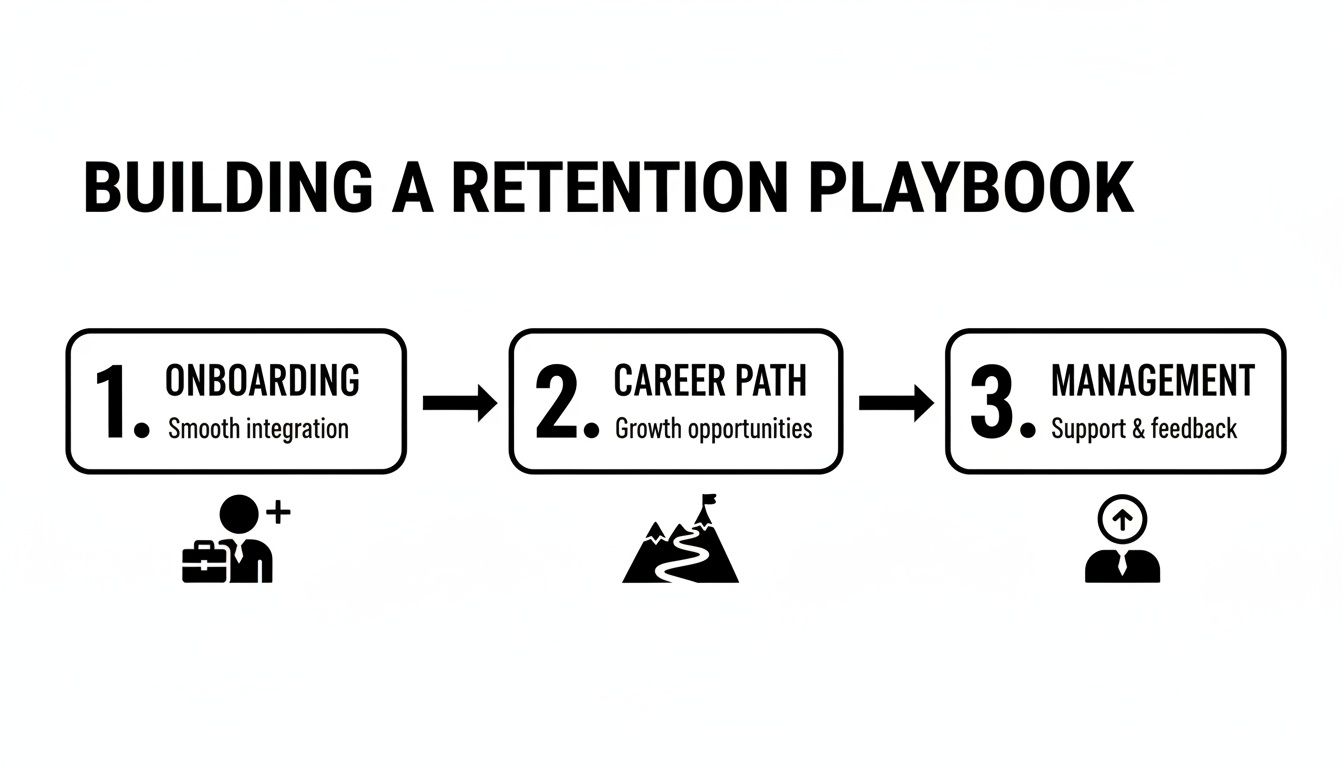
This just goes to show that retention isn't a one-off initiative. It’s a journey that starts with a strong foundation and requires continuous support from leadership.
Capturing Real-Time Feedback with Pulse Surveys
Annual engagement surveys give you a single snapshot in time. What you really need is a live video feed of your team's morale. That’s what automated pulse surveys deliver. These are short, frequent check-ins—often just one or two questions—sent automatically via Slack or email.
You could, for example, set up a simple workflow that asks everyone every Friday: "How are you feeling about your workload this week on a scale of 1-5?" If someone responds with a 1 or 2, an alert can be automatically sent to their manager.
This is how you get ahead of problems. It allows leaders to step in before a small issue with workload snowballs into burnout and a resignation. You shift from reactive damage control to proactive support.
Trying to do this manually is a nightmare, especially once your team grows beyond a handful of people. Automation makes it not just possible, but easy.
Connecting Your HR Tech Stack
The real magic happens when you get your HR systems talking to each other. With tools like Zapier or Make, you can build powerful workflows that connect your HRIS (like BambooHR), your communication tools (like Slack), and your project management software. If you're just starting out, it’s worth looking into the best HR software for startups to find platforms that play nicely together.
Your HR tools shouldn't live on separate islands. Automation is the bridge that connects them, letting you build some seriously effective cross-platform workflows.
Here are a few practical automations you could set up right now:
- Work Anniversary Recognition: When an employee’s anniversary approaches in your HRIS, automatically post a celebratory message in a public channel and send a private reminder to their manager to schedule a chat.
- Performance Review Nudges: Set up automated reminders for managers and employees to submit their feedback ahead of performance review deadlines. No more chasing people down.
- Offboarding Task Management: When an employee's departure is logged in your HRIS, automatically create an offboarding checklist in Asana or Trello and assign tasks like equipment return and knowledge transfer to the right people.
By taking these routine (but critical) processes off someone's plate, you don't just save a ton of admin time. You build a more reliable and supportive employee experience that strengthens loyalty and keeps your best people from walking out the door.
Tracking Your Progress with a Retention Dashboard
So, you’ve rolled out new strategies and invested in training your managers. But how do you actually know if any of it is working? Gut feelings are great for many things, but proving the ROI of your retention efforts isn't one of them. You need a way to measure what matters.
This is exactly why a retention dashboard is so critical. Think of it less as a stuffy report you glance at quarterly and more as a dynamic command center for your people strategy. It visualizes your progress, flags problem areas before they explode, and directly connects your actions—like that revamped onboarding program—to real, tangible results.
Identifying Your Core Retention KPIs
A powerful dashboard is built on the right metrics. It's easy to get lost in a sea of data, so the trick is to focus on a handful of key performance indicators (KPIs) that give you a clear, actionable picture of what's happening.
For any B2B or SaaS company, these are the non-negotiables:
- Overall Turnover Rate: This is your big-picture number. It's the total percentage of employees who leave over a set period, giving you a baseline to measure everything against.
- Voluntary vs. Involuntary Turnover: You have to know why people are leaving. This KPI splits the leavers into two camps: those who chose to go and those you had to let go. A high voluntary rate is a huge warning sign pointing to issues with culture, management, or career growth.
- New Hire Turnover Rate: Are people leaving within their first year? If this number is high, something is seriously broken in your hiring or onboarding process. It's an expensive mistake to keep making.
- Regrettable Attrition Rate: This might be the most important metric of all. It specifically tracks the turnover of your top performers—the people you absolutely cannot afford to lose. When these folks walk out the door, they take a piece of your company's future with them.
Tracking these metrics isn't just a reporting exercise for the leadership team. It's a real-time health check on your organization. A sudden spike in regrettable attrition, for example, is a five-alarm fire that demands immediate investigation.
Building Your Retention Dashboard
You don’t need to spend a fortune on a fancy system right away. A well-organized Google Sheet can be surprisingly powerful, or you can build it into your company's existing Business Intelligence (BI) tool like Tableau or Power BI.
The key is to make it visual and intuitive. Your dashboard should let you slice and dice the data to uncover the story hidden within. Can you filter turnover rates by department? By manager? By employee tenure? For some great ideas on how to present your data effectively, check out these business intelligence dashboard examples.
A quick look at your dashboard should answer critical questions:
- Which department is bleeding talent?
- Are we losing more people just before their first anniversary or after the three-year mark?
- Did turnover in the sales team drop after we rolled out that new coaching program?
From Reporting to Storytelling
Once your dashboard is up and running, it stops being just a collection of numbers and becomes your most powerful storytelling tool. It’s what allows you to connect the dots between your actions and the outcomes.
The next time a leader asks if that investment in career pathing is paying off, you won't have to guess. You can pull up a chart and show them exactly how turnover among mid-level engineers has trended down since the program launched.
This is how you prove your value. It shifts the conversation from, "We feel like this is helping," to, "We can show a 15% reduction in voluntary turnover since launching this initiative." That kind of data-driven proof is what gets you buy-in and secures resources for the future, cementing your retention strategy as a core business function, not just another HR project.
Your Top Turnover Questions Answered
Even with a detailed playbook in hand, you’re bound to run into some tough questions as you start digging into your company's turnover problem. I’ve seen it time and again—leaders grappling with the same hurdles, from what "good" actually looks like to where on earth they should start.
This is your quick-reference guide for those moments. I'll give you the straight, practical answers I share with B2B and SaaS leaders every day so you can keep moving forward.
What’s a Good Employee Turnover Rate for a SaaS Company?
It’s the first question everyone asks, and the answer isn't as simple as one number. But as a general benchmark, a healthy annual turnover rate in the SaaS world hovers somewhere between 10% and 15%.
If you're consistently seeing numbers tick above 20%, that's a red flag. It’s a clear signal that something is broken under the hood and needs your immediate attention.
But the real story is never in that top-line number.
A single turnover percentage is a vanity metric. To get real insight, you have to separate voluntary turnover (they quit) from involuntary turnover (you let them go). Even more important is tracking regrettable turnover—when your top performers walk out the door. Losing a star engineer hurts infinitely more than parting ways with someone who wasn't a good fit.
Breaking down the data this way shows you where the real problems are and helps you focus your energy where it'll actually make a difference.
How Long Until New Retention Strategies Show Results?
I know you want a quick fix, but it’s crucial to set realistic expectations here. While some changes can give you an immediate morale boost, seeing a measurable drop in your turnover rate is a long game.
For instance, things like training managers to give better feedback or launching a simple recognition program can make people feel better almost overnight. You’ll hear the positive buzz.
However, actually moving the needle on your core retention KPIs takes time. You should plan on it taking 6 to 12 months to see a real, sustained decrease in your turnover metrics. Retention isn't a project; it's a commitment. The strategies you put in place need time to sink in and become part of your company's DNA.
What Are the First Steps a Startup Should Take?
If you’re a startup, you’re already stretched thin on time and resources. Forget trying to boil the ocean. The key is to zero in on the highest-impact, lowest-cost activities first.
Here are three things you can do right now that will make a huge difference:
- Conduct "Stay" Interviews: Seriously, before you even think about exit interviews, talk to the people who aren't leaving. Ask them what they love, what keeps them coming back every day, and what would make their experience even better. It’s proactive, insightful, and gives you things you can fix immediately.
- Basic Manager Training: You don't need some massive, expensive leadership program. Just start by teaching your managers one thing: how to run a decent one-on-one meeting. This single skill can transform communication, build trust, and solve problems before they fester.
- Structure the First 30 Days: New hires often leave because their first few weeks are a chaotic mess. Create a simple, structured onboarding plan for their first month. A clear schedule of check-ins, early tasks, and team introductions makes people feel supported and set up for success from day one.
Is It Cheaper to Retain an Employee or Hire a New One?
It is dramatically more expensive to hire someone new. It’s not even a close call. The cost of replacing an employee is one of the most dangerously underestimated expenses in business.
When you start adding it all up, the numbers are truly staggering. You're not just paying for a job ad.
Think about it:
- Recruitment Costs: Fees for job boards, recruiter commissions, advertising spend.
- Time Spent Interviewing: The combined salary-per-hour cost of every single person involved in the hiring process—from the screener to the CEO.
- Training and Onboarding: The time and resources it takes to get someone ramped up and contributing.
- Lost Productivity: This is the big one. It can take a new hire up to a full year to reach the same productivity level as the experienced person they replaced.
Even the most conservative estimates put the cost of replacing someone at 50% to over 200% of their annual salary. Investing in retention isn’t just a "nice-to-have"; it delivers a far, far higher return.
Ready to stop losing your best people and build a more resilient team? MakeAutomation specializes in implementing the automated HR workflows that systemize retention. We help you create scalable onboarding, feedback, and recognition processes that keep your team engaged, freeing you up to focus on growth. Learn how we can help you build a retention engine that works.