

Jest Mock Class: A Developer’s Guide to Mastery
Your test suite usually looks solid until one class crosses a boundary you don’t control.
A BillingService instantiates a payment client. A LeadSyncJob creates a CRM SDK object. A UserRepository opens a database client and chains db().collection().find().toArray(). The code works in production, but your unit tests start acting like shaky integration tests. They get slower. They fail in CI for reasons that have nothing to do with the business logic you wanted to verify.
That’s where jest mock class patterns stop being a convenience and become part of engineering hygiene. The hard part isn’t learning one syntax. The hard part is choosing the right strategy for the dependency in front of you. Sometimes jest.mock() is enough. Sometimes you need a manual mock with state. Sometimes a single jest.spyOn() is the cleanest move and anything more is overkill.
Why Mocking Classes in Jest Can Be Tricky
The trouble starts when a class hides side effects behind a neat interface.
A service that looks simple in application code can create a lot of noise in tests:
export class LeadEnrichmentService {
  constructor(private crmClient: CrmClient) {}

  async enrichLead(email: string) {
    const profile = await this.crmClient.findByEmail(email);
    return {
      email,
      company: profile.company,
      score: profile.score,
    };
  }
}
That looks harmless. But if CrmClient talks to HubSpot, Salesforce, or an internal API wrapper, your “unit” test now depends on network behavior, API credentials, rate limits, and setup order.
The result is familiar. Local tests pass. CI fails. A teammate reruns the pipeline and it passes. That isn’t a code-quality problem. It’s a test-isolation problem.
Jest’s class mocking exists to separate those concerns. It lets you replace a real constructor and its instance methods with predictable stand-ins, so the test only checks what your code does with the dependency.
Practical rule: If the class under test reaches a database, queue, SDK, or HTTP client, stop and decide whether you’re writing a unit test or an integration test. Don’t let the test drift into the middle.
This matters even more in SaaS systems with lots of orchestration. A lead-routing service may depend on a CRM client, an enrichment client, and a notifier. If one unmocked class leaks through, your test starts exercising infrastructure instead of logic.
The fix isn’t “mock everything blindly.” The fix is choosing a mocking boundary that matches the behavior you care about. That same judgment shows up in good review habits too, especially when teams are trying to catch brittle tests early in practical code review examples.
Why classes create confusion
Functions are easy to fake because the call site is obvious.
Classes add a few more moving parts:
- Constructor behavior matters because instantiation can do work.
- Instance methods live on the prototype, not the class itself.
- Static methods behave differently from instance methods.
- Async methods can fail in ways that look like app bugs when they’re really mock bugs.
- Chained clients like database SDKs often return nested objects that you also need to fake.
That last case catches a lot of teams. If your repository uses a nested client chain, you can’t just stub one method and call it done. You need a mock that returns the next object in the chain.
The Automatic Approach with jest.mock
A common SaaS test looks like this: LeadService creates a CrmClient, calls one method, and returns a transformed result. You want to verify the service logic without touching the network or booting a real SDK. That is the sweet spot for jest.mock().
jest.mock() works best when the class is a boundary dependency and you want a full replacement fast. In practice, that usually means API clients, SDK wrappers, mailers, or analytics adapters. The trade-off is simple. You get speed and low setup, but less realism than a hand-built fake.

What auto-mocking gives you
When you call:
jest.mock('./CrmClient');
Jest replaces the imported class with a mock constructor. You can then control what each new instance returns and inspect how the class was used.
That gives you two useful assertions in one test:
- Was the dependency constructed correctly?
- Did the service call the right instance method with the right data?
That split matters in service-layer code because construction is often part of the behavior. A billing service that creates a Stripe wrapper with a tenant-specific API key has different risk than a pure function that just formats payloads.
Here’s a simple example:
// CrmClient.ts
export class CrmClient {
  async createLead(data: { email: string }) {
    return { id: 'real-id', ...data };
  }
}

// LeadService.ts
import { CrmClient } from './CrmClient';

export class LeadService {
  private crm = new CrmClient();

  async create(email: string) {
    return this.crm.createLead({ email });
  }
}
Test:
import { LeadService } from './LeadService';
import { CrmClient } from './CrmClient';

jest.mock('./CrmClient');

describe('LeadService', () => {
  it('creates a lead through the CRM client', async () => {
    const mockedCreateLead = jest.fn().mockResolvedValue({ id: '123', email: 'a@b.com' });

    (CrmClient as jest.Mock).mockImplementation(() => ({
      createLead: mockedCreateLead,
    }));

    const service = new LeadService();
    const result = await service.create('a@b.com');

    expect(CrmClient).toHaveBeenCalledTimes(1);
    expect(mockedCreateLead).toHaveBeenCalledWith({ email: 'a@b.com' });
    expect(result).toEqual({ id: '123', email: 'a@b.com' });
  });
});
How to decide if auto-mock is the right choice
Use auto-mock when the test question is about your code’s decisions, not the dependency’s internal behavior.
Good fits in SaaS code:
- a CRM client used to create or look up contacts
- an email provider wrapper used to send onboarding messages
- a fraud-check SDK client used for a single score lookup
- an analytics emitter where you only care that the event was sent
- a search client wrapper that returns already-shaped data
If your service mostly does “create client, call method, branch on result,” auto-mock keeps the test focused. That is usually the right call for unit tests around orchestration code.
A lead routing example shows the decision clearly:
export class OutreachSyncService {
  constructor(private crmClient: CrmClient) {}

  async syncProspect(prospect: { email: string; company: string }) {
    const existing = await this.crmClient.findByEmail(prospect.email);

    if (existing) return existing;

    return this.crmClient.createContact(prospect);
  }
}
For that service, the useful assertions are straightforward:
- if contact exists, do not create one
- if contact does not exist, create one
- send the expected payload
You do not need the actual CRM SDK to prove any of that. If you already use function-level mocks heavily, the same patterns apply here. The difference is that the constructor is mocked too. For a refresher on the lower-level API, see these Jest mock function patterns.
Accessing constructor and instance calls
One reason jest.mock() is practical is that Jest tracks both constructor calls and created instances.
You can inspect constructor usage:
expect(CrmClient).toHaveBeenCalled();
You can also inspect the first created instance:
const instance = (CrmClient as jest.Mock).mock.instances[0];
expect(instance.createLead).toHaveBeenCalled();
That is especially useful when the class under test creates the dependency internally instead of receiving it through dependency injection. You can still verify behavior without rewriting the production code just to satisfy the test.
Where auto-mock starts to get expensive
Auto-mock loses its advantage when you have to recreate too much of the dependency by hand.
That usually shows up in cases like these:
- the class has several methods that share state
- constructor arguments change behavior in meaningful ways
- the dependency returns nested objects or chainable APIs
- you only want to override one method and keep the rest real
For example, mocking a database client chain often turns into a nested factory:
jest.mock('mongodb', () => ({
  MongoClient: jest.fn(() => ({
    db: jest.fn(() => ({
      collection: jest.fn(() => ({
        find: jest.fn(() => ({
          toArray: jest.fn().mockResolvedValue([{ id: 1 }]),
        })),
      })),
    })),
  })),
}));
This can still be the correct choice if your repository code depends on that chain shape. But it is a signal. Once you are hand-building object trees or coordinating state across several mocked methods, auto-mock is no longer the low-friction option. At that point, a manual mock or a targeted spy usually gives you a cleaner test.
Manual Mocks vs Partial Spies A Control Spectrum
A billing service fails in CI because one test replaced the whole payment client, another spied on one method, and a third let the original constructor run and read missing env vars. The failure looks random. The cause is usually simpler. The team picked different mocking strategies for the same kind of dependency without being clear about what needed isolation and what real behavior was still useful.
That choice matters more than the mock syntax.
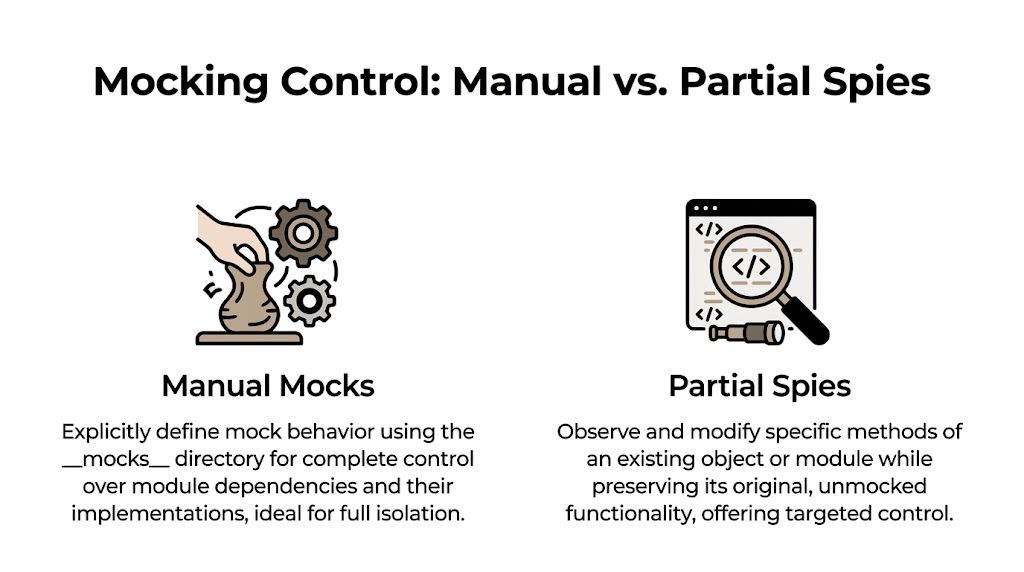
A good way to decide is to place each dependency on a control spectrum.
At one end, a manual mock replaces the class with a fake you own completely. At the other, a partial spy keeps the class real and overrides only the method that crosses a boundary, such as an HTTP call or a database query. For SaaS code, that usually maps cleanly to the dependency itself. If the whole class is an external boundary, replace it. If only one method is expensive or nondeterministic, spy on that method.
When manual mocks earn their keep
A manual mock lives in __mocks__ and exports a custom version of the module.
Use it when the dependency has enough behavior that repeating inline mock setup in every test becomes noisy, or when several test files need the same fake behavior.
Example:
// __mocks__/PaymentGateway.ts
export class PaymentGateway {
  charge = jest.fn().mockResolvedValue({ status: 'paid' });
  refund = jest.fn().mockResolvedValue({ status: 'refunded' });
}
Then in the test:
jest.mock('./PaymentGateway');
This fits classes like:
- payment gateways
- queue producers
- storage clients
- feature flag SDK wrappers
In a SaaS app, these integrations often sit behind one service class and show up in dozens of tests. A manual mock gives every test the same contract. That cuts setup noise and makes failures easier to read because the fake behavior is defined in one place.
What manual mocks buy you
- Consistency: every test starts with the same fake API.
- Readability: you avoid rebuilding constructor and method mocks in each file.
- State support: the fake can keep arrays, maps, counters, or flags when your test needs to verify multi-step behavior.
For example, a PaymentGateway mock can store charged invoice IDs so a subscription service test can assert retry logic or refund behavior without touching the actual provider.
Where manual mocks go wrong
Manual mocks can drift from production code.
That is the primary trade-off. If the original class changes its method names, constructor arguments, or return shape, the mock can keep passing tests while the app is already broken. This risk is highest for thin wrappers with very little behavior. In those cases, the mock can end up being more complex than the actual dependency.
I usually reach for a manual mock only when two conditions are true: the dependency appears in many tests, and the fake behavior is stable enough to centralize.
Partial spies are the surgical option
Use jest.spyOn() when you want to keep the class behavior that still has value in the test and replace only the unstable part.
A common SaaS example is an API client with one network method and a few pure formatting or mapping methods. You want the request under control, but the parsing logic is worth keeping real because it is part of the behavior you care about.
Example:
class ExchangeRateClient {
  async getLatestExchangeRate() {
    return 1.0;
  }

  formatCurrency(amount: number) {
    return `$${amount}`;
  }
}

jest
  .spyOn(ExchangeRateClient.prototype, 'getLatestExchangeRate')
  .mockResolvedValue(3.6725);
Now formatCurrency still runs as written, while the network-facing method is pinned to a known value.
That is usually a better fit when:
- one method calls an API
- the rest of the class is deterministic
- you want to keep real behavior and reduce mock drift
The prototype detail matters here. Instance methods live on the prototype, so the spy needs to target ClassName.prototype.methodName. Jack Caldwell’s article on mocking ES6 class methods with Jest shows the pattern clearly, including the need to return resolved promises for async methods.
When a spy is the wrong tool
A spy gives less isolation than a full replacement. That is fine when the untouched constructor and methods are safe to run.
It is a bad fit when object creation already causes side effects. Database clients that open connections in the constructor, SDK wrappers that read config on import, and clients that start timers are common examples. In those cases, spying on one method still allows the rest of the class to do real work you did not ask for.
If the constructor opens a socket, reads env config, or creates a client with side effects, replace the class instead of spying on one method.
Mocking Strategy Decision Guide
| Strategy | Best For | Pros | Cons |
|---|---|---|---|
Auto-mock with jest.mock() |
Simple dependency wrappers and constructor replacement | Fast to write, easy call assertions, good default choice | Gets messy for stateful or nested behavior |
Manual mock in __mocks__ |
Shared fake behavior across many tests | Centralized control, reusable, supports state | Can drift from real implementation |
Partial spy with jest.spyOn() |
Overriding one method while keeping the rest real | Minimal intrusion, lower maintenance, preserves useful logic | Not safe when constructors or untouched methods have side effects |
A practical hybrid pattern
Sometimes the right answer is not full replacement or full realism. You can keep the module mostly real, then spy on the one method that crosses the boundary.
jest.mock('./ExchangeRateClient', () => {
  const actual = jest.requireActual('./ExchangeRateClient');
  return {
    ...actual,
  };
});

import { ExchangeRateClient } from './ExchangeRateClient';

jest
  .spyOn(ExchangeRateClient.prototype, 'getLatestExchangeRate')
  .mockResolvedValue(3.6725);
I use this pattern for service clients that contain useful mapping logic but still call Stripe, HubSpot, Redis, or an internal billing API. The test keeps the transformation code honest while removing the slow or nondeterministic dependency.
How to choose without overthinking it
Ask a few direct questions:
Does this class mostly represent an external boundary?
Use auto-mock or a manual mock.Do many tests need the same fake behavior?
Use a manual mock.Is one method the only unstable part?
Use a partial spy.Does the constructor do work you do not want in tests?
Avoid spies unless construction is already safe.Will this test still make sense after a refactor?
If the mock mirrors too much internal structure, simplify it.
The goal is not to use the most advanced Jest feature. The goal is to choose the smallest amount of control that still makes the test reliable.
Solving Advanced Mocking Puzzles
A class mock usually looks fine until you hit the version used in real SaaS code. The client caches a token in the constructor, one method is static, another returns a promise, and the module is imported through an ESM barrel file. That is where teams lose time.
The fix is rarely “use more mocking.” The fix is choosing the right level of control for the failure you are isolating. For a payment gateway client, I usually replace the whole class if construction opens sockets or reads env state. For a reporting client with useful formatting logic, I keep the class real and spy on the one network method.

TypeScript without losing type safety
TypeScript friction usually starts the moment Jest replaces an imported class and the compiler still treats it as the original implementation.
Example:
import { CrmClient } from './CrmClient';

jest.mock('./CrmClient');

const MockedCrmClient = CrmClient as jest.MockedClass<typeof CrmClient>;
If you are mocking an imported module object instead of a class directly, jest.Mocked<typeof module> is usually the better fit.
Typed mocks make the test easier to change. You get method autocomplete, call assertions that match the actual API, and fewer as any shortcuts. If your team writes a lot of service-layer tests, keeping a small set of typed patterns in a shared unit test templates library saves a surprising amount of cleanup work later.
ESM and CommonJS fail differently
A lot of “mock not working” bugs are really module-loading bugs.
If your project uses CommonJS, this usually behaves predictably:
const { Client } = require('./Client');
jest.mock('./Client');
In ESM projects, import timing matters more. A dependency can be evaluated before the mock is applied if the file structure is off.
Two checks solve a lot of failures:
- declare mocks before importing modules that depend on them
- mock the boundary module your service imports, not a deeper file hidden behind re-exports
If a billing service imports ./clients/index.ts, mocking ./clients/StripeClient.ts may do nothing. The test has to intercept the path the runtime loads.
Static methods need a different target
Static methods live on the class itself, not on the prototype.
So this:
class TokenFactory {
  static getInstance() {
    return new TokenFactory();
  }
}
gets mocked like this:
jest.spyOn(TokenFactory, 'getInstance').mockReturnValue({
  create: jest.fn().mockReturnValue('fake-token'),
} as any);
Use this when the static call is the unstable boundary. A common example is a singleton factory for config, auth, or feature flags. If the instance methods are what vary, spy on the prototype instead. Mixing those targets is one of the fastest ways to end up with a spy that never fires.
Private fields force a design choice
Modern classes with #privateField are useful in production and restrictive in tests.
That restriction is often helpful. If a test only passes by reaching into private state, the class boundary is probably too muddled. In practice, the safer move is to mock or spy on the public method that exposes behavior.
class SessionClient {
  #token = 'real';

  async fetchUser() {
    return this.#token ? { id: '1' } : null;
  }
}

jest
  .spyOn(SessionClient.prototype, 'fetchUser')
  .mockResolvedValue({ id: 'test-user' });
That keeps the test centered on observable behavior. It also survives refactors better than hacks that depend on how the class stores state internally.
If private fields make the test hard to write, change the seam you test against, not the language feature.
Async methods are where flaky tests start
If the original method returns a promise, the mock should return a promise.
Bad:
client.getUser = jest.fn().mockReturnValue({ id: '1' });
Better:
client.getUser = jest.fn().mockResolvedValue({ id: '1' });
Or:
Client.prototype.getUser = jest.fn().mockReturnValue(Promise.resolve({ id: '1' }));
This is more than style. A sync return can hide ordering bugs, skipped catch paths, and broken rejection handling. I see this a lot in services that coordinate CRM updates, webhook dispatches, or background job retries.
Here’s the failure-path version:
jest
  .spyOn(CrmClient.prototype, 'findByEmail')
  .mockRejectedValue(new Error('CRM unavailable'));

await expect(service.syncProspect(input)).rejects.toThrow('CRM unavailable');
That test proves the service handles the rejected promise you will see in production.
A good quick explainer can help when you’re debugging one of these edge cases in real time:
Chained APIs need nested return shapes
Database clients and SDKs often return objects that return other objects:
await mongo.db('app').collection('users').find({ active: true }).toArray();
Mock the chain your code uses:
const toArray = jest.fn().mockResolvedValue([{ id: 1 }]);
const find = jest.fn(() => ({ toArray }));
const collection = jest.fn(() => ({ find }));
const db = jest.fn(() => ({ collection }));

(MongoClient as jest.Mock).mockImplementation(() => ({ db }));
This looks verbose because the production API is verbose. That is a fair trade when the chain itself is part of the contract. If several tests need the same shape, move it into a manual mock factory. If only one call in the chain is unstable, keep the original wrapper and spy closer to the edge.
That decision is the pattern behind most advanced class-mocking work. Full replacement is best when the class is mostly an external boundary. A manual mock is best when many tests need the same fake behavior. A spy is best when the class still contains business logic you want to exercise, and only one method needs control.
Best Practices for Maintainable Mocks
A mock becomes a maintenance problem when a billing test fails because someone renamed an internal method on StripeGateway, even though the checkout behavior never changed. That usually means the test is coupled to the class internals instead of the dependency boundary.
The goal is readability under change. A teammate should be able to scan the test, see why the dependency was mocked, and know whether a full class mock, a manual fake, or a spy was the right choice for that SaaS scenario.

Clean up after every test
Shared mock state is a common source of noisy failures. One test leaves a call count behind, the next test reads it, and now the failure points at the wrong behavior.
Use a reset pattern that matches how you mocked the class:
beforeEach(() => {
  jest.clearAllMocks();
});

afterEach(() => {
  jest.restoreAllMocks();
});
Use jest.clearAllMocks() if you want to keep the current mock implementation and only wipe call history.
Use jest.restoreAllMocks() if you used jest.spyOn() and need the original method back for the next test.
That distinction matters in practice. A spy on HubSpotClient.prototype.createContact can easily leak into unrelated lead-sync tests if you only clear calls and never restore the original method.
Mock the boundary that can actually change
For a service like LeadScoringService, the useful seam is usually the dependency it talks to, such as CrmClient or FeatureFlagClient. Mocking private helpers inside LeadScoringService gives you tests that fail during refactors and miss real regressions.
Choose the strategy based on the dependency's role:
- Use
jest.mock()when the class is mostly an external boundary, such as a payment SDK, email provider, or analytics client. - Use a manual mock when many tests need the same fake behavior, such as a shared in-memory repository or a stable fake Redis client.
- Use a spy when the class still contains business logic you want to exercise, and only one unstable method needs control.
That decision keeps the test focused on behavior. The useful question is simple: what should this service do when its dependency returns this result, throws this error, or times out?
Prefer the smallest fake that proves the rule
Big mocks drift fast. They also hide intent.
If your notification client exposes send, schedule, cancel, and getStatus, but the service under test only calls send, mock send and stop there. Adding the rest creates surface area you now have to maintain without getting better coverage.
This is one place where spies often age better than full replacements. If UsageReporter has solid formatting logic but one method posts to an external API, keep the formatter real and spy on the network call. You get a test that still exercises the class behavior without dragging in the outside system.
Write tests that read like service contracts
A maintainable class mock supports a business rule, not a pile of setup. Good test names do half the work, and the mock should make the other half obvious.
Teams that want consistency across service tests usually benefit from a shared structure. These unit test templates for service and repository tests are a good starting point if your suite needs a cleaner pattern.
Examples:
- returns cached contact when CRM already has the lead
- creates contact when CRM lookup returns null
- retries once when billing client returns a transient 503
- bubbles provider error when CRM call rejects
Those names tell the next engineer what matters. The mock should only supply the condition that triggers that rule.
Revisit mocks when the production code changes shape
Mocks are code. They need refactoring too.
If a database client call changed from one method to a chained query builder, an old flat mock is now lying about the integration shape. If a class gained retry logic, a mock that always resolves on the first call may no longer cover the risk that caused the change. Updating the fake is part of maintaining the test, not a separate cleanup task.
A short checklist helps:
- Reset call history when tests assert interactions.
- Restore spies when you changed real methods.
- Mock promises as promises for async methods.
- Choose one seam instead of mocking multiple layers.
- Delete mock behavior once a test no longer needs it.
MakeAutomation helps B2B and SaaS teams turn messy operations into reliable systems, whether that means cleaner testing practices, stronger automation workflows, or full implementation support for AI automation and Voice AI Agents. If your team is scaling fast and the engineering process needs to catch up, MakeAutomation can help.