

Marketing Automation for Lead Generation That Converts
A founder opens the pipeline report and sees the same problem again: traffic is arriving, forms are being completed, and campaigns are running, but qualified opportunities aren't moving fast enough. Two sales reps are working through hundreds of leads in scattered inboxes and spreadsheets. A promising prospect can wait days for a response, while an account with weak fit receives the same attention as a high-intent buyer.
That isn't a motivation problem. It's a system problem. Marketing automation for lead generation connects sourcing, qualification, nurturing, routing, and revenue reporting so that every lead follows a defined path, while people spend their time on judgment, conversations, and deals.
Why Lead Generation Breaks Without Automation
Manual lead management usually works at the beginning. A founder can review each form, forward a few messages, and remember which prospect needs a follow-up. The process starts failing when volume, channels, and buying signals multiply. New leads arrive from content downloads, demo requests, events, paid campaigns, and product activity, but the team still relies on memory to decide what happens next.
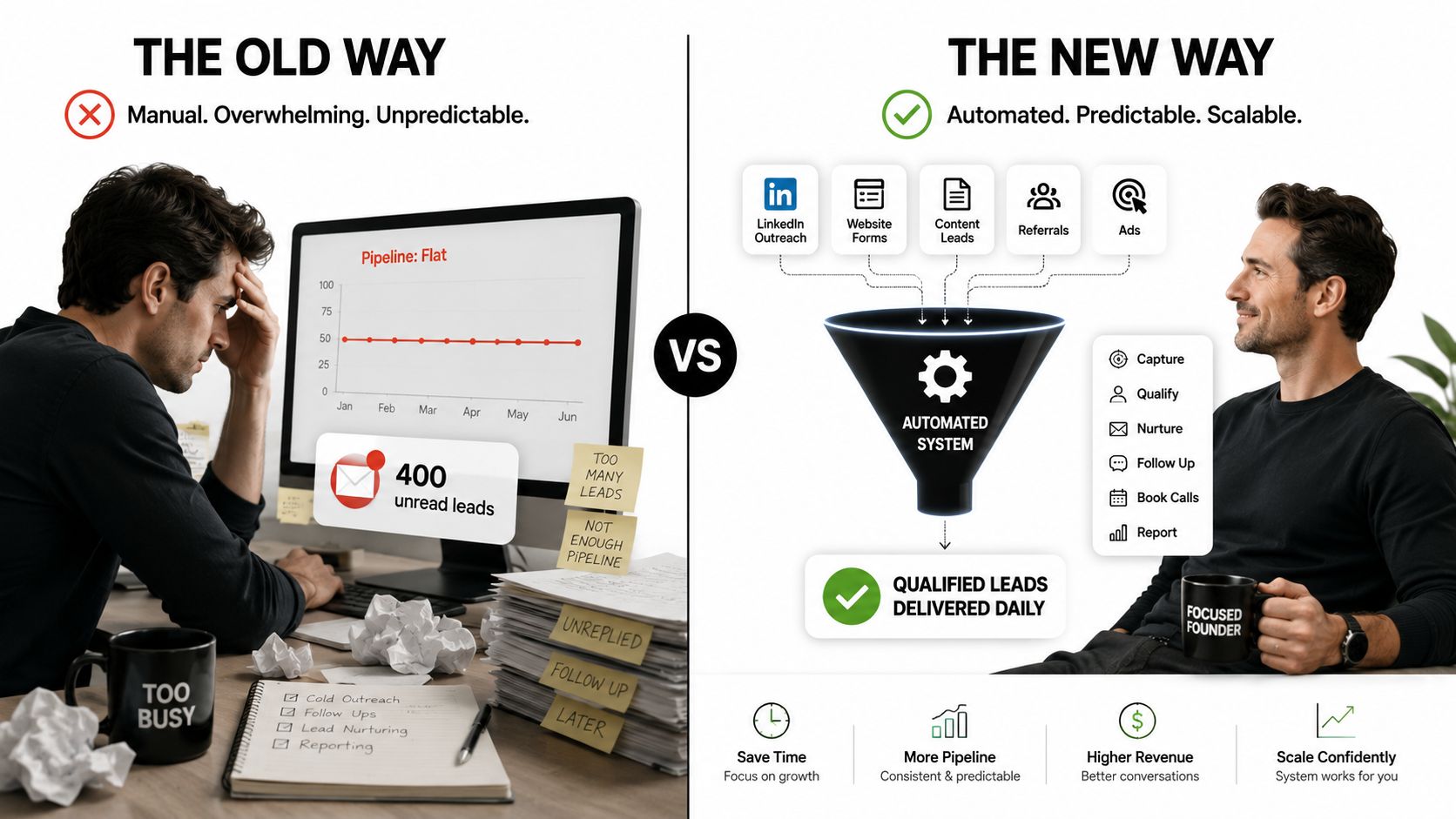
The first break point is lead leakage. Without routing rules, a form submission may sit in a shared inbox or remain unassigned in the CRM. No one owns the next action, so sales responds according to availability rather than intent. The consequence is practical: a buyer who was ready to talk receives silence while the team spends time searching for the next task.
The three operational failure points
Inconsistent qualification creates a second problem. One rep may prioritize company size, another may prioritize job title, and a third may respond to whoever replied most recently. Account executives then receive leads that don't match the ideal customer profile, while qualified opportunities get buried among low-propensity contacts. That wastes selling capacity and makes marketing performance difficult to judge.
Repetitive work creates the third constraint. Reps manually research companies, copy data into the CRM, send confirmation emails, create reminders, and assemble context before each handoff. Every task looks small, but together they slow campaign launches and reduce the time available for meaningful prospect conversations.
Oracle's benchmark gives a useful historical reference point: organizations using marketing automation saw lead quantity rise by 80%, while qualified leads increased by 451% when automation was applied to prospect nurturing, as summarized in its marketing automation statistics. The important lesson isn't that a platform magically creates demand. Automation helps teams process existing attention more consistently, apply qualification logic repeatedly, and keep follow-up from depending on an individual inbox.
Operator rule: If the team can't explain who owns a lead, what qualifies it, and what happens after each behavior, the workflow isn't scalable yet.
What Marketing Automation Actually Means in 2026
Marketing automation is the operating layer that watches lead activity, evaluates data, and triggers the next action. A form submission can create a contact, enrich the company record, assign a preliminary score, start a relevant nurture path, and alert the correct sales owner without someone manually coordinating those steps.
Think of it as a control tower for the funnel. The system receives signals from the website, CRM, email platform, product, events, and enrichment tools. It applies rules or predictive models, then decides whether the lead should be nurtured, routed, suppressed, or reviewed by a human.
That definition separates three technologies that teams often blur together:
- The CRM stores commercial truth. It holds accounts, contacts, opportunities, owners, activities, and lifecycle stages.
- The automation platform orchestrates actions. It connects signals to workflows, timing, segmentation, alerts, and handoffs.
- AI tools analyze or generate. They can enrich records, predict propensity, summarize activity, personalize content, or help operators design workflows.
A CRM without orchestration becomes a passive database. AI without reliable lifecycle data produces attractive predictions that sales can't trust. Automation without CRM synchronization creates another silo. The useful architecture makes each layer responsible for a distinct job and keeps the data moving between them.
In current B2B practice, the meaningful shift is from isolated drip campaigns to event-driven, full-funnel operations. A pricing-page visit, product activation, webinar attendance, reply, or change in firmographic fit can alter the next step. The outcome isn't more activity for its own sake. It's faster routing, more consistent follow-up, and a clearer connection between marketing interactions and qualified pipeline.
The Core Building Blocks of an Automated Lead Engine
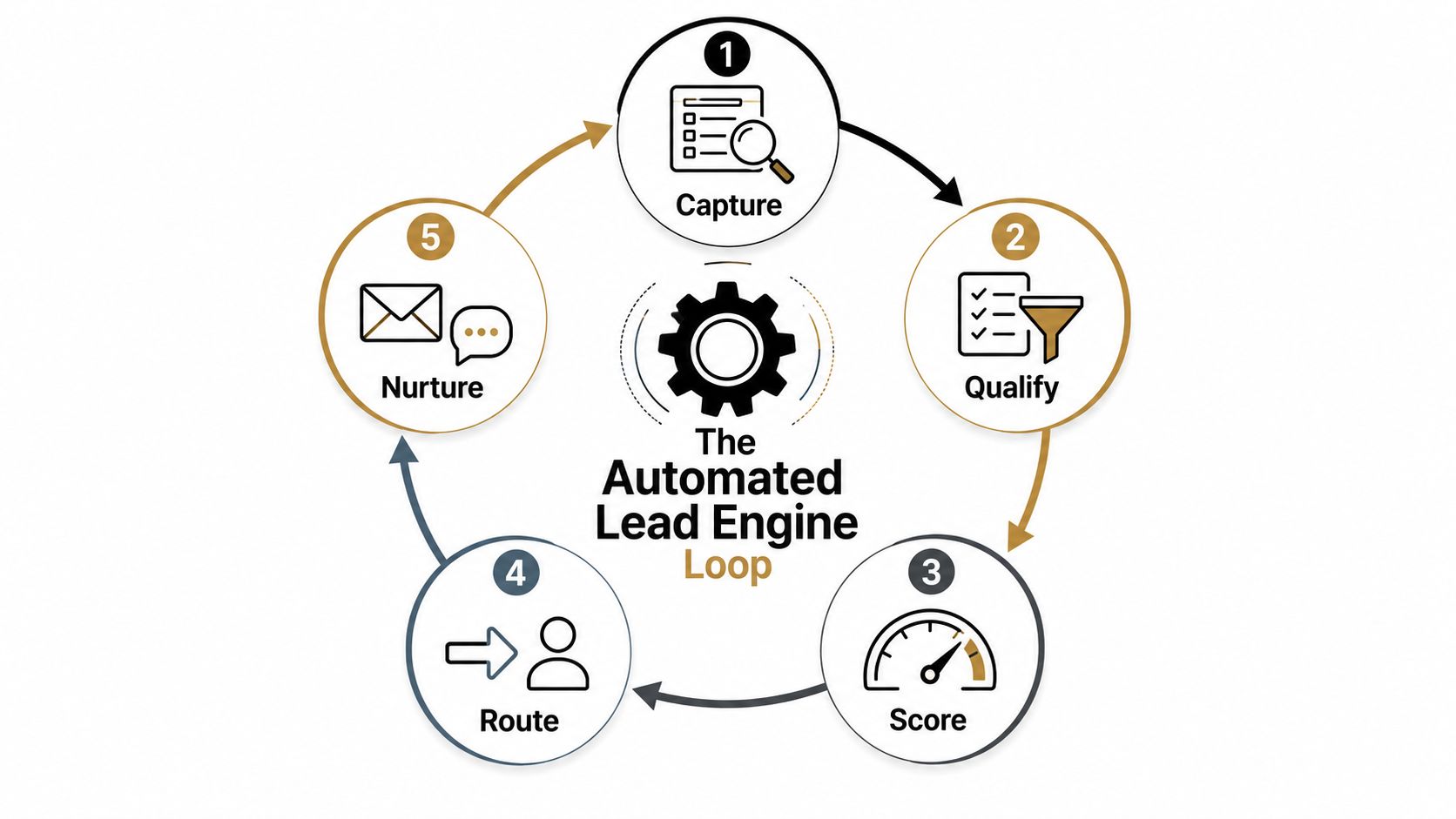
A lead engine has five connected blocks. Treating them as separate features produces disconnected workflows. Treating them as a loop lets each stage improve the next one.
Capture creates the usable record
Capture begins with forms, demo requests, content offers, event scans, chat, product signals, and account-identification tools. The design question isn't how to collect the most fields. It's how to collect enough information to start a useful journey without adding unnecessary friction.
A strong capture layer also handles consent, deduplication, source tracking, and immediate enrichment. If a returning visitor already provided a role and company, the next interaction can ask about a problem or buying stage instead of repeating the same fields.
Segmentation preserves relevance
Segmentation groups contacts by fit, role, industry, account, lifecycle stage, and behavior. A technical evaluator shouldn't receive the same message as an economic buyer. A small company researching a category shouldn't enter the same path as a high-fit account requesting a demo.
Dynamic segments are more useful than static lists because they change as data changes. A lead can move from education to consideration after a meaningful product interaction, then exit marketing nurture when sales accepts the handoff.
Scoring prioritizes attention
Scoring combines explicit information, such as company characteristics and role, with behavioral signals, such as content engagement, product activity, and high-intent page visits. Simple point rules work when the buying motion is clear. Predictive scoring becomes more useful when the business has enough historical outcomes to identify patterns that humans might miss.
Nurture develops readiness
Nurture sequences deliver education, proof, objection handling, and conversion prompts according to the lead's context. Trigger-based paths respond to behavior, while batch campaigns send the same message to a broad audience. The former usually creates better relevance, but it requires cleaner data and more maintenance.
Routing turns a score into revenue activity
Routing assigns sales-ready leads to the right owner, territory, queue, or specialist. The handoff should include the lead's source, score rationale, recent activity, stated need, and recommended next action. A score without ownership is merely a label.
The loop closes when opportunity outcomes return to the system. Closed-won and closed-lost data can refine scoring, while sales feedback can expose weak forms, poor segments, or nurture content that attracts the wrong audience. Teams evaluating the available stack can also review these lead generation automation tools against their data model and handoff requirements rather than choosing by feature count.
Designing a Lead Capture and Qualification Workflow
Start with the buying event, not the software. A demo request, a technical guide download, an event scan, and an identified account visit don't deserve identical treatment because they express different levels of intent and provide different amounts of information.
Build the path in five decisions
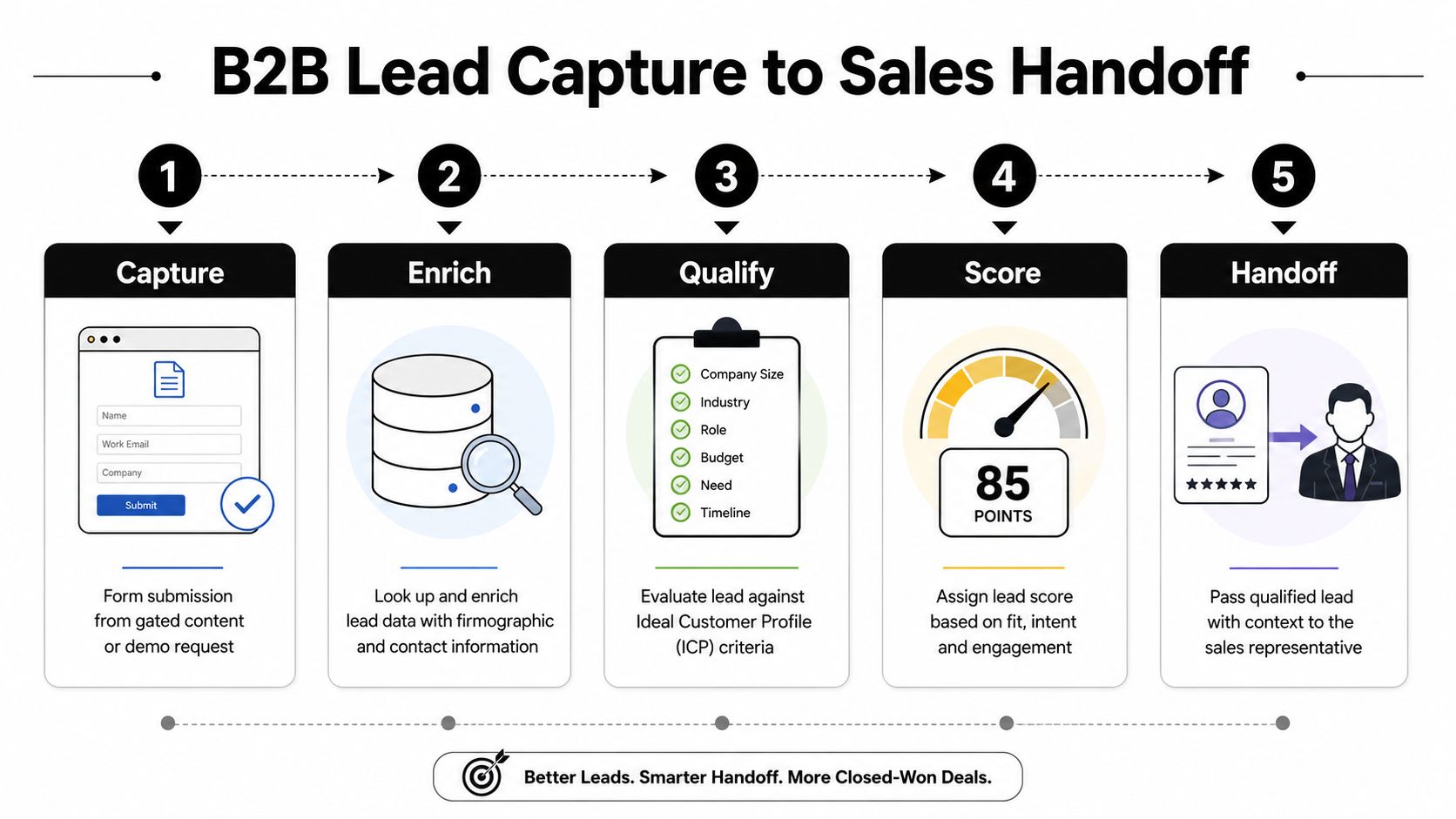
Capture the signal. Use a short form for early education and a more direct request form for demos or consultations. A form builder such as Kiwiform form builder can support the front-end collection, but the primary value comes from what the submission triggers afterward.
Enrich the record. Append company, role, industry, and account information through a data provider such as Clearbit or ZoomInfo, subject to your privacy and data-quality requirements. Enrichment should reduce manual research, not introduce unverified fields into the CRM without review.
Check fit and intent. Separate firmographic qualification from behavioral intent. A perfect-fit account that only downloads an introductory guide may need nurture. A less obvious account requesting a technical evaluation may deserve human review.
Apply routing logic. Route by company profile, product interest, geography, segment, or account ownership. Keep the rules understandable enough that sales can challenge them and operations can troubleshoot them.
Make the handoff visible. Send the assigned account executive a Slack alert or CRM task with the full context. The alert should explain why the lead was routed, not just announce that a new record exists.
A practical quarter-one workflow could capture a demo request, enrich it through Clearbit or ZoomInfo, check company size and stated intent, assign the appropriate account executive, send a Slack notification, and create a response task with a five-minute service-level target. That target is an operating decision, not a universal benchmark. If the team can't meet it consistently, design an escalation path rather than hiding the gap.
Balance friction against accuracy
Long forms produce more qualification data but can reduce completion. Short forms increase access but shift more work into enrichment and sales discovery. Progressive profiling is usually the better compromise. Ask for the minimum information required at the first touch, then request additional context when the lead returns or shows stronger intent.
Don't send every captured contact to sales. Qualification should protect both teams. Define the minimum fit criteria, the behavioral signals that indicate readiness, and the conditions that suppress or recycle a lead. Then review false positives and false negatives with sales regularly, because a workflow that looks logical on paper can still misclassify real buyers.
AI Lead Scoring and the Move Beyond Static Rules
Rules-based scoring is transparent. An operator can see that a target role, suitable company profile, or high-intent action added points. That makes rules valuable for a young funnel, a single ideal customer profile, or a team without dependable historical outcomes.
AI-driven scoring looks for relationships across many signals. It can evaluate first-party behavior, firmographic fit, third-party intent, and engagement patterns together, then estimate which contacts resemble previous successful opportunities. The model only becomes credible when the training data reflects actual commercial outcomes, including both closed-won and closed-lost records.
One independent benchmark cites 78% accuracy for enterprise B2B scoring models and notes that implementations typically need at least 1,000 historical conversions for reliable training, according to CDP's explanation of AI lead scoring. That threshold is a useful warning for teams with limited data. A predictive model trained on a small or biased sample can create false confidence rather than better prioritization.
| Dimension | Rules-Based Scoring | AI-Driven Scoring |
|---|---|---|
| Transparency | Easy for marketing and sales to inspect | Requires explanation tools and governance |
| Data requirement | Can start with agreed fit and intent criteria | Needs sufficient historical conversion outcomes |
| Best early use | Clear ICP and straightforward buying motion | Complex patterns across accounts and behaviors |
| Maintenance | Operators update points and thresholds | Teams monitor drift, bias, and model performance |
| Operational role | Directly triggers segments or handoffs | Ranks propensity and informs routing decisions |
Choose the model that matches the evidence
Stay with rules when the sales motion is still changing, the ICP is narrow, or the CRM contains inconsistent lifecycle history. Predictive scoring earns its cost when the team has meaningful outcome data, multiple segments, and enough signal volume to reveal patterns beyond a spreadsheet.
The common implementation error is treating the score as a verdict. A score should start a decision, such as routing to an SDR, adding an account to a review queue, or changing nurture intensity. It shouldn't replace qualification conversations or override negative signals such as poor fit, unsubscribes, bounced addresses, or explicit disinterest.
Teams considering broader AI workflows can compare the scoring layer with AI for lead generation while keeping model governance, data permissions, and sales adoption in scope.
Nurture Sequences That Turn Contacts into Pipeline
Nurture works when it reflects the buyer's situation. It fails when a team treats every contact as an address in a mailing list and measures success through opens alone.
A benchmark covering more than 175,000 senders reported automation emails averaging a 30.63% open rate and 7.39% click-through rate, compared with 20.73% and 2.27% for standard campaigns, as summarized by Martal's lead nurturing research. The operational implication is clear: timing, segmentation, and behavioral triggers matter. The figures aren't a reason to send more email. They're a reason to design the journey around context.
Pick the lightest channel mix that can work
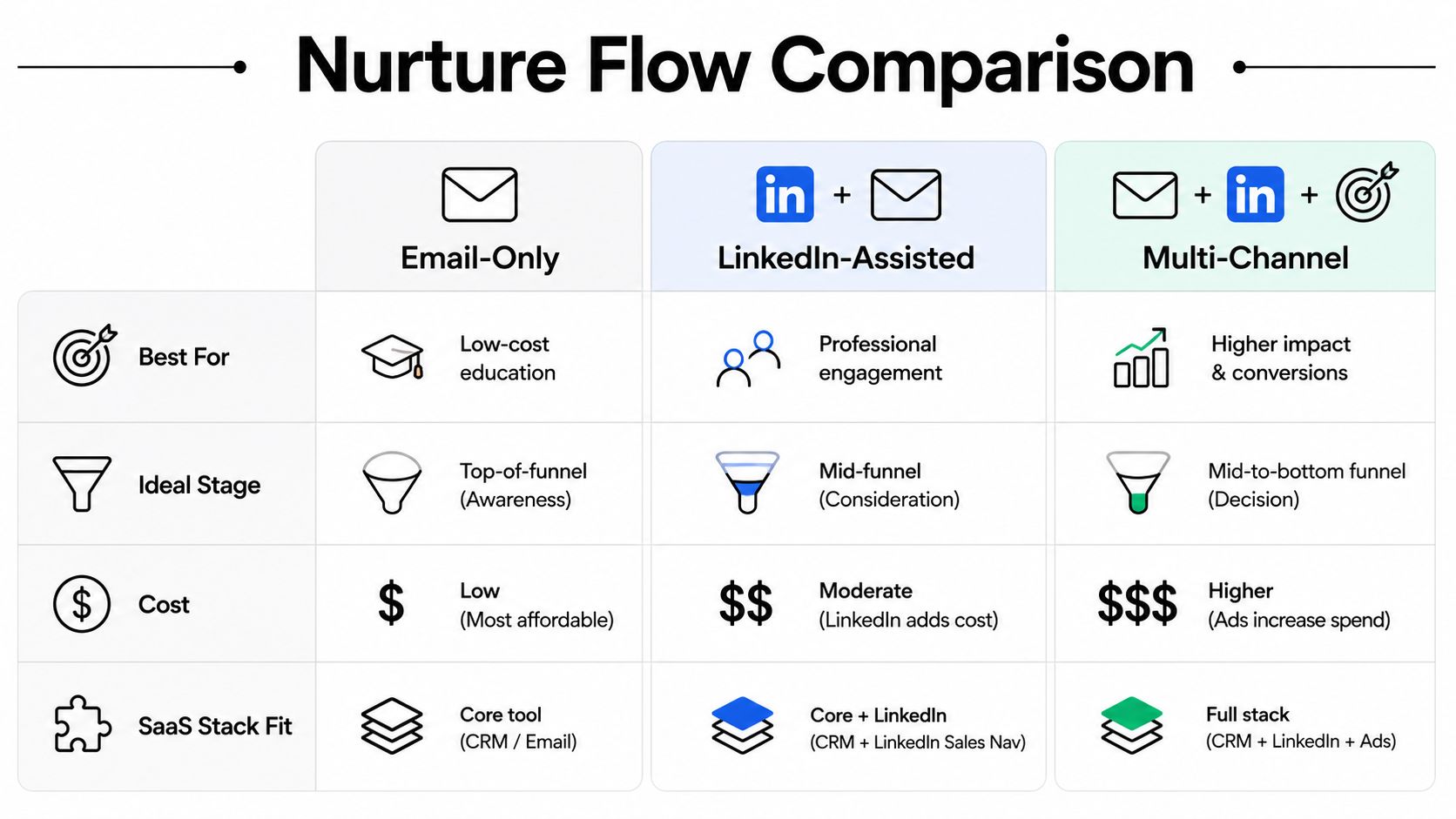
Email-only nurture belongs in low-cost education, newsletter programs, event promotion, and broad category awareness. It's easy to govern and inexpensive to operate, but it can't create the same personal context as a sales conversation.
LinkedIn-assisted nurture fits high-value opportunities where the buying committee is limited and identifiable. Marketing can educate through email while sales adds carefully chosen profile touches or direct messages. This approach demands coordination and restraint. Automated social activity that feels generic can damage trust faster than it creates attention.
Multi-channel orchestration earns its complexity when marketing and sales share lifecycle definitions, suppression rules, and an agreed MQL-to-SQL handoff. Email, LinkedIn, retargeting, events, and in-product messages should reinforce one narrative. If the systems don't share state, prospects may receive conflicting outreach.
Trigger-based sequences should branch on meaningful behavior, pause when a contact replies or books a meeting, and remove buyers from promotional paths after a sales handoff. A nurture benchmark summarized by Martal reports around 14.2% conversion across a full sequence, while segmented flows may convert at 8% to 12%, compared with about 1.5% for generic campaigns, all from the same lead nurturing source. Since that source URL has already been used, treat these as design benchmarks rather than promises.
Track meetings booked per 1,000 contacts in the cohort, progression to qualified stages, and sales-accepted leads. Open rates help diagnose delivery and subject lines, but they don't tell a founder whether nurture created pipeline. Teams refining sequence logic can use this guide to nurturing leads as a practical reference for lifecycle design.
Connecting Automation to Pipeline and ROI
A board-level automation report shouldn't begin with emails sent. It should show how the system changed the movement of qualified opportunities through the funnel.
Start by defining lifecycle events in the CRM. A contact becomes an MQL when it meets the agreed fit and engagement conditions. It becomes an SQL when sales accepts responsibility and confirms the opportunity deserves active pursuit. A demo request, opportunity creation, and closed deal need equally clear definitions, otherwise attribution becomes a debate over labels.
Build dashboards around decisions
A useful reporting layer answers four questions:
- Where do qualified contacts come from? Report form-fill-to-MQL conversion by source, campaign, segment, and offer.
- Which leads deserve sales attention? Track score-to-SQL rate and inspect false positives by model, segment, and owner.
- Which channels create pipeline? Connect sourced and influenced opportunities to channel, campaign, content, and account.
- Where does the process stall? Monitor acceptance, response activity, stage progression, recycling, and disqualification reasons.
Use cohorts rather than blending every contact into one total. A lead captured from a high-intent request should be evaluated separately from an early educational subscriber. Attribution can then assign appropriate credit across first touch, nurture engagement, sales acceptance, and opportunity creation, while revenue reporting remains grounded in CRM opportunity records.
Marketing and sales should review the same dashboard on a regular operating cadence. Marketing owns source quality and nurture progression. Sales owns acceptance, follow-up, and outcome feedback. Revenue operations owns definitions, data integrity, routing logic, and changes to the model.
When a CFO questions the platform fee, don't defend it with feature lists. Show the manual work removed, the lead leakage closed, the quality of sales-accepted leads, the pipeline associated with automated journeys, and the cost of maintaining the system. Then compare that result with the alternative, which is continuing to pay for traffic that the team can't process consistently.
Common Mistakes and How to Recover Quickly
I've inherited automation programs that looked advanced in diagrams and failed in daily use. The recurring issue wasn't a missing feature. It was a workflow built on weak data, unclear ownership, or assumptions nobody reviewed after launch.
Four repairs that unblock small teams
Training a model on a thin history creates unstable predictions. A team may label a short period of closed deals as representative, even though the sample reflects one campaign, one rep, or one temporary market condition. Fix: keep rules-based scoring in place, document the minimum data needed for a predictive model, and audit the training set for segment bias. The warning signal is a score that sales can't explain or that consistently favors one source without corresponding opportunity quality.
Writing nurture once and abandoning it turns automation into stale background noise. Buyer questions, product positioning, and objections change. Fix: review one active sequence each week, check replies and conversion by branch, and replace content that no longer matches the sales conversation. A rising unsubscribe rate or falling meeting creation should trigger the review.
Dropping context at handoff forces sales to repeat research the system already captured. Fix: include source, recent actions, fit fields, score rationale, and the suggested next step in the CRM task and alert. If reps regularly ask marketing why a lead was routed, the handoff payload is incomplete.
Letting integrations drift creates duplicate records, stale statuses, and sequences that continue after a deal moves stages. Fix: test the form-to-CRM, CRM-to-automation, and sales-status paths with controlled records, then assign an owner for weekly sync checks. Missing lifecycle updates, duplicate contacts, and active nurture after a booked meeting are immediate review signals.
The fastest recovery usually comes from simplifying. Remove branches nobody uses, make ownership explicit, and repair the data path before adding another channel or AI feature.
MakeAutomation helps B2B and SaaS teams design and implement lead-generation workflows that connect capture, enrichment, scoring, nurture, routing, and CRM operations. If your pipeline is being limited by manual handoffs or disconnected tools, visit MakeAutomation to discuss a practical automation framework and implementation support.