

Expert React JS Consulting: Accelerate Your SaaS Growth
So, you've decided to build your web application with React. It's a fantastic choice, but now comes the big question: who's going to draw up the blueprints? You could jump right in and have developers start coding, but without a solid plan, you risk building a digital house of cards.
This is where React JS consulting comes in. Think of it as hiring a master architect for your digital product. It's a strategic partnership that goes far beyond just writing code, focusing instead on designing a frontend that's scalable, easy to maintain, and perfectly aligned with your business goals.
What Is React JS Consulting and Why Does It Matter

Imagine you’re building a new SaaS platform. You could hire a construction crew to start laying digital bricks and pouring concrete right away. Or, you could first bring in an architect to design the entire skyscraper—ensuring its foundation can support future floors, its systems can adapt to new demands, and the whole thing can be built efficiently.
That architect is your React JS consultant. Their role is fundamentally different from a developer who is focused on specific tasks. While a developer is an expert at executing the plan and writing clean code, a consultant operates at a higher, strategic level. They're obsessed with the "why" and "how" behind the code, not just the "what."
The Developer vs. The Consultant
It's easy to confuse these roles, but their value propositions are worlds apart. A developer is your hands-on builder, while a consultant is your strategic planner.
Here's a simple breakdown to clarify the difference:
Developer vs React JS Consultant At a Glance
| Focus Area | Typical React Developer | Strategic React JS Consultant |
|---|---|---|
| Primary Goal | Write code to implement features. | Design an architecture that achieves business goals. |
| Scope | Task-based (e.g., "Build the login page"). | Project-wide and long-term. |
| Key Questions | "What do you want me to build?" | "Why are we building this, and how can we build it to last?" |
| Main Output | Functional components and features. | Architectural blueprints, technical roadmaps, best practices. |
| Impact | Delivers immediate functionality. | Prevents technical debt and ensures long-term scalability. |
Both roles are critical for success, but they solve different problems. Bringing in a consultant ensures your developers are building the right thing in the right way.
The Strategic Value of a React Consultant
A consultant’s main job is to connect your technology directly to your business objectives. This means they are laser-focused on building a frontend architecture that can support your company’s growth for years to come.
Their contributions almost always include:
- Scalable Architecture Design: They create the master plan for your folder structure, component hierarchy, and state management, ensuring it can grow without becoming a tangled mess.
- Preventing Technical Debt: They make smart, forward-thinking decisions that prevent you from needing expensive and time-consuming rewrites down the road.
- Accelerating Time-to-Market: By establishing reusable components and efficient workflows from day one, new features can be developed and shipped much faster.
- Team Mentorship and Upskilling: A great consultant guides your in-house team on best practices, elevating their skills and making the entire department more effective.
The meteoric rise of React itself highlights why this expertise is so necessary. Since Meta open-sourced it in May 2013, React has exploded from a niche tool into the undisputed leader in frontend development. As of April 2024, it powers over 4.7 million active websites and holds a staggering 69.7% market share among JavaScript frameworks, leaving alternatives like Vue far behind. You can explore the data yourself on TechnologyChecker.io.
This widespread adoption has fueled an immense demand for high-level React JS consulting, as businesses race to build competitive and scalable applications.
A React JS consultant doesn't just write code; they design the blueprint for your digital product's future success. Their focus is on building a sustainable, high-performance foundation that pays dividends long after their engagement ends.
This strategic oversight is a game-changer for founders and project managers. Without it, projects often sink under the weight of technical debt, leading to slower development, buggy user experiences, and frustrated developers. Engaging a consultant from the start is an investment in doing things right, ensuring your product can evolve as your business does.
The Real Business Impact of Expert React JS Consulting
Bringing in a React JS consulting expert is far more than just a tech hire—it's a direct investment in your company's future. It goes way beyond writing clean code or getting a slick new user interface. The real value is the tangible return you see on your bottom line, in your daily operations, and in your ability to outmaneuver the competition. This isn't about tacking on a few features; it's about building a core business asset that will pay for itself over and over.
The impact really boils down to three key areas: financial, operational, and strategic. Each one represents a different way an experienced consultant turns a technical expense into a powerful engine for growth.
The Financial ROI of Smart Architecture
The most immediate and easy-to-measure benefit is simple: cost savings. A good consultant's first priority is to design a frontend architecture that actively drives down your long-term expenses. This all starts with a custom, reusable component library.
Think of it like a set of high-quality, pre-built LEGO bricks for your application. Instead of your developers having to build every single button, form, or menu from scratch every time, they can just grab a finished, fully tested component from the library. This one move alone can slash development time by hundreds of hours, directly cutting your labor costs for every new project down the line.
The savings just keep compounding. When your app is built on a solid foundation, maintenance gets a whole lot simpler and cheaper. Fewer bugs mean your team spends less time putting out fires and more time building features that actually make you money.
Enhancing Operational Efficiency
A seasoned React JS consultant does more than just write code; they fine-tune your entire development engine. They introduce proven best practices, level up your in-house team's skills, and put automated systems in place that make everyone more effective.
On a practical level, this operational boost looks like this:
- Team Upskilling: The consultant acts as a mentor, teaching your team advanced React patterns, performance tricks, and state management techniques. Your existing developers become a more capable and self-sufficient unit.
- Streamlined Workflows: By setting up CI/CD (Continuous Integration/Continuous Deployment) pipelines and automated testing, they make sure new code is tested and deployed faster and with far fewer mistakes.
- Improved Collaboration: A well-defined architecture with clear documentation means new developers can get up to speed in days, not weeks. Everyone is on the same page, which cuts down on confusion and wasted effort.
These improvements create a more nimble and productive development culture, letting you ship better products faster than your competitors. For companies needing to connect React with their backend, knowing how to pair it with technologies like Node.js is key. You can check out our guide on using Node.js and microservices to see how a unified stack multiplies these benefits.
A consultant's strategic guidance transforms your React application from a static project into a dynamic platform that can grow and pivot with your business, preventing you from being trapped by outdated technology.
Gaining a Long-Term Strategic Advantage
Maybe the biggest impact of all is strategic. A consultant ensures your technology isn't just working for you today but is ready for whatever comes next. They design a flexible, scalable architecture that prevents you from getting stuck with a rigid system that can’t adapt to new market demands.
This kind of foresight helps you jump on new opportunities. For example, a properly structured React app makes it much easier to integrate with new APIs, add complex new features, or even expand into different markets.
The sheer popularity of React is a strategic benefit in itself. A 2024 survey revealed that 41.6% of professional developers use React, making it the most popular web framework by a wide margin. This massive talent pool means it's faster and easier to hire great developers as your company grows. This is backed by projections from the US Bureau of Labor Statistics, which sees a 13% growth in web developer jobs through 2030, with React skills being in high demand. Discover more insights from these React statistics.
Ultimately, expert React JS consulting gives you a powerful competitive edge. By investing in smart architecture, you aren't just building an app; you're creating a resilient, high-performance asset that drives real financial returns, operational excellence, and lasting business success.
Key Services and Deliverables to Expect
When you bring in a React consultant, you’re not just buying a few extra hours of coding. You're making a strategic investment to get specific, measurable results that directly improve your app and your business. The real value isn't in the time spent, but in the tangible assets you walk away with—things that turn abstract goals like "better performance" into a reality.
A good consultant won't start coding blindly. They'll work with you to map out a clear scope, defining exactly what they'll do and what you'll get. This transparency is key. It sets clear expectations, helps you track progress, and makes it easy to see the return on your investment.
Technical Audits and Strategic Roadmaps
One of the most valuable first steps is a deep technical audit. Think of it as a complete health check for your application. The consultant digs into your codebase, architecture, and developer workflows to uncover hidden problems and, more importantly, untapped opportunities.
What you get from this is an Audit Report with an Actionable Roadmap. This isn't just a laundry list of issues. It's a strategic guide that prioritizes fixes based on their impact on the business versus the effort required. It typically breaks down into:
- Code Quality Analysis: A thorough review of your code for maintainability, security flaws, and bugs waiting to happen, with clear examples and best-practice recommendations.
- Performance Bottleneck Identification: Pinpointing the exact components, API calls, or rendering patterns that are slowing your app down, along with a plan to fix them.
- Architectural Review: An assessment of your app’s fundamental structure—from state management to folder organization—with a blueprint for a more scalable and resilient design.
This document becomes your north star, ensuring your team’s effort is always focused on what truly matters.
Performance Optimization and Refactoring
Slow apps bleed users and money. It’s that simple. A core service for any React consultant is performance optimization, which is all about making your application feel fast and responsive. This goes way beyond surface-level tweaks; it’s a systematic process of improving how your app loads and renders.
The concrete deliverables you should expect include:
- Optimized Codebase: Refactored components that render efficiently, often using techniques like memoization and lazy loading to prevent wasted work.
- Reduced Bundle Size: A smaller, leaner application that loads in a snap, even for users on slower mobile networks.
- Performance Metrics Report: A clear before-and-after comparison of key metrics like First Contentful Paint (FCP) and Time to Interactive (TTI), giving you hard data on the ROI.
This is where technical work directly translates into business value, as shown below.
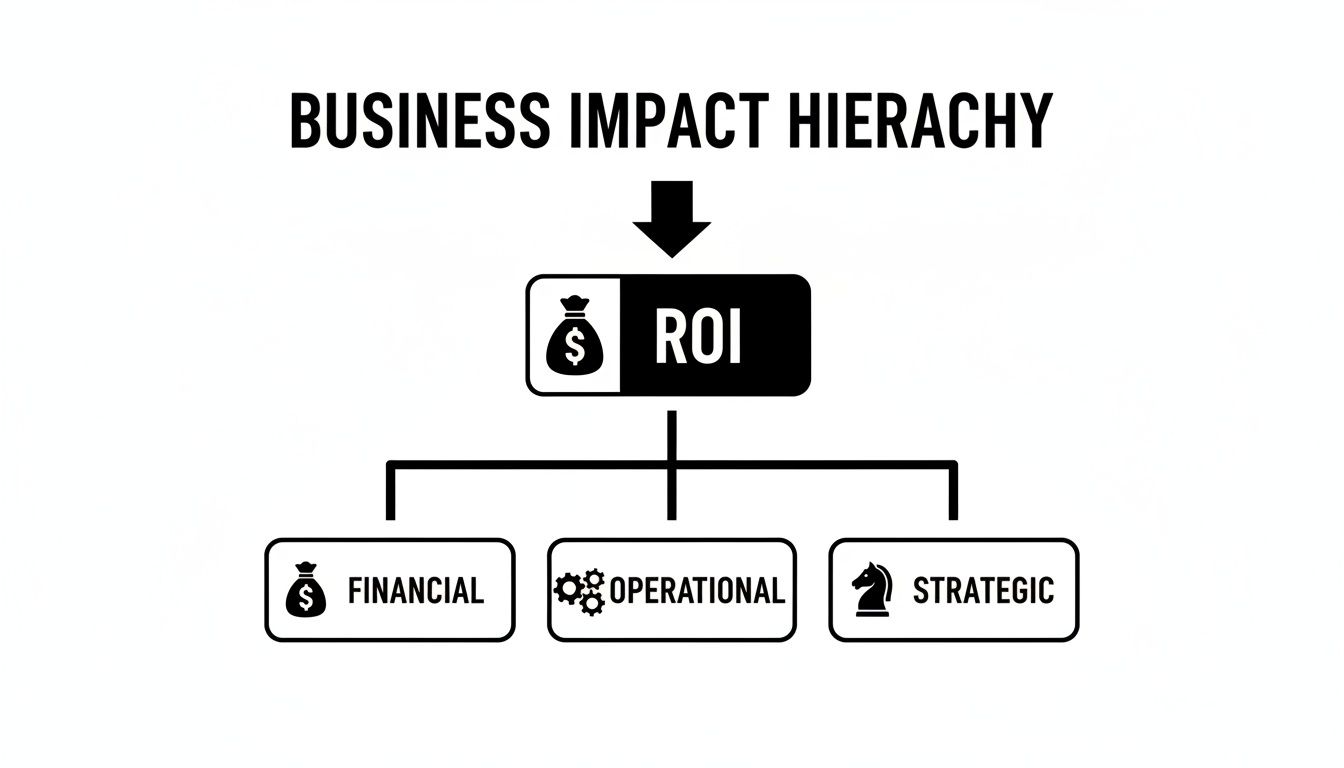
As you can see, the financial, operational, and strategic wins all sit on top of a solid technical foundation. Good engineering makes it all possible.
Custom Component Library Development
For any business serious about scaling, a custom component library is a game-changer. It’s your own private collection of reusable UI building blocks—like buttons, forms, and navigation bars—that ensures consistency across your entire product suite and dramatically cuts down future development time.
A great consultant doesn't just build components; they help you establish a design system. This includes documentation, usage guidelines, and a process for adding new components, which empowers your team to build better and faster on their own.
The main deliverable here is a Reusable UI Component Kit, usually published in a tool like Storybook. This isn't just a folder of code. It’s a living product for your development team that includes:
- A fully tested and versioned set of UI components.
- Interactive documentation that lets you see every component in every possible state.
- Clear installation and usage guides to get developers up and running immediately.
By centralizing your UI, you eliminate redundant work, enforce brand standards, and make your application far easier to maintain. These practices also create a more predictable and accessible experience for users, aligning with many of the principles we cover in our guide to web accessibility consulting.
How to Choose and Price Your Consulting Engagement
So, you're ready to bring in a React expert. The next big question is: how do you structure the deal? Figuring out the right engagement model for React JS consulting is just as important as picking the right person. It's all about aligning their work with your budget, timeline, and what you're ultimately trying to achieve.
Think of it like hiring help for a home renovation. Do you need a contractor for a fixed-price kitchen remodel, a handyman on a monthly service plan for ongoing upkeep, or an electrician by the hour to fix a specific problem? Each approach solves a different need.
Let's walk through the three most common engagement models so you can see which one makes the most sense for your situation.
Project-Based Engagements
This is the most straightforward option. You and the consultant agree on a very specific scope of work, a fixed price, and a clear deadline. It's clean, simple, and perfect for projects with a well-defined beginning and end.
This model works best when you need to:
- Build a Minimum Viable Product (MVP) from scratch to validate a new business idea.
- Add a major new capability, like a complex e-commerce checkout flow or a real-time analytics dashboard.
- Tackle a significant refactoring effort to clean up technical debt that's slowing your team down.
The biggest plus here is budget predictability. You know exactly what the cost will be before a single line of code is written. The trade-off is a lack of flexibility; if the scope changes mid-project, you'll need to renegotiate. For something like a new MVP, expect costs to start around $30,000 and go up from there depending on the complexity.
Retainer-Based Engagements
With a retainer, you pay a fixed monthly fee for a guaranteed number of hours or for ongoing access to an expert's strategic advice. This is the go-to model for businesses needing continuous, long-term support rather than just a one-and-done project.
A retainer turns your consultant from a temporary hired gun into a long-term strategic partner. They get to know your business, your team, and your code, allowing them to offer proactive advice that keeps you ahead of the curve.
This is the right fit for:
- Ongoing maintenance and optimization to keep your app fast, secure, and modern.
- Mentoring and upskilling your in-house team through regular code reviews and guidance.
- High-level strategic advisory for architectural decisions and technical roadmap planning.
The main advantage is having a dedicated expert who is deeply invested in your success. Monthly retainers for a senior-level consultant typically fall in the $5,000 to $20,000+ range. This model fosters an agile partnership, much like how a skilled CI/CD consultant can iteratively improve your entire development workflow over time.
Hourly Engagements
The hourly model offers the most flexibility. You pay the consultant for the exact hours they work. It's perfect for tasks that are tough to scope upfront or when you just need a quick burst of targeted expertise.
You might go with an hourly engagement for things like:
- A deep-dive technical audit to get an expert's opinion on your codebase.
- Troubleshooting a nasty bug or performance bottleneck that your team is stuck on.
- Initial discovery and project scoping to help define the work before committing to a larger project-based engagement.
While it's incredibly flexible, budgeting can be a challenge if the work balloons unexpectedly. In 2026, hourly rates for true expert-level React JS consulting generally land between $125 and $300 per hour. The higher end of that range reflects the immense value of strategic, senior talent who can solve problems in a fraction of the time.
React JS Consulting Engagement Model Comparison
To make the decision even clearer, here's a quick breakdown of how these three models stack up against each other. Each has its place, and understanding the core differences will help you select the structure that best serves your business goals.
| Engagement Model | Best For | Typical Pricing Structure | Key Advantage |
|---|---|---|---|
| Project-Based | Well-defined projects with a clear start and end (e.g., MVP builds, new features). | Fixed price for the entire project. | Cost Predictability |
| Retainer-Based | Long-term, ongoing support, team mentorship, and strategic advisory. | Fixed monthly fee for set hours. | Strategic Partnership |
| Hourly (Time & Materials) | Unpredictable tasks, quick troubleshooting, audits, and discovery phases. | Pay-as-you-go per hour worked. | Maximum Flexibility |
Ultimately, the right choice comes down to clarity. If your project's scope is crystal clear, a project-based model protects your budget. If you need a long-term guide, a retainer builds a powerful partnership. And if you're dealing with uncertainty, an hourly rate gives you the freedom to adapt as you go.
A Founder’s Checklist for Hiring the Right Consultant
Hiring a React JS consultant is a different ballgame than hiring a developer. You’re not just looking for someone who can write clean code. You’re bringing on a strategic partner who needs to connect technical decisions directly to your business goals. A quick look at their GitHub profile or a few algorithm puzzles simply won’t tell you what you need to know.
To make the right call, your process has to weigh business sense, architectural vision, and communication skills just as heavily as their technical chops. This checklist will help you cut through the noise and find a consultant who delivers real, measurable value.
Evaluating Their Portfolio and Past Work
First things first, dig into their track record. But don't just scan a list of past projects. You're looking for proof that they've tackled problems like yours, especially in a relevant business context like SaaS.
- Look for Relevant SaaS Experience: Have they actually built B2B platforms, complex dashboards, or apps with heavy user interaction? Building a simple e-commerce site is a world away from architecting a scalable SaaS product.
- Assess the Scale of Past Projects: Get specific about the size and complexity of applications they’ve architected. Someone who has only built small, brand-new projects has a completely different skill set than a consultant who has untangled a massive legacy app with thousands of active users.
- Review for Business Impact: This is key. Don't just ask what they built; ask what happened because of it. Did their work lead to a 20% bump in user engagement? Did they cut page load times by 50%? Can they point to a measurable lift in conversions?
A great consultant can also guide you on team building. They should have insights on how to hire React developers who can integrate smoothly with your current team and even have a network to tap into. This ability to help you build out your own internal talent is a massive plus.
Technical Interviewing for Strategic Thinkers
When it comes to the technical interview, you have to go deeper than basic React questions. Your mission is to see how they think about high-level architecture, performance trade-offs, and the long-term health of the codebase. Ditch the "gotcha" questions and focus on real-world problems.
Try asking questions that reveal their strategic mindset:
- Architectural Vision: "Imagine you're building a large-scale SaaS dashboard from the ground up. Walk me through how you'd decide on the folder structure, state management, and overall component architecture. What trade-offs are you thinking about from day one?"
- Performance and Optimization: "You've just inherited a React app. It loads slowly and feels clunky when you scroll. What are the first five things you'd investigate, and which tools would you reach for to find the real bottlenecks?"
- Code Refactoring and Business Value: "Tell me about a time you led a major refactor of a React codebase. What was the core technical problem, how did you sell the project to non-technical stakeholders, and what was the measurable outcome for the business?"
These kinds of open-ended questions force a candidate to show you how they think, not just what they know. Their answers will clearly show whether they are a simple task-taker or a genuine problem-solver.
A top-tier consultant won’t just give you a single "right" answer. They will ask clarifying questions about your business context, user base, and long-term goals before proposing a solution, demonstrating that they put strategy before implementation.
Assessing Soft Skills and Business Acumen
Finally, don't forget that a consultant is a communicator, a mentor, and an advisor. Their ability to gel with your team and truly understand your business is non-negotiable. A brilliant engineer who can't explain their decisions or collaborate with others will never deliver the value you're paying for.
In the interview, zero in on these areas:
- Communication and Mentorship: Ask how they handle mentoring junior developers or breaking down a complex technical idea for a project manager. A consultant’s ability to level up your team is a huge part of their value.
- Prioritization and ROI: Give them a tough, real-world scenario. For example: "We have two weeks. We can either refactor our messy state management or build a new feature our customers are screaming for. How do you help us make that call?"
- Pragmatism over Perfection: A great consultant knows that "perfect" is the enemy of "shipped." Ask about a time they had to make a pragmatic technical choice to hit a deadline, even if it wasn’t the textbook engineering solution.
By using this checklist, you stop hiring for a narrow technical skill set and start evaluating a candidate's potential as a true strategic partner. This is how you find a React JS consulting expert who won't just build your app—they'll help you build your business.
Future-Proofing Your SaaS with React and AI

How do you build a platform that won't feel dated in a year? You have to think beyond today's features and anticipate the next wave of innovation, which is clearly AI and automation. A great SaaS app is no longer just a slick interface—it needs to be the command center for intelligent, data-driven work.
This is where smart React JS consulting makes a huge difference. A consultant's real value isn't just in writing code, but in architecting your frontend so that adding AI-powered tools later feels like a simple plug-and-play operation. It's this foresight that separates an app that just works from one that can evolve and stay ahead of the curve.
Building the Bridge Between UI and AI
Think of it this way: your React app is the face of your business logic. An experienced consultant makes sure that face is ready for a brain upgrade. They aren't just building the features you need right now; they're laying the groundwork for the smarter workflows you'll want to add down the road.
For example, a consultant can structure your app to handle data coming from different AI services without slowing things down. This means your UI stays snappy and responsive, even while the backend is busy with complex automated jobs. The goal is a user experience that feels fluid, fast, and frankly, a lot smarter.
We're seeing this play out in a few key areas:
- Dynamic Dashboards: Instead of static charts, we can build interfaces that visualize real-time insights as they're crunched by backend analytics workflows.
- AI Agent Interfaces: Someone has to build the frontend for those AI sales agents and support bots. A consultant ensures that the human-to-AI conversation flows naturally.
- Automated Content Generation: We can design components that seamlessly pull in and display content from generative AI, like personalized sales emails or custom reports.
This approach turns your React application into the perfect launchpad for the AI features that will soon become standard in SaaS.
Your React App as a Foundation for Automation
A big piece of this puzzle is making sure your React app can talk to your automated backend services without any friction. A consultant will set up your app's state management and data-fetching logic to communicate cleanly with APIs that kick off these automated tasks.
A classic example is generating a PDF report from a complex data visualization on a dashboard. A consultant might architect this so that when a user clicks "Download," the app makes a single API call. That API then uses a tool like Puppeteer to spin up a headless browser, render the React component on the server, and save it as a PDF. This keeps the heavy lifting on your server, not your user's browser, so the app stays lightning-fast.
A well-architected React application becomes a flexible container for innovation. It allows you to plug in new AI and automation services without needing to rebuild your entire frontend, giving you a significant competitive advantage.
For founders trying to make sense of all this, bringing in specialized AI consultants can be a game-changer. Their job is to be the architect connecting your user-facing React app to a smart, automated backend, ensuring the platform you're building today is ready for whatever comes next.
Frequently Asked Questions About React JS Consulting
Even with a clear understanding of the benefits, you probably still have some practical questions about what it's really like to work with a React JS consultant. That's completely normal. Let's walk through some of the most common questions we hear from business leaders.
How Long Do Projects Usually Take?
This is the classic "how long is a piece of string?" question, but we can give you some solid ballpark figures based on the type of work you need.
- Technical Audit & Roadmap: If you need a deep dive into your current code and a strategic plan forward, expect this to take 1-3 weeks. It's a focused sprint to get you clarity.
- Performance Optimization: A project dedicated solely to making your app faster and more responsive usually falls in the 4-8 week range.
- New Application or Major Refactor: Building something from the ground up or completely overhauling an existing platform is a much bigger commitment. These projects typically last 3-6+ months.
Any good consultant will break the project into clear phases with milestones, so you always know what’s happening and when to expect it. There shouldn't be any surprises.
Will a Consultant Help My In-House Team?
Absolutely. In fact, this is one of the most valuable, yet often overlooked, benefits of React JS consulting. A great consultant doesn't just build things for you; they act as a force multiplier for your own developers.
They'll mentor your team on the job, introduce best practices, and set up efficient workflows like CI/CD pipelines. The goal is to leave your team more skilled and productive than they were before the project started, which pays dividends long after the engagement ends.
Is React a Good Choice for a New SaaS?
Yes, it’s a fantastic choice, especially if you're a non-technical founder launching a new product. The simple reason is that React's massive popularity gives you access to a huge talent pool, making it far easier to hire developers as your company grows. Its component-based structure also helps you build faster and makes the application easier to maintain, saving you time and money.
What Is the Difference Between React JS and React Native?
It’s a great question and a common point of confusion. The main difference is what you're building for.
React JS consulting is all about building applications for the web—the kind that run in a browser like Chrome or Safari. On the other hand, React Native consulting is for building true native mobile apps for iOS and Android, all from a single, shared codebase.
At MakeAutomation, we specialize in designing and implementing the automated systems that power modern SaaS applications. If you're ready to build a scalable, future-proof platform, we can help architect the powerful backend your React frontend deserves. Learn more about our approach at https://makeautomation.co.