

Sales Pipeline Visibility: How to Build and Maintain It
At the start of a quarter, the pipeline usually looks reassuring. The stages are populated, close dates sit inside the forecast period, and a dashboard gives leadership a clean view of expected revenue. Then a champion stops replying, a procurement review appears, or a buying committee changes, and the confidence behind those opportunities disappears faster than the CRM record reflects.
That gap is the sales pipeline visibility problem. A CRM can show every opportunity that someone entered, but it can't automatically show whether the buyer's priorities still hold, whether the next step has genuine agreement, or whether the deal owner has lost contact with the people who matter. Reliable visibility begins with complete, timely deal signals and shared definitions. Dashboards come last.
The Moment a Healthy Pipeline Suddenly Isn't
It's week 11 of the quarter. In the QBR, the VP of Sales points to coverage and argues that the team has enough late-stage opportunity to land the number. The forecast looks defensible until the close review reveals that several deals have slipped. One prospect froze budget, another lost its internal sponsor, and a third still has no confirmed economic buyer.
Nothing in the CRM necessarily lied. The opportunities were real when they were created. The stages reflected what sellers believed at the time. The problem was that the system recorded a series of snapshots while the buying process kept moving between those snapshots.
A historical benchmark illustrates why this matters. A LinkedIn Sales Solutions analysis of pipeline visibility estimated that 24% of forecasted deals go dark, while decision makers change roles at 20% per year and sales representatives change roles at 25% per year. Those figures are historical benchmarks, not a current forecast for every company, but they expose the operating risk clearly. Deal continuity depends on people, and people move.
The missing layer between records and decisions
A pipeline record tells you the amount, stage, owner, and expected close date. Visibility adds the context leadership needs to decide whether those fields still deserve trust:
- Buying committee health: Is the original champion still involved, and has the seller connected with other stakeholders?
- Commercial readiness: Has the buyer confirmed budget, timing, procurement, and approval requirements?
- Momentum: Did the prospect agree to a next step, or did the seller schedule a hopeful follow-up?
- Ownership continuity: Can another seller understand the deal if the current owner changes roles?
A dashboard can't recover a budget freeze mentioned in a call, a departure noted in an email thread, or a missing stakeholder discussed during a one-on-one. Those signals need to enter the operating system while they still matter. Teams that need to repair inconsistent records should start with a documented CRM data cleansing process before adding more reporting layers.
Practical rule: Treat every forecast surprise as a data-capture investigation before treating it as a dashboard failure.
The useful question isn't “Which chart should we add?” It's “What did the team know two weeks ago that the CRM still doesn't show?” That question leads to better stage criteria, more useful automation, and forecasts people can defend.
The Four Metrics That Prove Visibility Is Real
A pipeline earns trust when its records show four things clearly: forecast reliability, sufficient qualified value, real movement, and recent buyer evidence. Review these metrics weekly, then investigate the records behind the summary.
Forecast accuracy
Compare each forecast category and expected amount with closed revenue after the period ends. Break the review down by team, segment, owner, stage, and forecast category. A company-wide result can hide one segment consistently overstating deals.
One industry benchmark says fewer than 25% of sales organizations achieve forecast accuracy within 10% of actual results, while another cited benchmark says only about 20% of sales teams forecast with more than 75% accuracy using traditional pipeline methods. These benchmarks are summarized in sales forecasting methods and benchmarks. Use the 10% tolerance band as a management boundary, not as evidence that every opportunity is healthy.
Capture forecast category, amount, close date, stage, probability, next-step date, and final outcome in the CRM. Review changes during the week, especially moved close dates, reduced amounts, and category changes. Waiting until quarter-end turns a correctable signal into an explanation.
Coverage ratio
Divide qualified pipeline value by the revenue target. A commonly used benchmark is 3x to 4x pipeline coverage. Report the ratio by stage and segment so late-stage concentration does not disappear inside a total.
Coverage can look healthy while the underlying opportunities lack an active champion, confirmed approval path, or agreed commercial next step. Store qualification fields, stage-entry date, opportunity source, and close-plan status. Managers can then distinguish usable coverage from unqualified volume.
Stage progression
Measure the average time an opportunity spends in each stage and compare it with the team's historical pattern. Build a saved CRM view using stage-entry timestamps, current and previous stage, close-date changes, and next-step dates.
A stalled opportunity needs investigation even when its forecast category remains unchanged. Check whether the buyer has met the stage's exit criteria. Time in stage is a warning signal, not proof that the opportunity is ready to advance.
Data freshness
Create a view of open opportunities showing the last activity date, last meaningful buyer interaction, next-step date, close date, amount, and owner. Separate an internal field edit from a recent buyer signal. A rep can refresh a record without adding evidence that the deal is progressing.
A practical target is to keep freshness above 90% within the last seven days, but treat that as an operating goal rather than a universal rule. Review the activity type and associated contact alongside the timestamp. A recently edited opportunity with no buyer interaction may still be stale.
Teams connecting these measures to broader revenue movement can use a documented framework for what sales velocity measures, provided the inputs and definitions remain consistent. Metrics support visibility only when the underlying records preserve the deal's current reality.
Where Pipeline Data Actually Comes From
The CRM is the destination, not the origin. Deal intelligence begins in the interactions surrounding the opportunity, and each source carries a different part of the story.
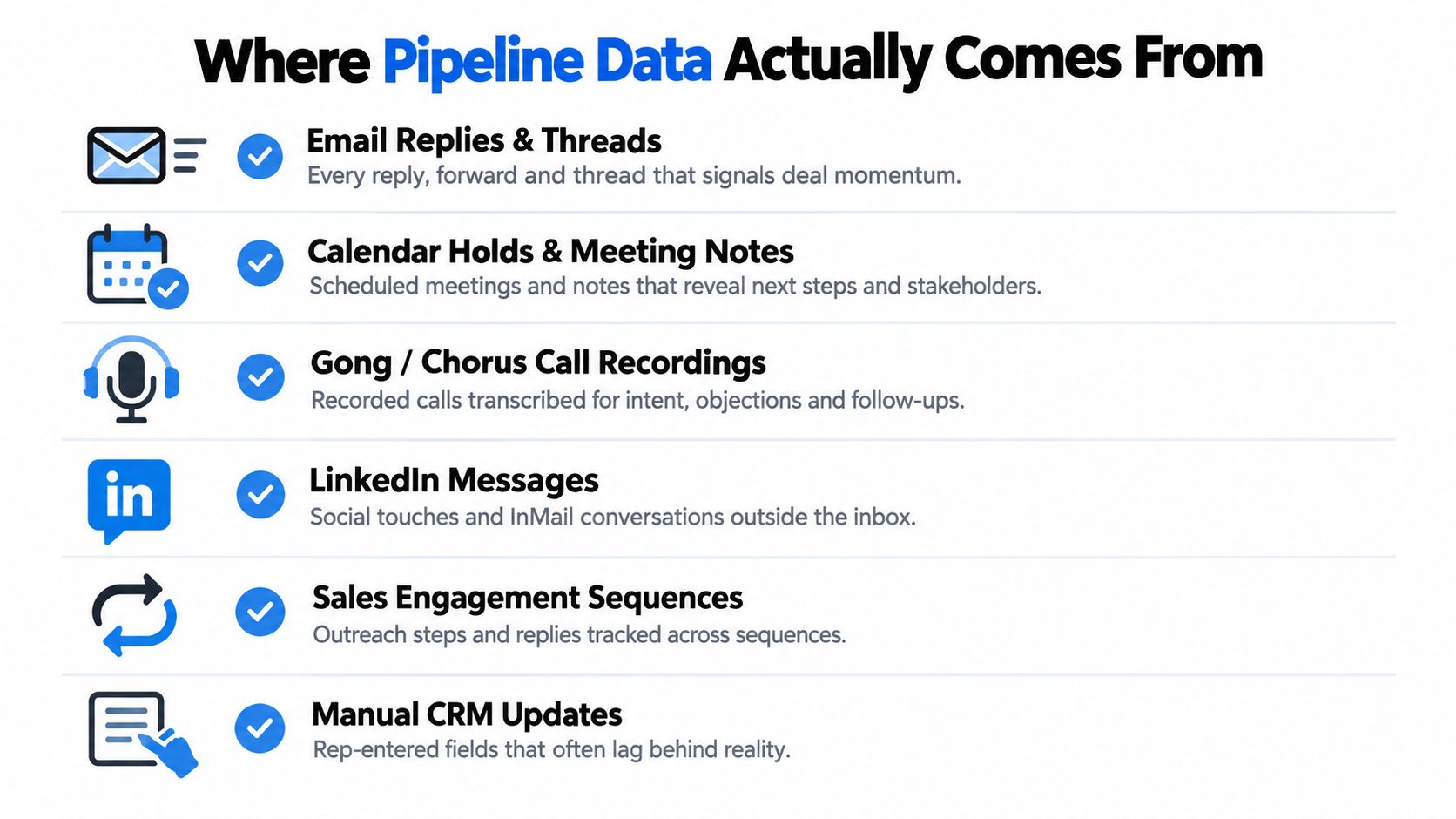
An email reply may reveal that legal has joined the review. A calendar hold may show that the prospect is bringing finance to the next meeting. A Gong or Chorus transcript may capture an objection that never appears in the opportunity notes. A LinkedIn message may contain the only response from a stakeholder outside the seller's normal contact path.
The data becomes unreliable when capture happens late, selectively, or only through manual memory. Reps may summarize a call days later, log an activity against the account instead of the opportunity, or update the stage without recording the reason. By the time a manager sees a stalled deal, the useful context may be spread across an inbox, meeting notes, call recordings, and a shared document.
The seven context leaks to check
- Email threads: Replies, forwards, and stakeholder changes remain outside the opportunity record.
- Calendar details: Attendees and rescheduled meetings reveal buying-committee movement.
- Meeting notes: Next steps may exist in a document that no manager can find.
- Call recordings: Objections, urgency, and internal politics often remain in transcripts.
- Social messages: LinkedIn conversations can contain meaningful buyer intent without creating CRM activity.
- Mutual action plans: Shared documents may hold dates, dependencies, and ownership that aren't mirrored in the deal.
- Rep memory: The seller remembers a concern but doesn't record it until the next review, or at all.
This is why CRM integration should mean more than connecting applications. A practical CRM integration and app syncing approach defines which source owns each signal, how it is associated with an opportunity, and what happens when records conflict.
For teams that rely on outbound calling, a structured hire cold callers resource can also help clarify how call outcomes, objections, and follow-up commitments should be captured. The channel matters less than the handoff. If a conversation changes the deal, the opportunity record needs that context quickly enough for another person to act on it.
No dashboard can rescue information that never enters the system. The capture design must come before the visualization design.
Automating CRM Capture and Data Hygiene
Automation should remove repetitive entry while preserving human judgment where the deal requires interpretation. Start by connecting email and calendar activity to the contact and opportunity, not merely the account. An account-level activity stream can confirm that something happened, but it may not identify which opportunity changed or which stakeholder created the risk.
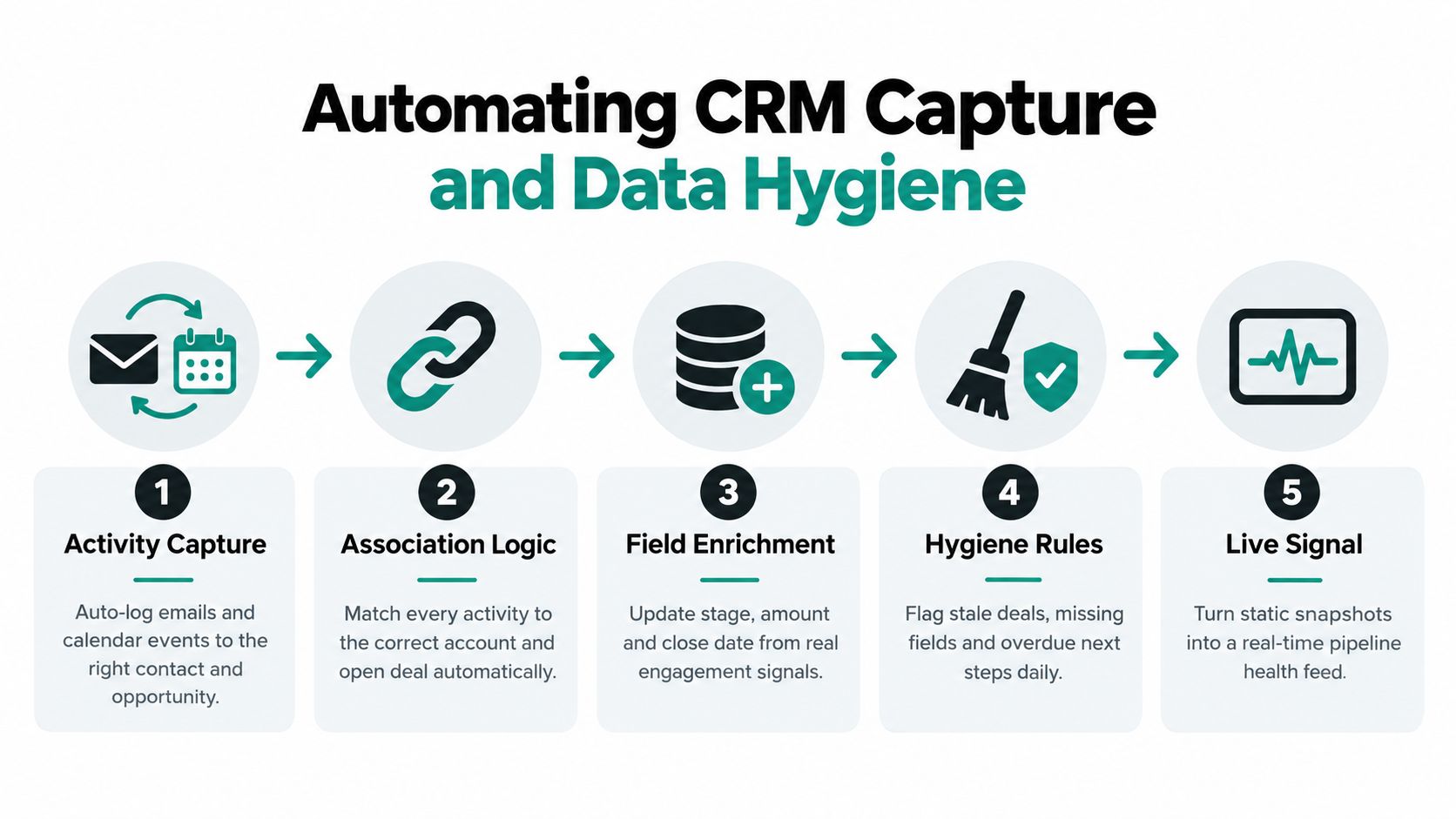
Build rules around evidence
Use stage-exit automation to require the information that makes a forecast usable. When a seller advances an opportunity, require a next-step date, close-date confirmation, current amount, buyer role, and the qualification fields appropriate to that stage. If a deal remains untouched for more than 14 days, a workflow can request a stall reason, prompt a close-date review, and route the record to a manager queue.
A Salesforce Flow could require completed MEDDIC fields before a seller moves an opportunity into Commit. A HubSpot workflow could create a follow-up task when an opportunity has had no meaningful activity for seven days. These examples aren't substitutes for judgment. They prevent the system from accepting a confident stage change without the minimum evidence needed to support it.
Automation should enforce the process your team agreed to, not compensate for a process nobody understands.
Useful hygiene routines are deliberately small:
- Monday pipeline scrub: Spend 15 minutes removing stale next steps, correcting ownership, and challenging slipped close dates.
- Stage-advance controls: Require fields only when they become relevant, so mandatory data supports decisions instead of creating entry fatigue.
- Duplicate management: Run account and lead deduplication jobs, then assign responsibility for resolving ambiguous matches.
- Late-stage review queue: Route opportunities with old activity, repeated close-date changes, or missing stakeholders to a manager view.
The cadence keeps automation honest. Review stage age weekly, audit source attribution monthly, and reset qualification criteria quarterly. Tools such as Salesforce Flow, HubSpot workflows, conversation-intelligence platforms, and integration layers can support the mechanics, but RevOps still owns the definitions and exceptions.
For a practical visual explanation of the workflow, review the short video below.
The best automation is usually quiet. It logs activity, associates records, raises exceptions, and gives sellers a short list of decisions to make. It shouldn't fill the CRM with low-value events or change a stage merely because a meeting occurred.
Aligning Sales, Marketing, and Finance Around One Pipeline
Three teams can use the word pipeline while describing different realities. Marketing may count qualified demand and influenced opportunities. Sales may count opportunities that passed discovery. Finance may focus on bookings and the forecast it can use for planning.
Those views don't need to become identical, but they do need a shared taxonomy. Define each stage with an owner, entry condition, exit condition, required evidence, and treatment in reporting. Qualification frameworks such as BANT or MEDDIC can help, but only if the teams agree on which fields are required and who validates them.
| Stage | Sales Definition | Marketing Signal | Finance Treatment |
|---|---|---|---|
| Qualified | Fit and buying problem are confirmed, with an agreed next step | Lead meets the agreed handoff standard | Excluded from committed revenue |
| Discovery | Seller is validating needs, stakeholders, and decision process | Campaign influence remains visible | Included in early pipeline reporting |
| Solution fit | Buyer has confirmed the relevant solution and evaluation path | Account engagement supports active opportunity status | Included in qualified coverage |
| Commercial review | Pricing, approval path, and timing are being worked | Marketing records supporting influence | Included in late-stage pipeline, not automatically committed |
| Commit | Required evidence and internal confidence support the forecast category | Marketing preserves source and influence history | Used in the agreed forecast view |
| Closed won | Commercial agreement is complete | Campaign attribution is finalized | Recognized according to finance policy |
Attribution creates another source of conflict. First-touch attribution credits initial demand creation, last-touch attribution credits the interaction nearest conversion, and weighted models distribute credit across multiple contacts. None is automatically correct for every decision. Document which model applies to campaign reporting, sourced pipeline, influenced pipeline, and compensation so the same opportunity doesn't produce contradictory answers.
A recent B2B pipeline-visibility analysis cites up to 27% lost forecasted revenue from inaccurate or outdated pipeline data, while emphasizing that inconsistent definitions and stale records undermine trust. See the cross-functional pipeline visibility analysis for that framing.
A monthly cross-functional review should use one report. Marketing, sales operations, and finance can challenge the assumptions behind the number before the CRO does. The purpose isn't to force agreement on every interpretation. It's to make disagreements visible, documented, and operationally manageable.
Designing Dashboards for Each Decision Level
A dashboard fails when it answers a question nobody at that level needs to ask. Executives, managers, and reps interact with the same pipeline, but they need different views of it.
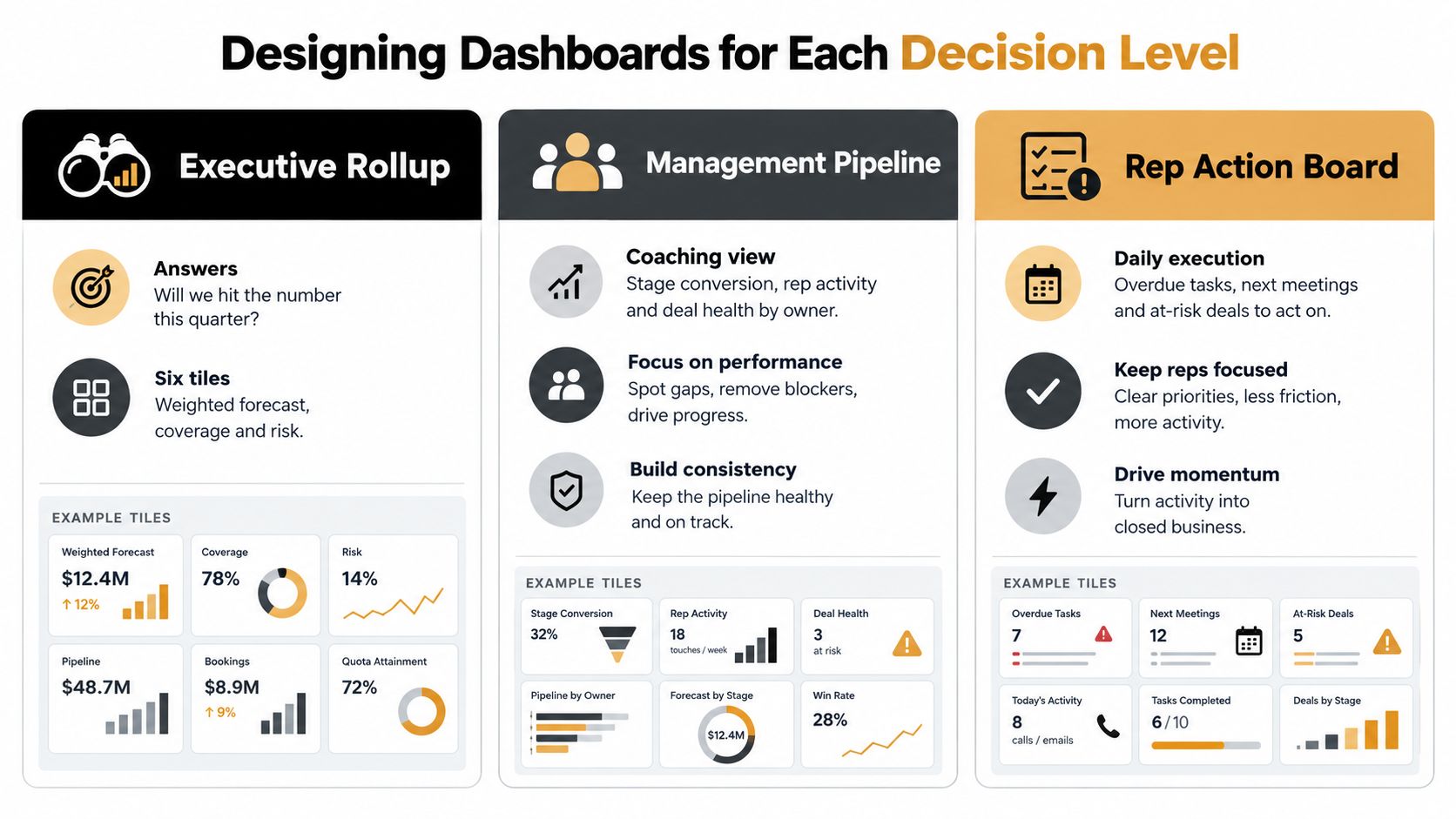
The executive rollup
The executive view should answer one question: Will we hit the number this quarter? Keep it to six tiles:
- Weighted forecast
- Commit coverage
- Best-case upside
- Slippage trend
- Win rate
- Pipeline created versus consumed
Each tile needs a clear definition and a drill path. If slippage rises, the CRO should be able to open the affected opportunities, owners, stages, and reasons without requesting a custom report. Adding more tiles because the CRM can calculate them usually reduces attention rather than improving control.
The manager drilldown
Managers need coaching signals, not a second executive rollup. Their dashboard should surface deal age, stage conversion by rep, opportunities without a credible next step, repeated close-date changes, and one-on-one review queues.
This view supports management by exception. A healthy opportunity moving through agreed stages may not need another status conversation. A large deal with no recent buyer activity, an incomplete stakeholder map, or an unexplained stage jump does.
The rep workspace
The rep's home screen should support action today:
- Action queue: Opportunities with overdue tasks or missing next steps.
- Meeting preparation: Upcoming buyer meetings, attendees, recent activity, and open risks.
- Pacing view: Quota attainment and current opportunity movement.
- Follow-up reminders: Commitments created from calls, emails, and meetings.
Put this workspace inside the CRM rather than behind a separate BI tab. A rep who must search for the action list will default to memory and inbox triage. Leaders comparing dashboard patterns can use these 7 KPI dashboard examples as a source of design inspiration, then remove anything that doesn't support a specific decision.
A dashboard should reduce the number of questions a manager has to ask, not give the manager more screens to interpret.
Layering matters because decision frequency determines the right level of detail. Executives need a compact periodic view, managers need investigative detail, and reps need immediate tasks. Keep those purposes separate even when the underlying data model is shared.
Owning Visibility With a Process That Survives Rep Turnover
Pipeline visibility is fragile when it belongs to the seller currently sitting in the role. A rep may know why a buyer paused, which stakeholder has influence, and what the next meeting must accomplish, but that knowledge has little operational value if it never reaches the CRM.
Assign a named owner, typically a RevOps lead, with a written charter. The charter should define data standards, stage definitions, required fields, dashboard ownership, exception handling, and the cadence for changing the process. Without that accountability, sales managers optimize for forecast calls, marketing optimizes for handoffs, and finance optimizes for reporting, while no one maintains the shared system.
A lightweight operating rhythm
- Weekly review: Use a 30-minute session to inspect stage hygiene, slipped deals, missing next steps, and late-stage exceptions.
- Monthly audit: Sample 5% to 10% of open opportunities for field completeness, contact freshness, activity association, and close-plan evidence. The range is a practical audit design, not a universal compliance standard.
- Quarterly reset: Reconcile stage criteria, qualification requirements, and close-plan expectations with how buyers are purchasing.
Rep turnover deserves its own control. Before a seller exits, require a handover containing active opportunities, next steps, champion and stakeholder contacts, current risks, close-date rationale, and closed-lost reasons where relevant. Reassign the deal owner in the CRM, preserve the activity history, and schedule a manager review so the new owner isn't forced to reconstruct the opportunity from scattered notes.
Onboarding should introduce the stage-definition document in the new rep's first week, not after the first forecast problem. If an SDR pipeline changes ownership, automate the reassignment and create tasks for the receiving owner. The system should preserve continuity without pretending that ownership changes are merely administrative.
The standard is simple: another competent seller should be able to open an opportunity and understand what is true, what is uncertain, and what must happen next. If only the previous owner can explain the deal, the company doesn't have pipeline visibility. It has individual memory.
MakeAutomation helps B2B and SaaS teams configure CRM stages, capture activity, build automation rules, and connect reporting to a more trustworthy sales pipeline. Visit MakeAutomation to discuss an automation framework that turns scattered deal signals into a maintained operating process.