
Mastering software project estimation: Deliver Projects On Time
You’re staring down a new project, the stakeholders want a hard deadline, but the path forward is anything but clear. This is where solid software project estimation comes in. It’s the art and science of predicting the time, effort, and cost needed to get a project over the finish line, turning gut feelings into a reliable roadmap.
Why Most Software Estimates Fail and How to Fix It
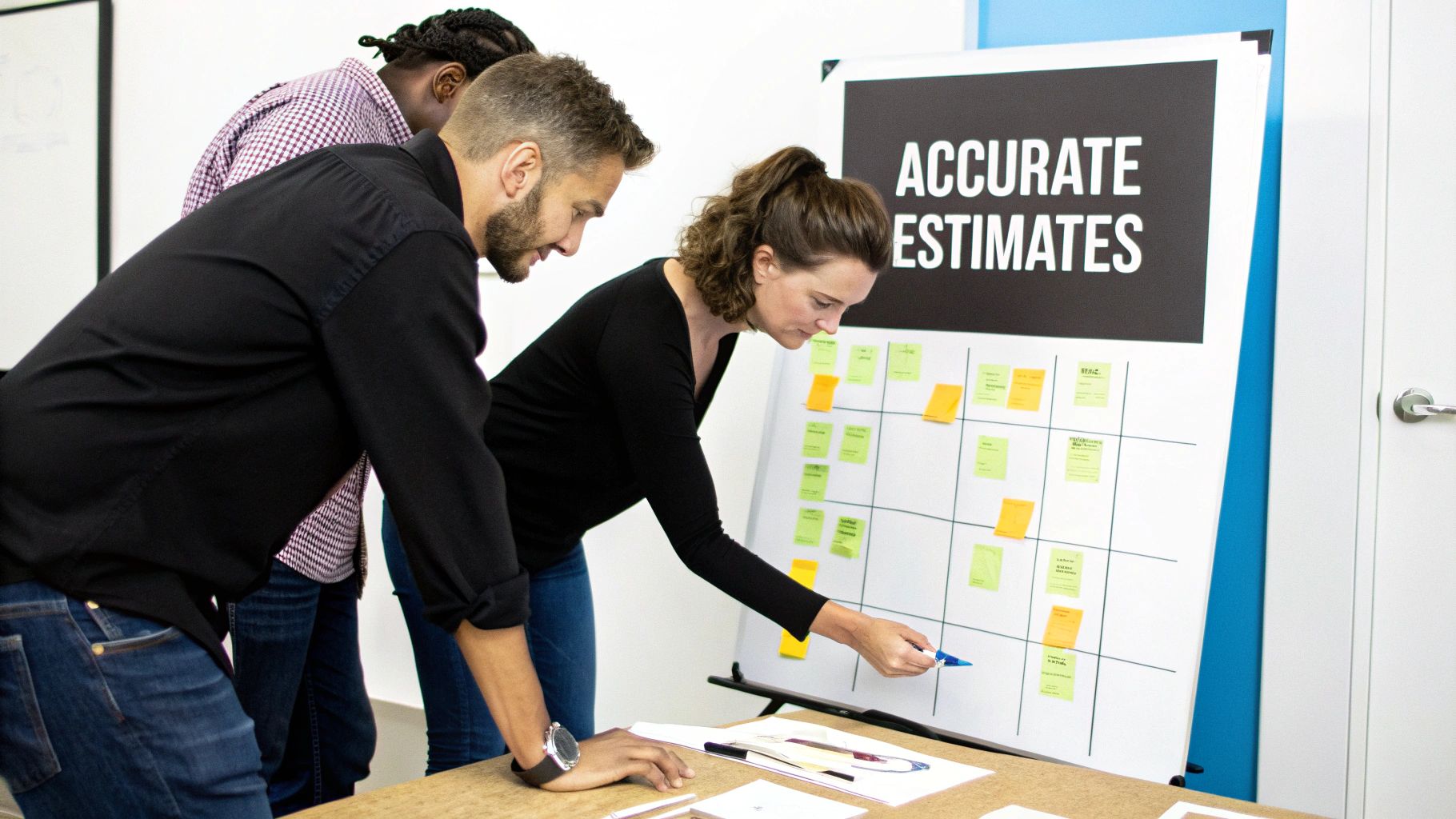
If you've ever seen a project's timeline balloon and its budget burst, you're in good company. The hard truth is that most initial software estimates are broken before a single line of code gets written. A huge part of the problem is our natural optimism bias—we tend to downplay complexity and assume a best-case scenario, ignoring the roadblocks that are almost certain to pop up.
This rosy outlook is usually amplified by pressure from stakeholders who need a firm number for their own budgets and planning. The result? A number gets pulled out of thin air, completely disconnected from the project's real scope or what the team can actually deliver.
The Real-World Impact of Bad Estimates
The fallout from bad estimation is brutal. A jaw-dropping 70% of software projects blow past their initial estimates. This often leads to budget overruns soaring as high as 189% and projects being delivered an average of 52% later than planned. These aren't just numbers; they represent a fundamental breakdown that leads to lost money, soured client relationships, and a burned-out team.
"An estimate is not a promise carved in stone; it's a forecast based on the information you have right now. The goal isn't perfect prediction but creating a reliable framework for making decisions."
When an estimate doesn't account for hidden technical debt, the inevitable "scope creep," or dependencies on third-party APIs, it’s doomed from the start. Each of these unknowns adds a layer of uncertainty that a simple, single-number guess can never cover.
Moving from Guesswork to Data-Informed Decisions
The fix is to build a repeatable estimation process that’s actually grounded in reality. It starts with breaking massive, intimidating projects into smaller, bite-sized pieces that are far easier to size up accurately. It also means looking at your team's past performance to get a clear picture of what they can realistically accomplish.
When you shift your mindset this way, estimates become strategic tools instead of fragile promises. Since so much of estimation is tied to team performance, it's always a good idea to look for ways to improve developer productivity. To make this transition, you'll need to focus on a few key areas:
- Detailed Scope Definition: Turn fuzzy concepts into a concrete work breakdown structure. No more vague requirements.
- Team Velocity Calibration: Dig into past project data. Understand your team's actual, proven output—not what you wish it was.
- Risk Assessment: Actively hunt for potential problems and build in realistic contingency buffers. What could go wrong?
- Method Selection: Pick the right tool for the job. Different project management methodologies call for different estimation techniques.
At the end of the day, accurate software project estimation is all about creating predictability. It builds trust with your clients, empowers your team, and sets everyone up for success.
Choosing Your Estimation Toolkit: Key Methods Explained
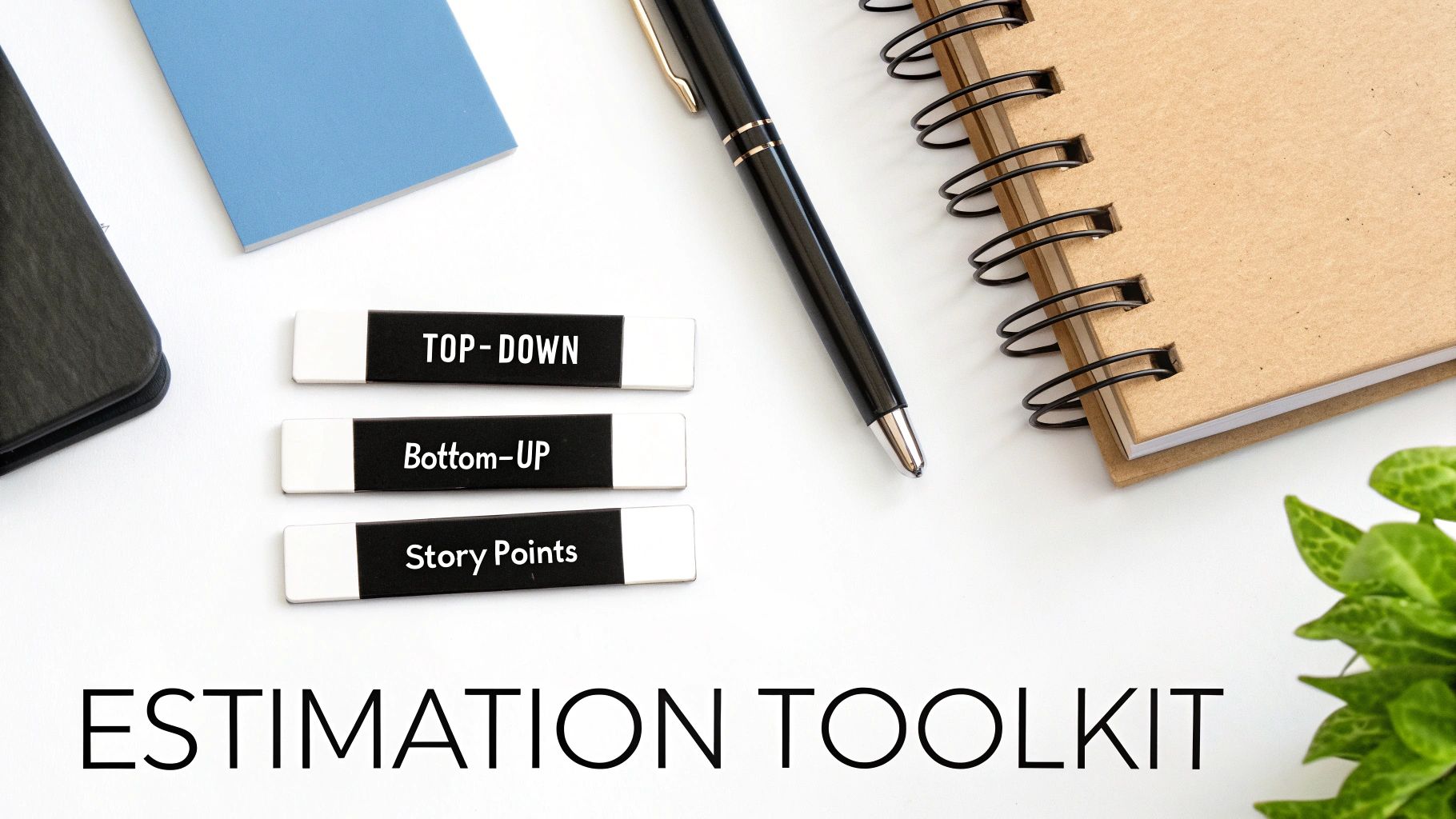
Think of software estimation methods like a mechanic's toolbox. You wouldn't use a sledgehammer for a delicate engine repair, right? The same logic applies here. The right technique depends on where you are in the project lifecycle, how much detail you have, and how your team works. The real skill is in building a versatile toolkit, not just relying on one go-to method for everything.
At the heart of it, most estimation techniques boil down to two core philosophies: you can either look at the project from 30,000 feet or get down in the weeds. Let's break down what that means in practice.
Top-Down Estimation: The Big Picture View
Top-down estimation is your go-to for quick, early-stage answers. It's essentially an educated guess based on past experience. You look at the new project, think of a similar one you've done before, and use that as a baseline.
This approach is perfect for those initial sales calls or stakeholder meetings when someone asks for a ballpark figure and you have little more than a concept to go on. For example, if you built a similar SaaS analytics dashboard six months ago that took about three months, you might propose a similar timeframe for the new request. It’s fast, simple, and gives everyone a starting point.
The obvious catch? It's only as good as the comparison. If the new project has hidden complexities or unique requirements, your estimate can be way off. Use it for initial guidance, but never treat it as the final, binding number.
Bottom-Up Estimation: The Detailed Approach
When accuracy is paramount, you need to switch to bottom-up estimation. This is the opposite of top-down. You break the entire project down into the smallest possible tasks—individual user stories, bug fixes, or technical components. Your team then estimates the effort for each tiny piece, and you add it all up.
It’s far more reliable because it forces you to think through every single step. Instead of just "build user authentication," you'd estimate the UI design, the front-end form, the back-end API, the database changes, and the integration tests separately.
By deconstructing the project into manageable tasks, bottom-up estimation uncovers hidden work and dependencies that high-level methods often miss, leading to a much more reliable final number.
The trade-off is time. This method is intensive and requires a well-defined scope. It’s best used after you've completed a discovery phase and have a clear Work Breakdown Structure (WBS) ready to go.
Agile and Data-Driven Models
Beyond those two fundamental approaches, the software world has developed more specialized methods to fit modern workflows and bring data into the picture.
Story Points (Agile): A favorite in Agile circles, story points measure relative effort. Instead of hours, teams assign points (often using a Fibonacci-like scale: 1, 2, 3, 5, 8) that reflect a task's complexity, uncertainty, and the work involved. It’s a brilliant way to decouple estimates from the clock and focus on the sheer size of the work.
Function Points (Traditional): This is a more formal method that sizes up a project based on the business functionality it delivers. It analyzes things like user inputs, outputs, and data files to assign a "function point" score, making it totally independent of the programming language or tech stack.
Parametric Modeling (Data-Driven): For teams with solid historical data, this is a powerful option. It uses statistical models to find relationships between project variables (like lines of code or team size) and final outcomes. The classic example is COCOMO, which can achieve accuracy within 20% for 80% of cases when fed high-quality data.
To help you decide which approach fits your needs, here's a quick-glance comparison of these common estimation techniques.
Comparison of Estimation Methods
| Method | Best For | Pros | Cons |
|---|---|---|---|
| Top-Down | Early-stage quotes, ROM estimates, sales proposals. | Fast, requires minimal detail, easy to understand. | Low accuracy, relies heavily on past projects being truly similar. |
| Bottom-Up | Detailed project planning when scope is clear. | Highly accurate, exposes hidden tasks and dependencies. | Time-consuming, requires a well-defined scope upfront. |
| Story Points | Agile/Scrum teams focusing on relative effort. | Decouples effort from time, accounts for complexity and risk. | Can be abstract for stakeholders, relies on team consistency. |
| Function Points | Large enterprise systems, projects where functionality is key. | Tech-agnostic, focuses on business value. | Complex to calculate, requires specialized training. |
| Parametric | Organizations with a large volume of historical project data. | Data-driven and objective, can be very accurate. | Requires clean, consistent historical data to be effective. |
Ultimately, there’s no single "best" method. The strongest teams I've worked with often blend these approaches. They might start with a top-down estimate for a sales proposal, then switch to a detailed bottom-up analysis once the contract is signed and the scope is locked in.
If you want to go even deeper, there are many different software estimation techniques you can explore and adapt to your team's specific needs. The key is to stay flexible and choose the right tool for the job at hand.
The Art of Sizing and Scoping Your Project
An estimate is only as good as the requirements it's built on. Simple as that. Before you can ever hope to put a number on a project, you have to get crystal clear on what you’re actually building. This is the foundational work—the part where you translate a client's big idea into a detailed, actionable plan. Get this right, and you stop scope creep before it even gets its shoes on.
This all starts with turning a vague request like "we need a new customer dashboard" into a rock-solid Statement of Work (SOW). A good SOW doesn't just list features. It draws the lines in the sand, spelling out deliverables and defining what a "win" looks like for everyone. Without that clarity, you're building your estimate on quicksand.
From Vague Ideas to Concrete Plans
The first real step is getting everyone in a room (virtual or otherwise) for some serious requirements gathering. Your job here is part-detective, part-therapist. You need to uncover the hidden complexities and assumptions that stakeholders don't even know they have. Don't just ask what they want—ask why. Time and time again, understanding the business goal behind a feature request reveals a much simpler, more effective path.
For instance, a client might ask for a complex, custom-built reporting engine. After digging in, you could discover all they really need is a weekly CSV export of user activity. That one insight can save weeks of development, completely changing the estimate. It’s about solving the real problem, not just building the shiny object they asked for.
A well-defined scope is your project's constitution. It's a shared agreement that protects the client from surprise bills and your team from an endless death march of un-scoped revisions.
Creating this shared understanding means going from high-level concepts to nitty-gritty details. This is where you bring in a Work Breakdown Structure.
Creating Your Work Breakdown Structure
A Work Breakdown Structure (WBS) is a fancy name for a simple concept: breaking a huge project into smaller, bite-sized pieces. Think of it like creating a detailed map before you start a cross-country road trip. You start with the big destinations (epics), break them down into cities (feature sets), and then into individual stops (user stories or tasks).
For example, an epic like "Implement User Authentication" might get broken down like this:
- Feature Set: User Registration & Login
- User Story 1: As a new user, I want to sign up with email and password to create an account.
- User Story 2: As a returning user, I want to log in to access my dashboard.
- Feature Set: Password Management
- User Story 3: As a user, I want to reset my forgotten password via email.
This hierarchy does more than just keep things organized. It forces the team to think through every single component, every dependency, and every potential hiccup. Each user story becomes a self-contained unit of work that can be estimated on its own—the absolute core of an accurate bottom-up estimate. To really nail this, you'll want a bulletproof agile requirements document backing you up.
Sizing Tasks and Defining Boundaries
With your WBS in hand, you can start sizing each task. It doesn’t matter if you use story points, ideal developer days, or plain old hours—the key is consistency. Remember, sizing isn't just about the time spent coding. It has to cover the entire lifecycle: design, dev, testing, code review, and deployment. Forgetting these "hidden" tasks is one of the most common and costly estimation mistakes.
This is also the moment where you get aggressive about defining what's out of scope. Stating what you won't be building is just as crucial as listing what you will.
For our authentication example, that might look like this:
- In Scope: User authentication via email and password.
- Out of Scope: Social logins (Google, Facebook), two-factor authentication (2FA), and single sign-on (SSO).
Putting these boundaries right in the SOW is your best defense against scope creep. Later on, when a stakeholder inevitably asks, "Can we just add Google login real quick?" you have a document to point to. It turns a potentially awkward "no" into a structured business conversation about a change request and its impact on the timeline and budget. By mastering this groundwork, your estimate becomes a credible plan, not just a hopeful guess.
Calibrating Your Team and Managing Uncertainty
Even a perfectly scoped project can fall apart if your estimate ignores two simple truths: every team has its own rhythm, and every project comes with surprises. A truly solid estimation process has to bridge the gap between the what of the project and the how of your team's real-world ability to deliver.
This all starts with getting a handle on your team's velocity. Think of velocity not as a target to hit, but as a historical measure of the work your team actually gets done in a typical sprint. It’s your most reliable crystal ball because it's based on cold, hard data—not wishful thinking.
Grounding Your Estimate in Reality with Team Velocity
Calculating velocity is straightforward. Just add up the story points (or whatever unit you use) for all the user stories your team fully completed over the last few sprints. If they knocked out 25, 28, and 22 points in the last three sprints, your average velocity is 25 points. That number is pure gold.
Suddenly, your entire estimate is grounded in reality. If you’ve sized a project at 150 story points, you can now forecast that it’ll take your team roughly six sprints to complete (150 points / 25 points per sprint). This data-driven approach removes emotion and replaces it with a forecast built on a proven track record.
An estimate without historical velocity is just a guess. An estimate with velocity is a forecast. It's a powerful way to show stakeholders that your timeline is based on measurable, past performance.
Of course, this is just the baseline. People take vacations, get sick, or join the team mid-project. Factoring in these real-world capacity shifts is a critical part of good resource allocation optimization, and it keeps your timeline from becoming a fantasy.
This whole process relies on breaking down big ideas into small, measurable tasks. This flow shows exactly how that's done.
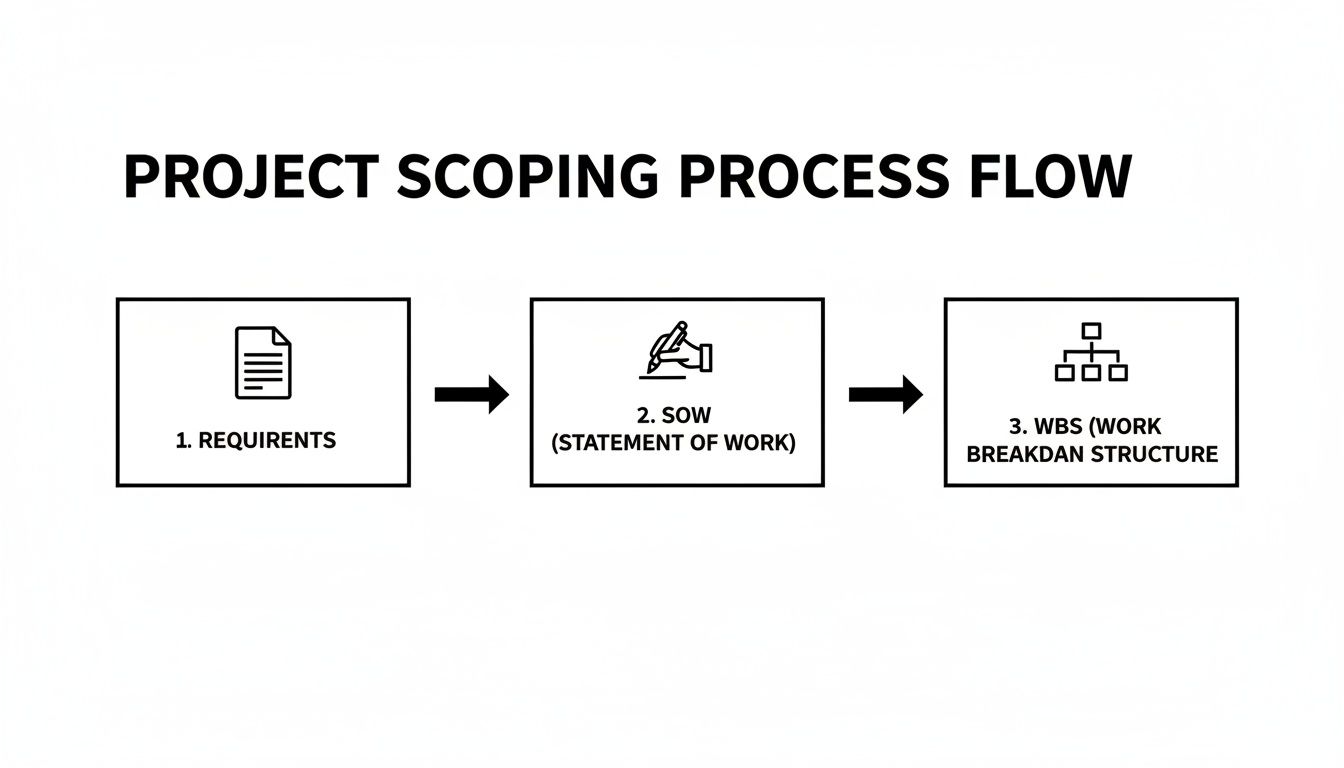
This journey from high-level requirements to a detailed Work Breakdown Structure (WBS) is what makes a reliable, bottom-up estimate possible.
Building Resilience with Risk Buffers and Contingency
No project goes exactly to plan. The projects that succeed are the ones that planned for things to go wrong. A mature estimation process doesn't just cross its fingers and hope for the best; it actively anticipates risks and builds in a cushion to absorb them.
Get your team in a room and start brainstorming. What could derail this project?
- Technical Risks: What if that third-party API is flakier than we thought? What hidden technical debt are we about to uncover?
- Team Risks: What’s the plan if our lead developer wins the lottery? Or just gets the flu for a week?
- Scope Risks: Are there any fuzzy requirements that could blow up into major new features down the road?
Once you have a list, you can build in a contingency buffer. This isn't just pulling a number out of thin air. It's a calculated reserve of time and budget set aside specifically for these unforeseen issues.
Below is a look at some common risks and the kind of buffers you might consider.
Common Project Risks and Mitigation Buffers
| Risk Category | Example | Typical Impact | Suggested Contingency Buffer |
|---|---|---|---|
| Technical Risk | Unreliable third-party API | High | 15-25% |
| Scope Creep | Vague or changing requirements | Medium to High | 10-20% |
| Resource Risk | Key team member leaves or is unavailable | High | 10-15% |
| External Dependencies | Delays from another team or vendor | Medium | 5-15% |
This approach transforms your estimate from a single, brittle number into a more honest and durable range. Instead of promising the project in "12 weeks," you can now confidently say "we're forecasting 12-14 weeks." This transparency tells everyone you have a plan for when—not if—the unexpected happens, building trust and setting the project up for success.
Integrating Estimation into Your Daily Workflows
An incredibly accurate software estimate is completely useless if it just sits in a forgotten spreadsheet. For an estimate to be a real asset, it has to be a living, breathing part of your daily operations. This means weaving it into the very fabric of how your teams plan their work, execute on it, and ultimately deliver the final product.
The first thing you need to do is stop reinventing the wheel for every new project. Create a standardized estimation template that everyone on the team uses. This isn't about adding red tape; it's about building a consistent process that lets you compare apples to apples across different projects and ensures nothing critical gets missed.
This simple act of standardization is the foundation for getting better over time. When every project follows the same estimation structure, you start building a powerful library of historical data you can learn from.
Bridging Estimation and Project Management
Your estimate shouldn't be a fire-and-forget missile you launch at the beginning of a project. It needs to be directly connected to your project management tools, whether that’s Jira, Asana, or ClickUp. This integration is where the magic really happens, creating a powerful feedback loop.
By linking your initial estimates to the actual tasks and tickets your developers are working on, you can track progress in real time. Are certain tasks taking way longer than planned? Are others getting done faster? This data is gold. It lets you spot potential delays weeks in advance and adjust your plan, rather than getting blindsided right before a deadline.
A software project estimation that isn't tracked against actuals is just a guess. Integrating it with your project management system transforms it into a dynamic forecasting tool that sharpens your accuracy over time.
This real-time tracking does more than just keep the current project on course. It generates the raw data needed to refine your team's velocity and make your next estimate even more on the money.
Arming Your Sales Team with Data
Let's be honest: the estimation process often kicks off long before a project manager ever sees it—usually right in the middle of a sales conversation. An unprepared sales team, working off pure optimism, can easily make promises that set the delivery team up for failure. To stop this from happening, you need to arm them with the right tools.
Create a simplified, high-level estimation calculator based on your historical project data. This gives your sales reps a way to provide confident, data-backed initial estimates without needing to be deep technical experts. It could be a simple spreadsheet or a more polished internal tool that asks a few key questions about the project's scope.
For instance, a calculator for a new SaaS feature might ask for inputs like:
- Number of new data models: (e.g., users, products, orders)
- UI complexity: (e.g., simple forms vs. interactive dashboards)
- Number of third-party integrations: (e.g., payment gateways, analytics tools)
Based on the answers, the tool can spit out a rough order of magnitude (ROM) estimate, like "400-500 hours" or "a 3-4 month project." This gives the client a realistic starting point and, more importantly, prevents the sales team from overcommitting.
Building a Continuous Improvement Loop
The ultimate goal here is to create a system where every project you finish makes your next estimate better. This is the feedback loop that separates high-performing teams from everyone else. At the end of each project, hold a post-mortem specifically focused on how well you estimated.
Get the team together and ask some tough questions:
- Where were our estimates most accurate?
- Which tasks completely blew past their estimates, and why did that happen?
- Did we forget to account for anything? (Think testing, deployment pipelines, endless meetings, etc.)
- How can we update our estimation template to capture what we just learned?
By diligently analyzing the gap between your estimates and reality, you turn every project—whether it was a runaway success or a painful slog—into a valuable learning experience. This transforms software estimation from a one-off chore into a strategic capability that drives predictability, builds client trust, and gives your business a serious competitive edge.
Your Top Software Project Estimation Questions Answered
Even with the best frameworks in place, let's be honest—software estimation is full of curveballs. Teams I've worked with tend to hit the same walls over and over again, from staring down a project with massive unknowns to managing expectations when the goalposts inevitably move.
This section tackles those common "what-if" scenarios head-on. Think of it less as a textbook and more as a field guide for the messy reality of building software. The goal is to give you the confidence to handle these situations, turning potential roadblocks into productive conversations.
How Do You Estimate a Project with Many Unknowns?
When a project is 90% fog and 10% clarity, giving a single, hard number is setting yourself up for failure. The trick is to embrace the ambiguity, not fight it.
Instead of locking yourself into "5 weeks," present a ranged estimate like "4-6 weeks." This one simple change immediately signals the level of uncertainty to everyone involved. It’s an honest reflection of what you know right now.
A concept I always come back to is the Cone of Uncertainty. It perfectly illustrates how estimates are naturally wide at the beginning of a project and get sharper as you learn more. Your process should mirror this.
Kick off with a high-level, top-down estimate to get the initial budget and plan approved. Then, make it clear that you’ll refine it iteratively. After the first sprint or a dedicated discovery phase, you can break down the next chunk of work and provide a much tighter, more reliable estimate for that specific piece. This approach builds massive trust by showing you have a clear plan for chipping away at the unknown.
What Is the Difference Between Effort and Duration?
This is easily one of the most common and damaging mix-ups in project estimation. Getting this wrong is how reasonable timelines turn into perceived disasters.
- Effort is the pure "hands-on-keyboard" time. Think of it as the total number of person-hours needed to get the job done. A task might require 40 hours of effort.
- Duration is the calendar time that ticks by from start to finish. It’s the reality of the work week, filled with meetings, coffee breaks, dependencies, and weekends.
A task needing 40 hours of effort from one developer will never take 40 hours of calendar time. It will take at least a full week, and probably more. You have to be explicit about which one you're talking about.
A rock-solid estimate always separates effort from duration. When you present a timeline, spell it out: "This feature requires 80 hours of development effort, which we forecast will take a duration of three calendar weeks to complete."
How Should We Handle Scope Creep After an Estimate Is Approved?
Scope creep is going to happen. The goal isn't to build an impenetrable wall against it but to manage it intelligently when it appears. Your best defense is a proactive offense: a crystal-clear initial scope and a formal change control process.
Think of this process as your project's immune system.
When a stakeholder requests something new, the process kicks in. This isn't about saying "no." It's about framing the conversation as, "Yes, we can definitely look at that. Here’s what it will mean for the timeline and budget."
A simple, effective change control workflow looks like this:
- Document the Request: Get the new requirement in writing. What is it? Why is it important for the business?
- Estimate the Impact: Your team does a quick analysis of the additional effort, cost, and time required.
- Present the Trade-Off: Go back to the stakeholder with a clear, simple choice. "We can add this new feature. It will add an estimated two weeks to the timeline and $10,000 to the budget. How would you like to proceed?"
This makes the consequences of scope changes visible and turns a tense negotiation into a collaborative business decision. It protects your team from burnout and keeps stakeholders firmly in control of the project's destiny.
How Often Should We Re-Estimate a Project?
For any project lasting more than a couple of weeks, the initial estimate should never be the final word. A software project is a journey of discovery, and your forecast needs to evolve as you learn. Re-estimating should be a routine activity, not an emergency meeting.
In Agile teams, this happens naturally every couple of weeks during sprint planning. The team is constantly re-calibrating its forecast for the next chunk of work.
For longer-term projects, it’s a good practice to formally review and adjust the overall project estimate at key milestones. This could be monthly or quarterly, depending on your project's rhythm. This cadence keeps the forecast from getting stale, lets you incorporate new information, and—most importantly—prevents stakeholders from being blindsided by bad news late in the game. It reinforces that an estimate is a living document, not a promise carved in stone.
At MakeAutomation, we specialize in building the robust processes that turn chaotic workflows into predictable, scalable systems. If you're ready to implement a professional software estimation framework that drives growth and client trust, let's talk.
Discover how MakeAutomation can optimize your project management workflows.