Guide: waterfall and agile project management
When you're trying to choose between waterfall and agile project management, you're really making a choice between two core philosophies: predictability versus adaptability. The Waterfall model gives you a clear, linear path that’s perfect when you know exactly what you need to build. Agile, on the other hand, is an iterative, flexible framework built for projects where the final destination might shift as you go.
The right choice isn't about which one is "better" but which one is right for your project. Do you need a detailed, unchangeable map, or do you need a reliable compass to navigate changing terrain?
Exploring Project Management Philosophies
Before we can really compare these two dominant methods, we have to get to the root of what they are. Each was developed to solve very different kinds of problems, and they reflect entirely different ways of thinking about getting work done. One is all about planning everything upfront, while the other is designed to embrace and respond to change.
The Structured Approach of Waterfall
The Waterfall methodology is as straightforward as it sounds—it's a sequential process where a project cascades down through distinct phases. Think of it like building a house. You have to pour the foundation before you put up the walls, and the walls have to be standing before you can even think about the roof. Each phase must be 100% complete and formally signed off before the next one can begin.
This model has its roots in manufacturing and construction, industries where changing your mind halfway through is incredibly expensive and disruptive. That’s why its greatest strength is predictability.
The key features of the Waterfall model are:
- Sequential Phases: The project moves through a strict, one-way sequence: Requirements, Design, Implementation, Testing, and Deployment.
- Upfront Planning: A massive amount of effort goes into defining every single project requirement, deliverable, and timeline at the very beginning.
- Documentation-Heavy: Each stage produces comprehensive documentation that acts as the blueprint for the next phase. There's no moving forward without it.
The Adaptive Nature of Agile
In stark contrast, Agile is an iterative approach born out of the fast-paced and often unpredictable world of software development. Instead of one long, rigid development cycle, Agile breaks the project down into small, digestible chunks called sprints.
At its core, Agile is more of a mindset than a rigid process, guided by the values of collaboration, customer feedback, and responding to change. If you're new to the concept, understanding the basics of Agile Project Management is a great starting point. This approach lets teams deliver value to customers much faster and pivot based on real-world feedback.
Key features of Agile include:
- Iterative Sprints: Work is done in short, focused cycles (typically 1-4 weeks), and each sprint delivers a small, functional piece of the final product.
- Continuous Feedback: Stakeholders aren't just there at the beginning and the end; they're involved throughout the entire process, helping to steer the project.
- Flexibility: The plan is expected to change. New requirements can be added or prioritized between sprints, allowing the team to adapt to new information or market shifts.
Core Difference: Waterfall's strength is its rigidity, making it perfect for projects where the requirements are set in stone from day one. Agile's strength is its flexibility, making it the go-to for complex projects where you expect the requirements to evolve.
This table breaks down the fundamental differences at a glance.
| Feature | Waterfall Methodology | Agile Methodology |
|---|---|---|
| Philosophy | Linear and sequential | Iterative and incremental |
| Requirements | Fixed and defined upfront | Evolving and can change |
| Planning | Comprehensive and initial | Continuous and adaptive |
| Customer Involvement | At the start and finish | Constant and ongoing |
| Delivery Model | Single delivery at the end | Frequent, small deliveries |
| Flexibility | Low; change is costly | High; change is expected |
Comparing Core Principles and Processes
Once you get past the basic definitions, the real key to choosing between Waterfall and Agile project management is understanding how they operate on a daily basis. Their core philosophies shape everything, from the first planning meeting to how the team reacts when something inevitably goes wrong. Waterfall is all about predictability and control, while Agile is built for flexibility and learning as you go.
This core difference creates two completely different project environments. One is like following a detailed blueprint to build a house—every step is mapped out. The other is more like an expedition with a compass and a destination, where you adjust your path based on the terrain you discover along the way.
Planning And Requirements Management
The most glaring difference between the two is how they handle planning and requirements. Waterfall is famous for its massive, upfront planning phase. Every single detail is documented, debated, and signed off on before a single line of code is written or the first brick is laid. This creates a rigid, comprehensive blueprint for the entire project.
In the Waterfall world, requirements are treated as gospel. They are set in stone to eliminate any uncertainty from the get-go.
Agile, on the other hand, sees planning as a continuous activity. It kicks off with a high-level vision but fully accepts that you can't possibly know everything at the start. Requirements live in a dynamic product backlog—a prioritized wish list that can be constantly shuffled and refined between development cycles (sprints).
Key Takeaway: Waterfall locks down requirements to control the project's scope, treating change as a major risk. Agile not only expects but welcomes changing requirements, seeing them as a chance to build a better, more relevant product.
Customer Involvement And Feedback Loops
How you interact with your customer or key stakeholders is another night-and-day comparison. In a classic Waterfall project, the customer is heavily involved at the very beginning (defining requirements) and the very end (approving the final product). In between, their involvement is often limited to formal status reports.
This distance is a huge gamble. If the final product misses the mark because the customer's needs shifted over the months, you only find out when it's incredibly expensive and difficult to fix.
Agile is founded on the principle of constant collaboration. The customer (or a representative like a Product Owner) is an active, hands-on member of the team. They provide direct feedback after every single sprint, steering the project and ensuring the final result is exactly what they need.
For a deeper look at how various frameworks structure their work, check out this project management methodology comparison.
A Practical Comparison Scenario
Let's ground this in reality with two very different projects.
Scenario 1: Building a Bridge (Waterfall)
- Planning: The architectural and engineering plans have to be 100% complete and approved by regulators before any ground is broken. The requirements—load capacity, materials, dimensions—are non-negotiable.
- Execution: Construction follows a strict, linear sequence. You build the foundation, then the support pillars, then the road deck. You simply can't start the road before the pillars are in place.
- Changes: Imagine a mid-project request to add another traffic lane. It would be a disaster, forcing a total redesign and causing massive budget and timeline overruns. Rigidity is a feature, not a bug.
Scenario 2: Developing a Mobile App (Agile)
- Planning: The team starts with a core idea: a food delivery app. The initial backlog has just the essentials, like user login, restaurant search, and a basic checkout.
- Execution: The first sprint delivers a working prototype with only login and search. Early users test it and immediately say they want to filter by cuisine type—a feature the team hadn't prioritized.
- Changes: No problem. The team adds "cuisine filters" to the top of the backlog for the next sprint. This tight feedback loop ensures the app evolves based on what users actually want, not just the initial plan.
To make these distinctions even clearer, it helps to see them side-by-side. The table below breaks down the fundamental differences in how each methodology operates.
Waterfall vs Agile: A Core Process Comparison
This table offers a direct comparison of the fundamental processes and philosophies that define Waterfall and Agile, highlighting their contrasting approaches to project execution.
| Dimension | Waterfall Methodology | Agile Methodology |
|---|---|---|
| Project Planning | Exhaustive and upfront; the entire project is planned before execution. | Adaptive and continuous; planning occurs in cycles throughout the project. |
| Requirements | Fixed and documented in detail from the start. Change is discouraged. | Evolving and managed in a product backlog. Change is expected and managed. |
| Customer Role | Limited to initial requirements and final review. | Continuous and collaborative; an integral part of the team. |
| Delivery Cycle | A single, final delivery at the end of the project timeline. | Frequent, incremental deliveries of functional product pieces at the end of each sprint. |
| Risk Management | Aims to mitigate all risks through detailed upfront analysis and planning. | Mitigates risk by working in short cycles, allowing for early problem detection and course correction. |
Ultimately, Waterfall's strength lies in its predictability for well-defined projects, while Agile's power comes from its adaptability in the face of uncertainty.
Analyzing Success Rates and Performance Metrics
When you're trying to decide between waterfall and agile, you have to look past the theory and get into the real-world numbers. Success isn't just about crossing the finish line; it's about delivering a valuable product on time, on budget, and making sure stakeholders are happy. A close look at the data shows some clear patterns in where each methodology shines—and where it struggles.
Agile projects consistently post higher success rates, especially in fast-moving fields like software development. This isn't just luck. It's a direct result of Agile's built-in ability to tackle risks early and often. By working in short, iterative cycles, teams can spot and fix problems before they snowball into major disasters, keeping the project on track and aligned with what the business actually needs.
Data-Driven Success Rates
The empirical evidence shows a pretty stark difference in outcomes. When you dig into the success metrics, Agile consistently comes out ahead, particularly in the tech world. For instance, the 2020 Standish Group Chaos Study found that Agile projects are three times more likely to succeed than their Waterfall counterparts.
Even more telling, Waterfall projects are twice as likely to fail completely. The numbers paint a clear picture: a 64% success rate for Agile compared to just 49% for Waterfall. What’s really eye-opening is that a massive 29% of Waterfall projects fail outright.
This doesn't mean Waterfall is a bad methodology. It just means its rigid structure becomes a serious handicap when you're dealing with uncertainty and shifting requirements. Locking in the entire scope from day one is a huge gamble. If anything unexpected happens, the whole plan can fall apart, leading to blown budgets and missed deadlines.
Agile’s real superpower is its approach to risk. Instead of trying to predict and eliminate every possible problem upfront, it's designed to bring risks to the surface quickly, letting teams adjust in small, manageable steps.
Defining and Measuring Performance
How you measure success in Waterfall versus Agile is fundamentally different, and this reflects their core priorities. Understanding these metrics is crucial for figuring out which approach truly aligns with your organization's goals.
Waterfall Performance Metrics
In a Waterfall project, success is all about sticking to the original plan. The metrics are straightforward and tied to the targets set at the very beginning.
- On-Time Delivery: Did you hit the final deadline that was agreed upon months or even years ago?
- Budget Adherence: Did the project stay within the initial cost estimates?
- Scope Completion: Was every single feature and requirement from the initial spec delivered?
Agile Performance Metrics
Agile, on the other hand, measures success based on the value delivered and the team's ability to adapt. The focus shifts from following a rigid plan to achieving continuous improvement and satisfying the customer. To really get a handle on this, you should check out these agile performance metrics that truly matter.
Common metrics you'll see on Agile teams include:
- Velocity: This tracks how much work a team gets done during a sprint, which helps make future planning much more accurate.
- Cycle Time: This measures how long it takes for a task to go from "in progress" to "done," giving you a great read on team efficiency.
- Customer Satisfaction: This isn't an afterthought. It's measured constantly through direct feedback, user testing, and product adoption after each release.
In the end, the data tells us that success is all about context. Waterfall can work beautifully when you have a stable, predictable project where nothing is going to change. But for the vast majority of modern projects where change is the only constant, Agile’s adaptive nature provides a much more reliable path to delivering real business value.
How to Choose the Right Methodology for Your Project
Picking between Waterfall and Agile isn’t about which one is universally “better.” It's about finding the right strategic fit for your project's unique DNA. This decision comes down to a clear-eyed look at your project’s complexity, how stable its requirements are, your team’s culture, and what your stakeholders expect. Get this wrong, and you're setting yourself up for friction, missed deadlines, and a final product that just doesn't hit the mark.
Making the right choice at the beginning really sets the tone for everything that follows. If you're building an office building, the specifications are rigid and locked in from the start—a perfect scenario for Waterfall's linear, predictable path. But if you're launching a new SaaS product in a fast-moving market, you absolutely need the feedback loops and adaptability of Agile to stay relevant.
A Strategic Framework for Your Decision
So, how do you move from theory to a practical decision? You need a solid framework. By answering a few key questions about your project's core traits, you can find the clearest path forward and avoid just defaulting to whatever methodology you used last time.
Start with the foundation: your project requirements. Are they set in stone from day one, or do you expect them to change as you get feedback and learn more? This one factor is often the biggest clue to which approach will bring you success.
This decision tree gives you a visual for that primary branching point.
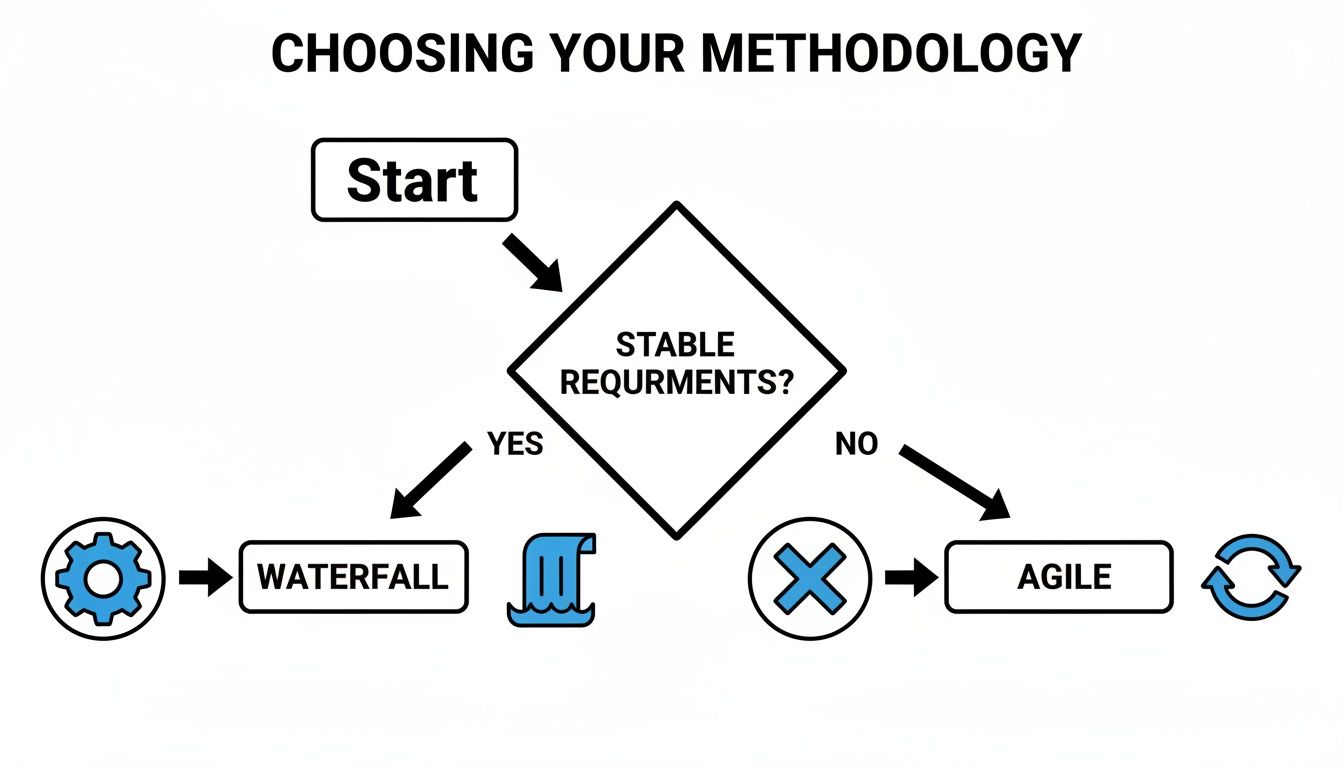
As the flowchart shows, the initial choice is pretty straightforward. If you have stable, well-understood requirements, the structure and control of Waterfall make sense. If those requirements are likely to evolve or are unclear, you need the flexibility of Agile.
But it goes deeper than just that first question. You should also consider these dimensions:
- Project Complexity: Is this a simple project with predictable steps, or a complex beast with lots of unknowns and tangled dependencies?
- Customer Involvement: How often do you need to check in with stakeholders? Is a sign-off at major milestones enough, or is constant collaboration the only way to succeed?
- Team Size and Culture: Are you working with a small, self-organizing team that thrives on autonomy? Or is it a larger, more structured group that needs clear, top-down direction?
- Risk Tolerance: Is your main goal to eliminate all possible risks with exhaustive upfront planning, or are you prepared to identify and adapt to risks as they pop up?
Thinking through these factors gives you a much richer, multi-dimensional view, ensuring your choice is a solid and well-informed one. For a look at how different platforms support these workflows, our guide on project management tools comparison can help connect the dots.
Exploring Powerful Hybrid Models
Of course, the choice isn't always a stark one between pure Waterfall and pure Agile. Many organizations are finding incredible value in hybrid models that cherry-pick the strengths of both. This creates a tailored approach that fits the messy reality of complex projects, especially large-scale initiatives that need both high-level structure and nimble execution.
A popular hybrid is Water-Scrum-Fall. Here’s how it works: the initial discovery and requirements-gathering phases follow a classic Waterfall structure to lock down the high-level scope and architecture. With that foundation in place, the development and implementation work is broken down into Agile sprints (using Scrum), which lets teams build and test features iteratively. Finally, the project might shift back to a more structured, Waterfall-like process for final deployment and maintenance.
Key Insight: Hybrid models like Water-Scrum-Fall offer a "best of both worlds" solution. They give you the strategic oversight and predictability of Waterfall for big-picture planning, while empowering development teams with the speed and adaptability of Agile for the day-to-day work.
This approach is a godsend for big enterprise projects, like rolling out a new ERP system. The business needs a firm, predictable plan for budgets and resources (Waterfall), but the software configuration teams need the flexibility to adapt to user feedback during the build-out (Agile).
Looking back at the history of these methodologies, it’s easy to see why hybrids became so necessary. Waterfall first appeared in a 1970 paper by Winston Royce, adapting the linear phases of manufacturing for software development in an era of rigid hardware. By the 1980s, it was the standard for over 90% of projects. Agile was a direct response to the frustrations of that rigidity, culminating in the 2001 Agile Manifesto, which prioritized people and working software over rigid processes. Today, blending these philosophies in hybrid models can push project success rates to 70% for large initiatives.
Ultimately, choosing the right methodology—whether it’s pure Waterfall, pure Agile, or a smart hybrid—is one of the most important decisions a project leader can make. By grounding your choice in a realistic assessment of your project's needs, you build a foundation for success and give your team a framework that’s actually designed to help them win.
Implementation Steps and Common Pitfalls to Avoid
Picking a project management framework is just the first step. The real work begins with implementation, and both Waterfall and Agile have their own distinct rhythms and potential tripwires. A successful rollout isn't just about following a manual; it’s about understanding the philosophy behind the method and anticipating the challenges that will inevitably pop up.
Your implementation strategy has to mirror the core principles of your chosen methodology. For Waterfall, that means a deep commitment to meticulous upfront planning and strict control. For Agile, it’s all about building a culture that thrives on collaboration and adaptation from the very start.
Navigating a Waterfall Implementation
Rolling out a Waterfall project is an exercise in precision. The entire process is linear, and each phase acts as a rigid gate—you can’t move forward until the current stage is complete and signed off. A small mistake early on can create a domino effect, throwing the entire project off schedule and over budget.
Here’s what that sequential journey typically looks like:
- Exhaustive Requirements Gathering: This is the foundation of everything. You must capture, document, and get formal stakeholder sign-off on every single functional and non-functional requirement before anything else happens.
- System Design: With requirements locked in, the team architects the entire system. This phase produces the detailed blueprints that developers will follow to the letter.
- Sequential Execution: Development, testing, and deployment happen in a strict, unchangeable order. One phase must be 100% complete before the next one can begin.
Critical Pitfall: Scope Creep
In a Waterfall project, an unmanaged change is a project killer. The single biggest trap is letting new requirements sneak in after the planning phase is closed. This "scope creep" completely undermines the original plan, often leading to massive budget overruns and missed deadlines.
Another classic Waterfall problem is finding a major design flaw during the final testing phase. Because testing happens so late in the game, uncovering a deep-rooted architectural issue can force the team to backtrack several steps. This means immense rework and puts the entire launch date in jeopardy.
Launching an Agile Framework
Getting Agile up and running is less about a rigid, step-by-step plan and more about nurturing a completely new mindset. It's a genuine cultural shift that demands patience, buy-in from leadership, and a commitment to new behaviors. This isn't just a trend; it's a fundamental change in how work gets done.
In fact, the data backs this up. A report from Veritis.com highlights a massive industry shift: Waterfall usage has plummeted from 70% to 37% over the last decade. Meanwhile, Agile adoption has climbed to 73% of projects in 2025, a huge jump from just 42% in 2018.
A good Agile rollout focuses on establishing a rhythm through key ceremonies and artifacts:
- Sprint Planning: The team pulls work from the product backlog and commits to what they can realistically accomplish in the next sprint.
- Daily Stand-ups: This is a quick, 15-minute daily huddle where everyone syncs up on what they did, what they’ll do next, and any roadblocks they're facing.
- Sprint Reviews & Retrospectives: At the end of a sprint, the team shows stakeholders what they built. Afterward, they meet privately to discuss what went well and identify concrete ways to improve in the next sprint.
One of the biggest hurdles I see is what people call "Scrum-but"—teams go through the motions of Agile ceremonies like stand-ups but miss the core principles of self-organization and continuous improvement. It’s a superficial adoption that delivers none of the real benefits.
It's also crucial to manage stakeholder expectations from day one. They need to understand that the plan is meant to evolve and that their constant feedback is what steers the project to success. To learn more about how documentation changes in this fluid environment, check out our guide to the agile requirements document.
Frequently Asked Questions
When you get down to the brass tacks of waterfall and agile project management, a lot of practical questions pop up. Let's tackle some of the most common ones to give you a clearer picture of how these methodologies play out in the real world.
Can You Switch From Waterfall to Agile Mid-Project?
Pulling a U-turn from Waterfall to Agile in the middle of a project is tricky, but not impossible. The key is to manage the transition carefully, not just flip a switch overnight. A sudden change will almost certainly cause chaos and lose critical requirements in the process.
A much smarter way to handle this is to see your current Waterfall phase through to completion. Once you have those signed-off deliverables, you can use them as the foundation for your initial product backlog in a new Agile setup. This kind of shift requires everyone on the team to be on board, plus some solid coaching and brutally honest communication with stakeholders about what's changing—the process, the timelines, and the deliverables.
Is One Methodology Cheaper Than the Other?
This is a common misconception. Neither methodology is inherently cheaper. The final cost of a project really comes down to how well it's executed and the specific context, not the framework you choose.
Waterfall tries to lock down costs with exhaustive upfront planning. On paper, this seems great for budget control. But if a major change is needed late in the game, the costs can skyrocket due to all the rework required.
Agile, on the other hand, gives you more budgetary wiggle room. Teams can prioritize the most valuable features first, potentially shipping a market-ready product faster and with less initial cash. The danger here is scope creep. Without disciplined management of the product backlog, that iterative approach can lead to endless additions and a bloated budget.
What Is the Role of a Project Manager in Agile vs. Waterfall?
The role of the project manager is a night-and-day difference between the two. In a Waterfall environment, the Project Manager is the command center. They're the ones directing tasks, owning the master plan, policing the scope, and acting as the main point of contact for stakeholders. It's a very traditional, authoritative role.
In the Agile world, that central authority is intentionally broken up and shared.
- The Product Owner takes charge of the product backlog, essentially acting as the voice of the customer and stakeholders.
- The Scrum Master is more of a coach and facilitator, focused on clearing roadblocks and ensuring the team follows the Agile process.
- The Development Team is empowered to self-organize, managing their own tasks and workload within each sprint.
The job shifts from one of top-down command and control to one of bottom-up empowerment and facilitation.
How Does Documentation Differ Between Waterfall and Agile?
If you want one of the starkest contrasts between waterfall and agile project management, look no further than documentation. Waterfall is built on a foundation of extensive, formal documentation. Think massive Business Requirements Documents or detailed design specs that have to be signed off at the end of each phase.
Agile operates on a completely different philosophy: "working software over comprehensive documentation." It favors a lean, just-in-time approach. You create only the documentation you absolutely need to move forward, like user stories and acceptance criteria. Agile documentation isn't a static artifact you create once and file away; it's a living, breathing part of the project that evolves with every sprint.
At MakeAutomation, we're experts at integrating AI and automation to make project management workflows smarter, not harder. Whether you’re running with Agile, Waterfall, or a mix of both, we have the frameworks and expertise to help you ditch the manual grunt work and focus on growth. See how we can help at https://makeautomation.co.