
10 High-Impact Ways to Increase Conversion Rates for B2B & SaaS in 2026
In the hyper-competitive B2B and SaaS landscape, the gap between market leaders and the rest is defined by one metric: conversion rate. A high conversion rate isn't just about successful marketing; it's a direct indicator of an efficient, scalable, and profitable business engine. Yet, many companies still rely on outdated tactics that yield diminishing returns, leading to a leaky funnel and wasted ad spend. This guide cuts through the noise.
We’re moving beyond generic advice to deliver a prioritized playbook of 10 modern, high-impact ways to increase conversion rates. This is not another collection of surface-level tips. Instead, we provide actionable frameworks and specific implementation details tailored for growth-stage companies. From harnessing AI-powered lead qualification to deploying sophisticated sales automation, these are the strategies that separate stagnant pipelines from exponential growth. To truly maximize your return on investment and build a robust conversion engine, it's crucial to understand proven strategies for how to improve website conversion rate, covering aspects like UX, copy, and social proof.
This comprehensive roundup will equip you with the tools to:
- Implement AI agents for intelligent lead scoring and qualification.
- Automate nurture sequences that guide prospects from awareness to decision.
- Optimize landing pages and signup flows through systematic A/B testing.
- Leverage social proof and credibility signals to build trust instantly.
Each strategy is designed for immediate impact, providing you with the playbooks needed to transform your approach, eliminate friction, and unlock the revenue potential hiding in your funnel. Let's begin.
1. AI-Powered Lead Qualification and Scoring
One of the most effective ways to increase conversion rates is to ensure your sales team spends their time on the most promising opportunities. AI-powered lead qualification and scoring automates this process, using machine learning to analyze lead behavior, firmographic data, and engagement patterns. It automatically assigns a score to each lead, identifying those most likely to convert before they ever reach a sales representative.
This method moves beyond simple manual scoring by identifying complex patterns in historical data that humans might miss. For instance, a platform like Salesforce Einstein or HubSpot’s AI recommendations can predict which leads are "sales-ready" with remarkable accuracy. This prioritization allows sales teams to engage prospects at the peak of their interest, dramatically improving the efficiency of the sales pipeline and boosting overall conversion rates.
How to Implement AI-Powered Lead Scoring
Implementing this strategy effectively requires a thoughtful approach to data and team alignment. To get started, you need to provide the AI model with a solid foundation and continuously refine its parameters.
- Gather Historical Data: Your model needs data to learn from. Start with at least 6 to 12 months of historical lead and customer data, including both converted and non-converted leads.
- Combine Data Types: For the most accurate predictions, combine firmographic data (company size, industry, revenue) with behavioral data (website visits, email opens, content downloads).
- Set Scoring Thresholds: Work with your sales team to define what score constitutes a "Marketing Qualified Lead" (MQL) or "Sales Qualified Lead" (SQL). This threshold determines when a lead is automatically routed to sales.
- Audit and Refine: Regularly review the scoring criteria with your sales team. Is the AI correctly identifying high-quality leads? Adjust the model based on their feedback and performance data to ensure it remains aligned with business goals. For a deeper dive into the mechanics, you can learn more about setting up a lead scoring system.
2. Conversational AI and Chatbot Implementation
One of the quickest ways to increase conversion rates is by engaging visitors the moment they show interest. Conversational AI and chatbot implementation allows you to do just that, providing real-time, 24/7 engagement on your website. These intelligent systems qualify prospects, answer common questions, and guide users through the funnel without human intervention, ensuring no lead is lost, even outside of business hours.

This strategy moves beyond static forms by creating an interactive dialogue that keeps visitors engaged. For instance, platforms like Drift and Intercom have shown how chatbots can double qualified demo requests and significantly increase sales meetings. By providing instant responses, you reduce bounce rates and create more opportunities to convert a curious visitor into a qualified lead, making it an essential tool for modern B2B and SaaS companies.
How to Implement Conversational AI and Chatbots
Effective implementation hinges on designing thoughtful conversation flows that serve user needs while achieving business goals. The key is to be helpful and personal, not robotic.
- Design User-Centric Flows: Map out conversation paths based on your top customer pain points, common objections, and frequently asked questions. Start with the goal (e.g., book a demo) and work backward.
- Enable a Smooth Human Handoff: Ensure a seamless transition to a live agent when the chatbot cannot resolve an issue or when a high-value prospect is identified. This prevents user frustration and captures critical opportunities.
- Personalize the Conversation: Use contextual data like the specific page a user is on, their company size, or their time on site to tailor the chatbot's opening lines and questions for a more relevant experience.
- Monitor and Optimize: Regularly analyze conversation transcripts and analytics to identify where users drop off or get confused. A/B test different openers, questions, and calls-to-action to continuously improve performance. For a complete overview, you can explore more about what conversational AI is and its applications.
3. Personalization and Dynamic Content Optimization
One of the most powerful ways to increase conversion rates is to move beyond a one-size-fits-all approach. Personalization and dynamic content optimization use visitor data, such as behavioral signals and firmographic information, to deliver customized website experiences, emails, and landing pages. This strategy makes each prospect feel that the solution is built specifically for their needs, significantly boosting engagement and conversions.
This approach tailors everything from headlines and calls-to-action to images and recommended content based on who is viewing it. For instance, a visitor from the financial services industry might see a case study relevant to banking, while a visitor from a tech startup sees a different one. This level of relevance is why giants like Amazon credit personalization for a huge portion of their revenue; it directly addresses the user's context and intent, creating a frictionless path to conversion.
How to Implement Personalization and Dynamic Content
Effective implementation starts with a clear strategy built on data and segmentation, allowing you to scale your efforts from simple changes to complex, algorithm-driven experiences.
- Start with Simple Segmentation: Begin by segmenting your audience based on accessible data like industry, company size, or geographic location. Use a tool like Mutiny or Intellimize to create different website experiences for these segments.
- Leverage Behavioral Data: Track user actions on your site, such as pages visited, content downloaded, or features used. Use this data to trigger personalized pop-ups, recommend relevant blog posts, or alter calls-to-action to match their stage in the buyer's journey.
- Implement Progressive Profiling: Instead of asking for all information at once in a long form, use progressive profiling. Ask for a name and email first, then on subsequent visits, ask for company size, role, or other qualifying information to enrich their profile over time.
- Map Content to Buyer Personas: Develop clear buyer personas and map your content to each stage of their journey. A first-time visitor might see a top-of-funnel ebook, while a returning lead sees a demo request CTA. Test these variations incrementally to measure their true impact on conversion rates.
4. Landing Page Optimization and A/B Testing
One of the most direct ways to increase conversion rates is by systematically improving the pages where conversions happen. Landing page optimization involves strategically designing and testing different versions of your pages to discover which elements, from headlines to calls-to-action (CTAs), resonate most effectively with your audience. This data-driven approach removes guesswork, allowing for continuous, iterative improvements that maximize performance.
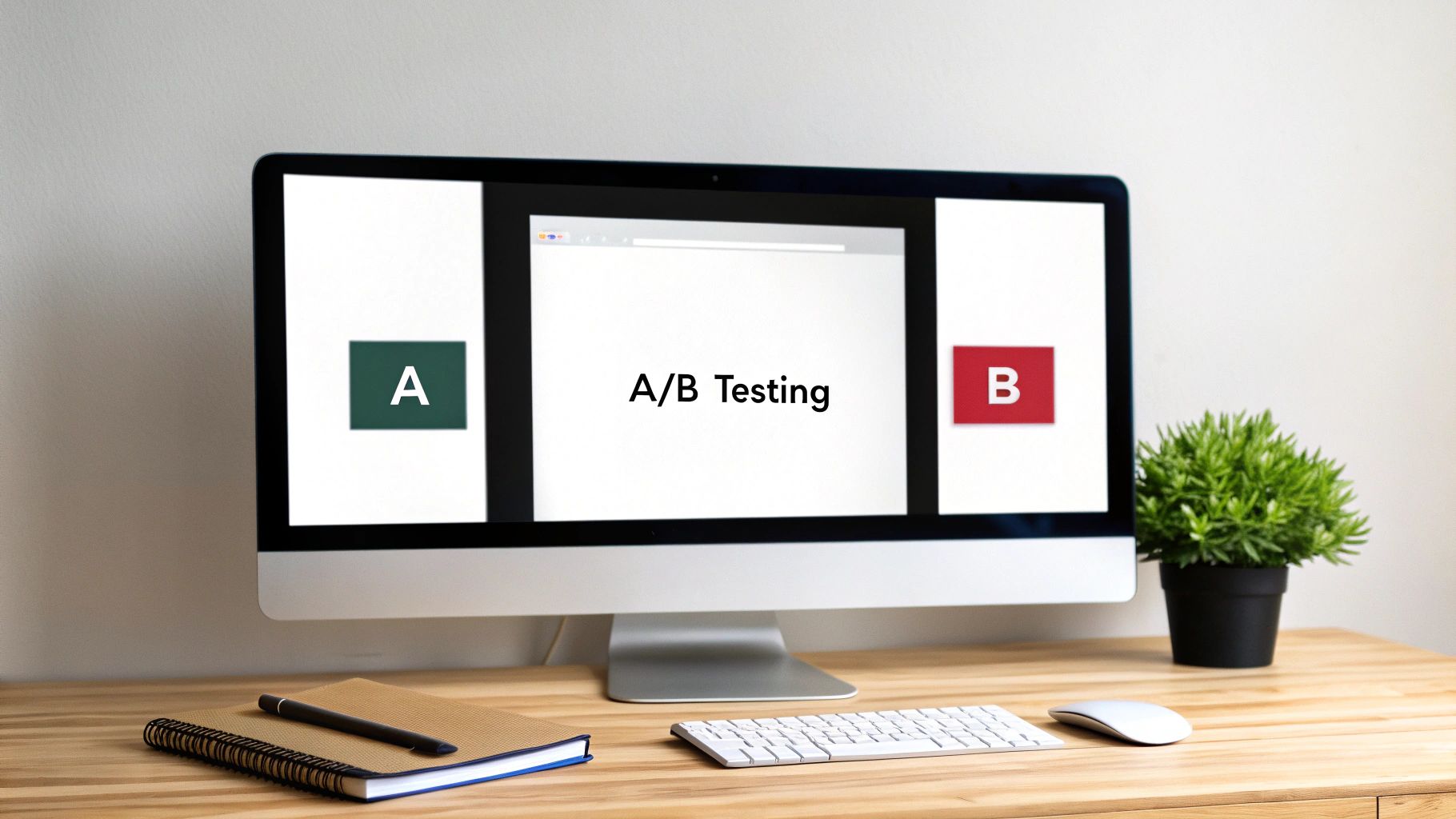
This method pits a control version (A) of a page against a variation (B) to see which one performs better. By isolating changes, you can definitively attribute performance lifts to specific elements. For example, ConvertKit famously improved its email signup conversion from 8% to 28% through rigorous landing page testing. Platforms like Unbounce and Instapage are built entirely around this concept, empowering marketers to build, test, and optimize high-converting pages without needing a developer.
How to Implement Landing Page Optimization
Effective A/B testing requires a structured process to ensure the results are reliable and actionable. This involves starting with a clear hypothesis and systematically measuring outcomes to inform your next steps.
- Focus on High-Impact Pages First: Begin testing on your highest-traffic landing pages. This ensures you gather statistically significant data quickly, allowing for faster learning cycles and a greater overall impact on your conversion goals.
- Test One Major Element at a Time: To accurately measure impact, isolate your variables. Test your headline, then your CTA button color, then your form length, but not all at once. This approach clarifies what change drove the result.
- Reduce Friction by Minimizing Form Fields: Every additional field in a form is a potential obstacle. Aim for 3-5 essential fields to reduce user effort and increase completion rates. You can always gather more information later in the customer journey.
- Implement Trust Signals: Build credibility by including testimonials, customer logos, security badges, and case studies. Social proof is a powerful motivator that reassures visitors they are making the right choice. A great resource for this is Optimizely, a leader in the A/B testing space.
5. Automated Lead Nurturing and Email Sequences
Once a lead enters your funnel, the journey to conversion has only just begun. Automated lead nurturing uses sophisticated email workflows to deliver targeted, relevant content to prospects at the right time based on their behavior and lifecycle stage. These sequences build trust, provide value, and guide prospects toward a purchase decision without requiring constant manual intervention from your team.
Instead of sending generic email blasts, this strategy ensures every communication is personalized and timely, making it one of the most effective ways to increase conversion rates over the long term. Platforms like HubSpot, ActiveCampaign, and Marketo have popularized this approach, with reports showing that nurtured leads make larger purchases and have shorter sales cycles. This system keeps your brand top-of-mind and systematically educates prospects, moving them from initial awareness to being sales-ready.
How to Implement Automated Lead Nurturing
Effective implementation goes beyond just setting up emails; it requires a deep understanding of the customer journey and a commitment to providing value at every step.
- Segment Your Audience: Group your contacts by buyer persona, lifecycle stage, and on-site behavior (e.g., downloaded an ebook vs. requested a demo). This allows for highly relevant messaging.
- Map Content to the Funnel: Create different email sequences for various entry points. A sequence for a whitepaper download should focus on education, while one for a demo request should be more sales-focused.
- Pace Your Communications: Space emails 3 to 7 days apart to maintain engagement without overwhelming subscribers. The goal is consistent, helpful contact, not daily spam.
- Include Clear CTAs: Every email should have a clear call-to-action that aligns with the prospect's stage in their journey. This could be anything from reading a case study to booking a call.
- Monitor and Optimize: Continuously track key metrics like open rates, click-through rates, and unsubscribe rates. Use this data to A/B test subject lines, content, and send times to refine your sequences for maximum impact.
6. Social Proof and Social Credibility Signals
Leveraging social proof is one of the most powerful ways to increase conversion rates because it addresses a fundamental prospect concern: trust. By strategically showcasing evidence that other businesses have succeeded with your product, you reduce purchase anxiety and build confidence. Social proof signals like customer testimonials, detailed case studies, and third-party reviews act as endorsements that validate your claims and demonstrate real-world value, which is particularly crucial in B2B sales cycles.
This strategy moves beyond simple marketing messages by providing objective validation from peers. For instance, Slack prominently displays its large user base ("millions of daily active users") to signal widespread adoption and reliability. Similarly, HubSpot's extensive library of case studies details specific customer challenges, implementation processes, and quantifiable ROI, giving prospects a clear blueprint for their own potential success. These elements make your solution feel like a safe, proven choice.
How to Implement Social Proof and Credibility Signals
Effective implementation goes beyond just dropping a quote on your homepage. It requires a systematic approach to gathering and deploying these trust-building assets across the entire customer journey.
- Gather High-Impact Testimonials: Request testimonials from customers who have achieved specific, measurable results. A quote that says "we increased lead-to-opportunity conversion by 40%" is far more powerful than one that simply says "we love the product."
- Develop In-Depth Case Studies: Create detailed case studies for each key customer segment, outlining the problem, solution, and quantifiable outcome. Feature customer logos and names (with permission) to add an extra layer of credibility.
- Integrate Third-Party Reviews: Embed widgets from trusted review sites like G2 or Capterra directly on your pricing and product pages. These impartial reviews often carry more weight than on-site testimonials alone.
- Place Signals Strategically: Don’t hide your social proof. Place customer logos, key metrics, and powerful testimonials near critical conversion points like sign-up forms, demo request buttons, and pricing tables to overcome last-minute hesitation.
7. Retargeting and Remarketing Campaigns
One of the most powerful ways to increase conversion rates is to reconnect with visitors who left your website without taking action. Retargeting and remarketing campaigns use pixel-based advertising to strategically display your ads to these prospects as they browse other sites and social media platforms. This approach keeps your brand top-of-mind and provides additional opportunities to persuade them to return.
This strategy is highly effective because it focuses your ad spend on a warm audience already familiar with your brand. By creating multiple, carefully sequenced touchpoints, you can address potential objections, showcase different value propositions, and guide prospects back into the sales funnel. Platforms like LinkedIn and Google have demonstrated that retargeting can convert visitors at 2-3x higher rates and achieve a significantly lower cost-per-acquisition compared to prospecting new audiences.
How to Implement Retargeting and Remarketing
A successful retargeting strategy goes beyond simply showing the same ad to everyone. It requires thoughtful audience segmentation and creative sequencing to nurture interest without causing ad fatigue.
- Segment Audiences by Behavior: Create distinct audience lists based on user actions. For example, segment users who visited your pricing page, requested a demo but didn't book, or abandoned a sign-up form.
- Create Sequential Messaging: Develop a multi-stage ad sequence. The first ad might remind them of your core value, the second could present a case study, and a third might offer a free trial or a consultation.
- Set Frequency Caps: To avoid overwhelming your audience, limit ad impressions to a reasonable number, typically between 3-7 per user per week. This maintains visibility without becoming intrusive.
- Refine Your Targeting: Continuously optimize your campaigns by excluding existing customers and those who have already converted. Use the data from successful campaigns to build lookalike audiences on platforms like Facebook to find new, high-potential prospects. For a deeper look at implementation, explore Google's remarketing setup guide.
8. Strategic CRM Integration and Sales Automation
Manual data entry and disjointed communication between marketing and sales are silent conversion killers. Strategic CRM integration and sales automation bridge this gap by creating a seamless, automated flow of information. This ensures that every lead is tracked, nurtured, and handed off at the perfect moment, eliminating the risk of valuable prospects falling through the cracks.
When your marketing automation platform (like Marketo or HubSpot) syncs flawlessly with your CRM (like Salesforce or Pipedrive), you empower your sales team with a complete history of every lead's interactions. This contextual data allows for highly personalized and timely follow-ups. Automating tasks like lead assignment, follow-up reminders, and data logging frees up reps to focus on what they do best: building relationships and closing deals. This efficiency is one of the most reliable ways to increase conversion rates in any B2B or SaaS environment.
How to Implement CRM and Sales Automation
Effective integration is more than just connecting two platforms; it involves designing intelligent workflows that align with your sales process. Start by mapping the entire lead journey to identify key automation opportunities.
- Map Lead Sources and Routing: Identify every channel that generates leads (e.g., website forms, webinars, social media) and create rules to automatically route them to the correct sales rep based on territory, industry, or product interest.
- Set Up Instant Notifications: Create workflows that send instant notifications via Slack or SMS to sales reps when a high-scoring lead takes a critical action, such as requesting a demo.
- Automate Follow-Up Cadences: Use your CRM to build automated email and task sequences for different lead segments. A new MQL might receive a different cadence than a lead who has gone cold.
- Implement Smart Lead Assignment: Use logic-based rules to distribute leads fairly and effectively. This prevents lead hoarding and ensures prompt follow-up, which directly impacts conversion. For a complete guide on how this works, you can understand the fundamentals of CRM integration.
9. Voice AI Agents and Intelligent Phone Engagement
While digital channels dominate, phone engagement remains a high-intent channel for closing deals. Voice AI agents automate inbound and outbound calls, qualifying leads, scheduling meetings, and handling routine inquiries 24/7 without human intervention. This technology ensures no phone-based opportunity is missed, engaging prospects immediately and efficiently.
This goes far beyond simple robocalls. Modern voice AI, powered by platforms like Five9 or Intercom, understands natural language, responds to questions, and can even detect sentiment. For example, some sales teams report a 35% improvement in scheduled meetings after deploying a voice AI to handle initial outreach and follow-up calls. This frees up human agents to focus on high-value, complex conversations, directly impacting conversion rates.
How to Implement Voice AI Agents
Successfully deploying voice AI requires a strategic approach focused on clear goals and seamless integration. The aim is to create a natural, helpful experience that accelerates the sales cycle, not a frustrating robotic one.
- Define Clear Call Objectives: Determine the primary goal for the AI agent. Is it to qualify inbound leads, schedule demos, or provide basic customer support? A focused objective leads to a more effective script and call flow.
- Train for Objections: Equip your AI with a library of common prospect objections and your company's best-practice responses. This training is critical for handling real-world conversations effectively.
- Integrate with Calendars and CRM: Connect the voice agent directly to your sales team's calendars for automated meeting scheduling. CRM integration ensures all call data and outcomes are logged for a complete view of the lead's journey.
- Plan for a Warm Handoff: Program the AI to recognize when a conversation requires human judgment or empathy. Implement a seamless, warm handoff process to transfer the call to a live agent without friction.
- Monitor and Continuously Improve: Use call recordings and sentiment analysis to identify areas for improvement. Regularly update scripts and responses based on what you learn from actual interactions to refine one of the most powerful ways to increase conversion rates.
10. Conversion Rate Optimization Through Friction Reduction
One of the most direct ways to increase conversion rates is to remove the obstacles standing between a prospect and your desired action. Friction reduction involves systematically identifying and eliminating any element that makes the conversion process difficult, confusing, or time-consuming. This could be anything from a complicated checkout process to an overly long sign-up form, all of which create unnecessary cognitive load and cause potential customers to abandon the funnel.
By streamlining the user journey, you make it as easy as possible for interested prospects to convert. Amazon’s one-click checkout is a legendary example, setting an industry standard for frictionless purchasing. Similarly, Dropbox famously simplified its signup flow from five steps down to two, boosting signups by 10%. These examples prove that every removed step, every clarified instruction, and every eliminated form field contributes directly to a higher conversion rate by respecting the user's time and effort.
How to Implement Friction Reduction
Implementing a friction-reduction strategy requires a critical audit of your entire conversion path from the user's perspective. The goal is to make the journey feel intuitive and effortless.
- Audit Your Funnel: Map out every single step a user must take to convert, from the initial click to the final submission. Count the number of clicks, pages, and form fields involved. Aim for a maximum of 2-3 steps.
- Eliminate Non-Essential Form Fields: Every field you ask a user to fill out is a potential drop-off point. Challenge the necessity of each one. Do you truly need their phone number or company name right now? Aim for 3-5 essential fields maximum.
- Simplify Page Layouts: Remove distracting elements like auto-playing videos, aggressive pop-ups, and complex navigation menus from your key conversion pages. A clean, single-column layout often performs best, especially on mobile devices.
- Show Progress: If your process involves multiple steps, use a visual progress bar. This manages user expectations and reduces the perceived effort, making them more likely to complete the entire flow. More tips on this can be found in a guide to improving user experience.
10 Conversion-Boosting Strategies Comparison
| Solution | Implementation complexity | Resource requirements | Expected outcomes | Ideal use cases | Key advantages |
|---|---|---|---|---|---|
| AI-Powered Lead Qualification and Scoring | Medium–High: model training, data pipelines, CRM integration | Historical data, ML expertise, integration effort, monitoring | Higher conversion rates (≈40–50%), faster sales cycles, reduced manual qualification | B2B SaaS with volume leads, teams needing lead prioritization | Automated prioritization, continuous improvement, data-driven insights |
| Conversational AI and Chatbot Implementation | Medium: NLP configuration, flow design, integrations | Conversation designers, training data, CRM/messaging connectors | +10–15% conversions, 24/7 capture, reduced initial support load | High-traffic sites, off-hours lead capture, qualifying common queries | Instant engagement, scalable qualification, multi-channel deployment |
| Personalization and Dynamic Content Optimization | High: data engineering, content mapping, real-time systems | Behavioral & firmographic data, content assets, privacy compliance | +20–30% conversions, higher engagement and CTRs | ABM, e-commerce recommendations, high-value prospect journeys | Relevance at scale, improved engagement, enables ABM |
| Landing Page Optimization and A/B Testing | Low–Medium: test setup, variant design, analysis | Testing tools, sufficient traffic, design/copy resources, analytics | +25–50% conversion improvement over time, clearer messaging | Campaign landing pages, paid acquisition channels, lead-gen offers | Data-driven improvements, high ROI, reduces guesswork |
| Automated Lead Nurturing and Email Sequences | Medium: workflow design, segmentation, personalization | Email platform, content library, segmentation data, analytics | +25–40% conversions, shorter sales cycles, scalable follow-up | Long sales cycles, content-led funnels, lead warming programs | Scalable consistent engagement, lifecycle targeting, cost-effective |
| Social Proof and Social Credibility Signals | Low–Medium: content collection, placement strategy | Customer outreach, testimonial production, review aggregation | +15–30% conversion lift, reduced buyer anxiety, stronger credibility | B2B enterprise sales, pricing pages, trust-dependent purchases | Builds trust quickly, sales enablement, relatively low ongoing cost |
| Retargeting and Remarketing Campaigns | Medium: pixel setup, audience sequencing, creative rotation | Ad spend, creative assets, tracking/attribution tools | +50–150% conversions among warm audiences, lower CPA vs cold | Abandoned visitors, demo seekers, long B2B funnels | High ROI on warm audiences, cross-platform reach, measurable results |
| Strategic CRM Integration and Sales Automation | High: system mapping, complex integrations, change management | Integration engineers, CRM licenses, governance and training | Faster responses, fewer missed leads, improved pipeline accuracy | Organizations scaling sales ops, multi-source lead routing | Eliminates manual entry, automates workflows, improves visibility |
| Voice AI Agents and Intelligent Phone Engagement | High: voice models, telephony & CRM integration, training | Voice AI platform, telephony, training data, monitoring, calendar sync | +30–40% conversions from phone channel, 24/7 availability, reduced hires | Phone-centric lead flows, appointment setting, service hotlines | Captures phone opportunities, automated scheduling, consistent brand calls |
| Conversion Rate Optimization Through Friction Reduction | Medium: user research, UX fixes, iterative testing | UX researchers, designers, analytics, testing resources | +20–40% conversion lift by removing barriers, improved UX | Checkout/signup flows, mobile onboarding, complex forms | High-impact low-cost changes, broad UX improvements, compounding effect |
From Strategy to System: Building Your Conversion Engine
We've explored ten powerful, high-impact strategies that go far beyond superficial tweaks. From implementing AI-powered lead qualification and dynamic content personalization to systematically reducing friction in your signup flow, these methods represent the modern playbook for B2B and SaaS growth. Each tactic, whether it's building automated nurture sequences, launching sophisticated retargeting campaigns, or leveraging Voice AI agents for engagement, serves as a critical component in a larger machine. The ultimate goal is to transition from a collection of disjointed tactics to a fully integrated, continuously improving conversion system.
This journey from isolated actions to a cohesive engine is where sustainable growth is born. It's about creating a flywheel effect where each optimization amplifies the next. Your chatbot implementation (Strategy #2) gathers initial data that your AI scoring model (Strategy #1) uses to prioritize leads. Your CRM integration (Strategy #8) then feeds this data to your automated email sequences (Strategy #5), which are continuously refined through A/B testing (Strategy #4). This interconnectedness is the secret to scaling your efforts effectively.
Your Actionable Roadmap to Higher Conversions
The sheer number of ways to increase conversion rates can feel overwhelming. The key is to start with a focused, methodical approach rather than trying to implement everything at once. Begin by diagnosing your funnel to identify the single biggest point of leakage or friction.
- Is top-of-funnel engagement the problem? Focus on implementing conversational AI, optimizing your landing pages with stronger social proof, and launching targeted retargeting campaigns to bring qualified visitors back.
- Are you losing leads during qualification or handoff? Prioritize AI-powered lead scoring and strategic CRM integration to ensure a seamless, data-driven transition from marketing to sales.
- Is your mid-funnel nurture failing to convert? Double down on personalized email sequences, dynamic content, and reducing friction in your user onboarding or trial signup process.
Select one or two of these high-priority areas and commit to implementing the relevant strategies discussed in this article. Set clear benchmarks, measure your results meticulously, and use the insights gained to inform your next move. This iterative process of diagnosing, implementing, and measuring is the core discipline of Conversion Rate Optimization (CRO).
The Compounding Value of a Systemized Approach
Mastering these ways to increase conversion rates is more than just a marketing exercise; it's a fundamental business imperative. A higher conversion rate directly translates to a lower customer acquisition cost (CAC), a higher return on ad spend (ROAS), and a more predictable revenue stream. It allows you to outbid competitors for traffic, confidently invest in new channels, and scale your operations without a proportional increase in manual effort.
By building this conversion engine, you are creating a strategic asset for your company. You are moving from a model dependent on manual intervention and guesswork to one driven by data, automation, and continuous optimization. This systematic approach doesn't just win you more customers today; it builds a resilient, scalable foundation for long-term, profitable growth. The future belongs to businesses that can not only attract attention but can also efficiently convert that attention into lasting customer relationships.
Ready to transform these strategies into a powerful, automated system? At MakeAutomation, we specialize in implementing the advanced automation frameworks discussed here, helping B2B and SaaS businesses eliminate manual work and build a scalable conversion engine. Schedule a discovery call with us to see how we can accelerate your path to predictable growth.