
What Is an Ideal Customer Profile: Drive B2B Growth
Your pipeline looks busy, but the calendar tells a different story. Sales is taking demos with companies that will never buy. Marketing is driving form fills that don't match the product. Customer success is onboarding accounts that ask for custom work, resist the process, and churn fast.
That usually isn't a lead volume problem. It's a targeting problem.
If you're asking what is an ideal customer profile, the practical answer is simple. It's the definition of the kind of company most likely to buy, get value, stay, and expand. Not every company that can buy. The companies that should buy.
In B2B growth, that distinction changes everything. Once the ICP is clear, prospecting gets tighter, messaging gets sharper, handoffs get cleaner, and automation starts producing efficiency instead of noise. When the ICP is vague, automation just helps you waste time faster.
Stop Chasing Bad Leads Start with an ICP
Teams typically don't set out to chase bad leads. They get there by default.
A founder says, "We help SaaS companies." Marketing turns that into broad campaigns. Sales builds lists with loose filters. RevOps creates a scoring model based on activity instead of fit. Soon, everyone is working hard, and very little of that work compounds.
A real ICP fixes that because it gives the business a shared target. It tells sales which accounts deserve time, tells marketing which segments to attract, and tells operations which workflows to automate first. If the company profile is wrong, everything built on top of it underperforms.
What an ICP actually does
An Ideal Customer Profile is a company-level definition of your best-fit account. In practical terms, it usually includes:
- Firmographics such as industry, company size, revenue band, and geography
- Technographics such as whether they use HubSpot, Salesforce, Zapier, Airtable, or another stack your offer depends on
- Operational signals such as messy handoffs, manual lead routing, slow follow-up, or repeated spreadsheet work
- Commercial fit such as whether they buy with urgency, have a clear owner, and can support implementation
If you're still qualifying mostly through gut feel, tighten that first. A structured qualification model works much better once it's anchored to a defined ICP, which is why a practical sales qualification framework matters before you pour more leads into the top of funnel.
Practical rule: If sales keeps saying leads are bad and marketing keeps saying lead volume is up, the ICP probably isn't clear enough.
A useful ICP isn't branding language. It's an operating filter. It helps your team say no earlier, which is usually where revenue efficiency starts.
ICP vs Buyer Persona The Company and The Champion
The most common confusion is treating the ICP and the buyer persona like the same thing. They're connected, but they solve different problems.
Your ICP describes the right company to target. Your buyer persona describes the right person inside that company to engage.
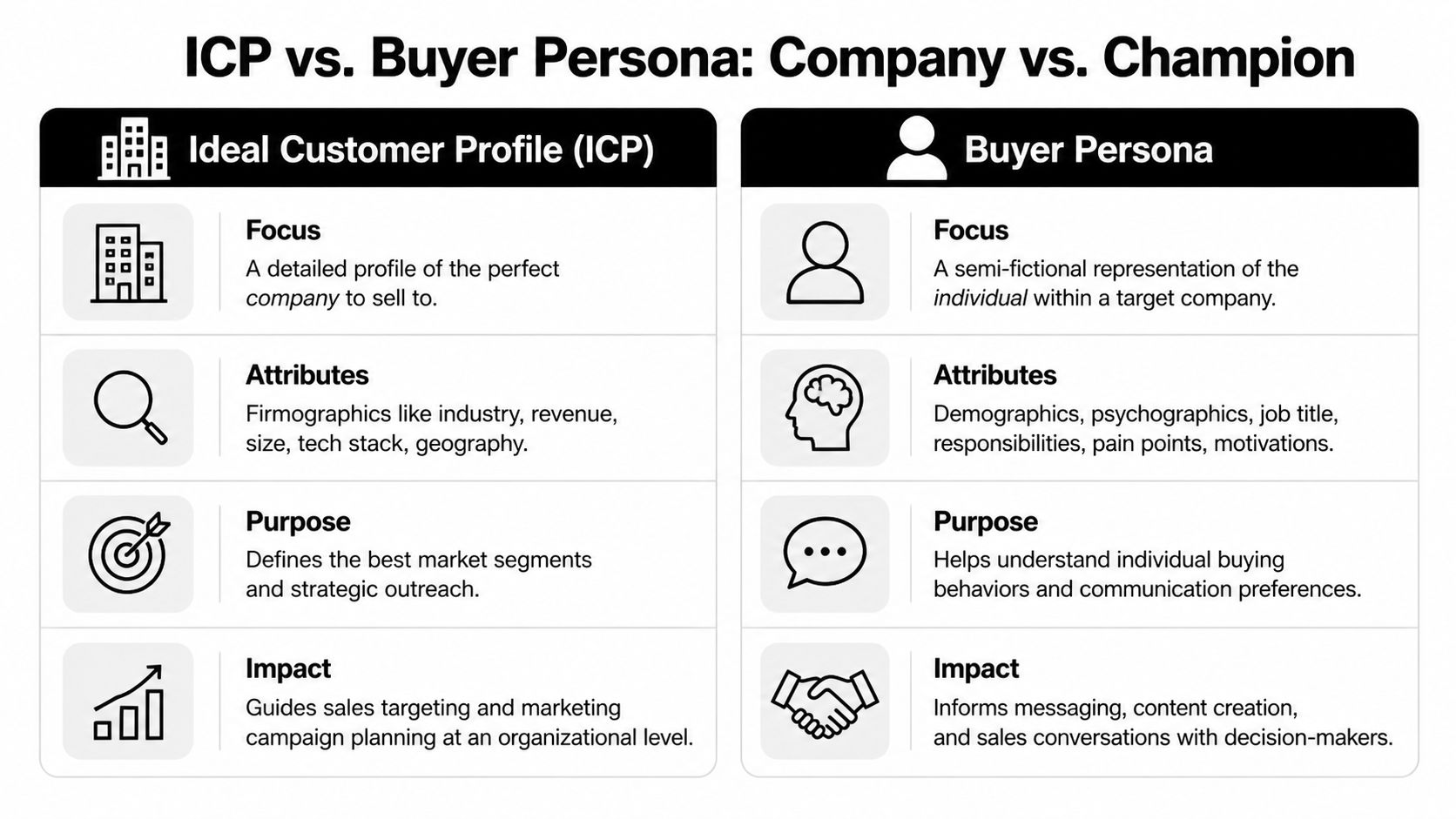
Think building first, then champion
A simple way to separate them:
- ICP finds the right building
- Buyer persona finds the right floor, role, and conversation inside that building
If you're selling workflow automation, your ICP might be growth-stage SaaS companies with a defined sales team, a CRM already in place, and visible manual process friction. Your buyer persona might be the operations director, head of revenue operations, founder, or VP of sales who owns the problem and can move the project forward.
Those are not interchangeable.
What belongs in each
A strong ICP usually includes company attributes like:
- Industry fit such as SaaS, tech-enabled services, or digital agencies
- Size and scale such as employee band and revenue range
- Tool stack compatibility such as Salesforce, HubSpot, Zapier, or Airtable
- Business model and maturity such as recurring revenue, active sales motion, and operational complexity
A buyer persona usually includes personal and role-specific details like:
- Job title and remit such as founder, revops lead, or sales manager
- Pain points such as slow handoffs, poor CRM hygiene, or missed follow-up
- Motivations such as efficiency, visibility, optimizing staff utilization, or cleaner reporting
- Buying behavior such as whether they need consensus, proof, or speed
HubSpot's 2018 State of Inbound report marked a key milestone in this evolution, showing that firms with a documented ICP had 2.5x more revenue growth than peers without one, as summarized in Salesforce's write-up on ideal customer profile strategy. That matters because it puts the company-level target first. You don't optimize messaging to a champion until you've chosen the right accounts.
Good targeting fails in two ways. You talk to the right person at the wrong company, or the wrong person at the right company.
This is also where conversion work gets more precise. Once you know the account type and the champion, your website and landing pages can match both. If you're refining that layer, Sight AI's insights on web conversions are useful because they focus on how messaging clarity affects action, which is exactly what happens after you narrow the target.
Why Your B2B Business Needs a Laser-Focused ICP
A broad target audience feels safer. It gives the illusion of market size. In practice, it usually creates weak positioning, noisy campaigns, and long sales cycles.
A tight ICP does the opposite. It narrows who you pursue so your offer lands harder with the accounts that are likely to close and succeed.

The business case is straightforward
According to industry analyses, businesses using ICPs see 67% higher win rates, while top-fit customers show 3x higher customer lifetime value and help reduce customer acquisition costs by 30-50%, based on ZoomInfo's discussion of ideal customer profile targeting. That's the commercial reason to stop treating ICP work as a marketing exercise.
Those gains happen because a defined ICP improves several parts of the system at once:
- Sales spends less time on dead-end accounts
- Marketing writes for a narrower problem set
- Operations can automate repeatable patterns
- Leadership gets clearer signal on what to scale
Automation works better when fit is clear
Many automation projects go wrong at this point. Teams automate outreach, routing, enrichment, follow-up, and reporting before they define who those workflows are for. The result is efficient activity aimed at low-fit accounts.
A better sequence is:
- Define the company profile.
- Turn the profile into qualification criteria.
- Embed those criteria into CRM fields, forms, lead scoring, routing rules, and outbound list building.
- Automate only after the fit logic is stable.
Field note: Automation multiplies targeting quality. If the input is vague, the output is just faster confusion.
For a B2B SaaS company, this often changes messaging immediately. Instead of saying, "We automate growth," you can say, "We help operations teams at growth-stage SaaS companies remove manual CRM and lead-routing work from existing HubSpot or Salesforce workflows." That lands because it describes a real environment, not a broad aspiration.
Better fit changes product conversations too
A good ICP also improves what happens after the deal closes.
When the company is a real fit, onboarding is cleaner, requirements are more predictable, and value realization happens faster. You spend less time forcing edge-case use cases into the product or service. That protects margins and gives customer success a cleaner path to expansion.
This is why the strongest ICP work isn't only about top-of-funnel efficiency. It's a decision about what kind of revenue your company wants more of.
How to Build Your Ideal Customer Profile Step by Step
The fastest way to build an ICP is not brainstorming in a meeting room. Start with customers you already have.
Look at the accounts that buy cleanly, onboard without chaos, use the solution properly, and create the least drag across sales, delivery, and support.

Start with your best customers
For B2B SaaS, an effective ICP should combine firmographic details such as 50-500 employees and $5-50M revenue with technographic details such as using HubSpot or Salesforce, because those attributes correlate with 3-5x higher customer lifetime value and 40% improved retention rates compared with mismatched accounts, according to HG Insights on building an ideal customer profile. For a worked example of this step, this guide on how to build an ICP shows how one B2B team rebuilt its profile from its own customer data. how to build an ICP
That doesn't mean you copy those exact ranges without thinking. It means you should look for the same kind of pattern in your own data.
Start by reviewing your best-fit accounts through four lenses:
Commercial quality
Which customers closed without endless education, scope drift, or discount pressure?Retention quality
Which customers stayed engaged, renewed smoothly, and kept using what they bought?Operational quality
Which accounts were easy to onboard because they had process owners, clean systems, and realistic expectations?Expansion quality
Which customers asked for adjacent workflows, new automations, or broader rollout after initial success?
If your data is messy, begin with a focused list and use prospect research methods to standardize how you evaluate account fit across industries, stacks, and buying conditions.
Pull data from the systems you already use
You don't need a giant research project. You need a disciplined extraction of signals from a few core systems.
Review:
- CRM records for industry, employee count, sales cycle notes, source, and closed-won patterns
- Marketing automation for form fills, campaign response, content engagement, and inbound themes
- Call notes and emails for repeated pain points, objections, and buying triggers
- Support and onboarding logs for implementation friction, adoption blockers, and team readiness
- Customer interviews for the language buyers use when describing the problem and outcome
A good companion resource here is Salesmotion's framework to validate your ICP strategy, especially if you need a practical way to test whether your draft profile reflects reality or internal opinion.
Turn patterns into a usable document
The final output is often overcomplicated. Your ICP should fit on one page and be easy to operationalize.
Include:
Company basics
Industry, size, geography, revenue range, and growth stage.System environment
CRM, marketing automation, workflow tools, and data maturity.Pain signals
Manual follow-up, poor handoffs, spreadsheet-heavy operations, or delayed reporting.Buying conditions
Budget ownership, implementation appetite, urgency, and access to a decision-maker.Exclusion criteria
Legacy systems with no integration appetite, no process owner, or no urgency to change.
Once you've done the first draft, use it in live qualification calls and outbound list reviews. The test isn't whether the document looks polished. The test is whether sales can use it to disqualify faster.
A quick visual walkthrough can help if your team is building this for the first time:
B2B SaaS ICP Examples and A Reusable Template
Theory gets clearer when you put it into a realistic profile.
Take a fictional company called AutomateFlow. It sells AI and workflow automation services to B2B companies that have already outgrown manual operations but haven't built a reliable system yet.
Example ICP for AutomateFlow
AutomateFlow's best-fit customer isn't "any SaaS company." It's a specific kind of operator-led business.
The account usually looks like this:
- Company type: Growth-stage B2B SaaS or digital services business
- Team structure: A defined sales or client-facing team with recurring operational work
- Core tools: Already using a CRM such as HubSpot or Salesforce, plus workflow tools or spreadsheets
- Visible problems: Lead follow-up is inconsistent, data entry is manual, reporting is delayed, and handoffs depend on people remembering steps
- Internal owner: Founder, operations director, or revops lead who feels the friction daily and wants cleaner execution
- Desired outcome: Standardized workflows, faster response times, cleaner CRM data, and less manual admin
Technographic alignment matters here. Best-fit customers using complementary stacks such as a CRM like HubSpot and a no-code tool like Airtable show 4x higher product usage rates and 28% lower churn because integration friction is lower, according to Right Left's analysis of ideal customer profile technographics.
When a prospect says, "We're still moving leads between forms, spreadsheets, and the CRM by hand," that's not just a pain point. It's often an ICP signal.
What this looks like in practice
AutomateFlow would probably deprioritize a very small company with no CRM owner, no stable process, and no urgency to fix operations. The problem might be real, but the buying conditions are weak.
It would prioritize a company that already has a functioning sales motion and enough complexity to feel the cost of manual work every week. That's where automation gets adopted, not just admired.
Ideal Customer Profile template
| Attribute | Description / Specifics |
|---|---|
| Company type | |
| Industry | |
| Company size | |
| Revenue range | |
| Geography | |
| Growth stage | |
| Business model | |
| Core tech stack | |
| CRM in use | |
| Workflow tools in use | |
| Key operational pain points | |
| Trigger events | |
| Primary team affected | |
| Economic buyer | |
| Day-to-day champion | |
| Buying blockers | |
| Success criteria | |
| Expansion potential | |
| Unideal customer signals |
Copy this into a spreadsheet, CRM playbook, or Notion page. If your team can't fill every line with confidence, that tells you where your ICP is still based on assumptions.
How to Activate Your ICP Across Sales and Marketing
An ICP on a slide deck doesn't do anything. A useful ICP shows up inside systems, rules, and daily decisions.
That means translating your profile into fields, scores, sequences, routing logic, and campaign filters your team uses.
Put the ICP inside your CRM
Start with account-level properties. Add fields for industry, employee band, CRM in use, workflow maturity, integration readiness, and operational pain signals. Then build views that show only accounts matching your minimum criteria.
From there, create simple logic:
- If fit is high and intent is visible, route fast to sales
- If fit is high but timing is weak, place the account into nurture
- If fit is low, keep it out of sales queues unless a rep manually overrides with a reason
- If exclusion flags appear, mark the account as UCP and stop spending time on it
This is also where account-based motions get stronger. A documented ICP makes it easier to align list building, targeting, and outreach around defined companies instead of random lead activity. If your team is building that motion, this guide on account-based marketing is a useful reference point.
Turn profile criteria into automation rules
Marketing should use ICP rules too, not just sales.
Practical examples:
- Inbound forms can enrich and tag leads based on company attributes before anyone follows up
- Lead scoring should weight fit and not just clicks or page views
- Email sequences should branch based on company type, current stack, and pain category
- Paid campaigns should target narrower company segments with offer-specific messaging
- AI enrichment can help identify stack fit, account ownership, and likely use case before outreach begins
One practical option is MakeAutomation, which helps teams identify ICP-fit accounts, monitor intent signals, and support targeted outreach workflows. Used well, that kind of tooling reduces manual list review and makes account prioritization more consistent.
A lead score without fit criteria usually rewards curiosity. A lead score with fit criteria rewards commercial opportunity.
Clean execution matters as much as targeting
Once you activate the ICP, your delivery quality matters. Outbound campaigns still fail if email deliverability is poor, domains are unhealthy, or sequences trigger spam filters. Before scaling outreach, it's worth running copy and sending setups through an email spam checker so your targeting work doesn't get wasted at the inbox layer.
The broader point is this. Activation is where strategy becomes behavior. If your ICP isn't changing who enters campaigns, who gets routed first, and who gets filtered out, it isn't active yet.
Common ICP Mistakes and How to Avoid Them
Most ICPs fail for boring reasons. They're too broad, too static, or too vague for practical use.
The biggest mistake is writing an ICP that sounds good in a meeting but doesn't help a rep make a decision on a live account. "Mid-market SaaS" is not enough. Neither is "companies that need automation." Those labels don't tell your team who to pursue, who to nurture, and who to reject.
The mistakes that create wasted pipeline
Watch for these patterns:
Broad definitions
If your ICP could apply to half the market, it won't sharpen anything.Assumption-led criteria
Sales opinions matter, but they shouldn't replace CRM, onboarding, and retention evidence.No update cycle
Your best-fit customer can change as your offer matures, integrations improve, or your team moves upmarket.No exclusion logic
Teams often define the ideal account and forget to define the expensive mistake.
That last one matters more than most guides admit.
Build the Unideal Customer Profile too
A critical and often overlooked step is defining the Unideal Customer Profile, because businesses without a clear ICP and UCP can waste nearly half their marketing budget on poor-fit prospects, according to the growth analysis published at UC Growth on ideal customer profiles.
Your UCP should include the traits that repeatedly create bad outcomes. Examples include:
- No system owner who can support implementation
- Incompatible stack with no willingness to change
- Short-term buying behavior that pushes urgency in sales and disappears in onboarding
- High customization demands that break your standard delivery model
- Low operational maturity where the team wants automation before process discipline exists
The fastest way to improve pipeline quality is often subtractive. Remove the accounts that keep burning time.
A mature go-to-market team doesn't just know who it wants. It knows who it refuses to build around.
If your team has the right offer but the wrong targeting, the fix usually isn't more outreach. It's a sharper ICP, cleaner qualification, and automation embedded into the workflow instead of layered on top of chaos. MakeAutomation helps B2B and SaaS teams operationalize that work across lead generation, CRM automation, outreach systems, and AI-enabled processes so the right accounts move faster and the wrong ones get filtered out earlier.