What is intelligent process automation: A Practical Guide to IPA Success
Let's get straight to it. Intelligent Process Automation (IPA) is what you get when you give Robotic Process Automation (RPA) a brain. Imagine your software bots—the ones that handle mind-numbing, repetitive tasks—suddenly getting a massive upgrade. RPA gives them the hands to do the work, and Artificial Intelligence (AI) provides the mind to think, learn, and adapt.
Moving Beyond Simple Automation
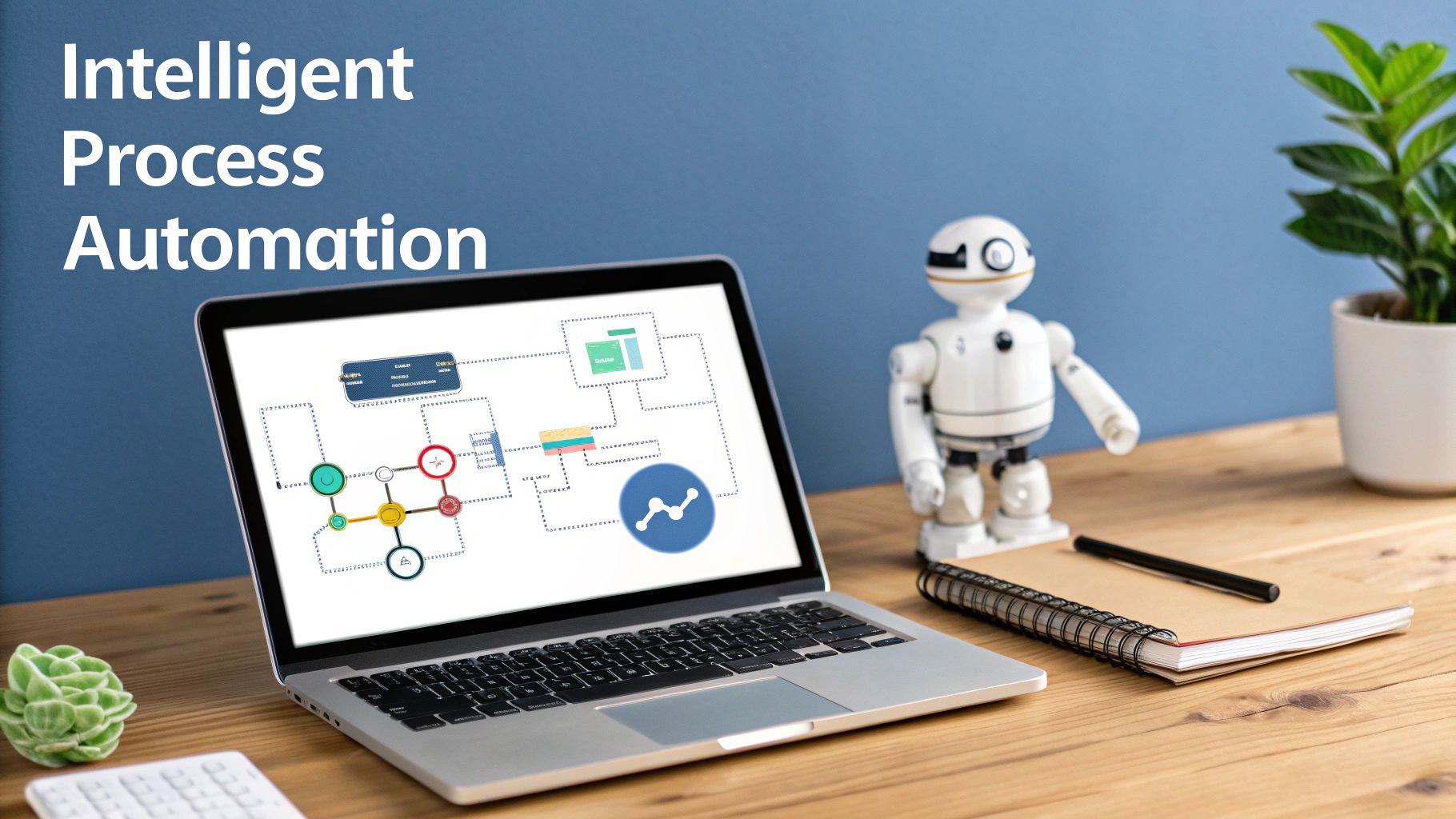
Most businesses are already using some form of basic automation. Think of a simple script that pulls data from a spreadsheet and plunks it into a CRM. It's useful, for sure, but also incredibly fragile. The second something changes—like a new column appears in that spreadsheet—the bot breaks.
This is where Intelligent Process Automation completely changes the game. Instead of rigidly following a pre-written script, IPA creates a "smart" digital workforce. This system can handle the messy stuff, like unstructured data. It can understand the context of a customer email or pull the right information from a PDF invoice, even if the layout changes every time.
The Power of a Digital Brain
At its heart, IPA is designed to mimic and even enhance human intelligence. It doesn't just do tasks; it learns from them. That learning ability is the key to managing the unpredictable, often chaotic, nature of real-world business processes.
Think about what this actually means:
- It can understand people. Using technologies like Natural Language Processing (NLP), an IPA system can read an email, a support ticket, or a document and actually grasp the intent behind the words.
- It gets smarter over time. Machine Learning (ML) algorithms enable the system to spot patterns, learn from exceptions, and improve its own performance without a developer having to recode it every time something new happens.
- It manages the whole show. IPA orchestrates entire workflows from start to finish. It knows when to assign a task to a bot and when to loop in a human, ensuring work flows smoothly between your digital and human teams.
By fusing the raw execution power of RPA with the cognitive skills of AI, IPA automates complex, judgment-based work that was previously impossible for machines to handle. It's the difference between a simple calculator and a seasoned data scientist.
Why Is This Shift Happening Now?
The rush toward IPA isn't just about chasing the latest tech trend. It's driven by a real, urgent need for businesses to become more efficient and scalable. And the numbers back this up. The global IPA market reached USD 14.55 billion in 2024 and is expected to explode to USD 44.74 billion by 2030.
This incredible growth is coming from companies trying to slash operational costs, speed up their digital projects, and find a competitive advantage. You can find more insights on the growing IPA market over on Processexcellencenetwork.com.
To help you understand how it all fits together, the table below breaks down the key technologies powering IPA. Think of it as a quick reference guide to the "org chart" of your new digital workforce.
A Quick Guide to Core IPA Technologies
This table breaks down the essential components of Intelligent Process Automation, explaining the role of each technology in creating an intelligent system.
| Technology Component | Primary Role | Example Use Case |
|---|---|---|
| Robotic Process Automation (RPA) | The "Hands" | Copying data from an invoice into an accounting system. |
| Artificial Intelligence (AI) | The "Brain" | Deciding if an invoice is legitimate based on past examples. |
| Natural Language Processing (NLP) | The "Ears & Eyes" | Reading a customer's email to understand their support request. |
| Process Orchestration | The "Supervisor" | Routing a complex support ticket from a bot to a human agent. |
Each piece plays a distinct but interconnected role. Without the "hands" of RPA, the "brain" of AI can't act. Without the "supervisor" of orchestration, the entire system would be chaotic. Together, they create a powerful, cohesive automation engine.
Exploring the Core Components of IPA
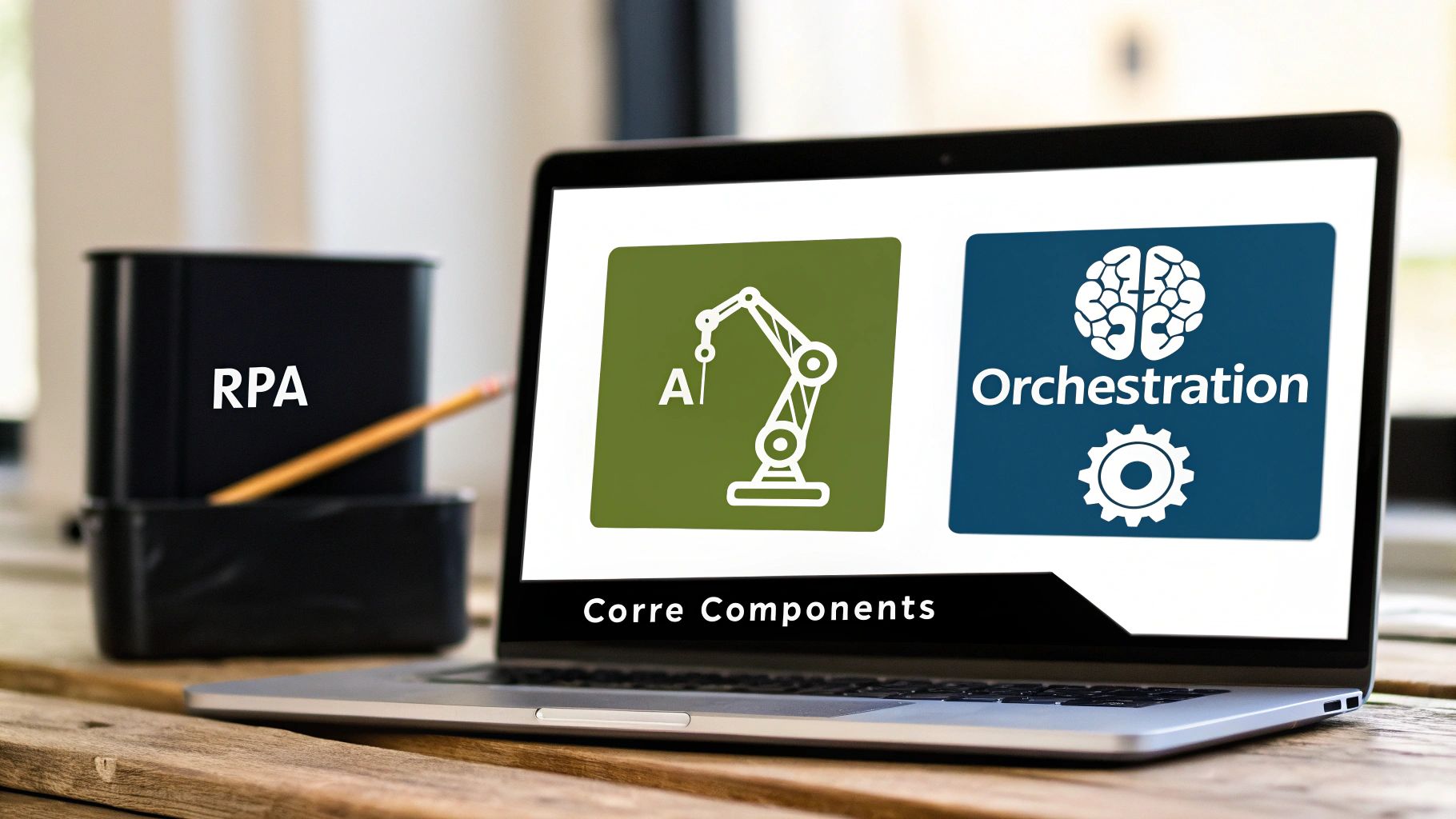
To really get what Intelligent Process Automation is all about, you have to look under the hood. IPA isn't just one piece of technology; it's a powerful combination of different tools working together. Think of it like a highly skilled project team, where each member has a specific and critical role.
You have the diligent worker, the sharp-minded analyst, and the strategic supervisor. Understanding how these pieces fit together is the key to seeing how IPA goes way beyond simple task-ticking to genuinely change how your business operates. Let's break down the core components that make it all possible.
Robotic Process Automation: The Digital Hands
First up is the foundation: Robotic Process Automation (RPA). This is the "doer" of the team—the digital hands that take on all the structured, mind-numbing tasks that bog down your people. RPA bots are masters at following crystal-clear, rules-based instructions.
They're brilliant at things like logging into different systems, copying data from a spreadsheet to your CRM, filling out forms, or moving files around. Picture an assembly line worker who never gets tired, never makes a typo, and can work 24/7 without a coffee break. That's RPA. It's the raw horsepower for any automation effort.
This foundational role is why RPA currently holds a massive 43.4% of the market share in 2024, acting as the bedrock for more advanced digital workforces. While RPA is the starting point, other technologies like process mining are catching up fast as businesses learn to map out their workflows before adding intelligence. You can dig into more of these market dynamics in recent intelligent process automation reports.
Artificial Intelligence: The Cognitive Brain
If RPA provides the hands, then Artificial Intelligence (AI) and Machine Learning (ML) provide the brain. This is what puts the "intelligent" in Intelligent Process Automation. AI gives the system the ability to navigate the messiness and variability of real-world business data.
A standard RPA bot would get stuck if an invoice showed up in a new format, but an AI-powered system learns and adapts. It uses cognitive abilities to mimic human judgment.
Here are the key AI skills inside an IPA toolkit:
- Natural Language Processing (NLP): This allows the system to read and actually understand human language from emails, support tickets, and customer chat logs.
- Intelligent Document Processing (IDP): This technology pulls key information from unstructured documents like PDFs, scanned images, and contracts, no matter how the layout changes. If you want to go deeper, check out our guide on what is intelligent document processing.
- Machine Learning (ML): These algorithms spot patterns in data, learn from past outcomes, and get smarter over time—all without someone having to manually update the rules.
Put together, these AI tools elevate automation from just following a script to truly understanding context, making smart decisions, and handling tricky exceptions.
Digital Process Orchestration: The Strategic Supervisor
The final piece of the puzzle is Digital Process Orchestration. This is the project manager or the conductor of the orchestra. It manages the entire end-to-end process, making sure all the different parts—bots, AI, and people—work together without a hitch.
Orchestration is essential because real business processes are rarely simple or contained within one system. They’re a mix of digital and human handoffs.
Orchestration directs the flow of work, intelligently assigning tasks to the right resource at the right time. It knows when a job is simple enough for an RPA bot, when it needs the cognitive muscle of an AI model, or when it requires the nuanced judgment of a human expert.
For instance, an IPA workflow could start with an RPA bot downloading email attachments. That bot then hands them off to an AI model to extract invoice data. If the AI flags an issue, like a missing PO number, the orchestration engine automatically routes it to someone in accounts payable for review. This dynamic coordination creates a fluid, efficient partnership between your digital and human teams.
Unpacking The Acronyms: IPA vs. RPA vs. BPA
The automation space is full of acronyms that can feel overwhelming and, frankly, a bit interchangeable. But getting them right is critical. Choosing the wrong approach is like using a sledgehammer to crack a nut—you might get the job done, but it’s going to be messy and inefficient. Let's clear the air and break down the real differences between Business Process Automation (BPA), Robotic Process Automation (RPA), and Intelligent Process Automation (IPA).
Think of it as hiring for different roles in your company. Each one has a specific job to do.
Business Process Automation: The Architect
First up is Business Process Automation (BPA). This isn't about a single tool; it's the big-picture strategy. BPA is the architect looking at the entire blueprint of a business workflow and redesigning it from the ground up for maximum efficiency. It often involves integrating multiple systems to work together seamlessly.
A classic BPA move would be deploying a new company-wide ERP system that connects finance, HR, and supply chain data. The goal isn't just to speed up one task but to re-engineer how the entire organization operates. BPA is the foundational decision to build a better, more connected way of working.
Robotic Process Automation: The Task Rabbit
Next, there's Robotic Process Automation (RPA). If BPA is the architect, RPA is the tireless worker you hire to handle the predictable, mind-numbing tasks. RPA bots are digital employees who follow a precise script without deviation. They are incredibly good at what they do, as long as the rules don't change.
They're perfect for jobs like:
- Migrating data from a spreadsheet into a legacy application.
- Moving thousands of files from one server to another.
- Logging into a portal every morning to download a report.
RPA thrives on structured data and clear, step-by-step instructions. Its limitation? It has no real intelligence. If a website button moves or an invoice arrives in a new format, the bot grinds to a halt, waiting for a human to show it what to do next. For a deeper dive into its mechanics, check out our guide on what is Robotic Process Automation.
Think of an RPA bot as the world's most obedient intern. It will follow your checklist flawlessly and never gets tired, but it can't think on its feet or handle anything unexpected.
Intelligent Process Automation: The Problem Solver
Finally, we arrive at Intelligent Process Automation (IPA). This is the experienced manager who doesn't just execute tasks but also thinks, learns, and makes decisions. IPA is what you get when you give the raw power of RPA a brain—specifically, the cognitive horsepower of AI and machine learning.
This upgrade is a game-changer. An IPA system can read an unstructured PDF invoice, understand the sentiment of an incoming customer support ticket, and make judgment calls based on what it has learned. Over time, it gets smarter, refining its own processes without constant hand-holding.
Comparison Of IPA vs RPA vs BPA
To really see how these three automation concepts stack up, it helps to put them side-by-side. The table below breaks down their key differences, which should help you figure out which approach best fits your company's challenges.
| Attribute | Business Process Automation (BPA) | Robotic Process Automation (RPA) | Intelligent Process Automation (IPA) |
|---|---|---|---|
| Primary Goal | Redesign entire business workflows for strategic efficiency. | Automate individual, repetitive, rules-based tasks. | Automate complex, end-to-end processes with decision-making. |
| Intelligence | Strategic; focused on process design and integration. | Low; follows pre-defined scripts without learning. | High; uses AI/ML to learn, adapt, and handle exceptions. |
| Data Handling | Manages data flow between integrated systems. | Works best with structured, predictable data formats. | Processes both structured and unstructured data (e.g., PDFs, emails). |
| Scope | Broad and organizational; focused on the big picture. | Narrow and task-specific; focused on single activities. | Broad and process-oriented; manages entire workflows. |
Ultimately, BPA sets the strategy, RPA handles the simple execution, and IPA takes on the complex, dynamic work. They aren't mutually exclusive; in fact, the most effective automation strategies often find a way to use all three.
Real World Examples of Intelligent Process Automation in Action
The theory behind Intelligent Process Automation is great, but let's get down to brass tacks. Seeing how it actually works is where the lightbulb really goes on. IPA isn't some far-off concept for giant corporations; it's a practical tool that businesses are using right now to solve frustrating problems, cut costs, and make life easier for everyone involved.
So, let's move past the "what" and into the "how." These examples show what happens when you pair the raw power of RPA with the brains of AI. From finance to customer support, IPA is overhauling workflows that were once thought to be way too complicated for automation.
Making Client Onboarding Painless
A clunky, slow onboarding process can sour a new client relationship before it even begins. Traditionally, this meant someone had to manually sift through ID cards, application forms, and business registrations, typing all that info into various systems. It was slow, riddled with typos, and a massive time drain.
Now, with IPA: An intelligent system steps in to handle the heavy lifting.
- The IPA solution uses Intelligent Document Processing (IDP) to read and pull data from any document a client submits, no matter the layout.
- It then instantly checks this information against public databases to verify identities and confirm business details.
- From there, it automatically creates the new client account in the CRM, sets up the billing profile, and kicks off a personalized welcome email.
What used to take days of back-and-forth now happens in minutes. The risk of human error drops to virtually zero, and the client gets a smooth, professional first impression.
Finally, Smarter Invoice Processing
Accounts payable teams are often drowning in invoices. Every vendor sends one in a slightly different format, and someone has to manually punch all that data into an accounting system. It’s a classic recipe for bottlenecks and expensive mistakes.
An IPA system learns to read and understand any invoice you throw at it. It’s not looking for a rigid template; it uses AI to spot the vendor name, invoice number, due date, and total amount—just like a person would.
This completely changes the game. The IPA tool can watch an email inbox for new invoices, pull out all the key data, match it to the right purchase order, and flag anything that looks off for a human to review. If it all lines up, the system can even schedule the payment. A tedious, multi-step chore becomes a hands-off, automated process.
Supercharging IT and Customer Support
When you look at real-world use cases, you can see how intelligent automation is making a huge difference in support departments. For example, AI-powered support platforms like supportGPT show how AI can be a core part of an IPA strategy to deliver better, faster customer service. Instead of having a human agent handle every single ticket, IPA can triage and resolve the easy stuff on its own.
Here’s what that looks like:
- An IPA bot keeps an eye on the support queue or ticketing system.
- It uses Natural Language Processing (NLP) to figure out what the user needs. Is it a password reset? A billing question? A technical glitch?
- For common requests like a password reset, the bot can directly access the necessary systems, perform the task, and close the ticket.
- If the issue is more complex, it intelligently routes the ticket to the right human expert, along with a handy summary of the problem and what’s been tried so far.
This frees up your support team to focus their brainpower on the tricky, high-value problems that actually require a human touch.
Industries like finance and healthcare are leading the charge, using this blend of AI, NLP, and OCR to find massive new efficiencies. The market for this technology, valued at USD 13.6 billion in 2022, is expected to jump to USD 25.9 billion by 2027. This growth is driven by companies automating 50-70% of their tasks to unlock huge annual savings. You can dig deeper into these market trends and automation savings.
How to Implement Intelligent Process Automation
Jumping into Intelligent Process Automation can feel like a huge undertaking, but it doesn't have to be. The best way to approach it is with a clear, step-by-step plan that starts small and builds on proven successes. A great implementation isn't just about the tech—it's about finding the right problems to solve first.
This roadmap breaks the journey down into manageable stages, guiding you from initial discovery all the way to scaling automation across your business. Following these steps helps you sidestep common mistakes and build an automation engine that truly delivers.
Start with Discovery and Strategy
Before you even think about vendors or tools, you need to look inward and understand your own processes. The goal here is to pinpoint workflows that are ripe for automation—the ones that will give you the biggest bang for your buck. Forget trying to automate everything at once. Look for the low-hanging fruit.
You’re hunting for workflows with a few key traits:
- Highly Repetitive: Think of tasks your team does on autopilot every single day, like routine data entry or generating the same old reports.
- Prone to Human Error: These are the processes where a simple slip-up can create a cascade of problems, like compliance checks or processing invoices.
- High Volume: Workflows that handle a ton of transactions are perfect candidates. Shaving off even a few minutes per item adds up to massive time savings.
- Mostly Rules-Based (with a twist): The sweet spot for IPA is a process that's predictable but has just enough exceptions to require a bit of judgment.
Getting this initial analysis right is everything. A fantastic tool for this is process mining, which digs into your system logs to map out how work actually flows through your organization, not just how you think it does. You can dive deeper into this with our guide on what is process mining.
Build Your Business Case
Once you've got a shortlist of potential automation targets, you need to get your leadership on board. This means building a solid business case that spells out the return on investment (ROI) in plain English. "It will save time" just isn't going to cut it.
You need to put real numbers to the benefits. Focus on metrics that matter:
- Cost Savings: Show exactly how many manual labor hours you'll cut.
- Error Reduction: What’s the dollar value of the mistakes you’ll eliminate?
- Increased Speed: How much faster will you be able to close deals, onboard clients, or resolve support tickets?
- Scalability: Demonstrate how you can handle 2x the workload without doubling your headcount.
This data-driven pitch elevates your idea from a simple tech project to a core business strategy that gets decision-makers excited.
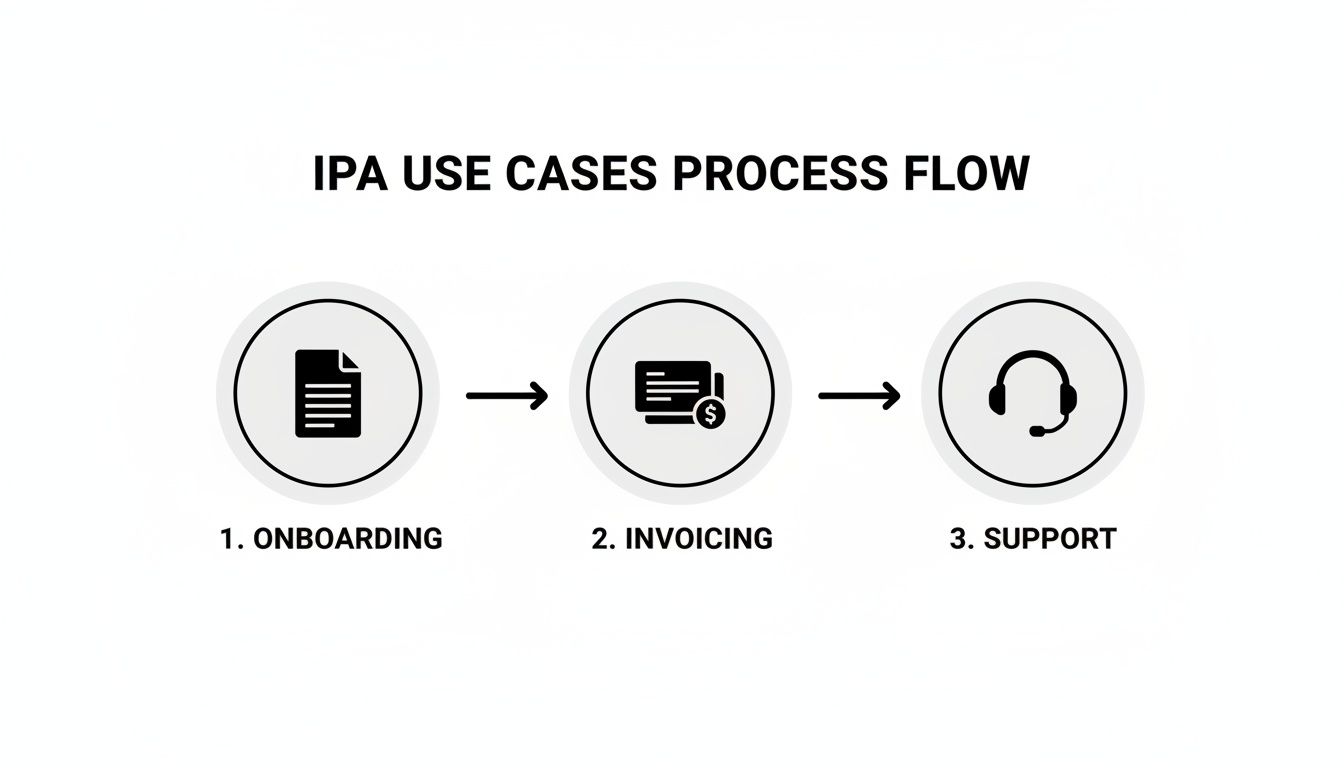
This diagram shows a few classic examples—onboarding, invoicing, and support—where businesses often see the fastest and most significant wins from IPA.
Execute a Pilot Project and Scale
With your business case approved, it's go-time. But hold back the impulse to launch a massive, company-wide initiative. The secret to long-term success is to start with a small, manageable pilot project. Pick one process from your list and automate it completely. This is your chance to test your assumptions, fine-tune your approach, and—most importantly—get a quick, tangible win on the board.
A successful pilot is your best salesperson. It’s hard proof that IPA works, making it infinitely easier to get the green light for bigger, more ambitious projects down the road.
After your pilot proves its worth, you can start to scale. Take what you learned and create a repeatable playbook for identifying, vetting, and automating more processes. This phased rollout keeps risk low and ensures that every new automation builds on the success of the last, fostering a true culture of continuous improvement.
How MakeAutomation Accelerates Your IPA Journey
Understanding intelligent process automation is one thing. Actually building it into a system that drives real profit? That’s a whole different ball game. This is where the rubber meets the road, and it’s exactly where we come in as your hands-on implementation partner.
We don’t just sell you a box of tools and wish you luck. Our entire model at MakeAutomation is designed to bridge the gap between knowing what IPA is and making it work for your B2B or SaaS company. We provide the strategic guidance and technical muscle to turn IPA into a genuine asset, not just another buzzword on a whiteboard.
From Strategy to Execution
Our partnership begins long before a single line of code is written. We kick things off with meticulous process discovery and a detailed ROI analysis. The goal is simple: find the exact workflows where automation will make the biggest dent in your bottom line.
From there, we build custom automation SOPs and manage all the technical heavy lifting, freeing you up to focus on what you do best—growing your business.
We build and deploy targeted solutions designed for scale, including:
- AI-Powered Lead Generation: Automatically find and qualify your most promising leads.
- Automated Client Outreach: Scale personalized communication without losing the human touch.
- Integrated Voice AI Agents: Handle inbound and outbound calls, crushing manual bottlenecks.
Our mission is to move you from knowing about Intelligent Process Automation to actively profiting from it. We handle the complex technical work so you can reclaim your time and scale smarter.
Your Partner in Growth
So many businesses get stuck trying to force a generic automation tool to solve a unique business problem. We work the other way around. We start with your specific challenges—maybe it's a leaky sales funnel or a swamped support desk—and then engineer an IPA solution that directly tackles the issue.
This hands-on approach means your investment starts delivering measurable results, fast. We manage the entire implementation, document every process, and provide the ongoing support needed to tweak and optimize performance over time.
This turns IPA from a daunting, complex project into a powerful, reliable engine for your company’s growth.
Ready to see how we can remove your biggest operational headaches? Let's connect. We’ll build a clear, actionable plan to put intelligent process automation to work and fast-track your journey to seven-figure scalability.
Got Questions About IPA? We've Got Answers.
As more businesses start looking into intelligent process automation, a few questions always pop up. It's only natural. Here, we'll give you straight, clear answers to help you get a real-world handle on this technology and see how it fits into the bigger picture. Let's cut through the jargon.
What's the Real Difference Between IPA and AI?
The biggest difference comes down to scope and application. Artificial Intelligence (AI) is the broad, underlying science of creating systems that can think, learn, and problem-solve like humans. It's the brains of the operation.
Intelligent Process Automation (IPA), on the other hand, is a specific business strategy. It's not just the AI—it’s the application of that AI, combined with Robotic Process Automation (RPA) and other tools, to automate a business workflow from start to finish.
Think of it this way: AI is a powerful engine. IPA is the entire car built around that engine, complete with a chassis (RPA) and a steering wheel (orchestration), all designed to get your business from point A to point B faster and more efficiently. AI provides the intelligence; IPA puts that intelligence to work on a specific business process.
Is Intelligent Process Automation Just for Big Companies?
Not anymore. It's true that large corporations were the first ones on the scene, but that's changed completely. With the rise of cloud platforms and user-friendly, low-code tools, this powerful tech is now well within reach for small and medium-sized businesses (SMBs).
The key isn't a massive, company-wide rollout. The smart strategy for smaller businesses is to start with a specific, high-impact process. Think about things like automating invoice data entry, qualifying new leads from your website, or handling those repetitive customer service questions. This targeted approach lets smaller teams get a quick, significant return on their investment without needing a huge budget or a dedicated IT army.
How Do I Actually Measure the ROI of an IPA Project?
Measuring the return on an IPA investment isn't just about one number. To get the full picture, you need to look at both the "hard" and "soft" benefits.
Hard Metrics are the tangible results you can easily count.
- Direct Cost Savings: This comes from calculating the reduction in hours your team spends on manual tasks.
- Increased Throughput: How many more invoices can you process or orders can you fulfill in the same amount of time?
- Lower Error Rates: Track the drop in costly mistakes that lead to rework or compliance headaches.
Soft Metrics are just as critical, but they focus more on the qualitative wins. This includes things like better employee morale (because no one likes doing tedious work), happier customers (thanks to faster response times), and stronger compliance because your processes are now auditable and consistent. A good implementation partner will help you nail down these KPIs from the very beginning so you can clearly see the impact.
At MakeAutomation, we don't just talk about IPA; we build it. We work with B2B and SaaS businesses to turn theory into reality, creating custom automation that delivers real, measurable ROI. Ready to get your time back and scale smarter? Book a consultation with us today.