
What Is Sales Development Your Guide to Building a Revenue Engine
So, what exactly is sales development? In a nutshell, it’s the engine room of a modern sales organization. It’s the focused, strategic process of finding, connecting with, and qualifying potential customers to build a predictable pipeline of sales-ready opportunities.
Think of it as the critical link between the broad-net-casting of marketing and the deal-closing expertise of your sales team. Its entire purpose is to make sure your closers spend their time in conversations that actually have a chance of going somewhere.
Understanding Sales Development Beyond The Buzzwords

Let’s use a simple analogy. Imagine your sales process is like building a custom home. Marketing is the team that designs the stunning blueprints and puts up "for sale" signs, getting the word out to the whole town. The Account Executives (AEs) are your expert closers—the ones who walk a buyer through the finished home, sign the final papers, and hand over the keys.
Where does sales development fit in? They are the on-site architects and general contractors. They don’t just wait for people to wander onto the lot. They actively seek out the right kind of buyers, vet their finances and timeline, and then schedule a formal meeting with the AE.
This dedicated role stops your closers from wasting hours with tire-kickers and window-shoppers. It’s about creating an efficient, repeatable system that fuels the entire revenue machine, especially in a B2B environment.
The Bridge Between Marketing and Sales
Sales development is the essential connective tissue between what marketing generates and what sales needs to succeed. Marketing’s job is to create awareness and capture initial interest through lead generation marketing. But those raw leads are rarely ready for a sales pitch.
The sales development team steps in to nurture and refine those leads, ensuring a smooth, intelligent handoff. This alignment is crucial; it means everyone agrees on what a truly "good" lead looks like.
Sales development transforms the unpredictable nature of lead generation into a predictable system for revenue growth. It's less about making a single sale and more about manufacturing a steady stream of qualified opportunities.
To quickly see how this function stands apart, here’s a simple breakdown.
Sales Development at a Glance
| Component | Sales Development (SDR) | Traditional Sales (Account Executive) |
|---|---|---|
| Primary Goal | Create qualified opportunities | Close deals and generate revenue |
| Key Activities | Prospecting, cold outreach, qualification | Demos, negotiation, contract signing |
| Main Metric | Meetings booked, opportunities created | Quota attainment, revenue closed |
| Focus | Top-of-funnel (generating pipeline) | Bottom-of-funnel (closing pipeline) |
This division of labor allows each role to develop deep expertise, making the entire sales process far more effective.
Core Functions and Purpose
The day-to-day mission of a sales development team is to start meaningful conversations and build initial relationships with potential customers. It’s a mix of proactive, strategic activities designed to guide a prospect from being a name on a list to someone eager for a sales call.
Here’s what that looks like in practice:
- Prospecting and Research: Hunting down and identifying the specific companies and people who fit your Ideal Customer Profile (ICP).
- Outreach: Systematically engaging those prospects across multiple channels—think personalized emails, cold calls, and social media messaging.
- Qualification: Asking smart questions to figure out if a lead has a real need, the budget to solve it, and the authority to make a decision.
- Setting Appointments: The grand finale. Once a lead is properly qualified, the SDR books a meeting or demo on the Account Executive's calendar.
By focusing only on these top-of-funnel activities, Sales Development Representatives (SDRs) get incredibly good at opening doors. Their effectiveness skyrockets when they’re armed with great data, a concept you can dive into in our guide on what is sales intelligence. This specialization isn't a luxury anymore; it's a fundamental part of building a competitive sales organization.
The Anatomy of a Modern Sales Development Team

A top-tier sales development operation isn't a one-person show. It's a finely tuned machine made up of specialized, complementary roles. This structure is all about focus and efficiency, making sure an expert handles every single step of the early sales funnel.
At the heart of it, the team is usually split into two key functions. While the titles are often thrown around interchangeably, they actually serve very different strategic purposes. Understanding this split is crucial to getting what is sales development in today's world. It’s about putting the right talent on the right tasks to build the strongest possible pipeline.
The Inbound Specialist: The Sales Development Representative
Think of the Sales Development Representative (SDR) as the master qualifier. Their entire world revolves around the inbound interest stirred up by the marketing team. When someone downloads an ebook, signs up for a webinar, or hits that "contact us" button, the SDR springs into action.
Their core mission? To sift through all these incoming signals and separate the genuinely interested prospects from the tire-kickers. A typical day for an SDR involves:
- Rapid Response: Following up on new leads in minutes, not hours, to catch them while their interest is red-hot.
- Lead Qualification: Using tried-and-true frameworks like BANT (Budget, Authority, Need, Timeline) to see if a lead is actually a good fit.
- Education and Nurturing: Answering initial questions and providing value to gently guide the prospect toward a real sales conversation.
In short, SDRs are the critical link that turns marketing spend into real sales opportunities. They stand guard at the gate, ensuring only well-vetted, high-potential leads ever land on an Account Executive’s calendar.
The Outbound Hunter: The Business Development Representative
While the SDR manages incoming traffic, the Business Development Representative (BDR) creates opportunities out of thin air. BDRs are proactive hunters focused exclusively on outbound prospecting. They don’t wait for leads to find them—they go out and find the leads.
This role demands a totally different skillset built on research, strategy, and a whole lot of resilience. A BDR is tasked with identifying and engaging companies that perfectly fit the Ideal Customer Profile (ICP) but might not even know your solution exists yet.
The BDR's role is to manufacture demand. They turn cold prospects into warm, qualified conversations through persistent and personalized outreach, effectively creating pipeline out of thin air.
Their main responsibilities include:
- Strategic Prospecting: Building hyper-targeted lists of accounts and finding the key decision-makers within them.
- Cold Outreach: Running multi-channel campaigns that mix personalized emails, cold calls, and savvy social media engagement.
- Initial Discovery: Kicking off the first conversations to uncover pain points and spark enough interest for a deeper dive.
SDRs are essential for capitalizing on existing demand, but BDRs are the engine for creating new market opportunities and driving predictable growth. To streamline their work, many teams bring in a Business Development Virtual Assistant to handle time-consuming research and admin tasks.
Uniting for a Common Goal
Even though their day-to-day work looks different, SDRs and BDRs are driving toward the exact same goal: feeding Account Executives (AEs) a steady diet of high-quality, sales-qualified appointments. This specialization frees up the AEs to do what they do best—run demos, negotiate contracts, and close deals.
The impact of this focused structure is huge. These representatives are the frontline warriors of the B2B sales pipeline, and their contribution is staggering. According to recent benchmarks, the median pipeline generated per SDR is an impressive $2.8 million.
Ultimately, this team structure ensures no opportunity slips through the cracks. To get a better handle on how to support these critical roles, check out our guide on https://makeautomation.co/what-is-sales-operations/, which dives into the systems and processes that help SDRs and BDRs operate at their best.
Measuring What Matters for Sales Development Success
In sales development, if you're not measuring, you're just guessing. Data tells the real story of your team's performance, but only if you’re focused on the right numbers. Flying by the seat of your pants might work for a little while, but building a predictable revenue engine demands a data-driven approach.
This means looking past "vanity metrics" like the sheer number of calls someone makes. Activity is a piece of the puzzle, sure, but it's the outcomes of that activity that actually move the needle. A solid measurement framework is your diagnostic tool—it helps you spot problems early, coach your team effectively, and fine-tune your entire outreach strategy.
The Three Pillars of Sales Development KPIs
To get a full, 360-degree view of your team's health, you need to track metrics across three core categories. Each one answers a different, but equally critical, question about how things are going. Think of them as the vital signs for your entire sales development operation.
- Activity Metrics: These are simple. They tell you, "Is my team putting in the effort?" They measure the raw output of your SDRs and BDRs.
- Efficiency Metrics: This is where things get interesting. These answer, "Is the effort we're putting in actually working?" They show you how good your team is at turning raw activity into real conversations.
- Outcome Metrics: This is the bottom line. It answers the most important question: "Is our work driving real business results?" These are the KPIs that connect all that hard work directly to revenue.
Balancing these three is how you truly understand performance. A ton of activity with almost no positive outcomes points to a messaging or targeting problem. On the flip side, low activity but amazing efficiency might mean your team has the capacity to handle a lot more volume.
Critical Activity and Efficiency Metrics
Let's start with the basics. Activity metrics are your foundation—they're the easiest to track and give you a baseline for what "a good day's work" looks like. They are the inputs.
Key activity metrics include:
- Dials: How many phone calls are being made?
- Emails Sent: What's the volume of email outreach going out the door?
- Social Touches: How many interactions are happening on platforms like LinkedIn?
But remember, activity without efficiency is just spinning your wheels. This is where efficiency metrics come in. They’re the conversion rates that reveal the quality of all that activity, and frankly, they’re far more insightful.
A rep who makes 100 calls and books 5 meetings is worlds more effective than a rep who needs 200 calls to book the same 5 meetings. Efficiency metrics tell you who has real skill, not just who is busy.
Examples of critical efficiency metrics:
- Lead-to-Meeting Rate: What percentage of the leads you engage actually turn into a booked meeting? This is a core indicator of an SDR's skill.
- Email Reply Rate: Are people actually responding to your emails? This is a direct test of your subject lines and messaging.
- Call Connection Rate: Of all the dials made, how many result in a real conversation with the right person?
Focusing on Game-Changing Outcome Metrics
While activity and efficiency metrics are crucial for your day-to-day management, outcome metrics are what get the leadership team's attention. These are the numbers that prove your team's impact on the company’s bottom line. They are the ultimate scoreboard.
The most important outcome metrics include:
- Sales Qualified Leads (SQLs): The number of meetings or opportunities that your Account Executives accept, confirming they meet the criteria to enter a real sales cycle.
- Pipeline Generated: This is huge. It's the total dollar value of the opportunities your sales development team has created.
- Win Rate: The final report card. What percentage of the opportunities your team sourced actually turn into closed-won deals?
Tracking all these KPIs is essential for building a high-performing sales development team. Here’s a quick look at the most important ones, along with some typical benchmarks to see how you stack up.
Essential Sales Development KPIs
| KPI Category | Metric | Description | Industry Benchmark |
|---|---|---|---|
| Activity | Dials / Emails per Day | The total number of outreach attempts an SDR makes daily. | 80-120 combined touches |
| Activity | Conversations | The number of live, two-way conversations with prospects. | 5-10 per day |
| Efficiency | Email Reply Rate | The percentage of emails that receive a response (positive or negative). | 5-10% |
| Efficiency | Lead-to-Meeting Rate | The percentage of contacted leads that result in a booked meeting. | 2-5% |
| Outcome | Meetings Held (SALs) | The number of initial discovery meetings that actually take place. | 80-90% of meetings booked |
| Outcome | Opportunities (SQLs) | The number of meetings that the sales team accepts as qualified. | 60-80% of meetings held |
| Outcome | Pipeline Generated | The total potential revenue value from all qualified opportunities. | Varies by company/ACV |
| Outcome | Closed-Won Deals | The number of SDR-sourced opportunities that become customers. | Average sales win rate is 21% |
These benchmarks can vary, of course, but they give you a solid starting point. The goal is to create a transparent, data-driven culture where performance is predictable and coaching is targeted. When you get this right, your sales development function stops being a cost center and becomes the powerful, reliable growth engine it was meant to be.
Interestingly, while the 21% average win rate highlights just how competitive the B2B space is, a separate study shows that 91% of teams report their win rates are either stable or improving. This suggests that even in a tough market, good process and execution pay off. You can dive into more insights on the latest sales statistics to see how your team compares.
Building a Repeatable Sales Development Process
Success in sales development isn't about random acts of brilliance. It comes from having a documented, repeatable process that your team can follow every single time. Without a clear playbook, your reps are just winging it, which leads to inconsistent results and a ton of wasted effort.
A well-defined process turns your SDR function from an art form into a science. It creates a reliable machine for generating qualified opportunities.
This playbook doesn't need to be overly complicated. It really boils down to four distinct stages that guide a potential customer from being just a name on a list to a warm introduction for an Account Executive. Let's break down what that looks like in the real world.
Stage 1: Research and Identification
Everything starts with knowing exactly who you're trying to reach. Before a single email is sent or a phone call is made, your team has to have a crystal-clear understanding of your Ideal Customer Profile (ICP). This is the foundation for everything else you do.
An ICP isn't just a persona; it's a detailed description of the perfect company you should be targeting. It includes firmographic data like:
- Industry or Vertical: Which specific markets get the most value out of your solution?
- Company Size: Are you selling to scrappy startups, mid-market businesses, or massive enterprises?
- Geography: Where are your best-fit customers located?
- Technographics: What other tools are they using that signal they might need you?
Once you’ve locked down your ICP, your BDRs can get to work building hyper-targeted account lists. This strategic approach means every ounce of effort is focused on prospects with the highest chance of becoming happy, successful customers.
The infographic below shows how to think about measuring your efforts across every stage of the process.
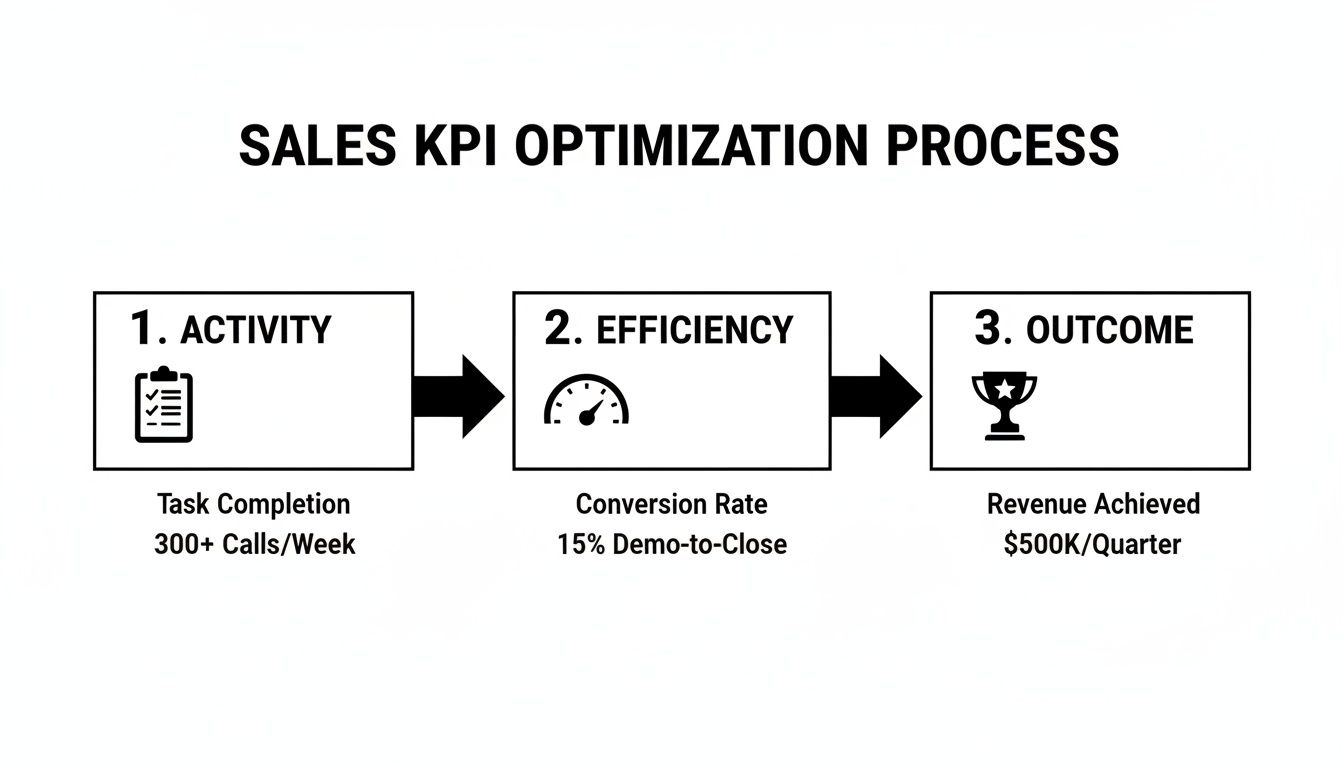
As you can see, success isn't just one number. It's a chain reaction that starts with raw activity, moves to efficient conversions, and ultimately drives real business outcomes.
Stage 2: Multi-Channel Outreach
With a targeted list ready to go, it’s time to start the conversation. In today's noisy world, sending one email and hoping for the best is a guaranteed path to failure. Modern outreach is a multi-touch, multi-channel sequence designed to cut through that noise.
A solid outreach cadence mixes different channels over several days or even weeks. For instance:
- Day 1: A highly personalized email that references a specific company trigger or pain point you've uncovered.
- Day 3: A follow-up call to the prospect’s direct line.
- Day 5: A connection request on LinkedIn with a brief, non-salesy note.
- Day 7: Another follow-up email, this time offering something valuable like a relevant case study or blog post.
The name of the game is persistence and personalization. Each touchpoint should build on the last one, adding value and showing you’ve actually done your homework. This structured approach massively increases your chances of getting a reply.
Stage 3: Rigorous Qualification
Getting a response is great, but it's just the beginning. The next critical step is qualification. This is where your SDRs dig in to find out if a prospect has a genuine need and is actually a good fit for a sales conversation. It’s how you separate the merely curious from the truly committed.
To do this right, teams lean on proven qualification frameworks. These are essentially structured sets of questions designed to uncover key information.
Qualification is the quality control checkpoint for your entire sales pipeline. Its job is to protect your Account Executives' valuable time by making sure they only talk to prospects with real problems you can solve.
Some of the most common frameworks you'll see are:
- BANT (Budget, Authority, Need, Timeline): The old-school classic for quickly gauging a lead's viability. Does the prospect have the budget, the authority to make a decision, a clear need, and a timeline for making it happen?
- MEDDIC (Metrics, Economic Buyer, Decision Criteria, Decision Process, Identify Pain, Champion): A more robust framework often used in complex B2B sales cycles to get a much deeper understanding of the customer's buying process.
Using a consistent framework ensures that every single lead passed over to the sales team meets the same high standard.
Stage 4: The Seamless Handoff
The final stage is the handoff—transitioning the qualified lead from the SDR to an Account Executive (AE). This is a make-or-break moment where a lot of sales processes completely fall apart. A sloppy handoff can kill all the rapport and momentum the SDR worked so hard to build.
A seamless handoff boils down to clear communication and a well-defined process. The SDR must log every relevant detail in the CRM, from the prospect’s specific pain points and goals to any other key info they picked up on the discovery call.
The goal is simple: arm the AE with so much context that the prospect never has to repeat themselves. A great handoff feels like a natural continuation of the conversation, setting the AE up for a successful demo and, hopefully, a closed deal.
How AI and Automation Give Your Sales Team Superpowers
In modern sales development, technology isn't just a nice-to-have tool—it's the engine that separates good teams from great ones. All those manual, mind-numbing tasks that used to eat up an SDR's day? Logging calls, sending the fifth follow-up email, sorting through messy lead lists—that's all perfect work for intelligent automation.
This shift lets your team graduate from being task-doers to genuine strategists. Instead of getting bogged down in administrative quicksand, they can pour their energy into what actually moves the needle: building real human connections, digging into customer problems, and crafting outreach that doesn't just get opened, but gets a reply.
From Manual Grind to Intelligent Operations
There's a reason AI adoption in sales is exploding: it works. It’s turning the old, manual grind of B2B and SaaS sales development into a smart, scalable operation. The numbers don't lie—AI use in sales shot up from 24% in 2023 to 43% in 2024, and it’s still climbing. This isn't just tech for tech's sake. Teams are seeing real benefits, with 68% reporting better lead quality and nearly 60% hitting their revenue goals more consistently. You can dive deeper into the data in HubSpot’s latest sales strategy report.
Think of AI and automation as a co-pilot for your sales team. It handles the monotonous, repetitive work, freeing up your reps to focus on the high-stakes, high-impact activities. This isn't about replacing people; it's about making them better, faster, and smarter.
The image below gives you a glimpse of how a platform can tie different tools together into a smooth, automated workflow.
This shows how you can connect your CRM, email, and chat apps to trigger a whole sequence of actions automatically. It's a massive time-saver.
AI-Powered Lead Scoring and Prioritization
One of the oldest problems in sales is figuring out where to focus your time. An SDR can have a list of hundreds of potential contacts, but only a tiny handful are actually ready to talk. This is where AI completely changes the game.
AI algorithms can chew through huge amounts of data—company size, website visits, social media activity, past email opens—to predict who is most likely to become a customer.
AI-driven lead scoring is like a GPS for your sales team. It highlights the fastest, most direct route to your best opportunities and stops reps from getting lost on dead-end roads.
Suddenly, your team can stop throwing spaghetti at the wall to see what sticks. They can concentrate their efforts on the leads with the highest potential, which is a massive boost for both efficiency and morale.
Automating Personalized Outreach at Scale
Everyone knows that personalization is what cuts through the inbox noise. But doing it right for hundreds of prospects is brutally time-consuming. This is the exact problem automation platforms were built to solve.
You can build out sophisticated, multi-step outreach sequences that feel personal because they are. By using dynamic fields, the system pulls in specific details for each prospect.
- Trigger-Based Follow-ups: Did a prospect click a link to your pricing page? The system can automatically send a tailored follow-up email an hour later.
- A/B Testing: You can constantly experiment with different subject lines, call-to-action buttons, or value props to see what actually works.
- Channel Integration: It's not just about email anymore. You can build a campaign that seamlessly weaves in LinkedIn connection requests, phone call reminders, and other touchpoints.
By letting the machines handle the mechanics of sending, your reps can spend their precious time researching that one killer talking point or personal detail that makes a real connection. If you're ready to get your hands dirty, our guide on AI-powered sales automation has the practical steps to get you started.
The Rise of Intelligent Agents
We're now moving beyond simple task automation. AI is now powering intelligent agents that can handle the first round of lead qualification all on their own. These AI bots can chat with visitors on your website or even handle the initial replies to inbound email inquiries.
They can ask the basic qualifying questions, give instant answers to FAQs, and even book a meeting directly on an SDR's calendar. This guarantees that every single lead gets an immediate response, 24/7. More importantly, it ensures your human reps only get involved once a lead has shown real intent and is a decent fit. This frees up your team to do what they do best: focus on high-value outbound prospecting and building meaningful business relationships.
Your Top Sales Development Questions, Answered
As you start building out your sales development function, a lot of questions come up. It's a common experience, whether you're a founder about to make that first hire or a seasoned sales leader trying to fine-tune an existing team. Getting these things right is crucial for creating a team that actually drives revenue.
Let's cut through the noise and tackle the big questions head-on. Think of this as your quick-reference guide for making smarter decisions about your sales development strategy.
What’s the Real Difference Between Sales and Sales Development?
This is easily the most common question, and the answer all comes down to focus. Sales development owns the very top of the sales funnel. Their entire mission is to find and qualify new leads to create genuine, sales-ready opportunities. At the end of the day, their main goal is to book a high-quality meeting for the sales team.
Traditional sales, which is usually handled by Account Executives (AEs), picks up right where sales development leaves off. AEs work the bottom half of the funnel. They're the ones nurturing those qualified opportunities through demos and negotiations, with the ultimate goal of closing the deal and bringing in the revenue.
Think of it like a relay race. The sales development team runs the first leg, building a strong lead before passing the baton cleanly. The sales team grabs that baton and runs the final leg to win the race.
Each role demands a totally different skillset. SDRs need to be masters of starting conversations and spotting potential, while AEs are experts at navigating a complex buying process all the way to a signed contract.
When Should a Startup Hire Its First SDR?
Hiring your first Sales Development Representative is a huge step, and getting the timing right is everything. You should seriously consider it once you've nailed down a reasonable degree of product-market fit and have some kind of repeatable—even if it's manual—way of generating leads.
A few signs that you're ready include:
- Founder Overload: The founder is spending way too much time prospecting and not enough time on strategy, product, or running the business.
- Inbound Leads Are Piling Up: You have a steady stream of inbound leads coming in, but nobody has the dedicated bandwidth to follow up and qualify them properly.
- You're Ready to Scale: You've proven you can close deals and now need a predictable, outbound pipeline to grow beyond just founder-led sales.
Before you bring someone on, it is absolutely critical to have a clear Ideal Customer Profile (ICP) and a basic sales process documented. This gives your new SDR a fighting chance to succeed from day one instead of setting them up to fail.
How Do You Actually Measure the ROI of a Sales Development Team?
Figuring out the return on your investment in a sales development team means looking past the simple activity numbers. You need to track both leading and lagging indicators to see the full picture of their impact.
Leading indicators are your early warning signs of performance. They include:
- Activity Metrics: The raw number of calls, emails, and social media messages.
- Conversion Rates: The percentage of prospects who actually book a meeting.
These are great for day-to-day management, but the real story is in the lagging indicators. These are the metrics that tie the SDRs' work directly to the bottom line.
Lagging indicators you should be tracking include:
- Pipeline Value Generated: The total dollar amount of the sales pipeline created by the team's efforts.
- Win Rate of Sourced Opportunities: The percentage of deals that came from an SDR that your AEs actually close.
- Average Deal Size: The typical revenue you see from the deals your SDR team sources.
The ultimate ROI calculation is pretty simple: (Revenue from SDR-Sourced Deals – Total Cost of the Sales Development Team) / Total Cost of the Team. The key is to automate this data capture in your CRM so you can accurately track these metrics and prove just how valuable the team really is.
What Are the Most Common Mistakes I Should Avoid?
Building a great sales development function is tough, and a few common mistakes can trip you up before you even get going. Knowing what they are is the first step to avoiding them.
Here are three of the most frequent errors we see companies make:
- No Defined Process: Throwing an SDR into the deep end without a clear outreach playbook, scripts, or qualification criteria is a recipe for disaster. They need structure to be effective.
- Poor Alignment with Sales: This is a huge source of friction. If an SDR’s idea of a “qualified lead” doesn’t match what an AE expects, you’re just creating frustration and wasting opportunities.
- Not Investing in Tools and Training: Expecting SDRs to crush their goals without the right tech (like a solid CRM and a sales engagement platform) or ongoing coaching is completely unrealistic. Investing in their success is non-negotiable.
Ultimately, building a strong foundation with clear processes, aligned goals between sales and marketing, and the right technology is the only way to achieve long-term success.
Ready to stop wasting time on manual outreach and build a scalable sales engine? The team at MakeAutomation specializes in implementing AI and automation frameworks that eliminate repetitive tasks, allowing your team to focus on what they do best—building relationships and closing deals. Discover how to optimize your workflows and accelerate your growth with us.