What is standard operating procedure: A practical guide to consistency
A Standard Operating Procedure (SOP) is really just a fancy term for a set of crystal-clear, step-by-step instructions that spells out how to handle a specific task. Think of it as your company’s playbook, making sure important jobs get done the right way, every time, no matter who's doing them.
The Blueprint for Business Consistency
Have you ever tried to assemble a complex piece of furniture without the instructions? You might get it done eventually, but it’s going to be slow, frustrating, and the final result will probably be a bit wobbly. A business running without SOPs is in the same boat—it's relying on guesswork, memory, and tribal knowledge that disappears the moment someone goes on vacation.
SOPs replace that chaos with clarity. They turn complex or routine tasks into a repeatable system that anyone can follow. This guide becomes the single source of truth for everything, whether it's onboarding a new SaaS client, deploying a software update, or handling a critical customer support ticket.
More Than Just a Checklist
While a simple checklist can be an SOP, a truly effective one goes deeper. It’s a complete resource that explains the "who, what, when, where, and why" behind a process. A great SOP doesn’t just list the steps; it gives your team the context they need to perform their roles confidently and efficiently. To really get this right, it helps to understand what process documentation is at its core.
Think about a pilot's pre-flight checklist. It's a non-negotiable SOP designed to eliminate human error where the stakes are incredibly high. Every item is checked, in order, without fail. In a B2B or SaaS business, SOPs bring that same level of discipline to your operations, guaranteeing the quality and consistency that are essential for scaling up.
To give you a clearer picture, here’s a quick breakdown of what makes a good SOP.
SOP At A Glance Key Characteristics
This table highlights the fundamental elements of an effective Standard Operating Procedure and explains why each one is so important for B2B and SaaS companies.
| Characteristic | Description | Why It Matters for B2B/SaaS |
|---|---|---|
| Clarity and Simplicity | Instructions are written in simple language, avoiding jargon. They are direct and easy to follow. | Reduces onboarding time for new hires and minimizes errors in complex technical processes like client setup or data migration. |
| Step-by-Step Format | The process is broken down into a logical, sequential series of actions. | Ensures that critical tasks, like software deployments or security protocols, are performed in the correct order, preventing costly mistakes. |
| Defined Scope | Clearly states the purpose of the SOP, including its start and end points. | Prevents confusion and process overlap between different teams (e.g., sales handoff to customer success). |
| Assigned Roles | Specifies who is responsible for each step or the overall process. | Creates clear accountability, which is vital for managing SLAs (Service Level Agreements) and customer support escalations. |
| Version Control | Includes a system for tracking updates, revisions, and approval dates. | Guarantees that everyone is using the most current, compliant version of a process, especially important for security and data handling. |
These characteristics are what transform a simple document into a powerful tool for consistency and growth.
A standard operating procedure isn't about restricting creativity. It's about building a stable foundation. When you standardize the routine stuff, you free up your team’s brainpower to focus on innovation and solving the big problems.
Ultimately, an SOP is a fundamental tool for operational excellence. It ensures your best practices aren't just ideas in someone's head but are consistently applied across the entire organization. This is what allows a business to scale smoothly, cut down on mistakes, and build the kind of trust that keeps customers coming back.
Why SOPs Are Your Secret Weapon for Growth

It’s easy to think of a standard operating procedure as just another boring document. But its real power isn’t in the definition—it’s in the results it drives. Forget restrictive rules. Think of SOPs as the playbook high-performing companies use to build unstoppable momentum. They are the engine that turns abstract goals into real, measurable outcomes by fueling consistency, efficiency, and scalable growth.
Every business has hidden costs that quietly drain resources. A study found that for a mid-sized company, just one hour of unproductive work per employee each week adds up to $5,900 in losses every year. SOPs fight this drain directly by making sure critical tasks get done the right way, every time. This creates predictable results and cuts down on wasted effort.
From Chaos to Consistency
The first and most obvious win from a good SOP is consistency. It guarantees a certain level of quality. For B2B and SaaS companies, this isn't just nice to have—it's the foundation of client trust and retention. When your clients know they'll get the same great service or product experience time after time, their confidence in you solidifies. That's how you build lasting partnerships and keep churn low.
This consistency then sends ripples across your entire organization, sparking some major improvements. If you're looking for more ways to make your operations smoother, check out our guide on how to improve operational efficiency.
Here’s how it breaks down:
- Slash Training Time: New hires can follow clear, documented guides to get up to speed in days, not weeks. This frees up your senior team and makes newcomers productive almost immediately.
- Minimize Costly Errors: By laying out the correct steps, SOPs cut down on human error in crucial areas like billing, data entry, or software setups. Fewer mistakes mean less time and money spent on fixes.
- Protect Your “Secret Sauce”: When a seasoned employee leaves, their knowledge doesn't have to walk out the door with them. SOPs capture that valuable expertise and make it a permanent company asset.
Connecting Process to Profit
It’s one thing to say SOPs make things run better, but how does that translate to actual dollars? The link is more direct than you might think. A systematic operation is a straight line to revenue growth because it sharpens the customer experience and helps you put your resources where they matter most.
Think about a classic SaaS scenario: a customer submits a support ticket for a critical bug.
- Company A (No SOP): The ticket lands with a junior agent who isn’t sure what to do. They ask a colleague for help, who tells them something different from what a senior dev would have said. The ticket gets bounced between departments for two days. Meanwhile, the client is getting more and more frustrated, probably already looking at your competitors.
- Company B (With an SOP): A detailed SOP for "Critical Bug Reporting" is ready to go. The agent instantly sees the ticket's priority level, follows a checklist to grab the right logs, and uses a pre-written template to escalate it directly to the on-call engineers. The client gets an acknowledgment in minutes, and a fix is deployed within hours. Trust is not only saved but strengthened.
In this case, the SOP didn't just fix a bug—it saved a client relationship and protected future revenue.
"SOPs aren't about controlling people; they're about controlling outcomes. They give you the freedom to scale your business without scaling the chaos, ensuring your standards for excellence grow right along with your team."
At the end of the day, SOPs allow your business to run with precision and predictability. They take your team's best practices from a good idea and turn them into a daily habit. This operational discipline is what lets a company finally stop putting out fires and start focusing on the big picture, creating the solid foundation you need for long-term, sustainable growth. They aren’t just documents; they're your blueprint for success.
The Anatomy of a Powerful SOP Document
A truly effective standard operating procedure is so much more than a simple to-do list. Think of it as a detailed blueprint for action, designed to get rid of guesswork and give your team the confidence to nail their tasks every single time. To build one that actually works, you have to understand its core components.
It’s a bit like building a car. You can't just throw a bunch of parts together and hope it starts. Each piece—the engine, the chassis, the electronics—has a specific job, and they all have to fit together perfectly. An SOP document is no different; every section serves a purpose, and together they create a powerful tool for consistency.
Starting with Purpose and Scope
Every great SOP starts with a crystal-clear purpose statement. This is a short, direct explanation of why the document even exists. What problem are we solving here? What's the goal? For a SaaS company, the purpose might be, "To ensure every new customer is onboarded successfully within their first 7 days."
Right after that, you need to define the scope. This sets the boundaries. It clearly spells out where the process begins and where it ends, which stops any confusion or overlap with other procedures. For our customer onboarding example, the scope would state that the process kicks off after the sales contract is signed and wraps up once the customer has completed their initial setup call.
A well-defined purpose and scope act as the North Star for your procedure. They keep the document focused and ensure everyone understands its context and limitations before diving into the steps.
Nailing these two elements upfront gets rid of ambiguity and makes sure the SOP is used exactly as intended.
Outlining the Core Procedure
This section is the heart of your SOP, where you break down the task into simple, actionable steps. The name of the game is absolute clarity. Someone with zero prior knowledge should be able to read this section and complete the process without a hitch.
There are a few solid formats for this, and the one you pick really depends on how complex the task is.
- Simple Checklists: Perfect for straightforward, linear tasks like a daily server health check.
- Hierarchical Lists: Great for more involved processes that have main steps and sub-tasks, like preparing for a new software release.
- Flowcharts: The best choice for procedures with decision points ("if this, then that"), like a customer support escalation path.
No matter the format, stick to simple language, ditch the jargon, and throw in visuals like screenshots or diagrams wherever they can add a bit more clarity.
Assigning Roles and Measuring Success
An SOP without clear accountability is just a piece of paper. The Roles and Responsibilities section needs to state exactly who is on the hook for each step of the process. This puts an end to the "I thought someone else was handling that" problem for good. For a feature release, this would define the duties of the Product Manager, Lead Developer, and QA Tester at each stage.
On top of that, you need to know if your SOP is actually working. That's where Key Performance Indicators (KPIs) come in. By attaching measurable metrics to the process, you can track how effective it is over time. For our onboarding SOP, KPIs might include "Time to First Value (TTV)" or "Customer Satisfaction Score (CSAT)" for new clients.
Finally, every powerful SOP includes a Revision History. This simple log tracks what was changed, when it was changed, and who made the update. It turns the SOP into a living document that grows with your business, ensuring it never gets stale.
Putting all these pieces together creates a comprehensive, easy-to-follow guide.
This handy table breaks down the key sections you'll want to include in any SOP you create.
SOP Document Structure
| Component | Purpose | Example Application |
|---|---|---|
| Title Page | Identifies the document with a clear title, ID number, and version. | SOP-MKT-003: New Blog Post Publishing Process, v2.1 |
| Purpose | Briefly explains why the SOP exists and what it aims to achieve. | To standardize the process for publishing blog content, ensuring quality and consistency. |
| Scope | Defines the boundaries of the procedure—what it covers and what it doesn't. | This process begins with a final draft and ends when the post is live on the website. |
| Roles & Responsibilities | Clarifies who is responsible for each part of the procedure. | Content Writer: Drafts post. Editor: Reviews content. Marketing Lead: Approves & schedules. |
| Procedure Steps | Provides a step-by-step guide to completing the task. | 1. Submit draft to editor. 2. Incorporate feedback. 3. Get final approval… |
| KPIs/Metrics | Lists the metrics used to measure the success of the process. | Time from draft to publication (target: <48 hours), social media engagement rate. |
| Revision History | Logs all changes, dates, and authors of the updates. | v2.1 (05/15/24, J. Doe): Updated SEO checklist in Step 4. |
A well-structured document like this is easy to navigate and immediately useful for your team.
For more structured guidance, you can explore various business process documentation templates to get started. This structure is becoming essential as companies scale. The SOP Management market was valued at USD 1,625.5 million worldwide and is projected to surge dramatically, fueled by the widespread adoption of automation. This growth signals that businesses are investing heavily in standardizing their operations for greater efficiency and reliability. To dive deeper into this trend, you can explore more about the SOP management market growth.
How to Build and Implement Your First SOP
Knowing you need an SOP is one thing, but actually creating your first one can feel like a huge task. It doesn't have to be. The whole thing breaks down into a few manageable steps, and this guide will walk you through building and launching a process your team will genuinely use.
The trick is to start small and aim for a quick win. Don’t try to document your entire business overnight. Instead, find one or two processes where a little bit of structure will make a massive difference right away.
Step 1: Identify Your Highest-Impact Processes
First things first, you need to pick your battles. Not all processes are created equal, so put your energy where it’ll count the most.
To zero in on the best candidates for your first SOP, ask yourself these questions:
- What are we doing over and over again? Standardizing repetitive, time-sucking tasks frees up your team for work that requires real brainpower.
- Where do mistakes keep happening? A solid SOP can nearly eliminate errors in things like customer billing or data entry.
- Which processes touch our customers? Consistent client onboarding or support ticket handling is a game-changer for customer happiness.
- What knowledge is trapped in one person's head? Documenting what they know protects your business if they get sick, go on vacation, or move on.
Answering these helps you pinpoint a process that's not only critical but also a frequent source of headaches. That’s the sweet spot for your first SOP.
Step 2: Gather Information from the Experts
Once you've picked a process, it's time for a fact-finding mission. The best information won't come from a manager’s office—it'll come from the people who actually do the work every single day. They're your subject matter experts.
Don't try to write the SOP in a vacuum. Go sit with your team. Watch them work. Ask them questions, take notes, and get a feel for the little details and workarounds you'd never see from a distance. Capturing their on-the-ground experience is what will make your document useful instead of just theoretical.
Involving your team in the creation process does more than just ensure accuracy. It fosters a sense of ownership and makes them far more likely to adopt and follow the new procedure once it's implemented.
This approach turns the SOP from a top-down mandate into a tool the team built together.
Step 3: Choose the Right Format and Write with Clarity
The way your SOP looks and feels should match the task it describes. The goal is always to make the information as simple and scannable as possible.
Think about which format makes the most sense:
- Simple Checklists: Perfect for straightforward, linear tasks where you can't miss a step.
- Step-by-Step Lists: Great for processes that have a bit more detail but still follow a clear A-to-B-to-C sequence.
- Flowcharts: The go-to for any procedure with decision points, like "If the client approves, do this; if not, do that."
When you start writing, keep your language clean and direct. Use the active voice and start sentences with action verbs. Instead of a passive phrase like "The report should be sent," just say, "Send the report to the client." Don't be afraid to add screenshots, diagrams, or even short video clips to make complex steps crystal clear.
This visual guide shows the core anatomy of any good SOP—it all starts with a clear purpose and scope before you ever get to the individual steps.
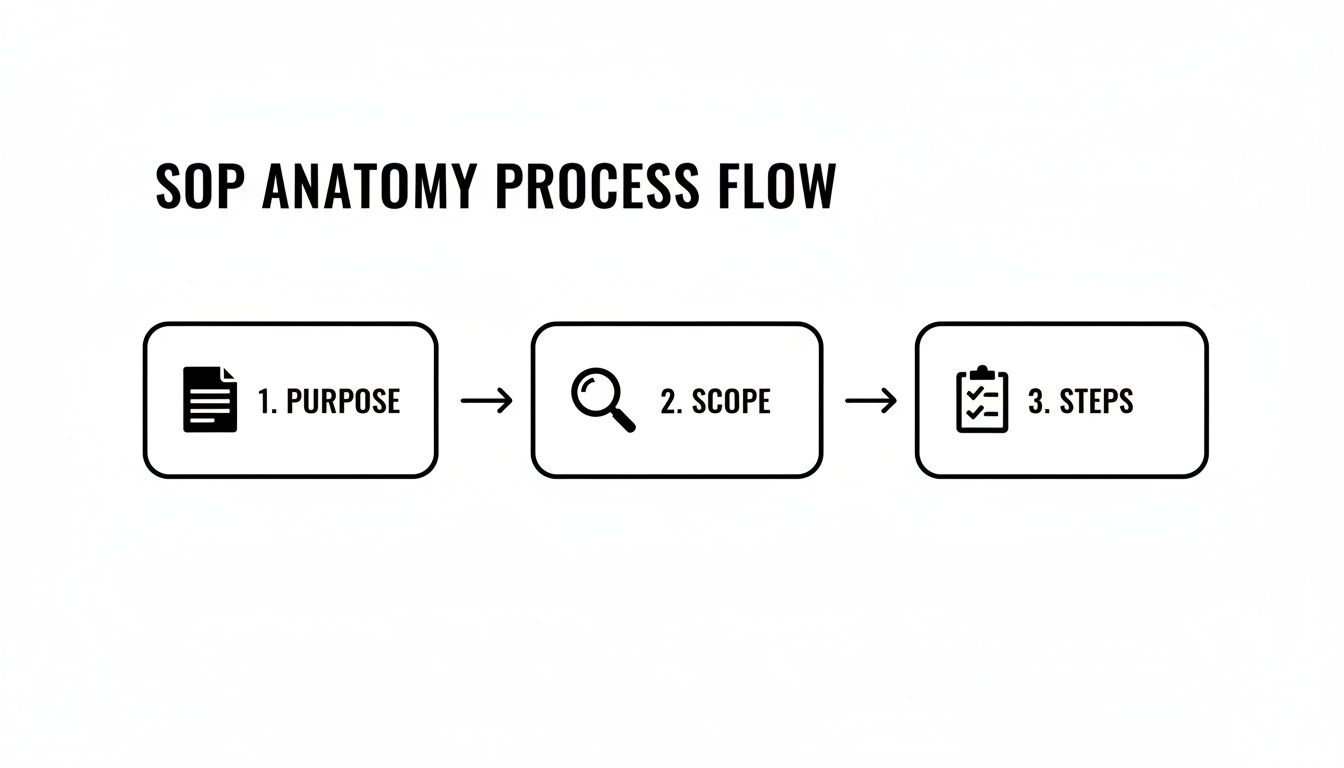
This flow is a great reminder that an SOP is useless if people don't know why it exists and when to use it.
Step 4: Train Your Team and Ask for Feedback
Writing the document is just half the job. A successful rollout is what actually puts it to work. Announce the new SOP to the team, but don't just send it in an email and hope for the best.
Set up a short training session. Walk them through the document, explain the "why" behind it, and give them a chance to ask questions. This ensures everyone is on the same page and understands their role in the new standard.
After the launch, open up a clear channel for feedback. Encourage your team to tell you what's confusing, what's clunky, or what's missing. This real-world feedback is gold—it’s how you’ll turn a good SOP into a great one.
Step 5: Schedule Regular Reviews and Updates
Finally, an SOP is not a "set it and forget it" project. It’s a living document. Your tools will change, your team will find smarter ways to work, and your processes will naturally evolve.
To keep your SOPs from gathering dust, schedule time to review them. A quick check-in at least once a year—or anytime a major part of the process changes—is all it takes. This simple habit ensures your operational playbook stays relevant and useful, making it a true asset for your business for years to come.
Real-World Examples of SOPs in Action

It's one thing to talk about SOPs in theory, but seeing them work in the real world is where it all clicks. Let’s look at a classic example from manufacturing, because the lessons are universal, even if you’re running a SaaS company.
Imagine a company, let's call them XYZ Manufacturing, constantly dealing with inconsistent products and runaway costs. They decided to get serious about their processes and rolled out detailed SOPs for their production lines. The results were nothing short of game-changing. Their product defect rate, which was a painful 15%, dropped all the way down to 5%. That's a 67% nosedive in costly mistakes.
That single improvement sent positive shockwaves through the entire business. On-time deliveries shot up from 73% to 91%, and new hires were fully trained in just two weeks instead of four. All told, these efficiencies slashed their annual production costs by 20%, saving them $300,000. If you're curious about the deeper mechanics, you can discover more about how SOPs drive business success.
Translating Factory Wins to SaaS and B2B
Okay, so how does a factory’s success story help a software company or a digital marketing agency? It's simple: the "product" might be different, but the root problems are identical. Inconsistency is the enemy of quality, whether you're assembling a car part or shipping a new software feature.
Think about it this way. A "product defect" on the factory floor is just a "bug" in a software release. A "production delay" is a "missed project deadline" for a client. The language changes, but the pain is the same.
Here’s how those manufacturing principles apply directly to the B2B and SaaS world:
- Software Development: An SOP for code reviews and QA testing is your best defense against bugs making it into a live environment. It stops the fire-drills and keeps your product stable.
- Sales Qualification: When every sales rep follows a clear SOP for qualifying leads, the pipeline gets much healthier. Your account executives stop wasting cycles on dead-end prospects and focus on deals that can actually close.
- Customer Onboarding: A standardized onboarding checklist ensures every new customer gets the same stellar setup and training experience. This is crucial for starting the relationship on the right foot and dramatically reducing early churn.
The lesson is clear: A systematic process is the most reliable path to operational excellence. It doesn’t matter if you’re building cars or code; the goal is to create predictable, high-quality outcomes every single time.
When you take the time to document and standardize how things get done, you build a solid foundation. You eliminate the guesswork and give your team the clarity they need to do their best work.
The Universal Key to Unlocking ROI
At the end of the day, the XYZ Manufacturing story proves one thing: investing time in building solid processes delivers a serious return. The exact same principles they used to cut costs and improve quality can be applied to any B2B or SaaS business.
Whether your goal is to boost customer satisfaction, ship projects faster, or just make day-to-day work less chaotic, it all begins with defining your best practices. A well-written SOP is the tool that turns a "good idea" into a repeatable, scalable engine for growth.
Still Have Questions About SOPs? Let's Clear Them Up.
Even after you're sold on the idea of standard operating procedures, a few practical questions always pop up. It's one thing to understand the concept, but it's another to actually start weaving them into your company's DNA.
Let's tackle some of the most common questions and concerns we hear from teams who are just getting started.
How Do I Know Which Process to Document First?
This is a big one. The temptation is to try and document everything all at once, which quickly leads to overwhelm. Don't do that. Instead, focus on where you’ll get the biggest bang for your buck right away.
Look for processes that are:
- Done All the Time: Think daily or weekly tasks. Even a tiny efficiency boost here will compound into huge time savings over a year.
- Mission-Critical: What absolutely has to happen for your business to run? Things like client billing, software deployment, or server maintenance are prime candidates.
- A Common Source of Errors: If there's a process that constantly causes headaches and requires someone to fix mistakes, an SOP can bring immediate relief and cut down on costly rework.
- Directly Tied to Revenue: Your sales outreach sequence or customer onboarding journey are perfect examples. Standardizing these ensures every prospect and new customer gets the same great experience, which directly impacts your bottom line.
Pick a process that checks a few of these boxes, and you’ll prove the value of SOPs to your team from day one.
Won't SOPs Just Make Us Rigid and Kill Creativity?
This is probably the most common fear we hear, but it’s based on a misunderstanding of what great SOPs actually do. They don't kill creativity—they focus it.
Think of it like this: by putting the boring, repetitive tasks on autopilot, you free up your team’s brainpower to solve bigger, more interesting problems. When no one has to waste mental energy figuring out how to do a routine task for the tenth time, they have more capacity to think strategically and innovate.
An SOP isn't a cage; it's a launchpad. It handles the predictable so your team can pour their creativity into the unpredictable challenges that drive real growth.
The best SOPs are never set in stone. They should be living documents that get better over time, thanks to feedback from the people actually doing the work. This creates a culture of continuous improvement, not one of rigid compliance.
What's the Best Format for an SOP?
There’s no single "best" format. The right choice is always whatever makes the process clearest for the person who has to follow it. You need to match the format to the task at hand.
- A simple checklist is perfect for straightforward tasks where the steps just need to be done in order. No fuss, no confusion.
- A flowchart is way more intuitive for any process with decision points—the classic "if this happens, then do that" scenarios.
- A detailed step-by-step document works best for highly complex procedures that need more explanation, screenshots, or context for each step.
The goal is always usability. Pick the format that makes the process as foolproof and easy to follow as possible.
How Often Should We Review and Update Our SOPs?
To make sure your SOPs don't become digital dust collectors, you need to review them regularly. A good starting point is to put a recurring calendar event to review every single SOP at least once a year.
But don't wait for the annual review if something changes. You should update an SOP immediately when:
- You start using new software or tools.
- Your company's strategy or goals change.
- Your team finds a better, smarter, or faster way to get the job done.
Keeping your SOPs current is what makes them a reliable resource your team can actually trust.
Ready to stop reinventing the wheel and start scaling your operations with a proven playbook? MakeAutomation helps B2B and SaaS businesses build the exact frameworks they need to grow without the chaos. We'll help you create powerful SOPs, automate key workflows, and get your valuable time back.
Learn how MakeAutomation can build your operational playbook.