

what is ai automation: A Practical, Clear Guide
AI automation is what happens when you give software a brain. It’s about building systems that don't just follow a script but can actually think, learn, and adapt to handle tasks that once required a person's judgment.
Understanding AI Automation Beyond the Hype
To get a real feel for what is AI automation, let's compare it to something we all know.
Think of traditional automation as a factory robot on an assembly line. It performs its one job—say, tightening a specific bolt—over and over again with perfect precision. But if that bolt is slightly out of place, the robot is stuck. It's incredibly efficient but completely rigid.
AI automation, however, is more like a seasoned chef running a kitchen. The chef starts with a recipe (the basic rules) but uses experience and intuition to make adjustments on the fly. They can swap out an ingredient, tweak the cooking time based on the feel of the dough, and even create a new special based on what they learned from yesterday's service. That's the key difference: the ability to perceive, reason, and adapt.
The Brains Behind the Operation
So what gives these systems their intelligence? AI automation isn't just one piece of tech; it's a blend of tools that mimic how we think and perceive the world. These components are the "senses" and "intelligence" that let automation break free from simple, repetitive work.
- Machine Learning (ML): This is the core learning engine. It allows the system to analyze huge datasets, spot patterns, and get smarter over time without a developer having to manually update its code for every new scenario.
- Natural Language Processing (NLP): This is how machines understand and communicate in human language. It’s the magic behind chatbots that can actually grasp what a customer is asking or software that can pull the key takeaways from a 50-page report.
- Computer Vision: This gives systems the power of sight. They can "see" and interpret visual data, whether that's identifying a defective product on a conveyor belt or pulling information from a scanned invoice.
To see how these intelligent capabilities stack up against older methods, it's helpful to compare them side-by-side.
Traditional Automation vs AI Automation at a Glance
| Attribute | Traditional Automation | AI Automation |
|---|---|---|
| Decision-Making | Follows predefined "if-then" rules. | Makes data-driven, probabilistic decisions. |
| Data Handling | Works with structured data only. | Manages structured and unstructured data. |
| Adaptability | Rigid; fails with unexpected inputs. | Learns from new data and adapts its process. |
| Task Complexity | Handles simple, repetitive tasks. | Manages complex, dynamic workflows. |
| Learning | Static; requires manual reprogramming. | Improves performance over time autonomously. |
The takeaway is clear: while traditional automation excels at predictable, high-volume tasks, AI automation tackles the messy, unpredictable work that makes up so much of modern business.
AI automation isn't about replacing people. It’s about augmenting them. It takes on the cognitive grunt work, freeing up your team to focus on high-value strategy, creative thinking, and solving the problems that really matter.
This shift toward intelligent systems is creating massive economic value. The global artificial intelligence market, which is deeply intertwined with automation, was valued at around USD 638.23 billion and is expected to rocket to nearly USD 3.68 trillion by 2034. That's a compound annual growth rate of about 19.2%, underscoring just how much businesses are investing in this technology.
For AI to truly learn and deliver results, it needs access to well-organized information. This relationship is explored perfectly in this expert guide on knowledge management and artificial intelligence. When you combine AI with other automation tools, you start moving toward an even more powerful strategy, which we dive into in our guide on what is hyperautomation.
The Building Blocks of AI Automation
To really get what AI automation is, we need to pop the hood and look at the technologies that give it a "brain." Unlike classic automation that just follows a strict, pre-written script, AI automation brings together a few powerful tools that let it learn, understand, and react to the world a lot more like a person would.
These aren't just abstract concepts. They're the engines that allow a system to move past simple, repetitive work and start tackling complex, unpredictable challenges. Think of them as the individual senses and cognitive skills that, when put together, create a genuinely intelligent system.
This diagram helps visualize how AI automation combines the ability to learn from data, adapt its processes, and make smarter decisions over time.
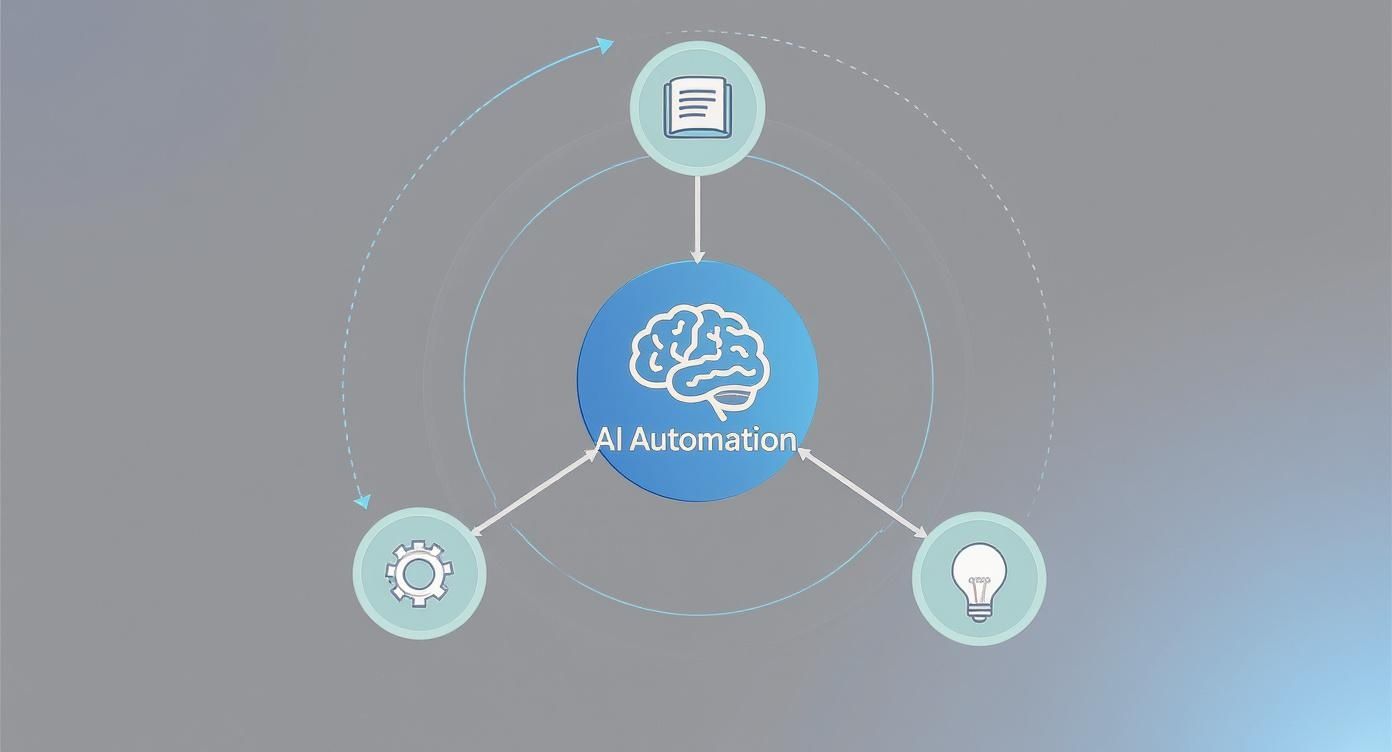
As you can see, it's not a one-and-done action. It's a continuous cycle of improvement, much like how a human expert gets better and better with experience.
Machine Learning: The Learning Engine
At the very heart of AI automation is Machine Learning (ML). This is what gives a system the ability to learn from data and improve its performance without someone having to manually program it for every single possible scenario. It’s the difference between giving a system a fish and actually teaching it how to fish.
Let's say you want to automate sorting customer support tickets. The old way involved writing hundreds of rules like, "If email contains 'refund,' send to the billing department." But what happens when a customer writes, "I want my money back"? An ML model learns to recognize the intent behind the words, not just the keywords.
This learning process means the system gets more accurate and efficient as it goes, handling new variations and oddball cases it's never encountered before.
Machine Learning gives automation the ability to make predictions and decisions based on patterns in data. Instead of being stuck with rigid "if-then" logic, it operates on probabilities, allowing it to navigate the gray areas of real-world business operations.
Natural Language Processing: The Universal Translator
While ML provides the power to learn, Natural Language Processing (NLP) gives AI automation its voice and ears. NLP is the branch of AI that’s all about teaching computers to understand, interpret, and generate human language, whether it's written text or spoken words.
It's the tech behind everything from smart chatbots that can sense a customer's frustration to tools that can distill a 20-page legal document into a handful of key bullet points. For a business, this opens the door to automating tasks that were once off-limits because they involved unstructured language.
- Sentiment Analysis: NLP can scan customer reviews or social media chatter to get a read on public opinion, figuring out if the tone is positive, negative, or neutral.
- Data Extraction: It can sift through thousands of emails or contracts to pull out specific details like names, dates, and invoice amounts, turning messy text into clean, organized data.
- Language Generation: Modern NLP can even draft emails, write marketing copy, or generate reports that sound natural and human.
This ability to work with language is a huge leap forward from older tools like Robotic Process Automation (RPA), which mostly just mimic human clicks and keystrokes on a screen. You can dig deeper into the specifics in our guide that explores what is Robotic Process Automation.
Computer Vision: The Power of Sight
The final piece of the puzzle is Computer Vision. This is what gives automated systems the ability to "see" and make sense of visual information from the world around them. Just like NLP processes language, Computer Vision processes images and videos.
This technology allows AI automation to interact with both the physical and digital worlds in a visual way. For instance, a system can analyze a photo of a damaged product to automatically kick off a return, or it can read the text on a scanned invoice to punch the details into an accounting system.
By weaving together these three pillars—ML, NLP, and Computer Vision—AI automation can perceive and process information in all its forms: structured data, text, and visuals. This multi-faceted understanding is what allows it to automate entire workflows that are far too complex and nuanced for any single technology to handle on its own.
Real-World AI Automation: From Theory to Impact
It's one thing to talk about machine learning and NLP in the abstract, but the real magic happens when you see AI automation solving actual business problems. This isn't science fiction; companies in every sector are already using these tools to redefine what’s possible in their day-to-day operations.
Imagine a customer service team that's finally free from the endless cycle of repetitive tickets. Think about a finance department closing the books in a few days, not a few weeks. This is the practical, on-the-ground impact of AI automation—turning clunky, error-prone tasks into smart, self-improving workflows.

The shift is well underway. The global market for AI in industrial automation is already valued at around USD 20.2 billion. What's more telling is its trajectory: it's expected to rocket to roughly USD 111.8 billion by 2034, showing just how fundamental this change is.
A New Era for Customer Support
Customer support is often the first and most obvious place to see AI automation deliver incredible value. Most support teams are drowning in a sea of inquiries, and a huge chunk of them are the same simple questions asked over and over.
- The Old Way: Agents spend their days manually sorting tickets, typing out the same answers, and hunting down information. This is a recipe for slow responses and frustrated employees.
- The New Way: An intelligent system uses Natural Language Processing (NLP) to instantly understand what a customer needs and routes the ticket correctly. AI-powered chatbots handle the common stuff 24/7, freeing up your human experts for the tough, high-value conversations.
A SaaS company, for instance, can set up an AI agent that doesn't just spit out knowledge base articles. It can look at a user's account data and provide personalized troubleshooting steps, resolving issues in a fraction of the time.
Reinventing Finance and Accounting
Finance departments are a perfect fit for AI automation. They’re full of tasks that are both rules-based and require a degree of judgment. Think about the hours spent on manual data entry from invoices, receipts, and expense reports—it's slow, tedious, and a prime spot for costly mistakes.
AI automation becomes a tireless, hyper-accurate financial analyst. It can read, understand, and process thousands of documents in minutes, locking in data integrity and compliance while freeing up your team for strategic work.
Take the accounts payable process. An AI system with computer vision can literally "read" an invoice, whether it's a PDF, a scanned image, or an email attachment. It pulls out key data like the vendor, invoice number, and amount, checks it against the purchase order, and flags anything that looks off for a human to review. It's common to see this one change cut invoice processing time by over 80%.
Supercharging Sales and Marketing
For sales and marketing teams, success is all about speed, personalization, and smart decisions. AI automation delivers on all three fronts, helping teams turn raw data into real revenue opportunities.
Lead management is a classic example. Instead of just talking about it, looking at how to automate lead generation shows exactly how this transforms a sales pipeline. AI can sift through leads from all your channels, score them on their odds of converting, and even draft personalized outreach emails to get the conversation started.
This ensures your sales team is always focused on the most promising prospects with the right message at the right time. The results are clear:
- Smarter Lead Prioritization: AI models analyze thousands of signals—from website clicks to firmographic data—to pinpoint which leads are ready for a sales call.
- Truly Personal Campaigns: Forget generic email blasts. AI can generate tailored content for different segments of your audience, driving engagement through the roof.
- Predictive Power: AI can forecast sales trends or identify customers at risk of churning, giving your team the chance to be proactive, not just reactive.
To show how this plays out across an organization, here’s a look at the typical gains you can expect when implementing AI automation.
Impact of AI Automation Across Business Functions
| Business Function | Common Use Case | Average Efficiency Gain | Typical ROI Timeline |
|---|---|---|---|
| Customer Support | AI-powered ticket routing & chatbots | 40-60% reduction in response time | 3-6 months |
| Finance & AP | Automated invoice processing | 70-85% faster processing | 6-9 months |
| Sales | AI-driven lead scoring & prioritization | 15-25% increase in conversion rates | 4-8 months |
| Marketing | Personalized campaign automation | 20-30% lift in engagement | 6-12 months |
| Human Resources | Resume screening & onboarding | 50% reduction in time-to-hire | 9-15 months |
| IT Operations | Anomaly detection & incident response | 60% faster issue resolution | 3-6 months |
These numbers highlight that AI automation isn't about incremental improvements; it's about making a significant, measurable impact on both efficiency and the bottom line.
From factory floors where computer vision spots product defects the human eye would miss, to healthcare systems where AI helps make sense of complex patient records, the applications are endless. The common theme is a shift away from rigid, manual processes toward intelligent workflows that learn, adapt, and deliver a powerful return on investment.
Your Practical Roadmap to AI Implementation
Knowing AI automation can change your business is one thing. Actually making it happen is a completely different ballgame. If you just jump in without a plan, you're likely to waste time and money on projects that go nowhere.
A structured, phased approach is the key. Think of it as a "crawl, walk, run" strategy. By breaking the journey into three simple stages—Assess, Pilot, and Scale—you can introduce AI into your business thoughtfully, minimizing risk and setting yourself up for real, long-term success.
Phase 1: Assess and Identify Opportunities
Before you automate a single task, you need a clear picture of where to start. This first phase is all about discovery. You're going to scan your entire business to pinpoint the processes that are practically begging for an upgrade.
Don't get distracted by the flashiest AI trends. Instead, hunt for the work that will give you the most significant and immediate impact. Look for tasks that are mind-numbingly repetitive, time-consuming, and prone to human error. These are your low-hanging fruit—the perfect places to score a quick win. Think about things like manual data entry, sorting customer support tickets, or sifting through new leads.
Once you have a shortlist of potential candidates, run them through a simple filter:
- Impact: How much will this actually help? Think in terms of real dollars saved, hours given back to your team, or a big jump in accuracy.
- Feasibility: How hard is this going to be? Consider the complexity of the task, the quality of the data you have to work with, and the tech needed to pull it off.
Your ideal first project sits in the sweet spot: high impact and low-to-moderate difficulty. This ensures you get a fantastic return without getting bogged down in a technical nightmare. This is also the time to decide exactly how you'll measure success by setting clear Key Performance Indicators (KPIs).
Phase 2: Pilot a Focused Project
With a prime target identified, it's time to get your hands dirty. The pilot phase is where you build and test your first AI automation, but you do it on a small, controlled scale. This is your sandbox—a chance to learn, tweak, and prove the concept before you bet the farm on it.
Pick a small slice of the bigger process you want to automate. For example, if your ultimate goal is to automate all invoice processing, your pilot might start by handling invoices from just one or two key vendors. Keeping the scope tight makes the project manageable and helps you gather clean, reliable data.
The point of a pilot isn't just to see if the technology works. It’s to understand how it fits into your current workflows, how your team actually uses it, and what you need to adjust to make it a seamless part of your operations.
Success needs to be defined upfront. Go back to those KPIs you set in phase one. Are you aiming for a 50% reduction in manual data entry time? A 95% accuracy rate in data extraction? A successful pilot is one that hits or beats these targets, giving you the hard data you need to move forward with confidence.
Phase 3: Scale and Integrate Across the Business
Once your pilot has proven its worth, you're ready to go big. Scaling is all about methodically expanding that successful automation across the entire department or even the whole company. But remember, this is more than a technical rollout; it’s a people-centric change management process.
Start by writing down everything you learned from the pilot—the good, the bad, and the ugly. This documentation becomes your playbook, forming the basis of your Standard Operating Procedures (SOPs) for all future automation projects. A solid foundation here is critical, and a guide on how to create an AI program can provide a great framework to build on.
As you expand, communication is everything. Keep your team in the loop and be crystal clear about how this automation will help them by getting rid of tedious work, not by replacing them. Provide great training and open up a feedback channel so you can quickly squash any problems that pop up.
Finally, resist the urge to do a "big bang" launch. A gradual rollout, maybe team by team, is almost always more effective. It allows you to manage the transition in bite-sized pieces and ensures the change sticks for good.
Navigating Common Challenges and Ensuring Success
Let's be realistic: adopting AI automation isn't as simple as flipping a switch. It comes with its own set of very real hurdles. Successfully bringing this technology into your business means anticipating these challenges and tackling them head-on with a clear strategy.
From data security to the human side of the equation, being aware of potential pitfalls is the first step toward avoiding them. This proactive approach is what separates the AI initiatives that thrive from the ones that stall out.

Establishing Strong Governance and Ethics
One of the biggest concerns I hear about AI automation is the risk of things going wrong without proper oversight. You've got issues like algorithmic bias, where an AI model makes unfair decisions because it was trained on flawed data, which can cause serious damage to your reputation. Then there's the critical need to handle sensitive customer or company data with robust privacy and security protocols.
To get this right, you need a clear governance framework in place from day one. This isn't just an IT problem—it's a business-wide responsibility. It means setting firm rules for how AI is developed, deployed, and monitored.
- Create an AI Ethics Board: Pull together a cross-functional team to review and approve automation projects. Their job is to make sure every initiative aligns with your company values and legal standards.
- Conduct Regular Audits: Routinely check your AI models for bias and performance drift. The system that worked perfectly on day one might develop issues as new data flows in, so you can't just set it and forget it.
- Prioritize Data Privacy: Implement strict data handling policies. You have to ensure all information used by your AI systems is secure and compliant with regulations like GDPR.
Managing the Human Element of Change
Perhaps the most delicate challenge is the human one. The phrase "AI automation" can spark fear and uncertainty among employees who worry about their jobs being replaced. If you don't manage this with care, you risk losing your team's buy-in, and that’s a dealbreaker for any new technology.
The key is to frame automation as a tool for augmentation, not replacement. It’s about getting rid of the tedious, repetitive parts of their jobs so they can focus on more strategic, creative, and ultimately more fulfilling work.
True success in AI automation is measured not just by efficiency gains, but by how well it empowers your people. The goal is to create a collaborative environment where humans and AI work together, each playing to their strengths.
This shift toward intelligent workflows is a top priority for modern businesses. In fact, automation technologies are now embraced by approximately 47% of businesses, which shows a significant trend toward freeing up people for higher-level problem-solving. You can dive deeper into these figures in this detailed report on workplace automation statistics.
Designing Human-in-the-Loop Systems
Finally, a crucial strategy for managing risk is to never give an AI full autonomy over critical decisions. A "human-in-the-loop" (HITL) system design builds checkpoints into an automated process where a person must review and approve the AI's work before it can proceed.
This approach gives you the best of both worlds: you get the speed and scale of automation, paired with the nuance and ethical judgment of a human expert. For instance, an AI might flag a high-value transaction as potentially fraudulent, but a human analyst makes the final call. This simple step can prevent costly errors and build trust in the system, ensuring your AI journey is both ambitious and safe.
Want to Get There Faster? Work with an Expert
Let's be honest: diving into AI automation can feel like trying to build an airplane while it's already taxiing down the runway. You have the instruction manual—this guide—but that's very different from having an experienced engineer in the cockpit with you. Going it alone often leads to expensive trial-and-error, pilot projects that never quite take off, and a lot of frustration.
That’s where a good partner comes in. Think of them less as a vendor and more as a specialist on your team who has already walked this path dozens of times. They know where the common traps are and can guide you around them, making sure your time and money go into strategies that actually work. This isn't just about setting up tools; it's about making sure your AI efforts are laser-focused on your most important business goals from the very start.
Turning Your Plan into a High-Performing Reality
At MakeAutomation, our entire focus is on transforming your AI goals from a whiteboard sketch into a practical, powerful system that delivers real results. We slot into your team, bringing the specialized skills you need to get moving quickly, without you having to recruit and build a whole new department from scratch. We’ve designed our process to cut the risk and boost the reward every step of the way.
Here’s how we get hands-on with you:
- Strategy & Assessment: First things first, we sit down with you to pinpoint the automation opportunities that will give you the biggest bang for your buck and create a clear, no-nonsense plan.
- Building with Proven Frameworks: We use our battle-tested frameworks to build solid solutions for everything from pulling in better leads to automating client communication and keeping projects on track.
- Full-Circle Support: We don’t just hand you the keys and disappear. We provide detailed documentation, train your team, and offer ongoing support to make sure the new systems become a natural part of your daily workflow.
Partnering with an expert isn't just another line item on a budget; it's an investment in getting things done right, and getting them done fast. It’s the difference between trying to assemble a V8 engine from a diagram versus having a master mechanic by your side.
We handle the technical heavy lifting of what is AI automation so you can stay focused on what you do best—growing your business. We help B2B and SaaS companies finally ditch the manual work that’s been holding them back, freeing up countless hours, driving up ROI, and setting them up to scale smarter.
If you’re ready to stop talking and start doing, working with a specialist is the most direct route to building a real competitive edge.
Got Questions? We've Got Answers
Even the clearest roadmap comes with a few questions along the way, especially when you're dealing with something as powerful as AI automation. Let's tackle some of the most common ones that pop up.
Isn't This Just a Fancy Name for RPA?
That's a great question, and it gets to the heart of what makes AI automation special. Think of Robotic Process Automation (RPA) as a very obedient digital assistant. It’s brilliant at following a strict, pre-programmed script—clicking buttons, copying data, and moving files exactly as a human would.
AI automation is the next step up. It adds a brain to the operation. Instead of just following rules, it can interpret unstructured information, like the text of an incoming customer email, and then make a smart decision. Simply put, RPA follows commands; AI automation understands context.
What's the Real Cost of AI Automation?
This is a "how long is a piece of string?" kind of question, as the investment can range from a simple monthly software subscription to a major custom build.
The most important thing is to shift your focus from the initial price tag to the Return on Investment (ROI). A well-chosen pilot project should start paying for itself in just a few months, whether through saved hours, fewer costly errors, or faster sales cycles. The trick is to start small with a project that offers a big impact for relatively low effort.
A common mistake is seeing AI automation as just another expense on a spreadsheet. Frame it as an investment in your company's operational horsepower. The right solution doesn’t just trim costs; it unlocks growth and gives you back your team's most valuable asset: their time.
Is AI Going to Replace My Team?
This is easily the biggest concern we hear, and the honest answer is that it's more of a job evolution than a replacement. AI automation is absolutely designed to take over the manual, repetitive tasks that no one really enjoys doing anyway.
History has shown us time and again that new technology changes the nature of work, it doesn't just erase it. AI is taking the tedious data entry and monotonous report-pulling off our plates. This frees up your people to focus on what they do best: strategic thinking, creative problem-solving, and building customer relationships. The companies that thrive will be the ones who help their teams learn to work with these new intelligent tools, creating a workforce that's more effective than ever.
Ready to stop wondering what AI automation is and start seeing what it can do for you? MakeAutomation offers the expert guidance and hands-on partnership to build intelligent systems that deliver real results. We help you find the best opportunities, build reliable solutions, and scale your operations for a massive return on investment.
Discover how MakeAutomation can accelerate your journey