
How to Estimate Software Projects Without Getting It Wrong
Let's be real for a moment. Estimating a software project isn't about finding a single, magical number. It's a continuous process of discovery and managing risk. The most successful teams don't rely on a secret formula; they use a repeatable framework that blends detailed scoping, proven estimation techniques, and, most importantly, transparent communication. It’s all about shifting from a wild guess to an informed forecast.
Why Most Software Estimates Are Doomed from The Start

We’ve all been there. Asking a developer, "So, how long will this take?" often feels like a loaded question. For too many teams, the whole process is riddled with anxiety, pressure, and the nagging feeling that they're going to be wrong. This isn't a knock on their skills—it's just that software development is, by its very nature, complex and unpredictable.
The real problem starts when an estimate is treated like a fixed-price contract instead of what it truly is: a forecast based on the best information you have right now. This fundamental misunderstanding is what creates a vicious cycle of missed deadlines and frustrated teams.
The Anatomy of a Failed Estimate
A few usual suspects consistently sabotage software estimates before anyone even writes a line of code. These issues don't just add up; they multiply, turning a reasonable forecast into an impossible deadline.
Here are the big ones:
- Vague Requirements: You can't accurately estimate a task like "build a user-friendly dashboard." What does "user-friendly" even mean? Without specific, measurable criteria, developers have no choice but to fill in the blanks with their own assumptions.
- Hidden Complexity: What looks simple on the surface can hide a world of technical debt and unforeseen challenges. It’s like installing a new washing machine—what should be a 10-minute job can easily turn into a four-hour nightmare when you discover the plumbing doesn't match and you need to drill new holes for the cables.
- Stakeholder Pressure: All too often, business goals dictate the deadline. This forces teams to work backward from a date on a calendar instead of forward from a realistic scope, leading to overly optimistic estimates that conveniently ignore every potential risk.
The harsh reality is that chronic underestimation isn't just frustrating; it leads to massive cost and schedule overruns. A typical software project often balloons to 1.5–2.0 times its original estimated cost, with schedule delays being just as common. You can dive deeper into the data and models behind this on erikbern.com.
This guide will give you a solid framework to sidestep these pitfalls. To kick things off, the table below provides a quick overview of the different estimation techniques we'll be exploring. This should help you get a feel for which methods might be the right fit for your team and projects.
Software Estimation Techniques at a Glance
| Technique | Best For | Complexity |
|---|---|---|
| Expert Judgment | Quick, early-stage estimates with experienced teams. | Low |
| Story Points | Agile teams estimating relative effort for sprints. | Medium |
| T-shirt Sizing | High-level roadmap planning and prioritizing features. | Low |
| Function/Feature Points | Large enterprise projects requiring objective metrics. | High |
| Parametric Modeling | Data-driven forecasting for large-scale projects. | High |
Think of this table as your menu. Each technique has its place, and the key is knowing when to use which one. Now, let’s get into the details of how to build an estimate you can actually stand behind.
Building a Rock-Solid Foundation with Scope and Requirements
Let's be honest: trying to estimate a software project without a crystal-clear understanding of what you’re building is just a guessing game. Any reliable forecast you create has to be built on a well-defined scope. This isn’t about creating massive, dusty documents nobody reads. It’s about collaborative discovery to root out the late-stage surprises that absolutely wreck budgets and timelines.
Before you can put any numbers down, you have to deconstruct the idea. A vague request like "improve the checkout process" is completely un-estimable. You have to break that big concept down into smaller, tangible pieces of work. This is the process that turns a wish into a workable plan.
From Vague Ideas to Actionable Tasks
The real trick here is translating broad business goals into specific user stories and technical tasks. A critical first step is learning how to write product requirements that leave no room for misinterpretation. For that e-commerce checkout flow, this means mapping out every single step a user takes.
For example, "Add item to cart and proceed to checkout" breaks down into real work:
- Develop the "Review Cart" summary component.
- Implement the shipping address form with real-time validation.
- Integrate a third-party address verification API.
- Build the payment method selection UI (credit card, PayPal, etc.).
- Connect to a payment gateway to actually process the transaction.
Getting this granular forces important conversations early on. Suddenly, you're talking about dependencies, international shipping fees, and complex tax calculations before they become mid-sprint emergencies.
Visualizing the Work with a WBS
A Work Breakdown Structure (WBS) is a fantastic tool for this. Think of it as a visual map of everything that needs to get done, organized in a hierarchy. It’s a powerful way to make sure the entire team—from developers to stakeholders—shares the exact same picture of the project scope.
Agile teams often get to this same level of clarity using user story mapping, which is another great approach. If you’re working in an agile environment, our guide on documenting requirements in agile has some really practical frameworks you can use.
A WBS breaks a project down into manageable chunks, just like in this example.
This structure makes it obvious how major features are supported by smaller tasks, and those smaller tasks are infinitely easier to estimate with any real accuracy.
When you break a large, intimidating project into a series of small, well-defined tasks, you completely change the conversation. It shifts from "How long will this whole thing take?" to "How long will this specific task take?" That small change is the secret to building a credible, bottom-up estimate.
At the end of the day, this foundational step is less about documentation and more about alignment. When your developers, product owner, and stakeholders all agree on what "done" means for every single task, you’ve stamped out the biggest source of bad estimates: ambiguity. With this solid foundation in place, you’re finally ready to start estimating.
Choosing the Right Estimation Technique for Your Team
Once you've nailed down the scope, you can finally shift your focus from what you're building to how long it's actually going to take. Let's be clear: there's no single magic bullet for estimating software projects. The best method really boils down to your team’s way of working, the project's gnarliness, and how precise you need to be.
Think of these techniques as different tools in a toolbox. You wouldn't use a sledgehammer to hang a picture, right? In the same way, you wouldn't use T-shirt sizes to map out a detailed, two-week sprint.
High-Level Estimates for Roadmaps and Discovery
In the early stages, trying to be too precise is a trap. The goal here is to get a rough sense of scale to help prioritize features and set realistic expectations, not to get bogged down in a line-by-line project plan.
T-Shirt Sizing (XS, S, M, L, XL) is my go-to for this phase. It's incredibly fast, gets the whole team talking, and forces everyone to think in relative terms. Everyone immediately understands that an "XL" feature is a whole lot bigger than an "S" one, and that’s often all you need for those high-level roadmap debates.
Granular Estimates for Development Sprints
When you get closer to writing actual code, you need more detail. This is where abstract but relative units help teams get a real handle on what they can knock out in a sprint.
Agile Story Points are the bread and butter for most development teams for a good reason. Instead of asking the flawed question, "How many hours will this take?" you ask, "How complex is this compared to other things we've done?" This brilliantly sidesteps the guesswork of time-based estimates by focusing on what really matters: effort, complexity, and uncertainty. A task you rate as 5 points should be roughly half the work of a 10-point task. If your team is serious about agile, diving into resources on Agile Estimation Techniques is a fantastic investment.
This process always starts by breaking down big, fuzzy ideas into small, manageable chunks.
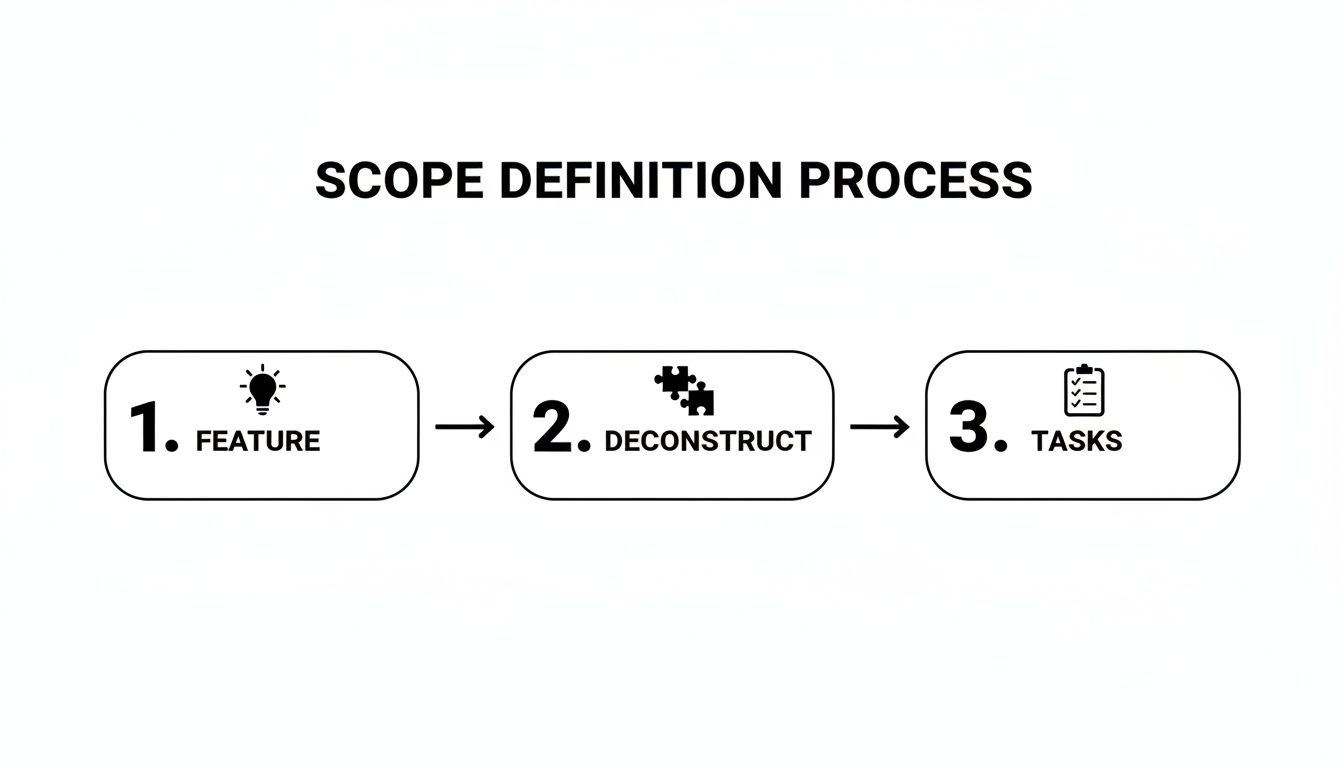
As you can see, you take a big, abstract feature and systematically deconstruct it into concrete tasks. This is the absolute foundation for applying any estimation technique effectively.
Finding a Method That Fits Your Team
Your choice of technique really does impact your accuracy. In the real world, you’ll see a huge variety of methods in play. While agile teams are all-in on planning poker and story points, you’ll find that large enterprise or government projects often require something more formal like function points to establish a contractual cost baseline.
The best technique is the one your team actually understands, trusts, and will use consistently. Don't be afraid to experiment. Maybe you start with T-shirt sizing for the quarterly roadmap, then switch to story points for sprint planning. The goal is always clarity and a shared understanding, not just blindly following a textbook.
Whatever you choose, the secret sauce is consistency. When you use the same method over and over, you build up a goldmine of historical data. That data makes every future estimate a little sharper and a little more accurate. Suddenly, estimation isn't a chore—it's a powerful strategic tool.
From Effort to Real-World Cost and Timelines

An estimate in Story Points or developer days is a fantastic internal tool for the technical team. It helps us plan sprints and manage capacity. But let's be honest—it doesn't pay the bills.
For clients and stakeholders, these abstract units are meaningless. They need to see the two things that matter most: dollars and deadlines. This is the pivotal step where we connect our team's effort forecast to a concrete business plan. It's not just a simple multiplication problem; it's a thoughtful process of accounting for all the real-world costs, from salaries to the hidden overhead that keeps the lights on.
Calculating Your Core Team Cost
First things first, you need to figure out your blended hourly rate. This isn't just a simple average of what you pay everyone. A proper blended rate includes all the overhead: benefits, equipment, software licenses, even office space.
Let’s walk through a scenario. Say your team has sized a project at 200 Story Points. Looking at past projects, you know your team consistently knocks out about 20 Story Points every two-week sprint. A little quick math tells you this project should take around 10 sprints, or a total of 20 weeks, to complete.
Now, we can put some real numbers to it:
- Project Duration: 20 weeks
- Team Size: 4 Developers, 1 QA Engineer, 1 Project Manager (part-time)
- Blended Team Cost: $5,000 per week
- Base Project Cost: 20 weeks x $5,000/week = $100,000
This calculation gives you a solid baseline. But it's just the starting point. One of the biggest mistakes I see teams make when they estimate software projects is stopping here. This number ignores the single biggest variable in all of software development: uncertainty.
Don’t present your initial calculation as the final number. A good estimate isn't a single point; it's a financial forecast that honestly reflects the project's risks. This is about building trust through transparency.
Adding Buffers for Risk and Contingency
I’ve never seen a project go exactly as planned. Not once. Unexpected technical hurdles pop up, team members get sick, and minor scope adjustments are pretty much a given. Building a contingency buffer into your estimate isn't "padding"—it's a professional acknowledgment of reality.
How big should that buffer be? It really depends on the project's complexity and overall risk level.
- Low Risk (10-15% Buffer): The project is straightforward, using tech you know inside and out with a rock-solid scope.
- Medium Risk (20-25% Buffer): You’re dealing with some new components or a few requirements that are still a bit fuzzy. This is the most common scenario.
- High Risk (30%+ Buffer): Buckle up. This project involves brand-new technologies, major unknowns, or tricky third-party integrations that are out of your control.
Applying a 20% contingency to our example project adds $20,000, bringing our total estimated cost to $120,000. This buffer gives you the breathing room to handle surprises without constantly going back to the client for more money. For a deeper dive into financial models, this guide to estimating software projects is a great resource.
By converting abstract effort into a clear cost model and layering in a realistic contingency, you transform a simple guess into a defensible financial plan. This gives stakeholders the clarity they need to make smart decisions and, more importantly, sets your project up for success from day one.
Putting Tools and AI to Work for Smarter Estimates

Relying on spreadsheets and gut feelings to estimate a complex software project just doesn't cut it anymore. It's a bit like navigating with a paper map in the age of GPS. Modern tools do more than just organize your work; they inject a dose of data-driven reality into your entire estimation process. When you finally ditch the spreadsheets, you start building a system that actually learns from its own history.
This isn't just about convenience. The numbers show a clear connection between the right tools and better outcomes. Organizations using proper project management software complete around 61% of their projects on time. Compare that to the 41% success rate for teams still roughing it without dedicated tools. The data is pretty compelling; you can dig into more project management statistics at electroiq.com.
Mine Your Own Gold: Unlocking Historical Data
If you’re using platforms like Jira or Asana, you're sitting on a goldmine of estimation data. Every task you've ever completed, every sprint velocity chart, every bug ticket—it's all a historical record of what your team can actually do.
This data is your ground truth. It helps you spot patterns you’d otherwise miss and answer the questions that really matter:
- How many story points does our team realistically burn through in a sprint?
- What kind of tasks always seem to blow past their original estimates?
- Are we consistently underestimating the time it takes to fix bugs?
Having this historical context changes the conversation entirely. You move from "I think this will take two weeks…" to "Based on the last three times we built a similar feature, this is likely to take…" It’s a much stronger, more defensible position.
Technology doesn’t replace your team's expertise; it supercharges it. The goal is to combine human judgment with data-backed insights to create estimates that are faster, more consistent, and easier to justify to stakeholders.
The Rise of AI in Project Estimation
The next step in this evolution is, naturally, artificial intelligence. AI tools can sift through the massive amounts of historical data in your project management system to find subtle patterns and connections that are nearly impossible for a human to spot.
Think of it like having an AI co-pilot. It might flag a new task as high-risk because it has identified that similar work in the past always went over budget. Or, it could analyze the language in a user story and suggest a more accurate story point value by comparing it to thousands of previous tickets. This is huge for actively reducing the human biases—like our natural tendency toward optimism—that so often derail forecasts.
AI’s role here is to be your data-savvy partner, sharpening your team’s ability to predict the future. If you're curious about what's out there, we've put together a guide on the best AI tools for project management that can help with exactly this. By bringing these tools into your workflow, you start to shift estimation from a subjective art form into a data-informed science.
Bringing It All Together: Presenting Your Estimate and Managing Expectations
You can have the most technically sound, data-backed estimate in the world, but if you fumble the delivery, it's all for nothing. How you present your numbers is just as crucial as how you came up with them. This isn't just about sharing a final cost; it's about starting a strategic conversation that builds trust and aligns everyone on what’s actually achievable.
The single biggest mistake I see teams make is dropping a single, concrete number on the table. A single figure screams "this is a promise," implying a level of certainty that simply doesn't exist in software development. It immediately puts you on the defensive the moment the first unexpected issue arises.
That’s why you should always, always present your estimate as a range.
The Power of the Three-Point Estimate
A three-point estimate is a brilliantly simple tool for communicating uncertainty right from the start. It gives stakeholders a much clearer picture of the potential outcomes and, just as importantly, the variables that can push the project in one direction or another.
Here’s how it breaks down:
- Optimistic Estimate: This is your best-case scenario. Think of it as the "everything goes perfectly" number—no roadblocks, no unexpected technical debt, and the team is in a state of flow. It’s not likely, but it sets the absolute floor.
- Realistic Estimate: This is the number you have the most confidence in. It's grounded in your historical data, accounts for the risks you already know about, and assumes a pretty standard pace of work. This is your target.
- Pessimistic Estimate: This is your worst-case scenario. It assumes a few of those identified risks actually happen, causing real delays. This number is your buffer, protecting both you and the client from nasty surprises down the road.
Framing your estimate as "$100k – $140k, with a target of $120k" completely reframes the entire discussion. It’s no longer a take-it-or-leave-it figure. It’s an invitation to talk about risks, assumptions, and priorities.
Frame the Conversation Around Trade-Offs
When a stakeholder inevitably asks, "Can we do it for less?" or "Can we get it done faster?" your estimate becomes your most valuable negotiation tool. The answer isn't a flat "no." The answer is, "Yes, we can. Let's talk about what that would mean."
An estimate isn't a final verdict; it's a conversation starter. Your goal is to clearly link the scope, timeline, and budget, showing how a change in one will always affect the others. This transparency is the foundation of a healthy client relationship.
This is where you can have a productive discussion about trade-offs. To hit that lower budget, which features are we comfortable moving to a phase two? To meet a tighter deadline, are they open to simplifying that complex custom dashboard?
By clearly articulating the assumptions baked into your estimate—things like the immediate availability of your senior developers or the expected stability of a third-party API—you make the consequences of any change crystal clear. This approach positions you not as an order-taker, but as a strategic partner invested in finding the best path forward together.
At MakeAutomation, we specialize in implementing AI and automation frameworks that bring data-driven clarity to complex processes like project management and estimation. If you're ready to build scalable, predictable systems for your B2B or SaaS business, learn more about our approach.