Define Project Lifecycle A Roadmap from Concept to Completion
Think of a project lifecycle as the master blueprint for getting anything done. It’s a series of distinct, sequential phases that takes a project from a simple idea scribbled on a napkin all the way to the finish line. This structure is what gives you clarity, control, and a predictable path forward.
What Is a Project Lifecycle and Why Does It Matter?
Ever tried to build a complex piece of furniture without the instructions? You might get a few pieces to fit, but soon enough, you're left with a wobbly, confusing mess. That's a project without a lifecycle. It’s the essential set of instructions that turns a potentially chaotic process into a well-oiled machine, making sure everyone knows what they’re doing, when it's due, and how it fits into the bigger picture.
When you skip this step, projects tend to drift. Teams run into all the classic frustrations: deadlines fly by, budgets spiral out of control, and nobody seems to be on the same page. For B2B and SaaS companies, where delivering reliable value is everything, that kind of chaos just isn't an option.
The Real-World Benefits of a Defined Lifecycle
A solid lifecycle is more than just a timeline; it's a repeatable recipe for success. It creates a shared language that gets stakeholders, team members, and even clients all pulling in the same direction. If you've ever worked in tech, you might see parallels in how the Software Development Life Cycle (SDLC) explained provides a similar road map for building great software.
Ultimately, putting a formal lifecycle in place helps your organization:
- Establish Clear Control: Each phase has specific goals and deliverables. This makes tracking progress and managing your resources much simpler.
- Improve Stakeholder Communication: When you have defined stages and milestones, keeping stakeholders in the loop is no longer a guessing game. It builds trust and keeps everyone aligned.
- Mitigate Risks Proactively: Every phase acts as a natural checkpoint. It’s a chance to spot potential problems and fix them before they have a chance to blow up the entire project.
By breaking a massive undertaking into manageable chunks, a project lifecycle makes even the most daunting goals feel achievable. It’s how you turn a big, ambitious vision into a series of practical, concrete steps that lead to real results.
The 5 Phases of a Successful Project Journey
Every project, whether you're launching a new software feature or building a client's website, follows a predictable path. This journey is broken down into five distinct phases that make up the project lifecycle. Grasping these stages is what turns a massive, complex goal into a series of manageable, logical steps, giving you a clear roadmap from A to Z.
Think of it like building a house. You don't just show up with a hammer and start nailing boards together. It all starts with a high-level concept. Then you create a detailed blueprint, build the structure, inspect the work as it goes, and finally, hand over the keys. Each step is critical to getting the outcome you want.
This visual captures that flow perfectly—moving from a raw idea to a structured framework and, ultimately, to tangible results.
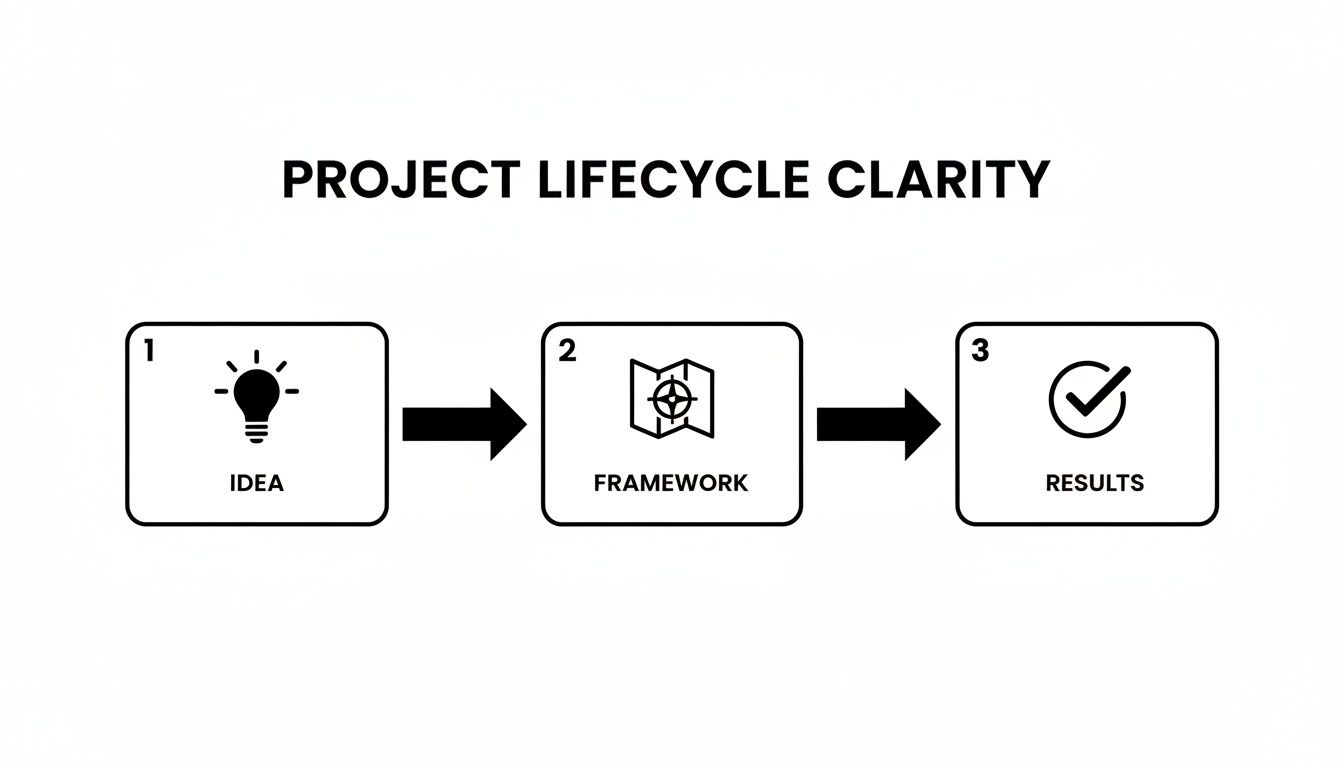
It’s a simple but powerful illustration: without that middle piece—the framework—a great idea rarely becomes a successful reality.
To get a better handle on how this works in practice, let's take a closer look at the five standard phases that bring a project to life.
The 5 Project Lifecycle Phases at a Glance
This table breaks down each of the five phases, showing you exactly what happens, why it matters, and what you should have in hand by the end of each one.
| Phase | Core Purpose | Key Activities | Primary Deliverable |
|---|---|---|---|
| Initiation | To define the project's 'why' and confirm its value and feasibility. | Conducting feasibility studies, identifying stakeholders, defining high-level goals. | Project Charter |
| Planning | To create a detailed roadmap for achieving the project's objectives. | Defining scope, creating a Work Breakdown Structure (WBS), setting a timeline, and budgeting. | Project Plan |
| Execution | To complete the work defined in the project plan. | Assigning tasks, holding team meetings, developing the product or service. | Completed Deliverables |
| Monitoring & Control | To track progress and ensure the project stays on course. | Measuring performance with KPIs, managing changes, and mitigating risks. | Status Reports |
| Closure | To formally complete the project and capture key learnings. | Finalizing deliverables, getting client sign-off, and conducting a post-mortem. | Lessons Learned Report |
Now that you have the big picture, let’s dig into the specifics of what each phase entails.
Phase 1: Initiation
This is where it all begins—the birth of the project. The initiation phase is about defining the project at a high level and answering one fundamental question: "Why are we doing this?" The whole point is to figure out if the project has value and is feasible before you start pouring serious time and money into it.
Key activities here usually involve:
- A Feasibility Study: Can this even be done? You’ll look at whether it's viable from a technical, financial, and operational perspective.
- Identifying Key Stakeholders: Figuring out everyone who has a vested interest in the project's success, from the CEO to the end-user.
- Creating a Project Charter: This is the formal document that outlines the project's objectives, scope, and stakeholders, officially giving it the green light.
For instance, if you're developing a new SaaS feature, the initiation phase would involve identifying a real customer pain point, estimating the potential revenue boost, and getting the thumbs-up from leadership. Once the project is formally authorized, you're ready for the next step.
Phase 2: Planning
With the project officially a "go," it's time to draw the map. The planning phase is arguably the most critical because it lays the foundation for everything that follows. This is where you get into the nitty-gritty of what needs to be done, who will do it, when it will get done, and how you'll handle any curveballs.
Don't underestimate this stage. A staggering 39% of projects fail due to poor planning. Research from Harvard Business Review highlights that only 35% of projects actually finish on time, on budget, and meet their original goals. Most failures can be traced right back to issues like scope creep or misaligned expectations that should have been ironed out during planning. If you want to dive deeper, you can explore more project management statistics that really drive home the impact of proper planning.
The goal of planning isn't to create a rigid, unchangeable document. It's to create a clear, comprehensive guide that gets the team aligned and gives you a baseline for measuring progress.
A solid project plan will always include:
- Scope Statement: A clear definition of what’s in—and just as importantly, what’s out.
- Work Breakdown Structure (WBS): Breaking down large project deliverables into smaller, more manageable tasks.
- Timeline and Milestones: A realistic schedule with key checkpoints to track progress.
- Budget and Resource Plan: A detailed breakdown of who you need and how much it will cost.
- Risk Management Plan: Identifying what could go wrong and having a plan B (and C) ready.
Phase 3: Execution
This is the "doing" phase. During execution, the project team rolls up their sleeves and gets to work, tackling the tasks laid out in the project plan to produce the actual deliverables. The project manager's role pivots from planner to conductor—overseeing the work, coordinating resources, and keeping the team focused and motivated.
Phase 4: Monitoring and Control
This phase doesn’t happen in a vacuum; it runs right alongside the execution phase. Think of it as the project's real-time dashboard. It's all about continuously tracking progress against the plan, keeping a close eye on key metrics to make sure the project stays on schedule, within budget, and up to quality standards. If things start to drift, it's the project manager's job to take corrective action and get the train back on the tracks.
Phase 5: Closure
The final phase, closure, is more than just checking off the last task. It's about formally wrapping everything up. This means delivering the final product, releasing project resources so they can move on to other things, and, crucially, documenting the lessons learned. A proper closure ensures a smooth handover to the client or end-user and captures valuable insights that will make your next project even more successful.
Choosing Your Path: Waterfall, Agile, or Hybrid?
Alright, so we've walked through the five core phases that every project goes through. But knowing the phases is one thing; navigating them is another entirely. The real question is, how do you actually move from one to the next?
Not all projects travel the same road. The path you take depends on your destination, your team, and how much you expect the terrain to change along the way. Think of it as choosing between a detailed road map, a GPS that reroutes on the fly, or a combination of both.
Let's break down the three primary models that will guide your journey: Waterfall, Agile, and Hybrid. Picking the right one isn't just a matter of preference; it's a critical decision that can make or break your project's success.
The Architect: The Waterfall Model
The Waterfall model is the classic, tried-and-true approach. Imagine you're building a skyscraper from a fixed blueprint. Every single step is planned out in advance. You lay the foundation, then build the frame, then add the walls—you must complete one stage fully before the next can begin.
It's a linear, sequential process where each phase cascades down to the next, just like a waterfall. This rigid structure is both its greatest strength and its most significant limitation. Waterfall is fantastic when you know exactly what you need to build from day one and don't expect any surprises.
- Best for: Construction projects, manufacturing runs, or simple software installations where the scope is locked, the outcome is predictable, and the requirements are well-documented upfront.
- Challenges: There’s almost no room for flexibility. If you're halfway through and realize a design flaw, going back to fix it is incredibly difficult and expensive.
For projects where stability and predictability are the top priorities, Waterfall provides a clear and highly controlled path forward.
The Chef: The Agile Model
Now, let's flip the script. Agile is less like an architect and more like a creative chef designing a new tasting menu. Instead of one massive, rigid plan, the work is broken down into small, manageable cycles called “sprints.” In each sprint, the team whips up a small part of the final product, gets immediate feedback, makes adjustments, and then starts the next course.
This model doesn't just tolerate change; it embraces it. It’s built for projects where the final outcome might be a bit fuzzy at the start. Agile puts flexibility, customer collaboration, and delivering working pieces of the project quickly above all else.
An Agile approach allows teams to respond to feedback in real time, making it ideal for software development, product design, and any project operating in a fast-moving market.
Because it's so iterative, you can pivot on a dime without derailing the whole effort. The one watch-out? This same flexibility can sometimes lead to "scope creep" if it isn't managed with discipline.
The Best of Both Worlds: The Hybrid Model
So, what happens when you need the upfront clarity of a blueprint but the in-the-kitchen flexibility of a chef? That's where the Hybrid model shines. It’s not about choosing one or the other; it’s about blending elements from both to create a framework that actually fits your project's unique needs.
For instance, a team might use a Waterfall approach for the initial Initiation and Planning phases. This helps lock in a firm budget, timeline, and high-level scope to keep stakeholders happy. But once that foundation is set, they switch to an Agile methodology for the Execution and Monitoring phases, using sprints to build, test, and refine the product.
This approach is a favorite for many SaaS companies. It gives leadership the structure and predictability they need while giving development teams the freedom to adapt and innovate. If you want to dive deeper, you can learn more about combining Waterfall and Agile project management to find that perfect balance.
Waterfall vs Agile vs Hybrid: Which Model Is Right for You?
Choosing between these models can feel overwhelming, but it often comes down to a few key factors about your project. The table below breaks down the core differences to help you decide which path makes the most sense for your team and your goals.
| Criteria | Waterfall Model | Agile Model | Hybrid Model |
|---|---|---|---|
| Flexibility | Low. Requirements are fixed upfront; changes are difficult and costly. | High. Changes are expected and welcomed throughout the project. | Moderate. Combines a fixed plan with flexible execution. |
| Planning | Upfront. A comprehensive plan is created before any work begins. | Iterative. Planning occurs in short cycles (sprints) throughout. | Phased. Detailed upfront planning for initial stages, agile planning for execution. |
| Delivery | Single Delivery. The final product is delivered at the end of the project. | Incremental. Delivers functional pieces of the product frequently. | Blended. May have key milestone deliveries with incremental updates in between. |
| Client Involvement | Low. Primarily involved at the beginning (requirements) and end (approval). | High. Continuous collaboration and feedback are essential. | Periodic. High involvement during planning and key review stages. |
| Best For | Projects with clear, stable requirements and a predictable outcome. | Complex projects where requirements are expected to evolve. | Projects needing both upfront structure and adaptive execution. |
Ultimately, there's no single "best" model—only the one that’s best for your project. Use this as a guide to assess your project's needs, your team's culture, and your stakeholder's expectations to make an informed choice.
How Automation Powers Every Project Phase
Knowing the phases of a project lifecycle is one thing, but making them run efficiently is a whole different ballgame. Automation isn't just a tech trend; it's the engine that can drive every single stage of your project, turning that textbook framework into a well-oiled machine.
The magic is in its ability to handle the repetitive, mind-numbing tasks, freeing up your team to focus on what humans do best: strategy, creativity, and problem-solving.
Think about kicking off a project where stakeholder feedback is collected, sorted, and summarized for you almost instantly. That’s automation at work in the Initiation phase. Instead of manually sending follow-up emails and trying to make sense of a dozen different survey responses, an automated tool can do the grunt work. You get a clear, concise picture of the project’s goals and viability in a fraction of the time.
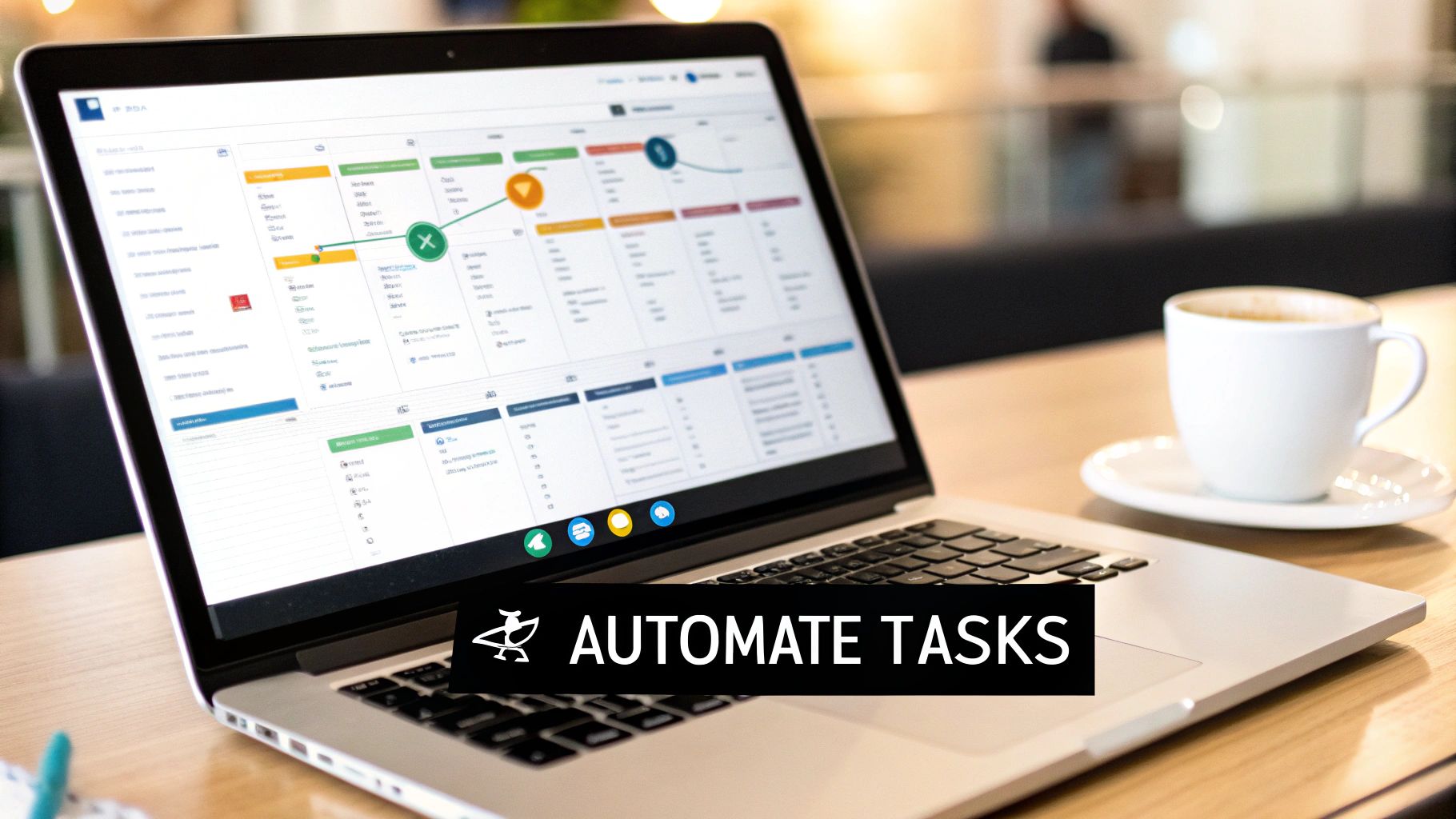
This boost in efficiency carries right into the next stage, fundamentally changing how you approach the rest of your project.
Optimizing Planning And Resource Allocation
Let’s be honest: the Planning phase is where many projects get stuck in the mud. Juggling timelines, assigning tasks, and building a budget can feel like a monumental effort. This is where automation can step in to make sense of the chaos.
Instead of guessing, automation tools can look at your past projects to predict more accurate timelines and even flag potential roadblocks before they become real problems.
For instance, an automated system can:
- Forecast Timelines: It can analyze similar past projects to build a schedule that’s actually realistic.
- Optimize Resource Allocation: Based on skills and current workloads, it can suggest the right person for the right job, preventing team burnout.
- Automate Budgeting: It can pull real-time data from different sources to help you build a detailed and accurate budget from day one.
This data-first approach takes the guesswork out of planning and gives your project a much stronger foundation for success.
By automating the tedious parts of planning, you're no longer just a coordinator buried in spreadsheets. You become a strategist. You get to spend your time thinking about the big picture and asking "what if?" instead of getting lost in the "who and when."
Driving Execution And Monitoring
Once your project is up and running, automation becomes your most reliable team member during the Execution and Monitoring phases. It works tirelessly in the background, making sure workflows are moving and information gets to the right people at the right time.
All those routine administrative jobs that eat up hours can be handed off completely.
Imagine these common scenarios handled for you:
- Automated Task Management: A developer marks a task as complete. The system automatically assigns the next dependent task to the QA tester and sends them a notification. No manual hand-off needed.
- Real-Time Progress Updates: Smart dashboards track your KPIs and immediately flag anything that’s falling behind schedule. This lets you spot risks early, not when they’ve already derailed the timeline.
- Streamlined Communication: Automated status reports are sent to stakeholders every Friday at 4 PM like clockwork, keeping everyone in the loop without you having to compile a single email.
This creates a far more transparent and efficient environment. To see just how powerful this can be, our guide on the role of AI in project management takes a deeper look at how these systems are changing project delivery.
Simplifying Project Closure
Even the final wrap-up can get a boost. The Closure phase is critical for capturing lessons learned, but it’s often rushed. Automation helps ensure a clean and thorough finish.
Instead of chasing down signatures and digging through folders, you can automate the final steps. A simple workflow can send the final deliverables for approval, archive all project files to the right place, and even generate a draft performance report.
This ensures nothing falls through the cracks. More importantly, it guarantees that every project gives you valuable insights to make the next one even better, helping you perfect how you define project lifecycle processes over time.
Mastering Project Closure to Maximize ROI
Too many projects end with a whimper, not a bang. The final phase is often treated like a quick cleanup after a party—rushed and overlooked. But real pros know that proper project closure is where you lock in long-term value and sharpen your sword for the next battle. It’s not about just ticking a box; it's a disciplined process of getting final sign-off, releasing your team, and, most importantly, mining for gold in the form of lessons learned.
Think of it as a powerful feedback loop. The insights you gain here feed directly into the planning for your next initiative, preventing you from making the same mistakes and wasting the same budget. When handoffs are messy and knowledge gets lost, you're just setting yourself up to solve the same problems over and over again.

Skipping this step has real financial consequences. Properly closing the project—which means finalizing deliverables, assessing performance, and capturing lessons—is a key driver of your long-term ROI. There’s a reason the Product Lifecycle Management (PLM) market is on track to hit $54.36 billion by 2030. According to Grand View Research, the demand for structured processes is skyrocketing. Why? Because well-managed methodologies can boost project success rates by a whopping 28%, often by catching failures that started way back in the planning stage.
Creating a Bulletproof Closure Process
A strong closure process doesn’t need to be complicated, but it does demand discipline. By creating a standardized checklist, you make sure every project, big or small, wraps up with the same professional rigor. This turns each project into a stepping stone, making your team smarter, faster, and more profitable over time.
Your closure checklist should always cover these key activities:
- Final Deliverable Sign-Off: Get formal, written acceptance from the client or stakeholder. This confirms the project has met all its requirements.
- Release of Team Resources: Officially reassign your team members so their skills can be put to work on new priorities.
- Financial Reconciliation: Tie up all the loose ends. Close out contracts, send the final invoices, and prepare the final project budget report.
- Performance Analysis: Hold the final results up against the original plan. How did you do on budget, schedule, and scope?
- Lessons Learned Session: This is critical. Get the team together for a post-mortem to document what went right, what went wrong, and why.
A well-executed closure phase is the final, critical step to define project lifecycle success. It ensures you not only deliver a great result today but also build a smarter organization for tomorrow.
This final step is also where you truly understand your financial wins. To get a better handle on this, check out our guide on how to calculate return on investment for your projects.
Frequently Asked Questions
Even with the best roadmap, you're bound to hit a few tricky intersections. Let's tackle some of the most common questions that pop up when you're putting project lifecycle theory into practice.
What's the Difference Between a Project Lifecycle and a Product Lifecycle?
It’s easy to get these two mixed up, but the distinction is pretty simple. Think of a project as a special mission to build something specific, while the product is the thing you've built, living its life out in the world.
A project lifecycle has a clear beginning and a definite end. Its whole purpose is to deliver a unique outcome—like developing a new app feature, constructing a building, or launching a marketing campaign. Once that feature goes live or the ribbon is cut, the project is officially done.
On the other hand, the product lifecycle covers the entire lifespan of that app feature. It starts when you introduce it to the market, tracks its growth and maturity, and ends only when it’s eventually retired. Over its lifetime, a single product will be shaped by dozens, if not hundreds, of individual projects.
How Do I Choose the Right Project Lifecycle Model?
There’s no magic formula here. The right model for you boils down to one thing: how much you know upfront versus how much you expect things to change.
Ultimately, you're making a trade-off between control and flexibility. Figuring out how much of each your project needs is the key to picking the right approach.
Let's break it down into a few scenarios:
- Go with Waterfall when you know exactly what you need to build. If the requirements are locked in, fully documented, and unlikely to budge, this model gives you maximum control and predictability.
- Opt for Agile if you expect the requirements to evolve. When you need to gather feedback, learn as you go, and adapt on the fly, Agile provides the flexibility you need to succeed.
- Consider a Hybrid model for the best of both worlds. This works great for projects where you need a solid, high-level plan for stakeholders but require agility and adaptability from the development team during the execution phase.
Can Small Businesses Benefit from a Formal Project Lifecycle?
Absolutely. In fact, they might benefit the most. A formal lifecycle isn't just for huge corporations with complex teams; it’s a lifeline for small businesses trying to do more with less.
For a small team, this framework brings order to the natural chaos of a growing business. It provides a repeatable process that helps you manage precious resources, keep everyone on the same page, and deliver consistent results for your clients.
Without a structured approach, growth often leads to disorganization, missed deadlines, and burnout. A simple, formal lifecycle builds the foundation you need to scale without stumbling.
Ready to stop wasting time on manual project tasks and start building a more efficient, scalable business? At MakeAutomation, we specialize in implementing AI and automation frameworks that power every phase of your project lifecycle. Book a discovery call today and see how we can help you accelerate your growth.