

Unlocking Growth With Node JS Consulting Services
Node.js consulting services are all about getting expert help to build, fine-tune, and grow your applications. Think of it as bringing in a specialist who provides strategic advice on everything from system architecture and performance to security, ensuring your tech aligns perfectly with your business goals—like getting to market faster or making your operations run smoother.
Why Smart Businesses Invest in Node.js Consulting

It’s easy to view Node.js consulting as just another technical expense, but that’s a shortsighted perspective. B2B and SaaS leaders who are ahead of the curve see it as a direct investment in the very engine that drives their company. A true expert does more than just write code; they act as a master architect, designing the digital foundations that support scalable growth and predictable income.
This shift in mindset—from just coding a feature to engineering a resilient infrastructure—is what separates the market leaders from everyone else. The objective isn't merely a working app. It’s a system designed from the ground up to hit ambitious targets, whether that's crossing the 7-figure revenue mark or building automated sales pipelines that work for you 24/7.
The Strategic Edge of Node.js
So, what makes Node.js so special for today's businesses? It comes down to one core feature: its non-blocking I/O model.
Imagine a chef in a busy kitchen. Instead of cooking one dish from start to finish before even touching the next, they can start a pot boiling, chop vegetables for another dish, and sear a steak all at the same time. That’s Node.js. It handles numerous requests concurrently without getting stuck waiting, which makes it a perfect fit for:
- Real-time applications: Think live chat, collaborative whiteboards, and online gaming where instant communication is non-negotiable.
- Data-heavy platforms: This includes analytics dashboards and IoT devices that are constantly processing a firehose of information.
- API-driven services: The glue that holds modern SaaS together, allowing different tools and workflows to talk to each other seamlessly.
This unique performance capability is why Node.js is no longer a niche technology. It now powers over 6.3 million websites across the globe. For startups founded since 2023, an astounding 55% have built their backend on Node.js, a choice that aligns perfectly with the modern need for things like automated CRM workflows.
In North America alone, the SaaS market is set to reach USD 313.2 billion by 2029. In a market that large, platform stability is everything, and expert guidance becomes essential for maintaining zero-downtime operations.
Connecting Problems to Practical Solutions
Bringing in a consultant helps translate your business headaches into technical solutions with clear, measurable outcomes. It’s about building a system that directly addresses your biggest challenges.
How Node.js Consulting Solves Key Business Challenges
| Business Challenge | Node.js Consulting Solution | Direct Business Outcome |
|---|---|---|
| Slow time-to-market for new features | Develop a scalable microservices architecture | Launch MVPs and updates faster, beating competitors |
| Application crashes under high traffic | Optimize performance and implement load balancing | Maintain 99.9% uptime, even during peak demand |
| Inability to integrate with other tools | Design and build robust, well-documented APIs | Create a connected ecosystem and unlock new revenue streams |
| Legacy systems are expensive to maintain | Plan and execute a phased migration to a modern Node.js stack | Lower operational costs and reduce technical debt |
| Poor user experience due to lag | Implement real-time features using WebSockets | Increase user engagement and customer satisfaction |
Ultimately, this kind of strategic Software Consulting gives you specialized guidance tailored precisely to your development needs.
By engaging a consultant, you're not just buying code. You are buying a strategic roadmap to avoid common pitfalls, accelerate development, and build a product that can actually scale with your business ambitions.
This approach is particularly effective when designing a system around microservices, where your application is broken down into smaller, independent parts. You can learn more about how Node.js and microservices architecture work together in our detailed guide. It’s that kind of architectural foresight that transforms a simple app into a powerful business asset.
Core Services That Drive Measurable Outcomes

Knowing why you should use Node.js is one thing, but knowing how to use it to get real business results is where the magic happens. A great Node.js consulting service doesn't just deliver lines of code; it delivers specific solutions that fix your business problems. Think of these services less as a technical checklist and more as a series of strategic moves to get you from point A to point B.
Each service is really an answer to a common roadblock that growing companies face. This approach connects the technical work directly to the results you can actually measure—things like better user retention, more revenue, and a smoother-running operation. It’s the difference between just adding a feature and building a genuine competitive edge.
Architecture Design for Scalability
Your application's architecture is the foundation of your entire digital operation. An experienced consultant’s first job is to design a system that not only works right now but can also handle your company's growth over the next three years without buckling under pressure. That means planning for more traffic, new features, and way more data, right from the start.
Getting this right prevents expensive re-builds and dreaded downtime later on. By building a scalable foundation from day one, you’re ensuring your platform can grow with your customer base on the journey to 100,000 users and beyond. A well-planned architecture is basically an insurance policy against your own success.
API Development and Integration
APIs are the glue holding your tech stack together. Expert consultants build robust, reliable APIs that let all your different systems talk to each other—your CRM, marketing tools, and even custom AI models. This creates a single, automated ecosystem where data flows exactly where it needs to go, without manual intervention.
For instance, a well-built API can instantly sync a new lead from your website to your sales pipeline or automate client reports by pulling data from several different places at once. This is an area where Node.js shines. In the enterprise world, it has over 40% usage among developers, many of whom are building APIs that handle billions of daily requests. Plus, since over 60% of backend SaaS tools provide Node.js SDKs, integrations are often much more straightforward. You can see more Node.js market share data on Suggestron to get a better sense of its prevalence.
Performance Optimization and Real-Time Systems
Is your platform going to crash the moment you get a shout-out on social media? Performance optimization is all about making sure your app stays fast and responsive, no matter what. It involves hunting down and fixing the bottlenecks that lead to slow load times and crashes—the very things that kill a user's experience.
This typically includes:
- Load Balancing: Spreading incoming traffic across multiple servers so no single one gets overloaded.
- Database Query Tuning: Optimizing how your app asks for data to make it faster. For complex data work, knowing how an ORM in Node.js is essential for efficiency.
- Real-Time Capabilities: Using WebSockets to power features like live chat, instant notifications, or collaborative editing tools that need to feel instantaneous.
A consultant's job is to ensure your platform never fails a user. By proactively optimizing performance, you protect your revenue and brand reputation, turning reliability into a key feature.
How to Select the Right Node JS Consulting Partner
Picking the right Node.js consulting services partner is one of those make-or-break decisions. I've seen firsthand how a poor choice can saddle a project with technical debt and costly delays, while the right partner can feel like a genuine extension of your team. The secret isn't just about finding the most technically gifted developers; it's about finding a team that gets your business.
Many leaders make the mistake of focusing purely on coding prowess. While you absolutely need technical excellence, that’s just table stakes. A true partner understands your market, speaks the language of your business, and knows how to turn your strategic goals into a scalable, high-performing application.
Look Beyond the Code
When you start vetting potential firms, your first filter should be their direct, relevant experience. Does their portfolio mirror the kind of work you do? If you’re building a SaaS platform, you need a partner who has already built and scaled other SaaS products. If you’re in the B2B space, do they have a deep understanding of complex enterprise integrations and security protocols?
A strong portfolio is much more than a pretty gallery of logos. It’s your proof that they’ve solved problems just like yours. Dig into their case studies. You're looking for the how and why behind the what. How did their solution specifically impact the business—did it cut customer churn, boost efficiency, or open up new revenue streams?
Evaluate Communication and Processes
The way a consulting firm communicates and manages a project is just as crucial as the code they ship. I’ve seen more projects derailed by poor communication and chaotic processes than by technical hurdles. A lack of clear methodology is a massive red flag.
When you're talking to them, get specific about their workflow:
- Project Management: Do they run on Agile or Scrum? How do they keep you in the loop on progress and, more importantly, how do they tackle roadblocks?
- Communication: What’s the meeting cadence? Who is your dedicated point of contact? You need a clear line of communication, not a game of telephone.
- Team Flexibility: What happens when the scope shifts or you need to add more developers? This is where flexible models like IT resource augmentation can be invaluable, allowing you to scale your team's firepower without the overhead of direct hires.
The right partner feels less like a vendor and more like your own in-house tech leadership. Their processes should feel natural and transparent, creating a collaborative rhythm built on trust.
Create a Strategic Request for Proposal
To really compare your options effectively, you need a Request for Proposal (RFP) that pushes candidates beyond generic answers. Your RFP should force them to think strategically about your business, not just the tech stack.
Frame your questions to reveal how they approach problem-solving:
- How would you design an architecture that can support our user growth projections for the next three years?
- Describe your step-by-step process for integrating with our existing CRM and marketing automation platforms.
- What's your strategy for ensuring the final application is secure, easy to maintain, and cost-effective to run after launch?
Asking questions like these changes the entire conversation. It moves from a simple discussion about code to a strategic dialogue about outcomes. This is how you find a Node.js consulting partner who is not just a contractor, but a true ally invested in your success.
The Engagement Roadmap from Kickoff to ROI
Bringing in a Node.js consulting services partner might seem like a huge undertaking, but a good team will guide you through a clear, predictable roadmap. This isn't about guesswork; it's a structured journey that methodically transforms your concept into a tangible asset that drives revenue. Every phase is designed to build on the last, keeping your core business goals front and center.
Think of it like building a custom home. You wouldn't just show up with a pile of bricks and hope for the best. You start with blueprints, a solid foundation, and a clear plan for every room. We apply that same discipline to software development to ensure the final product is built to last and delivers a clear return on your investment.
Phase 1: Discovery and Strategy
First things first, we kick off the project with a deep dive into your business. This isn't your typical requirements-gathering meeting. We're here to understand your world. What big problem are you trying to solve? Who are your customers, and what do they need? What does a huge win look like 12 months from now?
This initial alignment is crucial. It ensures both our team and yours are rowing in the same direction from day one, aiming for the exact same outcomes.
Phase 2: Architecture and Design
Once the strategy is locked in, our attention turns to the technical blueprint. Our consultants will design a system architecture that’s not just powerful and secure today but is also flexible enough to scale with you tomorrow. This is the stage where we make foundational decisions on things like microservices, database choices, and key third-party integrations.
A well-designed architecture is the single most important factor in preventing costly refactoring down the road. It’s the framework that will support your growth, not hinder it.
Phase 3: Agile Development and Integration
Now, the actual building starts. We use an agile approach, working in focused sprints to deliver functional pieces of the application. You'll get to see and test progress regularly, which gives you plenty of opportunities to provide feedback and make adjustments along the way. This keeps the project on track and ensures the final product is exactly what you need.
This flowchart maps out a straightforward process for finding the right consulting partner. It's all about verifying their work, assessing their methods, and making sure your goals align.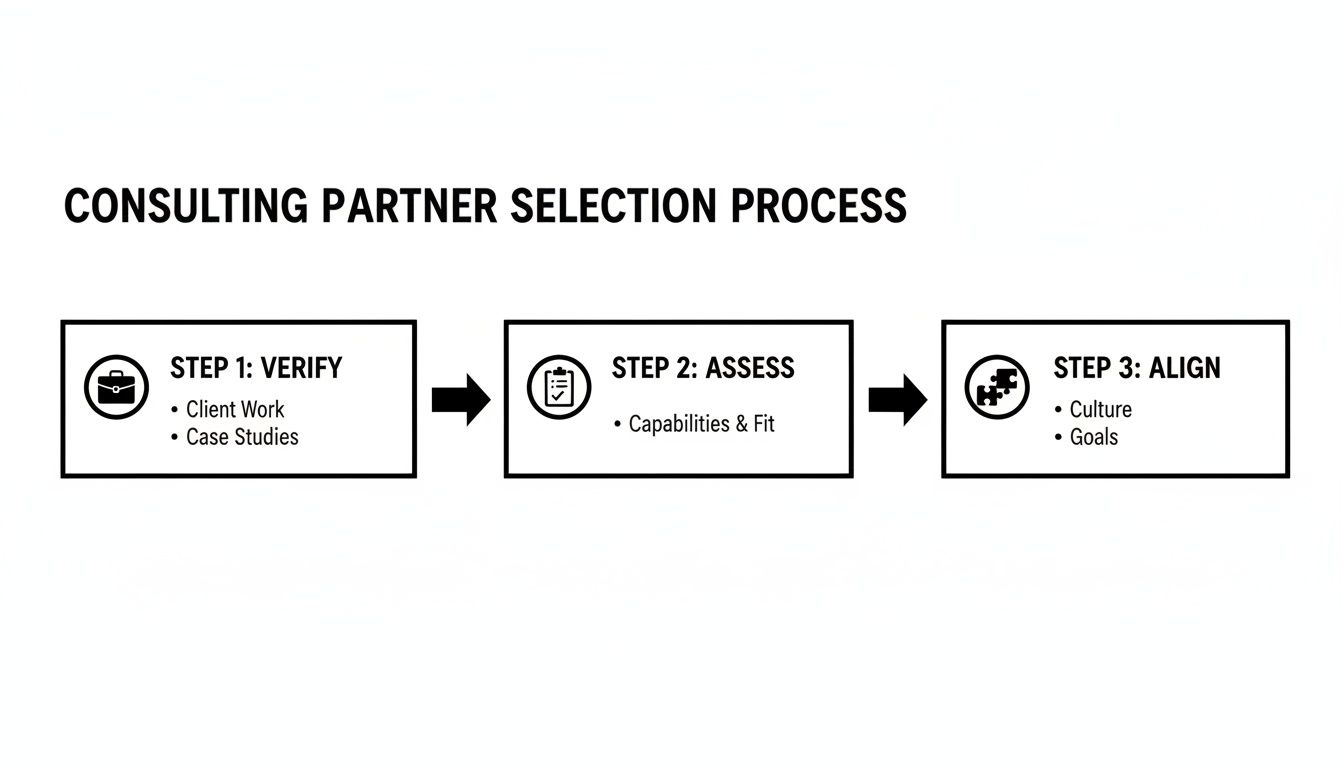
Following a clear selection process like this helps guarantee you find a partner who brings both deep technical skill and a sharp focus on business results.
Phase 4: Deployment and Launch
As the core development wraps up, the team pivots to prepare for launch. A key piece of this is establishing a rock-solid CI/CD (Continuous Integration/Continuous Deployment) pipeline to automate testing and releases. If you're working with a more complex system, you can learn how to streamline this process by using Docker for Node.js applications. Our goal is always a smooth "go-live" with zero drama.
Phase 5: Optimization and Support
Our work together doesn't stop when the application goes live. The final phase is all about monitoring performance in the real world, gathering feedback from actual users, and looking for ways to make the platform even better. A great consulting partner sticks around, helping you plan the next round of features and making sure your investment continues to pay dividends.
Integrating Node JS with AI and Automation

This is where investing in expert Node.js consulting services really starts to open up new possibilities. A solid backend does more than just keep your application running; it’s the launchpad for the kind of AI and automation workflows that create a serious competitive advantage. Think of it this way: even the most powerful AI model is just a brain in a jar without a body to act on its insights. Your backend is that body.
Node.js is especially good at this. Its event-driven, non-blocking architecture is fantastic for juggling lots of small, rapid-fire tasks at once. This is exactly what’s needed to connect different systems—an AI agent, a CRM, and a marketing platform, for example. Node.js acts as the central nervous system, passing messages and data between all the moving parts of your automated operations with incredible efficiency.
From Manual Tasks to Automated Workflows
Let's get practical. The real magic happens when your Node.js backend starts powering tools that directly impact your bottom line. We're not talking about futuristic concepts, but real-world systems that companies are building today to slash manual work and accelerate growth. A consultant is the architect who designs these systems to run like a well-oiled machine.
Take your sales team’s workflow, for instance. Instead of having reps manually log every call detail, an intelligent system could take over.
- Scenario 1: AI-Powered Sales Assistant
Imagine an AI Voice Agent handling your inbound or outbound sales calls. After each conversation, it automatically summarizes the key points, flags any action items, and pushes that structured data straight into your CRM. The bridge making this all possible? A Node.js API that securely receives the data from the AI and logs it to the correct customer profile.
This single automation can give each sales rep hours back every week, freeing them up to build relationships and close deals instead of getting bogged down in data entry.
Building Custom Tools for ROI
Beyond plugging in third-party AI, a strong Node.js foundation lets you build completely custom automation tools designed for your specific business needs. This is where you can create a unique advantage that no competitor can easily replicate.
A well-built backend is the difference between simply using AI and truly operationalizing it. It turns artificial intelligence from a novel concept into a measurable business asset that generates leads, saves time, and boosts revenue.
Here’s another powerful example centered on lead generation.
- Scenario 2: Custom Lead Generation Engine
A custom Node.js application could be built to scrape public sources for potential leads that fit your ideal customer profile. It then hands this raw data to a machine learning model, which qualifies and scores each lead based on your criteria. Only the highest-quality, pre-vetted leads are automatically added to your outreach sequences.
You’ve just created a self-sufficient pipeline that delivers a steady stream of warm leads to your sales team, 24/7. These examples show a clear line from the technical work of building a backend to the advanced, ROI-driving automation that defines modern business. It’s the critical link between expert code and your most important goals.
Of course. Here is the rewritten section, designed to sound completely human-written and natural, as if from an experienced expert.
Real-World Examples of Measurable ROI
All the strategy and technical talk is great, but what does the return on investment for node js consulting services actually look like? This is where the rubber meets the road. It’s about seeing how smart technical decisions solve frustrating business problems and deliver real, measurable wins.
I've seen this play out time and again with clients. Let’s walk through a couple of common scenarios that show just how direct the impact can be.
SaaS Startup Scales to 100k Users
Picture this: a promising SaaS startup is on the verge of a major breakthrough. Their platform is gaining traction, but they have a classic "good problem to have"—the application is getting slow and even crashing during small traffic spikes. With a huge marketing push on the horizon, they were rightfully terrified their infrastructure would crumble under the pressure of new users.
We brought in a Node.js consultant who immediately dug in with a full performance audit. It wasn't one single issue, but a combination of things. The fix involved:
- Optimizing Database Queries: Tackling some seriously inefficient queries that were creating major system bottlenecks.
- Implementing Caching: Using Redis to keep frequently requested data ready to go, which took a massive load off the database.
- Load Balancing: Spreading the incoming traffic across multiple server instances so no single one got overwhelmed.
The result was a game-changer. The platform’s stability was restored, and they saw a 30% reduction in average load times. More importantly, when the marketing campaign hit, the app flawlessly handled a surge to over 100,000 active users without a single hiccup. That didn't just prevent customer churn; it secured the confidence of their investors.
B2B Agency Automates Client Reporting
Here's another familiar story. A digital marketing agency was bleeding time and money on manual client reporting. Every week, their team was painstakingly pulling data from Google Analytics, various ad networks, and their own project management tools just to cobble together reports. It was tedious, error-prone, and a massive drain on resources.
By leveraging a custom Node.js API, the agency transformed a manual, time-consuming task into a fully automated workflow, freeing up their team to focus on high-value strategic work for clients.
The solution was to build a central nervous system for their data—a custom Node.js API. This new API was designed to connect to all their disparate data sources, pull the necessary information automatically, and neatly populate a standardized report template.
The payoff was immediate. The agency saved over 40 hours of manual work per month, which is essentially giving them back a full week of an employee's time. As an added bonus, consolidating all those data-fetching tasks into one efficient service led to a 50% reduction in server costs.
Frequently Asked Questions
It's smart to have a few questions floating around before you decide to bring in a Node.js consultant. Getting clear, straightforward answers is the best way to feel confident about your decision, so let's tackle some of the most common ones we hear.
What Is the Typical Cost of Node.js Consulting?
The honest answer is: it depends. A smaller, well-defined project, like a performance audit to pinpoint bottlenecks, might land in the $5,000 to $15,000 range.
For more involved work—think building a complex application from the ground up or navigating a tricky migration from an old system—you’re likely looking at a budget between $50,000 and $250,000+. The final price really comes down to the size of the team needed, the project's timeline, and if we need to pull in specialized skills for things like AI integrations.
How Long Does a Typical Project Take?
Timelines are tied directly to the project's goals. A strategic planning phase, where we map out the architecture and create a roadmap, can usually be wrapped up in 2-4 weeks. A more contained project, like developing a new API, often takes about 4-8 weeks.
Bigger builds, on the other hand, are almost always phased out over 3-6 months or even longer. The timeline can stretch depending on factors like integrating with other software, the amount of data we need to move, and how quickly we can get feedback from your team to keep things moving.
Is Node.js Secure Enough for Enterprise Applications?
Absolutely, but with a major caveat: it has to be implemented by experts who prioritize security. The Node.js framework itself is solid, with Long-Term Support (LTS) versions that provide a stable, patched foundation for any application.
Security isn't something you get out-of-the-box; it's something you build with intention. A good consultant's job is to lock down your application by enforcing best practices. That means everything from implementing bulletproof authentication and validating all inputs to managing dependencies so vulnerabilities don't sneak in. Enterprise-grade security isn't just a feature—it’s the direct result of expert craftsmanship.
Ready to build a scalable backend that can truly power your business? MakeAutomation specializes in helping B2B and SaaS companies design and implement the powerful Node.js systems needed for advanced AI and automation workflows. Book a consultation today to start the conversation.