
Unlock Growth with Continuous Integration Consulting
Your product team is ready to ship a feature that sales already promised to prospects. Marketing has the launch sequence drafted. Customer success has prepared onboarding notes. Then release week turns into bug week.
One engineer is untangling a merge conflict. Another is fixing a test that only fails on one machine. A third is manually checking whether the latest code broke billing, login, or your analytics events. Nobody feels slow, but the company moves slowly anyway.
That’s the moment many founders start looking at continuous integration consulting. Not because they want a shinier engineering setup, but because they need a business system that makes releases predictable. When software delivery is unstable, it doesn’t stay inside engineering. It delays campaigns, pushes back revenue, and creates avoidable customer friction.
The shift toward this discipline is not small. The global Continuous Integration tools market is projected to grow from USD 2.58 billion in 2026 to USD 12.66 billion by 2034, at a CAGR of 22.02% according to Fortune Business Insights on the continuous integration tools market. Founders don’t invest attention in categories like this unless the business pain is real.
From Development Gridlock to Growth Engine
A growth-stage SaaS company usually doesn’t hit delivery problems because the team lacks talent. It hits them because the process that worked with a small codebase stops working when the company has more customers, more integrations, and more people editing the same product.
At first, the symptoms look unrelated. Features take longer to release. Hotfixes interrupt roadmap work. Sales loses confidence in launch dates. Product meetings get filled with “almost done” updates. Engineers spend time coordinating instead of building.
Those symptoms all point to the same issue. New code is arriving faster than the team can safely combine, test, and release it.
Continuous integration consulting treats release friction as an operating problem, not just a developer problem.
A good consultant looks at how code moves from idea to production and asks practical questions. Where do changes pile up? Which tests are manual? Who gets blocked waiting for approvals or environment fixes? Why does one release feel routine while the next one feels risky?
What founders often miss
Many founders assume this is just the price of growth. It isn’t. Delivery chaos usually comes from missing automation, inconsistent standards, and weak feedback loops.
That matters because every unstable release creates downstream business cost:
- Marketing delays: Campaigns wait for features that aren’t dependable enough to announce.
- Sales friction: Reps hesitate to promise timelines when recent launches slipped.
- Support load: Customers report issues that should have been caught before release.
- Leadership drag: Founders spend time arbitrating release risk instead of steering growth.
Why consulting changes the equation
Buying Jenkins, GitHub Actions, GitLab CI, or CircleCI won’t solve this by itself. Tools don’t redesign habits. They don’t decide what should be tested first, how fast feedback must arrive, or what quality gates fit your product.
That’s where continuous integration consulting becomes strategic. The consultant turns software delivery into a repeatable system. Done well, CI becomes less like a technical safeguard and more like a growth engine that helps every team trust release velocity again.
Demystifying Continuous Integration Consulting
Think of CI as an automated factory for code.
Your developers keep producing parts: a bug fix, a new workflow, a billing update, a UI improvement. If those parts sit around and only get assembled occasionally, defects pile up and it becomes hard to tell which change caused the problem. Continuous integration fixes that by combining small changes frequently and checking them automatically.

A consultant is the architect and operator coach for that factory. They don’t just install tools. They decide how work should flow, where checks belong, and what kind of automation protects speed without creating new bottlenecks.
What the pipeline is
A CI pipeline is the path code follows after a developer commits a change. In plain language, it usually does a few jobs:
- Builds the application: It confirms the product still compiles or packages correctly.
- Runs automated checks: Unit tests, linting, static analysis, and integration tests catch problems early.
- Reports failures fast: The team sees what broke and where.
- Creates a reliable handoff: If the code passes, it’s ready for the next step toward deployment.
That’s the “what.” The pipeline is the mechanism.
What the consultant actually does
The consultant handles the “who” and the “how.” They study your current workflow and shape a system that fits your product, team, and growth goals.
Typical responsibilities include:
Workflow diagnosis
They inspect how your team uses Git, branches, reviews, environments, and release approvals.Tool selection
They help match your stack to the right setup, whether that means GitHub Actions, GitLab CI, Jenkins, Bitbucket Pipelines, Docker, or test tools like pytest, Jest, Cypress, or Selenium.Automation design
They decide which checks must run on every commit, which belong later, and how to keep feedback fast enough that developers use it.Quality policy
They define rules for merging, rollback, alerts, and ownership.Team adoption
They train the team so the system becomes routine, not consultant-dependent.
Practical rule: If your team has to “remember” a quality step, it probably belongs in automation.
Why this matters beyond engineering
Founders often hear “CI” and think “developer tooling.” But the business value comes from risk control and decision speed. When each change is checked automatically, you get fewer unpleasant surprises at release time. That gives product, sales, and marketing firmer ground to plan around.
If you’re mapping operational improvements across teams, it helps to see how CI fits within broader various automation solutions used to reduce manual work across the business. And if you want a practical view of how CI connects to release discipline, this guide to DevOps and continuous delivery services gives useful context.
The Real ROI of CI for B2B and SaaS Businesses
Founders rarely need to be sold on the idea that shipping faster is good. The core question is whether continuous integration consulting produces enough business value to justify the effort, the spend, and the internal change.
It can, but only if you measure the right outcomes.
The most useful ROI lens isn’t “Did engineering get a new pipeline?” It’s “Did the company reduce release risk, recover faster from mistakes, and move product changes into customer hands with less drama?”
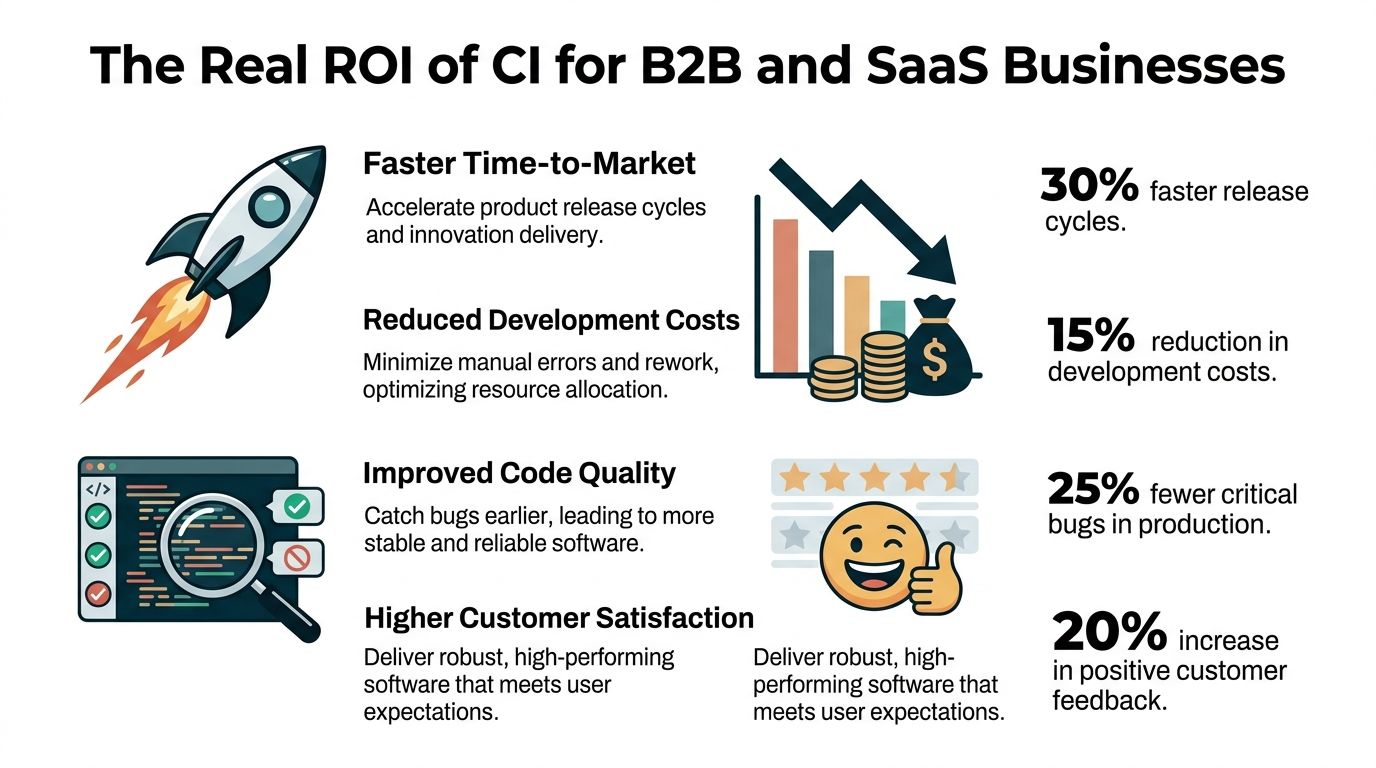
One metric matters more than many non-technical leaders realize: change failure rate, often shortened to CFR. According to TierPoint’s explanation of continuous integration benefits, CI consulting can help optimize change failure rates to under 5% by enforcing automated testing. The same source notes this can cut mean-time-to-recovery by 50% to 75%.
Those numbers matter because failed changes are expensive in ways finance dashboards don’t always show clearly. A broken release costs engineering hours, but it also disrupts demos, delays campaigns, damages trust with customers, and forces leaders into reactive decision-making.
Where the return shows up first
The fastest payback usually appears in four places.
- Release confidence: Teams stop treating each launch like a special event. Smaller, validated changes become normal.
- Lower interruption cost: Engineers spend less time firefighting and more time working on roadmap items.
- Faster customer response: Product can act on feedback sooner because changes move through the system with less friction.
- Better cross-functional planning: Sales and marketing can coordinate launches around reliable delivery windows.
Why fewer failures raise revenue efficiency
A founder doesn’t need every sprint to move faster in a dramatic way. They need fewer setbacks that compound over time.
If your team ships a feature and then spends days cleaning up after the release, you haven’t just lost engineering time. You’ve also delayed the next feature, weakened launch momentum, and increased the odds that prospects hear “not yet” from sales. CI consulting improves ROI by reducing these hidden taxes on growth.
Consider a simple business translation of technical metrics:
| Technical metric | What it means operationally | Why leadership should care |
|---|---|---|
| Build success | The code passes automated checks consistently | Fewer surprise failures before launch |
| CFR | Changes break production less often | Lower outage and recovery cost |
| MTTR | The team restores service faster | Smaller customer and revenue impact |
| Cycle time | Work moves from development to release faster | Quicker monetization of product work |
ROI is not just speed
Some founders evaluate CI consulting only through release frequency. That’s too narrow. The strongest return often comes from stability plus speed.
A team that ships slightly less often but with fewer failures can create more business value than a team that ships constantly and breaks trust each month.
There’s also a leadership benefit. When engineering stops operating in constant recovery mode, managers can plan with more certainty. Product leaders can prioritize against real capacity. Customer-facing teams stop padding timelines to protect themselves from instability.
A better way to think about the investment
Treat CI consulting like an investment in production capacity and quality control. Manufacturers don’t install quality checks because they enjoy inspections. They do it because defects found late are more expensive than defects found early.
Software works the same way. When code is integrated and validated continuously, issues surface when they’re still small, local, and cheaper to fix. That’s what turns CI from a line item into a growth lever.
Structuring Your CI Consulting Engagement
A lot of hesitation around continuous integration consulting has nothing to do with technology. It comes from uncertainty about the engagement itself. How long will it take? What are you paying for? Is this a one-time setup or an ongoing relationship?
That uncertainty is common. According to eSparkInfo’s review of CI/CD consulting companies, only 29% of teams use CI for automated builds and tests, and unclear ROI is a major reason teams hesitate. If you can’t picture the shape of the engagement, it’s hard to approve the investment.
The three common models
Most CI consulting engagements fall into one of three structures.
| Model | Best For | Cost Structure | Typical Duration |
|---|---|---|---|
| Project-based | Teams that need an initial pipeline, migration, or defined implementation outcome | Fixed scope or milestone-based fee | Short-term |
| Retainer-based | Companies that want ongoing optimization, support, and iterative improvements | Monthly recurring fee | Ongoing |
| Advisory services | Founders or tech leaders who need strategic oversight more than hands-on implementation | Scheduled advisory fee or consulting hours | Flexible |
Project-based engagement
This works well when the problem is concrete. You may want a consultant to set up your first CI pipeline, standardize automated checks, or modernize an outdated Jenkins workflow.
The upside is clarity. You define the deliverable, agree on scope, and move toward a visible endpoint.
The risk is equally clear. If your team’s habits, testing discipline, or release process are immature, the consultant can finish the project while the organization still struggles to sustain it.
Retainer-based support
A retainer fits companies that already know CI is not a one-and-done project. They want someone to keep improving build performance, refine testing layers, tune alerts, and help the team evolve as the product changes.
This model is often better for growing SaaS teams because needs shift. A startup may begin with one service and later add mobile apps, background workers, customer-specific environments, or more complex deployment workflows. Ongoing support keeps the CI system aligned with the business.
The best retainer isn’t endless dependency. It’s a controlled path toward a stronger in-house team.
Advisory services
Some companies already have capable engineers but need outside judgment. In that case, advisory work can make sense.
An advisor may review architecture decisions, evaluate tool choices, audit process gaps, or coach leadership on rollout strategy. This can be useful when the team wants objective guidance without outsourcing implementation.
How to choose the right structure
The right engagement model depends less on company size and more on organizational readiness.
Choose based on questions like these:
- Is the goal narrow or broad? A single pipeline rollout points toward project work. Process change across multiple teams often points toward retainer support.
- Does your team need execution or judgment? If your engineers can build but need direction, advisory may be enough.
- Are you trying to solve a tooling problem or an operating problem? Tooling problems are easier to scope tightly. Operating problems usually need longer support.
- Can you measure value quickly? If yes, a staged project can work. If value depends on adoption over time, a retainer is usually safer.
Many founders make the mistake of choosing the cheapest structure instead of the one that matches the actual risk. The better question is simple: which model gives your team the highest chance of lasting improvement?
Your Roadmap from Code Chaos to Automated Pipelines
A strong CI initiative rarely starts with tool installation. It starts with diagnosis. If a consultant rushes to configure GitHub Actions or Jenkins before understanding how your team works, you’ll get automation layered on top of confusion.
The better path is phased. Each step should reduce risk and increase clarity.
Audit and goal setting
The first phase is operational, not technical. A consultant reviews your repositories, branching habits, test coverage, release rhythm, ownership model, and deployment pain points.
This is also where founders need a readiness check. Before building anything, ask:
- Source control discipline: Does the team consistently use Git in a shared, reviewable way?
- Clear release goals: Are you trying to reduce launch delays, improve quality, shorten cycle time, or all three?
- Basic test culture: Do developers already write some automated tests, even if the current setup is inconsistent?
- Ownership clarity: Who will maintain the pipeline after launch?
- Leadership support: Will product and engineering leaders enforce the new workflow when deadlines get tight?
If those answers are shaky, the consultant’s job includes process repair, not just pipeline design.
Toolchain selection and workflow design
Now the consultant chooses the mechanics. The right setup depends on your stack and team habits.
A Node product might pair GitHub Actions with Jest and Cypress. A Python platform may lean on pytest and containerized builds. A larger enterprise environment may still use Jenkins for flexibility. Docker often becomes part of the equation because it helps standardize execution across environments.
What matters most is fit. The consultant should design a path that developers will utilize, not the most impressive stack on a diagram.
For teams expanding across regions or coordinating more complex operating structures, lessons from international business consulting can be surprisingly relevant. Cross-team alignment, process clarity, and standard operating models matter in CI rollouts just as much as they do in broader business scaling.
Pilot implementation
A smart consultant usually starts with one product, service, or team. This pilot acts like a controlled proving ground.
The goal isn’t perfection. It’s to confirm that the workflow is workable, the checks are meaningful, and the feedback loop is fast enough to support real daily use.
You can see a practical example of this progression in guidance around an auto DevOps pipeline approach, where automation is introduced as an operating system for delivery rather than a loose collection of scripts.
Start where the pain is visible and the team is cooperative. Early wins create political capital for wider adoption.
Automated testing integration
At this stage, many CI efforts either become valuable or become noisy.
According to KDAB’s CI and CD best practices, expert implementations often use dual build configurations. One is a fast 2 to 5 minute pipeline for per-commit checks. The other is a more thorough nightly build. KDAB notes that this approach can achieve more than 95% early defect detection.
That setup makes business sense. Fast checks protect developer flow. Broader nightly validation catches deeper issues without slowing every commit.
A practical implementation often looks like this:
Per-commit pipeline
Run smoke tests, static analysis, linting, and fast unit tests immediately after each commit.Nightly or scheduled build
Run full integration suites, broader regression coverage, and heavier environment checks later.Failure routing
Decide who gets alerted, how severity is classified, and when a broken pipeline blocks merges.
Here’s a useful explainer if your team wants a visual walkthrough before rollout:
Team onboarding and rollout
A pipeline isn’t finished when it runs. It’s finished when the team trusts it.
That means documenting expectations, teaching developers how to interpret failures, setting branch protection rules, and making quality gates part of everyday work. Product managers also need context. If a release is blocked, they should understand why that’s protecting the business rather than “slowing engineering down.”
What a healthy rollout feels like
The best sign of progress is cultural, not visual. The team stops asking whether they should use the pipeline and starts assuming every change goes through it. Releases become smaller, calmer, and easier to predict.
That’s when CI stops being a technical project and becomes part of how the company operates.
Essential Deliverables and Outcomes from Your Consultant
A founder should expect more than “the build passes now.” If that’s all the consultant leaves behind, the company has bought a fragile setup, not an enduring capability.
The right deliverables create independence. They let your team run, improve, and troubleshoot the system without needing outside rescue every time something changes.
The technical assets you should receive
At a minimum, the engagement should produce a set of durable technical outputs.
- A working CI pipeline: This includes build logic, automated checks, failure notifications, and merge or release rules aligned with your workflow.
- Repository-level standards: Branching conventions, commit expectations, review requirements, and environment assumptions should be defined clearly.
- Test integration: Your key automated tests should be wired into the pipeline in the right order, with clear expectations about what blocks a merge.
- Operational visibility: Teams should be able to see build history, failure patterns, and pipeline status without chasing tribal knowledge.
The documentation that protects your investment
Many engagements often fall short. A consultant may build well but document poorly.
Good documentation should include:
- Runbooks: What to do when builds fail, who owns which response, and how to escalate.
- Standard operating procedures: How developers create changes, what happens before merge, and how releases move forward.
- Tooling map: Which systems connect to the pipeline and why.
- Maintenance notes: How to update dependencies, rotate workflows, and extend the pipeline safely.
If the consultant disappears tomorrow, your team should still know how the system works.
The management layer most teams forget
A pipeline alone doesn’t help leadership unless results are visible in a business-friendly form. That’s why a useful consultant also delivers reporting and interpretation.
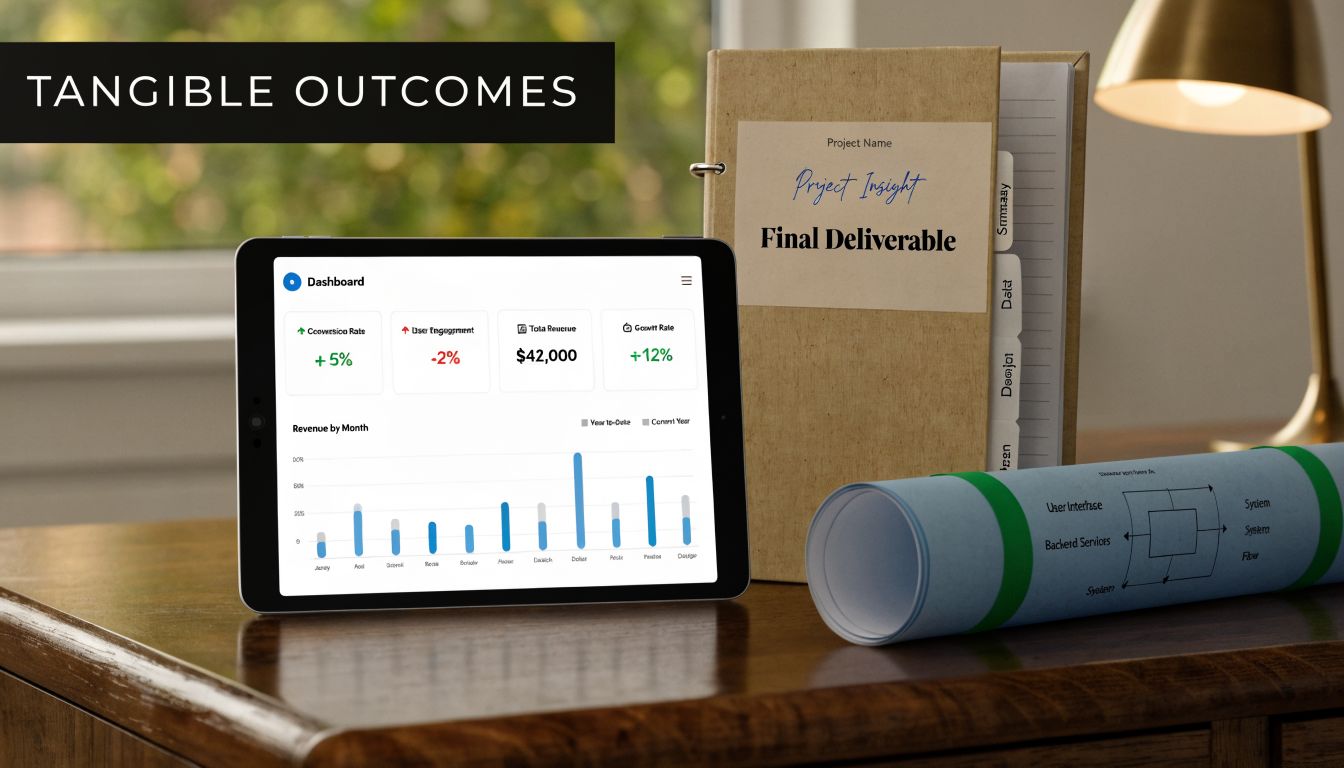
A metrics dashboard should make it easy to monitor issues such as build health, recurring failures, release friction, and trends in delivery stability. A founder doesn’t need raw log files. They need a readable signal.
That signal helps answer questions like:
- Are failures concentrated in one product area?
- Is the team waiting too long for feedback?
- Which checks create value and which create noise?
- Are release blockers decreasing over time?
Training is a deliverable, not a bonus
The final outcome should be a more capable team. That means workshops, live walkthroughs, code review norms, and clear ownership transfer.
Some developers need help writing pipeline-aware tests. Some engineering managers need help reading delivery metrics. Some product leaders need help understanding when a blocked merge protects roadmap quality. A strong consultant handles all three audiences.
What lasting value looks like
The best result is not a flashy setup. It’s a system your team uses consistently, understands thoroughly, and can improve without fear.
When that happens, the consultant has delivered something bigger than automation. They’ve helped build an internal operating asset that supports quality, speed, and resilience long after the contract ends.
Choosing a CI Partner Who Understands Business Growth
Many consultants can discuss pipelines, containers, branching strategies, and build agents. Fewer can connect those choices to revenue timing, launch confidence, or operational efficiency. If you’re hiring for continuous integration consulting, that difference matters.
A technically competent partner can still be the wrong partner if they treat your company like a generic software shop. B2B and SaaS businesses have different pressures. Customer commitments, launch timing, churn risk, support overhead, and cross-functional coordination all shape what “good CI” means.
That’s one reason partner selection deserves more scrutiny than founders often give it. According to Technologent’s discussion of CI/CD pipeline challenges, Gartner analysts predicted 90% of DevOps initiatives fail to meet expectations, often because of weak testing integration and cultural resistance. In other words, failure usually comes from how the change is introduced and adopted, not from lack of tooling.
Questions worth asking before you sign
Ask questions that reveal whether the consultant understands business outcomes, not just technical implementation.
How will you define success for our business?
Look for answers tied to release reliability, team efficiency, and customer-facing impact.What will you need from our team to make this stick?
Good consultants talk about ownership, habits, and decision-making, not just access credentials.How do you handle rollout resistance?
If they ignore cultural friction, expect adoption problems later.What documentation and training do you leave behind?
A strong partner plans for independence from the start.How do you decide what should run on every commit versus later?
This reveals whether they can balance speed with coverage.How will you report progress to non-technical leadership?
You need a partner who can translate engineering work into operational clarity.
Red flags founders should notice
Some warning signs are easy to miss during a polished sales conversation.
A consultant may focus heavily on favorite tools before understanding your workflow. They may promise broad transformation without discussing ownership or training. They may also propose a one-size-fits-all framework that sounds efficient but ignores your product complexity and team maturity.
Other red flags include:
- Minimal interest in current bottlenecks
- No plan for documentation
- No explanation of how the team will maintain the system
- An implementation-heavy pitch with little mention of business metrics
- A tendency to treat testing as optional cleanup instead of core design
A CI partner should reduce operational risk, not just increase automation volume.
What business-aware consulting looks like
The best partner usually sounds less dramatic than the worst one. They won’t promise magic. They’ll ask careful questions about release pain, customer commitments, internal skills, and how your teams operate under pressure.
They’ll also understand that CI doesn’t live in a vacuum. In many growth-stage companies, software delivery is connected to lead routing, CRM workflows, onboarding processes, support operations, and internal SOPs. A useful partner sees those dependencies because release quality affects much more than engineering.
If you want a benchmark for what a specialized partner can look like, this profile of a CI/CD consultant for business-focused automation environments is a good reference point. The key idea isn’t the title. It’s the orientation toward scalable operations rather than isolated tooling work.
The best fit for a SaaS founder
Founders usually need a partner who can do three things at once:
- Design the technical workflow well
- Translate it into business impact clearly
- Leave the company stronger after the engagement
That combination is rarer than it should be. Many consultants can do one or two. The partner worth hiring does all three.
If you choose well, continuous integration consulting becomes a force multiplier. It helps engineering move cleanly, gives customer-facing teams more confidence, and creates a company-wide rhythm where shipping no longer feels hazardous. That’s not just a DevOps win. It’s a growth advantage.
Invest in Speed, Invest in Growth
Continuous integration consulting works best when you stop viewing it as a technical upgrade and start viewing it as business infrastructure. It helps your company release with less friction, catch problems earlier, and recover faster when something does go wrong.
For B2B and SaaS firms, those gains show up everywhere. Product can respond to customer feedback sooner. Sales can speak with more confidence about launch timing. Marketing can run campaigns without fearing last-minute instability. Engineering spends more time building and less time cleaning up preventable failures.
The core decision isn’t whether automation sounds useful. It’s whether your current delivery process is strong enough to support the growth you want. If releases are still too manual, too risky, or too dependent on heroic effort, the cost is already showing up across the business.
Continuous integration consulting gives you a practical way to replace release anxiety with a repeatable system. That’s why the true investment isn’t in pipelines alone. It’s in speed, quality, and operational confidence.
If your team is dealing with release bottlenecks, fragile workflows, or too much manual coordination, MakeAutomation can help you turn software delivery into a scalable operating system. Their work spans automation strategy, DevOps process design, SOP development, and hands-on implementation for B2B and SaaS companies that want cleaner execution and stronger ROI.