
Agile Methodology Epic Story: A Practical Guide (2026)
Your team is busy, the backlog keeps growing, and yet it’s still hard to answer a simple founder question: what business result are we driving?
That’s where most agile work starts to drift. Sales asks for lead routing automation. HR wants recruitment workflow cleanup. Operations wants fewer manual handoffs. Product or engineering turns each request into tickets, but the work often lands as a flat list of tasks with no strategic thread tying it together.
The agile methodology epic story model fixes that. It gives you a way to connect a business objective to executable work, then measure whether the outcome mattered. For B2B and SaaS companies, that matters even more outside classic software delivery. If you’re automating onboarding, lead qualification, CRM hygiene, or hiring operations, you need structure that supports delivery and a way to prove ROI after launch.
What is an Agile Epic (and Why It’s Not Just a Big Story)
A backlog without hierarchy becomes administrative noise. You see tasks, but you don’t see intent. That’s usually the first sign a team is treating everything like a ticketing problem instead of a planning problem.
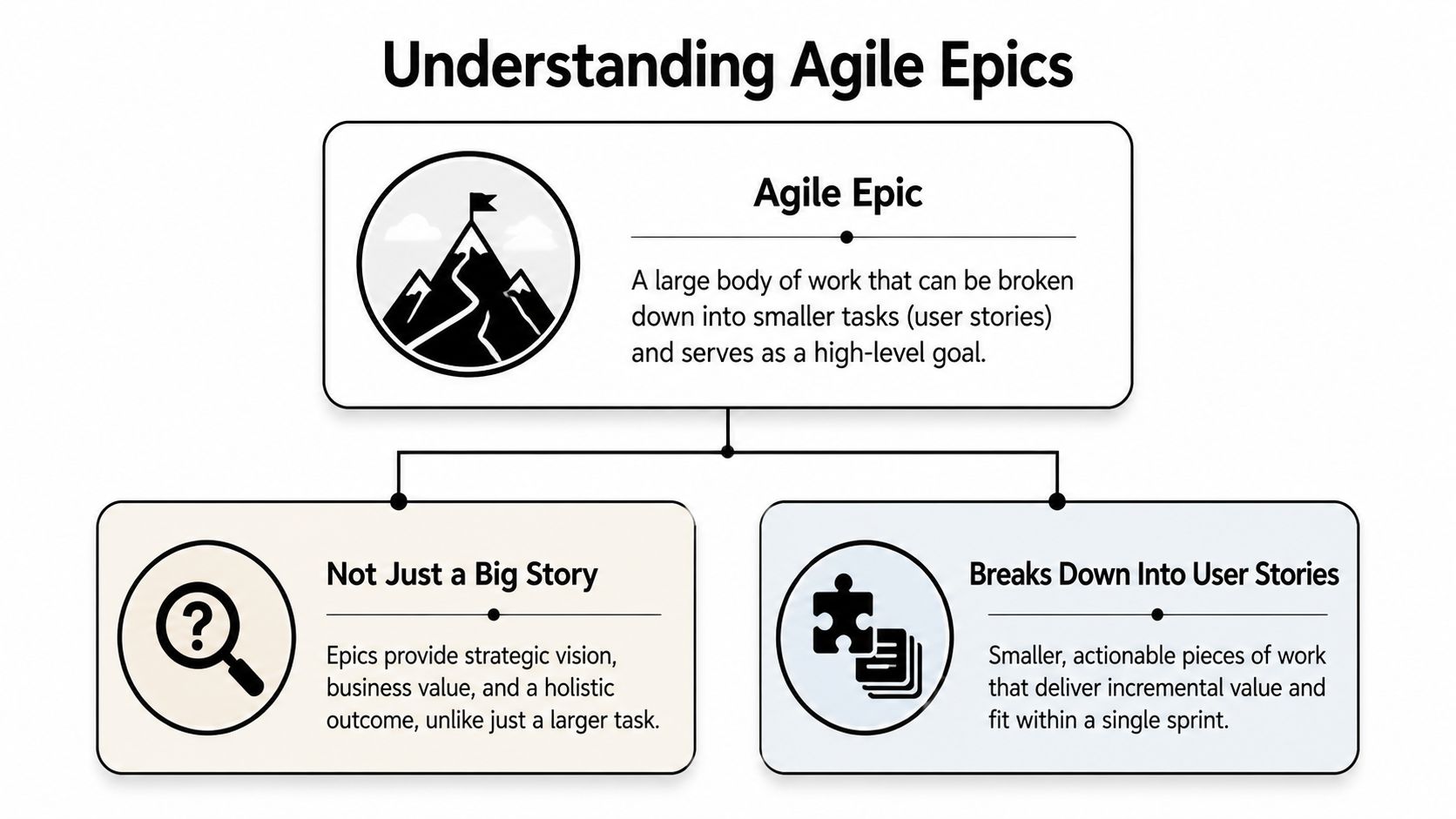
An epic is the top-level container for a meaningful business objective. It sits above features, user stories, and tasks. In practical terms, the hierarchy looks like this: Epics → Features → User Stories → Tasks/Subtasks. That structure became standard as agile teams needed a better way to manage work across multiple teams, projects, and boards, rather than keeping everything in disconnected lists, as described in Atlassian’s overview of epics, stories, and themes.
The difference that actually matters
A story describes one usable slice of value. An epic describes a larger outcome that requires multiple slices to deliver.
If your team says, “Let’s automate new client onboarding,” that’s not a story. It’s too broad, touches several workflows, and usually involves handoffs across sales, customer success, CRM, documentation, and notifications. That makes it an epic.
A story inside that epic might be: “As a new client, I receive an automated welcome email after contract signature so I know my next steps.” That’s specific enough to build, test, and release.
Practical rule: If an item gives direction to many smaller pieces of work, it’s an epic. If it’s ready for one sprint-sized delivery conversation, it’s a story or feature.
Why epics matter outside software
Founders often assume epics belong only in product teams. They don’t. In operations-heavy companies, epics are often more useful in business systems work than in pure feature development.
Examples:
- Sales operations epic: Automate inbound lead qualification across forms, CRM assignment, and follow-up triggers
- Marketing operations epic: Standardize campaign handoff from ad platform to CRM to sales alerts
- HR epic: Streamline recruitment workflows from application intake through interview scheduling
- Client services epic: Automate SaaS onboarding from signed proposal to kickoff readiness
What makes these epics valuable isn’t size alone. It’s strategic coherence. The epic gives stakeholders one container for a business goal, instead of scattering related work across random tickets.
Not just bigger. Different.
Teams get into trouble when they think an epic is a “large story.” It isn’t. A large story is still just oversized work. An epic should carry business context, boundaries, and an intended outcome.
A weak item sounds like this:
- “Improve CRM”
- “Fix onboarding”
- “Automate HR”
A strong epic sounds like this:
- “Reduce manual client onboarding handoffs by automating account setup, welcome communication, and internal task creation”
The second version tells your team what problem they’re solving, where the work starts, and what “better” should look like. That’s the essence of the agile methodology epic story framework. It turns effort into a narrative the business can understand.
How to Define and Write a Powerful Epic
Most bad epics fail before delivery starts. They’re vague, politically overloaded, or written as wish lists. A useful epic should help your team make decisions when trade-offs appear, not create more debate.
Start with one rule. Name the business change, not the implementation. “Implement HubSpot workflow” is tool-first and narrow. “Automate new SaaS client onboarding” is better because it names the outcome.

A practical epic template
Use a format that forces clarity before work begins.
| Element | Description | Example ('Automate Client Onboarding') |
|---|---|---|
| Epic name | Short, outcome-focused title | Automate Client Onboarding |
| Narrative | User or stakeholder-centered statement of value | As a new client and internal delivery team, we need onboarding steps to trigger automatically so kickoff happens consistently and without manual chasing |
| Business case | Why this matters commercially or operationally | Manual onboarding creates delays, inconsistent communication, and hidden admin work across sales and customer success |
| In scope | What the epic includes | Contract-signed trigger, welcome email, account setup tasks, onboarding checklist, internal alerts |
| Out of scope | What the epic does not include | Product training redesign, billing system migration, full customer education program |
| Success metrics | Business outcomes and operating signals to track | Workflow adoption, time-to-value, handoff completion quality, stakeholder response timeliness |
| Dependencies | Teams, tools, approvals, or systems involved | CRM admin, customer success lead, legal-approved email templates, project tool integration |
| Risks and assumptions | Known constraints | Existing CRM data quality may limit automation accuracy at launch |
This is the level of definition many teams skip. Then they wonder why sprint planning turns into interpretation.
Write the narrative in business language
Your epic doesn’t need to sound like a requirements document. It needs to be understandable by leadership, operators, and the people doing the work.
A strong narrative usually includes:
- Who benefits
- What changes
- Why it matters
For example:
A new client should move from signed agreement to kickoff-ready status through automated steps so the team reduces manual coordination and the client gets a consistent first experience.
That statement is far more useful than “build onboarding automation.” It frames the epic around behavior and outcome.
Define the edges early
Scope creep usually starts because nobody writes the “not included” list. That’s a mistake, especially in automation work where one workflow quickly touches five others.
If you’re working on client onboarding, decide up front whether billing triggers, support portal setup, and training content are part of the same epic or separate ones. Otherwise your “simple automation” becomes a sprawling operational rewrite.
A clean epic should answer these questions:
- What starts the workflow
- What finished state counts as complete
- Which teams are affected
- What we are intentionally leaving for later
The fastest way to weaken an epic is to make it absorb every adjacent process.
Make success measurable before launch
An epic without a success definition becomes impossible to judge. You’ll know stories were completed, but you won’t know whether the work improved anything that matters.
For non-software teams, that means using business language. Think workflow adoption, handoff speed, onboarding consistency, response timeliness, or time-to-value. If you need a few concrete patterns, these epic user stories examples are useful for translating broad goals into workable agile structures.
The main discipline is simple. Write the epic so a founder can read it and understand the commercial reason it exists. If they can’t, it’s not ready.
Decomposing Epics into Manageable User Stories
An epic becomes useful only when the team can break it into slices that deliver value incrementally. If decomposition is weak, planning gets fuzzy, stories grow too large, and delivery slips.
Healthy epics are bounded. According to Wrike’s agile guidance, a healthy epic typically contains 5 to 15 user stories and spans 1 to 3 months, and work that needs more than 3 sprints qualifies as an epic while work that fits within 1 to 2 sprints is better treated as a feature, as outlined in this guide to agile epics. That’s a useful operating constraint because it stops epics from turning into quarter-long holding bins.

Slice by workflow, not by department
Take the epic Automate New SaaS Client Onboarding.
A poor decomposition would split work by team:
- Sales task
- CS task
- CRM task
- Ops task
That creates handoff-heavy stories that don’t deliver usable value on their own.
A better approach uses vertical slices. Each story should produce a working piece of the experience.
Examples:
- As a new client, I receive an automated welcome email after my agreement is marked signed
- As a customer success manager, I can see onboarding status in one dashboard
- As an internal ops lead, I get an alert when required onboarding details are missing
- As a new client, I receive a checklist showing the next actions needed before kickoff
- As an account owner, I can trigger a fallback manual path if required onboarding data fails validation
Each of those stories can be tested and released independently. That’s what makes them useful.
Story mapping works well for automation
When the workflow crosses teams, story mapping is usually the fastest way to break the epic apart. Place the main journey across the top. For onboarding, that might be:
- Agreement signed
- Welcome triggered
- Internal tasks created
- Client details collected
- Kickoff readiness confirmed
Then add stories beneath each stage. This keeps the epic tied to a real operating flow instead of a random backlog cluster. If your team manages this structure in Jira, these practical notes on Jira epics and stories help translate the model into board-level execution.
Add acceptance criteria that remove ambiguity
A story without acceptance criteria becomes a conversation that never ends. For automation projects, ambiguity usually shows up around triggers, exceptions, and ownership.
Use a simple Given / When / Then format.
Example story:
As a new client, I receive a welcome email with next steps after contract signature.
Acceptance criteria:
- Given the deal stage is marked as closed won, when the required onboarding fields are complete, then the system sends the welcome email automatically
- Given the deal is marked as closed won, when required onboarding fields are missing, then the system does not send the email and alerts the account owner
- Given the email is sent, when the send is confirmed, then the CRM timeline records the event
That level of precision matters more in business automation than many teams expect. A missing field, a bad status trigger, or an unclear exception path can break trust in the system quickly.
Small stories reduce planning friction. Clear acceptance criteria reduce rework.
What not to do
These are signs your decomposition is still weak:
- Stories describe internal tasks only instead of user-visible outcomes
- One story contains several triggers and multiple exception cases
- Nothing can be released early
- The epic still sounds like a program of work, not a milestone
When that happens, split further. The goal isn’t administrative purity. The goal is faster learning and cleaner delivery.
Prioritizing Epics on Your Product Roadmap
Many teams don’t have a shortage of ideas. They have a shortage of sequencing discipline.
A B2B founder may have three valid automation candidates at once: improve inbound lead qualification, streamline recruitment workflows, and automate client onboarding. All three matter. The hard part is choosing what gets roadmap attention now.
Start with the quarter, not the backlog
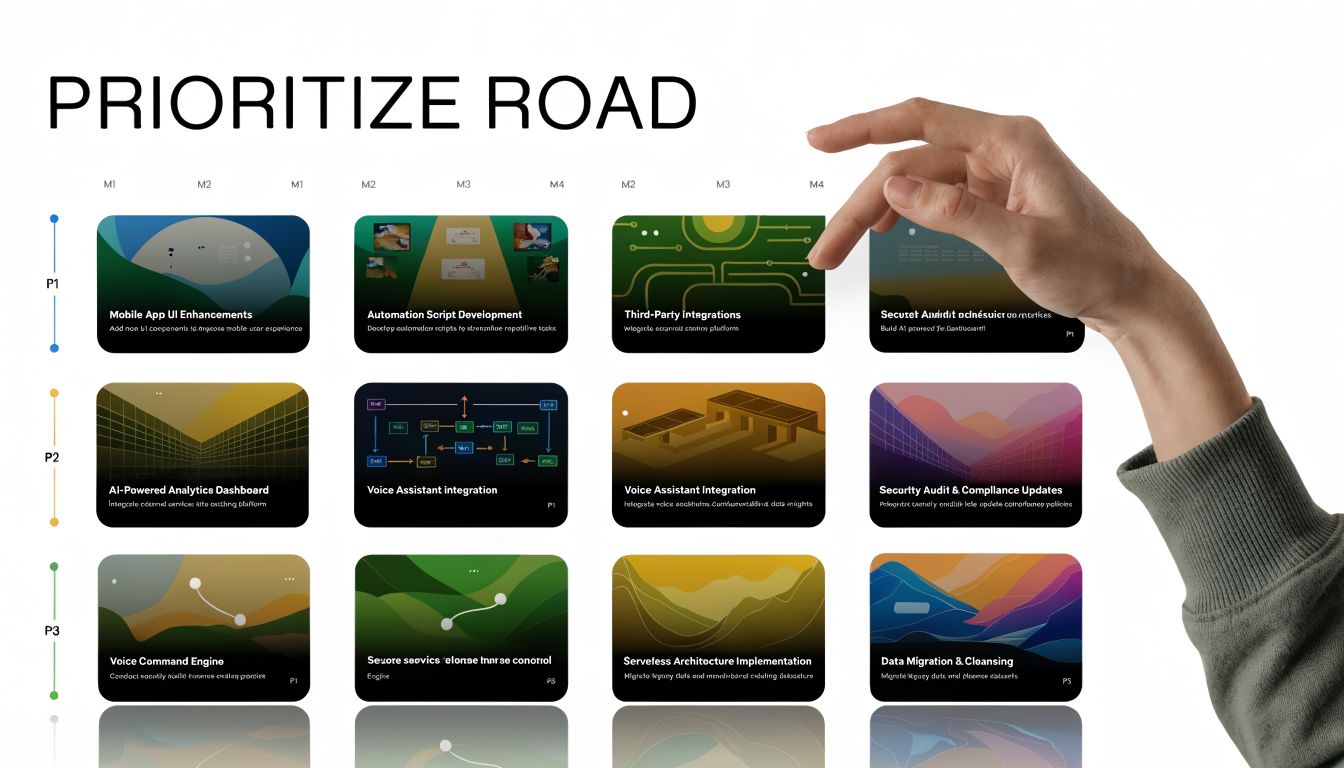
An epic should earn its place by supporting a current business objective. If this quarter’s pressure is pipeline quality, an inbound qualification epic probably outranks a recruitment workflow epic. If delivery capacity is constrained by onboarding delays, client onboarding moves up.
This sounds obvious, but teams often prioritize by urgency, stakeholder volume, or who pushed hardest in the last leadership meeting.
For founders building structured planning habits, this guide on building effective product roadmaps is helpful because it connects roadmap choices to business direction rather than feature accumulation.
Three practical ways to compare epics
You don’t need a heavyweight PMO process. You need a repeatable decision method.
Value versus effort
This is the fastest model. Compare expected business impact against implementation complexity.
Use it when you need a quick decision in leadership or planning sessions.
- High value, lower effort: usually first in line
- High value, high effort: plan carefully and break into phases
- Lower value, lower effort: consider only if it enables something else
- Lower value, high effort: usually defer
For example, if lead qualification automation can improve response quality quickly with existing CRM tooling, it may beat a recruitment epic that requires policy alignment, hiring manager changes, and multiple approval paths.
RICE-style thinking
Some teams prefer a more explicit scoring discussion. Even if you don’t formalize every variable, the logic is useful:
- Reach: who or what part of the business is affected
- Impact: how meaningful the change is
- Confidence: how certain you are about the assumptions
- Effort: how hard it is to implement
This helps when two epics both sound valuable but one is built on shaky assumptions.
Dependency-first prioritization
In operations and automation work, dependencies often dominate. A seemingly smaller epic may deserve priority because it enables later work.
Example:
If your CRM data structure is inconsistent, an onboarding automation epic may fail unless you first standardize account fields and lifecycle stages. In that case, “clean up CRM foundations” might not look glamorous, but it’s the right precursor.
A simple comparison example
Suppose you’re choosing between:
- Automate inbound lead qualification
- Streamline employee recruitment workflows
Lead qualification may win if sales capacity is stretched and routing delays hurt follow-up consistency. Recruitment may win if hiring bottlenecks are actively limiting revenue delivery. The right answer depends less on preference and more on what constraint is currently shaping the business.
Here’s a helpful walkthrough before choosing tools or board structure.
Keep the roadmap honest
Roadmaps become fiction when teams load too many epics into the same period. If everything is strategic, nothing is.
A better rule is to commit only to the epics that directly support the current business push and that your operating teams can realistically absorb. If you’re organizing the hierarchy above epics as well, these notes on creating initiatives in Jira can help separate broad business bets from the epic-level work that teams execute.
Measuring the Business Impact of Your Epics
Completing an epic is not success. It’s output.
For B2B and SaaS companies running automation projects, the key question is whether the epic improved the business. Did sales respond faster? Did onboarding become cleaner? Did hiring coordination become less manual? If you only track delivery mechanics, you won’t know.
That’s one reason traditional agile metrics fall short in operations work. Velocity and burndown can describe team activity, but they don’t tell a founder whether a workflow change improved revenue operations, reduced admin burden, or accelerated time-to-value.
Why output metrics are not enough
A team can close every story in an epic and still ship something nobody uses. That happens constantly in business systems work.
The gap is especially visible in non-software functions. The challenge for operations directors and HR teams is often how to define whether an epic such as workflow streamlining actually delivered business value, because traditional agile measures don’t capture operational improvements like time saved or cost reduction, a problem highlighted in this discussion of epics and user stories in practice.
If the epic changed process behavior but didn’t improve a business outcome, you finished work. You didn’t finish the job.
What high-performing teams do differently
A useful signal comes from Parallel. Organizations with the highest project performance report a 75.4% success rate, and 39% of them explicitly track epic-to-story traceability and success metrics, with automation-focused guidance emphasizing adoption metrics and time-to-value before launch, according to Parallel’s article on how to write an epic in agile.
That matters because traceability forces discipline. You can connect each story back to the business objective and judge whether the stories being built are moving the intended result.
A better measurement model for automation epics
Use two layers of measurement.
Leading indicators
These tell you whether delivery and rollout are on track.
- Story completion versus plan
- Dependency resolution speed
- Stakeholder feedback timeliness
- Team confidence on the solution path
These are useful during execution because they help you catch drift before the epic stalls.
Business outcome metrics
These tell you whether the epic produced value after release.
For automation work, strong business measures often include:
- Adoption metrics for the new workflow
- Time-to-value from implementation to operational benefit
- Activation or usage quality where relevant
- Revenue impact where the workflow affects pipeline or conversion
If you’re trying to sharpen this part of your planning discipline, it’s worth reviewing several ways teams discover product prioritization methods so your roadmap and measurement model stay connected.
A concrete example
Take the epic Automate Lead Scoring and Qualification.
Weak success definition:
- Workflow built
- Sales team trained
- Stories complete
Better success definition:
- Sales uses the automated qualification path consistently
- Time-to-value is visible soon after launch
- Routing quality improves enough that the team trusts the system
- Revenue-facing teams can see whether the workflow is helping downstream conversion efforts
Notice the difference. The first set describes activity. The second describes changed business behavior.
Release partial value early
One more point gets missed in many agile discussions. Don’t hold the entire epic until every branch of the automation is complete.
Release a vertical slice first. For example, automate qualification for one lead source before covering every source. Or automate onboarding for one client segment before rebuilding the whole process. That gives you earlier feedback on adoption and business usefulness.
The agile methodology epic story model works best when it connects planning, delivery, and measurable outcomes. If one of those pieces is missing, the work may look organized but still fail commercially.
Common Pitfalls and Pro Tips for Epic Management
Epic management breaks down in familiar ways. The names differ, but the failure patterns are consistent.
The first is the saga epic. This is the epic that never seems to end because the team kept adding adjacent work. The second is the folder epic. It exists only to group tickets and carries no strategic meaning. The third is the completion trap. Teams celebrate done work without proving the workflow changed anything important.
The checklist I’d use with any B2B team
- Keep the epic tied to one business outcome. If an epic tries to fix onboarding, CRM quality, support handoff, and billing at once, split it.
- Write non-goals. This is one of the easiest ways to block scope creep before it starts.
- Don’t confuse team ownership with story structure. Cross-functional work should still be sliced by value, not by department boundaries.
- Include operational edge cases early. Automation work fails in exceptions, not in the happy path.
- Review the epic after partial release. If users bypass the workflow, the epic needs adjustment even if the board says green.
What strong teams do that weak teams skip
Strong teams revisit the epic narrative as delivery progresses. Weak teams never look at it again after kickoff.
Strong teams ask whether a released slice changed behavior. Weak teams ask only whether all acceptance criteria were marked complete.
A lot of practical agile execution comes down to habits like these. If you want a broader operating checklist, this roundup of agile development best practices is a useful companion to epic-level planning.
The best epics don’t add bureaucracy. They reduce ambiguity.
Final do and don’t list
| Do | Don’t |
|---|---|
| Define success before work starts | Wait until release to decide what success means |
| Break epics into releasable user stories | Break them into internal task buckets |
| Use epics for business outcomes | Use epics as labels only |
| Track adoption and time-to-value | Rely only on velocity or story completion |
| Split oversized epics early | Let them sprawl across planning cycles |
The main takeaway is simple. For operations directors, HR leaders, and founders, the hardest part isn’t creating more agile artifacts. It’s making sure your epic structure stays connected to business value. That’s the gap many teams still miss, especially when the work involves recruitment, CRM operations, or workflow automation rather than classic product features.
If you want help turning messy operational work into measurable automation epics, MakeAutomation can help you design the workflow, break it into stories, and track whether it improves time saved, process quality, and revenue outcomes.