Increase Customer Lifetime Value: SaaS & B2B Growth
A 5% increase in customer retention can increase profits by 25% to 95%, depending on your industry and margin structure, according to Bain & Company research cited in the CLV benchmark literature (Rivo's summary of the retention-profit relationship). That's why customer lifetime value is never just a finance metric. It's the clearest sign of whether your onboarding, product experience, support model, and expansion motions are compounding value.
B2B and SaaS teams often treat CLV as a report. That's the mistake. CLV is a system, and the strongest systems are built around retention first, then expansion, then margin, with each layer supported by automation and operational discipline. If you want to increase customer lifetime value, start by measuring it correctly, segmenting it aggressively, and then building workflows that help customers reach value faster and keep finding it.
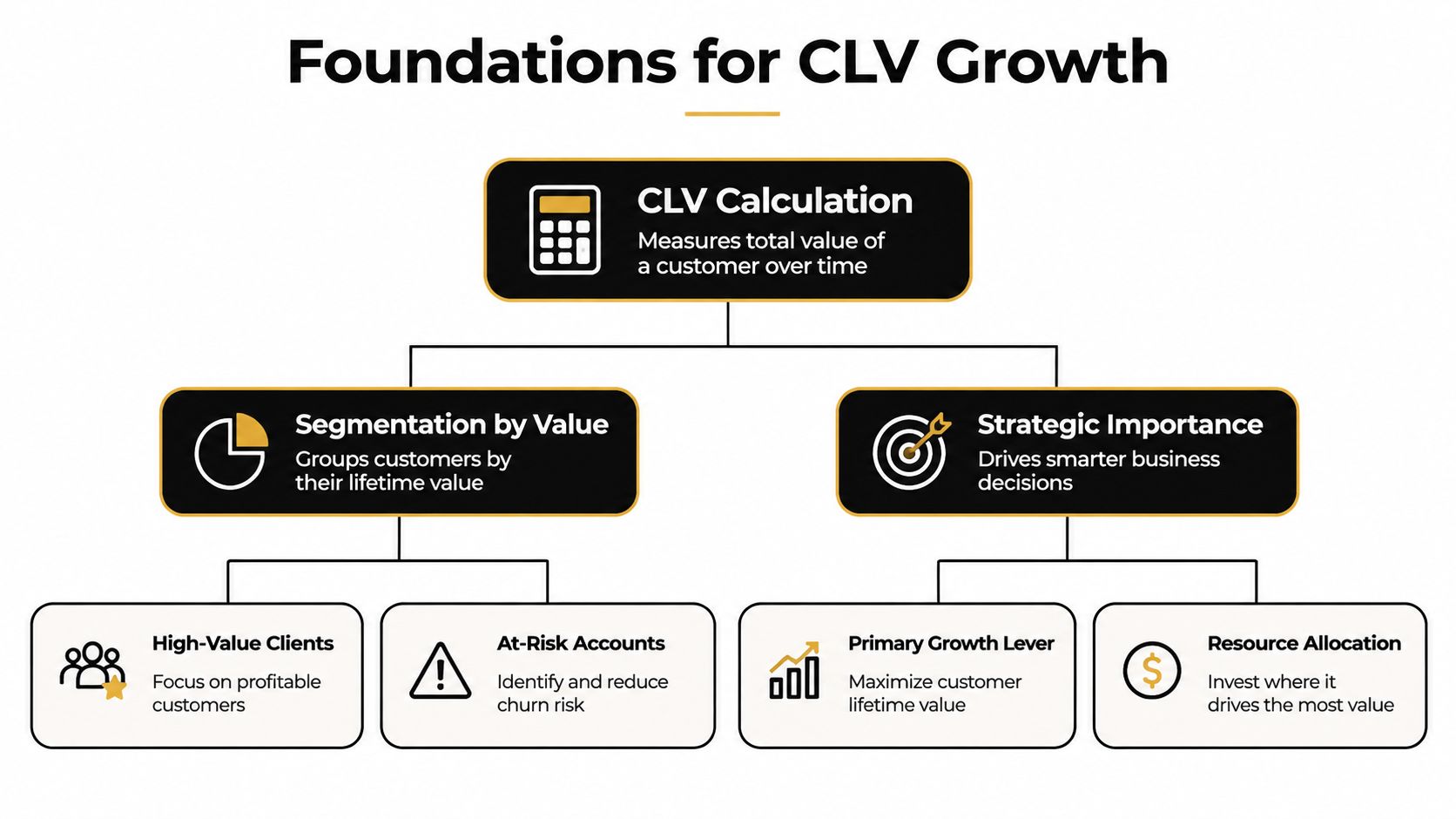
Foundations for CLV Growth Calculating and Segmenting Value
CLV works because it ties profit to relationship length, not just the first sale. Wharton and Salesforce both describe it as the expected value of future purchases or revenue across the relationship, which is exactly why subscription and SaaS companies care so much about renewals and expansion revenue (Wharton on why customer lifetime value matters). In plain terms, the business that keeps a customer active for longer has more chances to sell, more chances to educate, and more chances to earn loyalty.
The simplest practical model is average order value × purchase frequency × customer lifespan. For recurring-revenue businesses, the same logic applies, but the relationship is shaped by renewals, usage depth, and expansion. The point isn't to obsess over a perfect formula. The point is to make sure the number reflects actual behavior, not a blended average that hides who is really valuable.
Segment before you optimize
A single CLV number is too blunt to guide action. The more useful approach is to calculate baseline CLV by segment, then split cohorts by acquisition channel, product entry point, plan tier, or sales motion. That's where the signal appears. One channel may bring in accounts that renew and expand cleanly, while another fills the pipeline with customers who look cheap to acquire but never mature into real value.
A practical way to do this is to track revenue per cohort monthly for at least 12 months, then compare retention curves and payback behavior. That cadence exposes whether your problem is onboarding, product-market fit, pricing, or channel quality. It also keeps you from overreacting to a strong first sale that doesn't convert into a long relationship.
Practical rule: if a segment can't be explained in operational terms, it can't be improved in operational terms.
For a useful starting point on how segmentation changes the quality of your CLV analysis, see this internal guide on customer segmentation strategies. The goal is not to create more dashboards. The goal is to decide which customer groups deserve more product attention, more success coverage, and more expansion logic.
A common benchmark in CLV planning is that CLTV should be at least 3x CAC to stay sustainable, a rule highlighted in data-driven retailer guidance (Upside's CLV guidance). If your blended ratio looks healthy but one segment is weak, the blended number is lying to you. Segment-level analysis is where decision-making starts.
Automated Onboarding and Proactive Retention Playbooks
Most churn is not random. It starts when customers never reach value quickly enough to form a habit. For SaaS and other recurring models, reducing time-to-value is one of the strongest retention levers, because early activation is tightly linked to whether a customer keeps using the product and eventually renews (Kissmetrics on onboarding and retention). If onboarding feels manual, inconsistent, or dependent on one CSM's memory, CLV will be capped before expansion even enters the picture.
The better model is an automated onboarding system that watches for behavior, not just sign-up status. That means every new customer should move through a sequence that is triggered by actions and stalled by inactivity. The customer doesn't need more messages. They need the next useful step at the right time.
The starting sequence is simple:
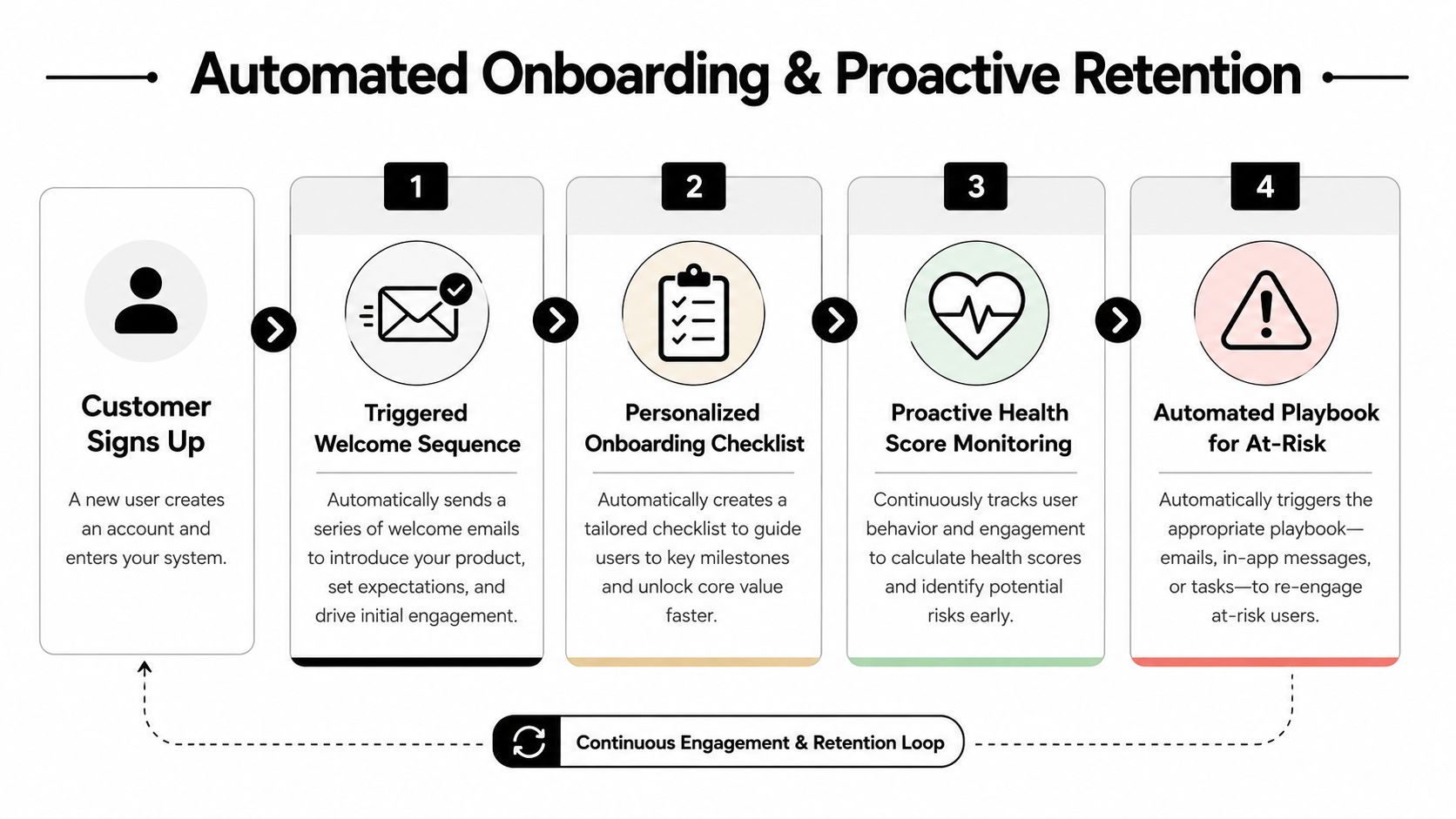
- Triggered welcome sequence. Send the first email or in-app prompt after signup, then tailor the next step based on whether the customer has completed setup or not.
- Personalized onboarding checklist. Show only the milestones relevant to the account's use case, so the customer sees progress instead of a generic task dump.
- Proactive health score monitoring. Watch product usage, first-value completion, support friction, and renewal risk indicators in one place.
- Automated playbook for at-risk accounts. Trigger intervention when behavior crosses a threshold, not when the renewal date is already close.
A short visual helps teams operationalize this without overthinking it. Use the infographic below as the basic workflow map.
The right onboarding system also needs automation discipline. The mistake is trying to personalize everything manually. That slows response time, hides churn risk, and burns CSM capacity on less impactful work. A better approach is to use templates, blueprints, tutorials, webinars, and behavior-based health scoring, then reserve human intervention for the moments that matter most (Kissmetrics onboarding guidance).
This client onboarding process template is useful if you want a structure you can adapt into a repeatable SOP. The real goal is simple, get the customer to the first visible win faster, then keep detecting friction before it turns into churn.
Unlocking Expansion Revenue Through Smart Pricing and Packaging
Retention keeps the relationship alive. Pricing and packaging decide whether that relationship compounds. In SaaS, a customer who stays for longer can generate far more value through renewals and expansion than through the original deal alone, which is why pricing should be treated as a living growth lever rather than a static launch decision (Wharton on recurring relationship value). If your tiers are flat, your offers are random, or your upgrade path is confusing, you're leaving expansion revenue on the table.
The best packaging creates a natural next step. That can mean feature gating, usage thresholds, service bundles, or support levels that map to customer maturity. What matters is that the customer sees the upgrade as the logical continuation of success, not a sales interruption. The most effective offers usually appear after the customer has already experienced value and reached a milestone that changes their needs.
For teams looking to map additional fit-based offers, finding cross-sell opportunities can be a useful way to spot adjacencies without turning the account motion into spam. Cross-sell and upsell work when they solve a next problem, not when they just ask for a bigger invoice. Poor timing, on the other hand, can undermine trust and reduce the effectiveness of expansion programs.
Operational rule: never ask for expansion before the customer has a reason to believe the product already pays for itself.
The sustainability checkpoint is the 3x CAC rule. If a customer relationship can't plausibly return at least three times the acquisition cost, the model is under pressure even if top-line revenue looks fine (Upside's CLV guidance). That makes pricing strategy a financial control, not just a sales tactic.
The practical test for packaging is straightforward. Each tier should answer three questions: what stage of maturity is this customer at, what problem do they need next, and what would make the upgrade feel obvious? If your team can't answer those questions, the pricing page is probably doing too much persuasion and not enough qualification. Sustainable CLV comes from helping the right accounts move up when they're ready.
Transform Customer Success into a Strategic Growth Engine
Customer Success often gets trapped in a support mindset. That's a waste, because the same team that sees adoption friction also sees expansion signals, renewal risk, and product gaps before most other functions do. When CSMs are armed with usage data and a clear commercial charter, they stop being ticket managers and become revenue operators. That shift matters, because the strongest CLV improvements usually come from teams acting on account health before the customer asks for help.
The core operating model is simple. Product usage tells you what customers are doing. Feedback tells you what they expected. Success tells you what to do next. If those three inputs stay separate, the company reacts too slowly. If they're connected, CSMs can surface the right issue, route it to product, and trigger the next best commercial action at the account level.
Make the CSM motion proactive
Executive Business Reviews work best when they're not status meetings. A strong EBR shows outcomes, usage, and missed opportunities side by side. It should answer whether the customer is getting value, where adoption is shallow, and what adjacent problem is now visible because the original one got solved. That's how you move from “Are you happy?” to “What are you trying to solve next?”
A useful training foundation for that operating style is this customer success training program resource. Training matters because proactive success is a skill, not a personality trait. CSMs need repeatable prompts, clear account segmentation, and a standard way to identify when an account is ready for escalation, education, or expansion.
The cleanest teams build a feedback loop with three layers:
- Usage review. Check adoption patterns and identify where the product is being used lightly.
- Outcome review. Confirm whether the customer's original business goal is being met.
- Opportunity review. Look for new problems the customer has not yet framed, but clearly needs to solve.
One practical note. A good CSM doesn't push a new offer too early. They wait until the customer has realized enough value to understand the next problem clearly. That timing discipline is what makes the account feel guided instead of sold to.
Putting CLV on Autopilot with AI and Automation
Old personalization advice assumes you can see everything. You can't. Customer journeys now move across email, SMS, apps, support tools, and paid media, while consent rules and identity gaps make tracking harder. The actual opportunity is not more generic personalization. It's better timing, better context, and better use of first-party signals in a privacy-constrained environment (Bloomreach on the CLV gap in privacy-constrained journeys). That's where automation becomes a competitive advantage.
The operating principle is straightforward. Use the signals you own. That means product events, helpdesk behavior, renewal dates, onboarding milestones, account expansion history, and engagement with prior messages. Then let automation decide when to act, not just what to send. If a customer stalls after setup, receives repeated support, or shows unusually low usage on a critical feature, the system should trigger an intervention before a human notices the problem in a weekly report.
Build workflows around limited but trustworthy signals
AI helps most when it reduces guesswork. For example, if you connect your outreach stack to a workflow engine, you can route accounts into different playbooks based on recent behavior instead of broad persona labels. That lets you create SOPs for first-value completion, renewal risk, expansion readiness, and re-engagement. If you want a practical reference for email automation workflows, Robotomail's guide to AI email integration is useful because it frames automation as a timing problem, not just a volume problem.
The same logic applies to support. An AI-assisted response layer can classify customer intent, surface likely next actions, and hand off only the cases that need human judgment. For teams that want to see how that connects to retention, this AI agent for customer service resource fits naturally into a broader CLV system.
A useful AI-first SOP for CLV usually looks like this:
- Ingest first-party events. Pull in onboarding completion, usage drops, unresolved tickets, renewal dates, and expansion history.
- Score the account. Use thresholds or rules to flag churn risk, upgrade readiness, or stalled activation.
- Trigger the right playbook. Send education, route to CSM outreach, or create a support task automatically.
- Log the outcome. Capture whether the intervention improved usage, prevented churn, or led to expansion.
Practical rule: automation should narrow the distance between customer behavior and company response, not just increase the number of messages in the inbox.
There are trade-offs. Over-automating can feel robotic if the trigger logic is sloppy, and over-personalizing manually just slows the team down. The best systems combine AI classification, clean SOPs, and human review only where judgment matters. In a CLV program, that combination is what lets a small team act like a much larger one without adding headcount linearly.
Build Your High-CLV Flywheel and Outpace the Competition
The strongest CLV programs don't look linear. They behave like a flywheel. Accurate segmentation points your team at the right accounts. Automated onboarding gets customers to value faster. Smart packaging gives them a natural reason to expand. Proactive success keeps them moving. Each motion feeds the next, and the business compounds what it learns instead of resetting every quarter.
That model fits the history of subscription and SaaS economics. Wharton's framing of CLV as the value of the ongoing relationship captures the shift clearly, because the long-term account matters more than the first invoice (Wharton on customer lifetime value). In that environment, the companies that win aren't the ones that chase the most new logos. They're the ones that build systems for keeping, growing, and protecting the accounts they already earned.
Your flywheel should be simple enough to run and strict enough to measure. If segmentation is weak, fix it. If onboarding is slow, automate it. If expansion is random, redesign the packaging. If customer success is reactive, give it a revenue charter. That's how CLV stops being a dashboard metric and becomes an operating model.
If you want help turning CLV strategy into an automated system, visit MakeAutomation. The team builds AI and automation workflows for onboarding, retention, CRM processes, and customer service so B2B and SaaS companies can scale lifetime value without scaling manual work.