

Growth Strategy for Startups: A Practical Framework
Most startup growth advice gets the order backwards. Founders are told to buy more traffic, open more channels, and “scale what works” before they've proven that customers stay, expand, and refer. That's how teams end up with polished acquisition systems feeding a leaky bucket.
A better growth strategy for startups starts with proof, not volume. The hard truth is that about 42% to 70% of startup failures are tied to no market need, while roughly 90% of startups fail overall and about 10% fail within the first year startup statistics guide. If the market doesn't want the product, no amount of channel testing will save it.
That's why I think the right conversation for B2B and SaaS founders isn't “Which channel should we test next?” It's “What signal proves customers will keep paying and expanding?” Once that's clear, acquisition becomes an amplifier instead of a gamble. For teams looking for a practical angle on this topic, the growth strategy for B2B marketing teams resource from Bazzly is a useful companion because it keeps the focus on repeatable demand, not vanity motion.
Why Most Startup Growth Strategies Fail Before They Start
The most common mistake is treating growth like a media plan. Founders get excited about LinkedIn posts, outbound sequences, paid campaigns, partner pitches, and SEO calendars, then wonder why the numbers do not hold. The problem usually is not effort. It is that the product has not earned the right to scale yet.
When a startup has weak market need, more promotion only speeds up disappointment. The statistics above matter because they explain why so many teams misread early traction as real traction. Signups can look healthy while churn, inactivity, and weak expansion behavior tell the story.
Retention is the first scaling test
If customers do not come back, your acquisition math breaks quickly. In SaaS and subscription businesses, founders need to track MRR, CAC, churn, retention, and LTV because those metrics show whether growth is compounding or just being replaced. A spike in signups without retention is just a more expensive way to learn the same lesson twice.
Practical rule: do not scale a channel until customers who arrive through it show durable behavior after first use.
That is why mature growth conversations sound more operational than promotional. The work is proving product–market fit, tightening onboarding, and making the offer specific enough that the right buyers recognize themselves immediately. If you skip that part, channel experimentation becomes noisy and expensive.
The startup benchmark data reinforces the same point. A 2024 to 2025 guide reports bootstrapped SaaS companies at a median annual growth rate of 23% and venture-backed SaaS at 25%, while early-stage ARR growth can average 144% before slowing to 15% to 45% year over year as companies mature startup statistics guide. Those numbers do not point to random bursts of activity. They point to sustained, measurable expansion, which is the kind of signal founders can build around. For teams that want a practical companion to that thinking, the growth strategy for B2B marketing teams resource keeps the focus on repeatable demand rather than vanity motion.
The right frame is simple. Growth is a system that proves demand, improves conversion, and keeps the customers you worked so hard to win.
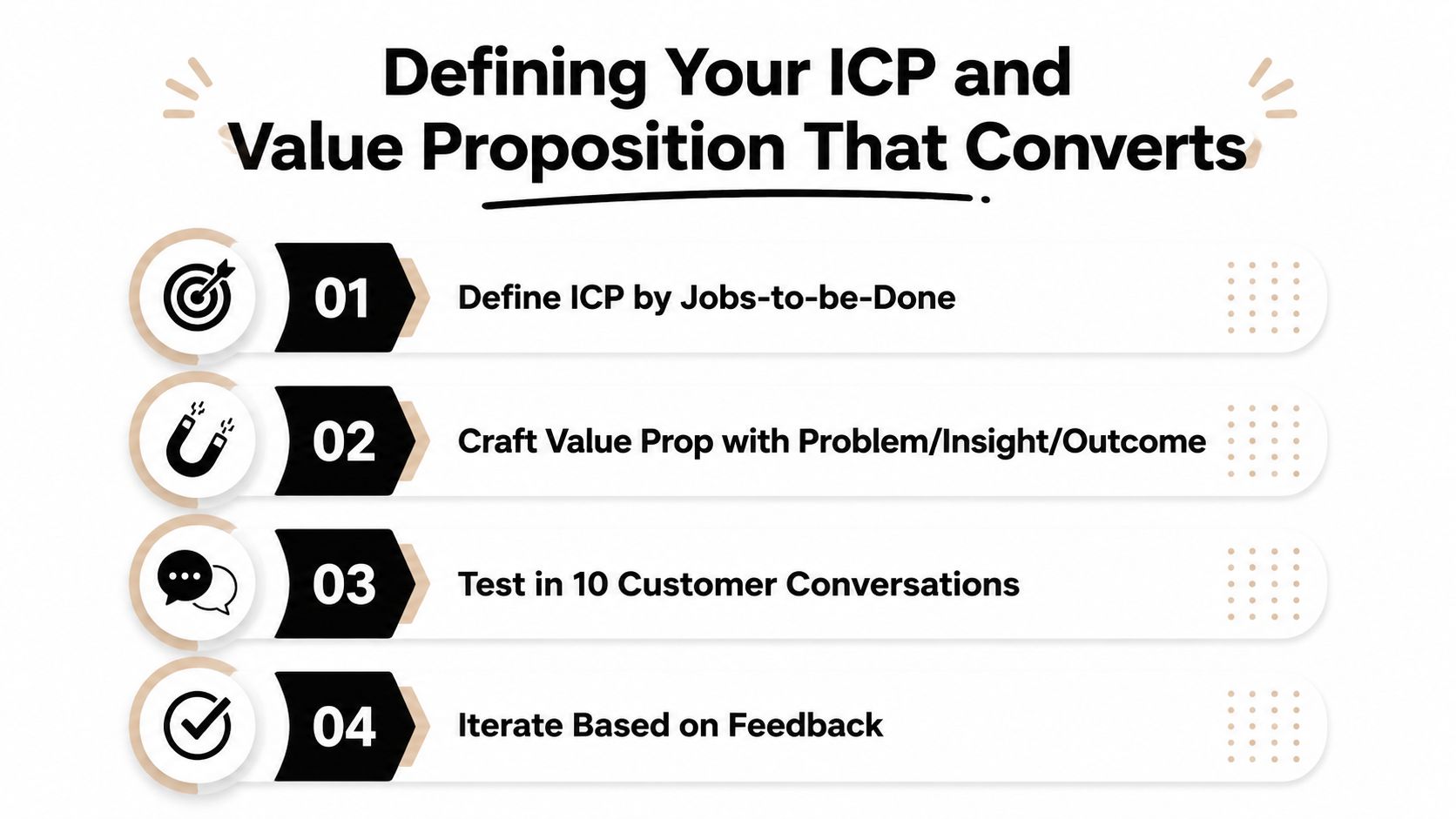
Defining Your ICP and Value Proposition That Converts
A vague persona won't save a weak offer. “Mid-market operations leaders” sounds strategic, but it doesn't help sales know who to call or marketing know what message will land. A useful Ideal Customer Profile is behavioral, not decorative. It describes the buyers who are most likely to convert, adopt, expand, and refer.
Start with the problem, not the demographic. A better ICP might be “SaaS companies with a sales-led motion, a recurring onboarding bottleneck, and a founder still approving every workflow manually.” That definition tells you who feels pain, who can buy, and where the workflow friction lives.
Write positioning that the market can repeat back
A value proposition has to name the pain, the insight, and the outcome. If the buyer can't paraphrase it after one conversation, it's not sharp enough. I prefer to write positioning in one sentence, then test whether it holds up in calls, demos, and replies.
A simple validation checklist helps keep this honest:
- Define the behavior: identify buyers who already have the problem, not just those who match a firmographic filter.
- Check the urgency: look for signals that the issue is already costing time, revenue, or team bandwidth.
- Listen for language: use the exact words customers use in interviews and sales calls.
- Inspect early pipeline: confirm that the right accounts are asking relevant questions, not just opening emails.
- Refine the promise: tighten the outcome until sales can say it verbatim without sounding scripted.
The internal anchor that fits here is this ICP guide, because a strong profile makes the rest of the growth system easier to run.
Test before you commit channel spend
Customer interviews are still the fastest truth serum. Ten conversations with real prospects will usually expose whether the messaging is fuzzy, too broad, or aimed at the wrong pain. Then early pipeline data shows whether the market is responding with intent or just polite curiosity.
If the buyer nods but doesn't move, the offer is probably too generic.
That's the main trade-off founders miss. Broader messaging can feel safer because it seems to address more people, but broad positioning usually reduces urgency. Specific positioning wins because it filters harder and attracts the buyers who already know they need help.
Selecting and Testing Traction Channels Without Burning Budget
Channel selection should follow buyer behavior, not founder preference. If your ICP lives in search, content and SEO make sense. If your ICP buys through relationships and trust, outbound or partnerships may be the better starting point. The wrong move is picking five channels because they all sound plausible.
The cost side matters too. One 2024 source says startups using content marketing see 13.5% lower customer acquisition cost than traditional advertising, and another benchmark puts average SaaS CAC at $395 proven growth strategies for startups. That doesn't mean content is always the answer. It means acquisition needs to be measured against efficiency, not ego.
Narrow the field before you spend
The best founders I've worked with don't start by asking, “What channels are available?” They ask, “Which two channels fit how our buyers already discover, compare, and buy?” That framing prevents the classic trap of spreading thin across too many experiments.
Use a short decision grid:
- If the deal is high-trust and complex: outbound, partnerships, and founder-led selling usually deserve attention first.
- If the product solves an obvious workflow pain: search-driven content, comparison pages, and lifecycle email often work better.
- If buyers need education before they buy: lead magnets, webinars, and sales-assisted nurture can create the right motion.
The point is not to be everywhere. The point is to find one repeatable path to qualified demand.
Track leading indicators, not just revenue
Revenue is lagging, and early growth teams can't afford to wait that long to learn. Track leading signals like pipeline velocity, content traffic growth, referral rate, and partner lead volume, then compare them across channel tests. That's how you know whether a channel is building momentum or just generating noise.
A useful rule is to keep tests time-boxed and hypothesis-driven. Define the audience, the message, the expected signal, and the owner before launch. If the hypothesis is unclear, the test will be hard to interpret, and you'll burn budget while collecting ambiguous results.
The best channel is the one your team can operate consistently, measure cleanly, and improve without guessing.
Building Conversion and Retention Levers That Compound
Acquisition is only one stage of the job. The companies that compound are the ones that turn first use into habit, habit into expansion, and expansion into referrals. That's why the AARRR framework matters, because it forces teams to look at Acquisition, Activation, Retention, Revenue, and Referral as connected parts of one system.
A conversion problem often looks like a marketing problem, but the leak may be inside the product or onboarding flow. If new users sign up and stall, the issue is usually time-to-value, not traffic quality. If customers buy once and leave, the issue is often retention mechanics, not campaign volume.
Retention-led growth beats top-funnel theatrics
Subscription businesses win when the product keeps creating value after first use. That's why onboarding sequences, usage nudges, milestone emails, and expansion triggers matter so much. They reduce friction early, then surface the next logical action before the customer drifts away.
An internal resource that fits naturally here is this guide to increasing customer lifetime value, because LTV improves when the post-sale journey is designed with intent.
The strongest growth loop is often invisible at the start, because it's built inside product behavior, not around a campaign launch.
Referrals also work better when they're tied to actual customer wins, not generic incentives. A buyer who has already gotten value is far more likely to introduce you to a peer if the ask is relevant and timed well. That's the difference between a real loop and a hopeful referral program.
Automation should support the human moment
Automation can accelerate activation, but it shouldn't flatten trust. In enterprise and mid-market deals, buyers still want judgment, context, and a real person when critical decisions are made. The winning pattern is usually automated follow-up for repetitive steps, then human intervention at decision points where nuance matters.
When teams get this right, growth compounds because every system does a little more of the work. The product reduces friction, the onboarding flow shortens time-to-value, and the referral path gives satisfied customers a way to amplify the result. That's not just better conversion. It's a more durable operating model.
Running a Weekly Growth Experiment Roadmap
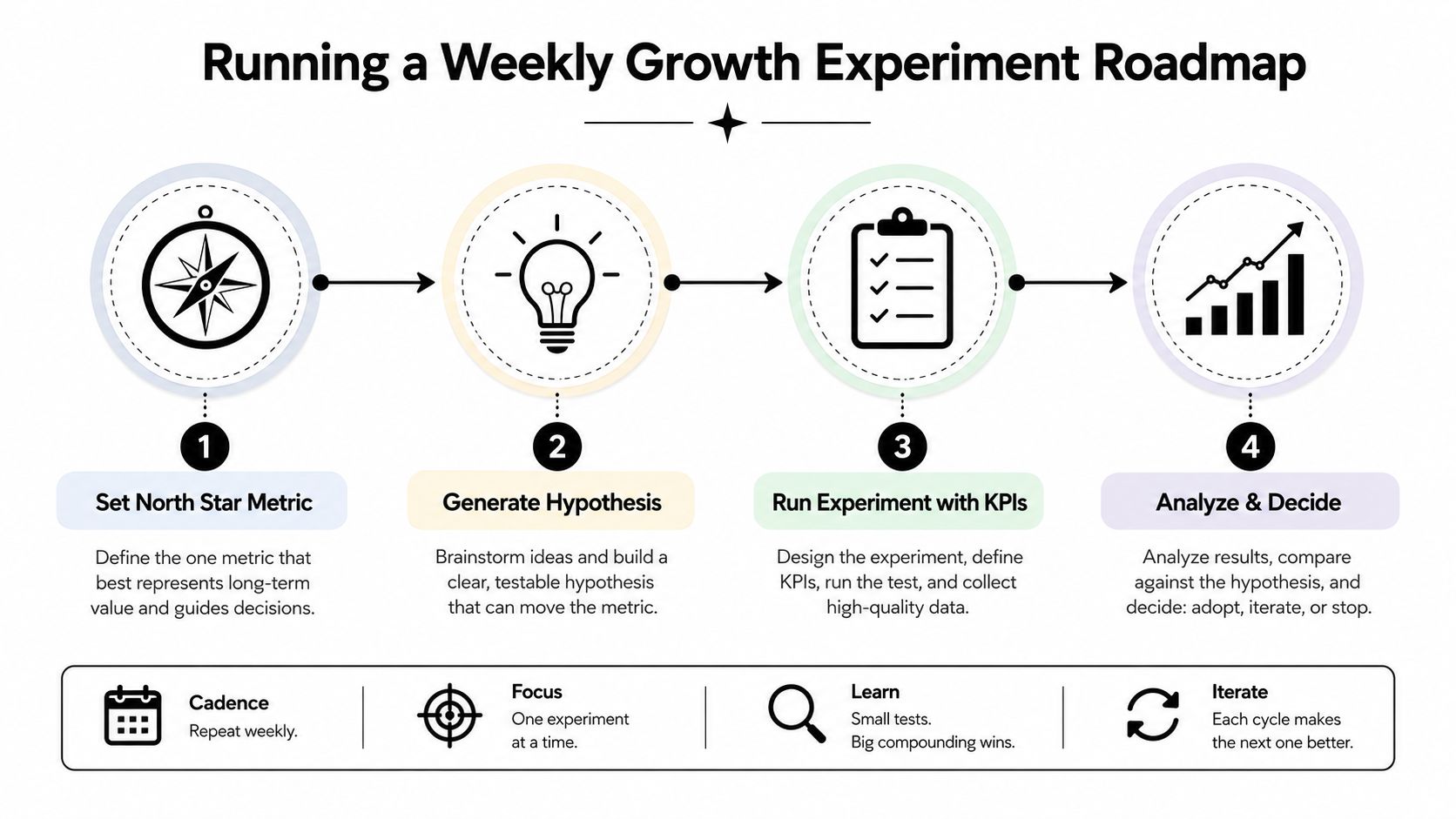
Growth works better as a weekly operating rhythm than as a quarterly brainstorm. The most disciplined teams I've seen set one North Star Metric, assign one owner per experiment, and keep the test loop short enough that learning stays fresh. That structure stops growth from becoming a pile of disconnected ideas.
A practical weekly cadence starts with a single hypothesis. For example, if trial-to-paid conversion is weak, the team might test a shorter onboarding sequence or a more explicit value email. The point is to isolate one variable so the result means something.
Use a simple prioritization standard
ICE scoring, Impact, Confidence, Ease, helps teams avoid chasing the loudest idea in the room. A high-impact but impossible test may be less useful than a modest test that can ship this week. That trade-off matters because early-stage teams don't win by doing more. They win by learning faster with cleaner data.
A simple weekly rhythm looks like this:
- Choose the metric. Pick the one number that reflects progress most accurately.
- Write the hypothesis. State what you expect to change and why.
- Assign the owner. One person owns setup, tracking, and follow-up.
- Review the result. Decide whether to double down, revise, or stop.
The reason this works is that it prevents channel sprawl before the acquisition engine is ready. It also forces clean analytics, which is where many startups get stuck. If you can't trust the measurement, you'll end up optimizing opinions instead of outcomes.
Growth meetings should end with decisions, not commentary.
The embedded video below is useful if you want a compact view of the experimentation mindset.
The hard boundary is simple. If retention isn't moving in the right direction, don't scale the experiment just because the top of funnel looks busy. Fix the leak first, then expand the motion.
Automating the Growth Engine Without Losing the Human Edge
The best automation doesn't replace judgment, it removes drag. I've seen too many startups automate broken processes and then wonder why the machine just produced broken output faster. Automation only helps once the workflow is already worth repeating.
A practical setup starts with lead capture, scoring, and routing. New leads can be enriched, tagged by ICP fit, and sent to the right owner without manual handoffs. That keeps response time tight and stops hot accounts from sitting untouched in a spreadsheet.
Where to automate and where to keep a person involved
Lead generation, CRM updates, and onboarding triggers are strong candidates for automation because they're repetitive and rule-based. Personalized outbound still needs human review, especially when the deal is strategic or the account has multiple stakeholders. The same goes for enterprise onboarding, where the first message can be automated but the first real decision conversation usually shouldn't be.
For teams that want a practical reference point, the marketing automation for SaaS guide is relevant because it ties journey mapping, lead scoring, and sales-marketing alignment into one workflow. If you need broader implementation support, the playbook for scaling with IT outsourcing from TekRecruiter is worth reviewing alongside your internal capacity plan.
Here's the pattern:
- Automate the repeatable: lead routing, follow-up reminders, onboarding nudges, and CRM hygiene.
- Keep the nuanced work human: discovery calls, pricing exceptions, contract negotiation, and high-value renewal discussions.
- Review the data weekly: automation should improve speed and consistency, not hide poor conversion.
MakeAutomation is one option in this space, since it builds AI and automation workflows for lead generation, CRM automation, recruitment, and SOP development, but the key is to fit the tooling to the process rather than the other way around.
Build infrastructure before you chase scale
A startup doesn't need perfect automation. It needs enough infrastructure that the team can repeat what works without adding headcount too early. That means clean fields in the CRM, well-defined triggers, and a handoff process sales can trust.
The founders who scale cleanly don't ask automation to create growth from nothing. They use it to protect time-to-value, improve follow-up consistency, and remove manual work from the path that already converts.
Your First 30 Days of Disciplined Growth Execution
The first month should prove sequence, not novelty. Start by tightening the ICP, sharpening the value proposition, and choosing the one retention signal that matters most for your model. That gives you a base that can support acquisition without pretending growth comes from the top of the funnel alone.
Week one should be customer reality work. Talk to prospects, review recent wins and losses, and write a positioning statement sales can use without translating it on the fly. If the message is vague, fix that before you spend on channels or tooling.
Week two should narrow the channel plan. Choose one or two traction channels that fit your buyers' behavior and your team's strengths, then define the leading indicators you will watch before revenue shows up. That keeps the team from mistaking busy work for traction.
Week three should build the retention and automation layer. Tighten onboarding, set the first lifecycle automations, and make sure CRM routing, follow-up, and handoffs are clean. If the customer path is messy, more traffic will just make the mess bigger, and support will feel the breakage before revenue does.
Week four should run the first experiment review. Decide what to commit more to, what to cut, and what needs a second test before you call it real. That cadence is how a growth strategy for startups turns from theory into an operating habit.
The growth benchmark numbers are useful here as a reality check. The bigger lesson is the slowdown itself. Early growth can look explosive, then it usually settles into a much lower range once the easy wins are gone, which is why the first 30 days should build repeatable systems instead of relying on short-lived spikes. The founder who executes a few levers well usually outperforms the founder who keeps chasing the next tactic.
If you want a practical operating rule, use this one. Make the customer journey easier to enter, easier to adopt, and easier to renew before you add more acquisition pressure. That is the part many teams skip, and it is usually the part that decides whether early growth holds up.
If you want to turn this into a working system, MakeAutomation helps B2B and SaaS teams map the workflows that create growth, then automate the repetitive parts without breaking the customer experience. Visit MakeAutomation if you want help building lead generation, CRM, onboarding, and AI automation that support retention-led growth instead of just adding more moving parts.