

Robotic Process Automation Benefits That Drive Real ROI
You're probably staring at the same ugly pattern right now. A sales ops lead is copying lead data into the CRM, finance is chasing invoice mismatches, support is rekeying the same customer details, and onboarding sits half-finished because three teams are waiting on one manual handoff. That's not a people problem, it's a process tax, and robotic process automation benefits show up fastest when you stop treating that tax like overhead you just have to live with.
RPA is worth serious attention because it changes the economics of repetitive work. Deloitte has reported an average payback period of 9 to 12 months for most RPA implementations, Gartner estimates an RPA bot costs about one-third of an offshore FTE and one-fifth of an onshore FTE, and market summaries show the RPA software market moved from $250 million in 2016 to $2.4 billion in 2021, a 57% CAGR expertbeacon.com/rpa-stats. Those numbers matter because they frame automation as a capital decision, not a software experiment.
Why RPA Is Suddenly a Growth Lever for B2B and SaaS
A SaaS founder usually does not feel automation pain in one dramatic moment. It shows up as a steady drip of interruptions, the invoice that needs manual matching, the churn-save list that gets exported, cleaned, and reimported, the onboarding packet that stalls because someone forgot to update a field. By Friday, the team has not just lost time, it has normalized friction.
That is why RPA has moved from back-office convenience to a growth lever. It lets operators treat repetitive execution as capacity that can be bought, configured, and scaled, instead of added one person at a time. The companies that get the most out of it also connect it to broader operating discipline, including AI for business efficiency, because automation only pays back when it is tied to real throughput, not vanity projects.
The real shift is how leaders budget for work
The smartest operators I have seen stop asking whether a task is tedious. They ask whether the task is repeatable, rules-based, and expensive to keep doing manually. Once that question gets asked directly, RPA stops looking like a productivity add-on and starts looking like a margin tool.
That mindset matters in growth-stage B2B and SaaS because manual work scales badly. Every new customer, every new invoice, every new applicant, every new support ticket adds more clicks, more checks, and more chances for rework. RPA does not remove the need for people. It removes the need for people to act like human middleware.
Practical rule: if a workflow lives in spreadsheets, inboxes, and repetitive portal logins, it is probably already costing more than the team admits.
The shift is also cultural. Founders and ops leaders are starting to judge automation the way they judge sales hires, as a tool that should be justified by output, not novelty. That is the right lens, because it forces every automation conversation back to business outcomes.
The point is not to automate everything. It is to stop paying skilled people to do work that software can repeat without getting bored, distracted, or inconsistent. That is where the economics start to change, and where RPA stops sounding like a pitch deck term and starts acting like an operational advantage.
What RPA Actually Does in Plain Language
RPA runs software the way an operations associate does. It opens applications, reads screen fields, copies data, validates entries, clicks buttons, and moves the work to the next step without requiring a custom API or a systems rebuild. That is why teams adopt it quickly in messy environments, it sits on top of the applications they already use IBM's RPA overview.
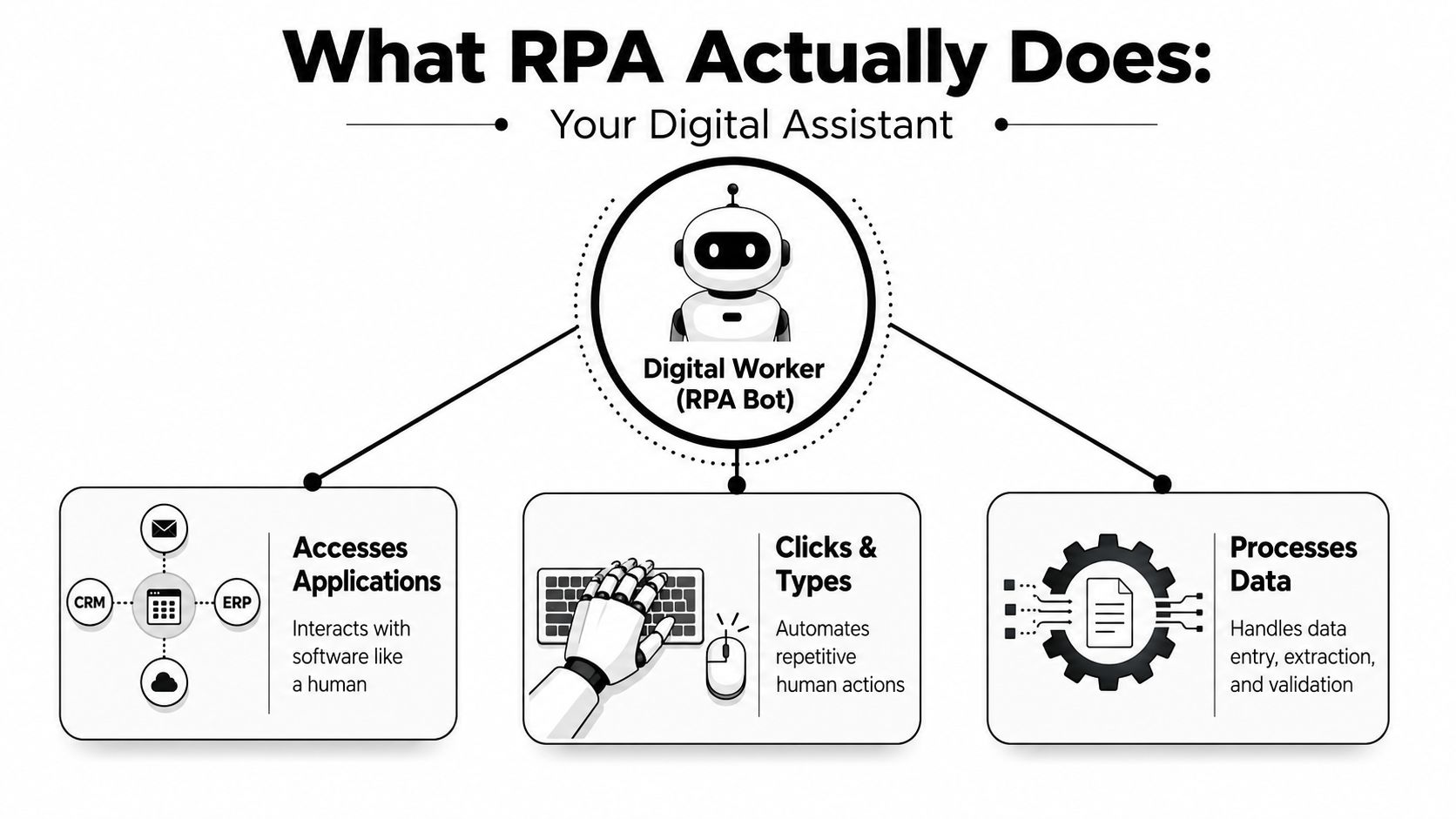
Where RPA fits and where it doesn't
RPA works best in workflows that are rule-based, repetitive, and already running across existing systems. Invoice matching, CRM updates, status checks, ticket routing, and data validation are the kinds of tasks that fit cleanly.
It also sits in a very specific place in the automation stack. Macros automate a narrow sequence inside one application. Custom scripts can be powerful, but they usually need engineering support and break when the interface changes. Full API integrations are cleaner when both systems support them, but many B2B and SaaS teams still operate with a patchwork of legacy tools, vendor portals, and manual steps. RPA bridges those gaps without forcing a rebuild.
That boundary matters. If a process changes every week, has endless edge cases, or depends on judgment at every step, RPA will not carry it. It only automates the stable parts.
IBM notes that RPA improves auditability, standardization, and compliance because the same steps are executed the same way every time, with an audit trail for exception handling IBM's RPA guidance. That matters because repeatable work is easier to inspect, easier to control, and easier to defend during review.
For a practical example of adjacent workflow automation, see how to automate screening.
The Core Benefits That Justify the Investment
RPA earns budget approval when it improves margin, reduces error, and gives teams room to absorb more volume without hiring in lockstep. Strong programs do not chase a single benefit. They stack efficiency, control, and resilience, then protect those gains with governance so the savings do not fade as exception rates rise.
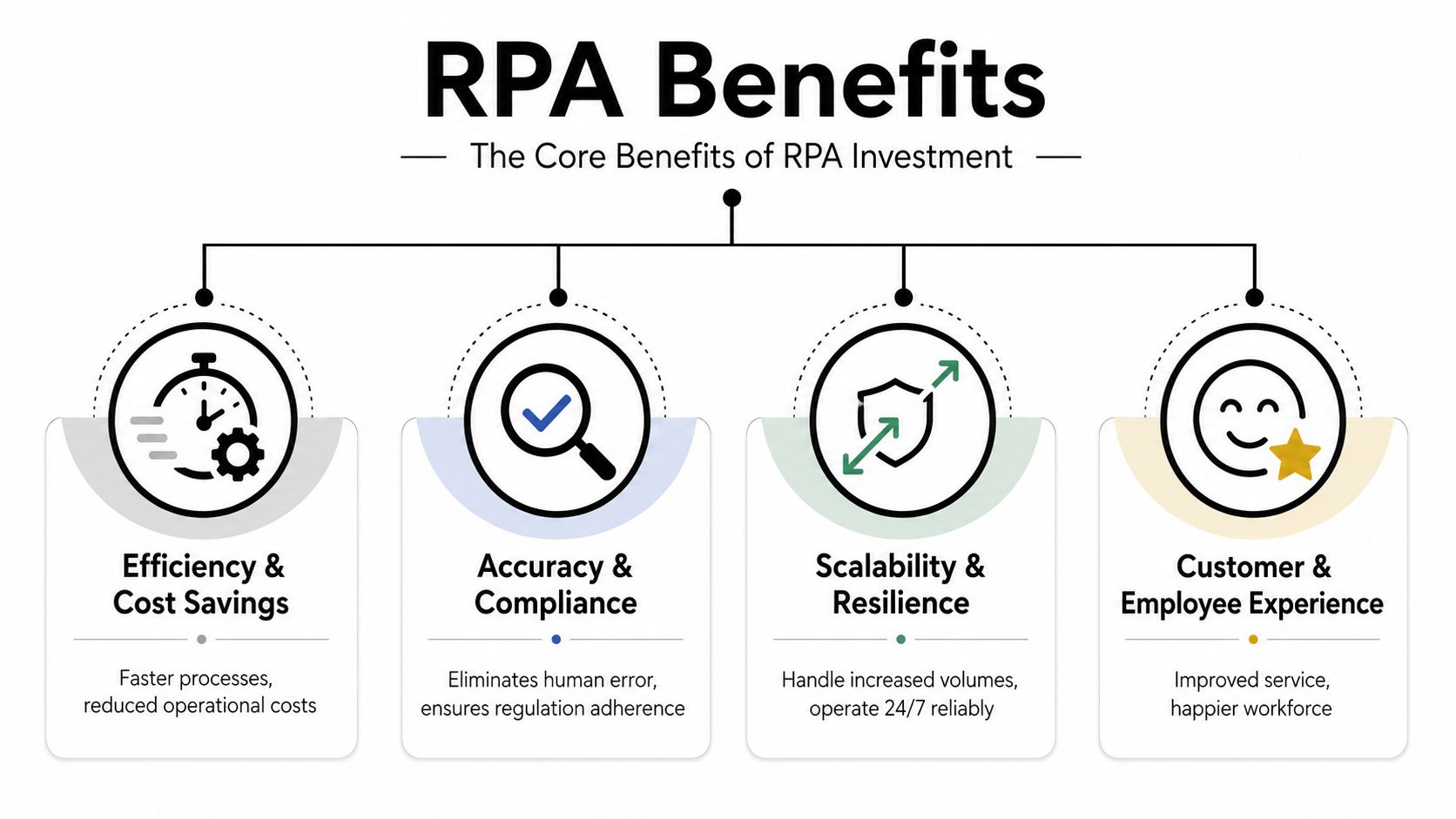
Efficiency and cost savings
This is usually the first win teams notice, and for good reason. It shows up in less time spent on rote execution and fewer hours lost to manual rework. In practice, that means one process can stop consuming a senior analyst's afternoon and routine ticket triage can stop blocking higher-value work.
That first wave of savings is real, but only if the workflow stays stable. If teams keep changing the process without updating the bot, the cost advantage starts to slip into exception handling and bot babysitting. Good governance keeps the savings intact by making ownership, change control, and exception review part of the operating model.
The mechanism is straightforward. Bots can run constantly and absorb repetitive work without proportional headcount growth, which lowers cost per transaction. That is the kind of savings operations leaders can defend, because it comes from removing manual touches, not from asking people to work faster.
Accuracy and compliance
Manual work introduces variation. People skip fields, misread values, or take slightly different steps depending on workload. RPA reduces that drift because the bot follows the same sequence every time, which is why compliance-heavy teams use it early.
That consistency matters when audit trails and standardized handling are part of the job. It also matters after launch, because a bot that is not monitored will repeat the same mistake at speed. Strong review routines, clear exception rules, and change logs keep the accuracy benefit from turning into a maintenance problem.
It is one reason RPA often lands in finance and administration before more ambitious AI projects. You are not trying to guess. You are trying to execute the same approved steps every time.
Scalability and resilience
RPA helps teams handle volume spikes without rebuilding the whole operating model. That matters in growth-stage companies where customer count, ticket load, and administrative work do not rise evenly. A bot can work through a backlog while people are offline, which gives the business more breathing room when demand shifts.
The downside is easy to miss. Scaling without governance multiplies bad rules just as fast as it multiplies good output. Capacity only turns into real resilience when the team actively manages bot performance, re-tests processes after change, and keeps exception rates from eating the gain.
Customer and employee experience
This benefit gets buried too often, yet it is one of the clearest signs the automation is working. Customers feel faster responses and fewer handoff mistakes. Employees get out of low-value busywork, which improves morale because they stop spending their day on copy-paste tasks that should never have been a career requirement.
That experience gain only holds if the bot keeps handing off exceptions cleanly. When the process is well governed, people spend their time on judgment calls instead of the same keystrokes over and over. That is where the long-term value compounds, because the team gets both better service and a cleaner operating cadence.
The Financial Case Payback Cost and Market Momentum
CFOs do not fund automation because it sounds modern. They fund it when the payback is clear and the operational gain is easy to defend. RPA sits in a narrow group of automation tools where the economics can be explained in a boardroom without building a fragile model full of assumptions.
The number that matters first is payback. Analysts at Expert Beacon summarize a 9 to 12 month average payback window, and Gartner's cost comparison, about one-third of an offshore FTE and one-fifth of an onshore FTE, shows why the software often makes sense fast expertbeacon.com/rpa-stats. That is the right way to frame the case, cost to automate versus cost to keep adding people for repetitive work. If you need a cleaner way to structure the math, how to calculate return on investment gives you the basic approach.
Use this table as a board-level reference, but treat it as a starting point, not a promise. Bot economics still depend on how stable the process is, how often exceptions appear, and how much governance the team is willing to maintain after launch.
| Metric | Reported Range | Source |
|---|---|---|
| Payback period | 9 to 12 months | expertbeacon.com/rpa-stats |
| Bot cost versus offshore FTE | About one-third | expertbeacon.com/rpa-stats |
| Bot cost versus onshore FTE | About one-fifth | expertbeacon.com/rpa-stats |
| Annual savings on process costs | Up to 40% | Roland Berger RPA report |
| Process-time reduction | 40 to 70% | Roland Berger RPA report |
| Processing speed | Up to 15x | Roland Berger RPA report |
Market momentum matters too, but only as a sign that the category has matured. A software market that expanded from $250 million in 2016 to $2.4 billion in 2021 with a 57% CAGR shows RPA moved well beyond the early-adopter phase expertbeacon.com/rpa-stats. That does not mean every rollout works. It does mean the tooling, buyer familiarity, and implementation playbooks are far stronger than they were a few years ago.
The mistake is to treat market growth as proof of value. Real payback comes from stable processes, disciplined exception handling, and a team that keeps reviewing bot performance after the launch glow fades. That is where the economics hold up in months 6 through 24, when weak governance starts to erase the benefit.
High-ROI Use Cases for B2B and SaaS Teams
The fastest wins usually sit in the handoffs. That's where data changes hands, systems don't talk cleanly, and people become the integration layer. If you want robotic process automation benefits that show up quickly, start there.
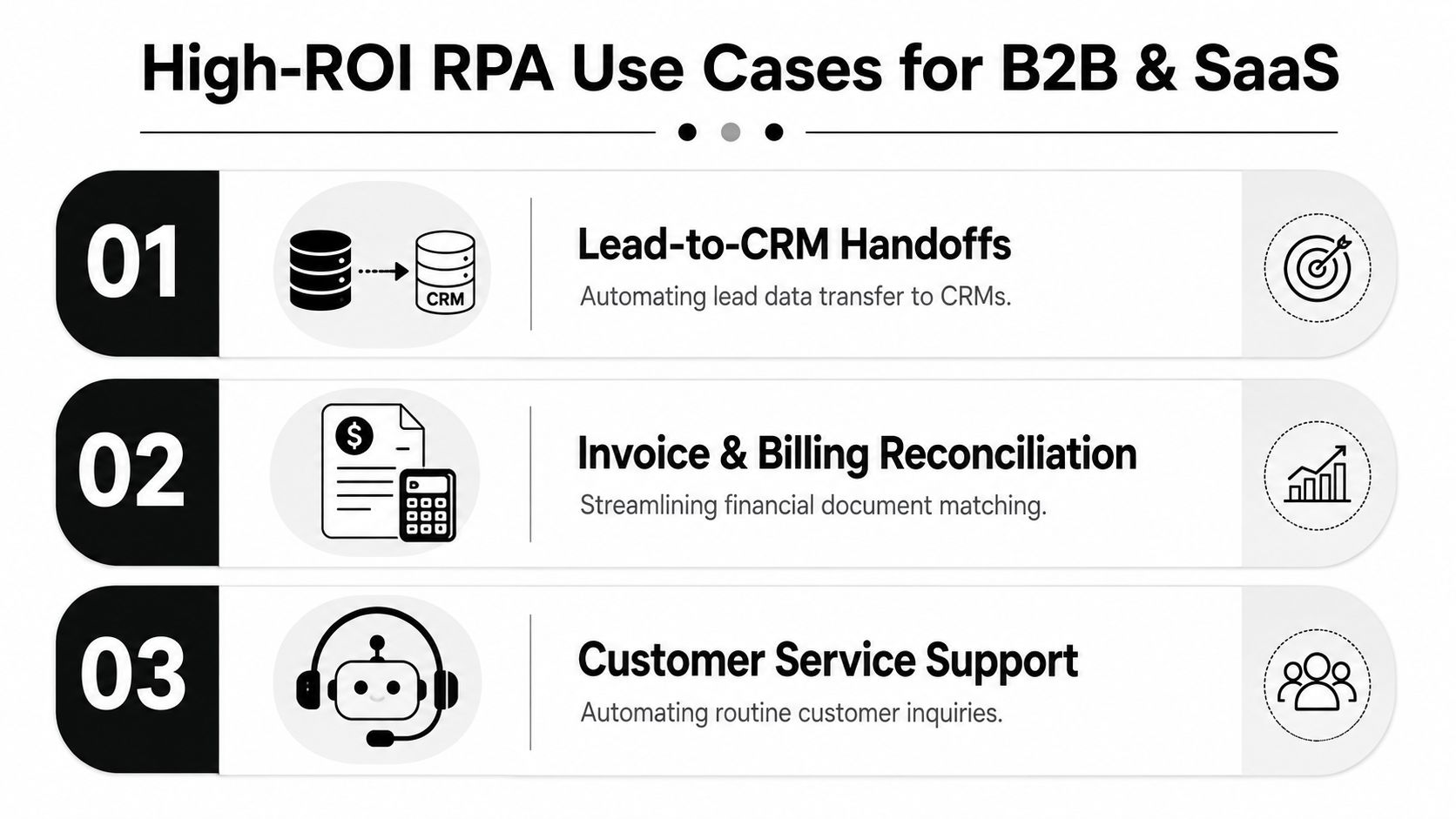
The best starting points
Lead-to-CRM handoffs. When marketing or outbound tools create leads in one place and sales works them in another, RPA can move the data cleanly and consistently. That reduces lag, avoids duplicate entry, and keeps pipeline hygiene from depending on someone's memory.
Invoice and billing reconciliation. This is one of the clearest back-office wins. Bots can match documents, flag mismatches, and route exceptions, which is especially valuable when finance teams are stuck validating routine transactions by hand.
Customer service support. Support queues fill with repetitive questions and status checks. RPA can route, classify, and prep cases so agents spend more time on real problems and less time on administrative triage.
The point isn't to automate everything. It's to remove the work that blocks throughput. I've seen teams get seduced by shiny workflows like change management approvals or cross-department scorecards, then ignore the simple fixes that save the most time.
Use case rule: if a process repeats daily, touches multiple systems, and creates recurring cleanup work, it belongs on the shortlist.
For B2B teams that manage procurement or vendor response workflows, the logic is similar. A platform such as real-world tender platform uses is relevant because tender and bid workflows often involve the same document movement, status tracking, and exception handling that RPA handles well. The best pilot is usually the one that cuts manual handoffs before it tries to “transform” the whole function.
The Hidden Costs Most Benefit Articles Skip
Most RPA pitches stop at launch. That's a mistake. The hard part starts when the process changes, the interface shifts, or the exception rate climbs and the bot starts needing more care than the workflow used to need from a person.
Maintenance and governance are real line items
A 2023 review found that RPA can offer competitive adoption costs and shorter implementation time, but maintenance still matters, and bots work best on rule-based tasks with existing systems rather than as a substitute for deeper integration scitepress.org review. That's the part most benefit articles skip because it's less exciting than launch day. It's also the part that determines whether value compounds or leaks away.
The maintenance problem usually starts with UI changes. Someone renames a field, moves a button, or changes a validation rule, and a bot that used to be stable suddenly needs attention. As the automation estate grows, governance overhead follows, because you need ownership, access controls, monitoring, and an escalation path for exceptions.
What makes programs drift
The biggest hidden cost isn't the bot itself, it's process ambiguity. If your team automates a broken workflow, the bot just executes the same mess faster. If the process keeps changing, the bot turns into a maintenance habit instead of a productivity asset.
That's why the strongest programs treat governance as part of the design, not an afterthought. They standardize the workflow first, assign ownership, and define what happens when exceptions appear. Without that discipline, the savings you expected in month one can get diluted by support time in month nine.
Hard truth: a bot that needs constant babysitting is just a more expensive version of the manual process you already had.
How to Decide If RPA Is Right for Your Business
Use a narrow test. If the process is high-volume, rule-based, and costly when errors happen, it's a candidate. If it depends on judgment, changes weekly, or sits on top of a broken workflow, leave it alone.
The five checks I'd use are simple. First, look at volume. Second, ask whether the rules are stable enough to encode. Third, measure the cost of mistakes. Fourth, map how many systems the team touches. Fifth, confirm that someone owns exceptions when the bot gets stuck.
A few launch mistakes kill programs early:
- Automating a broken process: fix the workflow before you script it.
- Skipping exception design: decide what the bot does when data is missing or invalid.
- Underinvesting in change management: users need to know how the bot changes their work.
- Choosing the wrong first use case: don't start with something politically messy or highly variable.
- Ignoring monitoring: if no one watches success and failure patterns, drift will surprise you.
If you're comparing automation approaches, what is intelligent process automation helps frame where RPA ends and broader automation begins. In practice, I'd rather see a team start with one clean RPA pilot, prove control, then expand, than buy a sprawling platform before the operating model is ready.
Your Next Step and How MakeAutomation Can Help
Start with one process and one owner. Document the workflow, remove obvious waste, define the exception paths, and pilot the bot where the handoffs are repetitive and the failure cost is visible. In the next 30 days, you should know whether automation is relieving real operational pressure or just adding another layer of tools.
MakeAutomation supports that kind of rollout with SOP development, CRM automation, AI-enhanced operations, and Voice AI agents for inbound and outbound calls. That combination matters because RPA works best when the process is documented, the systems are mapped, and the team has a clear handoff model for what stays human and what gets automated.
If you want help turning repetitive work into a real operating advantage, talk to MakeAutomation. They work with B2B and SaaS teams on SOPs, CRM automation, AI-enhanced operations, and voice workflows that reduce manual load without forcing a system rebuild.