AI Orchestration Platforms: The B2B Buyer’s Evaluation Guide
Most buying guides for AI orchestration platforms start with a feature matrix. That's the wrong starting point. A platform can offer impressive agent routing, connectors, and model support, yet still fail when a workflow pauses for approval, loses state between systems, produces an untraceable decision, or hands a task from one agent to another with no reliable audit trail.
The central buying question is simpler and harder: can your organization operate AI workflows safely after the pilot ends? Market estimates place the AI orchestration category at USD 11.65 billion in 2025, rising to USD 13.99 billion in 2026 and potentially USD 60.34 billion by 2034, while another forecast projects growth from USD 11.1 billion in 2025 to about USD 82.15 billion by 2035. The forecasts differ, but both point to the same conclusion: orchestration is becoming infrastructure between models, applications, and business operations. (Fortune Business Insights market analysis)
| Platform approach | Primary strength | Main operational risk | Best fit |
|---|---|---|---|
| Vendor ecosystem | Fast deployment and native services | Lock-in and limited architectural control | Teams standardized on one cloud |
| Model API layer | Model flexibility and direct control | More engineering responsibility | Technical teams building custom workflows |
| Open orchestration framework | Deep state and workflow customization | Higher implementation burden | Teams with strong engineering capability |
| Visual automation platform | Rapid cross-system integration | Complex workflows may require careful governance | B2B teams connecting business applications |
Why Platform Selection Is Not Your Real Problem
The popular advice says to compare platforms until you find the one with the best agent builder, model catalog, or integration library. That advice sends teams in the wrong direction. A platform doesn't turn an unreliable process into a production system. It only gives your team a place to encode that process.
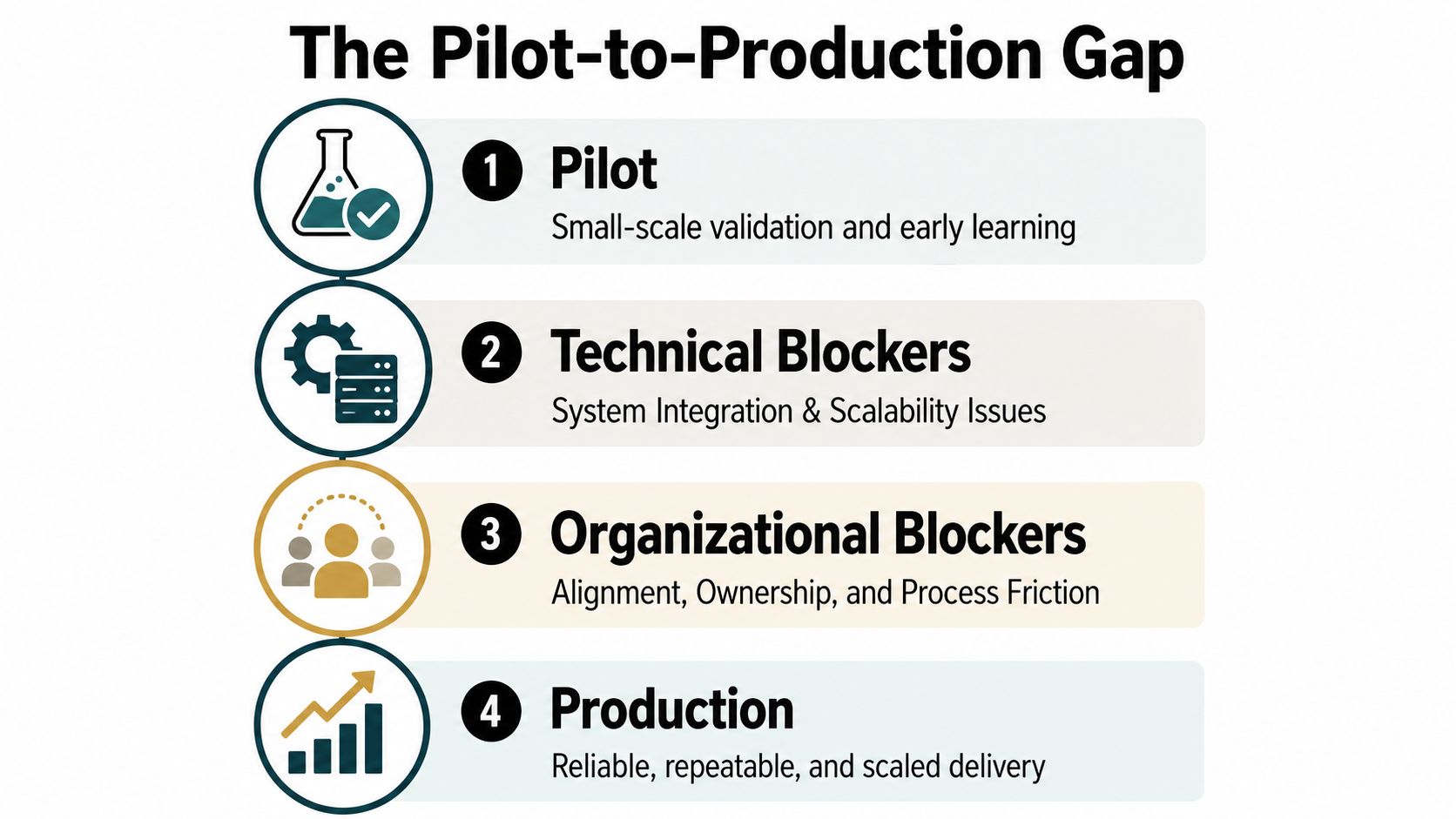
The pilot-to-production data makes the problem visible. 78% of enterprise technology leaders have at least one AI agent pilot running, but only 11% to 14% have scaled an agent to organization-wide production use, according to reporting on the adoption gap. (Analysis of the multi-agent orchestration adoption wall) Most organizations aren't blocked by a missing feature. They're blocked by the work that vendors tend to understate: persistent state, operational ownership, observability, exception handling, and governance.
A prototype usually follows the happy path. It receives clean input, calls the expected tools, gets a usable model response, and completes quickly. Production workflows don't behave that way. CRM records are incomplete, APIs time out, permissions change, users reject recommendations, and a workflow may need to wait for an approval before resuming.
Practical rule: Don't evaluate a platform with a feature checklist until you've documented how the workflow behaves when every major dependency fails.
Operational readiness comes before vendor choice
Start by mapping the workflow as an operating process, not as an automation diagram. Identify who owns each decision, what data the system may access, which actions require approval, and what happens when the process stops halfway through.
The core questions are concrete:
- State management: Where does the workflow store context, decisions, approvals, and pending actions?
- Observability: Can an operator reconstruct what happened, which agent acted, what data it used, and why the workflow stopped?
- Handoff control: What happens when one agent passes an incomplete or contradictory result to another?
- Governance: Can administrators restrict tools, data, prompts, model access, and action permissions by role?
- Recovery: Can the system retry safely without duplicating an email, CRM update, or financial action?
Teams often spend months choosing between platforms, then discover that none of them has solved their internal ownership model. A useful AI operational efficiency framework helps expose those process gaps before procurement turns them into software requirements.
Your platform should support the operating model you can maintain. If nobody owns failed runs, approval queues, prompt changes, and integration health, the project isn't ready for production, regardless of which vendor you select.
What AI Orchestration Does for B2B Workflows
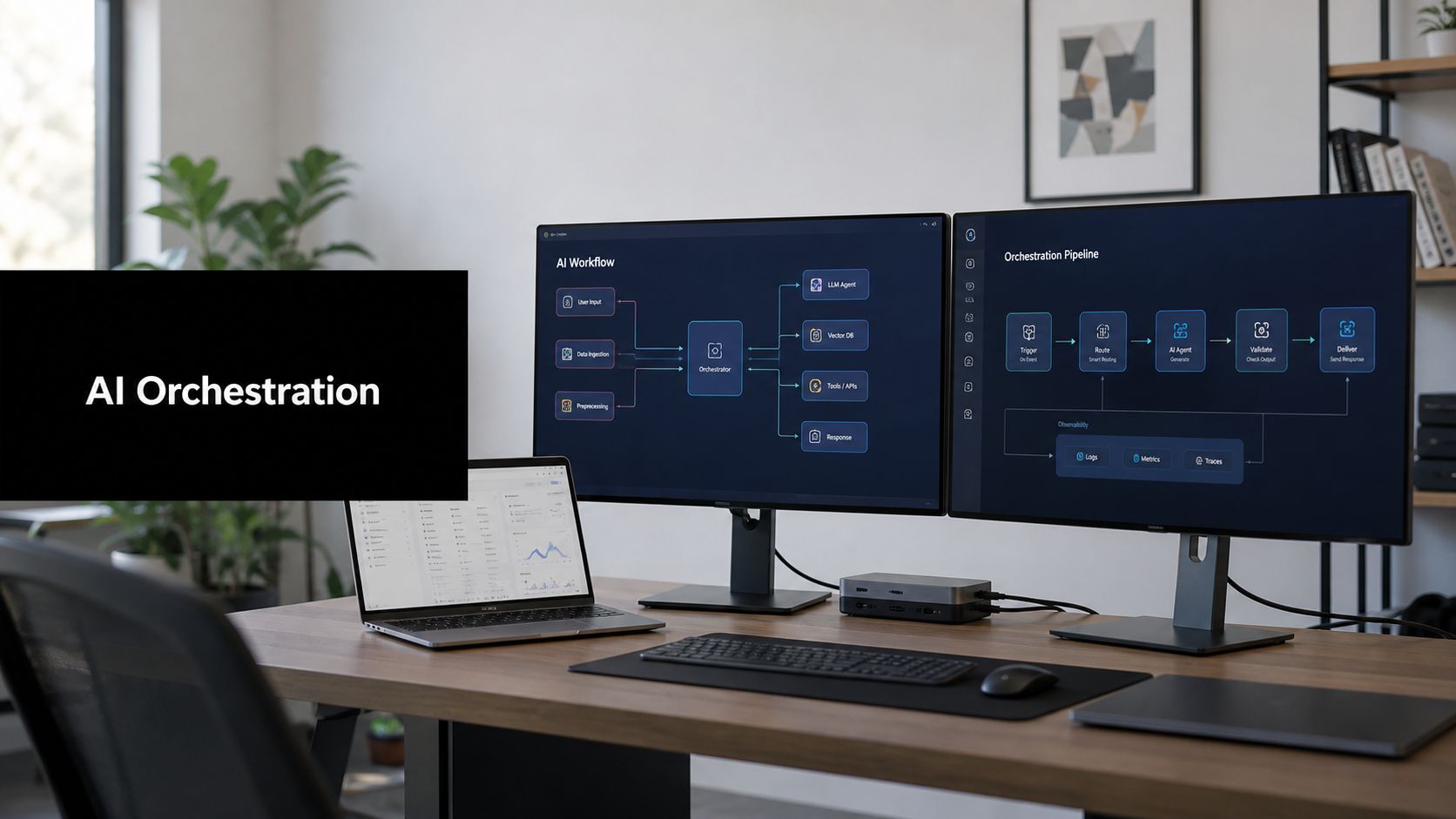
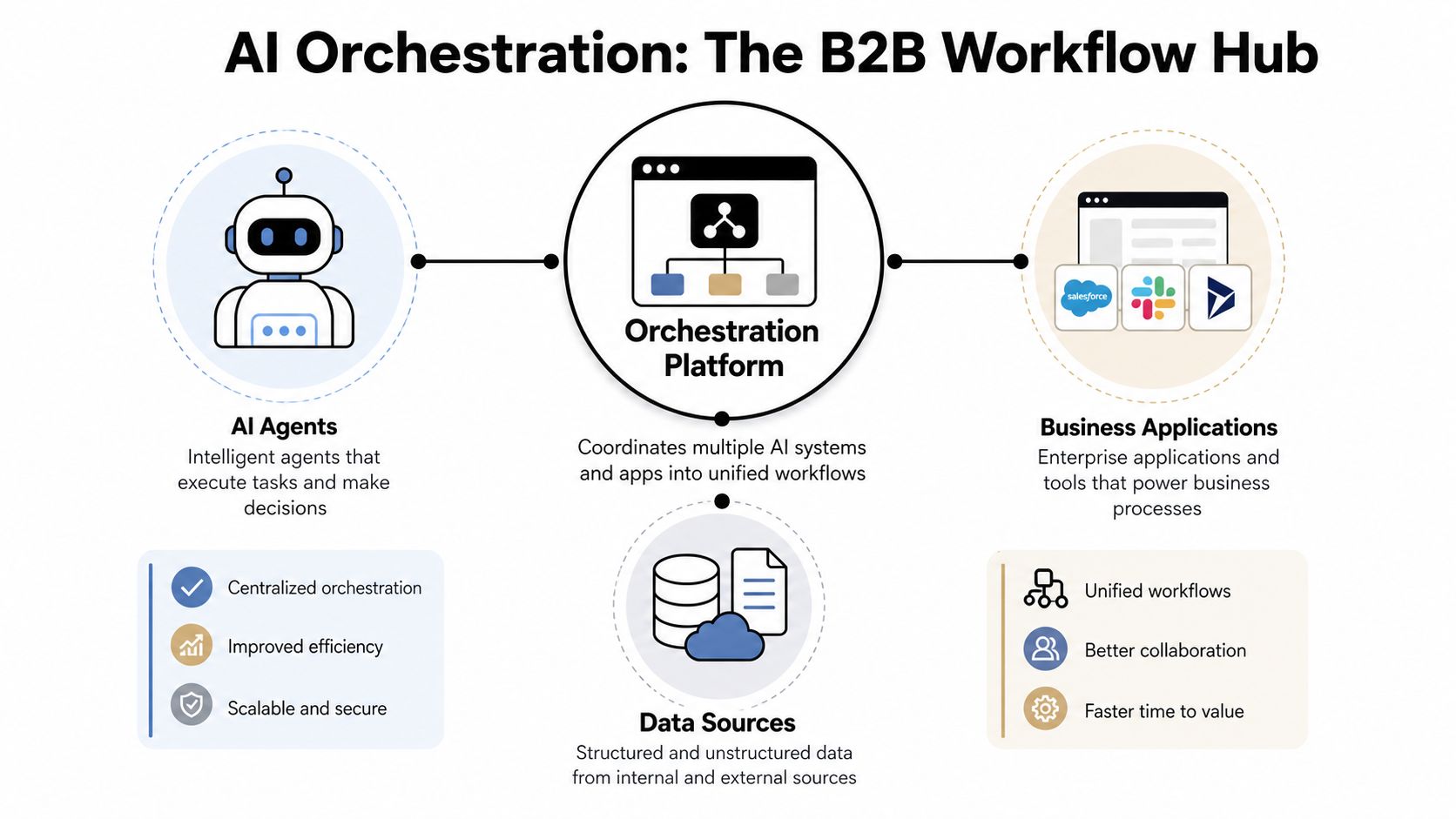
A basic automation triggers one action after another. AI orchestration coordinates models, agents, data, tools, and business applications as one controlled workflow. The platform assigns work to the right agent, supplies approved context, limits tool access, routes results for review, and pauses for human approval when the next action carries risk.
That coordination matters because B2B work crosses applications and ownership boundaries. A lead workflow may retrieve a company record from a CRM, enrich it with external data, classify fit, draft outreach, check contact rules, send the draft for approval, and record the final activity in the CRM. A single model can generate text, but it should not control every decision and transaction in that chain.
The practical value is control over dependencies. Each step needs a defined input, permitted action, output, and failure path. Without those boundaries, a workflow can produce a plausible answer while writing bad data, breaching a contact rule, or triggering an action nobody intended.
The category's growth reflects this shift toward specialized agents coordinating across systems during 2025 and 2026. Deloitte projected that the autonomous AI agent market could reach US$8.5 billion by 2026 and US$35 billion by 2030, with stronger orchestration potentially increasing the 2030 value by 15% to 30%, to as much as US$45 billion. (G2's 2025 AI agent research report)
The control layer between intelligence and execution
An AI orchestration platform sits between foundation models and operational systems, managing the flow between them. Models provide reasoning or generation, agents handle specialized tasks, and business applications store records or execute transactions. The platform coordinates those responsibilities and records how work moves from one step to the next.
A reliable design separates responsibilities:
- Planning agents break a business objective into bounded tasks.
- Research or retrieval agents collect approved information from defined sources.
- Decision agents apply policies, classifications, or business rules.
- Action agents update systems or communicate externally.
- Review gates give people authority over sensitive or ambiguous outcomes.
This structure limits the access granted to any one agent and makes failures easier to isolate. If enrichment returns poor data, the team can inspect that step without treating the entire workflow as a black box. Production readiness depends on whether operators can reconstruct the run, restore state, and identify the owner of the failed handoff.
AI orchestration platforms are infrastructure, not another productivity app. Their design affects access control, reliability, cost allocation, and employee trust in automated decisions. Choose based on how well the platform governs execution across your stack, not on how impressive its demo looks.
Comparing Leading Platforms on What Matters for B2B
The right comparison isn't “which platform has the most features?” It's “which platform gives this business the right balance of control, integration, and operating simplicity?” A regulated company may value data boundaries and approval controls more than rapid deployment. A SaaS company with a Microsoft-heavy stack may accept ecosystem dependence to reduce integration work.
Adoption momentum provides useful context, but it shouldn't decide architecture by itself. A 2026 tracker reported Microsoft Copilot Studio and Azure AI Studio at 38.6% primary-platform adoption, OpenAI's APIs at 25.7%, and Anthropic at 5.7%. (Multi-agent orchestration platform market coverage) Those figures show where buyers are concentrating, not which option is safest for your workflow.
| Platform | Data sovereignty | Human-in-loop | CRM integration | Best for |
|---|---|---|---|---|
| Microsoft Copilot Studio and Azure AI Studio | Strong fit for organizations already governed through Microsoft cloud controls | Suitable for approval-based enterprise workflows | Strongest where Dynamics and Microsoft services are already central | Microsoft-centered enterprises prioritizing deployment speed |
| OpenAI APIs | Flexible model access, with architecture and data controls largely determined by the implementation | Requires application-level workflow and approval design | Broad integration potential through custom development | Product and engineering teams building custom agent experiences |
| Anthropic APIs | Useful for teams seeking model-provider choice and a multi-model architecture | Requires orchestration logic outside the model layer | Depends on connectors, middleware, and custom integration | Teams avoiding dependence on one model ecosystem |
| LangGraph | High control over stateful, graph-based execution and custom deployment | Strong support for explicit checkpoints and intervention logic | Requires engineering or integration middleware | Technical teams with complex branching and reliability requirements |
| AutoGen | Strong fit for agent-to-agent experimentation and Microsoft-oriented development | Depends on the surrounding application architecture | Depends on implementation and connected services | Teams exploring collaborative agent patterns |
Match architecture to risk
Choose a vendor ecosystem when the main constraint is deployment speed, your existing identity and data controls already fit that ecosystem, and the workflow has bounded risk. Choose an independent framework when you need deterministic routing, model portability, custom state handling, or deeper control over where data and execution live.
Don't confuse native integration with operational suitability. A connector may read a CRM record successfully but still lack the permissions model, retry behavior, audit detail, or field-level safeguards your process requires. Test the complete action path, including failed calls and human rejection, before treating an integration as production-ready.
The Pilot-to-Production Gap and How to Close It
A successful pilot proves that an agent can complete a task once. Production requires the organization to supervise, recover, and improve that task repeatedly. Platform selection rarely blocks that transition. Governance, state management, and observability do. That is why promising demonstrations often stall after stakeholders approve the concept.
The orchestration layer coordinates agents, data, tools, and business applications into a controlled workflow. Production failures usually come from predictable gaps: no persistent state after a pause, no trace-level observability to identify the responsible agent or tool response, excessive handoff latency across agent chains, and permissions broader than the process requires. A pilot can hide each problem because its scope is small and consequences are limited.
Diagnose the actual failure point
Answer these questions before expanding scope:
- Can the workflow resume? If a customer approval arrives later, does the system recover the original context and continue from the correct step?
- Can an operator investigate? Is there a complete record of prompts, tool calls, outputs, policy checks, and human interventions?
- Can the business contain risk? Can administrators stop a workflow, revoke a tool, restrict an action, or require approval without rebuilding the system?
- Can the process tolerate delay? What happens when a model or external API responds slowly, returns malformed data, or becomes unavailable?
- Can ownership be assigned? Who receives the failure, decides what to do, and updates the workflow afterward?
Coordination overhead must be measured in the workflow you intend to run. In Tacavar's 2026 benchmark using a standardized three-agent research workflow with five tool calls and two revision loops, LangGraph recorded the lowest average latency at 2,340 ms, the lowest P95 latency at 4,200 ms, and token overhead of about 8%, while AutoGen recorded 3,120 ms average latency and about 15% token overhead. (Tacavar's AI agent orchestration framework benchmark) These results do not make LangGraph universally superior. They show why teams should test their own workflow shape instead of assuming agent coordination is free.
State management deserves early design attention. Workflows that cross legacy applications, approval queues, or long-running client processes need durable checkpoints and explicit recovery rules. Teams connecting older applications should treat legacy system integration as part of the orchestration design, not cleanup after launch. Governance must define permissions, intervention points, and ownership before scale exposes the gaps.
Your Evaluation Framework for Choosing a Platform
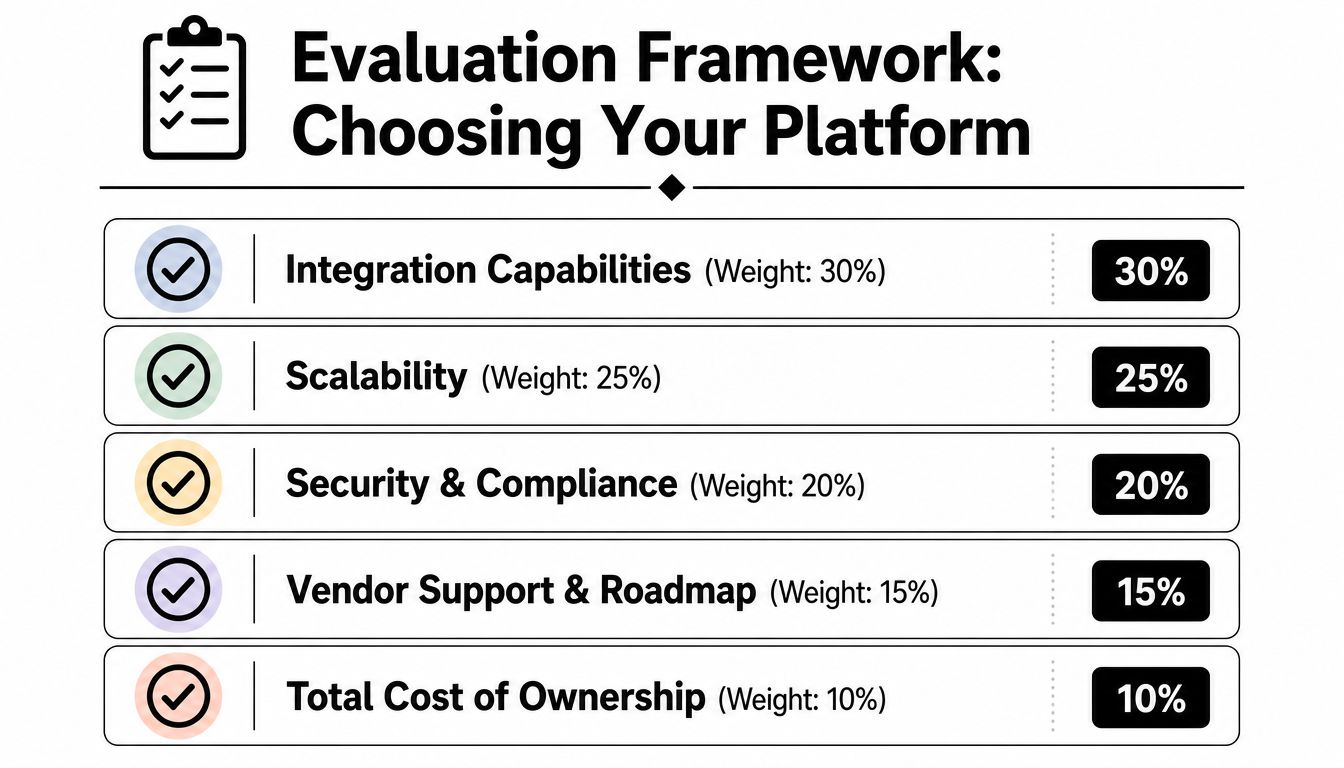
Use a weighted evaluation instead of a vendor beauty contest. Score each platform against your actual workflow, using evidence from a controlled test rather than a sales demonstration. The weights below are a practical starting point, not a universal formula.
Score the architecture, not the interface
Integration capability should carry the greatest weight. Test authentication, read and write permissions, schema changes, rate limits, retries, and duplicate prevention across the systems your workflow uses. A platform that connects to your CRM but can't preserve reliable identity and record context isn't integrated in the operational sense.
Scalability comes next. Run concurrent workflows, long pauses, repeated retries, and partial failures. Review whether the system exposes queues, state, execution limits, and resource behavior clearly enough for your operations team to manage.
Security and compliance need a real test. Verify tenant boundaries, role-based access, data retention, audit logs, secret management, and model routing. Ask where prompts, outputs, and business records are stored, then confirm the answer through documentation and configuration.
Vendor support and roadmap matter after the technical proof. Evaluate response quality, migration options, release discipline, and whether the vendor explains breaking changes. A fast-moving platform without operational communication can create more work than it removes.
Total cost of ownership is broader than licensing. Include implementation, integration maintenance, monitoring, evaluation, incident response, model usage, approval operations, and the engineering time required to change workflows. A cost-benefit analysis framework can help separate apparent license savings from the labor required to keep the system dependable.
Apply situational recommendations
- Choose an ecosystem platform when your identity, data, CRM, and governance already sit inside one cloud environment and speed has priority.
- Choose an API-led architecture when your product needs model flexibility, custom user experiences, or precise control over execution.
- Choose a graph-based framework when workflows contain branching, retries, durable state, and frequent human checkpoints.
- Choose a visual automation layer when business operators need to inspect and modify cross-application workflows without waiting for a full engineering cycle.
Require every finalist to demonstrate the same scenario, including a timeout, rejected approval, malformed response, permission failure, and resumed execution. The winner is the platform that makes those events visible and recoverable, not the one with the most polished demo.
Real-World Implementation Scenarios for B2B Teams
Platform choice rarely blocks a B2B workflow from reaching production. The harder work is defining ownership, preserving state, and making each automated decision observable. A lead process shows why.
A new account enters the CRM. A research agent checks approved company data, a qualification agent applies the firm's criteria, and a writing agent prepares an outreach draft. The orchestration layer passes structured context between steps, records the decision, and waits for the required review before sending anything.

Production failures usually come from inconsistent identity resolution, stale CRM data, duplicate outreach, or an approval step that gives the reviewer too little context. Create a stable record key, store the evidence supporting qualification, and define a safe stop before any external action. Log the state needed to resume the run without repeating a message or losing the approval history.
Outreach requires bounded autonomy
An outreach system can coordinate an account researcher, personalization agent, sequence planner, and compliance reviewer. The researcher gathers account context, the personalization agent proposes relevant language, and the reviewer checks claims, tone, and contact rules before scheduling.
Separate drafting from sending. Give the drafting agent access to the information it needs, but reserve external action for a controlled step with deduplication and human approval where the risk warrants it. If a model invents a project detail, the workflow should flag the missing evidence instead of inserting the claim into a message.
A short visual walkthrough can help stakeholders understand how these stages connect:
Support and recruitment need different gates
In customer support, an intake agent can classify the request, a retrieval agent can locate approved product guidance, and a resolution agent can draft the response. Route billing disputes, security concerns, unclear requests, and emotionally sensitive cases to a human. Do not force the model to complete every ticket.
Recruitment needs a different control pattern. An intake agent can organize applications against explicit role requirements, while another agent prepares a structured summary for a recruiter. Human reviewers should retain authority over progression decisions, and the system should preserve the source information behind each recommendation.
Across both use cases, the platform only coordinates the work. Production reliability comes from clear boundaries, durable context, visible execution history, and an escalation path employees trust.
Building Your Phased Adoption Roadmap
Adopt orchestration in phases, while making the first phase test the future operating model. A pilot must cover failure handling, permissions, state persistence, monitoring, and ownership. Leave out those controls, and a successful demo will create false confidence.
Phase one should prove the workflow
Select one process with clear inputs, repeatable decisions, and a meaningful manual handoff. Document the current path, define permitted actions, set a human approval point, and record a baseline for time, rework, errors, and completion quality. The baseline only needs to be consistent enough for a fair comparison.
Phase two should harden operations
Add durable state, structured logs, alerting, retry rules, access controls, and a runbook for failed executions. Test abnormal cases deliberately. A workflow that performs well on clean data is not ready for production if operators cannot see stale information, skipped policy checks, or incomplete handoffs.
Track these operating measures:
- Completion quality: Whether the output meets defined review criteria.
- Human intervention: Where reviewers step in and which interventions expose missing rules.
- Failure recovery: Whether the system resumes safely without duplicate actions.
- Latency: How long each handoff and the full workflow take under realistic conditions.
- Usage cost: What model, integration, monitoring, and support resources each completed workflow consumes.
- Adoption: Whether process owners trust and use the system.
Phase three should earn expansion
Expand only after the workflow has stable ownership and reliable evidence. Add connected systems gradually, keeping the same audit and approval standards. Pause expansion when failures become difficult to explain, operators create manual workarounds, or changes depend on undocumented specialist knowledge.
Platform investment creates value only when leaders fund the operating discipline around it. Start with one workflow, make its state and decisions visible, and expand only after production behavior supports wider access. Governance, state management, and observability determine whether a pilot survives contact with real operations.
MakeAutomation helps B2B and SaaS teams design, document, and implement AI-powered workflows across lead generation, outreach, CRM operations, recruitment, project management, and inbound or outbound voice agents. Visit MakeAutomation to evaluate an orchestration use case around your real systems, approval rules, and production requirements before committing to a platform.