

What Is Data Governance and Why B2B SaaS Needs It in 2026
Data governance is a system of decision rights, accountabilities, and workflows that controls who can do what with company data, when, and under which rules. In 2026, the implementation gap is clear: 71% of organizations discuss data governance at senior leadership level, but only 23% have a formal process with defined roles, responsibilities, and policies.
The popular advice says to start by writing a detailed policy. That's usually where programs lose momentum. A document can describe responsible behavior, but it can't assign a CRM owner, block an unsafe data transfer, define an approved customer metric, or show an AI team where a sensitive field came from.
For B2B SaaS companies, governance works when it becomes part of normal operations. Sales needs dependable account definitions. Marketing needs consent and audience rules. Product teams need trustworthy event data. Finance needs consistent revenue logic. Operations needs controlled integrations. AI teams need traceable, permissioned inputs.
Data governance has also moved well beyond an internal compliance concern. A 2025 academic review found that data governance research had an annual publication growth rate of 43.4%, while market forecasts place the category in the multi-billion-dollar range. One forecast estimates growth from USD 3.35 billion in 2023 to USD 12.66 billion by 2030, with a 21.7% CAGR. Another projects USD 4.12 billion in 2025 to USD 16.51 billion by 2034, with North America holding 38.4% share in 2025. These figures point to a broader shift, documented in the academic review of data governance's evolution, from internal policy discipline to a strategic operating layer.
Rethinking Data Governance for Modern SaaS Companies
Data governance isn't just a compliance checkbox. It's the operating system behind decisions about data ownership, access, quality, movement, and use.
A SaaS founder may approve a privacy policy and assume governance is covered. Then the revenue dashboard uses a different customer definition from the CRM, a customer export sits in an unmanaged workspace, and an AI assistant receives support transcripts without a clear retention or access rule. None of those problems are solved by adding another paragraph to the policy.
A working definition is more practical: data governance determines who may make decisions about information, who performs the day-to-day controls, and which workflows enforce those decisions. It covers customer records, product events, financial data, employee information, vendor data, and the metadata that explains how each asset should be used.
The hidden cost of ungoverned growth
Early-stage teams can often resolve data questions through personal knowledge. Someone knows which Salesforce field is reliable, which warehouse table feeds the board report, and who approves a customer export. Growth removes that informal safety net.
New hires create their own spreadsheets. Revenue operations adds fields to the CRM. Marketing connects another platform. Product changes event names. An automation copies data into a system nobody considers part of the official architecture. The business still appears to function, but every report, integration, and AI project carries more uncertainty.
That uncertainty creates operational drag. Teams spend time reconciling definitions instead of acting on results. Analysts answer questions about lineage instead of producing analysis. Engineers repair broken synchronizations. Security and compliance teams struggle to identify where information is processed.
Leaders looking for an executive-level treatment can use this data governance for CIOs resource to frame governance around accountability, risk, and business value. For implementation teams, the practical connection to data integration best practices matters just as much, because governance rules must follow information as it moves between systems.
Practical rule: If a governance requirement doesn't change a decision, workflow, permission, definition, or escalation path, it's probably documentation rather than governance.
The strategic question isn't whether your company has data policies. It's whether those policies operate at the point where people create, transform, share, and consume data.
Core Components That Make Governance Work
A governance model works when authority, accountability, context, and enforcement connect to daily operations. Without that connection, a company can have a catalog nobody owns, owners who cannot approve changes, or policies that never affect system behavior.
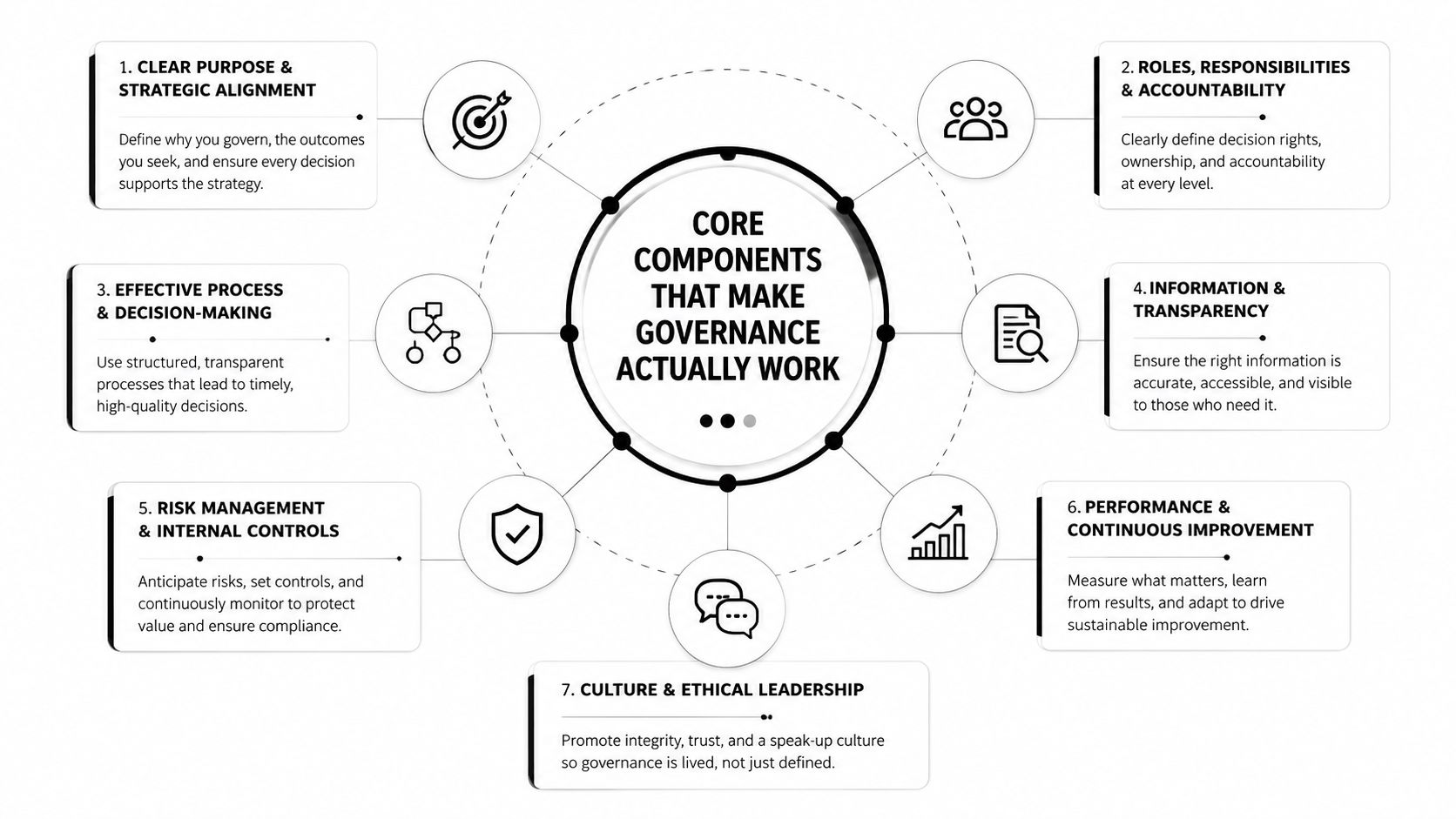
Consider a customer record moving from a CRM to a revenue dashboard. A defined creation process establishes how the record begins. A business owner decides what “customer” means and which fields are authoritative. A data steward checks required attributes, duplicate handling, and approved resolution steps. Metadata records definitions, source system, sensitivity, and downstream uses. Lineage connects the CRM value to its warehouse column and dashboard metric. Access rules specify who may view or modify it, while monitoring routes exceptions to the responsible person.
The governance chain
Audit a SaaS data environment with these questions:
- Decision rights: Who approves definitions, changes to critical fields, or new uses?
- Data owners: Which person or function is accountable for the asset's business meaning and acceptable use?
- Stewards: Who handles quality issues, documentation, and routine exceptions?
- Metadata: Can a new employee understand a field without asking its creator?
- Lineage: Can someone trace a metric to its source and transformations?
- Policies: Are collection, access, retention, sharing, and disposal rules written in usable language?
- Enforcement: Does a system or workflow apply each rule, or does the company rely on memory?
Ownership and stewardship serve different purposes. The owner makes accountable business decisions. The steward keeps the asset usable in routine work. Engineering may build controls, while security or privacy teams define requirements. In a smaller company, one person may hold several roles, but each responsibility still needs an explicit owner.
Product teams also need a direct way to address quality problems. This guide on data quality for product teams can help identify how inconsistent definitions, incomplete records, and unclear validation rules disrupt product decisions.
Governance programs gain adoption when they target a small set of high-impact assets first. Prioritize data tied to revenue reporting, customer commitments, regulated information, security decisions, or AI use. For each asset, assign a clear owner, define the rule, and provide a fast exception path. That turns governance from a compliance talking point into an operating model that supports automation and AI-readiness.
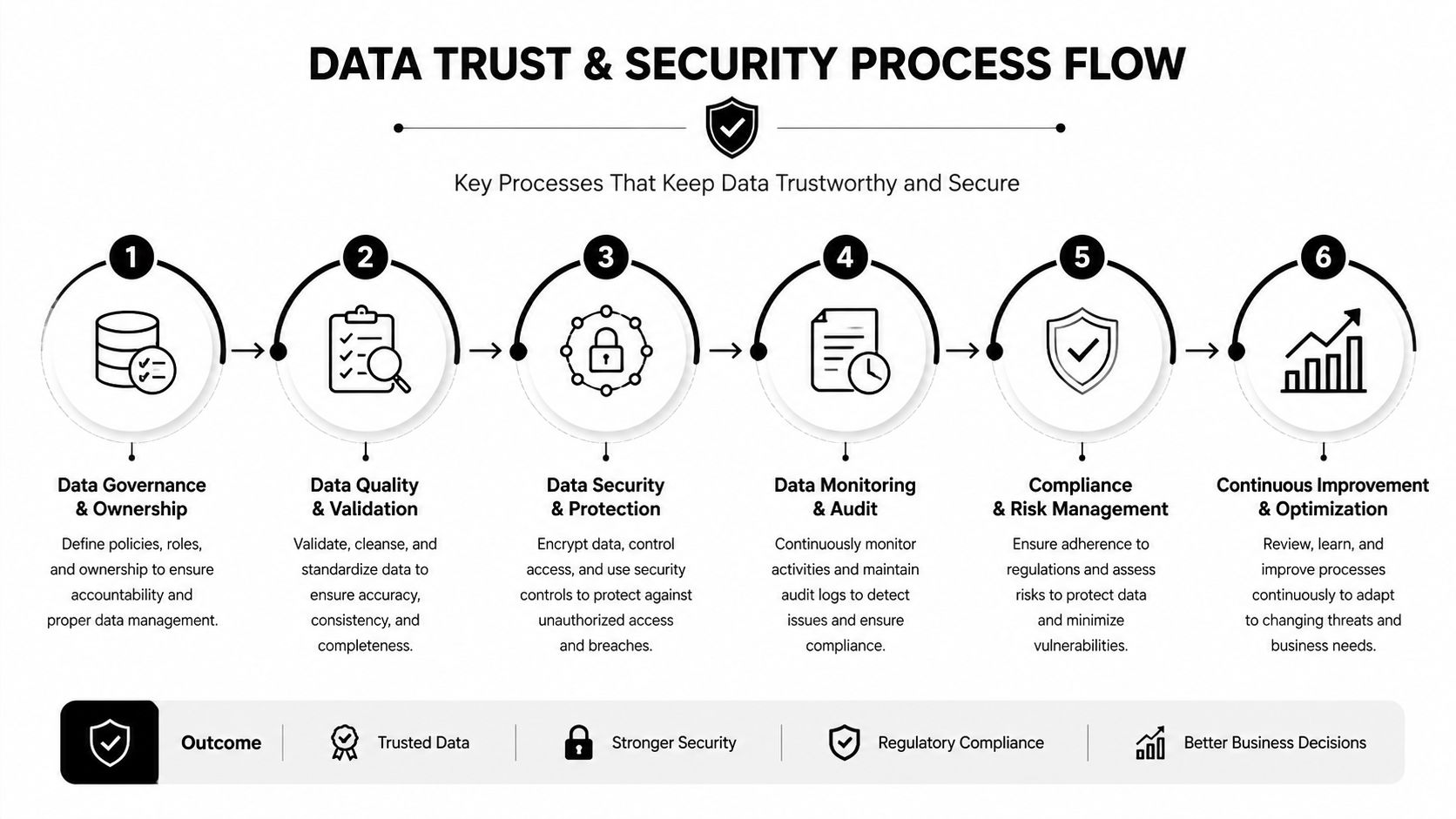
Key Processes That Keep Data Trustworthy and Secure
Governance becomes visible through recurring processes. Each process needs an input, an accountable owner, a defined action, and an output that another team can trust.
Start with quality controls
A quality workflow begins by selecting a priority asset, such as account, subscription, invoice, or product event data. The owner defines what “fit for use” means. The steward then establishes validation checks for required values, accepted formats, duplicates, and relationships between records.
When a check fails, the workflow should create an issue with enough context to act. That means identifying the affected asset, the source, the rule that failed, the person responsible, and the expected resolution. A dashboard showing errors without an owner becomes another passive report.
Teams can use the process for improving data quality to connect profiling, validation, correction, and monitoring rather than treating cleanup as a one-time project.
Make the data discoverable
A catalog gives users a reliable inventory of important assets. Each entry should include a business definition, technical location, owner, steward, sensitivity classification, refresh expectations, and known limitations. The catalog doesn't need to contain every piece of information on day one. It needs to make high-value data understandable.
Lineage adds the history behind the asset. If a board metric changes, the team should be able to trace the calculation through its warehouse models, source applications, and transformation logic. That trace supports debugging, change review, impact analysis, and privacy investigations.
Control access as a workflow
Access should follow a repeatable request and approval path. The request needs a business purpose, the asset or role requested, an approver, an expiry or review condition where appropriate, and an audit record. Sensitive data should use narrower permissions than general operational data.
Privacy and security controls also need to cover third parties. Review the systems that receive data through APIs, automation platforms, enrichment vendors, support tools, and AI services. A governance program that maps only its internal warehouse can miss the most important processing paths.
The processes reinforce one another. A catalog without quality status can create false confidence. Quality checks without lineage make root-cause analysis slow. Access controls without ownership create approval bottlenecks. Together, they create a manageable control loop that supports reporting, onboarding, integrations, and AI delivery.
Choosing the Right Governance Framework for Your Team
There isn't one universally correct governance structure. A centralized model improves consistency, but it can become a queue for every business decision. A federated model gives domain teams speed and context, but standards can drift. A hybrid structure usually offers a practical compromise, provided the central team defines essential controls and domain teams own local execution.
A 2025 enterprise survey found that centralized, federated, and hybrid governance structures are split almost evenly, which supports a practical conclusion: the operating model should reflect how your company makes decisions rather than follow a fashionable label. The same report found that 39% of data leaders struggle to prove governance impact to leadership, so the framework must make outcomes visible as well as responsibilities clear. Both findings are documented in the enterprise governance statistics report.
| Model | Decision Speed | Consistency | Best Fit |
|---|---|---|---|
| Centralized | Slower for domain-specific requests | Strong across teams | Companies with concentrated data ownership or strict control requirements |
| Federated | Faster within business domains | Depends on shared standards | Organizations with independent product, sales, or regional teams |
| Hybrid | Fast for local decisions, controlled for critical standards | Strong where central rules are explicit | Growth-stage SaaS companies balancing speed with accountability |
Match the model to maturity
Oracle's governance guidance summarizes a six-stage maturity path: None, Initial, Managed, Standardized, Advanced, and Optimized. These stages are useful because they describe governance as an organizational capability, not a software purchase. A company at the Initial stage may be assigning its first owners. A Standardized organization may have shared definitions and policy repositories. An Advanced program may connect those rules to monitoring and automated controls.
The historic foundation is the formalization of decision rights, accountability, and stewardship. Oracle's guidance draws on the Data Governance Institute definition of governance as a system that establishes who can take what actions with what information, when, under which circumstances, and using which methods. That framing keeps the discussion focused on operating behavior.
For a cloud-heavy SaaS environment, a governance in cloud computing guide can provide useful context on distributed infrastructure and control design. Don't adopt a framework because it has the most terminology. Choose the smallest structure that can assign ownership, resolve disputes, enforce critical policies, and scale with your architecture.
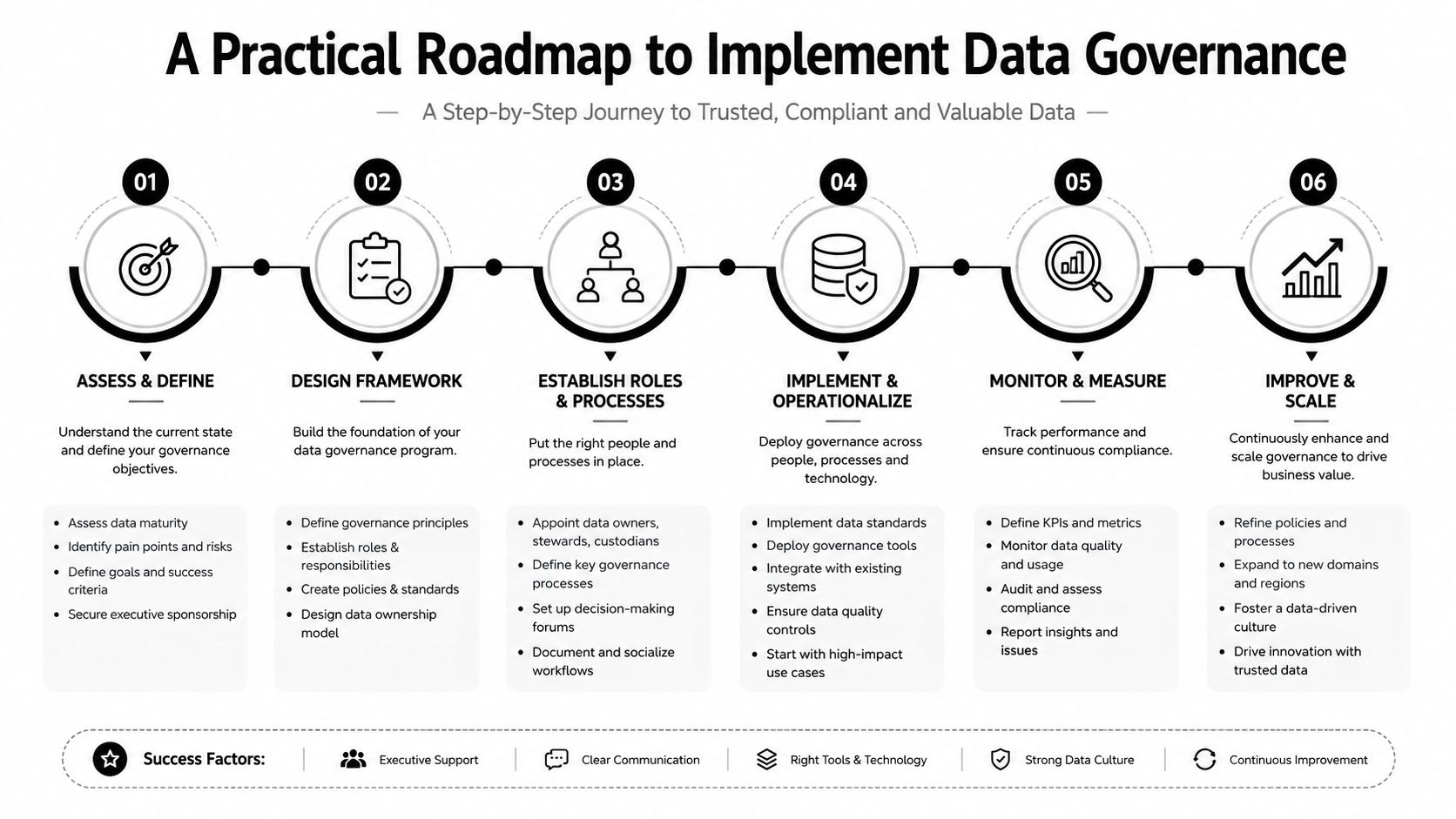
A Practical Roadmap to Implement Data Governance
A governance rollout should begin with a business problem, not a blank policy library. Pick one high-impact data domain and make the controls useful to the people who work with it every day.
Build the first operating loop
Use this sequence for an initial rollout:
- Select a priority domain: Choose customer, subscription, product, finance, or sensitive employee data. Tie the choice to a visible operational problem, such as inconsistent reporting or uncontrolled access.
- Inventory the critical assets: List the systems, tables, fields, dashboards, automations, and external services involved. Mark what is authoritative and what is derived.
- Assign an owner and steward: Give the owner decision authority over meaning and use. Give the steward responsibility for documentation, issue handling, and routine checks.
- Write minimum standards: Define required fields, accepted values, naming rules, access conditions, retention expectations, and escalation paths. Keep the first version usable by sales, marketing, product, and operations.
- Embed controls in tools: Add validation to the CRM, permissions to the warehouse, approval steps to automation workflows, and metadata requirements to analytics or AI intake processes.
- Review and expand: Examine exceptions, unresolved issues, adoption signals, and business friction. Improve the workflow before adding another domain.
A realistic first cycle can be organized as a focused 90-day implementation plan, without treating the period as a promise of universal maturity. Early work should produce visible artifacts: an asset register, a glossary, named owners, quality checks, an access workflow, and a recurring review meeting.
Make adoption easier than avoidance
Require governance at the moment of action. When a team creates a new CRM field, require a definition and owner. When an employee requests sensitive data, route the request through an approval workflow. When an AI project proposes a new dataset, require source, purpose, access scope, and retention details.
Avoid creating a committee that only discusses principles. Give the council a decision log, an issue backlog, and authority to resolve conflicts. Give stewards templates that reduce documentation effort. Give engineering a prioritized list of controls rather than a vague request to “improve governance.”
The program should also connect to existing change management. Every new integration, major schema change, vendor onboarding, and AI deployment should trigger a lightweight governance review. That keeps the operating model aligned with how the company already ships work.
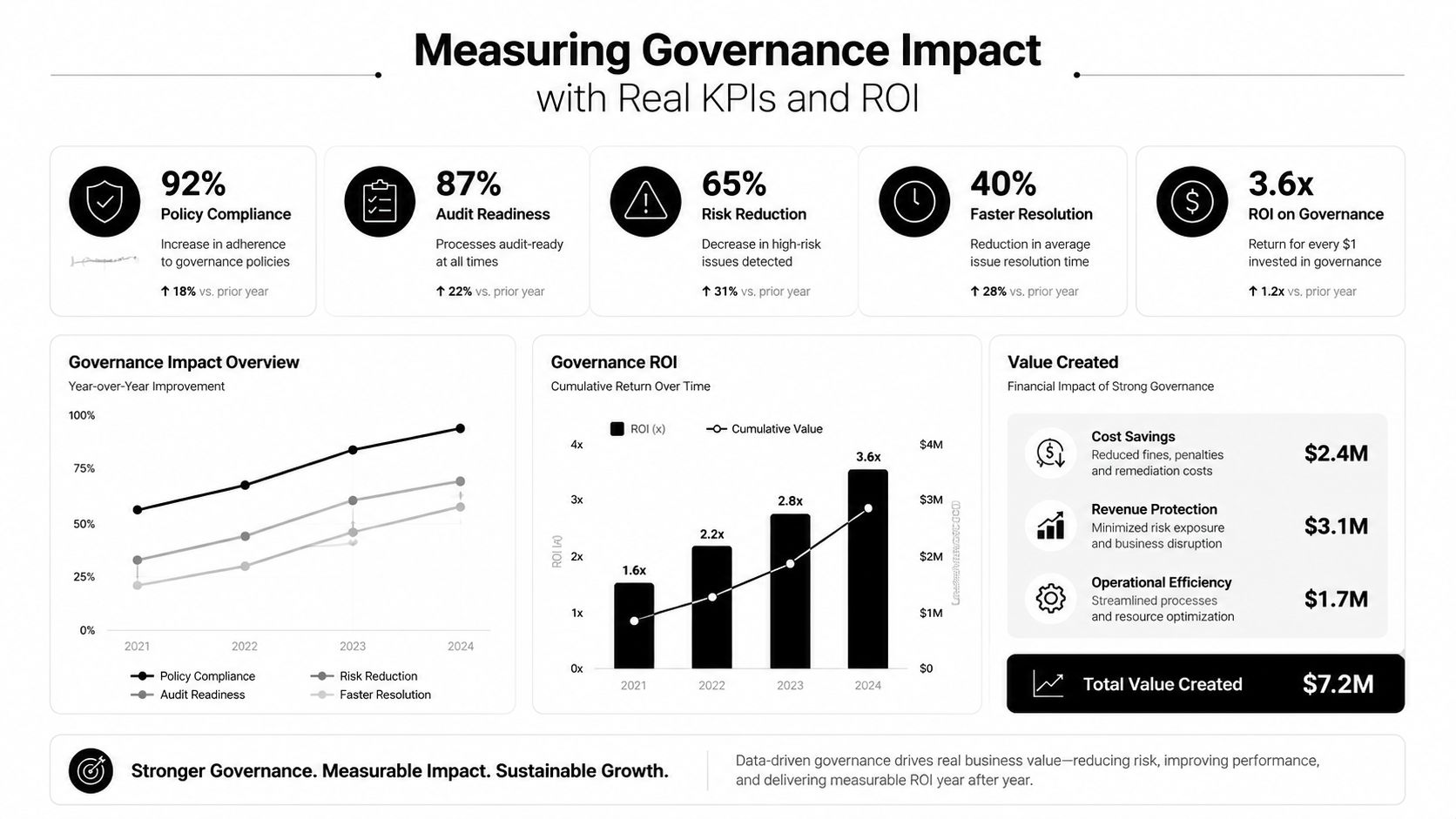
Measuring Governance Impact with Real KPIs and ROI
Governance programs lose funding when leaders can't see what changed. A policy count proves that documents exist. It doesn't prove that teams use accurate definitions, follow access workflows, or resolve data issues faster.
Track operational indicators across four categories:
- Ownership: Measure the percentage of priority assets with named owners and accountable stewards.
- Definition: Measure the percentage of key business terms with approved definitions.
- Metadata: Measure the share of governed data products that meet the organization's minimum metadata standard.
- Access: Measure the percentage of sensitive assets using standard access request and approval workflows.
These KPI examples come from the data governance metrics and KPI playbook. They work because they test whether governance is being used, not merely announced.
Connect controls to business outcomes
Pair adoption metrics with outcomes that executives already understand. Track time spent resolving reporting disputes, the rate of recurring data issues, the time required to approve access, and the effort needed to trace a metric or dataset. For AI initiatives, track whether teams can identify approved sources, document data use, and investigate an output or input when questions arise.
Don't reduce ROI to a single financial estimate when the causal chain is uncertain. Show the baseline, the intervention, and the resulting operational change. A metric such as “priority assets with owners” becomes more persuasive when linked to fewer unresolved issues or faster decisions.
A monthly operating review is usually more useful than an annual governance presentation. Report exceptions, overdue ownership decisions, quality trends, access activity, and the business projects supported. Use the same operational efficiency metrics that the company uses elsewhere, so governance appears as part of operating performance rather than as a separate compliance exercise.
Avoiding Common Pitfalls and Using AI to Accelerate Governance
Leadership may approve a governance policy long before anyone can answer who owns the customer object or how a sensitive export gets approved. Over-documentation creates that gap. Start with a few enforceable rules, assign owners, and expand only when recurring exceptions show that another control is needed.
External processing creates a second blind spot. Recent coverage reports that only 36% of organizations can identify where their data is processed by external partners, while 61% have fragmented audit trails and 57% lack centralized data gateways. The findings are reported in this 2026 data governance analysis. Governance therefore has to cover vendors, APIs, automation tools, and AI services alongside internal databases.
AI governance often exposes the difference between awareness and execution. A 2025 enterprise report found that 31% of organizations were still in the early stages of AI governance policy development, while only 7% of leaders placed AI governance among their top focus areas. Treat each AI use case as an intake workflow. Record its purpose, source data, permissions, human owner, monitoring approach, and failure escalation before deployment.
Automation applies these controls consistently. Approval routing, audit-event capture, required-metadata checks, unusual data-movement alerts, and automatic issue creation can run inside existing workflows. AI can assist with classification and documentation, while a human owner remains accountable for sensitive decisions.
Keep the operating model small:
- Name an accountable owner.
- Define the business meaning.
- Record source and lineage.
- Control access and external sharing.
- Monitor exceptions.
- Review AI use before deployment.
MakeAutomation helps B2B and SaaS teams document procedures, connect business systems through custom integrations, and add approvals, audit trails, and access controls to automated workflows. Visit MakeAutomation to discuss governance and automation for CRM, reporting, integrations, or AI operations.