

B2B Lead Generation Outsourcing: A Founder’s Playbook
The global lead generation business process outsourcing market was valued at US$14.4573 billion in 2025 and is projected to reach US$31.4507 billion by 2033, representing a projected 10.3% CAGR across the forecast period, according to Stealth Agents' lead generation outsourcing research. That scale changes the question for founders. B2B lead generation outsourcing isn't a temporary fix for a weak quarter. It's an operating model that needs to be designed, measured, and controlled like any other revenue system.
The blunt version is simple: you don't outsource responsibility when you outsource SDR execution. You still own the ICP, the offer, the qualification standard, the CRM architecture, and the handoff to sales. If those pieces are vague, an agency can produce activity while your pipeline gets worse.
Why B2B Lead Generation Outsourcing Is Now Mainstream
Outsourced lead generation has moved well beyond the “rent a few appointment setters” phase. The market's projected expansion, combined with broad adoption among B2B companies, shows that businesses now use external teams as part of their core go-to-market infrastructure. One 2026 industry summary reports that roughly 72% of B2B companies globally use some form of outsourced lead generation, while 59% outsource at least part of the function. It also reports an approximate 43% reduction in cost per lead compared with in-house SDR teams, alongside higher lead volume and more qualified discovery calls for outsourced programs. See the B2B lead generation benchmarking summary for the underlying figures.
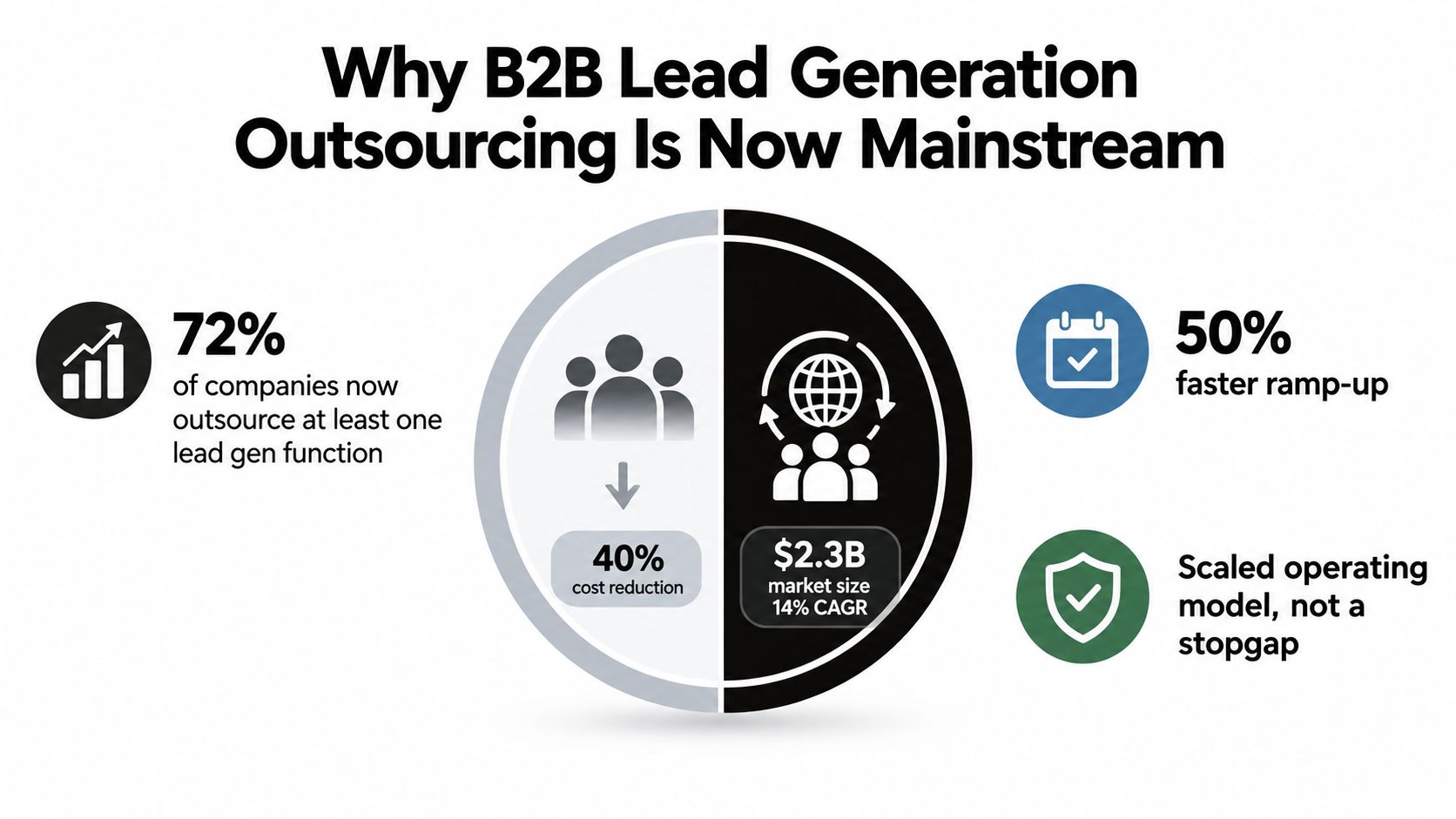
North America generated the most revenue in 2025, while India is projected to record the highest CAGR from 2026 to 2033, according to the market research cited above. That geographic spread matters because it confirms that outsourcing isn't limited to one sales culture or one labor market. Mature markets are buying capacity and specialization, while emerging markets are expanding delivery capability.
Founders who treat an outsourced SDR partner as a vendor usually ask the wrong questions. They ask how many calls the team will make, how many contacts sit in a database, or how quickly the campaign can launch. Those are inputs. The deliverable is a repeatable ICP-to-meeting pipeline that sales can trust.
Advisor's rule: Don't buy outreach activity. Engineer a pipeline with defined inputs, controlled handoffs, and measurable failure points.
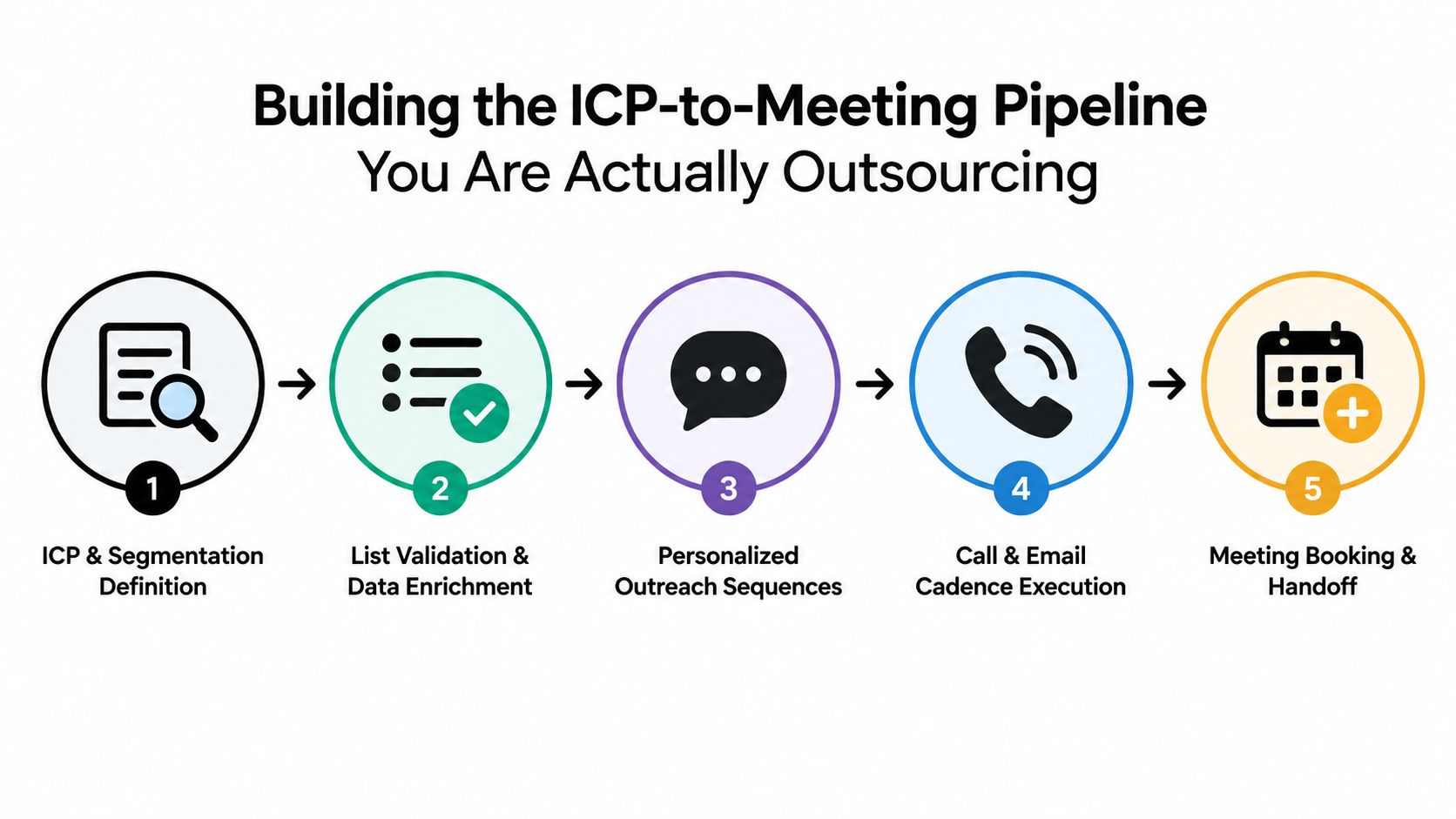
That means locking down the ICP, segmenting accounts by fit and intent, validating contact data, approving sequences, scoring replies, and routing qualified opportunities into the CRM. Founders who want a broader operating reference can review these B2B lead generation best practices, but the implementation standard should be stricter than a generic checklist.
The same principle applies to channel selection. If LinkedIn is central to your market, study examples of Brisbane LinkedIn campaigns that deliver to understand how audience definition and campaign execution need to work together. The point isn't to copy a channel. It's to connect targeting, message, response handling, and sales follow-up into one accountable system.
Building the ICP-to-Meeting Pipeline You Are Actually Outsourcing
An outsourced SDR program cannot rescue a vague ICP. “SaaS companies with more than 50 employees” is a starting label, not an operating brief. Your contract and CRM must define geography, funding status, technology environment, buying trigger, economic buyer, urgency, and disqualifying conditions.
Start with a segmentation map, not an industry list. Define the account traits that indicate fit, then group accounts into campaigns the team can execute. A cybersecurity SaaS company might separate firms expanding their security team, firms responding to a compliance requirement, and firms replacing an existing platform. Each segment needs its own reason to respond, message, qualification path, and exit rule.
Lock the inputs before launch
Put these documents under founder ownership:
- ICP definition: Company profile, buyer roles, geography, commercial fit, pain signals, and exclusions.
- Segment rules: Why an account belongs in a campaign, including trigger events and persona-specific angles.
- Offer brief: The problem solved, promised business outcome, supportable proof points, and call to action.
- Qualification standard: What makes a reply qualified, what makes a meeting qualified, and which responses must be rejected.
- Handoff template: The information an AE needs before accepting ownership.
Use this ideal customer profile guide to structure the first document, then adapt it to your product. Your team understands pricing logic, implementation risks, product limits, and customer language better than an external SDR. The agency should execute an approved policy, not invent one.
List quality requires its own controls. Require the partner to document how records are sourced, checked, enriched, and suppressed when inaccurate. Set CRM fields for source, verification status, segment, owner, and suppression reason. If those fields are missing, neither side can identify whether poor performance came from targeting, data, messaging, or follow-up.
Sequences must stop when a prospect replies and change according to intent. A positive reply, a referral to another stakeholder, a timing objection, and an unsubscribe request are separate states. Configure each state with a response owner, service-level expectation, and CRM outcome. Do not let the agency count a booked call as success if the record lacks qualification evidence.
Make the handoff impossible to misunderstand
Require every accepted meeting to include:
- Account and contact details
- ICP segment and fit rationale
- Trigger or buying signal
- Pain or business problem stated by the prospect
- Exact response or call summary
- Product area discussed
- Meeting date and participants
- Agreed next step
- Disqualification risks
The outsourced team owns execution and documentation. The founder owns the ICP, qualification policy, offer language, and acceptance criteria. Put those boundaries in the agreement, then enforce them through required CRM fields and rejection rules. If responsibility is reversed, the agency will optimize for reportable activity, usually contacts or booked calls, instead of opportunities sales can convert.
The workflow may use email, phone, LinkedIn, enrichment tools, and automation. Choose channels based on where the defined segment responds, then make every touch update the same account record. The pipeline is engineered through inputs, handoffs, acceptance criteria, and failure-mode guardrails, not purchased as a vendor package.
Comparing In-House SDR Costs Against Outsourced Programs
The in-house versus outsourced decision depends on the full operating cost, not salary alone. A fully loaded SDR seat includes compensation, benefits, sales engagement software, data, management time, recruiting, onboarding, and slow ramp-up. Available industry benchmarks place fully loaded in-house SDR seats above US$150,000 per year, while outsourced programs commonly report US$40,000 to US$50,000. Those figures come from SalesHive's outsourced sales services benchmarks.
| Dimension | In-House SDR | Outsourced Program |
|---|---|---|
| Cost structure | Salary, benefits, tools, management, recruiting, and enablement remain on your books. | A retainer, qualified-lead model, meeting model, or hybrid structure packages specialist execution. |
| Control | Managers control messaging, calling, coaching, and product education directly. | Control depends on documentation, approval gates, CRM permissions, and service-level terms. |
| Ramp profile | Hiring and onboarding take time, while the founder carries turnover risk. | A specialist team may bring an established process, but still needs a precise product brief. |
| Product depth | Direct access to product, customer success, and engineering supports deeper context. | Training, objection handling, call reviews, and escalation paths must be defined. |
| Flexibility | Capacity changes require hiring, reassignment, or layoffs. | Segment coverage and campaign capacity can be adjusted through the operating agreement. |
| Best commercial use | A validated motion requiring permanent ownership and strong customer context. | Market testing, new-segment expansion, or top-of-funnel execution before internal hiring. |
| Primary risk | High fixed cost during ramp, turnover, or inconsistent productivity. | Misaligned incentives that produce meetings without fit or sales acceptance. |
| Useful output metric | Pipeline contribution per SDR, not calls completed. | Cost per qualified meeting, sales acceptance, show quality, and resulting pipeline. |
Outsourcing may reduce top-of-funnel cost by roughly 40% to 60% versus an in-house SDR team. Industry benchmarks also report an approximate 43% ROI improvement and, in some programs, up to 50% higher ROI than internal-only efforts. Treat those figures as reference ranges, not promises. Specialization, data quality, offer strength, and AE follow-up determine whether the economics hold.
Well-aligned US programs commonly report US$400 to US$650 per qualified meeting. Use that figure for budget review, then calculate your own break-even point from contribution margin, close rate, sales-cycle length, and AE capacity.
The contract must define what counts as a qualified meeting, who accepts or rejects it, and which CRM fields prove fit. Otherwise, the vendor can optimize for booked calls while your sales team receives weak opportunities.
In-house usually wins when the message is stable, the segment can keep an SDR productive, and product knowledge materially affects conversion. Outsourcing wins when you need market testing, quick capacity, or a reversible commitment before the motion earns a permanent team. Compare the cost of the process you need, then choose the ownership model that can produce accepted pipeline.
Running a 30-60-90 Day Pilot Playbook
A pilot should answer one commercial question: can this process create sales-accepted pipeline from a defined segment? Put that question, the qualification rules, handoff requirements, and decision gates in the contract before outreach starts. Otherwise, the vendor can keep changing scope while your company keeps paying.
Days 1 to 30
Choose one ICP segment and one primary offer. Freeze the qualification rules, required CRM fields, rejection reasons, and meeting-handoff steps before the first message goes out. Approve one sequence and one reporting format. Asking the vendor to test every message at once creates noisy results and makes accountability difficult.
Require access to list construction, data-validation checks, deliverability checks, reply categories, and disqualification reasons. This phase tests operating discipline. Confirm that the partner can follow the agreed process, document exceptions, and report cleanly before you judge volume.
Days 31 to 60
Review reply rate, qualified-reply rate, meetings set, meetings held, bounce rate, and AE acceptance. Use the agreed benchmark ranges as diagnostic signals, not promises. A weak reply rate points to the ICP or offer. Excessive bounces point to list quality or deliverability. Strong reply volume with low AE acceptance usually means the qualification rules are too loose.
Audit the first ten discovery calls for context quality. Did the AE know why the prospect agreed to meet? Did the prospect understand the reason for the call? Was the next step captured in the CRM? If any answer is no, fix the handoff before increasing activity.
Write the correction into the operating plan. Specify the owner, the field or workflow that changes, and the date for reviewing the result.
Days 61 to 90
Make a hard decision. Scale the winning motion into another segment, revise the offer and restart the pilot, or stop the program. Do not extend a weak campaign because the vendor says it needs “more time.” Require a named process defect and a measurable correction before approving additional weeks.
| Phase | Days | Focus | Key KPIs | Decision Gate |
|---|---|---|---|---|
| Foundation | 1 to 30 | ICP freeze, list audit, sequence approval, CRM setup | Data-validity review, bounce rate, reply categories, process compliance | Continue only if the vendor follows the agreed operating model |
| Validation | 31 to 60 | Message and handoff testing | Reply rate, qualified replies, meetings set, meetings held, AE acceptance | Change list, copy, or qualification rules when quality breaks |
| Scale or stop | 61 to 90 | Commercial evaluation | Cost per qualified meeting, sales feedback, accepted opportunities, pipeline impact | Expand the winning motion or terminate the pilot |
Score the vendor on fit, qualification accuracy, handoff completeness, response speed, CRM hygiene, and cost per qualified meeting. Calls sent belong in the activity report. They should not determine whether the program earns more budget.
Wiring Outsourced Programs into Your CRM and Automation Stack
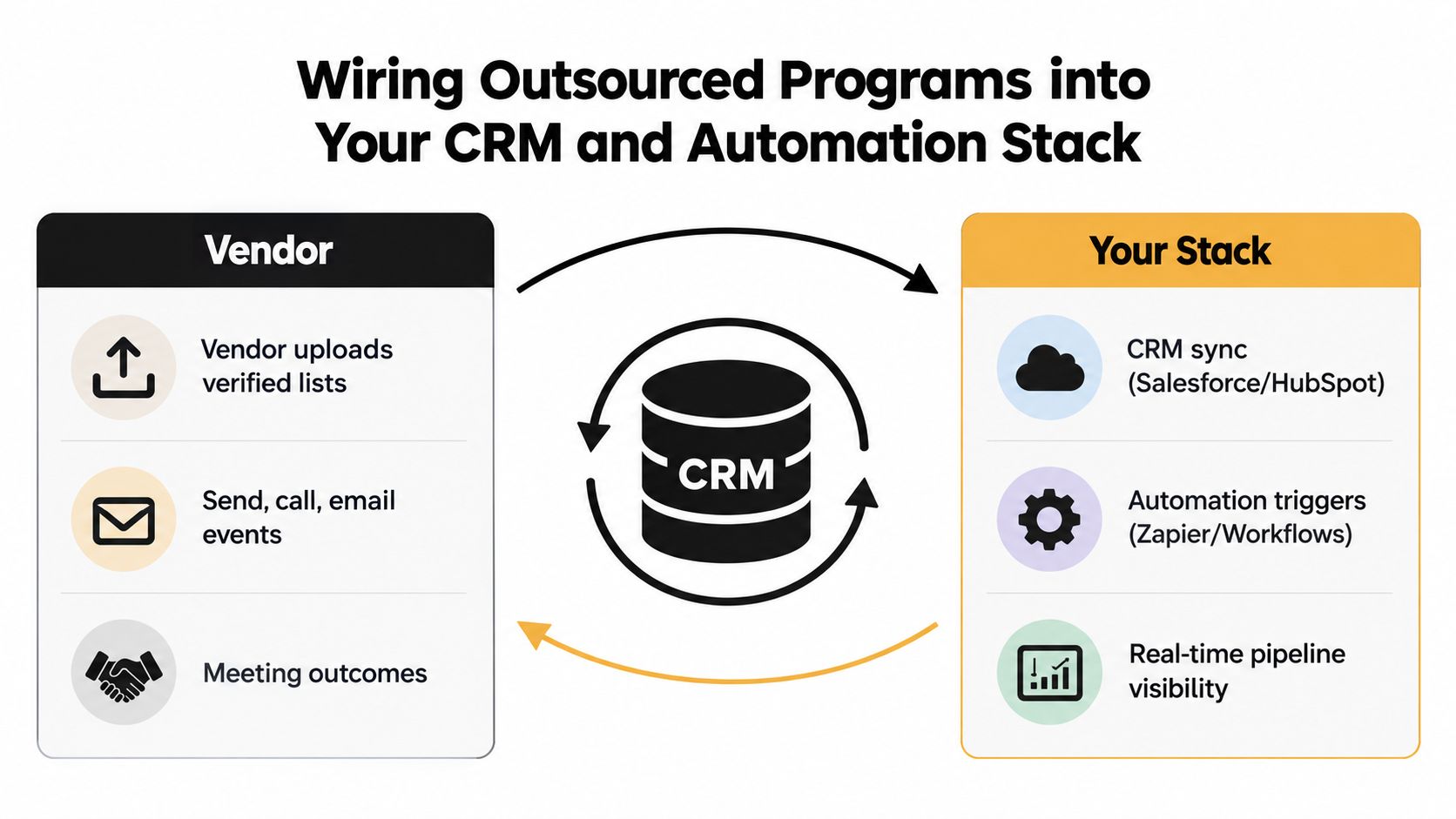
An outsourced SDR program becomes measurable only when the vendor works inside your data model. If the agency operates in a private spreadsheet and sends a weekly summary, you don't have a pipeline system. You have a reporting delay.
Use HubSpot or Salesforce as the system of record. Outreach, Salesloft, or Apollo can manage sequences, but every contact, account, touch, reply, disposition, and meeting outcome should map back to the CRM with source attribution. The vendor can execute in specialist tools, but it shouldn't own the only copy of your revenue data.
Define the minimum CRM schema
Create required fields for:
- Partner ID: Identifies the outsourced provider and campaign owner.
- List source: Records where the contact or account entered the system.
- Sequence ID: Connects the record to the approved outreach motion.
- ICP segment: Makes performance analysis possible by audience.
- Qualification status: Separates raw replies, qualified replies, accepted meetings, and disqualified records.
- Handoff timestamp: Measures the time between reply and AE assignment.
- Meeting outcome: Captures held, rescheduled, no-show, disqualified, and opportunity outcomes.
Build a dedicated pipeline stage for outsourced meetings. Don't mix them with inbound leads or partner referrals. Attribution gets unreliable when one stage carries multiple acquisition motions with different qualification standards.
For teams reviewing CRM integration fundamentals, the practical requirement is straightforward. The CRM must show not only who booked the meeting, but also why the contact qualified, which message generated the response, and what the AE did next.
Make routing and response speed explicit
A routing rule might read:
If
qualification_status = sales_acceptedandterritory = North America, assign the record to the North America AE queue, create a follow-up task, and notify the account owner.
A Slack notification should contain the context needed for action:
New qualified reply: Acme account, target segment, trigger identified, prospect pain recorded, meeting requested, owner assigned, source partner, sequence ID, reply timestamp.
Use automation to enforce the handoff, not to hide missing information. Tools such as Zapier, native HubSpot workflows, Salesforce Flow, and MakeAutomation can support lead routing, scoring logic, outreach workflows, and AI-assisted qualification. The vendor still needs clear permissions, field definitions, and escalation rules.
Three Failure Modes That Quietly Kill Outsourced Lead Generation
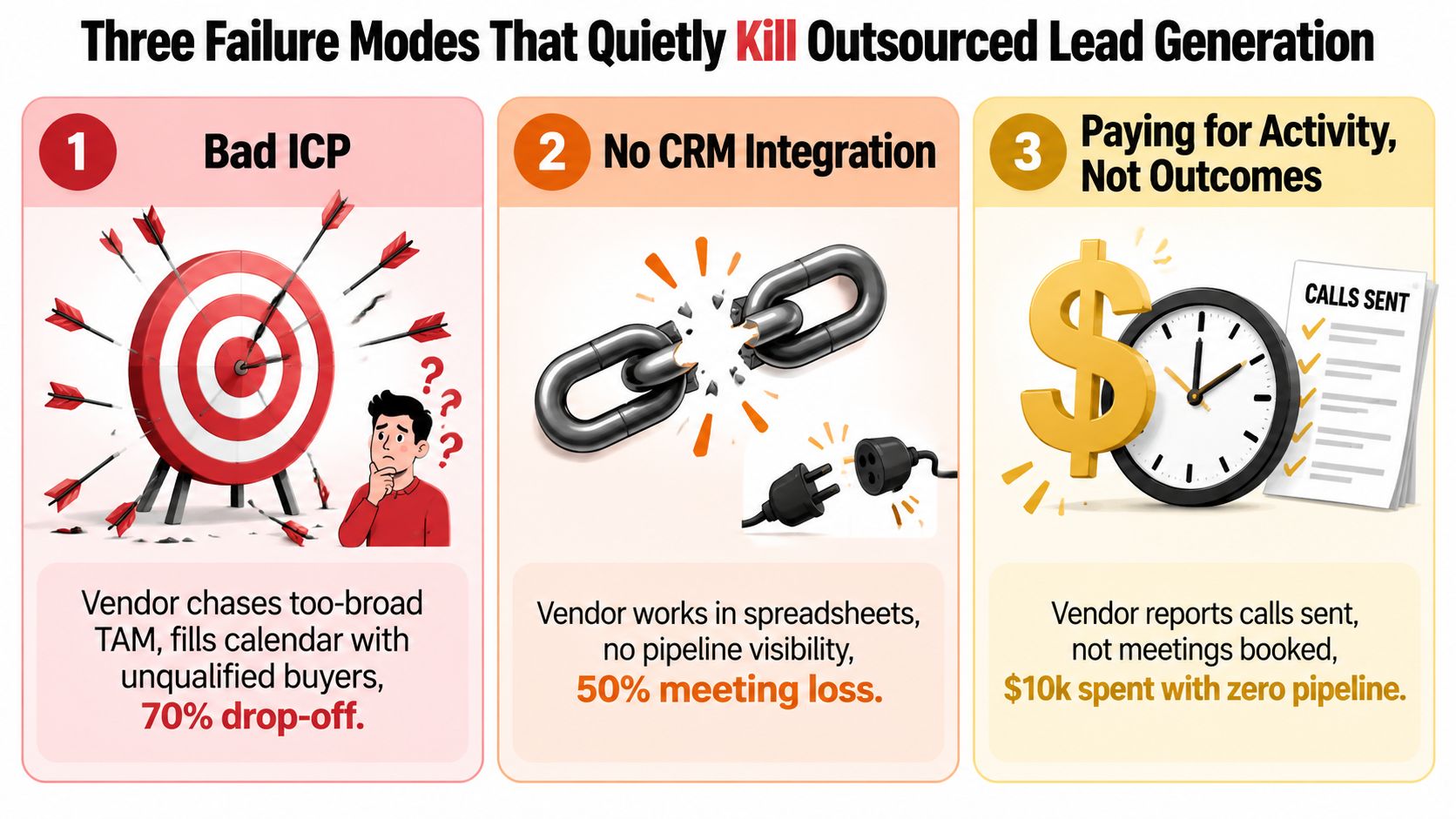
Failed outsourced programs rarely suffer from low activity alone. They fail when the process targets the wrong buyers, transfers meetings without usable context, or pays for outputs that do not become qualified pipeline. Treat outsourcing as a system to engineer. Put each guardrail in the contract, qualification form, and CRM.
Bad ICP
A vendor given a broad total addressable market will contact every plausible buyer. Replies may increase, while meetings fill with prospects who lack the problem, authority, timing, or commercial fit to buy.
The supplied failure scenario uses a reply rate above 12% combined with a meeting-show rate below 40% as an early warning signal. These figures belong to that scenario, not to every campaign. Review a sample of replies and meetings against the ICP. If fit is weak, narrow the segment, require a buying trigger, and rewrite the campaign around one painful use case. Do not ask the vendor to “improve quality” without changing those inputs.
Weak handoff
An SDR books a meeting after a contact expresses interest, then sends the AE only a name, company, and calendar link. The handoff omits the pain statement, trigger, stakeholder map, objection, and agreed agenda. The AE joins cold, the prospect repeats the story, and trust drops before discovery starts.
Audit the first calls for missing context. Make the handoff form block meeting acceptance until the required fields are complete. Require the CRM record to store the qualification evidence, campaign message, and next action, not just the appointment.
If the AE accepts every meeting automatically, add sales-accepted and sales-rejected dispositions. Review rejected records with the vendor each week and classify the failure, such as weak fit, missing pain, wrong role, or poor timing. Then change the script or targeting rule responsible.
Wrong pricing model
Per-lead or per-deliverable pricing rewards records, replies, or appointments that may never create qualified pipeline. Ambiguous definitions of “qualified reply” also make invoice disputes predictable.
Ask what happens when a meeting fails the ICP criteria or a prospect no-shows. Use a mixed commercial model: a controlled base fee for execution, plus outcome-linked payment tied to written qualification and acceptance rules. State the remedy for rejected meetings, and require reporting that separates activity from accepted outcomes. As noted earlier, outsourcing works only when specialization is paired with process control. Otherwise, it shifts waste instead of reducing it.
Contract Clauses, SLAs, and a Pre-Launch Checklist
A lead generation contract should describe a measurable operating system, not a vague promise to “generate leads.” If the agreement doesn't define quality, the vendor will default to activity. If it doesn't define data ownership, you may lose the campaign history when the relationship ends.
Put these terms in writing
- Scope and ownership: Name the ICP, segments, channels, territories, tools, sending identities, and assets each party controls.
- Qualification definition: Define ICP fit, buyer role, buying signal, pain confirmation, meeting acceptance, and disqualification criteria.
- SLA for handoff: Specify how quickly qualified replies enter the CRM, when an AE receives an alert, and how the vendor handles unanswered or reassigned leads.
- Data delivery cadence: Require event-level CRM updates for sends, replies, dispositions, meetings, no-shows, and outcomes.
- Quality remedy: State what happens when a meeting fails the agreed standard. Use replacement, credit, retraining, or campaign correction terms.
- Payment mechanics: Tie variable payment to accepted outcomes, not raw activity. Separate execution fees from qualified pipeline results.
- Data ownership and portability: Your company should own contact records, campaign history, copy, reply data, meeting notes, and reporting exports.
- Exit clause: Require a clean handover, tool access removal, suppression-list transfer, and export of all records when the agreement ends.
- Confidentiality and compliance: Cover customer information, product details, messaging approval, applicable anti-spam obligations, and indemnification for agreed compliance failures.
The contract should also require a 14-day operational audit before paid activity begins. During that period, verify the ICP, approve the list logic, inspect sample records, test CRM field mapping, review sequence branches, confirm unsubscribe handling, and run a complete test handoff.
Use a pre-launch gate
Before the first live send, confirm:
- ICP freeze: Founder and sales leader approve the segment and exclusions.
- Message approval: Every sequence, call script, and LinkedIn message has an owner.
- CRM readiness: Partner ID, source, sequence ID, qualification status, and routing rules work in a test record.
- AE readiness: AEs know the definition of acceptance, response expectations, and escalation path.
- Reporting access: Both sides can see activity, replies, quality, meetings, and outcomes.
- Stop conditions: The contract states when to pause for deliverability, list quality, compliance, or qualification failure.
Outsourcing works when the system makes bad behavior visible early. Build the guardrails before the vendor gets access to your market.
MakeAutomation helps B2B and SaaS teams build lead-routing, scoring, outreach, CRM, and AI workflow systems that qualify prospects and support meeting booking. Visit MakeAutomation to discuss how to connect an outsourced SDR program to a measurable automation and handoff process.