Testing Automation Framework: A B2B & SaaS Growth Guide
Your release train is already moving. Product wants a new workflow shipped, sales wants a bug fixed before the next demo, and QA is stuck replaying the same login, checkout, and permission tests by hand. That's the point where a testing automation framework stops being an engineering nice-to-have and starts becoming a business control surface.
Moving from a workshop bench to an assembly line. A bench can make one good product at a time, but an assembly line needs repeatable stations, clear standards, and reliable handoffs. A framework gives automation that structure, so your team isn't just “running scripts.” It's building a reusable system that can keep pace with releases, product changes, and the pressure that comes with growth-stage SaaS.
Moving Beyond Manual Testing Bottlenecks
Manual QA works until the product starts compounding. Once your app has more users, more permissions, more integrations, and more release pressure, the same tests begin to consume the team instead of protecting it. That's usually the moment leaders realize they don't need more heroic effort, they need a system.
A testing automation framework is the system. Industry guidance describes it as a set of guidelines, tools, standards, reusable components, and coding practices that make automated testing more consistent and maintainable across projects, and modern architectures include linear, modular, library, data-driven, keyword-driven, and hybrid approaches (BrowserStack). That matters because the value isn't in “automating a test,” it's in making sure the same test can be reused, maintained, and run reliably as the product evolves.
Why SaaS teams feel the pain first
Growth-stage SaaS companies usually hit the bottleneck in the same places. Regression testing gets longer after every feature release. Cross-browser checks pile up. Flaky environment behavior starts consuming review cycles. The team still wants speed, but the release process has become fragile.
A framework changes the shape of that work. Instead of each test living as a one-off script, the team creates a shared foundation for test data, object repositories, reporting, and execution flow. That structure is what makes automation useful in CI/CD, because tests need to run repeatedly and predictably across browsers, platforms, and environments (BrowserStack).
Practical rule: if a test is expensive to maintain and hard to rerun, it's not really framework-backed automation yet.
For SaaS leaders, the business case is simple. Better structure means fewer brittle tests, cleaner handoffs between engineers and QA, and less time wasted on repetitive verification. The payoff shows up as faster releases and less QA drag, not as a pile of scripts that only one person understands.
Understanding Your Frameworks Core Architecture
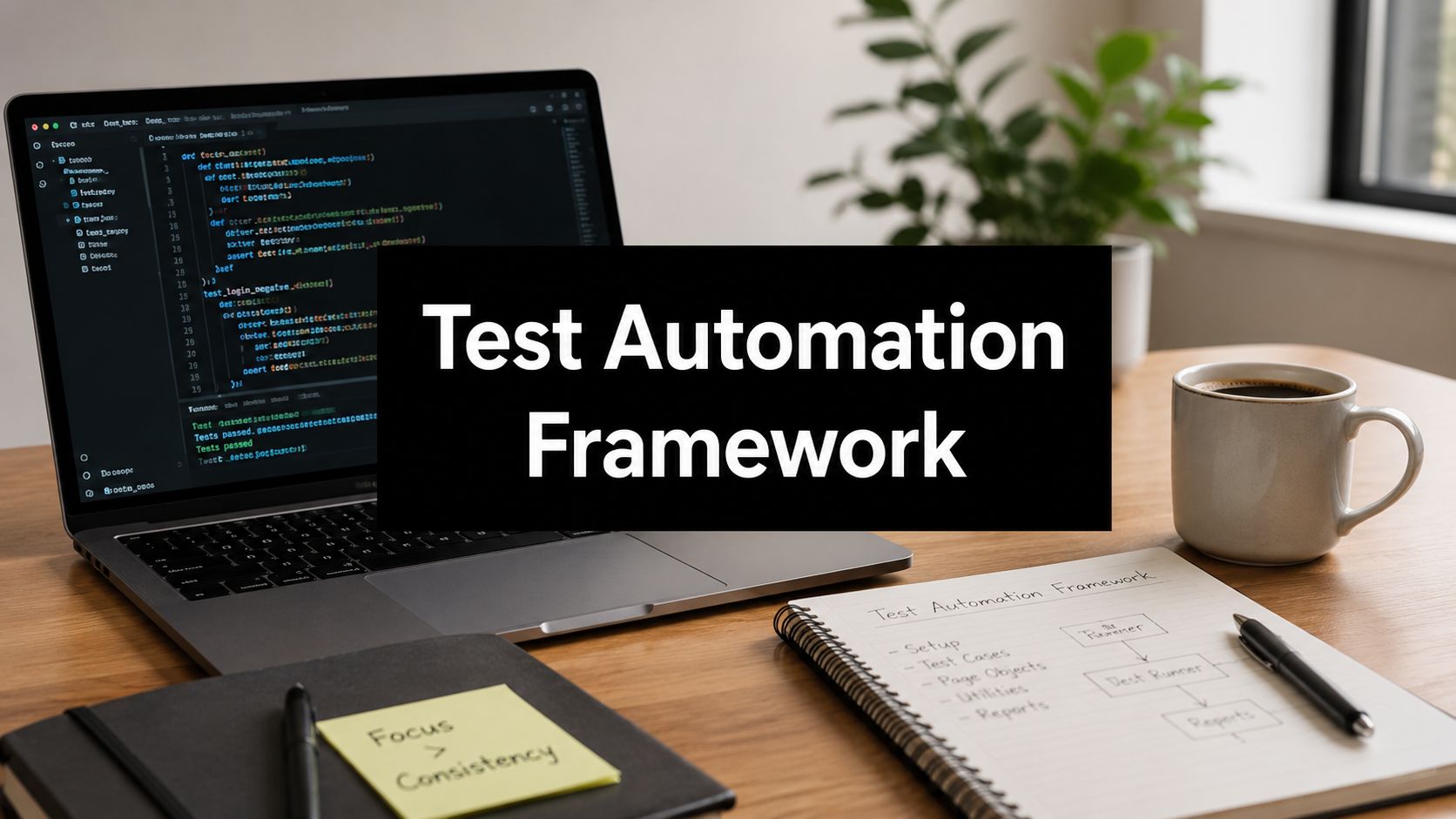
A testing automation framework should function as an orchestration layer, not a script folder. It sits between the test code and the application, standardizing how tests are configured, how data is loaded, how results are reported, and how environments are managed. That structure lets a SaaS team grow the suite without letting it turn into a scattered set of one-off checks.
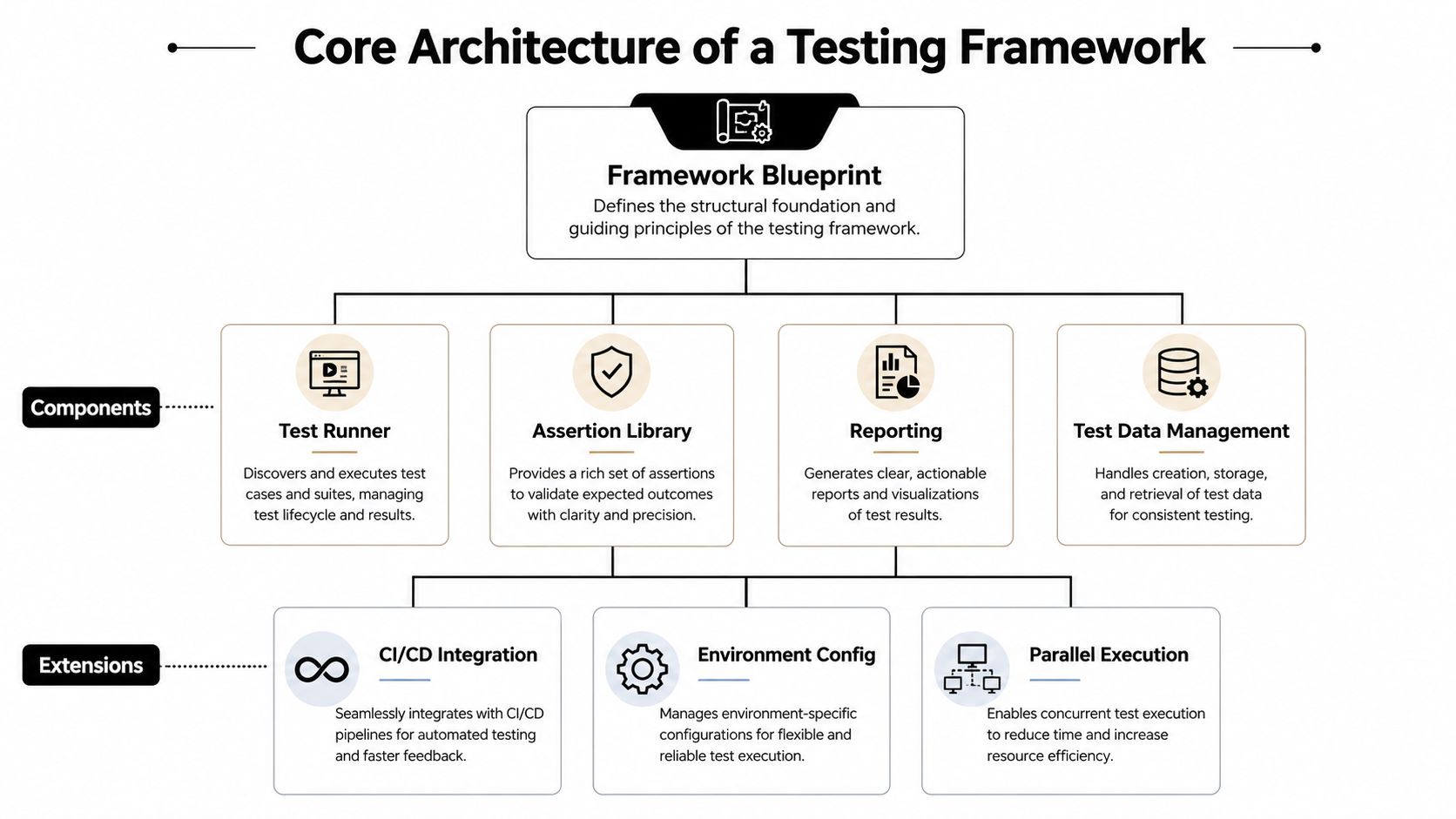
The components that matter in practice
At the center is the test runner, the part that executes the suite and coordinates order, retries, and parallel behavior. Around it, you usually find an assertion layer for validating outcomes, a reporting layer for telling the team what passed or failed, and a test data layer so inputs do not get hard-coded into every script. In mature setups, an object repository or similar abstraction keeps UI locators from being repeated across dozens of files.
Each piece reduces maintenance pressure in a different way. If UI selectors live in one place, a design change does not force a rewrite across the suite. If test data is centralized, the same flow can be exercised against multiple scenarios without duplicating logic. If reporting is standardized, product and QA can see failure patterns without opening individual logs. For teams building out Cypress integration tests, that separation keeps the framework practical as the test surface expands.
What an architecture gives you that scripts don't
The framework also sets execution discipline. It standardizes configuration, environment management, and reporting so the same suite behaves predictably in local runs, CI jobs, and cloud grids. That consistency is what makes larger suites workable without forcing the team to spend release time sorting through avoidable breakage.
Architecture choices also shape day-to-day QA cost. A lightweight setup can move fast at first, but it often becomes harder to maintain when the product grows, test data multiplies, and different teams need to reuse the same flows. A more deliberate framework gives engineering and QA a shared structure for execution, which helps keep release work repeatable and keeps automation from becoming a side project owned by one person.
Modern framework design has moved well beyond simple record-and-playback thinking. The basic options now cover multiple architecture styles, which reflects a shift from ad hoc scripting to layered engineering practice (BrowserStack). For a B2B SaaS company, that matters because the framework has to support CI/CD, survive product change, and make test maintenance cheaper over time. As one practical reference on scaling automation notes, the framework should support reuse, predictable execution, and easier extension as the suite grows (Augment Code).
Comparing Popular Framework Approaches for SaaS
The “best” framework depends on your team's skillset, your product surface area, and how much CI/CD discipline you already have. For B2B SaaS, the decision is rarely between one perfect tool and another. It's usually between moving quickly with a familiar stack or adopting a newer stack that reduces long-term friction.
| Framework Type | Best For | Typical Skillset | CI/CD Integration | Key Trade-off |
|---|---|---|---|---|
| Selenium-based frameworks | Broad web coverage, mature QA teams, complex browser testing | Strong coding skills in Java, Python, C#, or JavaScript | Mature and flexible, but usually needs more setup | Powerful and widely supported, but more maintenance overhead |
| Cypress | Frontend-heavy SaaS apps with modern JavaScript teams | JavaScript, frontend engineering familiarity | Straightforward for web pipelines, especially for app teams already shipping in JS | Fast feedback, but narrower fit for some cross-browser use cases |
| Playwright | Teams wanting modern browser automation with strong reliability | JavaScript or TypeScript, test engineering mindset | Strong fit for CI/CD and parallel runs | Newer than Selenium, so some teams still need time to build patterns |
| AI-driven or low-code platforms | Teams trying to reduce setup effort or accelerate test creation | Lower code dependency, process-driven QA collaboration | Often designed for quick pipeline adoption | Easier entry, but trust, governance, and maintainability need close attention |
The useful question isn't “which tool is most popular.” It's “which choice matches the people who will maintain it?” A seasoned Java QA team can usually stretch a Selenium or TestNG-based stack far. A product engineering team that lives in TypeScript may get faster value from a Playwright or Cypress approach.
If you're evaluating browser automation for a frontend-heavy SaaS product, a practical reference point is this Cypress integration tests guide. It's worth reading alongside your architecture discussion because integration quality matters more than syntax preference.
Choosing by operating model, not hype
Older stacks tend to offer broad flexibility and deep community history. Newer stacks usually reduce friction for developers who want fast, readable tests. AI-assisted and low-code platforms can shorten setup time, but they also shift the burden to governance, test review, and trust in generated output.
That trade-off is where many first-time framework builds go wrong. Teams choose based on the first demo, then discover six months later that the stack doesn't fit their maintenance model. A good SaaS choice is the one your team can extend, review, and debug under release pressure.
Integrating Your Framework into the CI/CD Pipeline
A testing automation framework only creates business value when it runs inside the delivery path, not beside it. For a B2B SaaS team, that means connecting test execution to code commits, build triggers, staging deploys, and release gates. Without that link, automation becomes a separate QA activity instead of part of how software ships.
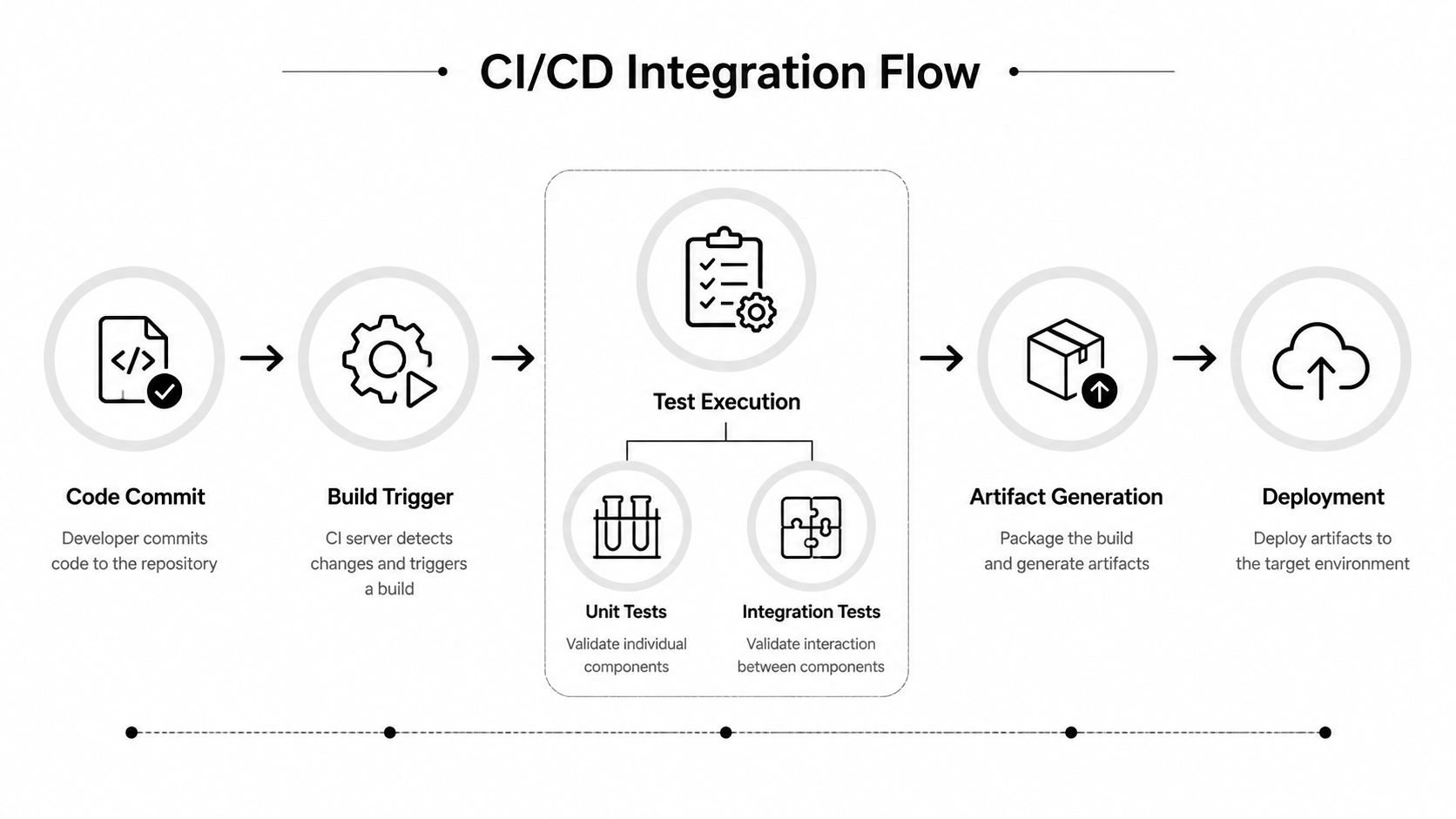
Where the framework sits in the pipeline
The cleanest model is direct. A code commit triggers a build, the build triggers test execution, and the result decides whether the pipeline can continue to artifact creation and deployment. That makes the framework a quality gate, not a separate report that someone checks later. For a SaaS company, that gate is what keeps unstable changes from reaching customers before QA can catch them.
The orchestration layer matters because it keeps configuration, test data, reporting, and environment management consistent across CI runs. That consistency is what separates a framework that merely runs in CI from one that runs reliably under release pressure. Teams that want a practical reference for delivery structure can also review Auto DevOps pipeline implementation alongside their framework design.
If the pipeline cannot explain why a test failed in plain language, the framework is too weak for release gating.
How to keep CI runs trustworthy
Start by splitting the suite by purpose. Smoke tests should guard the narrowest release path. Broader regression coverage can run later or in parallel, which keeps developers from waiting on the full suite every time they push a small change.
Protect the environment next. Flaky test behavior usually comes from unstable test data, inconsistent environments, or hidden dependencies between tests. A well-structured framework reduces those risks by centralizing configuration and data handling instead of letting each script handle them differently. In practice, this is also where architecture discipline matters, as noted earlier in broader guidance on Augment Code, because maintainability matters more than raw test count.
Parallel execution belongs here, but only after the foundation is stable. Running more tests at once does not fix weak test design. It only makes failures arrive faster.
A Practical Rollout Roadmap for Your First Framework
The safest first implementation is small, visible, and tied to revenue risk. Pick one high-value journey, usually the workflow that sales, support, or customer success cares about most. That gives the team a pilot with real stakes, not a lab experiment.
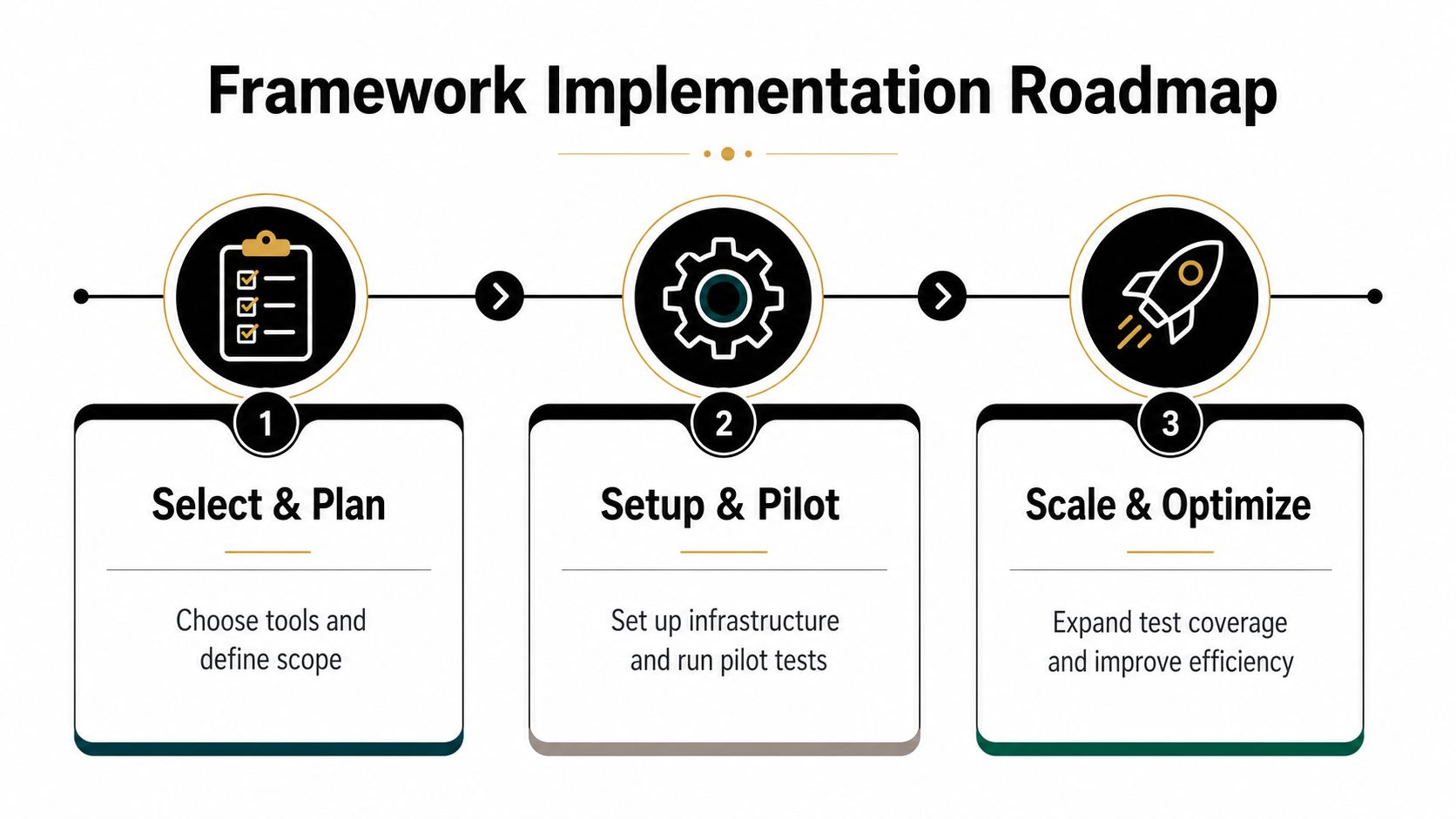
Phase 1 Select and plan
Choose a workflow that fails often enough to matter, but not so widely that the first build becomes unmanageable. Authentication flows, billing paths, onboarding steps, and role-based permissions are common candidates in SaaS because they touch core customer value.
Define the scope tightly. Decide which browsers, environments, and data sets matter first. If you try to automate everything at once, the team will spend more time building support scaffolding than proving value.
Phase 2 Setup and pilot
Build the reusable core. That usually means the runner, reporting, data handling, and a small set of stable page or API abstractions. Keep the pilot focused on one path and one quality goal, such as catching regressions before staging.
Use the pilot to validate maintenance costs, not just pass rates. A framework that looks impressive in week one but falls apart in week six is a false win. The point of the pilot is to see whether the structure survives real product change.
Phase 3 Scale and optimize
Once the pilot proves value, expand carefully. Add adjacent flows, introduce team conventions, and document how new tests should be written and reviewed. That is also the right time to socialize ownership, because automation breaks when it depends on a single enthusiast.
For teams that want a visual walkthrough of the implementation mindset, the embedded video below is a useful supplement.
Scaling is where governance starts to matter more than construction. The World Quality Report 2023 found that only 29% of organizations had achieved full test automation, and most still described automation as a work in progress, not a solved capability (World Quality Report discussion). That is a reminder that the framework is the beginning of the operating model, not the end.
Measuring Success and Calculating Automation ROI
A testing automation framework earns its place when release reviews change. The team spends less time rerunning the same checks, product and QA spend more time on quality decisions, and repeated defects stop soaking up the same effort sprint after sprint. The key question is whether the framework lowers cost, shortens cycle time, and reduces false failures enough to justify the work needed to keep it healthy.
The clearest signal comes from what changes in day-to-day delivery. In one industry dataset, 46% of teams said automation had replaced 50% or more of manual testing, while 20% said it had replaced 75% or more. The same source says over 60% of organizations saw a positive ROI from automated testing investment, which suggests that frameworks now sit inside the operating model rather than outside it as optional QA tooling (RaaS Cloud).
Metrics that matter to SaaS leaders
Track the measures that affect release speed and support load, not just test volume. Manual hours removed, release wait time, flaky failure rate, and the share of critical paths covered by automation give a clearer view than a pass or fail dashboard. Those numbers show whether engineering effort is helping the business ship faster with fewer interruptions.
ROI becomes easier to defend when the math stays concrete. Compare the cost of building and maintaining the framework with the time saved from repeated execution and the business value of avoiding blocking defects before release. If the framework prevents repeated manual regression before every deployment, the payoff usually appears as fewer delays, fewer hotfixes, and less time spent on late-stage surprise work.
Useful discipline: track framework health the same way you track product health. If maintenance effort rises while release confidence stays flat, the system is losing value.
Governance is the real long game
Building the first version is rarely the hard part. Keeping it useful over time is where teams either preserve ROI or lose it. That means clear ownership, review standards, clean test data, and a policy for retiring weak tests before they add noise to the suite.
For a business-focused view of the math, the how to calculate return on investment guide is a helpful reference, and the Australian R&D Tax Incentive guide is worth reviewing if your organization is assessing how automation work may fit into broader investment planning. Both pair well with the operational metrics above, because framework success should be expressed in business terms, not only QA activity.
Future-Proofing Your Framework with AI and Modularity
The next round of framework decisions won't be about whether automation exists. They'll be about how much of it can be assisted, maintained, and validated intelligently. A recent market analysis projects the AI in software testing market to grow from $1.0 billion in 2024 to $3.7 billion by 2029, and survey data from The State of AI in Software Testing 2024 found 58% of teams already using AI in test creation (mabl).

Build for replacement, not permanence
The safest architecture is modular. If your framework separates runners, data sources, selectors, reporting, and execution rules, you can swap tools without rewriting the entire system. That matters because the testing stack will keep changing, especially as AI-assisted creation and maintenance tools get more capable.
The unresolved issue is trust. Teams are already using AI in test creation, but they still need to validate outputs carefully, because the risk is not novelty, it's hidden technical debt and false confidence (mabl). A modular framework gives you the room to add AI where it helps, while keeping humans in control of review and reliability.
If you're also thinking about whether automation investment can qualify for broader innovation support, the Australian R&D Tax Incentive guide is a useful external reference for understanding how some companies frame development work.
The takeaway is straightforward. Build a framework that can absorb new tools, not one that depends on a single generation of them. That's what keeps it useful when your product, team, and release cadence all keep evolving.
If you're planning your first scalable testing automation framework, MakeAutomation can help you turn that plan into a system your team can run and maintain. Visit MakeAutomation to see how a practical automation blueprint can support faster releases, cleaner QA operations, and better ROI.